
Reviewed by Alex Francisco
Published November 10, 2026 · Fact-checked against the sources listed below
What do moth eggs look like?
That depends on which moth laid them. The two common household moths lay tiny, pale eggs one or a few at a time, right on what their caterpillars eat: white, pinhead-sized clothes moth eggs on wool and grayish-white pantry moth eggs on stored food. Outdoors, the moth eggs people notice are egg masses, hundreds of eggs under hair, froth or a varnish-like coat, like the spongy moth mass below.
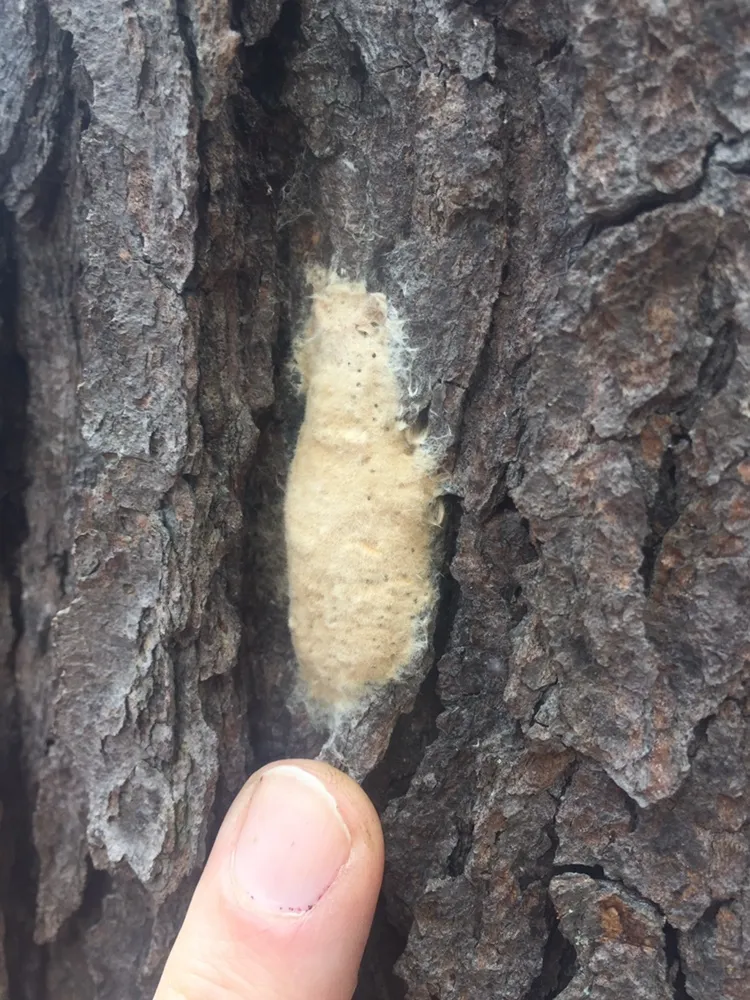
Each kind lays where its young will feed or shelter, so the place you found the eggs narrows the list fastest:
- In a closet, on wool or along a rug edge: clothes moth eggs, usually with silk webbing, cases or grazed wool nearby.
- In or near stored food: pantry moth eggs; caterpillars or silk cocoons on the kitchen wall are the next stage.
- On a tree, a wall, firewood or patio furniture: often a spongy moth egg mass, where that moth lives. A shiny band around a twig, a hanging bag or froth on a cocoon belongs to another outdoor moth.
- On an indoor wall in a humid Southern state: probably a household casebearer's flat, gray case.
- In a mattress seam, a pet's bed, a cobweb or under a leaf: a look-alike, covered further down.
What do clothes moth eggs look like?
Clothes moth eggs are white specks about as big as a pinhead, easy to miss because they sit down among the fibers. Clemson Extension's fabric pest fact sheet calls them small, white and pinhead-sized, laid on or near the fabric the larvae will eat, and UC IPM's clothes moth Pest Notes say the female glues each egg to the threads with a sticky secretion.
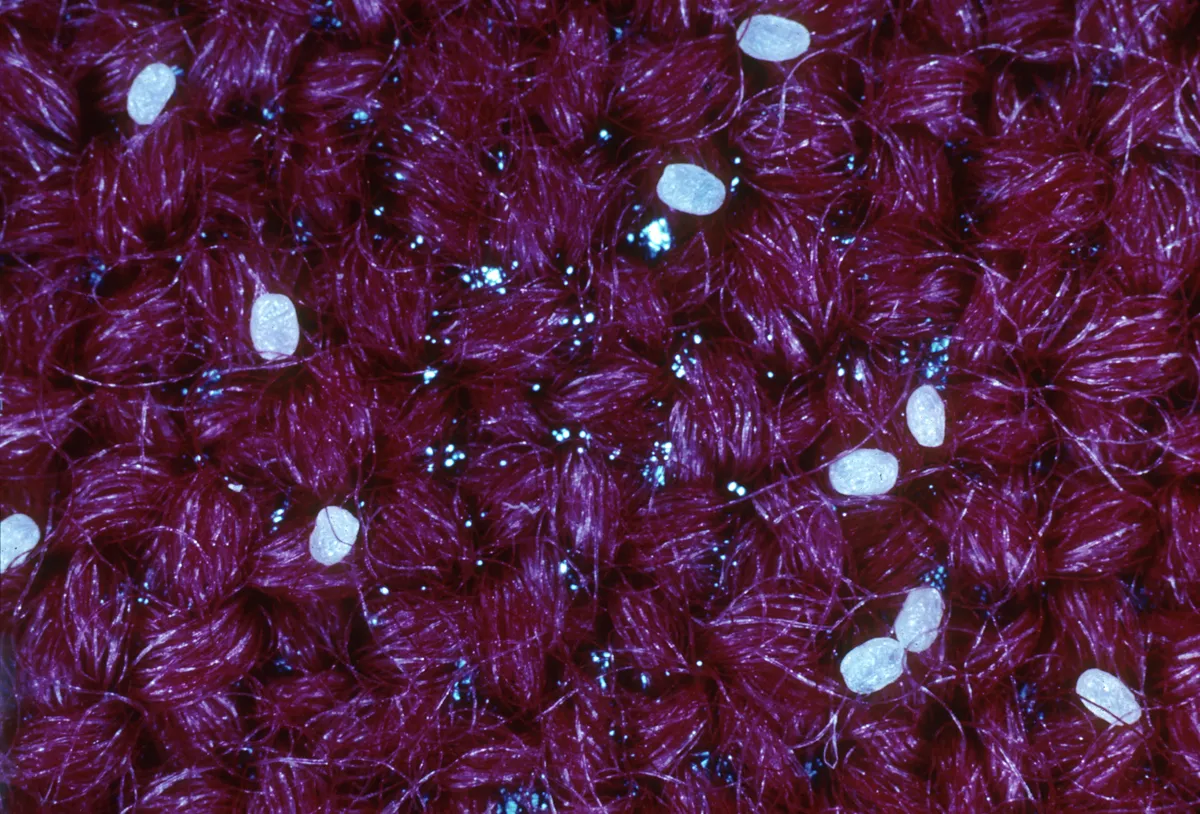
UC IPM and the University of Kentucky's ENTFACT on clothes moths put a female's output at about 40 to 50 eggs, laid over two to three weeks in UC IPM's account; Clemson gives 100 to 150. Penn State Extension's page on clothes moths says the moths usually mate and lay eggs within a day or two of emerging and that hatching takes 4 to 10 days in summer but can stretch to three weeks or more in winter; Clemson says about five days.
The eggs go where the larvae will feed, in dark places that are left alone. UC IPM names the hidden spots: under collars and cuffs, in crevices of upholstered furniture, in closets where wool and fur are kept, and in carpet under heavy furniture and along its edges. The larvae feed on animal fibers, which Kentucky gives as wool, fur, feathers, silk, felt and leather; it says cotton and synthetic fabrics are rarely attacked unless they are blended with wool or heavily soiled with food or body oils. Kentucky also traces some infestations to bird nests in attics and chimneys, and finds larvae feeding on lint and pet hair in vents and ducts.
The signs around the eggs are easier to spot. Grazed wool is the clue Penn State gives: the larvae graze furrows into the surface, and holes appear only occasionally or in heavy infestations. UC IPM says webbing clothes moth larvae leave patches of silk while casemaking larvae carry a silk case. The creamy-white caterpillars grow to about 1/2 inch, in Kentucky's description; the guide to moths in the house shows the larvae and adults and how to tell clothes moths from the pantry moth.
What do pantry moth eggs look like?
Pantry moth eggs are grayish-white grains, 0.3 to 0.5 mm (under 1/50 inch), that the female drops one at a time or in clusters right on the food. That is how the University of Florida's Featured Creatures profile of the Indian meal moth describes them, and UC IPM's pantry pest Pest Notes say no moth turns up on stored food in homes more often.
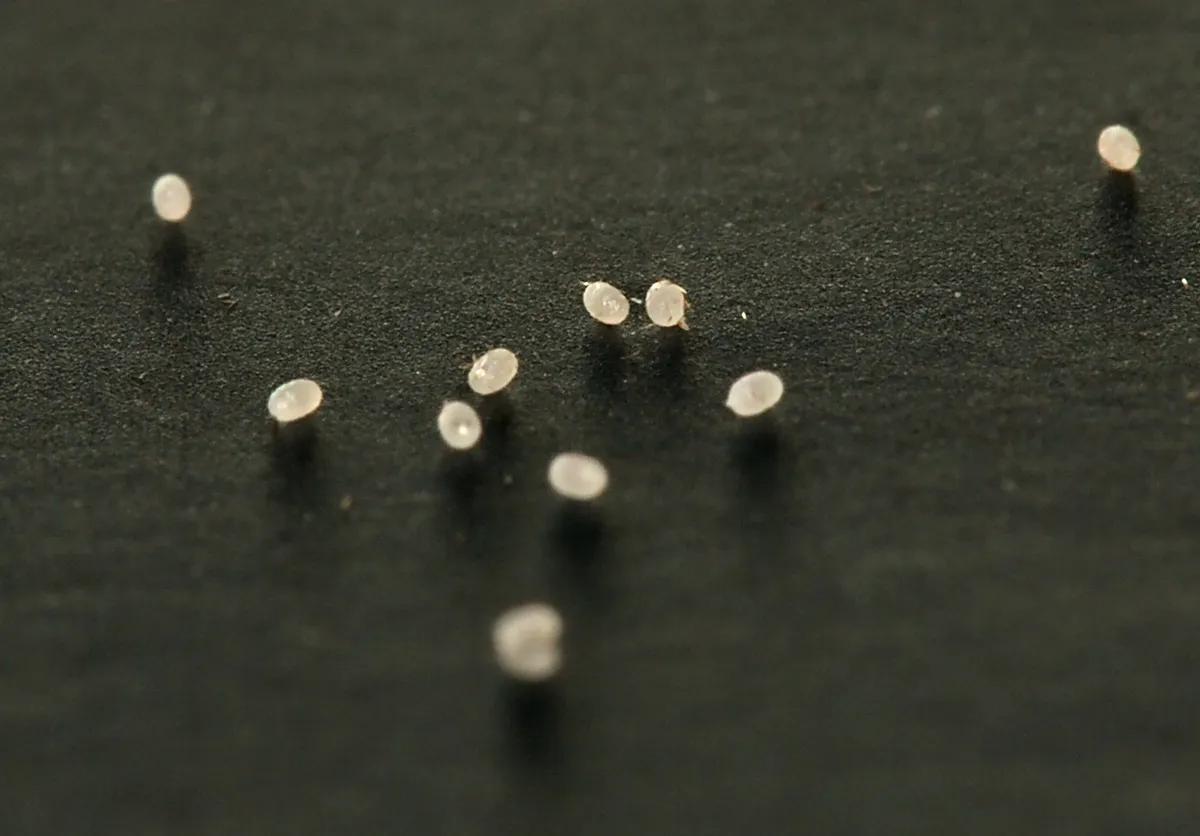
A single female lays as many as 400 eggs, starting about three days after she emerges, and Florida says they take 7 to 8 days to hatch at 68°F but only 3 to 4 days at 86°F. The larvae go after cereal, flour, cornmeal, rice, dried fruit, dehydrated vegetables, nuts, chocolate and candy, UC IPM says, and a full generation takes about six to eight weeks in warm weather.
What hatches is easier to find than the eggs. UC IPM says the larvae leave silk threads wherever they crawl, and Florida describes silk that binds droppings, cast skins and eggshells into the food, and larvae that climb to other shelves to pupate, even inside a container lid or on a soup can. The pantry pest guide sorts the other insects found in flour, rice and cereal, beetles included, and a review of pantry moth pheromone traps explains what the traps can tell you. UC IPM notes that those traps lure only male moths, not the females that lay the eggs, though catching males before they mate may cut down on eggs.
How big are moth eggs?
Indoor moth eggs are specks, under 1/50 inch for the Indian meal moth and about pinhead size for clothes moths, while outdoor egg masses run from about 1 inch to almost 2 inches long. The line-up runs smallest to largest, look-alikes included; the photos with a thumb or fingertip show the real scale.
| Egg, mass or case | Size | Eggs |
|---|---|---|
| Indian meal moth egg | 0.3 to 0.5 mm, under 1/50 inch | Up to 400 per female |
| Household casebearer egg | About 0.4 mm, about 1/64 inch | About 200 per female |
| Flea egg | About 0.5 mm, about 1/50 inch | Up to one an hour per female |
| Clothes moth egg | About the size of a pinhead | 40 to 50, or 100 to 150, per female |
| Bed bug egg | About 1 mm, about 1/25 inch | Found near mattress seams, piping and tags |
| Brown marmorated stink bug egg | 1.6 by 1.3 mm, about 1/16 inch | 20 to 30 per mass |
| Common house spider egg sac | 6 to 9 mm, about 1/4 to 3/8 inch | 140 to 380 per sac |
| Household casebearer case | 1/3 to 1/2 inch long | A larva, not eggs |
| Spotted lanternfly egg mass | About 1 inch long | 30 to 50 |
| Spongy moth egg mass | About 1 1/2 by 3/4 inch | Up to 1,000; often 600 or more |
| Eastern tent caterpillar egg mass | A band around a twig about pencil-thick or thinner | 150 to 400 |
| Bagworm bag | Up to almost 2 inches long | 500 to 1,000 in a female's bag |
Sizes and counts from the University of Florida, Clemson, the University of Kentucky, the EPA, Penn State, USDA APHIS, Wisconsin Extension and UConn, each linked on this page. Inch figures are converted from the sources' millimeters, so two differ from Florida's own: it prints 0.12 to 0.15 inch for Indian meal moth eggs and about 1/64 inch for flea eggs, but 0.5 mm is about 1/50 inch.
What is the fuzzy tan patch on my tree, wall or patio furniture?
Where the spongy moth lives, most likely one of its egg masses. USDA APHIS's spongy moth page describes the masses as about 1 1/2 inches long and 3/4 inch wide on average, covered with buff or yellowish hair and holding up to 1,000 eggs. The insect, Lymantria dispar, was formerly called the gypsy moth, as Penn State Extension's egg mass survey guide notes.
APHIS says the females, nearly white and unable to fly, attach their egg masses to trees, stones, walls and logs and to household items such as patio furniture, toys, lawn equipment, grills, trailers and stacked firewood. On trees, Penn State says, the masses tend to sit in sheltered spots such as the undersides of branches but can be anywhere from the base of the trunk to the canopy, or on fallen branches and rocks.
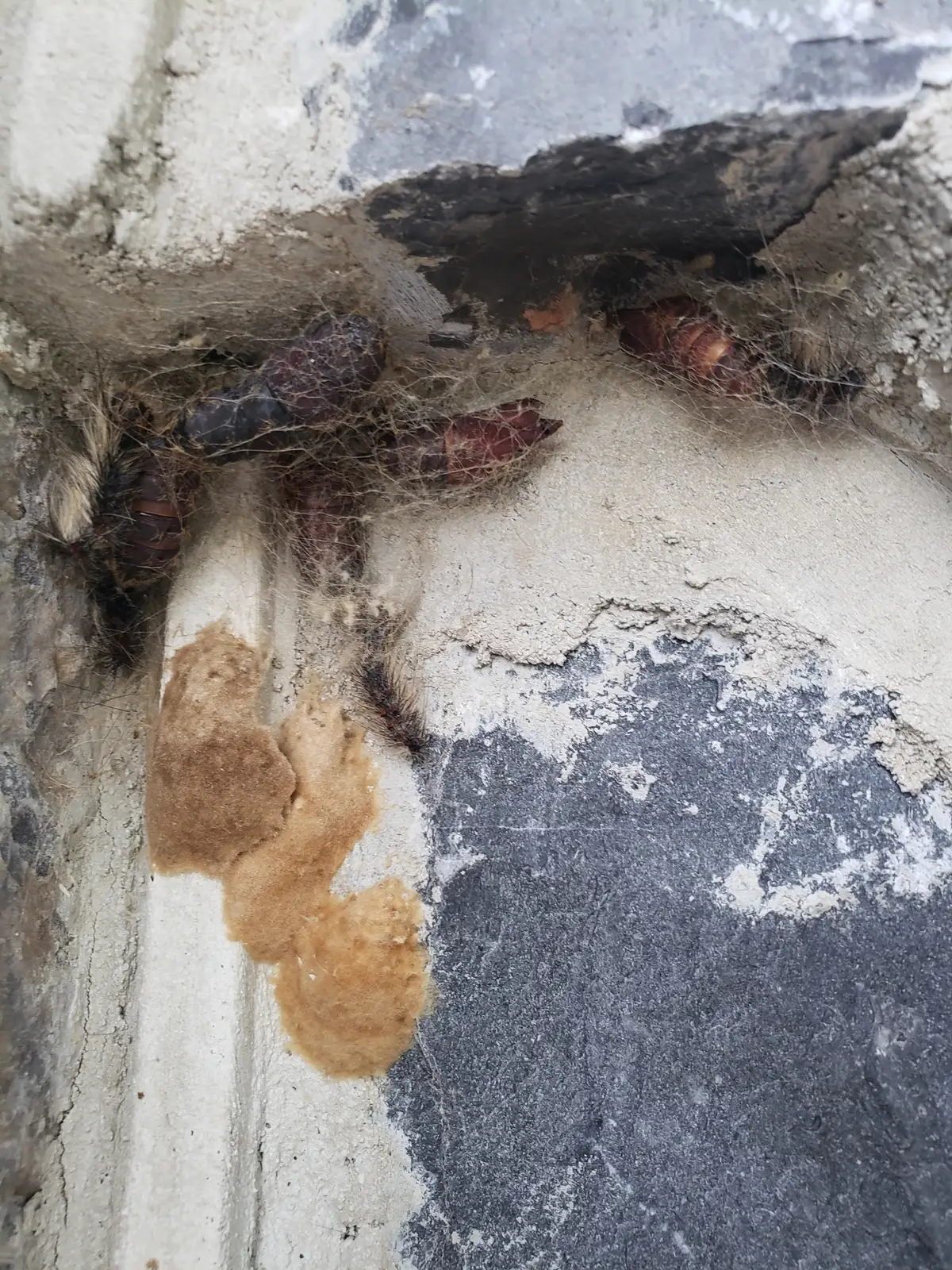
As of November 2026, APHIS lists the moth as present in Connecticut, Delaware, the District of Columbia, Illinois, Indiana, Maine, Maryland, Massachusetts, Michigan, Minnesota, New Hampshire, New Jersey, New York, North Carolina, Ohio, Pennsylvania, Rhode Island, Vermont, Virginia, West Virginia and Wisconsin, and it lists egg masses as the stage to look for in late summer, winter and spring. Elsewhere, check a fuzzy patch against the look-alikes below.
Is the egg mass old or new?
Press it gently. Penn State says this season's masses feel hard and full and usually look darker and less ragged, while old ones tend to feel soft and spongy, and that spent masses from earlier years can stay on a tree with nothing more hatching from them; in its example, last year's masses were powdery and fragile.
Tiny pinholes are a different sign. Wisconsin Extension's spongy moth calendar for homeowners says pinholes in August and September show that a small parasitic wasp, Ooencyrtus kuvanae, is attacking the eggs, and asks homeowners not to treat egg masses at that time so the wasps can build up; the wasp does not sting people.
Can you move firewood or patio furniture with spongy moth eggs on it?
Not out of a quarantine area without inspecting it and removing the egg masses first. APHIS says that when people move the items egg masses are stuck to, the eggs move too, and that anyone moving from a spongy moth quarantine area to a place outside it must inspect household goods and remove the egg masses; people who are required to inspect but fail to do so may face penalties. Its steps:
- Check APHIS's quarantine map to see whether you are leaving a quarantined area.
- Inspect every outdoor household item, from patio furniture, grills and toys to lawn equipment and trailers, for egg masses and other life stages, using APHIS's self-inspection checklist.
- Remove and destroy what you find, as described at the end of this page.
- If you move between April and August, do the inspection on moving day if you can; if you cannot, you must protect the items by sealing them under a tarp or keeping them indoors or in a closed moving truck.
- Keep a copy of the completed checklist in the vehicle carrying the goods.
For firewood, APHIS's advice is simpler: buy local firewood and burn it on site, and do not move firewood. In Canada, the Canadian Food Inspection Agency, which calls the insect the spongy (LDD) moth, says campers, trailers, outdoor furniture and play equipment stored outside can carry it, and that egg masses must be removed before those items move with you to an area where the spongy moth isn't present.
What other moth eggs turn up on twigs, shrubs and cocoons?
Three other moths leave eggs homeowners notice: a varnished band on a twig, a hanging bag, and white froth on a cocoon.
Eastern tent caterpillar: a shiny band around a twig
The University of Kentucky's eastern tent caterpillar fact sheet says the insect spends the winter as eggs, 150 to 400 to a mass, under a shiny, black, varnish-like coating that encircles branches about pencil-size or smaller. The caterpillars hatch about the time the buds begin to open, usually in early March in Kentucky, and their silk tents are most common on wild cherry, apple and crabapple.
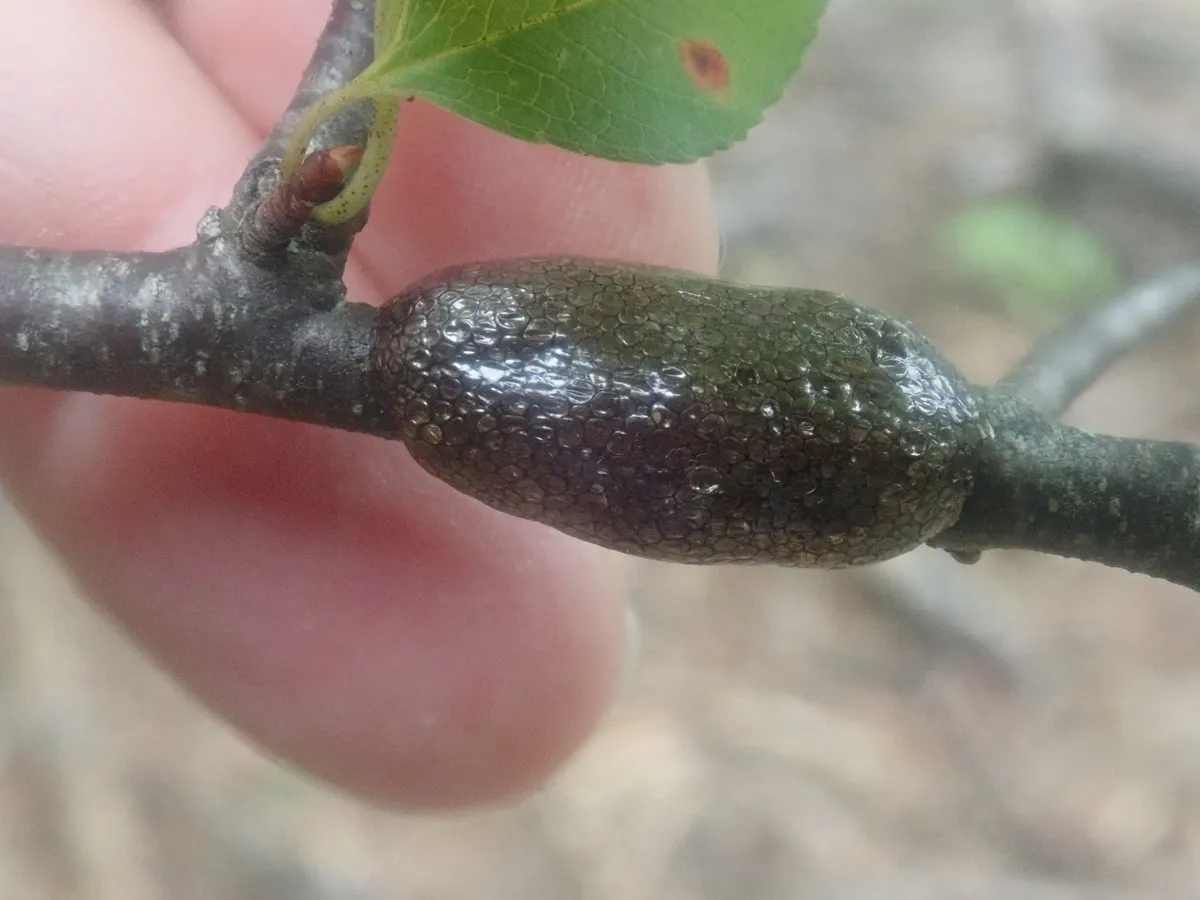
It is easy to tell from a spongy moth mass: tent caterpillar eggs are glossy and coated and ring the twig, while a spongy moth mass is a patch of buff hair on one surface.
Bagworms: eggs inside a hanging bag
A bag of silk and bits of leaves or needles dangling from a branch in winter may hold hundreds of eggs. UConn's bagworm fact sheet says the wingless female does not leave her bag to mate and lays 500 to 1,000 smooth eggs inside it in the fall; the sheet gives the hatch as late May through early June in one place and about mid-June in another. The bags reach almost 2 inches and hang especially from conifers such as arborvitae, cedar, juniper and pine, though UConn also finds them on oaks, cherry and willow in Connecticut, and on other structures.
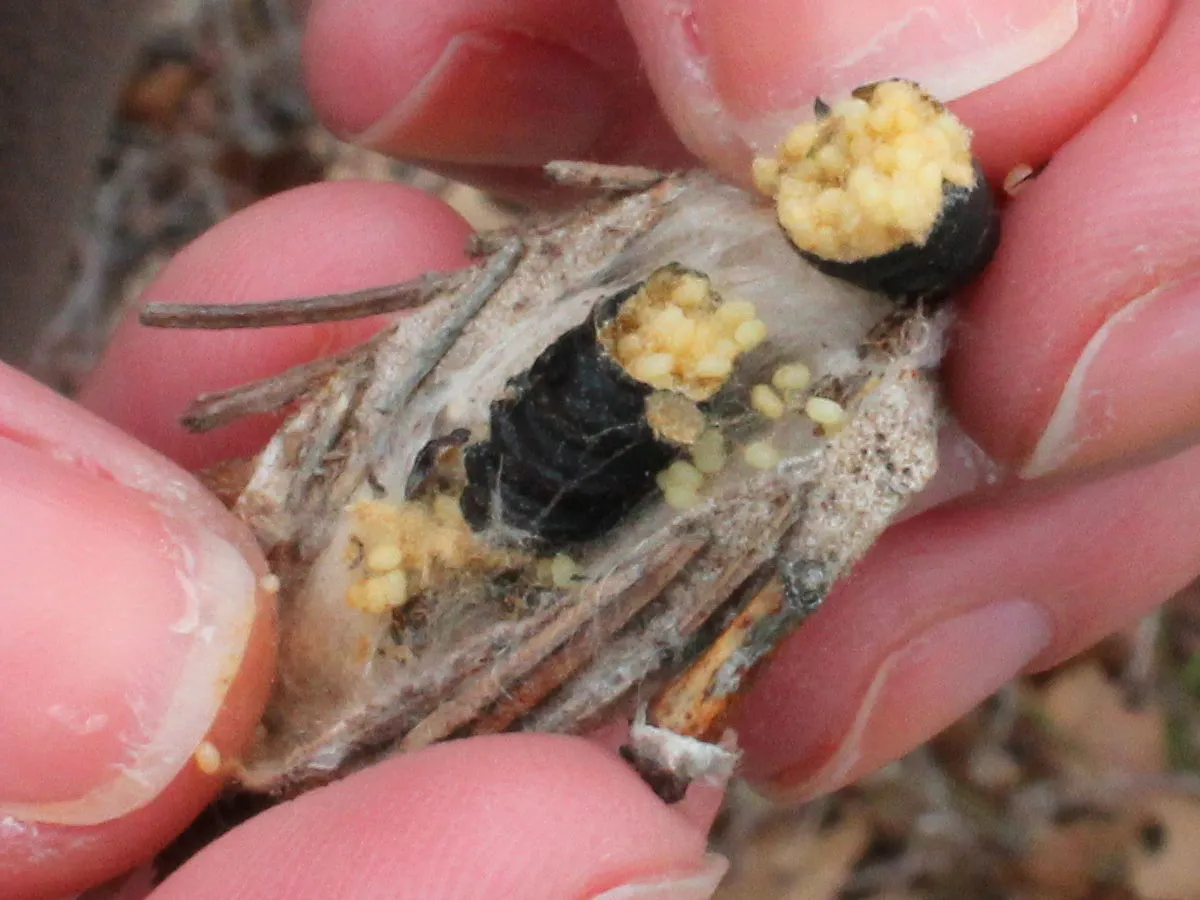
White-marked tussock moth: froth on a cocoon
A lump of white froth on a gray, hairy cocoon is a tussock moth's egg mass. UMass Extension's white-marked tussock moth guide says the wingless female, drab white, hairy and about 1/2 inch long, lays about 300 eggs in a white, frothy mass on the cocoon she came out of. The eggs spend the winter there and hatch from about April to June, as the host plant's leaves emerge. UMass adds that the cocoons, built with the caterpillars' own hairs, hold those irritating hairs and can cause allergic reactions, so it advises gloves rather than bare hands.
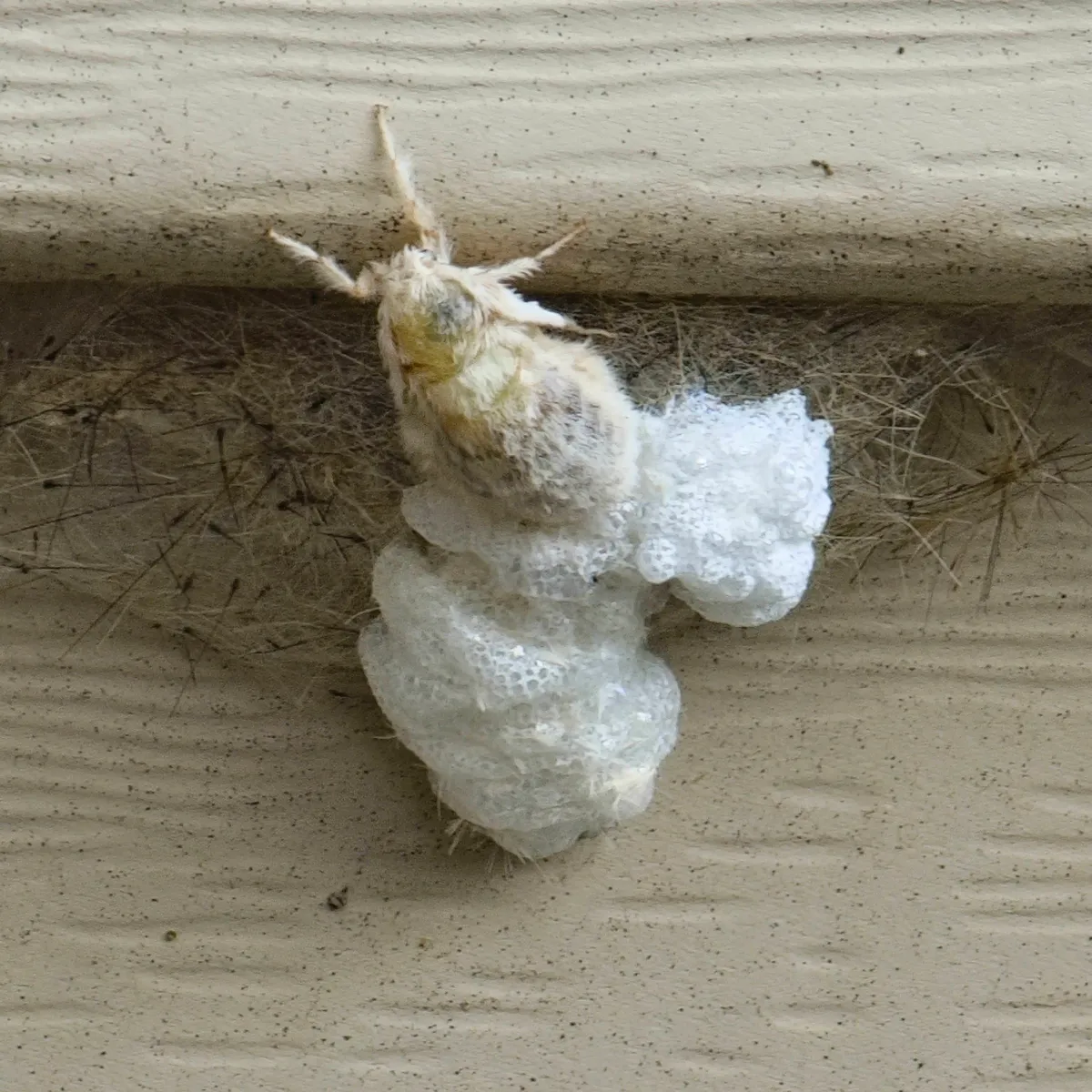
Are the gray seed-shaped things on my wall moth eggs?
No. Flat, gray cases 1/3 to 1/2 inch long on an indoor wall belong to the household casebearer, a small moth whose larva lives inside. The University of Florida's household casebearer profile describes the case as a flat spindle, like a cantaloupe or pumpkin seed, with identical ends, pulled along by the larva. UF says the moth needs high humidity, which limits its spread, and that in south and central Florida people usually see only empty cases on house walls; cases also turn up under spider webs and in bathrooms, bedrooms and garages.
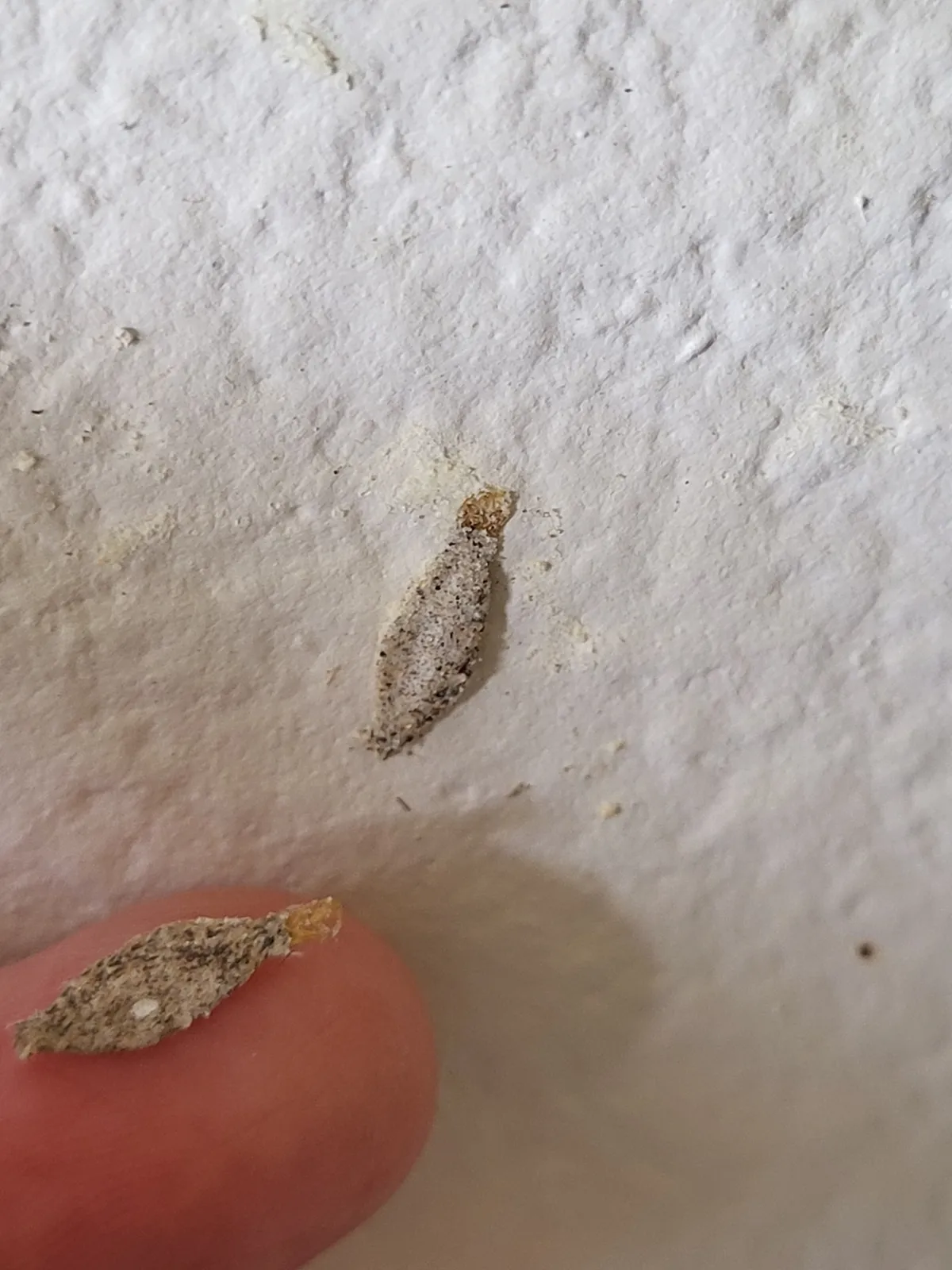
The casebearer's own eggs are tiny: UF describes them as soft, pale bluish and about 0.4 mm across (about 1/64 inch), cemented to debris in crevices and where walls meet floors, about 200 per female. The larvae feed mainly on old spider webs, so UF says hand-picking or vacuuming the cases and clearing the webs should be enough.
Two other wall finds get taken for moth eggs: a brown, papery sac in a cobweb is a spider egg sac, and a silk cocoon on a kitchen wall or shelf may be a pantry moth larva that crawled away from the food to pupate.
When do moth eggs hatch?
Indoor moth eggs hatch in days to a few weeks, all year in a heated home, as UC IPM notes for clothes moths; outdoor egg masses mostly wait out the winter and hatch in spring.
| Moth | Eggs laid | Eggs seen | Eggs hatch |
|---|---|---|---|
| Clothes moths | Usually within a day or two of the moth emerging | Any month, on wool and other animal fibers | 4 to 10 days in warm weather; can take 3 weeks or more in winter |
| Indian meal moth | About 3 days after the moth emerges | Whenever infested food is stored | 7 to 8 days at 68°F; 3 to 4 days at 86°F |
| Spongy moth | Summer, when the adult moths are out | Late summer through spring | Spring; Wisconsin times its late-April barrier bands for just after hatch |
| Eastern tent caterpillar | On small branches, after the moths emerge (about 3 weeks after the caterpillars spin cocoons) and mate | Through fall and winter | As buds open; usually early March in Kentucky |
| Bagworm | Fall, inside the female's bag | In bags hanging through winter | Late May to early June, or about mid-June (UConn gives both) |
| White-marked tussock moth | On the cocoon the female came out of | Through winter, as white froth on cocoons | About April to June, as leaves emerge |
From UC IPM, Penn State, the University of Florida, USDA APHIS, Wisconsin Extension (which sets out barrier bands in late April, just after the eggs hatch), the University of Kentucky, UConn and UMass.
What else looks like moth eggs?
Bed bug eggs, flea eggs, stink bug eggs, spider egg sacs, carpet beetle signs and spotted lanternfly egg masses are the usual mix-ups, and where you found them separates most of them.
- Bed bug eggs. About 1 mm (1/25 inch), near the seams, piping and tags of mattresses and box springs, often with dark spots nearby that may bleed into fabric like marker, by the EPA's advice on finding bed bugs. The bed bug egg guide has close-ups.
- Flea eggs. Smooth, white ovals about 1/50 inch (0.5 mm) that slip out of a pet's fur; the University of Florida's Featured Creatures page on the cat flea says the white eggs all but vanish against carpet or bedding. See what flea eggs look like.
- Carpet beetle signs. Damaged wool with no silk points to carpet beetles: UC IPM's carpet beetle Pest Notes say the fuzzy larvae make no webs, leave bristly brown cast skins and droppings the size of a grain of salt, and tend to chew out one large patch, while moth damage is usually scattered holes. See the carpet beetle larvae guide and the signs of carpet beetles.
- Spider egg sacs. One silk sac, not loose eggs: Penn State Extension describes the common house spider's sacs as brown, egg-shaped and papery, 6 to 9 mm (1/4 to 3/8 inch) wide and packed with 140 to 380 eggs, hung in webs in wall corners, windows and floor joists. The spider egg sac guide covers other spiders.
- Stink bug eggs. Eggs glued side by side under leaves, 20 to 30 to a mass, each 1.6 by 1.3 mm (about 1/16 inch), laid from May through August, by Penn State Extension's page on the brown marmorated stink bug. See the stink bug egg guide.
- Spotted lanternfly egg masses. About 1 inch with 30 to 50 eggs, gray and putty-like at first, then dull brown like cracked mud, on bark, bricks, stones, grills, vehicles and outdoor furniture, per USDA APHIS's spotted lanternfly page. Spongy moth masses are hairy instead.
Checks that separate moth eggs from look-alikes
- Where. Wool points to clothes moths, food to pantry moths, mattress seams to bed bugs, a pet's bed to fleas, a cobweb to a spider.
- One or many. Indoor moth eggs lie singly or a few together; outdoor moths pack hundreds into one mass.
- Covering. Buff hair: spongy moth. A shiny band on a twig: tent caterpillar. White froth on a cocoon: tussock moth. A mud-like smear: spotted lanternfly. Papery silk: spider.
- Size. Beside a ruler marked in inches, indoor moth eggs are specks and outdoor masses about 1 to 2 inches.
- Neighbors. Silk or cases mean moths; shed, bristly skins without silk, carpet beetles; dark spots in seams, bed bugs.
- Season. A fuzzy mass from late summer to spring fits spongy moth; eggs side by side under a leaf from May to August, stink bugs.
Commonly confused with
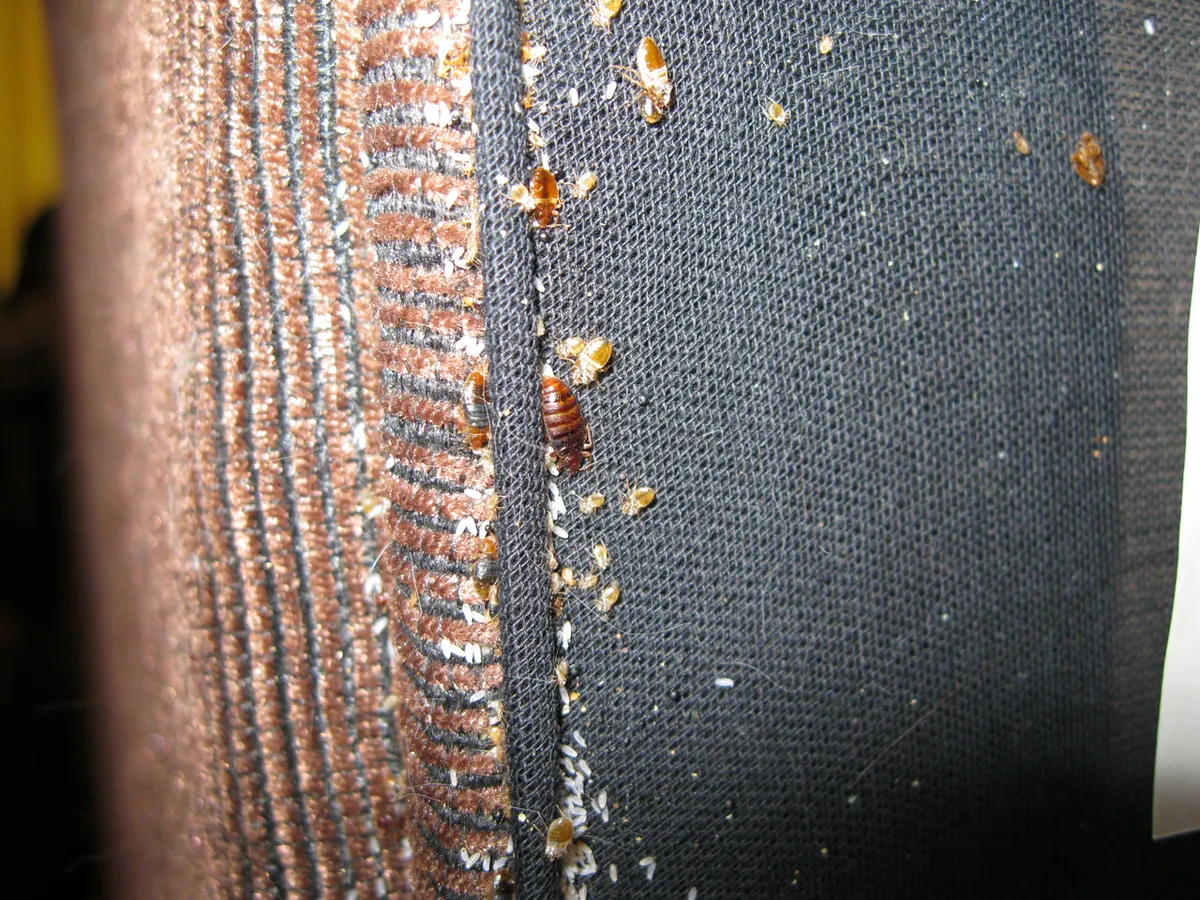 Bed bug eggsAbout 1/25 inch, in mattress seams and tags, near dark spots that may bleed into fabric
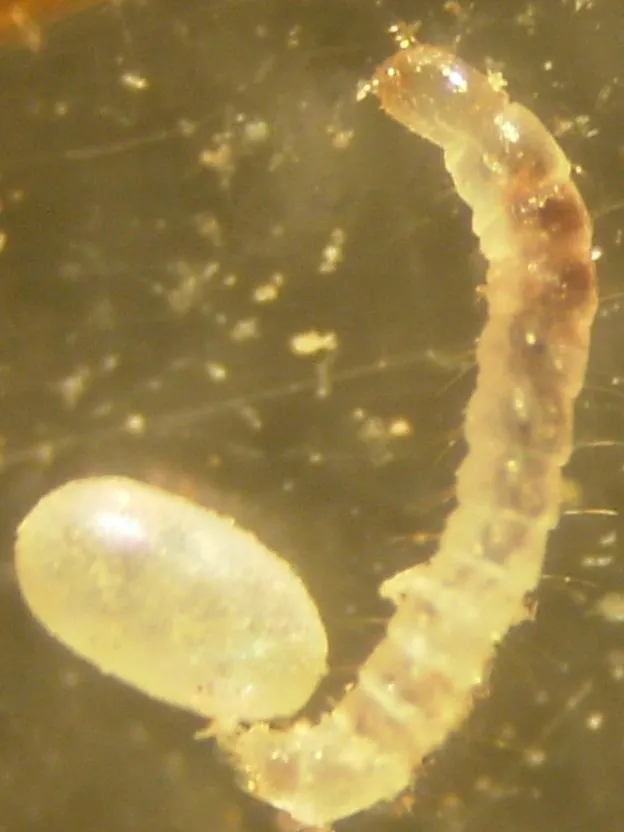 Flea eggsSmooth white ovals about 1/50 inch that drop out of a pet's fur
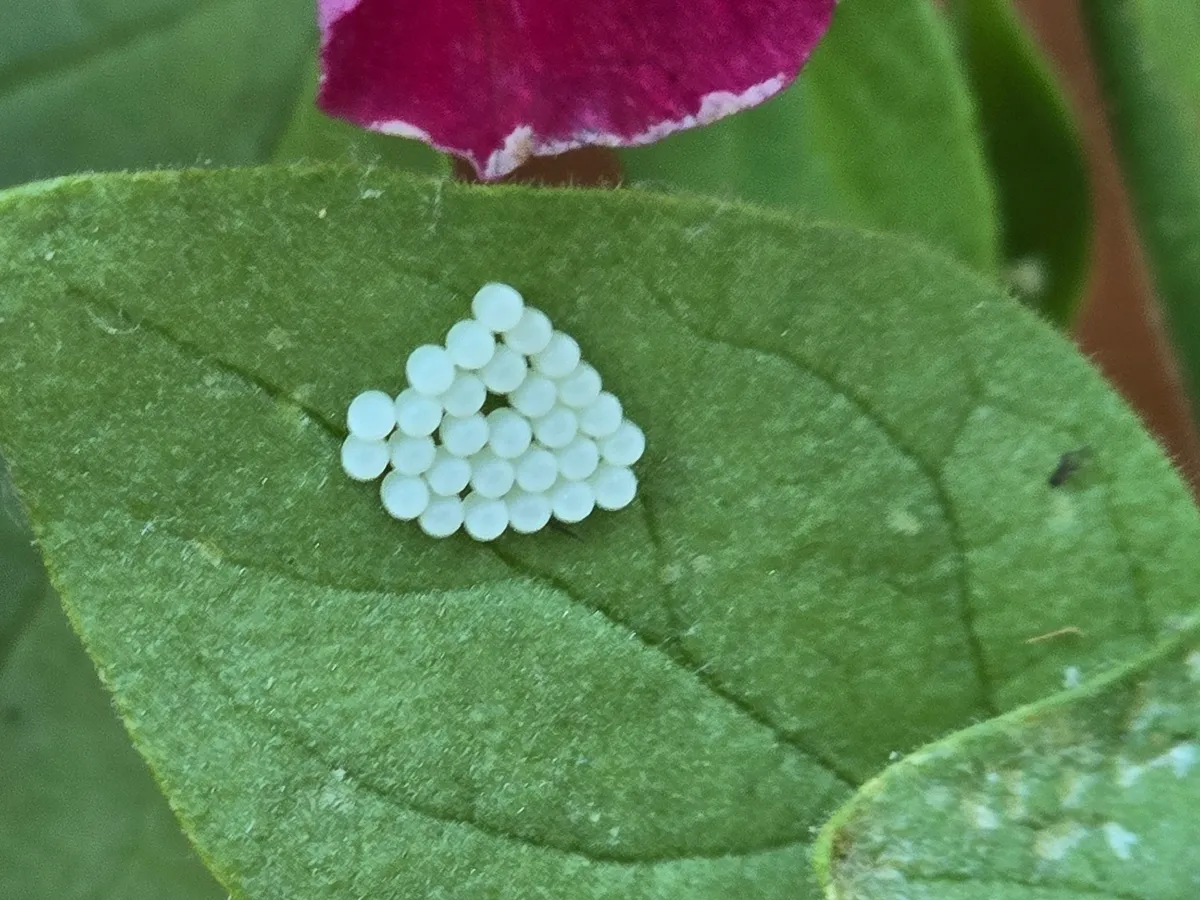 Stink bug eggsEggs glued side by side, 20 to 30 to a mass, under leaves from May to August
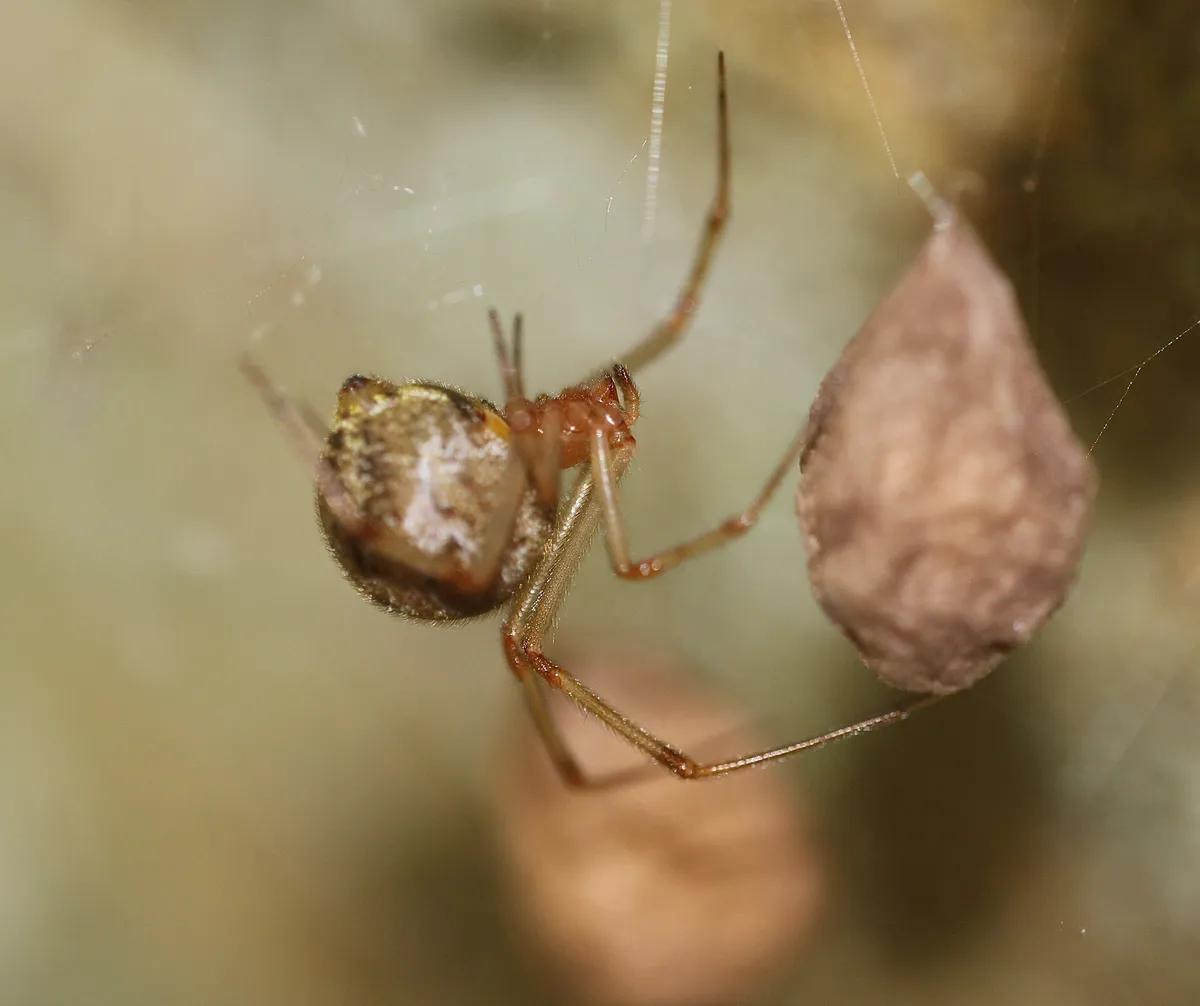 Spider egg sacOne brown, papery, egg-shaped sac about 1/4 to 3/8 inch across, in a cobweb
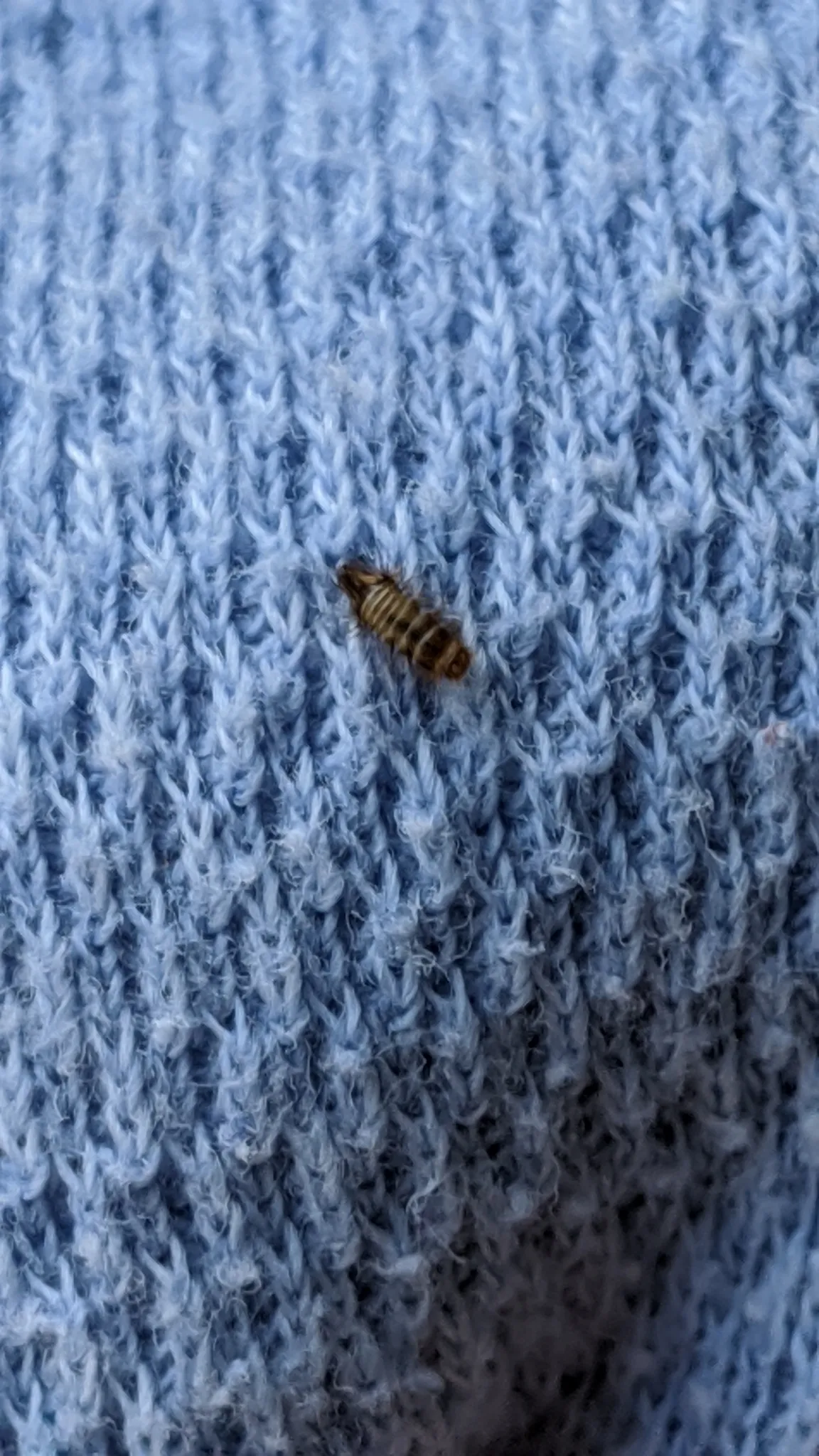 Carpet beetle larvaA fuzzy larva that spins no silk and leaves bristly brown skins in wool
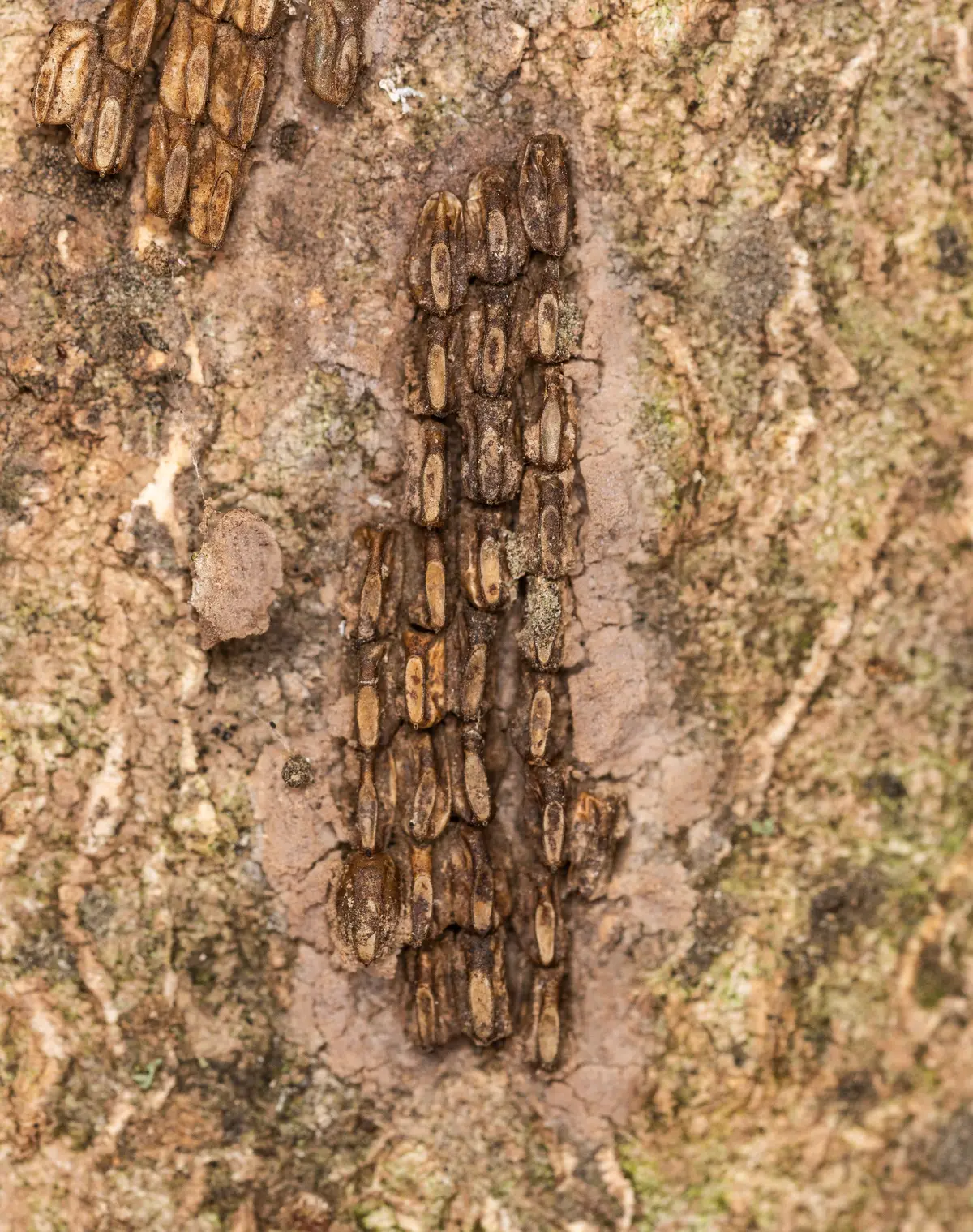 Spotted lanternfly eggsAbout 1 inch, like putty or cracked mud rather than hair, on bark, stone and outdoor items
Photos: Bed bug eggs: Charlysays, Public domain, via Wikimedia Commons, public domain. Flea eggs: Auguste Le Roux, Public domain, via Wikimedia Commons, public domain. Stink bug eggs: no rights reserved, via iNaturalist, CC0 1.0. Spider egg sac: (c) Joey M, some rights reserved (CC BY), via iNaturalist, CC BY 4.0. Carpet beetle larva: (c) Erin Lalime, some rights reserved (CC BY), via iNaturalist, CC BY 4.0. Spotted lanternfly eggs: USDAgov, Public domain, via Wikimedia Commons, public domain.
What should you do once you know what laid the eggs?
Destroy the eggs where they are: wash, freeze or brush fabrics, throw out or treat food, and scrape outdoor egg masses into something that kills them.
What kills moth eggs in fabric and food?
| Method | What the sources say | Use it for |
|---|---|---|
| Hot wash | 20 to 30 minutes at 120°F or hotter kills every stage (UC IPM) | Washable clothes and blankets |
| Dry cleaning | Kills any eggs or larvae present (Kentucky) | Woolens that should not go in hot water |
| Dryer heat | Effective, Kentucky says, though it gives no setting | Items that can go in a dryer |
| Deep freeze | Sealed in plastic, a week at 0°F or 72 hours at minus 20°F, then a day to warm up before opening (Kentucky); several days below 18°F (UC IPM) | Wool, furs and keepsakes |
| Brushing | Destroys eggs, especially along seams and in folds and pockets (UC IPM); beating rugs on an outdoor line removes most eggs and larvae (Penn State) | Coats, rugs and stored woolens |
| Freezing or heating food | Several days in the freezer kills the eggs, and so does heat in an oven or microwave (Florida) | Flour, grains or nuts worth keeping |
| Throwing food out | Seal the package and get it out of the house at once (UC IPM) | Anything with silk, larvae or eggs in it |
From UC IPM's clothes moth and pantry pest guides, the University of Kentucky, Penn State and the University of Florida, each linked above.
Then take away the next hiding place. UC IPM says a vacuum bag can hold eggs and larvae, so empty it promptly after going over carpet edges, baseboards and closet floors, and it advises scrubbing or vacuuming pantry corners and crevices to lift out eggs and pupae. Store clean wool sealed in snug plastic bags or bins, as Kentucky advises, and dry food in containers with tight lids, which UC IPM prefers to plastic bags; it advises against insecticides for pantry pests. UC IPM also says mothball fumes kill insects slowly and only where they can build up, in an airtight container, and Kentucky warns never to scatter mothballs where children or pets could get at them; how mothball labels limit them to sealed containers explains why.
Egg masses outdoors
- Spongy moth. APHIS says to scrape egg masses off with a putty knife, stiff brush or similar tool into a container of hot, soapy water, or seal them in a plastic bag left in the sun. Wisconsin Extension's window is mid-October to mid-April: scrape every bit into a jar without damaging the bark, soak the eggs in soapy water for two days before trashing them, and never just scrape them onto the ground or crush them, since many eggs can survive. Its alternative is a horticultural oil labeled for spongy moth egg masses, sprayed until the mass is soaked and used as the label directs; never motor oil, mineral oil or another oil not labeled for spongy moth.
- Eastern tent caterpillar. Kentucky says removing and destroying the egg masses on ornamental and fruit trees during winter greatly reduces the problem the next spring.
- Bagworms. UConn says to pick the bags off small trees by hand any time before June, crush them, and drop them into a bucket of soapy water or a sealed bag.
- White-marked tussock moth. UMass says overwintering egg masses on spent cocoons can be removed and destroyed; wear gloves, since the cocoons hold irritating hairs.
- Spotted lanternfly. APHIS says to smash the egg masses and scrape them into a zip-top bag of hand sanitizer or rubbing alcohol, seal it, put it in the trash, and report what you found.
If the eggs match none of these, the five-question pest identifier can help name the insect itself, and the full set of pest guides covers the rest.
Use any pesticide exactly as its label directs. The label is the law, and what is registered and sold varies by state.
Frequently Asked Questions
Can you see moth eggs on clothes?+
Only just. Clemson Extension describes clothes moth eggs as small, white and about the size of a pinhead, and UC IPM says each is glued to a thread of the fabric by a sticky secretion, so they sit down among the fibers. Check the places UC IPM and the University of Kentucky say the larvae feed: under collars and cuffs, inside folds and along rug edges. The silk webbing, cases and grazed patches the larvae leave are usually easier to see than the eggs themselves.
Where do moths lay eggs in a house?+
On whatever their caterpillars will eat. Clothes moths lay on wool, fur, feathers, silk and other animal fibers, mostly where it is dark and nobody disturbs them: closets, the floor under heavy furniture and the edges of rugs, according to UC IPM and the University of Kentucky. The Indian meal moth, the usual pantry moth, lays its eggs singly or in clusters directly on stored food, the University of Florida says. Kentucky adds that clothes moth infestations can start in bird nests in attics or chimneys, and that larvae also feed on lint and pet hair in vents.
How long do moth eggs take to hatch?+
Days indoors, months outdoors. Clothes moth eggs need 4 to 10 days in warm weather, by UC IPM's and Penn State's figures, and Penn State says winter can stretch that to three weeks or more. Indian meal moth eggs take 7 to 8 days at 68°F and 3 to 4 days at 86°F, according to the University of Florida. Outdoor egg masses wait out the winter: USDA APHIS lists spongy moth caterpillars as a spring stage, and UConn says bagworm eggs laid in the fall hatch between late May and mid-June.
Does washing clothes kill moth eggs?+
Hot washing does. UC IPM's figure is 20 to 30 minutes at 120°F or hotter, which it says kills every stage of clothes moths, and the University of Kentucky says dry cleaning or hot laundering kills any eggs or larvae present and that a clothes dryer's heat works as well. For woolens that should not go in hot water, UC IPM says a dry cleaner may be the only suitable option, and freezing the item, sealed in plastic, is another.
Does freezing kill moth eggs?+
Yes, given enough cold for enough time. The University of Kentucky's rule is at least a week at 0°F or colder, or 72 hours if the freezer gets down to minus 20°F, with the item sealed in plastic first and left about a day to reach room temperature before it is opened. UC IPM gives several days below 18°F. For pantry moths, the University of Florida says freezing infested food for several days is an effective control.
Do mothballs kill moth eggs?+
Only in a sealed container, and slowly. UC IPM says the fumes from mothballs kill insects slowly once they are concentrated enough, and that they get that strong only in an airtight container, which an open closet is not. The University of Kentucky warns that misused mothballs can be hazardous and should never be left loose where children or pets could get at them. Washing, dry cleaning or freezing infested items, as these extension services describe, deals with the eggs directly.
What color are moth eggs?+
It depends on the moth. Clemson Extension describes clothes moth eggs as white, while Indian meal moth eggs are grayish white and household casebearer eggs pale bluish in the University of Florida's descriptions. Outdoors, the egg masses are what you see: a spongy moth mass is covered in buff or yellowish hair, according to USDA APHIS, an eastern tent caterpillar mass has a shiny black coat, per the University of Kentucky, and white-marked tussock moth eggs sit in white froth, per UMass Extension.
Do moths lay eggs on walls?+
Not usually indoors. Clothes moths attach their eggs to fabric threads and pantry moths lay on food, by UC IPM's and the University of Florida's descriptions, so flat gray cases on an indoor wall are more likely household casebearers, which UF says people in Florida mostly see as empty cases on house walls. Outdoors, yes: USDA APHIS says spongy moths attach egg masses to walls and stones as well as to trees, firewood and outdoor furniture.
What does a spongy moth egg mass look like?+
A fuzzy patch about 1 1/2 inches long and 3/4 inch wide, covered in buff or yellowish hair and holding up to 1,000 eggs, according to USDA APHIS. It turns up on tree trunks, the undersides of branches, walls, stones, firewood and outdoor furniture from late summer to spring. Penn State Extension says new masses feel hard and full and usually look darker, while spent masses from earlier years are soft, ragged and sometimes powdery. The moth was formerly called the gypsy moth.
Should you scrape off spongy moth egg masses?+
Yes, but make sure the eggs die. USDA APHIS says to scrape them off with a putty knife, stiff brush or similar tool into a container of hot, soapy water, or to seal them in a plastic bag left in the sun. Wisconsin Extension's window is mid-October to mid-April; it says to soak scraped eggs in soapy water for two days before throwing them out, never to scrape them onto the ground, and not to treat egg masses in August and September, when pinholes show parasitic wasps attacking the eggs.
Sources
- Pest Notes: Clothes Moths (UC ANR Publication 7435; D. H. Choe, updated March 2013) — University of California Statewide IPM Program
- ENTFACT-609: Clothes Moths (Michael F. Potter, revised March 2026) — University of Kentucky Entomology
- Clothes Moth (Steve Jacobs) — Penn State Extension
- Fabric Pest Control (HGIC 2416; Eric P. Benson and Patricia A. Zungoli, updated April 2020) — Clemson Cooperative Extension, Home and Garden Information Center
- Indianmeal Moth, Plodia interpunctella (Hübner) (EENY-026/IN153) — University of Florida IFAS Extension
- Pest Notes: Pantry Pests (UC ANR Publication 7452; D. H. Choe, updated March 2013) — University of California Statewide IPM Program
- Spongy Moth — USDA Animal and Plant Health Inspection Service
- Management Guide for Homeowners (Spongy Moth in Wisconsin) — University of Wisconsin-Madison Division of Extension
- Guide to Spongy Moth Egg Mass Surveying (Sarah Wurzbacher, updated September 3, 2024) — Penn State Extension
- Moving across Canada: Don't take the spongy (LDD) moth with you (modified July 11, 2022) — Canadian Food Inspection Agency
- ENTFACT-423: Eastern Tent Caterpillar (Ric Bessin, revised January 2026) — University of Kentucky Entomology
- Bagworm Moth (revised 2021) — UConn Home and Garden Education Center
- Orgyia leucostigma (white-marked tussock moth), Landscape Insect and Mite Guide (active ingredient list updated September 27, 2024) — UMass Amherst Center for Agriculture, Food, and the Environment
- Household Casebearer, Phereoeca uterella (=dubitatrix) Walsingham (EENY-003/IN129) — University of Florida IFAS Extension
- Spotted Lanternfly — USDA Animal and Plant Health Inspection Service
- How to Find Bed Bugs — U.S. Environmental Protection Agency
- Cat Flea, Ctenocephalides felis (Bouché) (EENY-011/IN137) — University of Florida IFAS Extension
- Common House Spider — Penn State Extension
- Pest Notes: Carpet Beetles (UC ANR Publication 7436; updated April 2020) — University of California Statewide IPM Program
- Brown Marmorated Stink Bug — Penn State Extension
Read and approved by Alex Francisco. Found an error? Email support@buzzskito.ca.