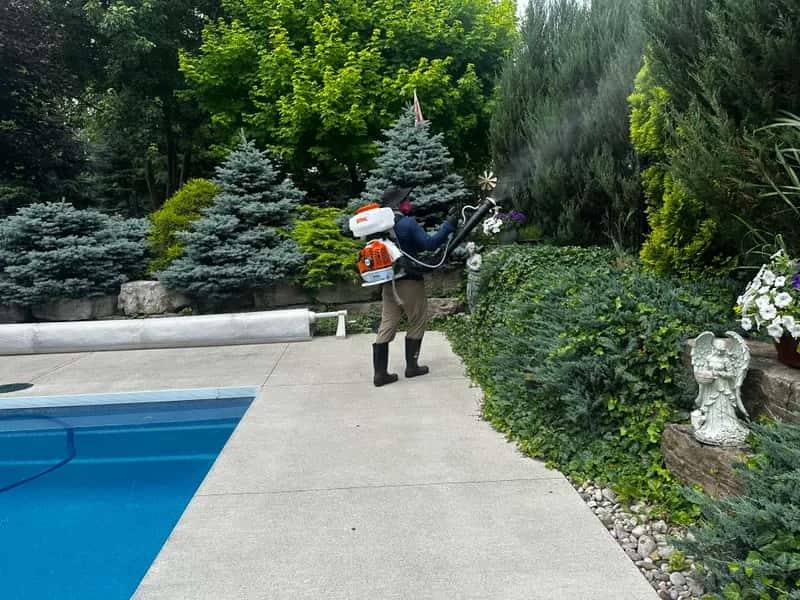
BuzzSkito Mosquito & Tick Control Specialists · Published April 28, 2026 · Updated July 12, 2026
The Mosquito Lifecycle (Why It Matters)
Mosquitoes have 4 distinct life stages, all but the last one in water:
- Egg (1–3 days) — Female mosquitoes lay eggs in standing water or in moist soil that floods. Some species lay floating egg rafts; others lay individually.
- Larva (4–14 days) — “Wigglers.” Filter-feed on water microorganisms. Grow through 4 instars, shedding skin each time. This is the stage you can target with BTI.
- Pupa (1–4 days) — “Tumblers.” Comma-shaped, don’t feed but still in water. Transitioning into adult form.
- Adult — Emerges from pupa, flies away, mates within 24 hours. Females then seek a blood meal to develop eggs and the cycle repeats.
Only about half of the adults emerging from your barrel will ever bite you. The blood meal in step 4 is a female requirement — she needs the protein in it to develop each batch of eggs — while males feed on flower nectar and cannot pierce skin at all. So every wriggler you kill is really about stopping a future egg-laying female: only female mosquitoes bite, and here is why, including how to tell the two apart by their antennae.
Total egg-to-adult time is about 7–14 days in typical Ontario summer temperatures. This is why weekly yard inspection is the most effective DIY mosquito prevention — you interrupt the cycle before adults emerge.
Where to Look on Your Property
Walk your yard every 7 days between May and September. The highest-yield inspection spots for mosquito larvae:
- Clogged gutters — #1 cause of urban mosquito problems
- Rain barrels without screens
- Plant pot saucers (especially under outdoor potted plants)
- Kids’ toys left outside (toy buckets, sandbox toys, kiddie pools)
- Tarps over BBQ, boats, woodpiles — water pools on top
- Birdbaths not refreshed weekly
- Old tires in side yards or garages
- Tree holes and stump cavities
- Drainage ditches at property edges
- Low spots in lawn that pool after rain
- Pet water bowls left outside more than 3 days
- Disused pools, hot tubs, fountains
When to Look: Mosquito Larvae Season by Region
In Canada, and specifically in the GTA, the working window is May to September — that is the schedule the list above is built around, and it matches when water in an Ontario yard is reliably warm enough for a 7–14 day generation.
In the United States, that window is wrong for most of the country. A reader in Houston who stops inspecting outside May–September misses two of their worst months. Larvae appear whenever water sits still and warm, so the season tracks latitude: mosquitoes enter diapause below roughly 50°F, and in northern and mountain states the first hard frost near 28°F effectively ends it. Find your row:
| Region | Start inspecting | Season typically ends | Notes |
|---|---|---|---|
| South Florida and the immediate Gulf Coast | Close to year-round | Rarely fully stops | Warm standing water never gets a hard reset |
| South Texas and the lower Southeast | February | November–December | Two months earlier than the Canadian schedule |
| Inland Texas, Louisiana, Gulf states | Early March | November | Long shoulder seasons on both ends |
| Southeast and Mid-Atlantic | March–April | October–November | Container Aedes drive the late-season biting |
| Midwest and Mountain West | April | September–October | First hard frost (~28°F) usually ends it |
| Pacific Northwest and Northern California | April | October | Long, cool, wet spring extends the larval window |
| Northern tier (MN, ND, upstate NY, ME) | May | September | Snowmelt pools produce a heavy early brood |
| Alaska | Late June | August | Compressed season, very high densities |
| Ontario and southern Canada | May | September | Peak June–July; 20–25°C water gives a 7–14 day generation |
Whichever row you are in, the inspection interval is the same everywhere: every seven days. The generation time, not the calendar, sets that number.
How to Get Rid of Mosquito Larvae (Ranked by Effectiveness)
- Drain the water (best). Empty the container, fix the drainage, or eliminate the water source. 100% effective, free, instant.
- BTI Mosquito Dunks or Bits. Drop in any water you can’t drain (rain barrel, ornamental pond, drainage ditch). BTI is a soil bacterium that kills only mosquito larvae — completely safe for fish, frogs, pets, humans, beneficial insects. Sold at Canadian Tire and Home Depot — one of the cheapest fixes on the shelf. Lasts 30 days per dunk. Full Mosquito Dunks Canada guide, or compare the two formats in Mosquito Bits vs Dunks — Bits act faster, Dunks last longer.
- Add fish to ornamental ponds. Goldfish, koi, and mosquitofish eat larvae aggressively. A stocked pond rarely needs treatment.
- Cooking oil or dish soap (last resort). A small amount on the water surface disrupts the larvae’s breathing siphon. Effective in disposable containers; don’t use in environmental water (kills other organisms).
Larvicides Available in the United States (All Five CDC Classes)
BTI is the option we reach for in Ontario and the one most Canadian garden centres stock, but it is not the only registered larvicide. In the United States, the U.S. Centers for Disease Control and Prevention describes five classes of mosquito larvicide, and knowing the difference matters because they do not all do the same job — only one class kills pupae:
| Active ingredient | What it is | Kills larvae? | Kills pupae? | Homeowner form |
|---|---|---|---|---|
| Bti (Bacillus thuringiensis israelensis) | Naturally occurring soil bacterium | Yes — must be eaten | No | Mosquito Dunks, Mosquito Bits |
| Lysinibacillus sphaericus | Bacterium; longer residual in dirty water | Yes — must be eaten | No | Granules and briquets. CDC notes it does NOT work on Aedes aegypti |
| Spinosad | From the bacterium Saccharopolyspora spinosa | Yes | No | Tablets and granules for containers |
| Methoprene, pyriproxyfen | Insect growth regulators (IGRs) | Prevents adults emerging rather than killing outright | Prevents emergence | Briquets, granules, sustained-release rings |
| Mineral oils, monomolecular films | Physical surface barrier | Yes — suffocation, within hours | YES — the only class that does | Liquid poured onto the water surface |
The label is the law in both countries. In the U.S., a larvicide must be registered with the U.S. Environmental Protection Agency and used according to its label instructions — the EPA registration number on the front of the pack is the thing to look for, and Summit Mosquito Dunks and Bits carry one. In Canada, the equivalent is a Health Canada PCP number issued by the Pest Management Regulatory Agency. Same product, different number on the box.
Where to buy. In Canada the dunks and bits sit in the garden aisle at Canadian Tire, Home Depot, and Rona for $10–$20. In the United States the same Summit products are stocked at Home Depot, Lowe’s, Walmart, Ace Hardware, and Tractor Supply, and the surface films and IGR briquets above are usually a special-order or online item rather than an end-cap product.
Does BTI Kill Mosquito Pupae? (No — and Here Is What Does)
BTI does not kill pupae. It has to be swallowed to work, and pupae — the comma-shaped “tumblers” — do not feed at all. They are a sealed transitional stage lasting one to four days before the adult flies off. The CDC is explicit on this point: mineral oils and monomolecular surface films are the only larvicide class that also kills pupae, because they work physically, by blocking the breathing trumpets at the surface, rather than by being eaten.
So if you look into a rain barrel and see tumblers rolling downward rather than wrigglers darting in an S-shape, the reliable moves are: dump the water if you can, or apply a surface film if you cannot. A BTI dunk added at that moment is still worth adding — it will kill the larvae behind the pupae and the next batch of eggs to hatch — but it will not stop the adults that are already pupating from emerging over the next day or two. This is the one place where “treat it with BTI” is not sufficient on its own.
What Eats Mosquito Larvae?
Quite a lot does, which is why a healthy pond rarely needs treating and a plastic bucket always does — the bucket has no predators in it.
- Fish — mosquitofish (Gambusia affinis), goldfish, koi, fathead minnows, guppies, bluegill, and bass all take larvae readily.
- Dragonfly and damselfly nymphs — ambush predators that live in the same still water; the single most effective wild control in a pond.
- Aquatic beetles and bugs — predaceous diving beetles and backswimmers. (Water boatmen look similar but mostly graze algae and detritus rather than hunting larvae.)
- Other mosquitoes — larvae of the genus Toxorhynchites prey on other mosquito larvae, and the adults do not bite or take blood.
- Frogs and turtles — take some larvae, and adult frogs take flying adults.
- Not tadpoles, mostly — most tadpoles graze algae and detritus rather than hunting, so a pond full of tadpoles is not a control plan. They do compete with larvae for food.
- Not birds or bats, at this stage — swallows, purple martins, and bats eat flying adults, not aquatic larvae. A bat house does nothing for the barrel.
One U.S.-specific caution: before stocking mosquitofish anywhere in the United States, check with your state cooperative extension service or your local mosquito abatement district. Gambusia are distributed free by some districts and treated as a regulated invasive species in others, and the rules are set at state level.
The Four Larval Instars — and How Big Mosquito Larvae Really Get
Larvae moult four times, and each stage between moults is called an instar. What you scoop out of a barrel is usually a mix of all four:
- First instar — about 1 mm at hatching, nearly transparent, easy to mistake for suspended grit.
- Second instar — 2–3 mm, visibly darkening, siphon becoming apparent.
- Third instar — 4–5 mm, obvious head, thorax, abdomen and siphon; the classic head-down hang is unmistakable.
- Fourth instar — the largest and the one people photograph. Feeds heavily, then stops feeding shortly before pupating.
On size, in both unit systems. The 5–8 mm figure used throughout this guide describes a typical full-grown Culex larva of the sort found in an Ontario rain barrel — roughly a quarter of an inch. Larger species run bigger: the American Mosquito Control Association puts a fourth-instar larva at up to about half an inch, and the Missouri Department of Conservation field guide gives a range of about 1/4 inch to over 1/2 inch (roughly 6 to 13 mm) across the species found in one U.S. state. So if the wriggler in your bucket looks bigger than a grain of rice, it is still very likely a mosquito larva — just a larger species or a well-fed fourth instar.
The instar detail has a practical edge: label guidance for larvicides generally notes they work best on younger larvae, and fourth-instar larvae stop feeding before pupating. Treat when you first see wrigglers, not after you have watched them for a week.
Free Help in the United States: Mosquito Abatement Districts
This is the single most useful thing a U.S. reader can take from this page, and it has no Canadian equivalent. Mosquito abatement districts (also called mosquito control districts) are funded local public agencies — there are hundreds across the United States — whose job is to survey and treat mosquito breeding water in their jurisdiction. The CDC describes districts as leading large-scale mosquito control in the U.S.
They handle exactly the problems a homeowner cannot: a drainage ditch at the property line, a storm drain, a roadside pond, a creek backwater, a neighbour’s abandoned green pool. Many will inspect and treat these at no cost to you, and a good number hand out free BTI dunks to residents who ask.
- Find yours by searching your county or state name plus “mosquito abatement district” or “mosquito control district”.
- No district in your area? Contact your county health department, or your state cooperative extension service — the land-grant university extension programme in your state, such as UC ANR in California. Extension is the canonical homeowner-facing authority on this in the U.S. and publishes region-specific guidance for ponds, fountains, and water gardens.
- Report, do not trespass. An abandoned pool next door is a district or code-enforcement matter, not a fence-hopping one.
In Canada there is no district system. Standing water on public land goes to your municipality — 311 across the GTA — and West Nile virus questions go to your regional public health unit. Some Ontario municipalities run catch-basin larviciding programmes of their own each summer.
Sources
Species ranges, larvicide classes, vector roles, and the point that only surface oils and films kill pupae follow the U.S. Centers for Disease Control and Prevention — Mosquitoes. Larvicide registration and label-use requirements follow the U.S. Environmental Protection Agency — Mosquito Control. Lifecycle, instar sizing, and the siphon variations in Anopheles, Coquillettidia and Mansonia follow the American Mosquito Control Association. Canadian West Nile virus and standing-water guidance follows Public Health Ontario and the Public Health Agency of Canada.
Everything on this page is general public health and pest-management information, not medical advice. For questions about mosquito-borne illness or symptoms, speak to a physician, your local public health unit in Canada, or your county health department in the United States. Always read and follow the label on any larvicide you apply.
The Bigger Picture
Larvae control on your own property eliminates mosquitoes born on your property. But adult mosquitoes from neighbours’ yards, ravines, creeks, and conservation areas can fly up to 3 km — they will still find your yard regardless of how thoroughly you eliminate your own breeding sites. That is why a spotless yard can still swarm: a ravine-backing lot in Toronto or a property along one of Mississauga’s creek corridors sits well inside flight range of breeding water nobody owns, which is why we pair source reduction with mosquito control in Toronto and mosquito control in Mississauga on those properties.
For complete yard mosquito control, combine larval source reduction with professional barrier spray that targets adult mosquitoes resting on your vegetation. It is worth being clear about which tool does what: a mosquito fogger kills flying adults and does nothing to larvae sitting in a rain barrel or ditch, so treat the water with BTI and save the fogging for the adults. If you are weighing a $10–$20 pack of dunks against hiring someone, single treatments start at $99 — see the full mosquito control cost breakdown. Larvae control + barrier spray + habitat modification is the three-leg stool of effective residential mosquito management.
One thing not to spend the dunk money on while you wait for the water to clear: a wearable repellent band. A wristband only puts repellent vapour next to the wrist, so ankles, neck, and the far arm stay unprotected — a 2017 New Mexico State University study of citronella and essential-oil wristbands found little protection beyond a few centimetres of the band. If you were about to buy a pack for the kids, read whether mosquito repellent bracelets work in Canada first, and note they do nothing at all for ticks.
Related Reading
- Mosquito Dunks Canada Complete Guide
- Mosquito Bits vs Dunks — Which Kills Larvae Faster?
- Hidden Mosquito Breeding Spots in Your Backyard
- Natural Mosquito Repellent — What Works
- When Does Mosquito Season Start in Ontario?
- Professional Mosquito Control Service
Frequently Asked Questions
What do mosquito larvae look like?+
Mosquito larvae are 5–8 mm long, brown to black or grey, and look like tiny wiggling worms with a distinct head, thorax, and abdomen. They breathe through a siphon tube that pokes through the water surface — when you disturb the water, they immediately wiggle downward in a characteristic S-shape. This wiggling motion is why they're commonly called "wigglers." Mosquito larvae always live in water and never on land.
How do you identify mosquito larvae?+
Three diagnostic features: (1) They live in still or slow-moving water, never on land. (2) They hang upside-down at the water surface with their breathing siphon poking through. (3) When the water is disturbed, they wiggle in a distinctive S or comma shape as they swim downward. Common look-alikes include midge larvae (live in mud/sediment, not at the water surface) and mayfly larvae (have visible gills along their abdomen — mosquito larvae don't).
Where do mosquito larvae live?+
Mosquito larvae live in any standing water that has remained undisturbed for 5+ days. Common locations: rain barrels, clogged gutters, neglected bird baths, plant saucers, old tires, tarps with water collected on top, kiddie pools, ornamental ponds without fish, drainage ditches, tree holes, and any container that holds water. A bottle cap full of water can produce dozens of mosquitoes. They CANNOT live in flowing water (creeks, rivers) or chlorinated swimming pools.
How long do mosquito larvae take to become adults?+
Mosquito larvae develop into adults in 7–14 days at typical Ontario summer temperatures (20–25°C). The lifecycle has 4 stages: egg (1–3 days), larva (4–14 days, growing through 4 instars), pupa (1–4 days), adult. Cold water slows development; warm water speeds it up. This is why removing standing water weekly is the most effective preventive measure — it interrupts the lifecycle before adults emerge.
How do you get rid of mosquito larvae?+
Three options ranked by effectiveness: (1) Drain or empty the water — most effective, kills 100% of larvae instantly. (2) BTI Mosquito Dunks or Bits (Bacillus thuringiensis israelensis) — bacterial larvicide, kills larvae in 24–48 hours, completely safe for fish/pets/humans. Available at Canadian Tire, Home Depot, Rona for $10–$20. (3) Cooking oil or dish soap on the water surface — disrupts the larvae's breathing siphon, kills within hours. Use only as last resort and only in non-environmental water (e.g., disposable containers).
Are mosquito larvae harmful to humans or pets?+
No. Mosquito larvae cannot bite — they have no piercing mouthparts. They live entirely in water and never come into contact with humans or pets. Pets occasionally drink water containing larvae with no harm. The harm comes from the ADULT mosquitoes that emerge from the larvae — adult females bite and can transmit West Nile virus, Eastern Equine Encephalitis, and other diseases. The goal of larvae control is to prevent adult mosquito emergence, not because the larvae themselves are dangerous.
How do I check my yard for mosquito larvae?+
Walk your yard once a week between May and September. Look for any standing water that has been still for more than 5 days: clogged gutters, plant saucers, kiddie pools, bird baths, rain barrels, tarps, old containers, and low spots in the lawn that pool after rain. If you see wigglers, either dump the water immediately or treat with a BTI mosquito dunk. Continuous weekly inspection is the single most effective DIY mosquito control practice.
Do fish eat mosquito larvae?+
Yes — most pond fish eat mosquito larvae aggressively. Goldfish and koi are particularly effective. If you have an ornamental pond with fish, you typically don't need to treat for mosquitoes — the fish handle larvae naturally. Mosquitofish (Gambusia affinis) are specifically bred for this purpose in some regions. Frogs and dragonfly larvae also eat mosquito larvae. A balanced pond ecosystem rarely needs mosquito treatment.
What kills mosquito larvae instantly?+
Draining the water kills 100% of mosquito larvae instantly — they cannot survive out of water for more than a few minutes. For water you can't drain, nothing safe works truly "instantly": BTI (Mosquito Dunks/Bits) kills larvae within 24–48 hours and is the safest option for ponds, rain barrels, and ditches. A thin film of dish soap or cooking oil suffocates larvae within hours but should only be used in disposable container water, never ponds. Avoid bleach or gasoline — they contaminate water, harm wildlife, and are illegal to dump in many municipalities.
Why are there mosquito larvae in my pool?+
Mosquito larvae appear in pools when chlorine has lapsed and the water has sat undisturbed for 5+ days — properly chlorinated, filtered pool water cannot support larvae. Fix it by shocking the pool, running the filter, and skimming; larvae die quickly in restored chlorine levels. Pool covers are a bigger culprit than the pool itself: rainwater pooling on top of a cover is a perfect nursery. Tip the cover off after rain or treat the puddles with a BTI dunk.
Can mosquito larvae survive without water?+
No. Mosquito larvae die within minutes out of water — they are fully aquatic and breathe through a siphon at the water surface. This is exactly why dumping standing water is the most effective control. Note the eggs are tougher: some mosquito species lay eggs in moist soil or dry container edges that hatch when re-flooded, and those eggs can survive weeks to months dry. So after dumping a container, scrub the sides to remove any eggs stuck to the walls, then store it upside down.
How do I get rid of mosquito larvae in a rain barrel?+
Do not dump a rain barrel you want to keep using — treat it instead. Drop one BTI Mosquito Dunk (or a scoop of Mosquito Bits) into the barrel; the Bacillus thuringiensis israelensis kills all mosquito larvae within 24–48 hours and is completely safe for garden plants, pets, and beneficial insects, so the water stays fine to use on your vegetables and flowers. One dunk keeps a barrel larvae-free for about 30 days. Then fit a fine mesh screen over the barrel opening so egg-laying females cannot get back in — screening plus a monthly dunk keeps a rain barrel mosquito-free all season.
How can I tell mosquito larvae apart from other larvae?+
Only mosquito larvae hang head-down at the water surface with a breathing siphon poking through the surface tension and dart downward in a distinctive S-shaped wiggle when disturbed. Midge larvae (often red "bloodworms") live in bottom mud and swim in a figure-eight; mayfly larvae have feathery gills along the abdomen and need clean flowing water; drain-fly larvae live in the slime film inside pipes, never in open standing water. If it is at the surface of still water and wiggles in an S when you touch the water, it is a mosquito larva — and it will become a biting adult in 7–14 days.
What do mosquito eggs look like?+
Mosquito eggs are tiny — under 1 mm — and dark brown to black. Depending on the species, they appear either as a floating raft of 100–300 eggs stuck together in a boat shape on the water surface, or as single eggs laid along the moist edges of containers and damp soil. To the naked eye a raft looks like a small speck of dirt or soot bobbing on still water, so it is easy to overlook until larvae hatch a day or two later.
How big are mosquito larvae?+
Mosquito larvae are about 5–8 mm long when fully grown — roughly the size of a grain of rice. They start much smaller, around 1 mm, when they first hatch, then grow through four moults (instars) over 4–14 days before pupating. Even at full size they are small enough that many homeowners mistake a rain barrel or bird bath full of them for floating debris until the water is disturbed and the larvae wiggle.
What do mosquito larvae eat?+
Mosquito larvae are filter feeders that eat microscopic organic matter suspended in the water — bacteria, algae, fungi, protozoa, and decaying plant material — sweeping food toward their mouth with brush-like mouthparts. This feeding habit is exactly why BTI larvicides such as Mosquito Dunks and Bits work: the larvae swallow the bacterial spores along with their food, and the BTI proteins destroy their gut within 24 hours. Larvae never bite or feed on blood — only adult female mosquitoes do.
What do mosquito pupae look like?+
Mosquito pupae — nicknamed 'tumblers' — are comma or question-mark shaped, with a bulbous head-and-thorax section and a curled tail. They rest at the water surface and tumble downward in a rolling somersault when disturbed, unlike the S-shaped wiggle of larvae. Pupae do not feed and last only 1–4 days before the adult mosquito emerges. Seeing tumblers means adults are about to hatch, so drain or treat the water with BTI immediately.
How do you identify mosquito larvae in water?+
To identify mosquito larvae in water, look for small worm-like creatures hanging head-down just beneath the surface with a breathing siphon poking through the surface film. Tap or disturb the water and they dart downward in a distinctive S-shaped wiggle, then float back up to breathe. They appear only in still or slow water that has sat undisturbed for 5 or more days — rain barrels, bird baths, clogged gutters, and plant saucers are the usual spots in a GTA backyard.
What do baby mosquitoes look like?+
'Baby mosquitoes' almost always means the aquatic larvae — 5–8 mm brown-black wiggling worms that live in standing water, not tiny flying adults. Mosquitoes have no small winged juvenile stage; they go egg → larva → pupa → adult, and the adult emerges full-sized. So if you are seeing something small and mosquito-like in water, it is a larva or a comma-shaped pupa. A newly emerged adult is already the same size as any other adult mosquito.
Should I kill mosquito larvae?+
Yes — in water you own and manage. Every larva left in a container, gutter, tarp puddle, or unscreened rain barrel becomes a biting adult in roughly a week, and dumping the water costs nothing. The sensible exception is a stocked pond, a stream, or a natural wetland: those already hold fish, dragonfly nymphs, and diving beetles that eat larvae continuously, and the larvae themselves are food for that system. Kill the larvae in your containers; leave natural water to its predators.
Should I dump out water with mosquito larvae?+
Yes, if the container is yours and you do not need the water. Dumping kills 100% of the larvae instantly, needs no product, and takes seconds. Pour it onto dry lawn, gravel, or a garden bed rather than into another container or a storm drain. Then scrub the inside walls — several container-breeding species glue eggs to the sides above the waterline, and those eggs hatch when the container refills weeks later. Store it upside down or under cover afterwards.
Is water with mosquito larvae safe?+
The larvae themselves are harmless: they have no piercing mouthparts, cannot bite, and a pet or bird that swallows a few comes to no harm. But water that has sat still long enough to grow larvae has also been growing bacteria and algae, so treat it as non-potable — do not drink it, and refresh birdbaths, pet bowls, and livestock troughs rather than topping them up. Rain-barrel water treated with BTI remains fine for watering plants, including vegetables. This is general information, not medical advice.
Will putting vinegar in water kill mosquito larvae?+
Not reliably. Household vinegar is about 5% acetic acid, and while a heavy dose in a cup of water can kill larvae over several hours, the volume needed to acidify a rain barrel or pond is impractical and would damage plants and fish. Neither white vinegar nor apple cider vinegar is registered as a larvicide by the U.S. Environmental Protection Agency or Health Canada. Dumping the water is instant and free; BTI works in 24–48 hours and is registered for the job.
Does bleach kill mosquito larvae?+
Yes, but it is rarely the right choice. Bleach will kill larvae in a bucket you intend to empty anyway. It must never go into an ornamental pond, a rain barrel used on the garden, bare soil, or a storm drain — it kills fish and beneficial insects, and discharging it to water bodies or sewers is restricted by many U.S. states and Ontario municipalities. If you are willing to bleach the water, you are willing to dump it, and dumping is faster, free, and does no downstream damage.
Does dish soap kill mosquito larvae?+
Yes. A few drops of dish soap break the surface tension that larvae and pupae depend on to hang from the surface film, and they drown or suffocate within hours. It is a legitimate emergency fix for a disposable container of water. Do not use it in a pond, a birdbath birds still drink from, or anything draining to soil or storm water — the same surfactant action harms other aquatic life. Purpose-made mineral oils and monomolecular surface films do the same job and are EPA-registered for it.
What eats mosquito larvae?+
A long list. Fish do most of the work: mosquitofish (Gambusia affinis), goldfish, koi, fathead minnows, guppies, bluegill, and bass all take larvae. So do dragonfly and damselfly nymphs, predaceous diving beetles, and backswimmers. Larvae of the mosquito genus Toxorhynchites eat other mosquito larvae, and its adults do not bite. Before stocking mosquitofish anywhere in the United States, check with your state cooperative extension service or mosquito abatement district — they are regulated, and treated as invasive, in several states.
Do tadpoles eat mosquito larvae?+
Mostly no. Most tadpoles are algae and detritus grazers rather than predators, so a pond full of tadpoles is not a mosquito control plan — though they do compete with larvae for the same food. Adult frogs take some flying adults. Telling the two apart is easy: a tadpole has a rounded body with one broad paddle tail and grazes along surfaces, while a mosquito larva is a thin segmented wriggler that hangs at the surface film and darts away in an S-shape when you disturb the water.
What are the four mosquito larvae stages?+
Larvae pass through four instars, moulting between each one. The first instar is about 1 mm and nearly transparent at hatching. The second is 2–3 mm and darkening. The third is 4–5 mm with an obvious siphon. The fourth instar is the largest — about 5–8 mm for a typical Culex, and up to roughly half an inch (about 12 mm) in larger species, per the American Mosquito Control Association and the Missouri Department of Conservation. Fourth-instar larvae stop feeding shortly before pupating, which is why larvicides work best on younger larvae.
Do all mosquito larvae hang head-down with a siphon?+
No — and this is the single most common identification mistake. Anopheles larvae, including Anopheles quadrimaculatus, a routine backyard species across the eastern United States, have no prominent siphon and lie flat and parallel just under the surface film instead of hanging head-down. Coquillettidia and Mansonia go further: their modified siphons pierce the stems and roots of cattails and other aquatic plants, so they never surface at all. A flat-lying larva in still water is still a mosquito larva.
Does BTI kill mosquito pupae?+
No. BTI has to be eaten to work, and pupae do not feed — the pupal stage is a sealed transition lasting one to four days before the adult flies off. The U.S. Centers for Disease Control and Prevention states that mineral oils and monomolecular surface films are the only larvicide class that also kills pupae, because they act physically by blocking the breathing trumpets rather than by being swallowed. If you see comma-shaped tumblers, dump the water or apply a surface film; BTI will still kill the larvae behind them.
What are mosquito hawk larvae?+
"Mosquito hawk" is a regional U.S. nickname for the crane fly, and crane fly larvae are not mosquito larvae. They are grey-brown and leathery, up to about 1.5 inches long, live in wet soil, lawn thatch, and pond margins rather than open water, and have no breathing siphon. Despite the nickname, neither adult crane flies nor their larvae eat mosquitoes, and adult crane flies do not bite. Dragonfly nymphs are the pond predator people usually have in mind.
How do I get rid of mosquito larvae in a fish tank?+
Usually you do not have to do anything — almost any tank fish will eat mosquito larvae within minutes, and they are a nutritious live food. If the tank has no fish, net the larvae out and discard them, or drain and refill. Never put a BTI dunk, dish soap, bleach, or oil into a display aquarium. Indoor tanks only get larvae when a female mosquito reaches an open, uncovered tank, so fitting a lid solves it permanently.
When is mosquito larvae season in the United States?+
It depends on your latitude. South Florida and parts of South Texas produce larvae close to year-round and can open in February. The Gulf states and inland Texas start in early March. The Southeast, Mid-Atlantic, Midwest, and West typically run April through September or October. The northern tier starts in May, and Alaska may only see late June into July. Mosquitoes enter diapause below roughly 50°F, and a hard frost near 28°F ends the season in northern and mountain states. In Ontario and southern Canada the working window is May to September.
Who do I call about mosquito larvae in a ditch or an abandoned pool?+
In the United States, call your local mosquito abatement or mosquito control district. These are funded public agencies — hundreds of them nationally — and many will inspect and treat a ditch, storm drain, roadside pond, or a neighbour's green pool at no cost to you, with some handing out free BTI dunks to residents. Search your county or state name plus "mosquito abatement district"; if there is none, contact your county health department or state cooperative extension service. Ontario has no district system: report standing water on public land to your municipality (311 in the GTA) and West Nile concerns to your regional public health unit.
Which mosquito species will I find in my yard in the United States?+
Culex pipiens, the northern house mosquito, dominates urban and suburban standing water in the eastern United States north of roughly 36° latitude, with Culex quinquefasciatus taking over to the south and a hybrid zone between them; the CDC identifies Culex as the primary West Nile virus vector in the U.S. Container water also produces Aedes albopictus across much of the East and South and Aedes aegypti in southern states — the CDC publishes estimated potential range maps for both and states that Aedes aegypti is more likely than Aedes albopictus to spread dengue, chikungunya, and Zika. Anopheles, Culiseta, Psorophora, and Ochlerotatus are common backyard genera too.
What larvicides can I buy in the United States?+
The CDC names five classes. BTI (Bacillus thuringiensis israelensis). Lysinibacillus sphaericus, which the CDC notes does not work on Aedes aegypti. Spinosad, derived from the bacterium Saccharopolyspora spinosa. The insect growth regulators methoprene and pyriproxyfen, which stop adults emerging rather than killing larvae outright. And mineral oils plus monomolecular surface films — the only class that also kills pupae. All must be EPA-registered and used according to the label. Summit Mosquito Dunks and Bits are the EPA-registered BTI products on U.S. shelves at Home Depot, Lowe's, Walmart, Ace, and Tractor Supply; in Canada the same products carry a Health Canada PCP number and sell at Canadian Tire, Home Depot, and Rona.
How long until mosquito larvae turn into mosquitos?+
Usually 7 to 14 days from egg to flying adult in warm weather: 1–3 days as an egg, 4–14 days as a larva through four instars, then 1–4 days as a non-feeding pupa. Temperature sets the pace. Near 80°F (27°C) some container species finish in under a week; near 60°F (16°C) it can stretch past a month; and development effectively stalls in cold water. That one-week floor is exactly why a weekly walk-round beats a monthly one.