
Published by BuzzSkito Mosquito & Tick Control
Published October 16, 2026 · Drafted with AI assistance and fact-checked against the sources listed below
How do you tell whose egg sac it is?
Look at where the sac is, then at its shape, surface and size. Spider egg sacs are silk: the Missouri Department of Conservation's (MDC) guide to Missouri's common spiders says females lay their eggs on a silken base and add more layers over them, then attach the sac to plants, hide it in a burrow or under a log or rock, or hold and carry it. Sacs hold dozens to over 1,000 eggs, depending on the species.
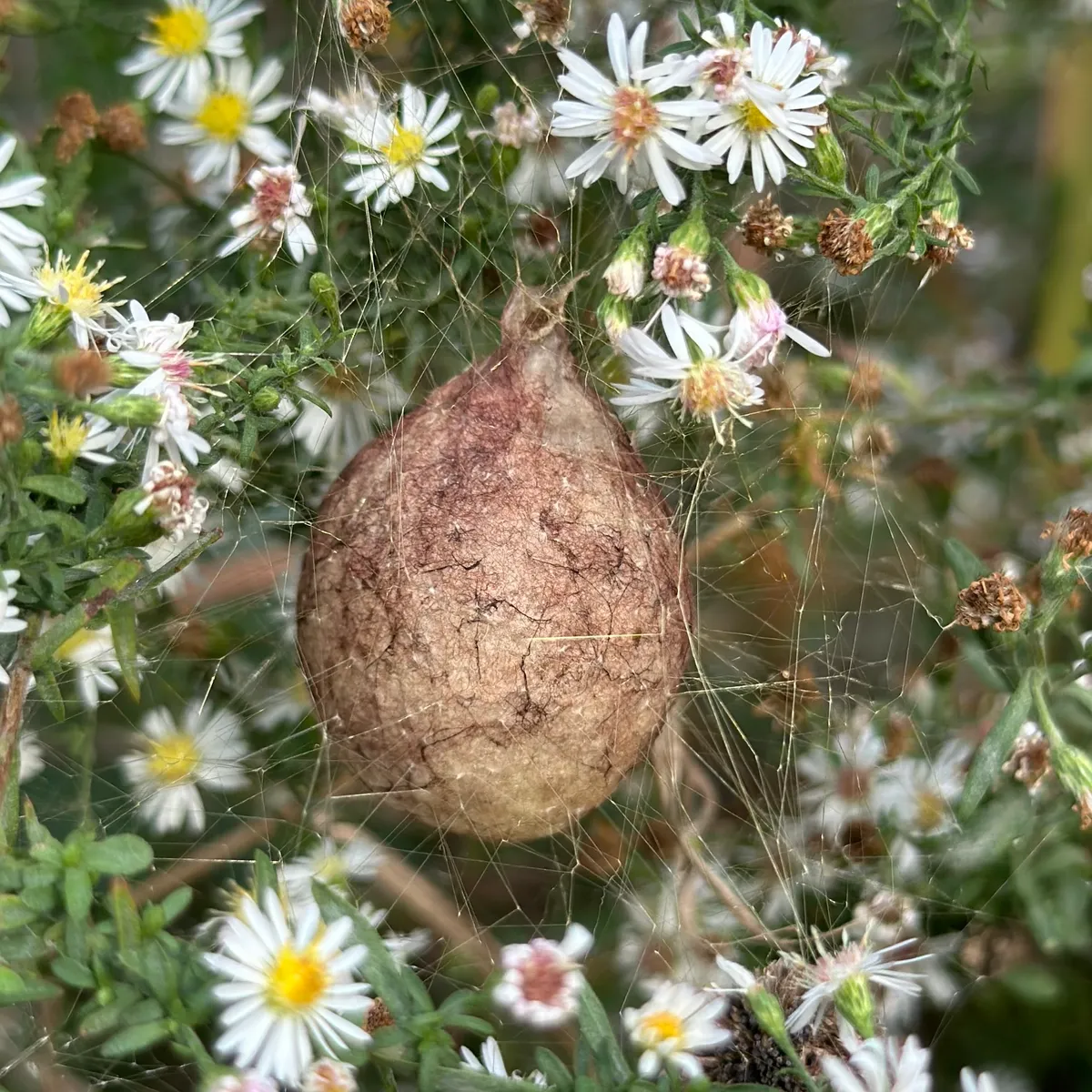
Many look alike at first. Rick Vetter of UC Riverside's Center for Invasive Species Research says most free-hanging spider egg sacs look like a lemon drop candy or a little cotton ball with indistinct edges. These checks sort them.
Checks for an egg sac you have found
- Where it is. In a cobweb, in a spider's jaws, at a spider's rear, near a wheel-shaped web, on a guarded shrub or in a silk retreat.
- Shape. Pear or teardrop: common house spider or western black widow. Round: other black widows, wolf spiders, brown recluse. Flattened on one side: green lynx spider.
- Surface. Tough and papery: common house spider. Tough, with clean edges: western black widow. Small silk points: brown widow or green lynx spider. Cottony, with no clear edge: false black widow, among others.
- Size. Hold a ruler marked in inches near it, not touching it, and compare with the sizes in the table below.
- Who is with it. A spider holding, carrying or guarding the sac is the strongest clue, so photograph it too.
Which spider egg sacs turn up in and around homes?
This page covers the sacs of common house spiders, cellar spiders, wolf spiders, garden spiders, widows, green lynx spiders and brown recluses:
| Spider | Where you find the sac | What it looks like |
|---|---|---|
| Common house spider | Cobwebs at windows, wall corners, basements | Brown, papery, pear-shaped; 1/4 to 3/8 inch |
| Longbodied cellar spider | Held in the female's jaws | 25 to 60 eggs in thin silk |
| Wolf spider | Carried at the female's rear | Round, about the size of a pea |
| Black-and-yellow garden spider | On plants near the web | Tan, papery, a little smaller than a ping-pong ball |
| Black widows | Tangled webs in woodpiles, sheds, garages | Round to teardrop, off-white to tan; about 1/2 inch |
| Brown widow | Webs under outdoor furniture and railings | Round, light tan, covered in small silk points |
| Green lynx spider | A shrub in the southern US, guarded | Straw-colored, spiky; 2/3 to 1 inch |
| Brown recluse | Retreats along joists, sills and rafters | Off-white, round; about 1/3 inch |
Sources: Penn State Extension, the Missouri Department of Conservation, Kansas State University, Clemson, UC IPM, UC Riverside, the University of Florida and the University of Kentucky, each linked below.
What does a common house spider egg sac look like?
It is a brown, papery sac about 1/4 to 3/8 inch across, hanging in a tangled cobweb. Penn State Extension's common house spider page calls the sacs brown and ovoid with tough, papery covers, and says one female may make 12 or more, each holding 140 to 380 eggs. The MDC guide calls them grayish-tan and pear-shaped and says they are commonly seen in the webs.
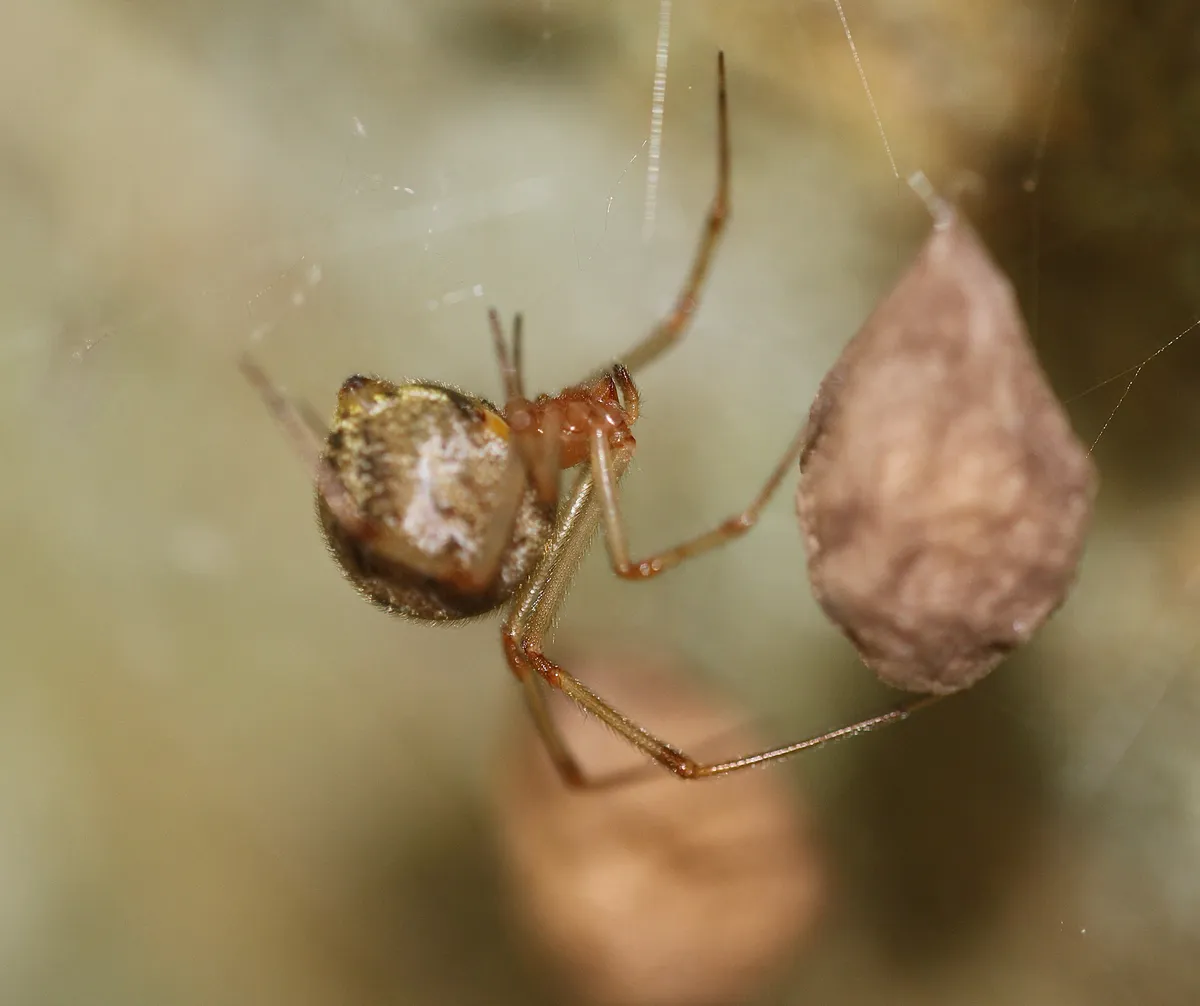
Penn State calls the spider extremely common in houses and barns, with webs in wall corners, on floor joists and in windows. The guide to common house spiders covers the spider and how to tell it from other indoor species.
Why is a spider holding a ball of eggs in its jaws?
A long-legged spider hanging upside down in a loose web with a bundle of eggs in its jaws is probably a cellar spider. Penn State Extension's longbodied cellar spider page says the female wraps 25 to 60 eggs in a thin layer of silk and holds them in her jaws as she hangs inverted in her web. It lives in cellars, garages and other dark, quiet spots, all year in heated buildings.
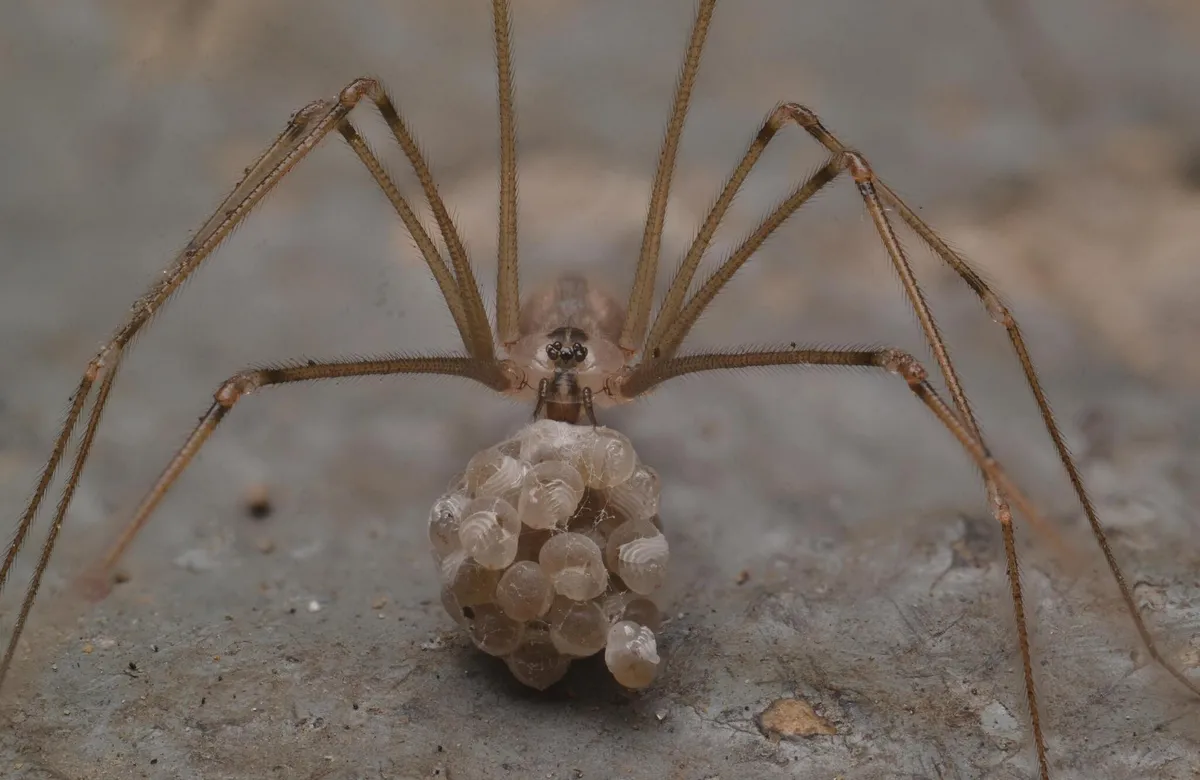
The photo shows a relative of the longbodied cellar spider; the MDC guide notes that cellar spider species are hard to tell apart even for experts. Female nursery web spiders and dark fishing spiders also carry their sacs in their jaws, the guide says, and nursery web spiders then guard a nursery web in low plants that looks like a tent caterpillar's web.
What does a wolf spider egg sac look like?
It is a round sac about the size of a pea, carried at the female's rear. The MDC wolf spider page says she attaches it to her spinnerets and searches frantically if separated from it; the spiderlings then ride on her abdomen for up to two weeks or more. MDC pictures a rabid wolf spider's sac that was baby blue.
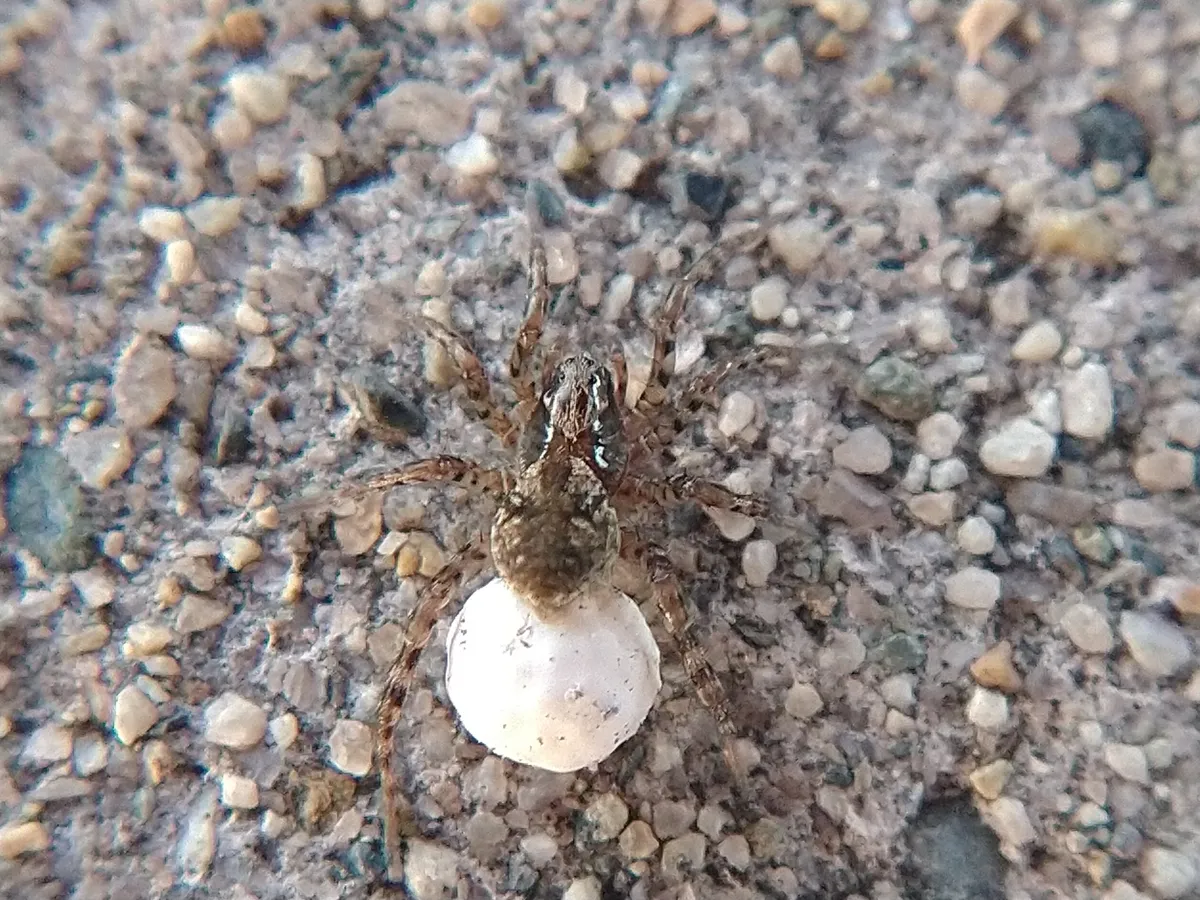
A wolf spider indoors came in from outside: University of Minnesota (UMN) Extension says hunting spiders wander in by accident, particularly in fall, do not survive well indoors and usually do not reproduce there. The wolf spider identification guide shows the common species, and the brown recluse look-alikes guide explains why a spider carrying a sac at its rear is not a recluse.
What is the big tan egg sac on a plant or wall outside?
One common maker is the black-and-yellow garden spider, which the MDC page on the black-and-yellow garden spider says is commonly found near houses and in gardens. Its egg cases are papery, tan and a little smaller than ping-pong balls and can hold over 1,000 eggs each. A female makes about four, generally attached to nearby plants, and by mid-September most in Missouri are making them.
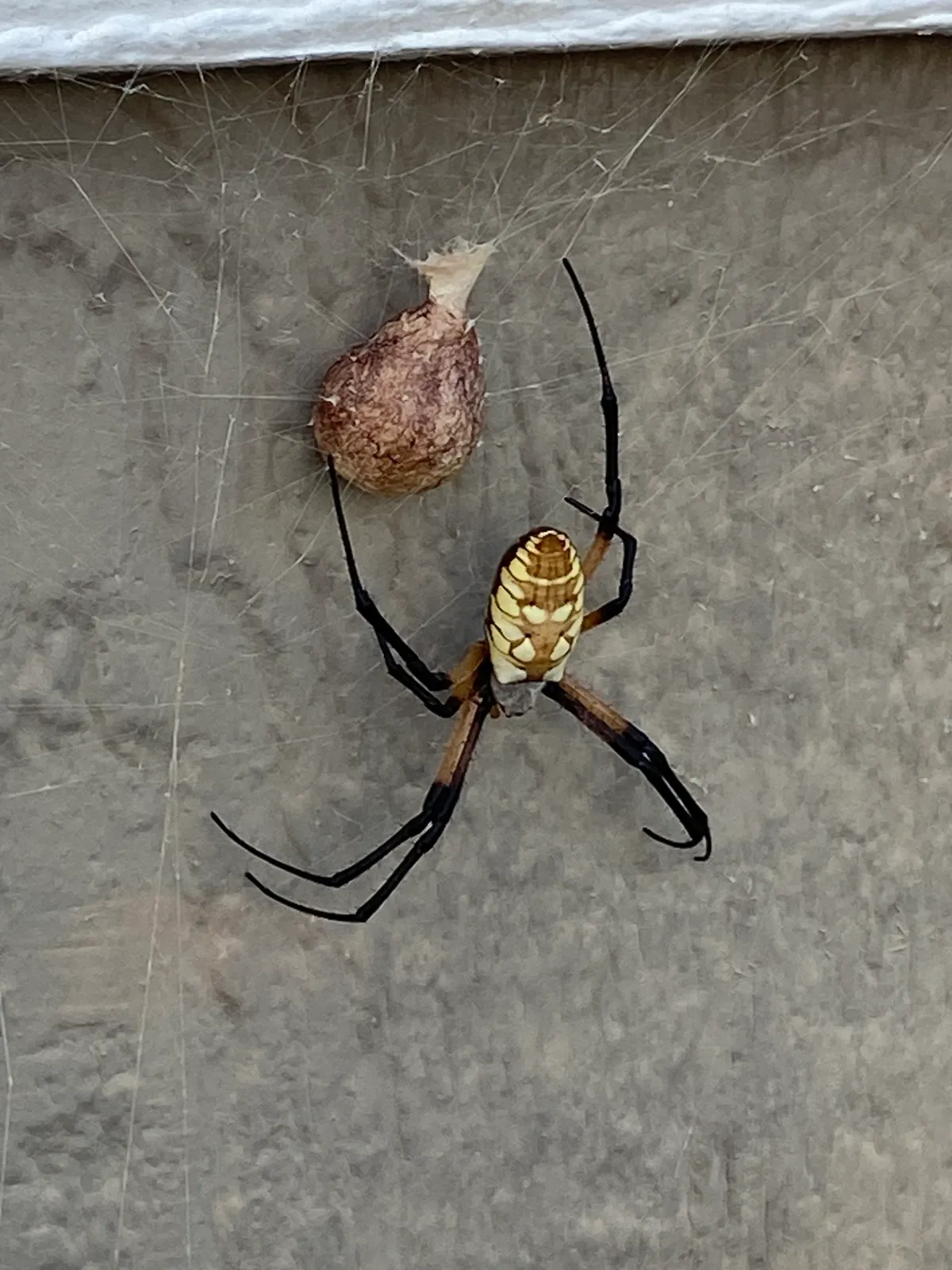
The female dies in the first frosts. The sacs stay out through the winter, when MDC says birds such as titmice and chickadees eat them, and the spiderlings emerge in spring. MDC calls these spiders harmless. Garden spiders and other orb weavers have their own guide.
What does a black widow egg sac look like?
A black widow's sac is round to teardrop-shaped and about 1/2 inch across, kept in the female's tangled web. Kansas State University's black widow fact sheet describes a spherical, off-white sac a little over 1/2 inch in diameter with 200 to 300 eggs, one of several a female may make in a year. Clemson Cooperative Extension calls southern and northern black widow sacs round and tan to grayish, with a single small point.
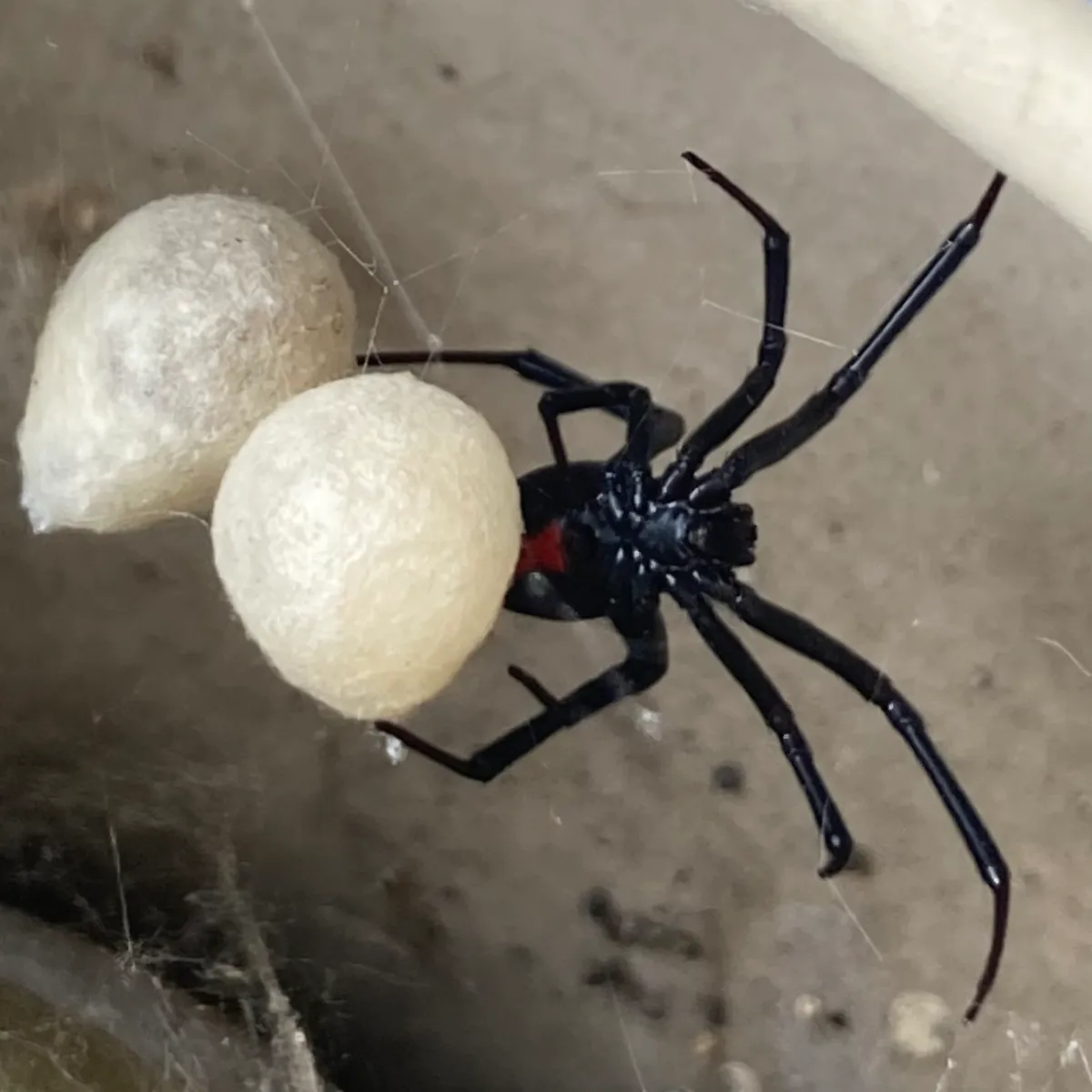
The western black widow's sac is yellowish and teardrop-shaped, with well-defined edges and a very tough cover, according to the University of California's Pest Note on widow spiders and their relatives (UC IPM). The false black widow, which UC IPM calls extremely common in Pacific Coast homes, makes a sac like a cotton ball with indistinct edges.
Kansas State says black widows seldom enter living spaces but turn up in sheds, garages, crawl spaces and cellars. The guide to venomous spiders in the US shows how to recognize them, and the black widow guide covers their webs.
Which spider makes an egg sac with spikes?
Probably a brown widow, unless the sac is on a shrub with a bright green spider guarding it. UC IPM says the brown widow's sac has silk bumps all over, like a very large pollen grain, and can confirm that brown widows are present; Clemson calls it rounded, light tan and covered in small points. Each holds about 130 eggs, and a female can make 20 or more.
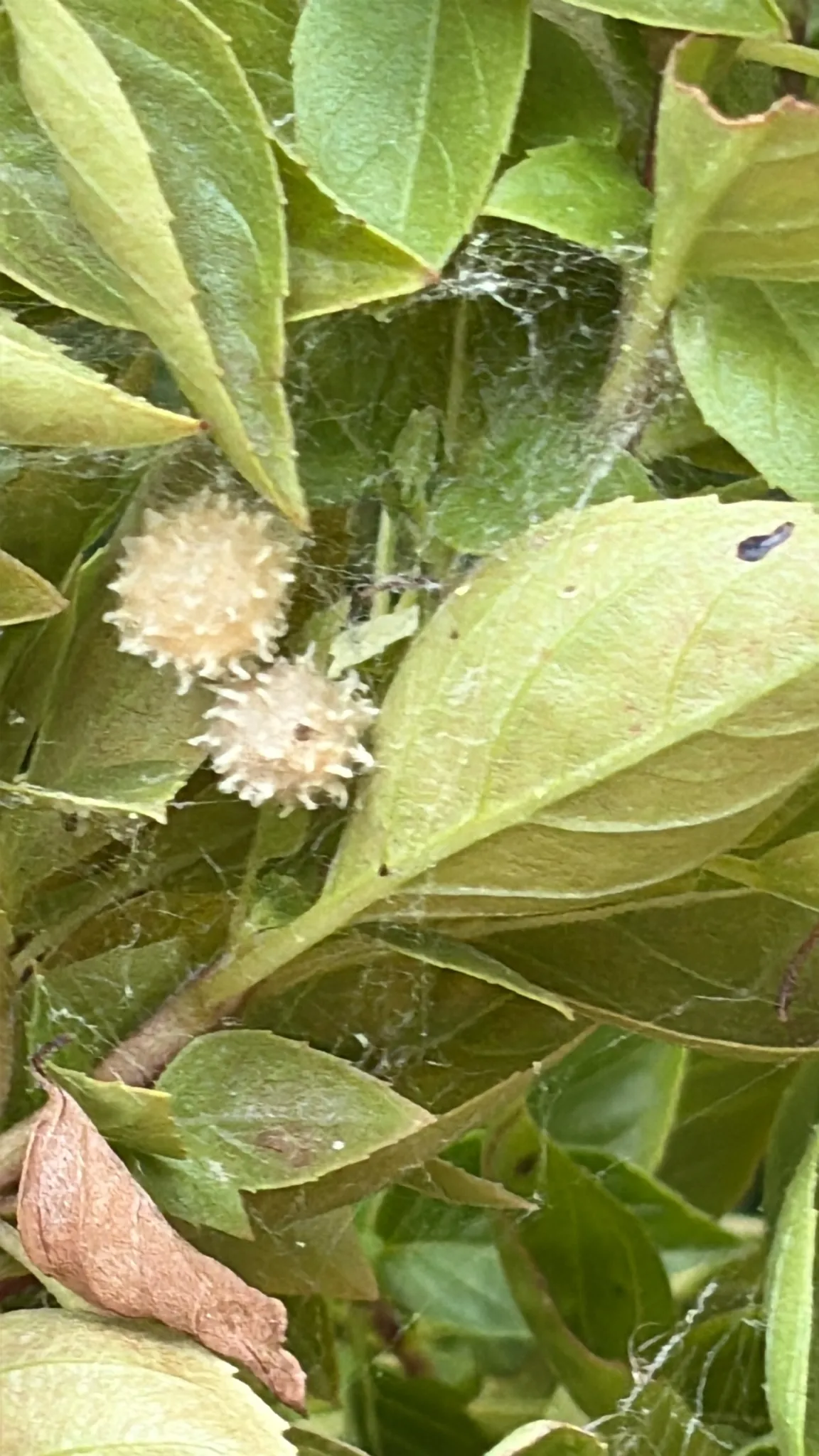
Vetter's UC Riverside page lists the undersides of outdoor furniture and wrought iron railings among brown widow web sites, and UC IPM says they are especially common under plastic patio furniture. Long confined in North America to Florida, the brown widow has spread through the Gulf Coast states, up the Atlantic coast into South Carolina and into Southern California, UC IPM says. The brown widow guide covers the spider and its bite.
How is a green lynx spider's sac different?
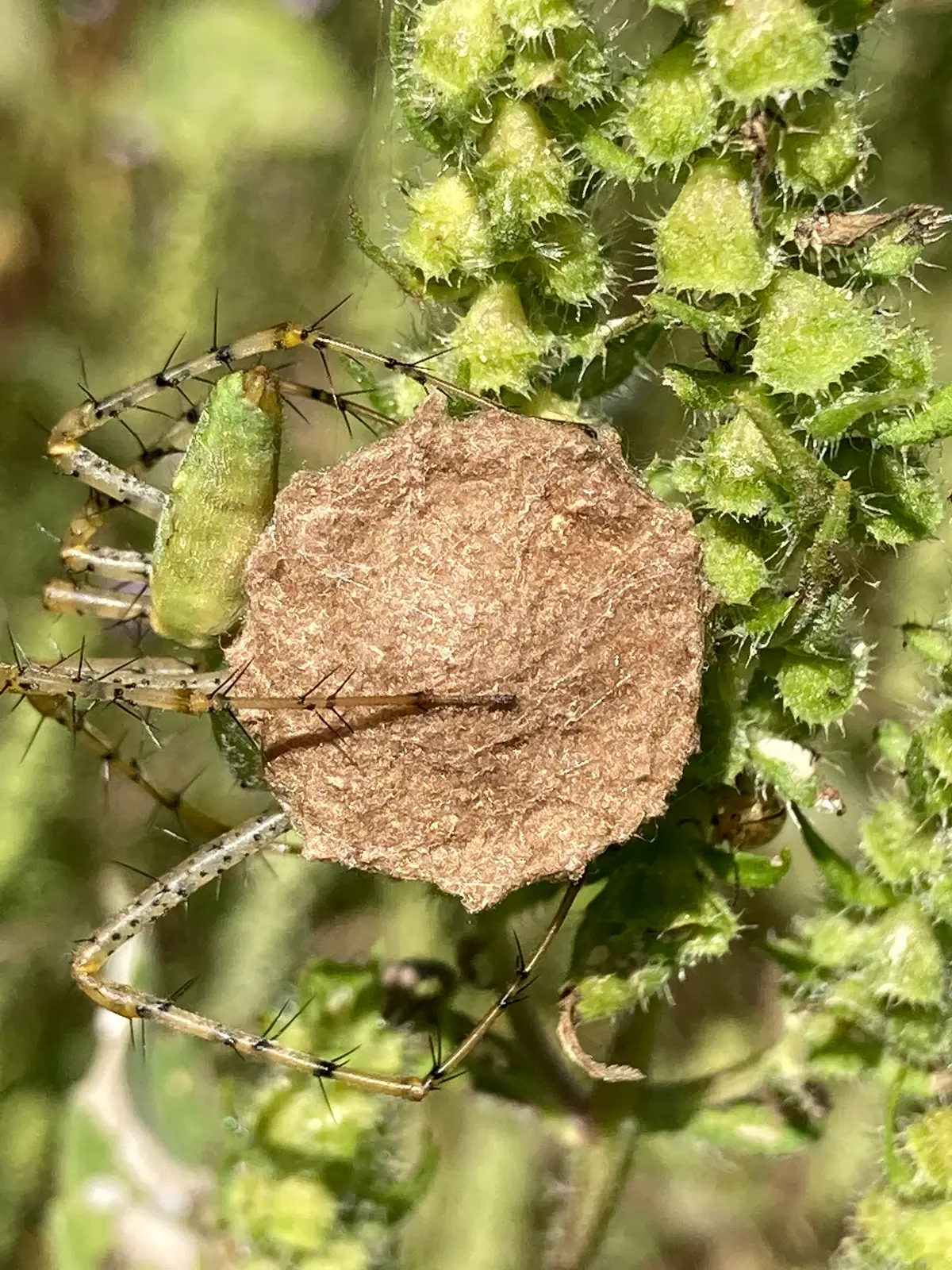
It is spiky too, but it hangs on a shrub with its guard. The University of Florida's green lynx spider profile describes a rounded sac 2/3 to 1 inch across, flattened on one side, with many small pointed projections, light green when new and straw-colored with age, mostly in the upper branches of woody shrubs across the southern US. The female usually hangs upside down from it and rushes at anything that threatens it.
Are brown recluse egg sacs found indoors?
Yes. The University of Kentucky's brown recluse fact sheet says the spiders, egg sacs and shed skins are often found along joists, sills and rafters and under rolled insulation in infested buildings. Kentucky says the sacs are off-white and silken, about 1/3 inch in diameter, with about 40 to 50 eggs, and a female makes up to 5 in her life.
Brown recluses spin silk retreats and round coverings for their eggs but no webs to catch prey, the MDC guide notes. Check the spider before blaming a recluse: the brown recluse look-alikes guide shows the six-eye test, and the brown recluse guide covers infestations.
Is it a spider egg sac or something else?
A hardened foam case, a bean-shaped capsule or a silk pouch with a spider inside may be something else:
- Praying mantid egg case. Kansas State's praying mantid fact sheet says females cover 200 to 300 eggs with a frothy material that hardens into a foam-like case, found on branches, stems, walls, fences, posts, sides of houses and eaves from November through April. The Chinese mantid's case is light brown and 1 to 1 1/4 inches long. Kept indoors at 70 °F or warmer, one can release 50 to 200 young mantids in four to six weeks.
- Cockroach egg case. Texas A&M AgriLife Extension describes a bean-shaped capsule of 12 to 36 eggs that the female carries, then glues to a surface or drops in a secluded spot. The guide to cockroach egg cases shows them species by species.
- Sac spider retreat. A small silk pouch in a wall or ceiling corner may hide a sac spider by day. Penn State Extension's sac spider page says the agrarian sac spider lays its eggs loosely inside a silk retreat and guards them, and the longlegged sac spider lays almost exclusively indoors. Yellow sac spiders have their own guide.
How long do spider eggs take to hatch?
Anywhere from under two weeks to the following spring, depending on the species and the season. Kansas State says black widow spiderlings hatch within 20 to 30 days, depending on temperature, and the University of Florida says green lynx eggs hatch in 11 to 16 days, with the young leaving the sac 10 to 13 days later.
Sacs made in fall can wait for spring. MDC says black-and-yellow garden spider young emerge in spring, and the MDC guide says many orb weavers do the same, while jumping, sheetweb and wolf spiders hatch in summer or fall and overwinter as young spiders. Common house spider young stay clustered near the sac for several days after they emerge, the guide adds.
Does an egg sac in the house mean more spiders are coming?
It can, if the sac belongs to a spider that lives indoors. UMN Extension says some web-building spiders reproduce well indoors, while hunting spiders that wander in usually do not. A common house spider sac in an indoor web suggests the spider is breeding indoors, and Penn State says one female can make 12 or more sacs of 140 to 380 eggs.
Not every egg becomes a spider in your house: Kansas State says few black widow young survive to adulthood, and the MDC guide says spiderlings spread out after hatching, some by ballooning on silk. Keeping spiders out of the house covers sealing the gaps they use.
What should you do with a spider egg sac?
Indoors, vacuum or sweep it up and throw it out; outdoors, a harmless spider's sac in the garden can stay. UMN Extension advises removing webbing with a broom or vacuum and destroying any egg sacs found indoors, and says surface treatments and fogs are not effective.
UMN says getting rid of spiders in the lawn, landscape and garden is not recommended. To keep wandering spiders from getting in, it suggests removing webs with a broom, vacuum or hard spray of water and destroying egg sacs.
Handle a widow sac with care. Kansas State advises leather gloves, long sleeves and long pants, and removing the spiders, webbing and all egg sacs with a broom or other long-handled tool, or a vacuum. Clemson suggests sealing the vacuum bag in a plastic bag for an outdoor trash bin, and optionally freezing it for several hours. Kansas State says black widow spiderlings carry a toxic substance that may harm pets or children if swallowed, and the MDC guide recommends a professional pest control company if widows need controlling.
If someone is bitten, what spider bites look like covers the signs that need care, and a step-by-step spider removal plan covers a bigger indoor problem.
This guide is general educational information, not medical advice. If you have symptoms or concerns after a bite or exposure, contact a healthcare provider.
Frequently Asked Questions
How many baby spiders come out of one egg sac?+
It depends on the species. The Missouri Department of Conservation says a sac can hold anywhere from 50 to over 1,000 eggs. Penn State Extension gives 140 to 380 for the common house spider, Kansas State 200 to 300 for black widows, the University of Kentucky about 40 to 50 for the brown recluse, and the Missouri Department of Conservation over 1,000 for the black-and-yellow garden spider. Far fewer grow up: Kansas State says few black widow young survive to adulthood.
Does bug spray kill spider eggs inside the sac?+
Not reliably. UC IPM notes that most registered spider pesticides are water-based while the silk of an egg sac repels water, and that in a 2016 study, water-based insecticides sprayed on brown widow egg sacs had no significant effect on the eggs inside. University of Minnesota Extension also says surface treatments and fogs are not effective against spiders. The extension services cited here advise removing sacs with a vacuum or broom and disposing of them instead.
Are baby black widows dangerous?+
Not by biting, according to the Missouri Department of Conservation, which says male and juvenile widow spiders pose no risk to people because their mouthparts and fangs are too small to pierce human skin. Kansas State University adds a different caution: young spiderlings carry a toxic substance in their bodies that may harm pets or children if swallowed. If a widow sac hatches near the house, keep children and pets away and remove the spiderlings and webbing with a vacuum or a long-handled tool.
Do spider egg sacs survive the winter?+
Many do. Kansas State says black widow females and egg sacs can overwinter in protected areas. The Missouri Department of Conservation says birds such as titmice and chickadees eat black-and-yellow garden spider egg cases in winter, and the young emerge in spring. Other spiders, including wolf and jumping spiders, hatch in late summer or fall and spend the winter as young spiders sheltering in tree crevices, leaf litter, small burrows or under rocks and logs.
Do wolf spiders lay eggs in houses?+
Usually not. University of Minnesota Extension says hunting spiders such as wolf spiders live outdoors, wander indoors by accident, particularly in fall, do not survive well indoors and usually do not reproduce there. A female that wanders in may still be carrying an egg sac or spiderlings, because the Missouri Department of Conservation says she carries the sac at her rear until the eggs hatch and then carries the young on her back.
Sources
- A Guide to Missouri's Common Spiders (David J. Bruns, 2026) — Missouri Department of Conservation
- Common House Spider — Penn State Extension
- Longbodied Cellar Spider — Penn State Extension
- Wolf Spiders — Missouri Department of Conservation
- Black-and-Yellow Garden Spider — Missouri Department of Conservation
- Black Widow Spiders (MF3346) — Kansas State University Research and Extension (R. J. Whitworth and H. N. Schwarting, 2017)
- Widow Spiders in South Carolina (HGIC 2518) — Clemson Cooperative Extension, Home and Garden Information Center
- Widow Spiders and Their Relatives (Pest Notes Publication 74149) — University of California Statewide IPM Program (R. S. Vetter, UC Riverside)
- Brown Widow Spider — Center for Invasive Species Research, UC Riverside (Richard S. Vetter)
- Green Lynx Spider, Peucetia viridans (Hentz) (Arachnida: Araneae: Oxyopidae) (EENY-249) — University of Florida IFAS Extension (H. V. Weems Jr. and W. H. Whitcomb)
- Brown Recluse Spider (ENTFACT-631) — University of Kentucky Department of Entomology (Michael F. Potter)
- Agrarian Sac Spider and Longlegged Sac Spider — Penn State Extension
- Spiders — University of Minnesota Extension
- Praying Mantids (MF3593) — Kansas State University Research and Extension (Raymond A. Cloyd, 2021)
- Cockroach Biology and Management (ENTO-PU-121) — Texas A&M AgriLife Extension
How this guide was made: it was researched and drafted with AI assistance from the sources listed above. A second, independent AI pass then checked each factual claim against those sources. Found an error? Email support@buzzskito.ca.