
Reviewed by Alex Francisco
Published November 19, 2026 · Fact-checked against the sources listed below
What do baby spiders look like?
A baby spider, or spiderling, is a smaller copy of its parents, often in different colors: eight legs and two body parts, the features the Missouri Department of Conservation's (MDC) guide to common spiders gives for all arachnids. Spiders grow by shedding their exoskeleton several times until they reach adulthood, and some, black widows among them, change color as they grow, so a spiderling's markings can look nothing like its mother's.
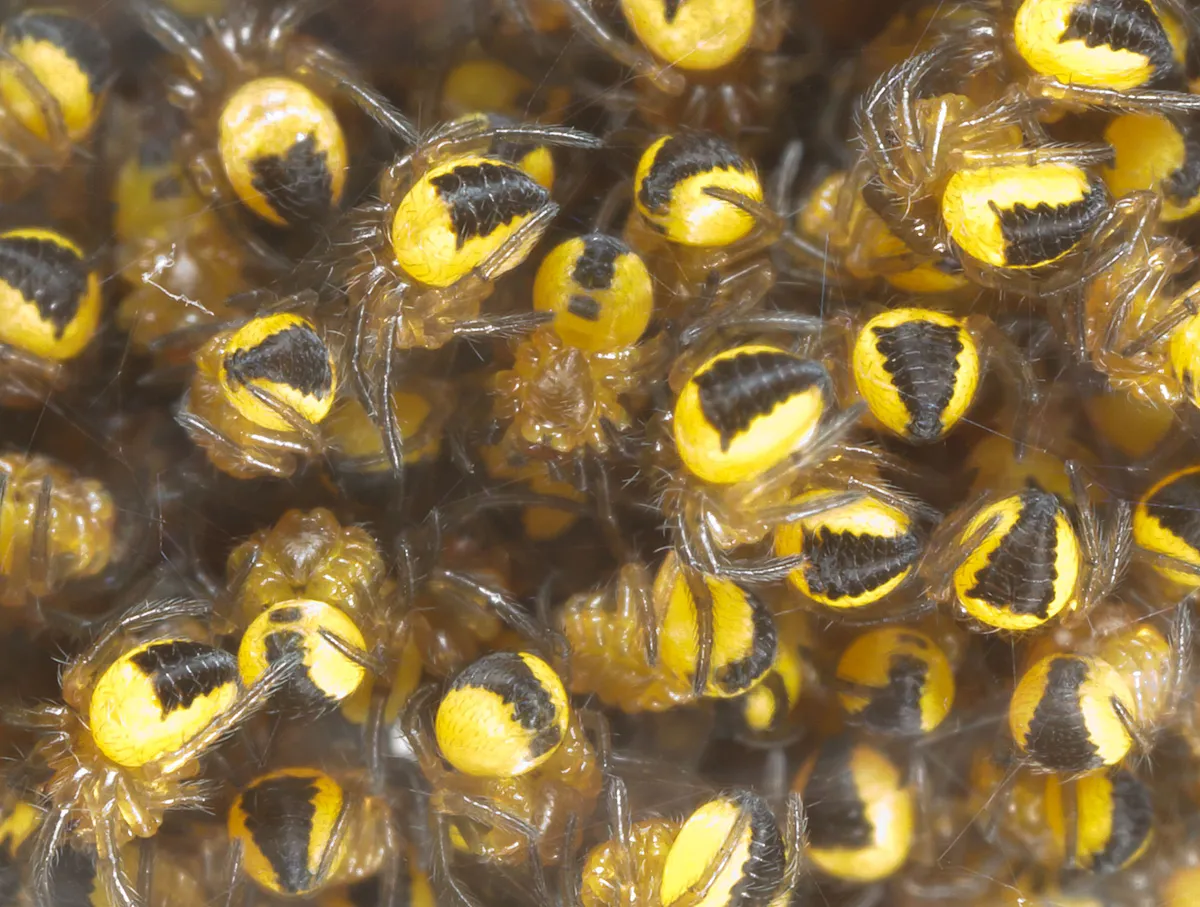
Three clues mark babies. They come in crowds, since one sac holds 50 to more than 1,000 eggs, MDC says; they stay near the sac, the web or the mother at first; and they are tiny: a University of California, Riverside study cites newly emerged black widow spiderlings at 1.2 to 1.8 mm, about 1/16 inch. Size alone settles nothing, though. MDC calls an adult spider small if its body is a quarter inch long or less, so one tiny spider on a wall may be fully grown.
Why are there baby spiders in my house?
Usually because an egg sac hatched nearby, often one that a common house spider hung in a cobweb. Penn State Extension's common house spider page calls the species extremely common in houses, with webs in wall corners, on floor joists and in windows. Its brown, papery sacs are 1/4 to 3/8 inch across (6 to 9 mm), and a female may make 12 or more, each holding 140 to 380 eggs. MDC says the spiderlings stay clustered near the sac for several days before they disperse, so they seem to appear all at once.
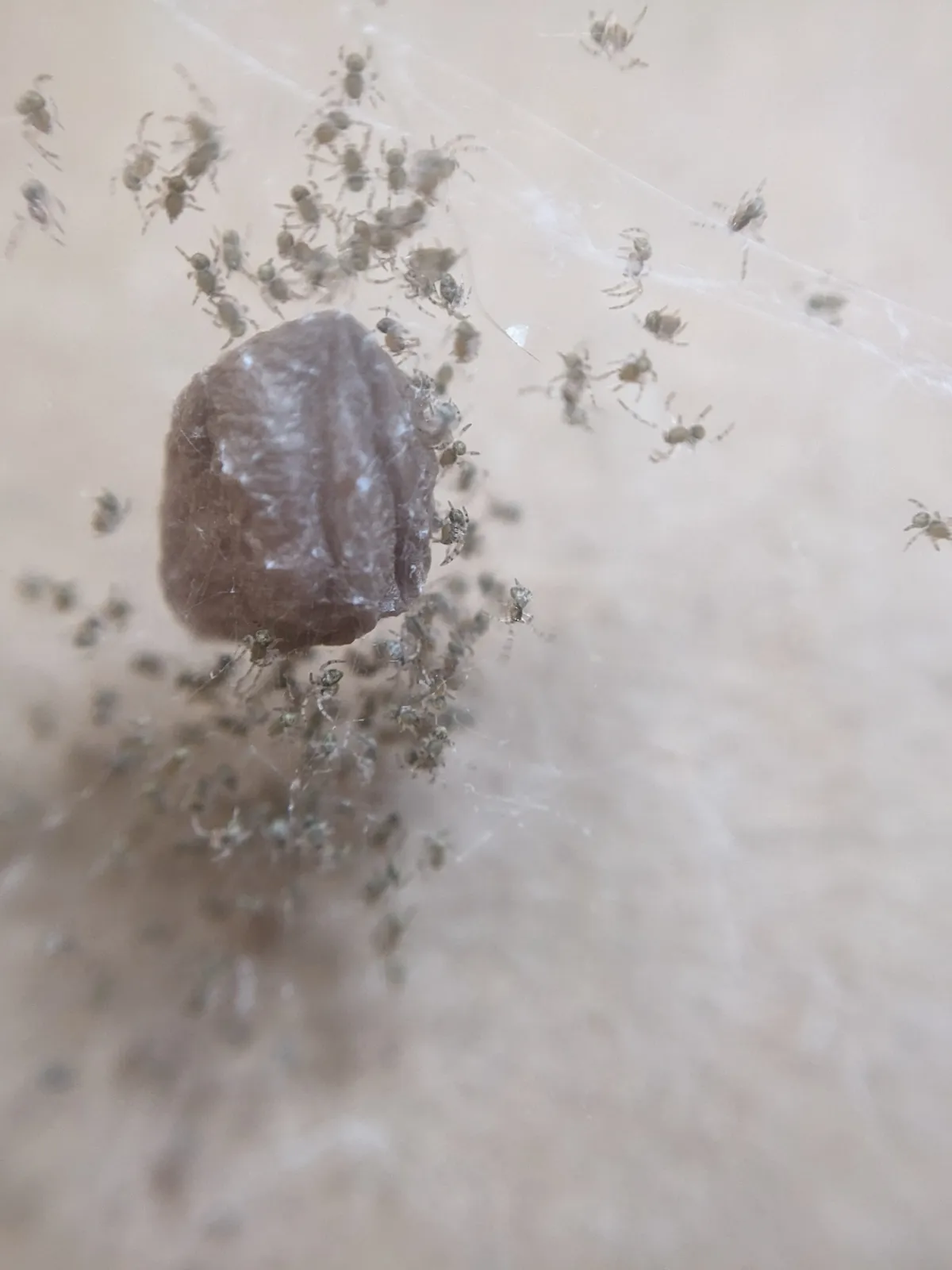
Spiders also come in from outside: UC IPM's guide to spiders says they enter through cracks and openings and can be carried in on plants, firewood and boxes. Window screens do not stop widow hatchlings: in the Riverside study, newly emerged black widow spiderlings crawled through mesh with 0.83 mm openings (about 1/32 inch), and the authors concluded they would pass through the aluminum screen used in typical household windows and doors.
Indoor spiders do not stop for winter: Penn State says longbodied cellar spiders can be found in heated buildings throughout the year, and common house spider males and females at any time of year. To work out whose sac hatched, compare it with the spider egg sac identification guide; the guide to common house spiders shows the adults.
Why do baby spiders cluster together and then disappear?
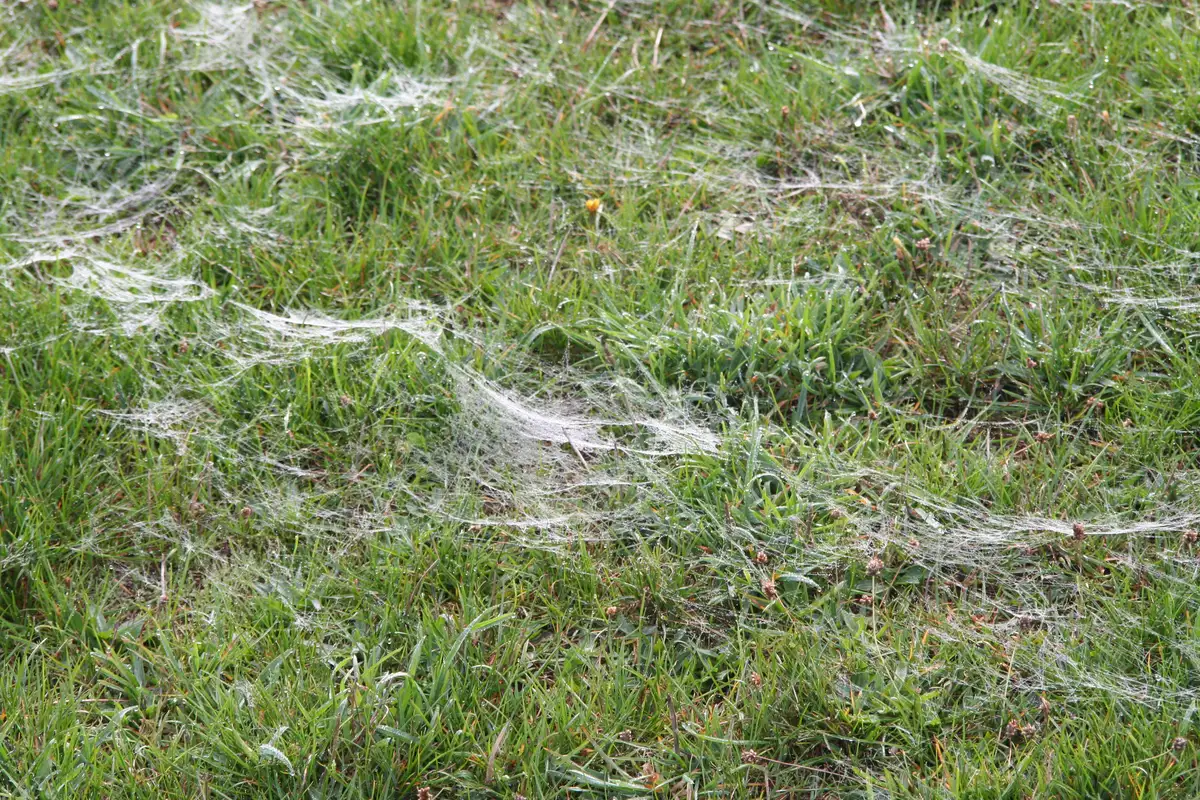
Many stay bunched up for a few days, then spread out, often on silk. MDC says spiderlings scatter so they do not compete for food and have a better chance of escaping predators. In a study of banded garden spiders in Tennessee, all the spiderlings in a sac came out within a single day, usually within an hour or two, spun a shared tangle of silk, stayed on it for several days, then climbed to the tops of plants to leave.
That trip is called ballooning. UC IPM's guide to widow spiders describes tiny spiderlings climbing a fence post or a plant on warm days with an updraft, raising their abdomens and letting out a thread of silk until the air carries them off; ballooning spiderlings have been caught 10,000 feet up and 200 miles offshore. In the Tennessee study they left mostly in calm spells, and not when the spiderlings were cooler than about 79°F (26°C).
For black widows, at least, few make it: Kansas State University's black widow fact sheet says mortality is high and few survive to adulthood, and the Riverside team found spiderlings that had probably eaten a sibling in the egg sac or just after leaving it.
Which baby spiders are you looking at?
Wolf spiders, black widows and brown recluses have their own sections below. These are the other spiderlings found around homes; the quick-ID table at the top shows where each one turns up.
Baby house spiders and cellar spiders
House spider spiderlings are the indoor hatch shown above. A cellar spider holds her eggs in her jaws instead: Penn State's longbodied cellar spider page describes clusters of 25 to 60 eggs, each about 1 mm (1/25 inch) across, wrapped in thin silk as she hangs upside down in her web, and says these spiders are not known to bite people. The cellar spider guide tells them from harvestmen.
Baby orb weavers and garden spiders
Orb weaver sacs made in late summer or fall hatch in spring. The Connecticut Agricultural Experiment Station's guide to landscape spiders says barn and cross spider eggs spend the winter in the female's shelter and hundreds of spiderlings emerge in spring, and that yellow garden spiderlings hatch early in spring from sacs laid at the end of summer. UC IPM says orb weaver spiderlings often make symmetrical webs. Orb weavers and types of spider webs have their own guides.
Baby nursery web and fishing spiders
A nursery web spider carries her egg sac in her jaws, then, as the eggs near hatching, builds a silk tent in low plants and guards the spiderlings until they can disperse, say MDC and Virginia Tech's guide to wolf and nursery web spiders. Fishing spiders also carry their sacs in their jaws but, MDC notes, do not carry their babies on their backs; fishing spiders have their own guide.
What do baby wolf spiders look like?
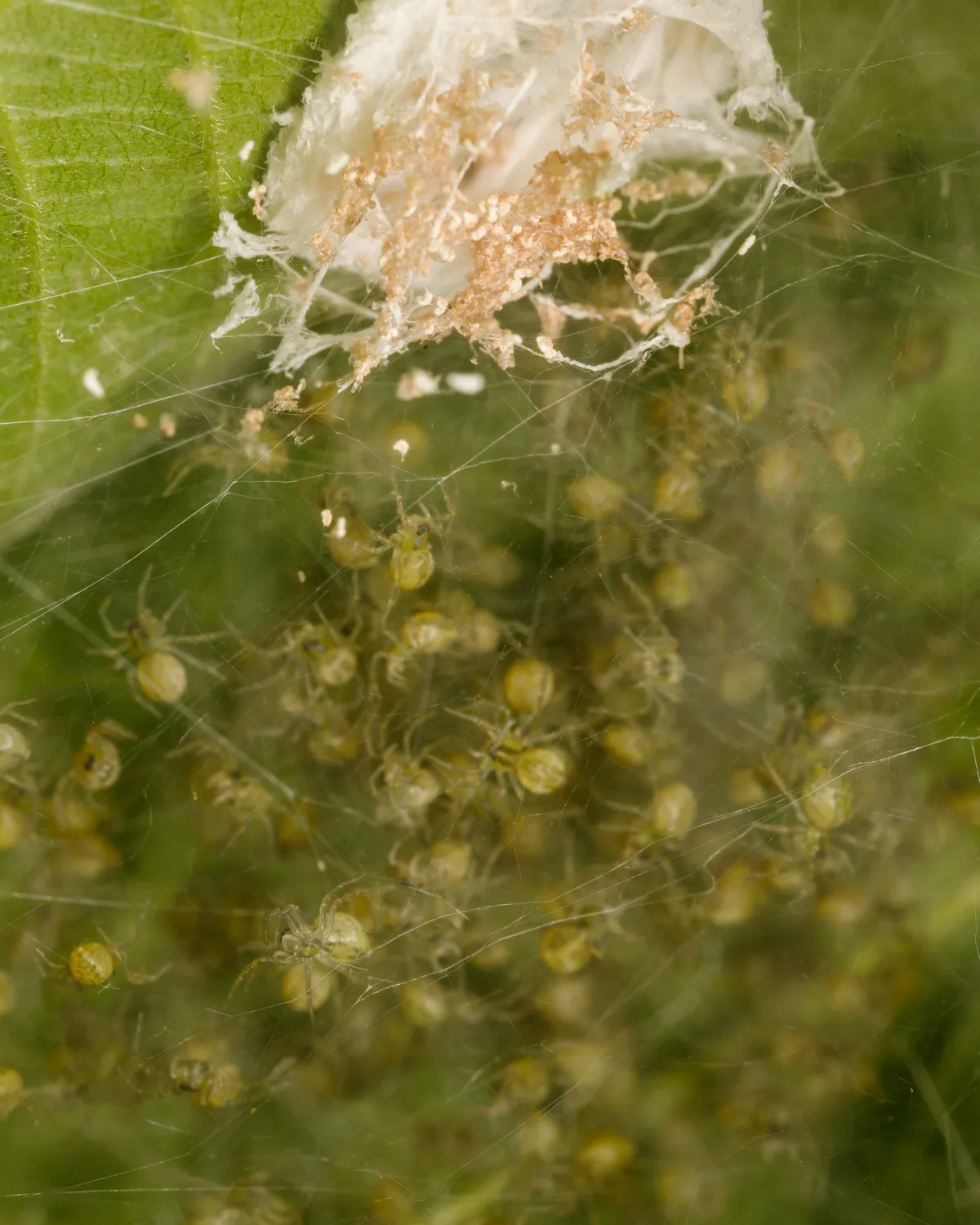
Before they leave home, baby wolf spiders look like a lumpy coat on their mother's back. MDC's wolf spider page says the spiderlings climb onto her abdomen when they come out of the sac and stay for up to two weeks or more; MDC's guide adds that they cling to special hairs on top of her abdomen and climb off gradually over several days while she keeps hunting.
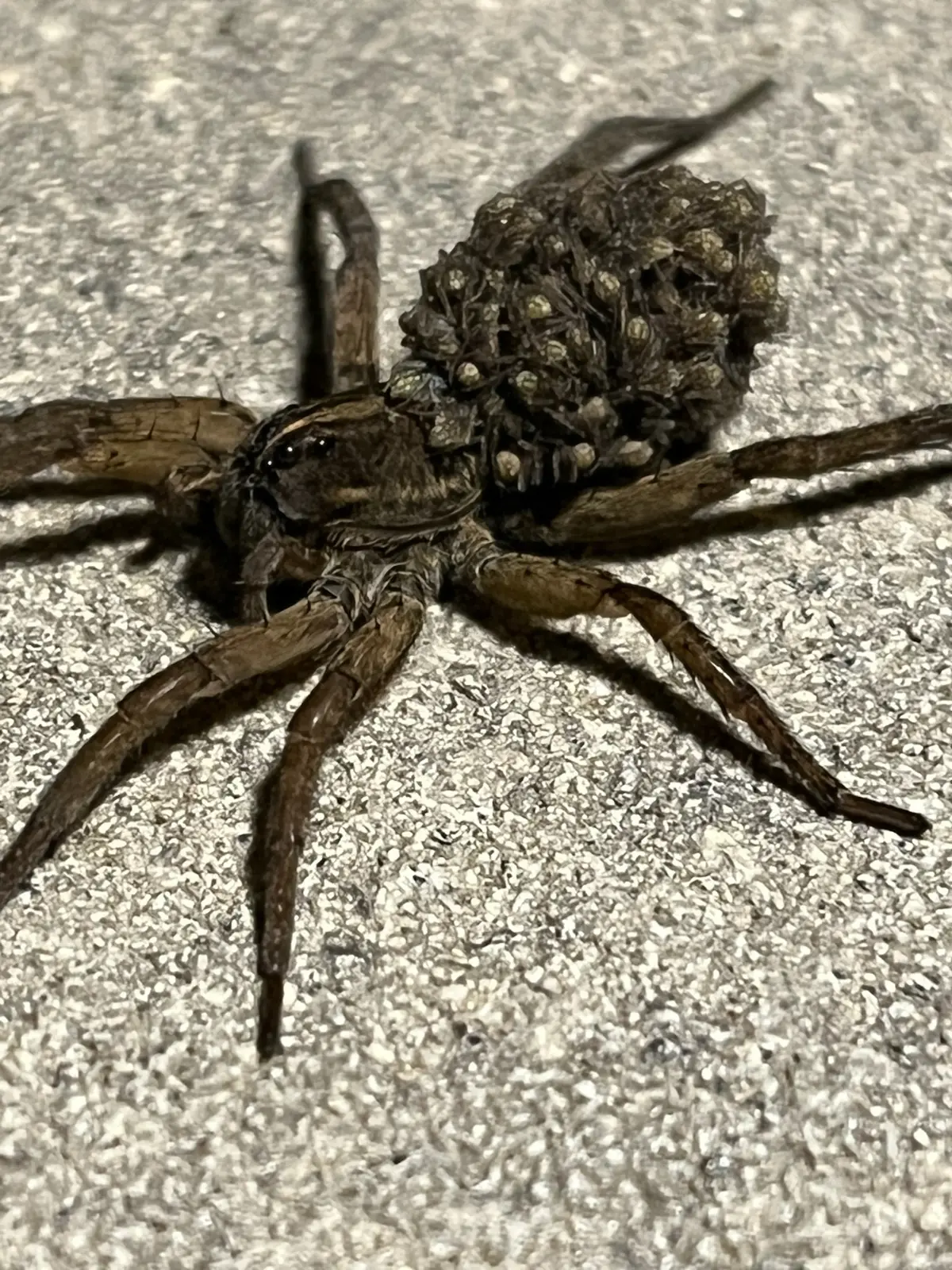
On their own, young wolf spiders are small hunters with the family's eye pattern, which MDC describes as four large eyes in a boxlike pattern and a row of four smaller ones. MDC says wolf spiders seen during warm spells in winter are usually juveniles or adult females. The wolf spider guide shows the adults and their eyes up close.
What does a baby black widow look like?
A baby black widow is not black. UC IPM's widow guide says spiderlings leave the sac with tan legs, a tan front body and a mostly white abdomen with a few black spots; as they grow, the abdomen turns olive-gray or tan, with white stripes and small black dots. Clemson Cooperative Extension describes southern and northern black widow spiderlings as orange, brown and white.
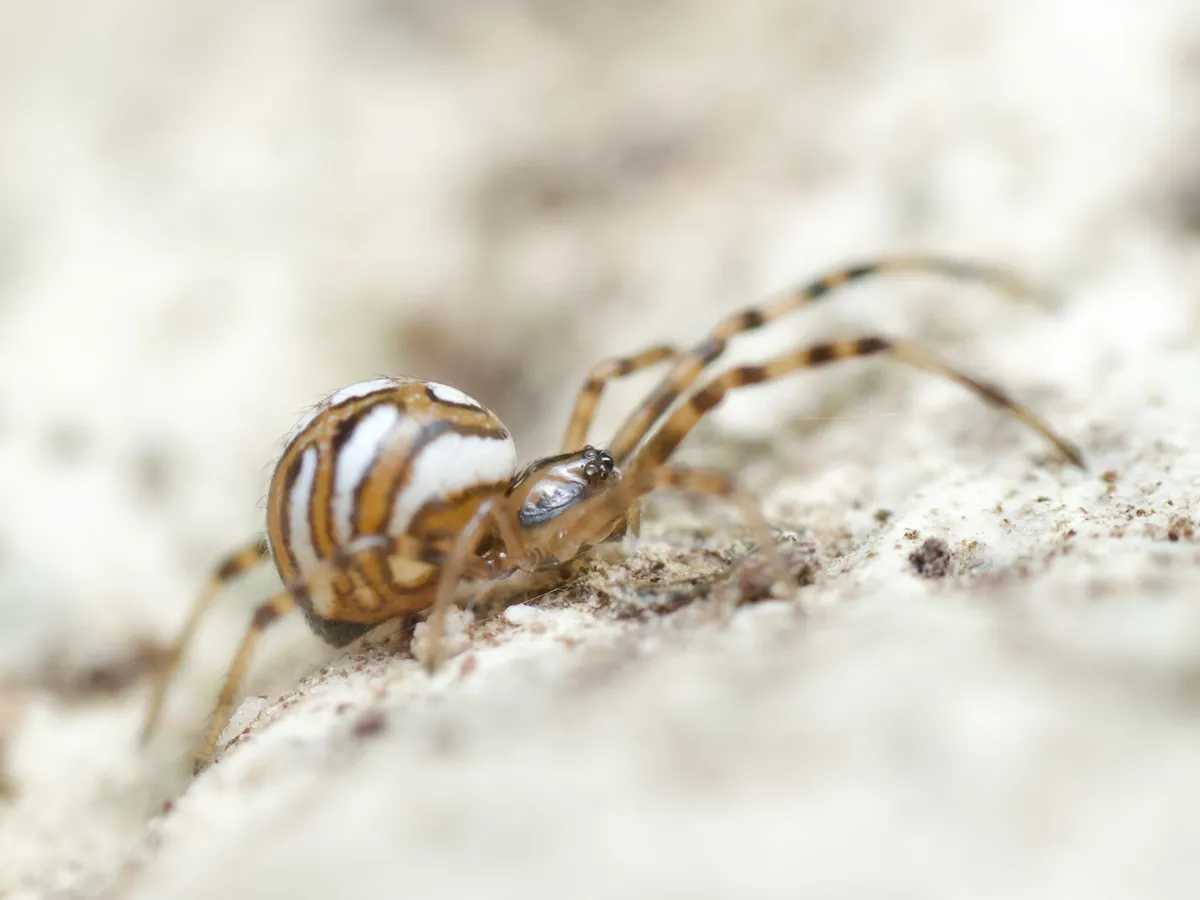
Females darken from there. With each molt the white stripes get thinner and the background turns toward black, while the patch where the hourglass forms changes from white-yellow to orange-red, UC IPM says. Males keep the juvenile coloring, so a small, striped widow may be an adult male rather than a baby.
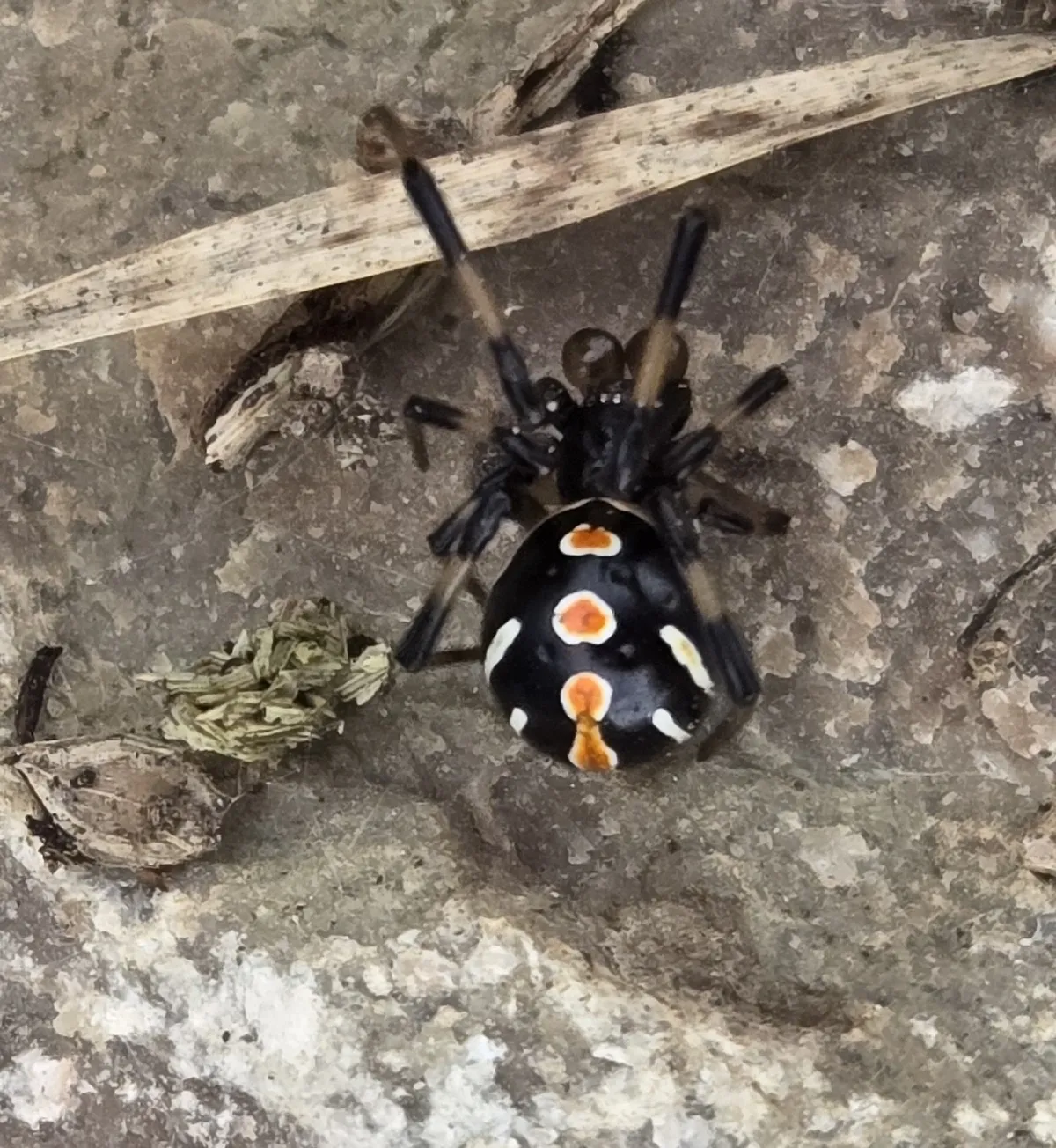
Two look-alikes differ from the start. UC IPM says false black widow spiderlings are dark like their mothers when they emerge, and UC Riverside's guide to identifying brown widows says baby brown widows look somewhat like baby black widows but have more brown. The black widow guide, the false widow guide and the brown widow guide cover the adults.
Can a baby black widow bite? MDC says male and juvenile widow spiders pose no risk to people because their fangs are too small to pierce human skin, and UC IPM says almost all medically important black widow bites come from adult females. Kansas State adds a warning: young spiderlings carry a toxic substance in their bodies that may harm pets or children if swallowed, so clean up a widow hatch carefully.
What does a baby brown recluse look like?
A young brown recluse looks like a small adult, but its violin mark can be faint. The University of Kentucky's brown recluse fact sheet says the violin is consistent in adults but sometimes less obvious in younger spiders, and calls the eyes a more definitive feature: six eyes in three pairs, where most spiders have eight. The legs and abdomen are each one color, with no stripes, bands or mottling.
They grow slowly. Kentucky says the young that come out of the off-white, 1/3-inch sacs, about 40 to 50 eggs to a sac and up to 5 sacs per female, molt five to eight times and mature in about a year. Their shed skins have a distinct outstretched look that can help confirm an infestation.
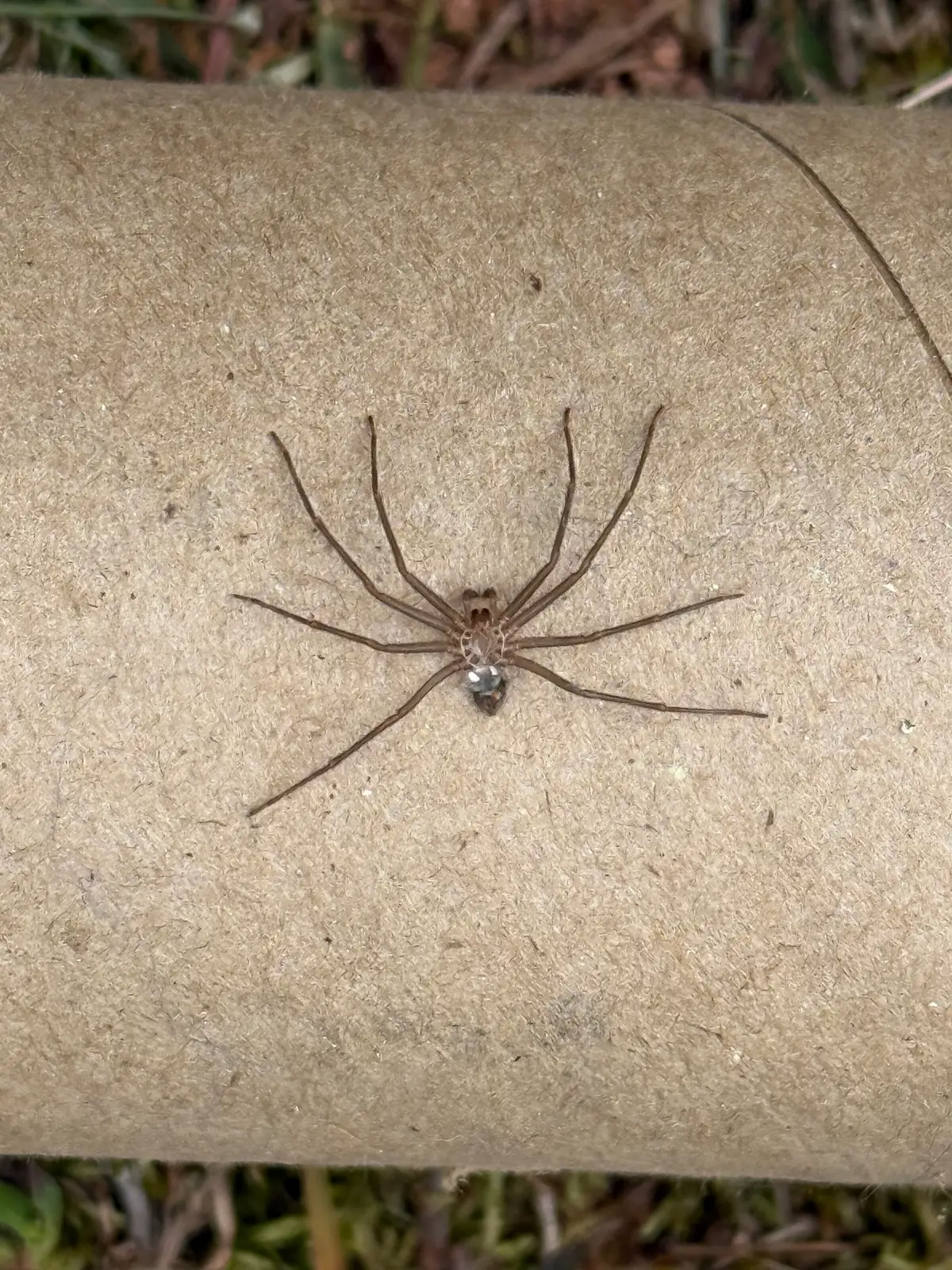
Unlike juvenile widows, young recluses are not described as too small to bite. Kentucky says males and older juveniles travel farther than adult females and are more likely to wander into shoes, clothing or bedding at night and bite when trapped against the skin. The brown recluse guide covers glue traps, and the brown recluse look-alikes guide shows the eye check.
Do baby spiders bite?
Most baby spiders cannot bite through human skin, but not all. UC IPM's spider guide says the jaws of most spiders are so small that the fangs cannot penetrate an adult's skin, and that spiders generally bite only when squeezed, lain on or otherwise provoked. As the sections above show, juvenile widows cannot, but older juvenile recluses can.
A red mark rarely proves a spider bite: UC IPM says skin lesions are often blamed on spiders with no proof, and MDC says a bite can be confirmed only if the spider is seen and correctly identified. For first aid, Poison Control advises washing the bite with soap and water, cooling it with cold water or an ice-filled cloth for 10 to 20 minutes, and seeking help if you think a black widow or brown recluse bit you (1-800-222-1222). What spider bites look like covers the signs that need a doctor, and black widow bites and brown recluse bites have their own guides.
Is it a baby spider or something else?
Count the legs first. A spider of any age has eight legs and two body parts, and several tiny look-alikes do not.
Checks for a tiny spider
- Eight legs and two body parts? It is probably a spider. Six legs means it is not: a tick larva has six.
- Dozens alike in one spot? It is a hatch, so look for a sac in a web or a mother nearby.
- Tan, orange and white stripes, in a tough, messy web in a garage or shed? It may be a young widow, so do not touch it.
- Plain tan with legs of one color, in a closet or box? Check the eyes with a magnifier: six in three pairs points to a recluse.
- Red and on a sunny windowsill in spring? It may be a clover mite.
| Look-alike | How it differs from a baby spider |
|---|---|
| Clover mite | About 1/32 inch (0.75 mm), reddish or greenish, with a greatly lengthened first pair of legs; gathers on sunny windowsills, worst in spring, and does not attack people |
| Spider mite | Under 1/20 inch; lives in colonies on the undersides of leaves, often with fine silk webbing |
| Seed tick (tick larva) | Six legs instead of eight; the first stage that hatches from a tick egg |
| Harvestman (daddy longlegs) | Looks like one body segment, not two, and never makes silk or webs |
From Penn State Extension's clover mite page, UC IPM's spider mite guide, CDC's tick life cycle page and MDC.
With the mother or a bigger one in view, the spider identifier asks seven questions and shows the likeliest matches with photos.
Commonly confused with
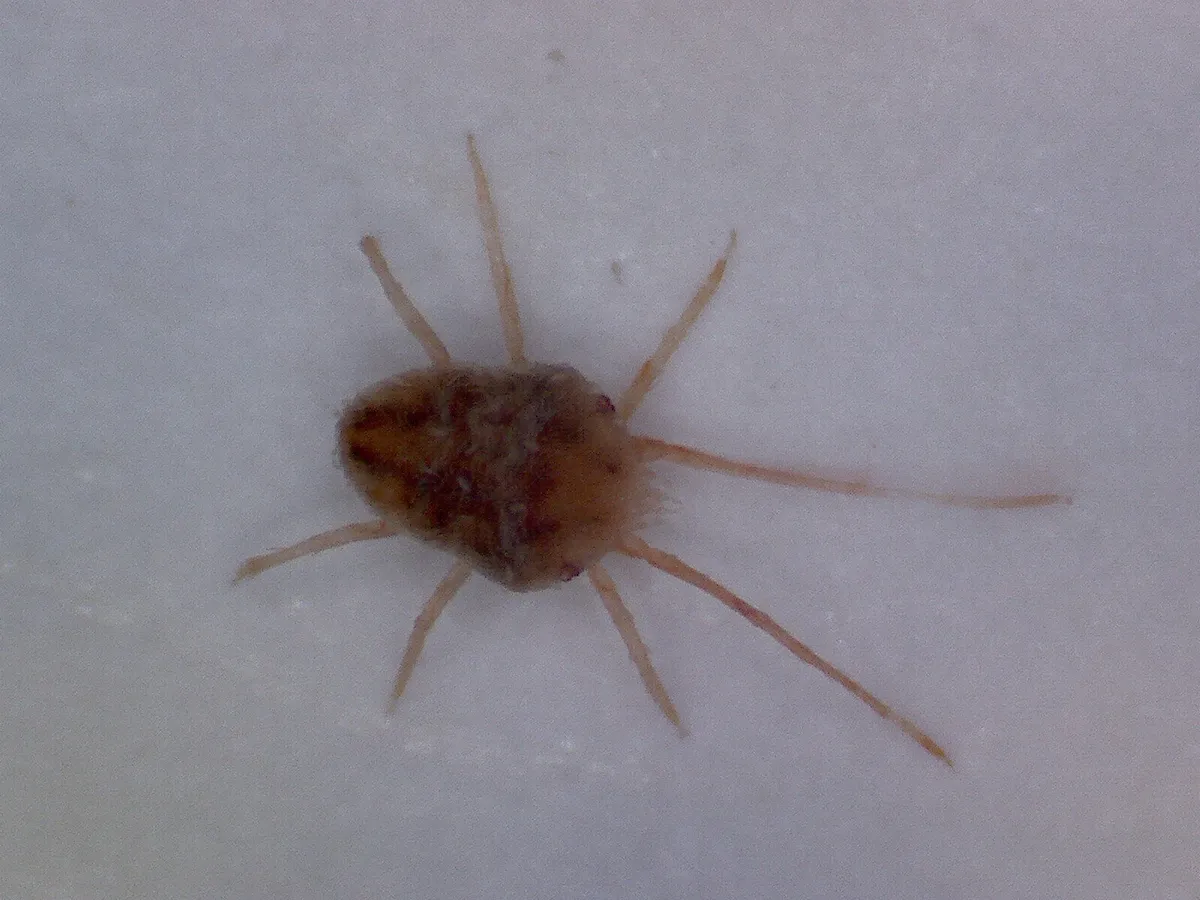 Clover miteAbout 1/32 inch and reddish, with very long front legs; crowds sunny windowsills in spring
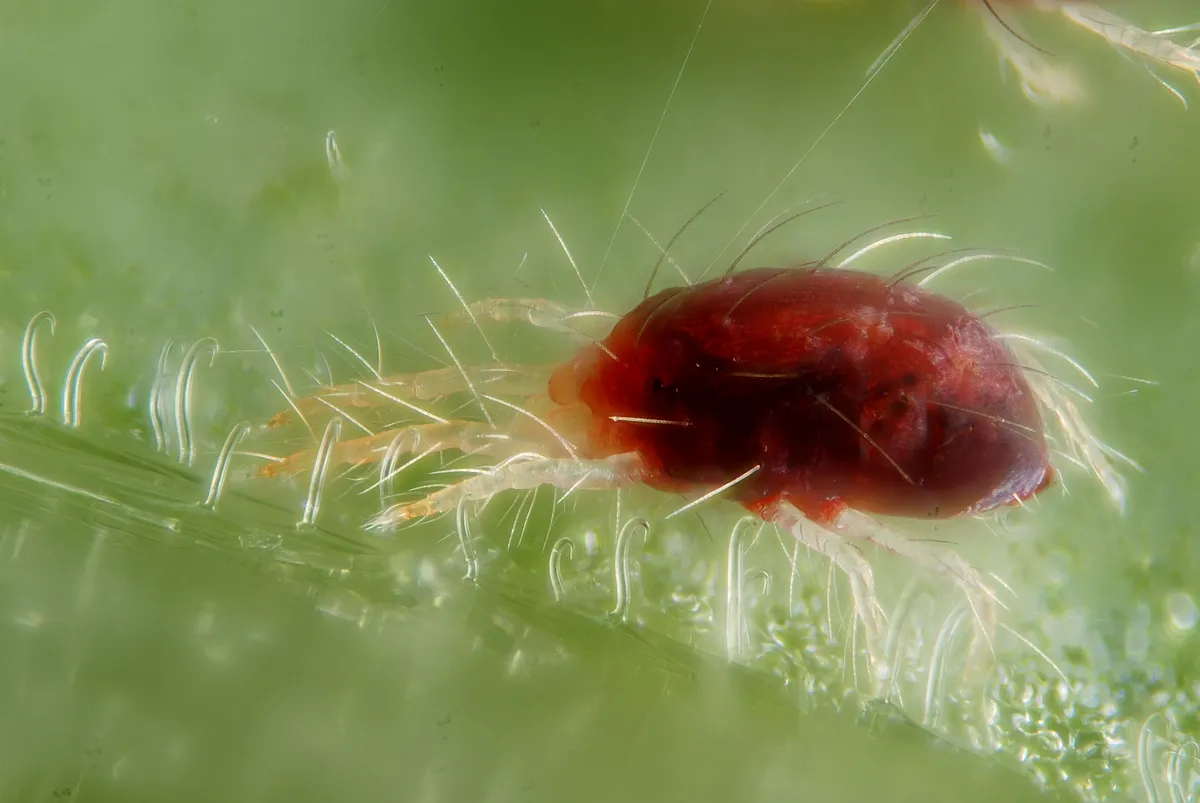 Spider miteUnder 1/20 inch; lives in colonies on the undersides of leaves, often with fine webbing
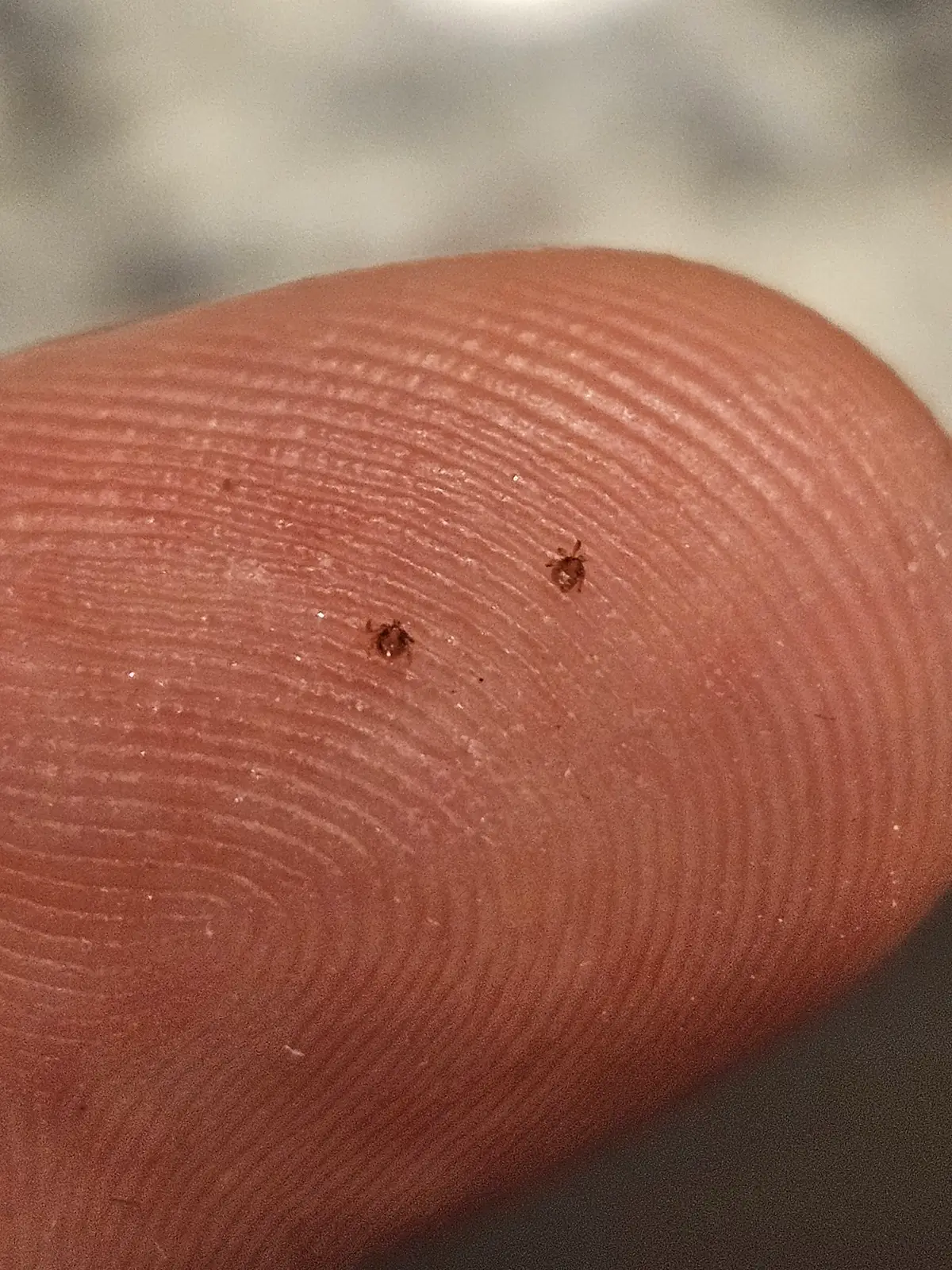 Seed tickSix legs instead of eight; the first stage that hatches from a tick egg
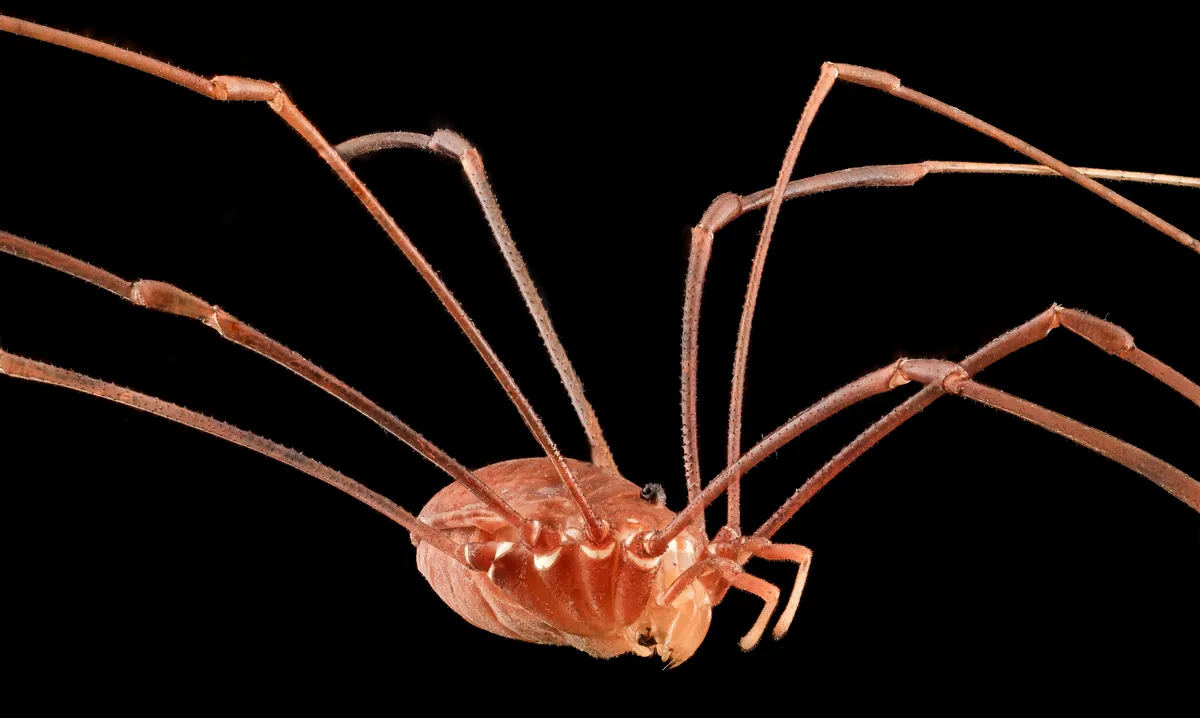 HarvestmanLooks like one body segment, not two, and never spins silk or webs
Photos: Clover mite: PerAsperaAdInferos, CC BY-SA 4.0, via Wikimedia Commons, CC BY-SA 4.0. Spider mite: Gilles San Martin, CC BY-SA 2.0, via Wikimedia Commons, CC BY-SA 2.0. Seed tick: (c) Alex Abair, some rights reserved (CC BY), via iNaturalist, CC BY 4.0. Harvestman: USGS Bee Inventory and Monitoring Lab, Public domain, via Wikimedia Commons, public domain.
What should you do about baby spiders in the house?
Vacuum them up, find the sac or web they came from, and expect a few stragglers:
- Find the source. Check nearby wall corners, windows and floor joists, where Penn State says house spiders build, and match any sac in the egg sac guide.
- Vacuum the spiderlings, web and sac. UC IPM says spiders' soft bodies usually do not survive the hose. Clemson advises sealing the bag in a plastic bag for an outdoor bin, or freezing it for several hours.
- Wear gloves near widows. Kansas State advises leather gloves, long sleeves and a long-handled tool or vacuum to remove widows, webbing and all egg sacs.
- Do not count on a spray. UC IPM says spraying is only temporary without housekeeping, and cites a 2016 study in which water-based insecticides had no significant effect on brown widow eggs inside their sacs.
- Close the way in. Kansas State suggests sealing cracks around doors and windows and repairing screens; how to keep spiders out of the house explains how.
- Leave outdoor spiders alone. The Connecticut Agricultural Experiment Station says spiders found outdoors do not require control, though UC IPM says widow spiderlings keep dropping onto a property, so clearing them near the house is a repeated job.
This guide is general educational information, not medical advice. If you have symptoms or concerns after a bite or exposure, contact a healthcare provider.
Frequently Asked Questions
What are baby spiders called?+
Baby spiders are called spiderlings. They hatch inside the egg sac, and a University of California, Riverside study notes that, like all spiders, they go through their first molt there before they come out. After that they keep shedding their exoskeleton as they grow, the Missouri Department of Conservation says, until they reach adulthood. The University of Kentucky says brown recluses molt five to eight times and take about a year to mature.
Why do I suddenly have lots of tiny spiders in my house?+
Usually because an egg sac hatched nearby. The common house spider, which Penn State Extension calls extremely common in houses, hangs brown, papery sacs of 140 to 380 eggs in cobwebs in wall corners, on floor joists and in windows. The Missouri Department of Conservation says the tiny spiderlings stay clustered near the sac for several days before dispersing, so they seem to appear all at once. Look for the sac in the nearest web and vacuum the spiderlings, the web and the sac.
Do baby spiders bite?+
Most cannot bite through human skin. UC IPM says the jaws of most spiders are so small that the fangs cannot penetrate an adult's skin, and the Missouri Department of Conservation says juvenile widow spiders pose no risk to people because their fangs are too small. Brown recluses are the exception to keep in mind: the University of Kentucky says older juveniles are more likely to wander into shoes, clothing or bedding at night and can bite when trapped against the skin.
How long do baby spiders stay with their mother?+
It depends on the spider. The Missouri Department of Conservation says wolf spiderlings ride on their mother's abdomen for up to two weeks or more, and that a nursery web spider guards her silk nursery until the spiderlings are mature enough to disperse. Common house spider spiderlings stay clustered near their egg sac for several days. After that, the department says, spiderlings generally spread out so they do not compete with each other for food.
Why are baby spiders floating in the air?+
They are ballooning, the way many spiderlings travel. UC IPM describes very small spiderlings climbing to the top of a fence post or plant on warm days with an updraft, raising their abdomens and releasing a fine thread of silk until the air lifts them away. It says ballooning spiderlings have been caught 10,000 feet above the ground and 200 miles offshore. The shiny strands left behind, called gossamer, show up on branches and in fields in spring and fall.
Can baby spiders get through window screens?+
Newly hatched black widows can. In a University of California, Riverside study, black widow spiderlings readily crawled through mesh with openings of 0.83 mm, about 1/32 inch, on their first day out of the egg sac. Standard household aluminum screen had openings of 1.2 by 1.5 mm, about 1/20 by 1/16 inch, so the authors concluded spiderlings would pass through it. Mesh fine enough to stop them was too small for practical use in most cases, the authors wrote.
What does a baby brown recluse look like?+
Like a small brown recluse whose violin mark may be faint. The University of Kentucky says the violin is consistent in adults but sometimes less obvious in younger spiders, so check the eyes instead: brown recluses have six eyes in three pairs, while most spiders have eight. The legs and abdomen are each one color, with no stripes, bands or mottling. Young recluses molt five to eight times and take about a year to mature.
Why are there baby spiders in my house in winter?+
Some spiders live indoors all year in heated buildings. Penn State Extension says longbodied cellar spiders of both sexes can be found in heated structures throughout the year, and that common house spider males and females can be found at any time of year. Outdoors, the Missouri Department of Conservation says, many species spend the winter as young spiders, and wolf spiders seen during warm spells in winter are usually juveniles or adult females.
Are tiny red spiders in the house baby spiders?+
A tiny red speck on a sunny windowsill may be a clover mite rather than a spider. Penn State Extension describes clover mites as about 0.75 mm long, roughly 1/32 inch, reddish or greenish, with a greatly lengthened first pair of legs, most troublesome in spring, and says they do not attack people. UC IPM says mites belong to the arachnid class along with spiders and ticks, and that spider mites, under 1/20 inch, live in colonies on the undersides of leaves.
Should you kill baby spiders in the house?+
Indoors, vacuuming is the simplest answer. UC IPM recommends vacuuming spiders and their webs, noting that their soft bodies usually do not survive the trip through the hose, and says spraying gives only temporary control unless it comes with housekeeping. Around widows, Kansas State advises gloves and a long-handled tool or a vacuum. Outdoors, the Connecticut Agricultural Experiment Station says spiders found outdoors do not require control.
Sources
- A Guide to Missouri's Common Spiders (David J. Bruns, 2026) — Missouri Department of Conservation
- Wolf Spiders — Missouri Department of Conservation
- Common House Spider — Penn State Extension
- Longbodied Cellar Spider — Penn State Extension
- Clover Mites — Penn State Extension
- Spiders (Pest Notes, Publication 7442) — University of California Statewide IPM Program (R. S. Vetter)
- Widow Spiders and Their Relatives (Pest Notes Publication 74149) — University of California Statewide IPM Program (R. S. Vetter, UC Riverside)
- Spider Mites (Pest Notes) — University of California Statewide IPM Program
- How to Identify Brown Widow Spiders — Center for Invasive Species Research, UC Riverside
- The Ability of Spiderlings of the Widow Spider Latrodectus hesperus to Pass Through Different Size Mesh Screen (Journal of Economic Entomology 102(3): 1396-1398, 2009) — R. S. Vetter, C. P. Flanders and M. K. Rust, University of California, Riverside
- Black Widow Spiders (MF3346) — Kansas State University Research and Extension (R. J. Whitworth and H. N. Schwarting, 2017)
- Widow Spiders in South Carolina (HGIC 2518) — Clemson Cooperative Extension, Home and Garden Information Center
- Brown Recluse Spider (ENTFACT-631) — University of Kentucky Department of Entomology (Michael F. Potter)
- Aerial Dispersal Behavior of Two Orb Weaving Spiders (Psyche 84: 13-27, 1977) — Wayne W. Tolbert, Psyche (Cambridge Entomological Club)
- Common Spiders in the Landscape (Katherine Dugas) — The Connecticut Agricultural Experiment Station
- Wolf Spiders and Nursery Web Spiders (3104-1586) — Virginia Cooperative Extension, Virginia Tech (T. A. Dellinger and E. Day)
- Tick Lifecycles — Centers for Disease Control and Prevention
- Insect and Spider Bites: When to Worry — Poison Control, National Capital Poison Center
Read and approved by Alex Francisco. Found an error? Email support@buzzskito.ca.