
Published by BuzzSkito Mosquito & Tick Control
Published October 16, 2026 · Drafted with AI assistance and fact-checked against the sources listed below
Which ticks live in Massachusetts?
The state health department names three ticks that bite people in Massachusetts. Blacklegged ticks, also called deer ticks, and dog ticks are found throughout the state, and lone star ticks turn up in some places, according to its tick-borne disease prevention page. A fourth species, the Asian longhorned tick, has been confirmed in four counties and is covered further down.
The blacklegged tick matters most for health. The state says it spreads Lyme disease, babesiosis, anaplasmosis, Borrelia miyamotoi infection and Powassan virus, and the state's Lyme disease fact sheet adds that one bite can pass on more than one of these germs.
| Tick | Where in Massachusetts | When it is most active | What it can spread |
|---|---|---|---|
| Blacklegged (deer) tick, Ixodes scapularis | Throughout the state; established in all 14 counties | Nymphs May to July; adults in spring and fall, and on winter days above freezing | Lyme disease, babesiosis, anaplasmosis, Borrelia miyamotoi infection, Powassan virus |
| American dog tick, Dermacentor variabilis | Throughout the state | Spring and summer, when bites are most likely; generally only adults bite people | Rocky Mountain spotted fever and some types of tularemia |
| Lone star tick, Amblyomma americanum | Some places; the state says populations have become established on Cape Cod, Martha's Vineyard and Nantucket | Spring through fall, but bites are possible in any month | Tularemia, ehrlichiosis and southern tick-associated rash illness (STARI); bites are linked to alpha-gal syndrome |
Sources: the state health department's prevention page, Lyme disease fact sheet and alpha-gal syndrome fact sheet; county status from the CDC ArboNET Tick Module, through December 2025.

Dog ticks are bigger and easier to spot. The state puts an adult at about the size of a watermelon seed and says that, in general, only adults bite people. It links dog ticks to Rocky Mountain spotted fever and some types of tularemia, not to Lyme disease, which it ties to deer ticks. For sizes and markings side by side, see how to tell the common US ticks apart.

Where are deer ticks found in Massachusetts?
In every county. CDC's county surveillance table, which runs through December 31, 2025, lists blacklegged ticks as established in all 14 Massachusetts counties, from Berkshire County on the New York line to Barnstable County on Cape Cod. Established means six or more ticks of one life stage, or more than one life stage, were collected in a county within 12 months. To compare other states, see tick maps and Lyme data for every state.
Backyards count too. The state's prevention page says ticks are most likely found in shady, damp, brushy, wooded or grassy areas, especially tall grass, and that this includes your own backyard. Ticks do not fly or jump; they latch on to people and animals that brush against them.
Which germs have been found in Massachusetts ticks?
CDC's companion table records where each germ has been found in host-seeking blacklegged ticks, meaning ticks out looking for a host rather than feeding on one. It is cumulative, and CDC says a county with no record may simply not have been sampled or tested, so a blank is not proof the germ is absent.
| Germ | Illness | Massachusetts counties with a record |
|---|---|---|
| Borrelia burgdorferi | Lyme disease | 6: Berkshire, Franklin, Hampden, Hampshire, Plymouth, Worcester |
| Babesia microti | Babesiosis | 4: Berkshire, Nantucket, Plymouth, Worcester |
| Borrelia miyamotoi | Borrelia miyamotoi infection (hard tick relapsing fever) | 4: Barnstable, Franklin, Plymouth, Worcester |
| Anaplasma phagocytophilum (human-active variant) | Anaplasmosis | 3: Berkshire, Hampshire, Plymouth |
| Ehrlichia muris eauclairensis | Ehrlichiosis | 1: Worcester |
| Powassan virus | Powassan virus disease | None |
Source: CDC ArboNET Tick Module, pathogen table through December 31, 2025.
Treat the blanks as possible gaps in sampling rather than proof of low risk. The state's Lyme fact sheet says Lyme disease occurs throughout Massachusetts, yet CDC's table records the Lyme germ in ticks from only 6 of the 14 counties. It also has no Massachusetts record of Powassan virus in host-seeking ticks, even though state residents have been diagnosed with Powassan virus disease every year since 2013.
Is the lone star tick in Massachusetts?
Yes, in a few places, mostly on the Cape and islands. CDC's lone star tick surveillance, which runs through 2025, lists the tick as established in Dukes County, which includes Martha's Vineyard, and reported in Barnstable, Middlesex, Nantucket and Worcester counties. The state's alpha-gal syndrome fact sheet goes further: it says lone star populations have become established on Cape Cod, Martha's Vineyard and Nantucket.
Lone star tick status by county, Massachusetts, through 2025
- Established
- Reported
- No record
Show the list
Established (1): Dukes
Reported (4): Barnstable, Middlesex, Nantucket, Worcester
No record (9): Berkshire, Bristol, Essex, Franklin, Hampden, Hampshire, Norfolk, Plymouth, Suffolk

The state's prevention page says lone star ticks have not been a significant source of infectious disease in Massachusetts, though they can spread tularemia, ehrlichiosis and STARI. Their saliva can irritate the skin, and redness at a bite is not by itself a sign of infection.
In the United States, alpha-gal syndrome, an allergy to meat and other products from mammals, is mainly associated with lone star tick bites. The alpha-gal fact sheet says the syndrome is most common in Massachusetts where lone star ticks have become established, and that allergic reactions usually begin 2 to 10 hours after eating. See alpha-gal syndrome and the tick bites linked to it for symptoms and diagnosis.
Has the Asian longhorned tick reached Massachusetts?
Yes. The national longhorned tick situation report from USDA's Animal and Plant Health Inspection Service, dated April 22, 2025, lists Massachusetts among the states with confirmed local populations and counts confirmed records in 4 of its 14 counties: Barnstable, Berkshire, Dukes and Nantucket.
The report's first-detection table shows the order. The earliest Massachusetts record is a tick collected from a dog in Barnstable County on July 23, 2018, and identified by DNA testing. Next came a dog in Berkshire County in August 2022, then collections from the environment rather than from an animal: on Nantucket in May 2023, confirmed that June by USDA's National Veterinary Services Laboratories, and in Dukes County in June 2023.

USDA's report describes an East Asian tick that is a serious livestock pest: it bites aggressively and can build heavy infestations on domestic animals, causing stress, slower growth and severe blood loss. Females can reproduce without a male, so a single fed female can start a population, and the species is a known or suspected carrier of germs behind livestock and human diseases. The state's alpha-gal fact sheet adds that in other countries its bites have been reported to cause alpha-gal syndrome.
If you find an unfamiliar tick, the state's list of tick identification services shows where one can be identified for a fee, and its prevention page advises asking a veterinarian how best to protect pets and livestock from ticks. For how to recognize this species, see the Asian longhorned tick guide.
How much Lyme disease does Massachusetts have?
Massachusetts residents reported 9,715 Lyme disease cases in 2023, according to CDC's Lyme disease surveillance data. Only New York (22,173) and Pennsylvania (16,671) reported more, and Massachusetts accounted for about 11% of the 89,468 cases reported nationwide. Its rate of 138.9 cases per 100,000 residents ranked fifth, behind Rhode Island, Vermont, Maine and West Virginia.
Reported Lyme disease cases in Massachusetts, 2008 to 2025
Cases per year, by place of residence
- CDC count, 2008 to 2023
- State count, 2024 and 2025
Show the numbers
| CDC count, 2008 to 2023 | State count, 2024 and 2025 | Total | |
|---|---|---|---|
| 2008 | 4,582 | – | 4,582 |
| 2009 | 5,256 | – | 5,256 |
| 2010 | 3,263 | – | 3,263 |
| 2011 | 2,476 | – | 2,476 |
| 2012 | 5,138 | – | 5,138 |
| 2013 | 5,290 | – | 5,290 |
| 2014 | 5,304 | – | 5,304 |
| 2015 | 4,224 | – | 4,224 |
| 2016 | 198 | – | 198 |
| 2017 | 410 | – | 410 |
| 2018 | 16 | – | 16 |
| 2019 | 7 | – | 7 |
| 2020 | 107 | – | 107 |
| 2021 | 27 | – | 27 |
| 2022 | 5,052 | – | 5,052 |
| 2023 | 9,715 | – | 9,715 |
| 2024 | – | 8,840 | 8,840 |
| 2025 | – | 8,619 | 8,619 |
Read the dip as a counting problem. As Lyme cases grew, collecting clinical information on them became too much work in several high-incidence states, and Massachusetts and New York adopted their own methods that often kept cases from reaching CDC, according to CDC's report on the revised case definition. The state's surveillance table spells out the result: from 2016 through 2021, cases were reported without active public health follow-up, so very few patients had enough information on record to count. CDC's Massachusetts totals for those years ranged from 410 down to 7.
Since January 1, 2022, a revised national definition has let high-incidence states such as Massachusetts count cases on laboratory evidence alone, and the state now records them as probable cases. CDC's report says the jump in national case numbers in 2022 likely reflects that change rather than a true increase in risk, and that it limits comparisons with earlier years.
The state's own table carries the count forward: 8,840 cases in 2024 and 8,619 in 2025, both below the 2023 high. As of October 2026 it showed 5,269 cases for 2026 through September 30, a preliminary count that covers only nine months. The state's monthly tick reports say tick-borne diseases are diagnosed most often in children and older adults.
How does Massachusetts compare with its neighbors?
Lyme disease is common across New England and New York, and two of Massachusetts's neighbors, Rhode Island and Vermont, had the highest rates of any state in 2023.
| State | Lyme cases, 2023 | Cases per 100,000, 2023 |
|---|---|---|
| New York | 22,173 | 111.7 |
| Massachusetts | 9,715 | 138.9 |
| Connecticut | 3,239 | 89.9 |
| Rhode Island | 2,852 | 260.0 |
| New Hampshire | 1,573 | 113.4 |
| Vermont | 1,445 | 223.3 |
Confirmed and probable cases by state of residence, from CDC Lyme disease surveillance data. Data through 2023, the latest year CDC had published as of October 2026.
Which Massachusetts counties have the most Lyme disease?
Relative to population, the islands. In 2023, Dukes County, which includes Martha's Vineyard, recorded about 1,600 Lyme cases per 100,000 residents and Nantucket County about 1,270, roughly 9 to 12 times the statewide rate. Berkshire County in the far west came third, at about 456. The map shows the 2023 rate for every county, calculated by BuzzSkito from CDC's county-level Lyme data and the Census Bureau's county population estimates.
Lyme disease cases per 100,000 residents by county, Massachusetts, 2023
- 500 or more
- 250 to 499
- 100 to 249
- Under 100
Show the list
500 or more (2): Dukes, Nantucket
250 to 499 (4): Barnstable, Berkshire, Bristol, Plymouth
100 to 249 (4): Franklin, Hampshire, Norfolk, Worcester
Under 100 (4): Essex, Hampden, Middlesex, Suffolk
| County | Lyme cases, 2023 | Cases per 100,000 |
|---|---|---|
| Dukes (includes Martha's Vineyard) | 337 | 1,600.0 |
| Nantucket | 185 | 1,270.4 |
| Berkshire | 588 | 455.7 |
| Barnstable (Cape Cod) | 774 | 331.3 |
| Bristol | 1,688 | 288.0 |
| Plymouth | 1,385 | 256.6 |
| Franklin | 143 | 201.8 |
| Hampshire | 260 | 157.4 |
| Worcester | 1,144 | 130.9 |
| Norfolk | 743 | 101.7 |
| Middlesex | 1,348 | 82.0 |
| Essex | 640 | 78.3 |
| Hampden | 218 | 47.2 |
| Suffolk (includes Boston) | 229 | 29.2 |
All 14 counties, highest rate first. Sources as for the map.
Raw counts follow population instead. Bristol County had the most cases in 2023 (1,688), followed by Plymouth (1,385) and Middlesex (1,348). Middlesex is the most populous county in the state, and its rate of 82 per 100,000 was well below the statewide figure. Suffolk County, which includes Boston, had the lowest rate, 29.2.
Two cautions apply to any county figure. Cases are counted where the patient lives, not necessarily where the bite happened, as CDC's Lyme case map page notes, so a Boston resident bitten on Cape Cod is counted in Suffolk County and summer visitors to the islands are counted at home. And island rates move fast: with about 21,000 residents in Dukes County, each extra case adds almost 5 per 100,000.
Which other tick-borne diseases occur in Massachusetts?
Anaplasmosis and babesiosis come next, and both are spread by the same blacklegged tick. The state's surveillance table counted 1,496 anaplasmosis cases and 881 babesiosis cases in 2025, the most for each in any year since the table begins in 2015. It also counted 107 cases of Borrelia miyamotoi infection in 2025, another high for the table.
| Disease | Tick that spreads it | Cases in 2025 | 2026, through Sept. 30 |
|---|---|---|---|
| Lyme disease | Blacklegged tick | 8,619 | 5,269 |
| Anaplasmosis | Blacklegged tick | 1,496 | 1,194 |
| Babesiosis | Blacklegged tick | 881 | 602 |
| Borrelia miyamotoi infection | Blacklegged tick | 107 | 66 |
| Powassan virus disease | Blacklegged tick | 12 | 13 |
State health department counts, preliminary and subject to change, as of October 5, 2026. Ticks: the state's prevention page.
The state's prevention page also lists tularemia and Rocky Mountain spotted fever among the diseases ticks spread in Massachusetts, and links both to dog ticks. The alpha-gal fact sheet says tularemia occurs on both Martha's Vineyard and Nantucket, and that most of the other infections lone star ticks can carry, such as ehrlichiosis and Heartland virus, are very rare in the state. For symptoms and treatment, see the guides to anaplasmosis and babesiosis.
How common is Powassan virus in Massachusetts?
It went from no reported cases to about a dozen a year. CDC's Powassan virus data, which start in 2004, show no Massachusetts cases before 2013 and 83 from 2013 through 2025, including 12 in 2025. Over the whole period only Minnesota and Wisconsin reported more. The state's preliminary count for 2026 had already reached 13 by September 30.
Powassan virus disease cases in Massachusetts residents, 2008 to 2025
Cases per year, by county of residence
Show the numbers
| Reported cases | |
|---|---|
| 2008 | 0 |
| 2009 | 0 |
| 2010 | 0 |
| 2011 | 0 |
| 2012 | 0 |
| 2013 | 1 |
| 2014 | 4 |
| 2015 | 3 |
| 2016 | 5 |
| 2017 | 3 |
| 2018 | 6 |
| 2019 | 9 |
| 2020 | 7 |
| 2021 | 6 |
| 2022 | 5 |
| 2023 | 11 |
| 2024 | 11 |
| 2025 | 12 |
Powassan is rare but serious. The state's Powassan virus fact sheet says most people exposed to the virus likely never feel ill, but others develop meningitis or encephalitis; about 10% of people with that severe form die, and there is no specific treatment. It also says there is evidence the virus can pass from a tick in as little as 15 minutes after it attaches. The Powassan virus guide covers symptoms in more detail.
When is tick season in Massachusetts?
All year, with the most risk from spring through fall. The state's monthly tick reports, which track reported tick bites and tick-borne disease diagnoses, say tick activity and tick-borne diseases occur year-round in Massachusetts. Activity depends on the weather but has two peaks: the first begins in March or April and lasts through August, and the second comes in October and November. Most tick-borne disease cases occur from June through August.
| Time of year | Blacklegged (deer) tick | Dog and lone star ticks | What the state's data show |
|---|---|---|---|
| Winter (December to February) | Adults can look for hosts on any day above freezing (32°F) | Lone star tick bites are possible in any month | Tick activity and tick-borne disease occur year-round |
| Spring (March to May) | Adults active; nymphs from May | Dog ticks most likely to bite (spring and summer) | The first peak in tick activity begins in March or April |
| Summer (June to August) | Nymphs most active through July | Dog ticks and lone star ticks active | Most tick-borne disease cases; the first peak lasts through August |
| Fall (September to November) | Adults most active again | Lone star ticks active into fall | A second peak in tick activity in October and November |
Sources: the state health department's Lyme disease fact sheet, prevention page, alpha-gal syndrome fact sheet and monthly tick reports.
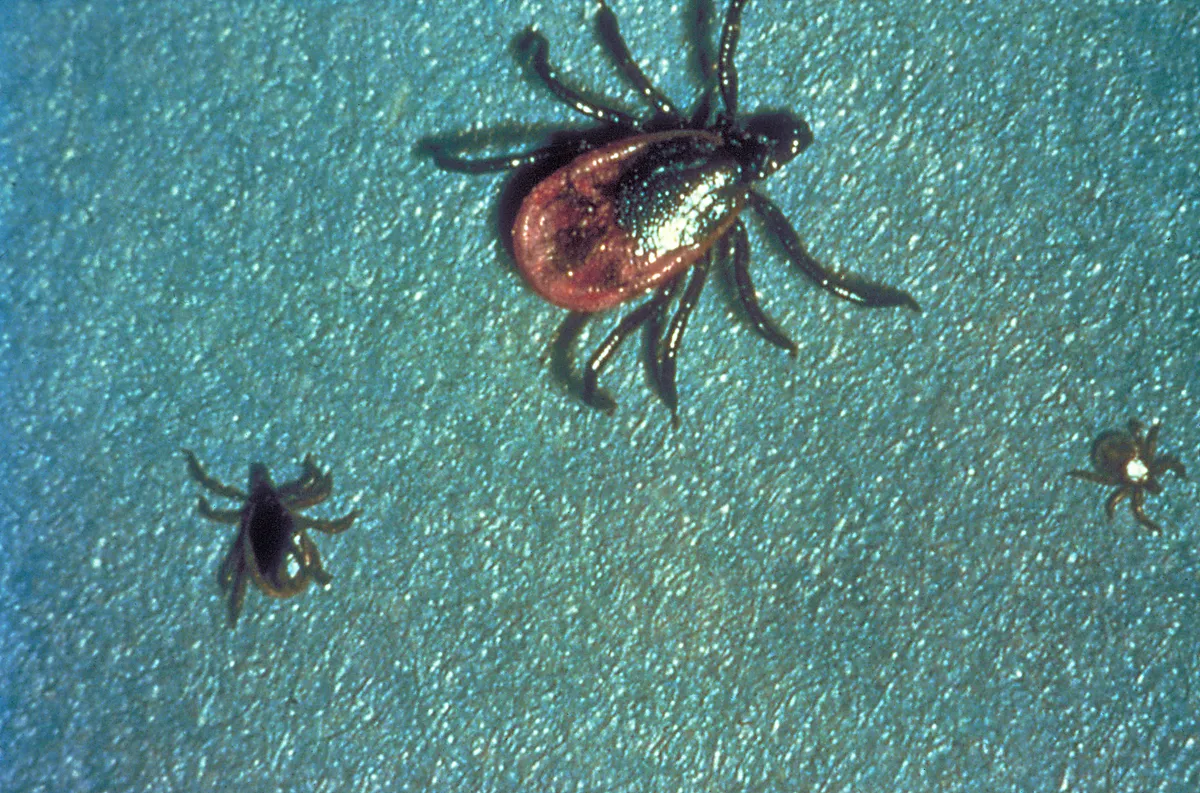
Winter is not tick-free. The state's Lyme fact sheet says adult deer ticks may be out looking for a host any time temperatures are above freezing, so a mild winter day in the woods still calls for a tick check. For how the season differs in other parts of the country, see when tick season starts and ends in each US region.
Can you get a tick identified or tested in Massachusetts?
Yes, but not from the state. As of October 2026, the state health department's tick testing page says it does not offer tick identification or tick testing. The page lists six labs that identify or test ticks for a fee, three of them in Massachusetts (in Acton, Amherst and Newton), without endorsing any of them. The list was current as of June 2021, so check the details with a lab before sending anything.
The department is cautious about what a result means:
- A tick result is not proof either way. A positive or negative result from a tick that bit you does not show for certain whether you were exposed.
- The tick you found may not be the one. Most people diagnosed with a tick-borne disease never knew they were bitten, and other ticks may have bitten you too.
- Negative results can mislead. Lab tests on ticks can, though probably rarely, give false results and may not cover every germ, so keep watching for a rash or fever.
- Do not wait for a result. Symptoms can start before results arrive, so see a health care provider if you feel sick.
- A positive tick does not automatically mean treatment. Discuss it with a provider, who will weigh when the bite happened, your symptoms and your likely exposure.
Tick testing does help track risk across the state. The department notes that the University of Massachusetts Laboratory of Medical Zoology publishes its results free of charge in the Tick-Borne Disease Network passive surveillance database, which shows where infected ticks were found while keeping senders' names and addresses private.
What should you do after a tick bite in Massachusetts?
Remove the tick right away, note the date, and tell a health care provider if it was a deer tick or if you feel ill. The state's prevention page and Lyme fact sheet describe removal this way:
- Grip the tick with fine-point tweezers as close to the skin as possible.
- Pull straight out with steady pressure, without squeezing or twisting the tick's body.
- Skip kerosene, petroleum jelly, nail polish and a hot match tip; the state says they do not work and may cause injury.
- Circle the date on a calendar and note where on the body the tick was attached. You may want to save the tick for identification.
A fuller walk-through is in the step-by-step tick removal guide, and a full-body tick check shows where ticks hide.
Speed matters. The state's Lyme disease fact sheet says a deer tick usually must be attached for at least 24 hours before it can spread the Lyme germ, while its Powassan fact sheet says that virus may pass in as little as 15 minutes. The prevention page adds that a physician may choose to treat you after a deer tick bite, so let your provider know if one bit you.
Then watch for symptoms. Early Lyme disease usually begins 3 to 30 days after the bite. CDC says about 70% to 80% of infected people get a rash called erythema migrans where the tick was attached; it expands over several days, up to 12 inches or more across, and only sometimes clears in the center. Fever, chills, headache, fatigue, muscle and joint aches and swollen lymph nodes can come with it, or without a rash. Untreated, Lyme disease can affect the joints, nerves and heart, and the state's fact sheet says about 60% of untreated people develop arthritis. The stages of Lyme disease symptoms covers what each stage looks like.

Alpha-gal syndrome gives a different warning. The state says to talk to a doctor about nausea, vomiting or diarrhea, or signs of an allergic reaction such as face or tongue swelling or hives, within several hours after eating meat or dairy products.
How do you prevent tick bites in Massachusetts?
Use repellent, cover up, stay on the trail and check for ticks every day. The state's Lyme disease fact sheet and prevention page recommend these steps:
- Use an EPA-registered repellent. DEET products can go on skin; the state's Lyme fact sheet says not to use them on children younger than 2 months and to use concentrations of 30% or less on older children. Picaridin, oil of lemon eucalyptus and IR3535 also protect against ticks. Follow the product label.
- Treat clothing, not skin, with permethrin. The state names clothing, shoes, bed nets and camping gear, and says permethrin should not be applied to skin.
- Cover up and stay central. Wear a long-sleeved shirt and long, light-colored pants tucked into socks or boots, and keep to the middle of trails, away from the edges where ticks are likely to be.
- Check once a day. Look over yourself, your children and your pets, especially between the toes, behind the knees, in the groin and armpits, along the hairline, at the back of the neck and behind the ears. Ticks are tiny, so look for new freckles.
- Protect pets. Ask a veterinarian about tick collars, repellents and other options for dogs and cats; the guide to ticks on dogs shows where to check a dog.
This guide is general educational information, not medical advice. If you have symptoms or concerns after a bite or exposure, contact a healthcare provider.
Use any pesticide exactly as its label directs. The label is the law, and what is registered and sold varies by state.
Frequently Asked Questions
Are ticks active in Massachusetts in the winter?+
Yes, adult deer ticks can be. The Massachusetts Department of Public Health says adult blacklegged ticks may be out looking for a host any time temperatures are above freezing, and its monthly reports say tick activity and tick-borne diseases occur year-round in the state. Activity peaks from March or April through August and again in October and November, so check for ticks after time in woods, brush or tall grass, even on a mild winter day.
Where in Massachusetts is Lyme disease most common?+
Relative to population, on the islands. In 2023, Dukes County, which includes Martha's Vineyard, had about 1,600 cases per 100,000 residents and Nantucket about 1,270, based on CDC county counts and Census population estimates. Berkshire and Barnstable counties came next. Bristol County had the most cases, 1,688. Cases are counted where patients live, not where they were bitten, and small island populations make rates swing widely.
Does Massachusetts test ticks for Lyme disease?+
No. As of October 2026, the Massachusetts Department of Public Health does not offer tick identification or testing, though it lists labs that offer identification, testing or both for a fee. The department cautions that a positive or negative result from a tick does not prove whether you were infected, and that symptoms can begin before results arrive. If you feel ill after a bite, see a health care provider rather than waiting for a test.
Are lone star ticks in Massachusetts?+
Yes, in a few places. CDC's surveillance lists them as established in Dukes County, which includes Martha's Vineyard, and reported in four other counties, and the state health department says populations have become established on Cape Cod, Martha's Vineyard and Nantucket. The state says lone star ticks have not been a significant source of infectious disease in Massachusetts, but their bites are linked to alpha-gal syndrome, an allergy to meat from mammals.
How long does a tick have to be attached to spread Lyme disease?+
Usually at least 24 hours, according to the Massachusetts Department of Public Health, which is why prompt removal and a daily tick check help. Powassan virus is different: the state says there is evidence it can pass from a tick in as little as 15 minutes. Remove any attached tick right away with fine-point tweezers, note the date, and tell a health care provider if it was a deer tick.
Why did Lyme disease cases in Massachusetts drop after 2015?+
They did not really drop. From 2016 through 2021, Massachusetts recorded cases without the active public health follow-up needed to collect clinical details, so very few patients could be counted, and CDC's totals fell as low as 7 in 2019. Since 2022, a revised case definition has let the state count cases from laboratory evidence alone, and reported cases returned to 5,052 in 2022 and 9,715 in 2023.
Sources
- Lyme Disease Surveillance Data — Centers for Disease Control and Prevention
- Lyme Disease Case Map (county-level data, 2023) — Centers for Disease Control and Prevention
- Signs and Symptoms of Untreated Lyme Disease (May 15, 2024) — Centers for Disease Control and Prevention
- Surveillance for Lyme Disease After Implementation of a Revised Case Definition - United States, 2022 — CDC Morbidity and Mortality Weekly Report
- Tick Surveillance Data Sets — Centers for Disease Control and Prevention (ArboNET Tick Module)
- Lone Star Tick Surveillance — Centers for Disease Control and Prevention (ArboNET Tick Module)
- Powassan Virus Historic Data (2004-2025) — Centers for Disease Control and Prevention (ArboNET)
- County Population Totals and Components of Change: 2020-2025 — U.S. Census Bureau
- National Haemaphysalis longicornis (Asian Longhorned Tick) Situation Report, as of April 22, 2025 — USDA Animal and Plant Health Inspection Service (copy hosted by Texas A&M AgriLife's Tick App)
- Tick-borne Disease Surveillance Summaries and Data — Massachusetts Department of Public Health
- Monthly Tick-borne Disease Reports — Massachusetts Department of Public Health
- Tick-borne Disease Prevention — Massachusetts Department of Public Health
- Lyme Disease (fact sheet) — Massachusetts Department of Public Health
- Tick Identification and Testing Services — Massachusetts Department of Public Health
- Alpha-gal Syndrome (AGS) (fact sheet) — Massachusetts Department of Public Health
- Powassan Virus (fact sheet) — Massachusetts Department of Public Health
How this guide was made: it was researched and drafted with AI assistance from the sources listed above. A second, independent AI pass then checked each factual claim against those sources. Found an error? Email support@buzzskito.ca.
