Published by BuzzSkito Mosquito & Tick Control
Published October 16, 2026 · Drafted with AI assistance and fact-checked against the sources listed below
Which ticks live in Texas?
Texas has 11 common tick species, and five of them are the ones people are most likely to meet: the lone star, Gulf Coast, American dog, blacklegged and brown dog ticks, according to Texas A&M AgriLife.
The clearest Texas data on which ticks bite people come from the state's tick testing program. Since 2004, ticks removed from people and mailed to the Texas Department of State Health Services (DSHS) have been tested by a laboratory at UNT Health in Fort Worth. A 2026 study of that program in CDC's journal Emerging Infectious Diseases covered 1,625 ticks of nine species tested from October 2014 through September 2021, and the lone star tick made up nearly half of them.
| Tick | Share of ticks removed from people, 2014 to 2021 | Top county of submission | What CDC says it can spread |
|---|---|---|---|
| Lone star tick, Amblyomma americanum | 48.9% | Anderson (130) | Ehrlichiosis, tularemia, Heartland and Bourbon viruses; bites are linked to STARI and alpha-gal syndrome |
| American dog tick, Dermacentor variabilis | 21.2% | Uvalde (35) | Rocky Mountain spotted fever, tularemia |
| Gulf Coast tick, Amblyomma maculatum | 11.9% | Travis (17) | Rickettsia parkeri rickettsiosis, a form of spotted fever |
| Blacklegged (deer) tick, Ixodes scapularis | 10.0% | Travis (37) | Lyme disease, anaplasmosis, babesiosis, ehrlichiosis, hard tick relapsing fever, Powassan virus disease |
| Brown dog tick, Rhipicephalus sanguineus | 3.8% | Travis (6) | Rocky Mountain spotted fever in the southwestern US and along the US-Mexico border |
Shares and counties: 1,625 ticks removed from people, submitted to DSHS and tested from October 2014 through September 2021 (Emerging Infectious Diseases, 2026); the remaining 4.2% were mostly Amblyomma mixtum. Diseases: CDC's guide to where ticks live, for the US as a whole.

The lone star tick is the one to know. DSHS calls it very common in Texas, and CDC describes it as a very aggressive tick that bites humans, with nymphs and adult females biting most often; the adult female carries a single white dot, the lone star, on her back. In the study, nymphs made up 42.8% of the lone star ticks sent in, and the most came from Anderson County in East Texas (130). For its full life cycle and range, see the lone star tick guide.

The American dog tick came second, at 21.2% of the ticks sent in, and 62.3% of those were females. CDC says adult females are the stage most likely to bite people and puts the highest risk of a bite in spring and summer. The most came from Uvalde County (35), west of San Antonio.
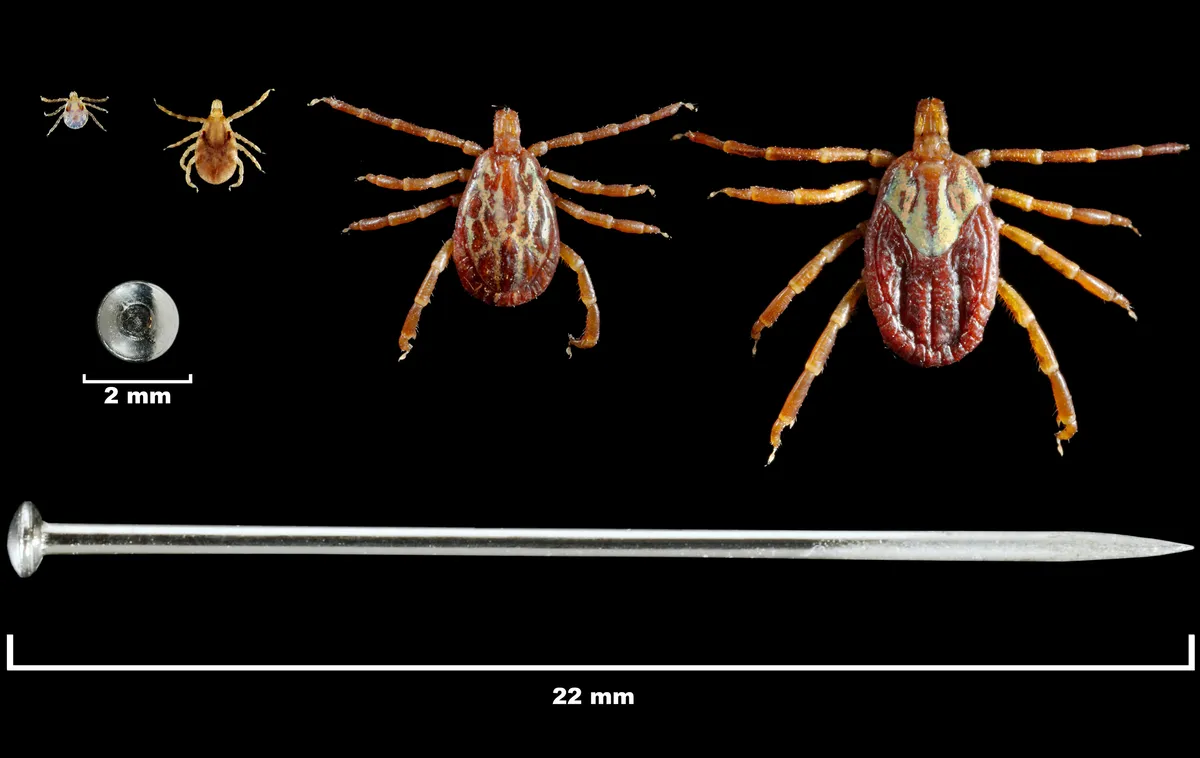
The Gulf Coast tick made up 11.9%. CDC links adult Gulf Coast ticks to Rickettsia parkeri rickettsiosis, a form of spotted fever, and 5.2% of the Gulf Coast ticks in the study carried R. parkeri. Submissions of adults peaked in August. For its markings and range, see how to recognize a Gulf Coast tick.
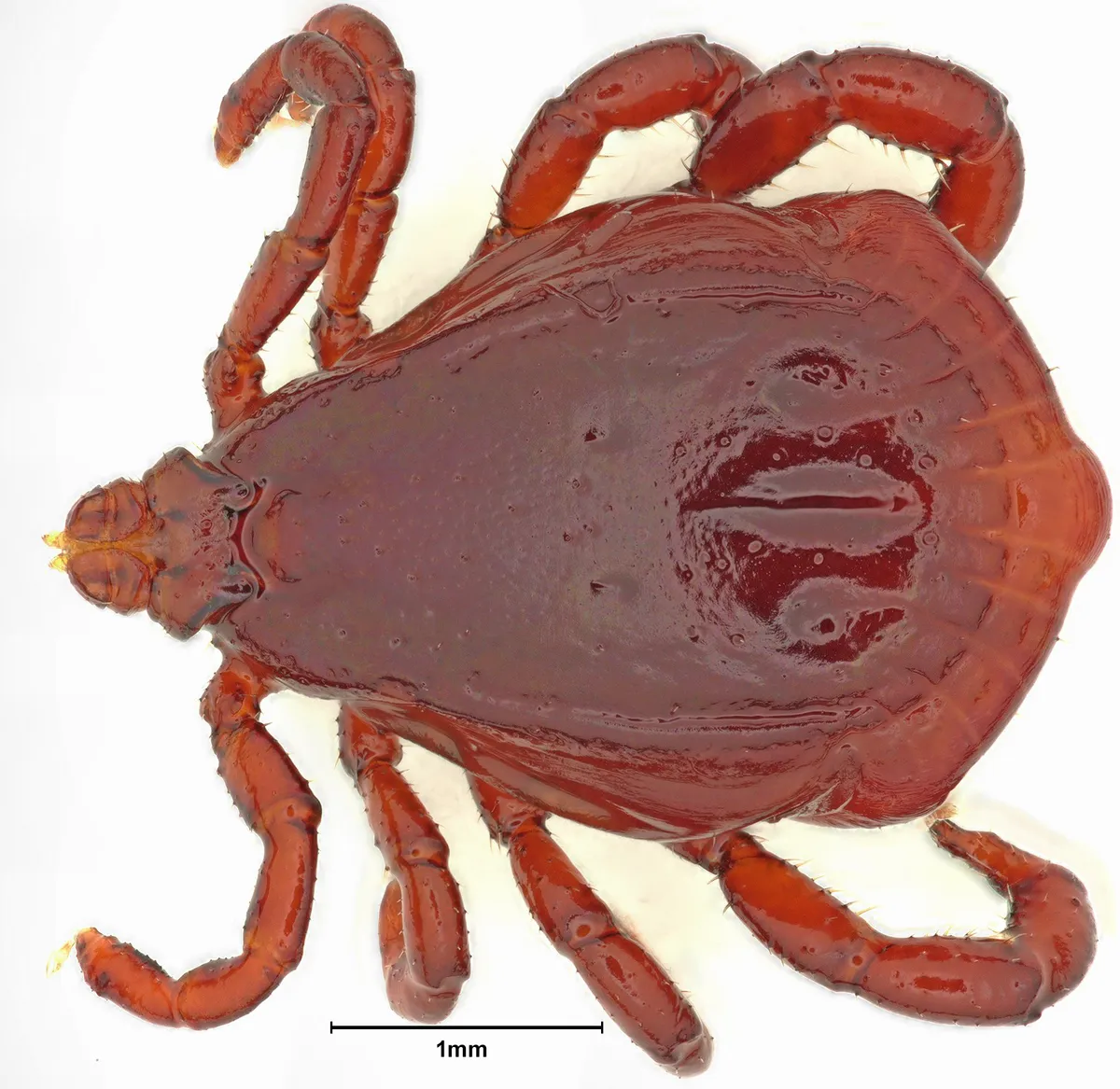
Brown dog ticks were 3.8% of submissions. CDC says dogs are their main host at every life stage, though the tick may also bite people, and that it spreads Rocky Mountain spotted fever in the southwestern US and along the US-Mexico border. Identification tips are in the brown dog tick guide.
One more tick is mostly a South Texas concern. Amblyomma mixtum made up 3.4% of submissions, mostly nymphs (60.0%), and every one came from the southeastern part of the state below 31°N latitude, most from Cameron County on the Rio Grande. Livestock owners have more to watch: AgriLife notes that ticks also cause deadly livestock diseases such as cattle fever. To compare the common species by size and markings, see how to tell the common US ticks apart.
Where are lone star ticks found in Texas?
Across East, Central, North and South Texas. CDC's lone star tick surveillance, which runs through 2025, lists the species as established in 118 of Texas's 254 counties and reported in 66 more, from the Louisiana line to the Hill Country and the Rio Grande Valley. The 70 counties with no record are nearly all in the Panhandle, the South Plains, the Rolling Plains and West Texas, with a few exceptions such as Orange County in the far southeast.
Lone star tick status by county, Texas, through 2025
- Established
- Reported
- No record
Show the list
Established (118): Anderson, Angelina, Archer, Austin, Bastrop, Bee, Bell, Bexar, Blanco, Bosque, Bowie, Brazoria, Brazos, Brown, Burnet, Caldwell, Cameron, Cass, Cherokee, Clay, Coleman, Colorado, Comal, Comanche, Cooke, Coryell, Dallas, Denton, DeWitt, Eastland, Edwards, Ellis, Erath, Falls, Fannin, Franklin, Frio, Gillespie, Grayson, Grimes, Guadalupe, Hamilton, Hardin, Harrison, Henderson, Hidalgo, Hill, Hood, Hopkins, Houston, Hunt, Jack, Jasper, Jefferson, Johnson, Karnes, Kaufman, Kendall, Kerr, Kimble, Kinney, Kleberg, Lamar, Lampasas, Lavaca, Leon, Liberty, Lipscomb, Live Oak, Llano, Madison, Marion, Mason, Maverick, McLennan, Medina, Mills, Montague, Montgomery, Morris, Navarro, Newton, Nolan, Palo Pinto, Parker, Polk, Rains, Real, Red River, Refugio, Rusk, Sabine, San Jacinto, San Patricio, San Saba, Shelby, Smith, Starr, Stephens, Sutton, Tarrant, Titus, Travis, Trinity, Tyler, Uvalde, Val Verde, Van Zandt, Walker, Webb, Wharton, Wichita, Wilbarger, Williamson, Wise, Wood, Young, Zavala
Reported (66): Aransas, Atascosa, Bailey, Bandera, Baylor, Brooks, Burleson, Calhoun, Callahan, Camp, Chambers, Collin, Collingsworth, Crockett, Dallam, Delta, Dimmit, Duval, Fayette, Fort Bend, Freestone, Galveston, Goliad, Gregg, Harris, Hartley, Haskell, Hays, Jackson, Jim Hogg, Jim Wells, Kenedy, Knox, La Salle, Lee, Limestone, Lubbock, Matagorda, McCulloch, McMullen, Menard, Midland, Milam, Mitchell, Nacogdoches, Nueces, Ochiltree, Panola, Randall, Robertson, Rockwall, San Augustine, Schleicher, Shackelford, Somervell, Stonewall, Taylor, Throckmorton, Tom Green, Upshur, Victoria, Waller, Washington, Wheeler, Wilson, Zapata
No record (70): Andrews, Armstrong, Borden, Brewster, Briscoe, Carson, Castro, Childress, Cochran, Coke, Concho, Cottle, Crane, Crosby, Culberson, Dawson, Deaf Smith, Dickens, Donley, Ector, El Paso, Fisher, Floyd, Foard, Gaines, Garza, Glasscock, Gonzales, Gray, Hale, Hall, Hansford, Hardeman, Hemphill, Hockley, Howard, Hudspeth, Hutchinson, Irion, Jeff Davis, Jones, Kent, King, Lamb, Loving, Lynn, Martin, Moore, Motley, Oldham, Orange, Parmer, Pecos, Potter, Presidio, Reagan, Reeves, Roberts, Runnels, Scurry, Sherman, Sterling, Swisher, Terrell, Terry, Upton, Ward, Willacy, Winkler, Yoakum
Read the map as a record of where lone star ticks have been collected and reported, not a measure of how many there are. CDC says changes in a county's status do not necessarily indicate that ticks have moved or become more common, and a county keeps its established label once it has earned it.
Where are blacklegged (deer) ticks found in Texas?
Mostly in East Texas and the Houston area. CDC's county table, which runs through December 31, 2025, lists blacklegged ticks as established in 28 of Texas's 254 counties and reported in 44 more; 182 counties have no record. The established counties run from Cass and Marion counties in the northeast through Smith, Nacogdoches, Angelina and Jasper counties to Harris, Montgomery and Brazoria counties, with a handful farther west, including Bexar, Bell, Parker and Real counties.
Blacklegged (deer) tick status by county, Texas, through 2025
- Established
- Reported
- No record
Show the list
Established (28): Anderson, Angelina, Aransas, Bell, Bexar, Brazoria, Brazos, Cass, Cherokee, Freestone, Grimes, Harris, Henderson, Jasper, Lavaca, Leon, Marion, Montgomery, Nacogdoches, Parker, Polk, Real, Smith, Trinity, Tyler, Walker, Waller, Wood
Reported (44): Austin, Bandera, Bastrop, Blanco, Bowie, Cameron, Colorado, Coryell, Dallas, Edwards, Fort Bend, Franklin, Grayson, Gregg, Hamilton, Harrison, Hays, Hidalgo, Houston, Hunt, Jefferson, Kerr, Kleberg, Lamar, Lampasas, Liberty, Llano, Mason, Matagorda, Newton, Palo Pinto, Robertson, Rusk, Sabine, San Augustine, Shelby, Sutton, Tarrant, Taylor, Upshur, Uvalde, Victoria, Washington, Zavala
No record (182): Andrews, Archer, Armstrong, Atascosa, Bailey, Baylor, Bee, Borden, Bosque, Brewster, Briscoe, Brooks, Brown, Burleson, Burnet, Caldwell, Calhoun, Callahan, Camp, Carson, Castro, Chambers, Childress, Clay, Cochran, Coke, Coleman, Collin, Collingsworth, Comal, Comanche, Concho, Cooke, Cottle, Crane, Crockett, Crosby, Culberson, Dallam, Dawson, Deaf Smith, Delta, Denton, DeWitt, Dickens, Dimmit, Donley, Duval, Eastland, Ector, El Paso, Ellis, Erath, Falls, Fannin, Fayette, Fisher, Floyd, Foard, Frio, Gaines, Galveston, Garza, Gillespie, Glasscock, Goliad, Gonzales, Gray, Guadalupe, Hale, Hall, Hansford, Hardeman, Hardin, Hartley, Haskell, Hemphill, Hill, Hockley, Hood, Hopkins, Howard, Hudspeth, Hutchinson, Irion, Jack, Jackson, Jeff Davis, Jim Hogg, Jim Wells, Johnson, Jones, Karnes, Kaufman, Kendall, Kenedy, Kent, Kimble, King, Kinney, Knox, La Salle, Lamb, Lee, Limestone, Lipscomb, Live Oak, Loving, Lubbock, Lynn, Madison, Martin, Maverick, McCulloch, McLennan, McMullen, Medina, Menard, Midland, Milam, Mills, Mitchell, Montague, Moore, Morris, Motley, Navarro, Nolan, Nueces, Ochiltree, Oldham, Orange, Panola, Parmer, Pecos, Potter, Presidio, Rains, Randall, Reagan, Red River, Reeves, Refugio, Roberts, Rockwall, Runnels, San Jacinto, San Patricio, San Saba, Schleicher, Scurry, Shackelford, Sherman, Somervell, Starr, Stephens, Sterling, Stonewall, Swisher, Terrell, Terry, Throckmorton, Titus, Tom Green, Travis, Upton, Val Verde, Van Zandt, Ward, Webb, Wharton, Wheeler, Wichita, Wilbarger, Willacy, Williamson, Wilson, Winkler, Wise, Yoakum, Young, Zapata

Ticks removed from people show the same eastern lean. In the study, 97.5% of the blacklegged ticks sent in came from eastern Texas, east of 98°W longitude, and 90.7% of them were females. The largest single source was Travis County, home to Austin, with 37, although CDC's table has no blacklegged record for Travis. The study does not say where each tick was picked up, but it is one more reason not to read a blank county as tick-free.
Do deer ticks in Texas carry the Lyme bacterium?
CDC has no record of it. Its companion table of germs found in host-seeking blacklegged ticks, meaning ticks hunting for a host rather than feeding on one, lists no Texas county with Borrelia burgdorferi, which causes Lyme disease, or with any of the six other germs it tracks, through December 31, 2025. CDC adds that no record can reflect a lack of sampling or testing, so this is not proof the germ is absent.
The ticks removed from people point the same way. The Lyme bacterium was not among the bacteria the UNT Health lab found in any of the 1,625 ticks, according to the study's appendix. Of the 162 blacklegged ticks, 138 (85.2%) carried Rickettsia tamurae subspecies buchneri, which the authors say is thought to be a microbe that lives in the tick without causing disease. For the two ticks that do spread Lyme disease elsewhere in the US, see what Lyme-carrying ticks look like at each life stage.
How common is Lyme disease in Texas?
Rare. Texas reported 27 Lyme disease cases in 2023, a rate of 0.1 per 100,000 residents, according to CDC's Lyme disease surveillance data. That was 27 of the 89,468 cases reported nationwide, and the lowest rate among the states in CDC's 2023 table, shared with Mississippi and Oklahoma. The state health department calls Texas a low-incidence state and says an average of 85 cases a year were reported from 2000 to 2020, with a low of 11 and a high of 276.
Reported Lyme disease cases in Texas, 2008 to 2023
Cases per year, by state of residence
Show the numbers
| Confirmed and probable cases | |
|---|---|
| 2008 | 153 |
| 2009 | 276 |
| 2010 | 142 |
| 2011 | 74 |
| 2012 | 75 |
| 2013 | 82 |
| 2014 | 40 |
| 2015 | 54 |
| 2016 | 71 |
| 2017 | 58 |
| 2018 | 47 |
| 2019 | 41 |
| 2020 | 11 |
| 2021 | 32 |
| 2022 | 23 |
| 2023 | 27 |
Compare years with care. Under the national case definition revised in 2022, high-incidence states can count a case on lab evidence alone, but low-incidence states such as Texas still need supporting clinical information, according to CDC's 2022 Lyme surveillance report. The report says the change rules out robust comparison with years counted under earlier definitions. It put Texas's 2022 count of 23 at 53.1% below the state's 2017 to 2019 average of 49.
Where do Texans catch Lyme disease?
Mostly in other states. DSHS says the majority of cases reported in Texas were acquired in a high-incidence state or country, primarily in the northeastern US. Its county breakdown for 2014 to 2020 lists 331 cases: 45 locally acquired (about 14%), 212 imported (64%) and 74 with an unknown source. CDC's state file counts 322 cases for those years; the split here is the state's own. The 45 local cases were spread across 34 counties, no more than three in any one, and even in Harris County, home to Houston, 34 of 51 cases were imported and 2 were local.
Two look-alikes complicate the count. Tick-borne relapsing fever, also caused by Borrelia bacteria, usually makes patients test positive for Lyme disease, so DSHS says doctors should consider it when a patient who tests positive has not traveled to a high-incidence area. And a rash much like the Lyme rash has been described after lone star tick bites; DSHS says the cause of this condition, southern tick-associated rash illness (STARI), is not known.
Which Texas counties report Lyme disease?
A few cases each, scattered across the state. CDC's county file of tick-borne diseases lists Lyme cases among residents of 37 Texas counties from 2019 to 2022, led by Collin (9), Harris (8), Dallas (6) and Travis (5). Cases are counted in the patient's county of residence, which is not necessarily where the infection happened, and cases without a reported county are left out.
How does Texas compare with its neighbors?
All four neighboring states also report very little Lyme disease. To compare the rest of the country, see tick maps and Lyme data for every state.
| State | Lyme cases, 2023 | Cases per 100,000, 2023 |
|---|---|---|
| Texas | 27 | 0.1 |
| Louisiana | 15 | 0.3 |
| New Mexico | 11 | 0.5 |
| Arkansas | 5 | 0.2 |
| Oklahoma | 3 | 0.1 |
Confirmed and probable cases by state of residence, from CDC Lyme disease surveillance data. Data through 2023, the latest year CDC had published as of October 2026.
Which other tick-borne diseases occur in Texas?
Spotted fever rickettsiosis and ehrlichiosis are the main ones after Lyme disease. CDC's county-level data counts these cases among Texas residents from 2019 to 2022:
| Disease | Ticks CDC links to it | Texas cases, 2019 to 2022 |
|---|---|---|
| Spotted fever rickettsiosis, including Rocky Mountain spotted fever | American dog tick; brown dog tick; Gulf Coast tick (R. parkeri) | 53 |
| Ehrlichiosis (Ehrlichia chaffeensis) | Lone star tick | 27 |
| Anaplasmosis | Blacklegged tick | 8 |
| Babesiosis | Blacklegged tick | 5 |
| Tularemia | Lone star tick; American dog tick | 2 |
| Lyme disease | Blacklegged tick | 84 |
Cases by county of residence. CDC leaves out cases whose county was not reported, which is why this file has 84 Lyme cases against 107 in CDC's state totals for the same years, and not every disease is reportable everywhere every year. Tick links: CDC's guide to where ticks live.
Spotted fever can be severe. DSHS says Rocky Mountain spotted fever typically causes fever and a measles-like rash and can cause serious illness and even death if not treated quickly. About a third of the 53 Texas cases, 18, were residents of five counties on the Mexican border: Hidalgo (7), Cameron (4), El Paso (3), Webb (3) and Maverick (1). CDC notes that brown dog ticks spread Rocky Mountain spotted fever along the US-Mexico border, but the county file does not say which germ or tick was involved, or where each person was infected. Rocky Mountain spotted fever symptoms and treatment covers the warning signs.
Texas reports far less spotted fever than two of its neighbors. CDC's spotted fever statistics for 2023 put the Texas rate at 0.49 cases per million residents, against 20.9 per million in Arkansas and 7.2 in Oklahoma; New Mexico (1.4) and Louisiana (0.87) were closer to Texas. These are reported cases, so they reflect how often people are tested and reported as well as how often they are infected.
Ehrlichiosis cases were led by Smith County (4) and Dallas County (3). The lone star tick spreads Ehrlichia chaffeensis, and the study found it in 0.4% of lone star ticks removed from people, mostly from eastern and central Texas. DSHS says the signs of ehrlichiosis and anaplasmosis are non-specific, typically fever, headache, muscle aches and fatigue.
Tularemia does not need a tick: DSHS says people can also catch it by handling infected animals, particularly wild rabbits and rodents, or through mud or water containing the bacteria. Tick-borne relapsing fever, which CDC's county file does not track, is another Texas risk; DSHS links it to exploring caves and sleeping in rustic cabins, and says it causes recurring bouts of fever, headache, muscle and joint aches, and nausea.
Lone star tick bites are also linked to alpha-gal syndrome, an allergy to red meat. Texas A&M AgriLife notes that most reported US cases come from the South, East and Central states where lone star ticks are found, and that CDC counted more than 110,000 suspected cases from 2010 to 2022. How a tick bite can trigger a red meat allergy covers symptoms and diagnosis.
Is the Asian longhorned tick in Texas?
Not as of July 2026. A University of Tennessee tracker update with data as of July 18, 2026, listed 27 states with active Asian longhorned tick detections. Texas was not among them, but neighboring Arkansas and Oklahoma were, and Oklahoma's county reports were still being verified.
CDC says the tick is not normally found in the Western Hemisphere, was first reported in the US in 2017 and has been found on pets, livestock, wildlife and people, and that its females can reproduce without mating. If an unfamiliar tick bites you, DSHS will identify it through its free submission program, described below; for ticks found on pets or outdoors, DSHS points to the Texas Tick Project. How to recognize an Asian longhorned tick describes its look and US range.
When is tick season in Texas?
All year, with the busiest months in the warm season. Texas A&M AgriLife says ticks are active year-round in Texas, with activity increasing in the warmer months, typically peaking in summer and then declining in fall. DSHS likewise says ticks are most active in the warmer months of spring and summer.
| Months | What the data show |
|---|---|
| December to February | Ticks stay active year-round in Texas; CDC says adult blacklegged ticks can look for a host whenever winter temperatures are above freezing |
| March and April | Submissions of adult blacklegged ticks removed from people peak in March |
| May to July | Submissions of adult lone star ticks are much higher; adult American dog ticks peak in June, and CDC puts the highest American dog tick risk in spring and summer |
| August and September | Submissions of adult Gulf Coast ticks peak in August; overall tick activity peaks in summer |
| October and November | Tick activity declines through the fall but does not stop |
Submission peaks: ticks removed from people, 2014 to 2021 (Emerging Infectious Diseases, 2026), which show when Texans met ticks. Year-round activity and the summer peak: Texas A&M AgriLife. Blacklegged and American dog tick risk by season: CDC.
Nymphs keep a looser schedule. The study found no clear seasonal pattern in nymphal lone star tick submissions, and its authors stress that the data reflect when people met ticks rather than the ticks' natural activity. Nationally, CDC puts the greatest risk of a blacklegged tick bite in spring, summer and fall.
Where can you get a tick identified or tested in Texas?
From the state health department, for free, if the tick was attached to a person. As of October 2026, DSHS's tick submission program accepts ticks from Texas residents mailed from a Texas address. DSHS Zoonosis Control identifies each tick by species, life stage and how engorged it is, then forwards it to the UNT Health Tick-Borne Disease Research Laboratory, which screens every tick for Borrelia, Ehrlichia and Rickettsia bacteria, the groups behind Lyme disease, ehrlichiosis and the spotted fevers. Results usually reach the sender within two weeks.
- Put the tick in a secure container, screw-cap vial or plastic bag, and seal that inside a second plastic bag.
- Do not preserve it in alcohol, formalin or saline, and do not tape it; ticks from different people or places go in separate, labeled containers.
- Fill out a Texas Tick Submission Form for each tick.
- Mail it to DSHS Zoonosis Control, MC 1956, P.O. Box 149347, Austin, TX 78714-9347; courier packages go to 1100 W. 49th St., Austin, TX 78756.
Treat the result as information, not a diagnosis. DSHS says the service exists for tick surveillance, that people infected by a tick usually develop symptoms within two weeks, before results arrive, and that anyone with typical symptoms such as fever, headache, muscle aches or a rash should not wait for the result before seeking care. A tick carrying a germ does not mean it was passed on, and a tick that tests negative does not rule out infection.
Two other routes help. For ticks found on pets or outdoors, DSHS refers people to the Texas Tick Project, which it says tests them for free. Texas A&M AgriLife describes its Tick App for Texas and the Southern Region as a tick identification tool that also offers removal guidance. Questions about ticks go to the DSHS Regional Zoonosis Control office for your area or to The.Vet@dshs.texas.gov.
What should you do after a tick bite in Texas?
Remove the tick right away, keep it if you want it tested, and watch your health for 30 days. DSHS describes removal this way:
- Use tweezers or forceps; if you use your fingers, wear disposable gloves or shield them with a paper towel.
- Grasp the tick as close to the skin as possible and pull upward with steady, even pressure.
- Do not twist or jerk it, which can break off the mouthparts in the skin.
- Skip folk remedies such as nail polish, petroleum jelly or heat; the aim is to remove the tick quickly, not to wait for it to let go.
For more detail, see the step-by-step tick removal guide. Redness alone is not a sure sign of infection: CDC says lone star tick saliva can be irritating, so redness and discomfort at the bite do not necessarily mean an infection.
Then watch for symptoms. DSHS advises talking to a health care provider if a rash, fever, headache, muscle or joint pain, or swollen lymph nodes develop within 30 days of a tick bite, and telling the doctor when the bite happened and where the tick was most likely picked up. Do not wait out a possible spotted fever: DSHS says Rocky Mountain spotted fever can cause serious illness and even death if not treated quickly. For the Lyme rash and what can follow it, see the stages of Lyme disease symptoms.

How do you prevent tick bites in Texas?
Treat your gear, use a registered repellent, stay out of tall grass and check yourself after every outing. CDC's tick bite prevention advice covers the basics:
- Treat your gear. Use products containing 0.5% permethrin on boots, clothing and camping gear; CDC says the protection lasts through several washings.
- Use an EPA-registered repellent containing DEET, picaridin, IR3535, oil of lemon eucalyptus (OLE), para-menthane-diol (PMD) or 2-undecanone, and follow the label. Do not use OLE or PMD products on children under 3.
- Stay in the middle of the trail. Ticks live in grassy, brushy and wooded areas, and yards can have them too; walk in the center of trails and avoid tall grass and leaf litter.
- Dry, then shower. Tumble dry clothes on high heat for 10 minutes to kill ticks, and shower within two hours of coming indoors.
- Check everywhere. Look under the arms, in and around the ears, inside the belly button, behind the knees, in the hair, between the legs and around the waist; a full-body tick check walks through it.
Around the house, Texas A&M AgriLife suggests keeping the lawn mowed, trimming brush, cutting down on brush piles and other hiding places for rodents and wildlife, and taking extra care around play areas. Check pets after time outdoors and ask a veterinarian about tick prevention; ticks on dogs covers where to look and how to remove them.
If mosquitoes are the other half of your outdoor problem, mosquito season in Texas, region by region explains when and where they bite.
This guide is general educational information, not medical advice. If you have symptoms or concerns after a bite or exposure, contact a healthcare provider.
Use any pesticide exactly as its label directs. The label is the law, and what is registered and sold varies by state.
Frequently Asked Questions
Is there Lyme disease in Texas?+
Yes, but very little. CDC counted 27 Lyme disease cases among Texas residents in 2023, a rate of 0.1 per 100,000, and the state health department calls Texas a low-incidence state. Most cases in Texans are caught elsewhere: of 331 cases the state recorded from 2014 to 2020, it classed 45 as locally acquired. Blacklegged ticks, which spread Lyme disease, are established in 28 Texas counties, mostly in East Texas, but CDC has no record of the Lyme bacterium in Texas ticks.
What is the most common tick in Texas?+
The lone star tick is the one people in Texas most often find attached. It made up 48.9% of 1,625 ticks removed from people and tested from October 2014 through September 2021, followed by the American dog tick at 21.2%, the Gulf Coast tick at 11.9% and the blacklegged tick at 10.0%, according to a study in CDC's journal Emerging Infectious Diseases. CDC lists lone star ticks as established in 118 of Texas's 254 counties. The adult female has a single white spot on her back.
Are ticks active in Texas in the winter?+
Yes. Texas A&M AgriLife says ticks are active year-round in Texas, although activity rises in the warmer months, typically peaks in summer and declines in fall. CDC says adult blacklegged ticks can look for a host any time winter temperatures are above freezing, and in Texas, submissions of adult blacklegged ticks removed from people peaked in March. Check yourself and your pets after time in brush, tall grass or woods in any month.
Can I get a tick tested in Texas?+
Yes, for free, if the tick was attached to a person and you send it from a Texas address. As of October 2026, the Texas Department of State Health Services identifies ticks mailed to its Zoonosis Control office and forwards them to the UNT Health laboratory, which tests for the bacteria behind Lyme disease, ehrlichiosis and spotted fevers; results usually come within two weeks. The state says the service is for surveillance, not diagnosis, so see a doctor if you feel ill instead of waiting. For ticks from pets or outdoors, it refers people to the Texas Tick Project.
Is the Asian longhorned tick in Texas?+
Not as of July 2026. A University of Tennessee tracker update with data as of July 18, 2026, listed 27 states with Asian longhorned tick detections, including neighboring Arkansas and Oklahoma, but not Texas. CDC says the tick is not normally found in the Western Hemisphere, was first reported in the United States in 2017, and has been found on pets, livestock, wildlife and people. If an unfamiliar tick bites you, the state health department will identify it for free.
Which ticks spread Rocky Mountain spotted fever in Texas?+
CDC links Rocky Mountain spotted fever to the American dog tick and, in the southwestern United States and along the US-Mexico border, to the brown dog tick. The Gulf Coast tick spreads a related spotted fever caused by Rickettsia parkeri. Texas residents reported 53 cases of spotted fever rickettsiosis from 2019 to 2022, about a third of them among residents of counties on the Mexican border, and CDC's 2023 rate for Texas, 0.49 cases per million, was far below neighboring Arkansas and Oklahoma. The state health department says the disease can be serious or fatal if not treated quickly, so see a provider promptly if fever follows a tick bite.
Sources
- Lyme Disease Surveillance Data — Centers for Disease Control and Prevention
- Data and Statistics on Spotted Fever Rickettsiosis (2023 incidence by state) — Centers for Disease Control and Prevention
- Surveillance for Lyme Disease After Implementation of a Revised Case Definition - United States, 2022 — CDC Morbidity and Mortality Weekly Report
- Tick Surveillance Data Sets — Centers for Disease Control and Prevention (ArboNET Tick Module)
- Lone Star Tick Surveillance — Centers for Disease Control and Prevention (ArboNET Tick Module)
- Surveillance of Ticks and Tickborne Borrelia, Ehrlichia, and Rickettsia spp., Texas, USA, 2014-2021 — Emerging Infectious Diseases (CDC), Zhang, Mitchell, Kilgore and Allen, August 2026
- Geographic Distribution of Tickborne Disease Cases (county of residence, 2019-2022) — Centers for Disease Control and Prevention
- Where Ticks Live — Centers for Disease Control and Prevention
- Preventing Tick Bites — Centers for Disease Control and Prevention
- Tick-borne Diseases — Texas Department of State Health Services
- Lyme Disease — Texas Department of State Health Services
- Lyme Cases in Texas Reported by County and Area of Disease Acquisition (2014-2020) — Texas Department of State Health Services
- Tick Submission and Testing — Texas Department of State Health Services
- Keep your family safe from ticks (June 19, 2024) — Texas A&M AgriLife Today
- National Exotic and Invasive Vector Species Stakeholder Call - July 2026 — University of Tennessee Institute of Agriculture, Exotic and Invasive Vector and Vector-borne Disease Watch
How this guide was made: it was researched and drafted with AI assistance from the sources listed above. A second, independent AI pass then checked each factual claim against those sources. Found an error? Email support@buzzskito.ca.