BuzzSkito Mosquito & Tick Control Specialists · Published July 16, 2026
Quick Answer
What feels like a “head” stuck in your skin is actually the tick’s mouthparts. Make one gentle attempt to lift it out with fine-tipped tweezers, and if it won’t come easily, leave it — your skin pushes it out like a splinter. Then disinfect and watch for infection.
- What people call the “head” is really the tick’s mouthparts — a barbed feeding tube called the hypostome, not a head.
- The U.S. CDC advises leaving embedded mouthparts to heal on their own if they don’t lift out with one gentle tweezer attempt.
- Retained mouthparts cannot transmit Lyme disease on their own — the bacteria live in the tick’s gut, which you’ve already removed.
- Left alone, the fragment usually works its way out within a few days to about 2 weeks, like a splinter.
- In Ontario, blacklegged-tick Lyme risk rises significantly after 24–36 hours of attachment (Public Health Ontario).
- Disinfect with rubbing alcohol; see a doctor if you get spreading redness, pus, or a rash 3–30 days later.
— BuzzSkito, GTA mosquito & tick control · 150+ five-star Google reviews
⚠️ Medical Disclaimer
This guide is for general information only and is not medical advice. If you are worried about a tick bite, an infection, or symptoms, consult a licensed healthcare provider. In an emergency, call 911 or go to the nearest emergency room.
Tick head stuck in skin: what it actually is
If part of a tick stayed behind after you pulled it off, take a breath — this is common and rarely serious. The first thing to understand is that a tick doesn’t really have a “head” the way you’re picturing. What anchors into your skin is a cluster of mouthparts, dominated by a barbed feeding tube called the hypostome. Those backward-facing barbs are exactly why a fragment snaps off and stays put when a tick is pulled too fast or grabbed by the body.
Crucially, that leftover speck is not a living tick and it is not still feeding. Once the tick’s body is gone, the mouthpart is just inert foreign material — think of it as a very small splinter, not an active threat.
As an Amazon Associate I earn from qualifying purchases. BuzzSkito only points to products we would genuinely use or recommend, at no extra cost to you.
A fine-tipped tick tool grips right at the skin and removes the whole tick in one piece — the best way to avoid leftover mouthparts:
As an Amazon Associate I earn from qualifying purchases. Price shown on Amazon.ca, at no extra cost to you.
🏆 Our Top Pick — Tick Removal Tool
8.7/10· BuzzSkito ratingTick Twister-style hooked remover
A notched, fine-tipped tick tool slides under the mouthparts and levers the whole tick out in one piece — the single best way to stop a head breaking off in the first place. Cheap enough to keep one in the first-aid kit, the car, and the dog-walking bag.
Pros
- Grips at the skin, not the body
- Removes the whole tick intact
- Works on people and pets
- Compact — keep several on hand
Cons
- Very fine tip can be fiddly on tiny nymphs
- Not a substitute for a doctor if the site gets infected
What happens if you leave a tick head in your skin?
In most cases, nothing serious happens. Your immune system treats the fragment as foreign material and gradually pushes it toward the surface, usually within a few days to two weeks. You might see a small red bump or feel mild tenderness while it works its way out — that’s normal healing, not a warning sign.
The one outcome worth watching for is a localized skin infection at the site — for example cellulitis — which shows up as spreading redness, warmth, swelling, or pus. That’s a wound-care problem, not a tick-disease problem, and it’s treatable, but it needs a clinician. The good news, echoed by the U.S. CDC, is that trying to dig out a stubborn mouthpart usually causes more skin trauma than simply leaving it alone.
How to remove a tick head (and when to stop)
Make exactly one careful attempt, then let it go if it resists. Here’s the safe method:
- Wash your hands and clean the area with rubbing alcohol or soap and water.
- Using clean, fine-tipped (pointed) tweezers — not the wide flat household kind — grasp the fragment as close to the skin surface as possible.
- Pull straight up with slow, steady pressure. Do not twist, jerk, or wiggle, which can break it further or bury it.
- If it lifts out, great. If it’s buried and won’t come with gentle pressure, stop and leave it — per CDC guidance, let the skin heal rather than gouging.
- Disinfect again, and note the date so you can watch the site over the next few weeks.
What you should never do: dig with a needle or pin, cut the skin, apply a hot match, smother it in petroleum jelly or nail polish, or squeeze the area. These old “tricks” don’t help and can push contaminants deeper or raise infection risk. For the full step-by-step on removing an attached tick the right way — before it ever breaks — see our guide to removing a tick safely.
Tick mouthparts left behind: leave it or dig it out?
Here’s the decision at a glance. When a fragment is embedded, the trade-off is almost always in favour of leaving it alone.
| Approach | What it is | Recommended? | Why |
|---|---|---|---|
| Gentle fine-tweezer lift | One careful pull straight up, gripping at the skin | Yes — one try | Removes a shallow fragment cleanly if it lifts easily |
| Leave it to heal | Disinfect and let the skin expel it like a splinter | Yes — default | CDC-endorsed when it won’t lift out; lowest infection risk |
| Dig with a needle/pin | Gouging or cutting to extract the fragment | No | Tears skin, drives bacteria deeper, raises infection risk |
| Burn / hot match | Applying heat to the site | No | Burns skin; does nothing useful to a dead fragment |
| Squeeze / crush | Pinching the area to force it out | No | Can inflame the wound without dislodging the fragment |
Is a tick head stuck in your skin dangerous?
For the vast majority of people, no — the leftover mouthpart itself is low-risk. Two separate things are worth monitoring, though, and it helps to keep them straight:
- Local skin infection at the site. In the first few days, watch for spreading redness, warmth, swelling, tenderness, or pus. That’s a treatable wound infection — see a clinician or walk-in clinic.
- Signs of a tick-borne illness, over 3–30 days. Regardless of the mouthpart, any tick bite can carry disease risk. Per Public Health Ontario and the CDC, watch for an expanding red or bull’s-eye rash (erythema migrans), fever, chills, headache, muscle or joint aches, or unusual fatigue. If any appear, contact a healthcare provider promptly.
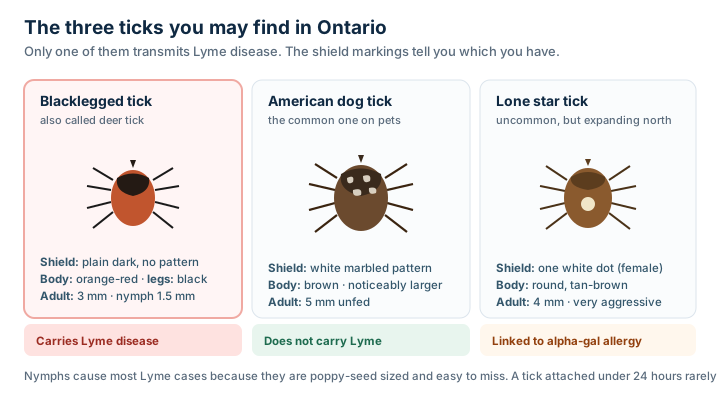
Will a leftover mouthpart give you Lyme disease? On its own, that’s very unlikely — the Borrelia bacteria live in the tick’s midgut and salivary glands, which are part of the body you already removed. Your actual Lyme risk is driven mainly by how long the whole tick was attached before removal. In Ontario, Public Health Ontario notes that transmission risk from a blacklegged tick rises significantly after 24–36 hours of attachment, so tell your provider how long it was on and, if you saved the tick, bring it. For the wider picture on symptoms and timelines, see our tick bite symptoms guide for Ontario.
See a doctor promptly if you notice…
- An expanding rash, especially a bull’s-eye pattern, 3–30 days after the bite
- Fever, chills, severe headache, or aching joints and muscles
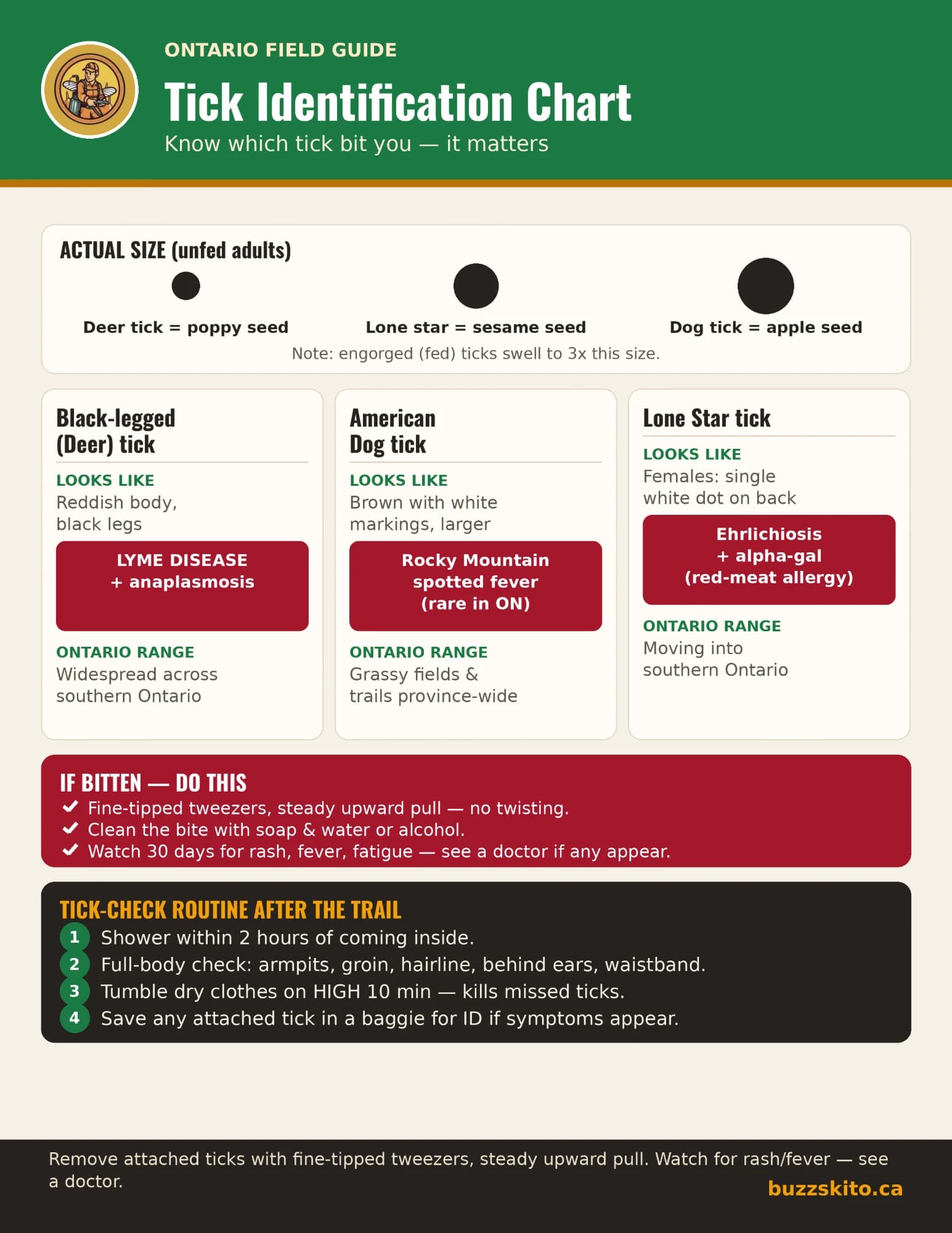
- Spreading redness, warmth, swelling, or pus at the bite site
- A fragment that is still clearly embedded after several weeks, or is getting worse
Tick head stuck in a dog: what to do
The logic is identical for pets. What’s left in your dog’s skin is the mouthpart, not a live tick, and it is not still feeding. Don’t gouge at the spot. If the fragment lifts out easily with fine-tipped tweezers or a pet tick tool, take it; if it resists, leave it and let the skin push it out naturally.
Clean the area and keep an eye on it. Signs to call your veterinarian: redness, swelling, oozing, a lump that isn’t shrinking, or your dog persistently licking, scratching, or biting the site. Because dogs are also at risk of tick-borne disease, mention the bite at your next vet visit. Our step-by-step guide to removing a tick from a dog in Ontario covers safe removal and aftercare in detail.
Why the head breaks off — and how to stop it next time
Nine times out of ten, a broken-off mouthpart comes down to technique. Those hypostome barbs anchor the tick firmly, so twisting, jerking, or grabbing the swollen body tends to snap the mouthparts off and leave them in the skin. The fix is simple: grip right where the mouthparts enter the skin, and pull straight up, slow and steady — no twisting.
Tools matter too. A purpose-built tick remover — a fine-tipped tweezer or a notched “tick key” style tool — slides under the mouthparts and levers the whole tick out intact far more reliably than fingers or blunt household tweezers. Keeping one in your first-aid kit, car, and dog-walking bag means you’re never tempted to yank a tick out by hand. Our tick removal tool guide compares the main types and how to use each.
Keep a proper remover on hand so the whole tick comes out in one piece:
The bottom line
A tick “head” stuck in your skin is really the mouthparts, and it’s usually a minor problem. Try once to lift it out with fine tweezers; if it won’t budge, leave it, disinfect, and let your skin expel it like a splinter over a couple of weeks. Skip the needle, the match, and the squeezing. Watch the site for infection, and watch yourself for rash or fever over the next month. When in doubt — or if it’s your child, or the area looks infected — a healthcare provider can settle it quickly.
Related reading
- How to Remove a Tick Safely (Step-by-Step)
- Tick Removal Tool Guide — Which Type Works Best
- Tick Bite Symptoms & What to Do in Ontario
- How to Remove a Tick from a Dog in Ontario
Frequently Asked Questions
What do you do if a tick head is stuck in your skin?+
First, know that what looks like a "head" is actually the tick's mouthparts — a barbed feeding tube called the hypostome. Try to lift the remaining fragment out with clean fine-tipped tweezers, grasping as close to the skin as possible. If it does not come out easily, leave it alone. Per the U.S. CDC, embedded mouthparts should simply be left to heal — your skin will usually expel them like a splinter over several days to two weeks. Disinfect the area with rubbing alcohol or soap and water, and watch it for signs of infection. Do not dig, gouge, burn, or squeeze the site.
What happens if you leave a tick head in your skin?+
In most cases, nothing serious happens. Retained mouthparts are foreign material, not a living tick, so they cannot continue to feed or (in most cases) transmit disease once the tick's body is gone. Your immune system treats the fragment like a splinter and gradually pushes it to the surface, typically within a few days to two weeks. You may notice a small red bump or mild tenderness while it works its way out. The main thing to watch for is a localized skin infection — spreading redness, warmth, pus, or increasing pain — which would need a doctor.
Can a tick head left in the skin still give you Lyme disease?+
It is very unlikely from the leftover mouthparts alone. The bacteria that cause Lyme disease (Borrelia burgdorferi) live in the tick's midgut and salivary glands — the body you have already removed — not in the mouthparts embedded in your skin. Because of this, most public-health guidance treats retained mouthparts as a wound-care issue, not an infection-risk issue. However, your overall Lyme risk depends on how long the whole tick was attached before removal. In Ontario, Public Health Ontario notes the risk of transmission from a blacklegged tick rises significantly after 24–36 hours of attachment, so tell your healthcare provider how long the tick was on.
How do you get a tick head out of your skin?+
Use clean, fine-tipped (pointed) tweezers — not the wide flat household kind. Grasp the mouthpart fragment as close to the skin surface as you can and pull upward with steady, even pressure. Do not twist or jerk, which can break it further. If the fragment is buried and will not lift out with a gentle attempt, stop — the CDC advises leaving it to heal on its own rather than digging. A proper tick-removal tool with a fine tip or notch makes this far easier than kitchen tweezers and reduces the chance of leaving parts behind in the first place.
Should I dig a tick head out with a needle?+
No. Digging with a needle, pin, or the corner of a knife tears the skin, drives bacteria deeper, and raises your risk of a secondary infection — often causing more harm than the tiny fragment itself. Health guidance from the CDC is to make one gentle attempt with fine tweezers and, if that fails, leave the mouthparts alone. If a fragment is genuinely bothering you or the area becomes infected, see a healthcare provider or a walk-in clinic, who can remove it cleanly under sterile conditions.
How long does it take for a tick head to work its way out?+
For most people, a retained mouthpart is pushed out by the skin within a few days to about two weeks, similar to a splinter. A small scab or firm bump may persist a little longer as the area heals. If the fragment is still clearly embedded after several weeks, or if the site becomes red, swollen, painful, or starts draining pus at any point, have a clinician take a look.
What does a tick mouthpart left in the skin look like?+
It usually appears as a tiny black or dark speck or dot at the bite site — often mistaken for the whole "head." It may sit slightly below the surface with a small red bump around it. This is different from the bite reaction itself, which is a red mark or mild swelling. If you are unsure whether the dark speck is a mouthpart, a scab, or dried blood, do not gouge at it — clean the area and let it heal, and see a provider if it is not resolving.
Is it dangerous to leave a tick head in your skin?+
For the vast majority of people it is low-risk. The realistic complication is a localized skin infection (such as cellulitis) at the site, not disease from the tick itself. Signs that warrant medical attention include an expanding area of redness, warmth, swelling, pus, or increasing pain over a day or two. Separately — and regardless of the mouthpart — watch for signs of tick-borne illness in the 3–30 days after any bite: an expanding "bull's-eye" rash, fever, headache, fatigue, or joint aches. Those symptoms mean see a doctor promptly.
What should I watch for after a tick head stays in my skin?+
Monitor for two separate things. (1) Local infection at the site: spreading redness, warmth, swelling, tenderness, or pus in the first few days — this needs a clinician. (2) Signs of tick-borne disease over the following 3–30 days: an expanding red or bull's-eye rash (erythema migrans), fever, chills, headache, muscle or joint aches, or unusual fatigue, per Public Health Ontario and the CDC. If you develop any of these, contact a healthcare provider and mention that you had a tick bite and how long the tick was attached.
My dog has a tick head stuck in its skin — what do I do?+
The approach is the same as for people: what stayed behind is the mouthpart, not a live tick, and it is not still feeding. Do not gouge at your dog's skin. If the fragment lifts out easily with fine-tipped tweezers or a pet tick tool, remove it; if not, leave it and let the skin expel it naturally. Clean the spot and watch for redness, swelling, oozing, or your dog licking or scratching at it. If the area looks infected, your dog seems unwell, or you are unsure, call your veterinarian. Our guide on removing a tick from a dog in Ontario walks through the full process.
Why did the tick head break off in the first place?+
Usually because of how it was pulled. The tick's hypostome is covered in backward-facing barbs that anchor it in the skin, so twisting, jerking, or grabbing the tick's swollen body (instead of gripping right at the skin) tends to snap the mouthparts off and leave them behind. Removing a tick slowly and straight up with fine-tipped tweezers or a dedicated tick tool — gripping as close to the skin as possible — is the best way to get the whole tick out in one piece next time.
Can I prevent tick heads from breaking off?+
Yes — technique and tools make the difference. Grip the tick right where its mouthparts enter the skin, not the body, and pull straight up with slow, steady pressure rather than twisting. A purpose-built tick-removal tool (a fine-tipped tweezer or a notched "tick key" style remover) slides under the mouthparts and levers the whole tick out intact far more reliably than fingers or blunt household tweezers. Keeping one in your first-aid kit, car, and dog-walking bag means you are never tempted to yank a tick out by hand.