
Published by BuzzSkito Mosquito & Tick Control
Published October 16, 2026 · Drafted with AI assistance and fact-checked against the sources listed below
Which ticks live in Wisconsin?
Sixteen hard tick species have been reported in Wisconsin, according to UW–Madison's page on other tick species found in the state, but many of them feed mainly on wildlife and rarely bite people. Three account for nearly all the ticks residents find: the American dog tick (also called the wood tick), the blacklegged tick (also called the deer tick) and, far behind, the lone star tick.
The Wisconsin Department of Health Services (DHS) sees that balance in its Tick Identification Service. In 2026, through the week of September 28, the service had received 525 submissions of American dog ticks, 266 of blacklegged ticks and 41 of lone star ticks from Wisconsin residents, plus 26 of insects or spiders and 37 listed as not identified, according to the department's tick surveillance report for that week. Its own field surveillance concentrates on the blacklegged tick, which it calls the most important carrier of human tick-borne infections in Wisconsin.
| Tick | Where in Wisconsin | What it can spread | Worth knowing |
|---|---|---|---|
| Blacklegged (deer) tick, Ixodes scapularis | Established in 61 of 72 counties; the state says deer ticks are present in all counties | Lyme disease; germs behind anaplasmosis, babesiosis, ehrlichiosis, hard tick relapsing fever and Powassan virus disease have also been found in Wisconsin deer ticks | Most people are infected by nymphs, which are about the size of a poppy seed |
| American dog tick (wood tick), Dermacentor variabilis | Widespread, in woods, grassy meadows and along roads and paths | Not associated with disease transmission in Wisconsin; elsewhere in the US it can spread Rocky Mountain spotted fever and tularemia | Adults are very common on people, dogs and cats; no evidence it can transmit the Lyme germ |
| Lone star tick, Amblyomma americanum | Rare; found mostly in the southern half, as far north as Douglas County; no established population, says UW–Madison, though CDC lists Dane County as established | Ehrlichiosis, tularemia and Heartland virus disease; its bite is linked to alpha-gal syndrome | Probably carried in by migrating birds each year |
| Ixodes cookei | Not very common; feeds mostly on small and medium-sized mammals | May transmit the germs behind Powassan virus disease and Lyme disease | Occasionally bites people |
| Brown dog tick, Rhipicephalus sanguineus | Extremely rare in Wisconsin | Rocky Mountain spotted fever elsewhere; that germ is rarely found in Wisconsin | Can complete its life cycle indoors, in homes or kennels |
Sources: UW–Madison Department of Entomology pages on the American dog tick, the lone star tick and other species; county status: CDC ArboNET Tick Module, through December 2025; deer tick notes: the DHS Lyme disease page; germs found in deer ticks: CDC's pathogen table, below.
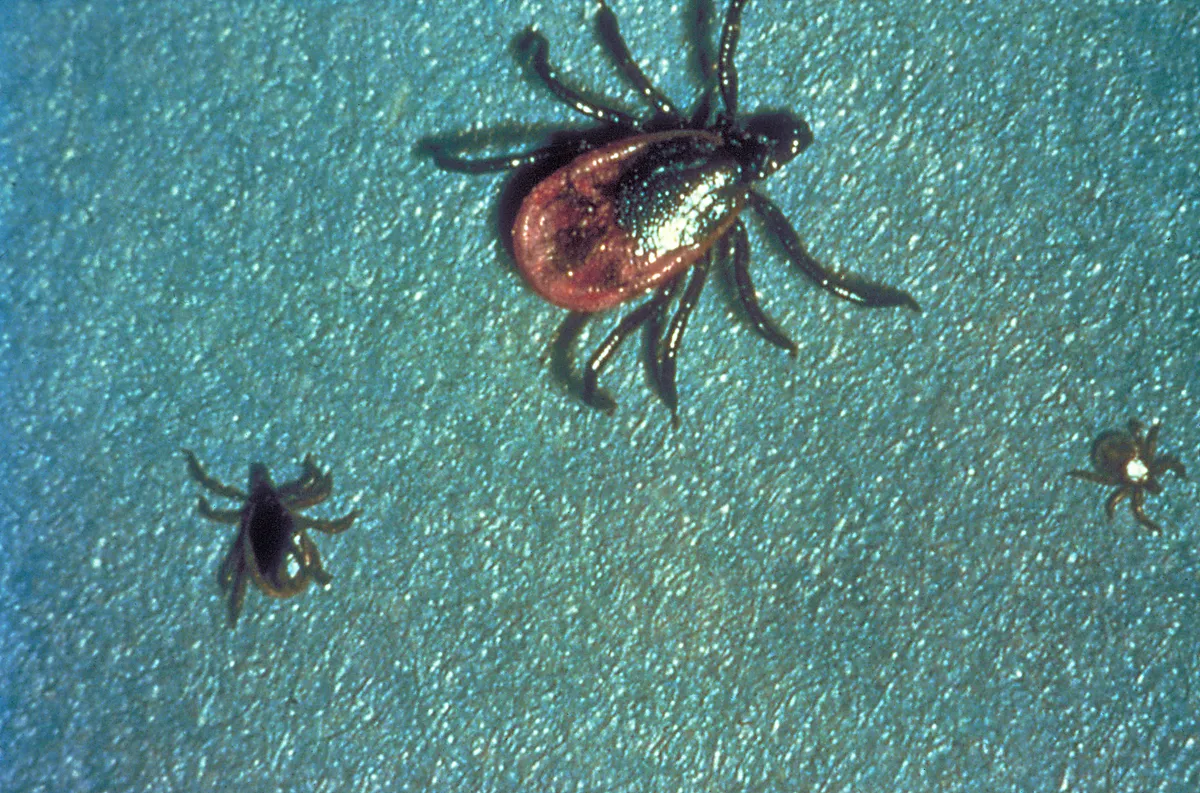
The blacklegged tick is the one that matters most for health. The DHS page about Lyme disease says it spreads the disease, that deer ticks are present in all counties in Wisconsin, and that most people are infected by nymphs, the immature stage, which are about the size of a poppy seed. Lyme disease is caused by the bacterium Borrelia burgdorferi and, rarely, Borrelia mayonii. To compare sizes and markings across species, see how to tell the common US ticks apart.
The American dog tick is the one most people meet. UW–Madison's wood tick page says the adults are very common on people, dogs and cats, while the larvae and nymphs almost never bite people. It adds that diseases from wood tick bites are rare in Wisconsin and that this tick has not been associated with disease transmission in the state, although it can transmit the bacteria behind Rocky Mountain spotted fever and tularemia in other parts of the US. The Lyme bacterium has been found in wood ticks, but there is no scientific evidence that they can pass it on.

The rest matter less for people. Ixodes cookei, which feeds mostly on small and medium-sized mammals, is not very common in Wisconsin but occasionally bites people, and UW–Madison says it may transmit the germs behind Powassan virus disease and Lyme disease. The brown dog tick, which can complete its life cycle indoors, is extremely rare in the state. The rabbit tick typically does not feed on people, and Ixodes texanus, found mostly on raccoons, only very occasionally bites people or pets.
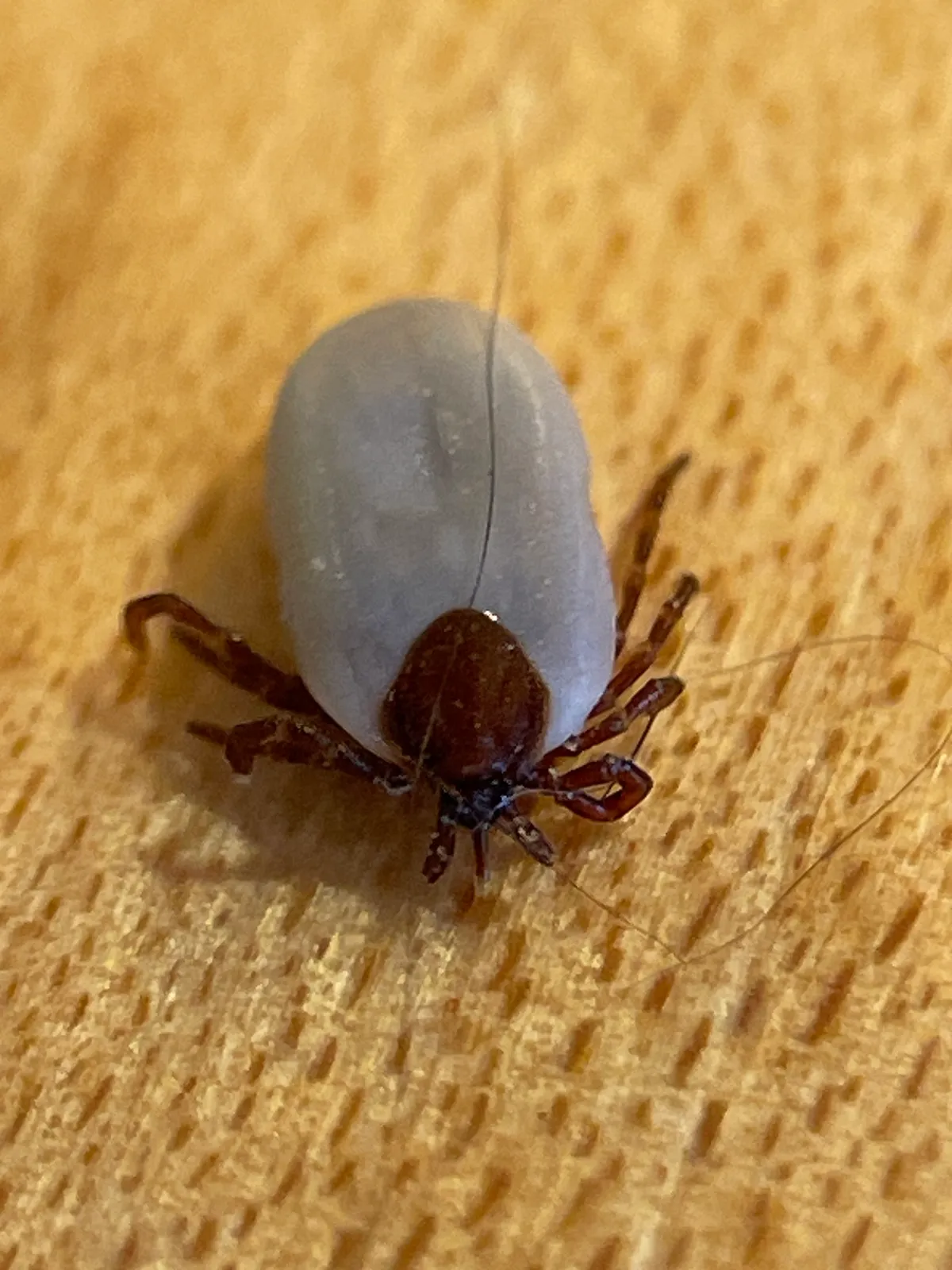
Where are blacklegged ticks found in Wisconsin?
Nearly everywhere. CDC's county surveillance table, which runs through December 31, 2025, lists blacklegged ticks as established in 61 of Wisconsin's 72 counties and reported in 7 more: Dodge, Florence, Outagamie, Ozaukee, Polk, Shawano and Winnebago. Calumet, Iron, Kewaunee and Washington counties have no record. Established means six or more ticks of one life stage, or more than one life stage, were collected in a county within 12 months; reported means fewer than six of one life stage. To compare other states, see tick maps and Lyme data for every state.
Blacklegged (deer) tick status by county, Wisconsin, through 2025
- Established
- Reported
- No record
Show the list
Established (61): Adams, Ashland, Barron, Bayfield, Brown, Buffalo, Burnett, Chippewa, Clark, Columbia, Crawford, Dane, Door, Douglas, Dunn, Eau Claire, Fond du Lac, Forest, Grant, Green, Green Lake, Iowa, Jackson, Jefferson, Juneau, Kenosha, La Crosse, Lafayette, Langlade, Lincoln, Manitowoc, Marathon, Marinette, Marquette, Menominee, Milwaukee, Monroe, Oconto, Oneida, Pepin, Pierce, Portage, Price, Racine, Richland, Rock, Rusk, Sauk, Sawyer, Sheboygan, St. Croix, Taylor, Trempealeau, Vernon, Vilas, Walworth, Washburn, Waukesha, Waupaca, Waushara, Wood
Reported (7): Dodge, Florence, Outagamie, Ozaukee, Polk, Shawano, Winnebago
No record (4): Calumet, Iron, Kewaunee, Washington
Read the map as a record of collecting, not of risk. CDC says a county with no records should not be taken as free of the tick, because the gap can reflect a lack of sampling, and DHS says deer ticks are present in every Wisconsin county. Florence County, listed only as reported, had the state's highest Lyme disease rate in 2023 (see the county map below). Status is also cumulative: once a county is established, it stays that way.

Which germs have been found in Wisconsin ticks?
CDC's companion table records where each germ has been found in host-seeking blacklegged ticks, meaning ticks hunting for a host rather than feeding on one. It is cumulative, and a county without a record is not proof the germ is absent.
| Germ | Illness | Wisconsin counties with a record |
|---|---|---|
| Borrelia burgdorferi | Lyme disease | 41 |
| Borrelia miyamotoi | Hard tick relapsing fever | 28 |
| Anaplasma phagocytophilum (human-active variant) | Anaplasmosis | 24 |
| Babesia microti | Babesiosis | 22 |
| Borrelia mayonii | Lyme disease (a rare cause) | 7 |
| Powassan virus | Powassan virus disease | 7 |
| Ehrlichia muris eauclairensis | Ehrlichiosis | 6 |
Source: CDC ArboNET Tick Module, pathogen table through December 2025.
The Lyme bacterium's 41 counties stretch from Bayfield and Ashland on Lake Superior to Walworth on the Illinois line, and the anaplasmosis and babesiosis germs have each been recorded in more than 20 counties.
Is the lone star tick in Wisconsin?
It turns up, but whether it has settled in depends on whom you ask. UW–Madison's lone star tick page says the species does not yet have an established population in Wisconsin. It is rarely found, though there are submissions every year, especially from the southern half of the state but as far north as Douglas County. The researchers think a few ticks most likely arrive on migrating birds each year and survive the summer, but not a Wisconsin winter.
CDC's tick surveillance data (ArboNET Tick Module) read differently: through 2025, they list the lone star tick as established in one Wisconsin county, Dane, and reported in 26 others. The two are not measuring the same thing. CDC calls a county established once six or more ticks of one life stage, or more than one life stage, have been collected there within 12 months, and the label stays in later years. UW–Madison is judging whether the tick breeds here and survives the winter, and it says its own map of counties with a lone star record does not mean the tick is established and breeding there.
Residents do find them. The DHS identification service received 41 lone star tick submissions from Wisconsin residents in 2026 through the week of September 28, about 1 in 20 of the ticks it identified, according to the department's late-September surveillance report.

Lyme disease is not the main worry with this tick: UW–Madison says transmission of the Lyme bacterium by lone star ticks has not been confirmed. The species is the main carrier of the bacteria behind two forms of ehrlichiosis, and the same page reports evidence of infection with one of them, Ehrlichia chaffeensis, in Wisconsin residents with no travel history, although DHS says most Wisconsin residents infected with it caught it while traveling to other states. Research also suggests its bite can leave some people allergic to red meat, a condition called alpha-gal syndrome, with symptoms UW–Madison says range from hives to severe shock; see alpha-gal syndrome and the tick bites linked to it.
Has the Asian longhorned tick reached Wisconsin?
Not as of April 2026. UW–Madison Extension said then that the tick had not been identified in Wisconsin, although it had been found in neighboring Michigan, Illinois and Iowa within the previous two years and research suggests Wisconsin's climate is suitable for it. First identified in the US in New Jersey in 2017, it has spread mainly as an unnoticed passenger on cattle and other livestock moved around the country, and its females can reproduce without mating.
Extension says ticks found on livestock can be submitted to a veterinarian or to the UW–Madison Department of Entomology for identification. A tick found on a person or a pet can also go to the DHS photo identification service described below.
How much Lyme disease does Wisconsin have?
More than any other Midwestern state. Wisconsin reported 6,283 Lyme disease cases in 2023, a rate of 106.9 per 100,000 residents, according to CDC's Lyme disease surveillance data. Only New York, Pennsylvania, Massachusetts and New Jersey reported more, Wisconsin's cases made up about 7% of the US total, and its rate ranked ninth among the states.
Reported Lyme disease cases in Wisconsin, 2008 to 2023
Cases per year, by state of residence
Show the numbers
| Confirmed and probable cases | |
|---|---|
| 2008 | 2,034 |
| 2009 | 2,589 |
| 2010 | 3,488 |
| 2011 | 3,649 |
| 2012 | 1,766 |
| 2013 | 1,872 |
| 2014 | 1,361 |
| 2015 | 1,894 |
| 2016 | 2,295 |
| 2017 | 3,000 |
| 2018 | 1,869 |
| 2019 | 2,178 |
| 2020 | 1,447 |
| 2021 | 2,193 |
| 2022 | 5,208 |
| 2023 | 6,283 |
Read the jump after 2021 with care. DHS says its current case definition, in effect since January 1, 2022, relies largely on laboratory data alone, where the old one leaned on a combination of laboratory and clinical information. Fewer criteria are now needed for a report to count as a case, which raised counts statewide and in most counties, so figures from 2022 on are not directly comparable with 2021 or earlier, according to the department's Lyme disease tracking page.
The state's newer counts are higher still. The department's downloadable data show 6,469 cases in 2024 and 8,930 in 2025 (its Lyme data page says 8,929), the most in records going back to 1991, a rate of 149.5 per 100,000 residents. DHS says most of the increase from 2024 to 2025 can be explained by a reporting change: in 2025 it began receiving reports of rashes diagnosed by health care providers through electronic case reporting, which was introduced to close gaps in reporting. For 2023 the state's own count is 6,379; this page uses CDC's 6,283 for the years CDC has published.
How does Wisconsin compare with its neighbors?
Wisconsin's 2023 count was more than double Minnesota's and more than five times Michigan's, while Illinois and Iowa reported a few hundred cases each. Minnesota's rate was about half of Wisconsin's.
| State | Lyme cases, 2023 | Cases per 100,000, 2023 |
|---|---|---|
| Wisconsin | 6,283 | 106.9 |
| Minnesota | 2,938 | 51.4 |
| Michigan | 1,152 | 11.5 |
| Illinois | 372 | 2.9 |
| Iowa | 212 | 6.6 |
Confirmed and probable cases by state of residence, from CDC Lyme disease surveillance data. Data through 2023, the latest year CDC had published as of October 2026.
Which Wisconsin counties have the most Lyme disease?
Relative to population, counties across the north, the center and the west. In 2023, Florence, Jackson and Pepin counties each recorded more than 500 cases per 100,000 residents, about five times the statewide rate, and 20 more counties were between 250 and 499. The map shows the 2023 rate for every county, calculated by BuzzSkito from CDC's county-level Lyme data and the Census Bureau's county population estimates.
Lyme disease cases per 100,000 residents by county, Wisconsin, 2023
- 500 or more
- 250 to 499
- 100 to 249
- Under 100
Show the list
500 or more (3): Florence, Jackson, Pepin
250 to 499 (20): Adams, Bayfield, Buffalo, Burnett, Door, Dunn, Forest, Juneau, Lincoln, Marinette, Marquette, Oconto, Oneida, Polk, Price, Rusk, Sawyer, Trempealeau, Washburn, Waushara
100 to 249 (28): Ashland, Barron, Chippewa, Clark, Columbia, Crawford, Douglas, Eau Claire, Grant, Green Lake, Iowa, La Crosse, Langlade, Marathon, Menominee, Monroe, Pierce, Portage, Richland, Sauk, Shawano, St. Croix, Taylor, Vernon, Vilas, Washington, Waupaca, Wood
Under 100 (21): Brown, Calumet, Dane, Dodge, Fond du Lac, Green, Iron, Jefferson, Kenosha, Kewaunee, Lafayette, Manitowoc, Milwaukee, Outagamie, Ozaukee, Racine, Rock, Sheboygan, Walworth, Waukesha, Winnebago
| County | Lyme cases, 2023 | Cases per 100,000 |
|---|---|---|
| Florence | 27 | 575.8 |
| Jackson | 113 | 539.9 |
| Pepin | 38 | 508.2 |
| Burnett | 72 | 420.9 |
| Marquette | 65 | 408.6 |
| Washburn | 66 | 388.3 |
| Oneida | 139 | 364.3 |
| Adams | 79 | 363.7 |
| Price | 51 | 361.9 |
| Marinette | 145 | 344.3 |
The ten counties with the highest 2023 rates. Sources as for the map.
Raw counts follow population instead. Dane County, home to Madison, had the most cases in 2023 (295), followed by Waukesha (268), Marathon (245) and Eau Claire (229), yet Dane's rate of 50.9 per 100,000 was less than half the state's. Rates were lowest in the south and east: Lafayette (17.6), Milwaukee (21.6), Kenosha (26.2) and Racine (27.9) counties had the four lowest.
Two cautions apply to any county figure. Cases are counted where the patient lives, which is not necessarily where the bite happened, as CDC's Lyme case map page notes, and DHS adds that some infections are picked up while traveling. And small counties swing from year to year: Florence County's rate rests on 27 cases among about 4,700 residents, Lafayette's on 3.
Which other tick-borne diseases occur in Wisconsin?
Anaplasmosis comes next. DHS calls it the second most common illness spread by ticks in Wisconsin, after Lyme disease. The state averaged 617 confirmed and probable cases a year from 2016 through 2025, and 2025 brought 1,076, the most ever documented in Wisconsin, according to the department's anaplasmosis data page. Cases are most common in June and July and are reported most often among people living in the northern, western and northeastern regions. CDC's table records the germ's human-active variant in blacklegged ticks from 24 counties.
Powassan virus disease is rare, but Wisconsin reports more of it than almost any other state. CDC's Powassan virus data show 85 Wisconsin cases from 2004 through 2025, second only to Minnesota's 89, including 12 in 2024 and 18 in 2025, the most of any state that year. Of the 85, 76 were neuroinvasive, which CDC describes as the severe form; it notes that milder illness is more likely to go unreported. CDC's tick table records Powassan virus in blacklegged ticks from 7 Wisconsin counties.
Reported Powassan virus disease cases in Wisconsin, 2004 to 2025
Cases per year
Show the numbers
| All reported cases | |
|---|---|
| 2004 | 0 |
| 2005 | 0 |
| 2006 | 1 |
| 2007 | 1 |
| 2008 | 0 |
| 2009 | 0 |
| 2010 | 4 |
| 2011 | 4 |
| 2012 | 2 |
| 2013 | 5 |
| 2014 | 2 |
| 2015 | 1 |
| 2016 | 5 |
| 2017 | 3 |
| 2018 | 3 |
| 2019 | 7 |
| 2020 | 4 |
| 2021 | 3 |
| 2022 | 8 |
| 2023 | 2 |
| 2024 | 12 |
| 2025 | 18 |
Other germs travel with Wisconsin's deer ticks too. CDC's table records Babesia microti, the cause of babesiosis, in ticks from 22 counties; Borrelia miyamotoi, the cause of hard tick relapsing fever, in 28; and Ehrlichia muris eauclairensis, a cause of ehrlichiosis, in 6.
When is tick season in Wisconsin?
Mainly April through September, but exposure can happen in any month. The DHS page on ticks in Wisconsin says ticks are most active during the warmer months, April to September, and that tick exposure can occur year-round. The two stages that usually spread illness, nymphs and adult females, peak at different times: deer tick nymphs from late May into July, and adults in spring and again in fall.
DHS tracks the season in the field. About every other week from March through November, its staff pull a white denim drag cloth along a path about 2,460 feet (750 meters) long at sentinel sites in Iowa, Lincoln and Waupaca counties and collect the ticks that cling to it. In 2026, adult deer ticks peaked in mid-April, nymphs were most numerous from late May through July, and larvae peaked in early August; by the end of September adults were increasing again, the department's late-September report shows. Its charts for 2025 show adults collected again from October into November.
| Time of year | Adult deer ticks | Deer tick nymphs | What Wisconsin's data show |
|---|---|---|---|
| December to February | Not sampled; the state's field collections run from about March to November | Not sampled | Tick exposure can still occur year-round, DHS says |
| March to May | Active; at the sentinel sites they peaked in mid-April in 2026 | First appear in mid to late May | Tick bite emergency visits begin to rise in spring, when adult ticks are active |
| June and July | Few after early June | Most numerous, from late May through July | Emergency visits build to a summer peak as nymphs emerge; anaplasmosis cases are most common in June and July |
| August and September | Few until late September, then increasing | Tapering off | Larvae peak in early August, but usually only nymphs and adult females spread illness |
| October and November | Active again; in 2025 they were collected into November | Few or none | Field sampling typically ends in November |
Life stages: DHS sentinel-site collections in Iowa, Lincoln and Waupaca counties, from the late-September 2026 tick surveillance report, which also charts 2025; DHS notes the sites may not reflect the chance of meeting a tick everywhere in the state. Emergency visits and the year-round warning: Ticks in Wisconsin: Data and Surveillance. Anaplasmosis months: DHS anaplasmosis data.
Where can you get a tick identified in Wisconsin?
Through the DHS Tick Identification Service. The department's tick data page says residents of Wisconsin, Illinois, Iowa, Michigan and Minnesota can answer a few questions and submit photographs online to have a tick identified. As of October 2026, the service cannot determine whether the tick was carrying germs or whether it made you sick.
DHS says the only way to know whether a tick made you sick is an evaluation, and sometimes a blood test, by a health care provider. Identification still helps: knowing whether it was a deer tick, the tick that spreads Lyme disease in Wisconsin, gives your provider something concrete, so photograph a tick before you dispose of it.
What should you do after a tick bite in Wisconsin?
Remove the tick right away, consider calling a health care provider promptly about a single preventive antibiotic dose, and watch your health for 30 days. The DHS tick bite prevention page describes removal this way:
- Grasp the tick with narrow-bladed tweezers as close to the skin as possible; if you have none, cover your fingers with tissue paper or rubber gloves.
- Pull up and out with steady, firm pressure.
- Clean the bite with rubbing alcohol, then wash your hands with soap and water.
- Do not twist, squeeze, crush or puncture the tick, and do not put petroleum jelly, a hot match or nail polish on it.
For a fuller walk-through, see the step-by-step tick removal guide.
DHS's tick data page suggests that anyone bitten who lives in Wisconsin, where Lyme disease is common, consider contacting a health care provider right away to see whether a single dose of antibiotics may be appropriate. Its Lyme disease page says preventive treatment must be taken within 72 hours of removing the tick, and CDC says a tick usually must be attached for more than 24 hours to spread Lyme disease, so quick removal counts. A provider decides whether the dose fits your case.
Then watch for symptoms. DHS asks people to monitor themselves for a rash, fever, new muscle and joint pain and new fatigue for 30 days after a bite, and to call a provider at once if any appear. CDC lists early Lyme symptoms 3 to 30 days after the bite: fever, chills, headache, fatigue, muscle and joint aches and swollen lymph nodes.
The rash appears in about 70% to 80% of cases, expands over days or weeks, and can look reddish, gray or purple depending on skin tone; it may clear in the center as it grows. A small bump or redness at the bite site is common and usually fades in one to two days. The stages of Lyme disease symptoms covers what can follow if it goes untreated.

How do you prevent tick bites in Wisconsin?
Use repellent, treat clothing with permethrin, keep to the middle of trails and check everyone, pets included, after time outdoors. The DHS tick bite prevention page recommends:
- Repellent on skin and clothing. The department lists products with 20% to 30% DEET, 10% to 20% picaridin, 15% to 20% IR3535 or 30% to 40% oil of lemon eucalyptus. Do not use oil of lemon eucalyptus on children under 3, and apply repellent to children yourself, avoiding their hands, eyes and mouth.
- Permethrin on clothes, not skin. Treat clothing, shoes and gear; the treatment lasts through several washes.
- Covered, light-colored clothing. Wear long sleeves, long pants and tall socks, tuck your shirt into your pants and your pants into your socks or shoes, and tape the gap for long days outdoors.
- The middle of the trail. Walk in the center, avoid brushing against plants at the edge, and stay out of brushy areas with tall grass and leaf litter.
- Checks, a shower and the dryer. Check your whole body after being outdoors, including in your own yard: armpits, behind the knees, scalp, in and around the ears, inside the belly button and the groin. Shower within two hours of coming inside, and tumble dry clothes on high heat for 10 minutes, or 60 minutes if they are damp.
Around the house, DHS suggests clearing tall grass, brush and leaf litter, mowing often, putting a barrier of wood chips or gravel between lawn and woods (CDC recommends one 3 feet wide), keeping play equipment in a sunny spot away from the woods, not feeding deer, and stacking firewood neatly in a dry place away from the house. It also mentions a spring application of a tick-killing pesticide, following federal and state pesticide rules.
Pets bring ticks indoors as well. DHS advises checking pets, clothing and gear before going inside and using a tick treatment your veterinarian recommends. Our guide to ticks on dogs covers checks and removal on pets.
This guide is general educational information, not medical advice. If you have symptoms or concerns after a bite or exposure, contact a healthcare provider.
Use any pesticide exactly as its label directs. The label is the law, and what is registered and sold varies by state.
Frequently Asked Questions
Do wood ticks carry Lyme disease in Wisconsin?+
There is no evidence that they can pass it on. UW–Madison's tick researchers say the Lyme bacterium has been found in wood ticks, also called American dog ticks, but there is no scientific evidence that they can transmit it, and the tick has not been associated with disease transmission in Wisconsin. Elsewhere in the US it can spread Rocky Mountain spotted fever and tularemia. In Wisconsin, Lyme disease is spread by the blacklegged, or deer, tick, so it helps to know which tick bit you.
Are ticks active in Wisconsin in the winter?+
Tick exposure can occur year-round, the state health department says, although ticks are most active from April through September. Adult deer ticks are most active in the cooler months: at the state's sampling sites they peak in spring and return in fall, and in 2025 they were still being collected in November. The department advises caution throughout the year, so check for ticks after time in woods, brush or leaf litter on mild days.
Which Wisconsin county has the most Lyme disease?+
It depends on whether you count cases or rates. Dane County had the most cases in 2023, 295, because so many people live there. Relative to population, Florence County was highest, at about 576 cases per 100,000 residents, followed by Jackson and Pepin counties, based on CDC county counts and Census population estimates. Cases are counted where patients live, not where they were bitten, and small counties can swing sharply from year to year.
Can I get a tick tested for Lyme disease in Wisconsin?+
Not through the state's identification service. As of October 2026, the Wisconsin Department of Health Services identifies ticks from photos submitted online, but the service cannot tell whether a tick carried germs or made you sick. The department says the only way to know whether a tick made you sick is an evaluation, and sometimes a blood test, by a health care provider. After a bite, the department suggests Wisconsin residents consider asking a provider promptly about a single preventive antibiotic dose, which must be taken within 72 hours of removing the tick.
How many Lyme disease cases did Wisconsin have in 2025?+
The state health department counted 8,930 confirmed and probable cases in 2025, the most in its records, which go back to 1991, or about 149.5 per 100,000 residents. It says most of the increase from 2024, when it counted 6,469, came from a reporting change: rashes diagnosed by health care providers began reaching the state through electronic case reporting. As of October 2026, CDC's published state figures ran only through 2023, when Wisconsin reported 6,283 cases.
Is the lone star tick established in Wisconsin?+
It depends on the definition. UW–Madison's tick researchers say the species does not yet have an established population in the state, while CDC's surveillance data, which count a county as established once a collection threshold is met, list one county, Dane, as established through 2025. Lone star ticks are found every year, mostly in the southern half of Wisconsin but as far north as Douglas County, and most likely arrive on migrating birds without surviving the winter. The state's identification service had received 41 from residents in 2026 as of early October. Lyme transmission by this tick has not been confirmed, but research suggests its bite can trigger a red meat allergy, alpha-gal syndrome.
Sources
- Lyme Disease Surveillance Data — Centers for Disease Control and Prevention
- Lyme Disease Case Maps (county-level data, 2023) — Centers for Disease Control and Prevention
- How Lyme Disease Spreads (September 24, 2024) — Centers for Disease Control and Prevention
- Signs and Symptoms of Untreated Lyme Disease (May 15, 2024) — Centers for Disease Control and Prevention
- Tick Surveillance Data Sets — Centers for Disease Control and Prevention (ArboNET Tick Module)
- Powassan Virus: Historic Data (2004-2025) — Centers for Disease Control and Prevention (ArboNET)
- County Population Totals and Components of Change: 2020-2025 — U.S. Census Bureau
- Environmental Public Health Tracking: Lyme Disease (with downloadable state data) — Wisconsin Department of Health Services
- About Lyme Disease — Wisconsin Department of Health Services
- Ticks in Wisconsin: Data and Surveillance — Wisconsin Department of Health Services
- Tick Surveillance Report, Epidemiological Week 39 (collection dates September 28 to October 2, 2026), P-03757 — Wisconsin Department of Health Services, Vectorborne Disease Unit
- Anaplasmosis: Wisconsin Data — Wisconsin Department of Health Services
- Tick Bite Prevention — Wisconsin Department of Health Services
- The American Dog Tick/Wood Tick (Dermacentor variabilis) — University of Wisconsin–Madison, Department of Entomology (Wisconsin Ticks and Tick-borne Diseases)
- The Lone Star Tick (Amblyomma americanum) — University of Wisconsin–Madison, Department of Entomology (Wisconsin Ticks and Tick-borne Diseases)
- Other Tick Species Found in Wisconsin — University of Wisconsin–Madison, Department of Entomology (Wisconsin Ticks and Tick-borne Diseases)
- Livestock Producers Encouraged to be on the Lookout for Asian Longhorned Ticks (April 14, 2026) — University of Wisconsin–Madison Division of Extension, Livestock Program
How this guide was made: it was researched and drafted with AI assistance from the sources listed above. A second, independent AI pass then checked each factual claim against those sources. Found an error? Email support@buzzskito.ca.
