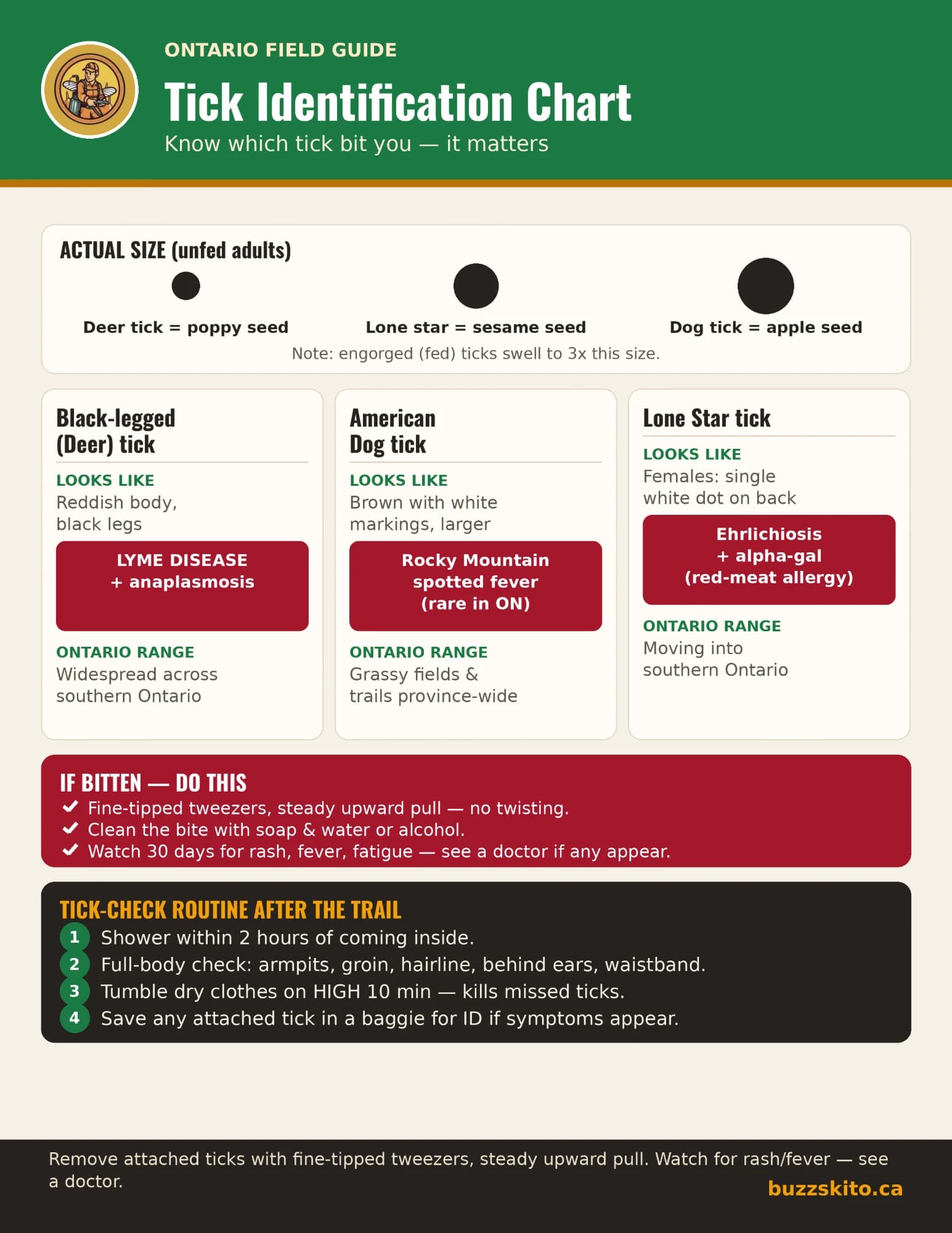
What tick causes the red meat allergy?
The lone star tick (Amblyomma americanum) is the tick that causes the red meat allergy known as alpha-gal syndrome. When it bites, it can transfer a sugar called galactose-alpha-1,3-galactose — alpha-gal for short — into the person, and the immune system may then treat that sugar as a threat.
Alpha-gal is present in most non-primate mammals, so once someone is sensitized, their body can react to beef, pork, lamb, venison, and sometimes dairy, gelatin, and a handful of medications. The U.S. Centers for Disease Control and Prevention (CDC) names the lone star tick as the primary cause of alpha-gal syndrome in the United States. Researchers elsewhere are studying whether other tick species could occasionally play a role, but as of 2026 the lone star tick is the main documented culprit worldwide. You can see how it differs from the ticks Canadians actually meet in our tick identification guide.
As an Amazon Associate I earn from qualifying purchases. BuzzSkito only points to products we would genuinely use or recommend, at no extra cost to you.
As an Amazon Associate I earn from qualifying purchases. Price shown on Amazon.ca, at no extra cost to you.
🏆 Worth Keeping in the Drawer
Whether the tick turns out to be a lone star or, far more likely, a blacklegged tick, the safe removal is the same: grip at the skin line and lift straight out. A fine-tipped tool does that cleanly, and the intact tick can be photographed for an eTick.ca identification.
Check price on Amazon.caIs the lone star tick in Canada?
The lone star tick is not established in Canada. Canada’s national tick-surveillance platform eTick and the Public Health Agency of Canada (PHAC) log only a small number of “adventive” lone star ticks each year — individual ticks found well outside their normal range, most believed to have hitched a ride north on migratory birds rather than breeding here.
That distinction matters. An adventive tick is a one-off arrival; an established tick has a self-sustaining local population, the way the blacklegged tick now does across much of southern Ontario. As of 2026, there is no confirmed established, reproducing lone star tick population anywhere in Canada. The species’ core range sits in the U.S. Southeast and south-central states, though it has been steadily expanding north and east for decades — the same climate-driven pattern that pushed blacklegged ticks into the GTA. That is why scientists keep watching, and why every verified Canadian find is logged. For the broader picture of which ticks live here, see are there ticks in Canada?
Is the lone star tick in Ontario?
Occasionally, yes — but it is not established in Ontario. Southern Ontario, including the Greater Toronto Area, records a handful of lone star tick submissions to eTick in a typical year, and almost all are thought to be single ticks dropped by migratory birds rather than evidence of a local population.
Ontario’s two established human-biting ticks remain the blacklegged (deer) tick, which is the Lyme disease vector, and the American dog tick. If you pull a tick off yourself, a family member, or a pet in Ontario, the overwhelming odds are that it is one of those two — not a lone star tick. The safest move is not to guess: photograph it and submit it to eTick.ca for a free expert identification, which also feeds the surveillance data that tracks any northward spread.
How the lone star tick compares to Ontario’s established ticks
The quickest way to place the lone star tick in context is side by side with the two ticks you are actually likely to encounter in the GTA.
| Feature | Lone star tick | Blacklegged (deer) tick | American dog tick |
|---|---|---|---|
| Scientific name | Amblyomma americanum | Ixodes scapularis | Dermacentor variabilis |
| Established in Ontario? | No — rare adventive finds | Yes — expanding | Yes — widespread |
| Distinctive mark | Single white dot on female’s back | Plain reddish-black body, black legs | Mottled grey-and-brown shield |
| Main concern | Alpha-gal (red meat allergy) | Lyme disease | Rocky Mountain spotted fever (rare) |
| Causes alpha-gal? | Primary cause | Not documented | Not documented |
The takeaway: the tick behind the red meat allergy is the one Ontario is least likely to have, while the tick Ontario definitely has (blacklegged) carries a different risk — Lyme disease — that is well worth taking seriously.
What is alpha-gal syndrome?
Alpha-gal syndrome (AGS) is an allergic condition in which a person reacts to galactose-alpha-1,3-galactose, a sugar molecule found in most mammals but not in humans, apes, or Old World monkeys. It is sometimes called alpha-gal allergy or simply the “red meat allergy.”
The unusual part is how it starts: rather than being born with it, people typically acquire alpha-gal syndrome after one or more tick bites — primarily lone star tick bites in the United States. The bite appears to prime the immune system to recognize alpha-gal, so that eating mammalian products later triggers an allergic response. Affected foods can include beef, pork, lamb, venison, and organ meats, and for some people dairy, gelatin (in candy, marshmallows, and some capsules), and certain medical products that contain mammalian ingredients. The condition is recognized by both the U.S. CDC and allergy specialists internationally, though awareness in Canada is still growing.
What are the symptoms of alpha-gal syndrome?
Alpha-gal symptoms usually appear 2 to 6 hours after eating mammalian meat or products, and they range from mild to life-threatening. That delay is the single most confusing feature of the syndrome — most food allergies strike within minutes, so people rarely connect a midnight bout of hives to the steak they ate at dinner.
Reported signs include:
- Hives, itching, or an eczema-like rash
- Swelling of the lips, face, tongue, or throat
- Stomach pain, nausea, diarrhea, or vomiting
- Runny nose, sneezing, or shortness of breath
- A sharp drop in blood pressure, dizziness, or fainting
- Anaphylaxis — a severe, whole-body reaction that is a medical emergency
Because reactions are delayed and vary from meal to meal (fatty cuts and factors like exercise or alcohol can intensify them), alpha-gal syndrome is often misdiagnosed or missed for months. Diagnosis is made by a physician or allergist, usually with a blood test that measures alpha-gal specific IgE antibodies. If you suspect it, do not attempt to self-diagnose — this is a YMYL health matter and warrants a professional assessment.
Medical note: anaphylaxis can be fatal. If someone has difficulty breathing, throat swelling, or collapses after eating, call 911 and use an epinephrine auto-injector if one has been prescribed. This page does not replace advice from a doctor or allergist.
Can you get a meat allergy from a tick in Canada?
It is possible but very rare in Canada. Because the lone star tick is not established here, the chance of acquiring alpha-gal syndrome from a bite that happened on Canadian soil is low as of 2026. The higher-risk exposure for Canadians is travel — a great many alpha-gal cases connected to Canada trace back to time spent in endemic U.S. regions such as the Southeast, where the lone star tick is common and residents spend the summer outdoors in its habitat.
That said, the risk is not strictly zero. Occasional lone star ticks do reach Canada, and researchers continue to investigate whether other tick species might rarely contribute to alpha-gal sensitization. For now, the honest summary is this: a home-grown Ontario meat allergy caused by a local tick is uncommon and not something the average GTA homeowner needs to lose sleep over — but it is a real emerging condition worth understanding, especially if you travel south or if you develop unexplained delayed reactions after eating red meat. In either case, an allergist is the right next stop.
How to lower your tick-bite risk in the GTA
Whatever the tick species, the prevention playbook is the same, and it also happens to be your best defence against the far more common local threat — Lyme disease from blacklegged ticks.
- Dress for it. In tick habitat, wear light-coloured long sleeves and long pants tucked into your socks so ticks are easier to spot and slower to reach skin.
- Use a repellent. Apply a repellent such as DEET or icaridin, with a PCP registration number on the label, to exposed skin, following the label.
- Stay on the trail. Ticks wait on tall grass and brush at trail edges — walking down the centre of cleared paths keeps you out of their reach.
- Check within two hours. Do a full-body tick check (and check kids and pets) soon after coming indoors; a shower helps wash off unattached ticks.
- Manage the yard. Keep grass mown, clear leaf litter, and maintain a barrier between lawn and any wooded or tall-grass edge — the transition zone where ticks concentrate.
- Remove ticks promptly. Use fine-tipped tweezers, grasp at the head close to the skin, and pull straight up without twisting. Save the tick and submit a photo to eTick.ca.
Step two is the one most people under-do: a repellent with a PCP registration number on the label, applied to socks, ankles and lower legs, because ticks climb aboard from the ground up rather than landing from the air. See icaridin repellents on Amazon.ca →
The bottom line for Ontario residents
The lone star tick is the cause of alpha-gal syndrome, and alpha-gal syndrome is a genuine, sometimes serious red meat allergy. But the lone star tick is not established in Canada — only occasional individuals turn up, and there is no confirmed breeding population in Ontario as of 2026. Your realistic tick risk in the GTA is Lyme disease from the blacklegged tick, which is exactly why the prevention steps above are worth building into every warm-weather outing. Watch the lone star tick as a slow-moving, climate-linked story; act on the ticks Ontario already has.
As an Amazon Associate I earn from qualifying purchases. BuzzSkito only points to products we would genuinely use or recommend, at no extra cost to you.
Whatever the species turns out to be, step six on that list is the one that decides how the bite goes, and it is far easier with a dedicated remover than with the blunt tweezers in most bathroom drawers. A fine-tipped tick tool grips the mouthparts right at skin level and lifts the tick straight out, so you are less likely to leave the head behind or squeeze the tick’s gut contents into the wound — and the tick comes off intact enough to photograph for an eTick.ca submission, which is exactly what surveillance needs if it ever is a lone star. Worth keeping one by the back door and one in the hiking pack: check tick-removal tools on Amazon.ca →
Related Reading
- Types of Ticks — Identification Guide
- Blacklegged (Deer) Tick in Ontario — Lyme Risk
- American Dog Tick — Canada Identification & Risk
- Are There Ticks in Canada?
- BuzzSkito Tick Control Service
Frequently Asked Questions
What tick causes the red meat allergy (alpha-gal syndrome)?+
The lone star tick (Amblyomma americanum) is the tick species most strongly linked to alpha-gal syndrome, the delayed allergy to red meat. Its bite can transfer galactose-alpha-1,3-galactose (alpha-gal) — a sugar found in most non-primate mammals — into a person, and the immune system can then react to that same sugar when they later eat beef, pork, lamb, or other mammalian products. According to the U.S. CDC, the lone star tick is the primary cause in the United States. Researchers are investigating whether other tick species could contribute elsewhere, but as of 2026 the lone star tick remains the main documented culprit.
Is the lone star tick in Canada?+
The lone star tick is not established in Canada. Canada's national tick-monitoring platform eTick and the Public Health Agency of Canada (PHAC) record only occasional "adventive" lone star ticks each year — individual specimens that turn up far outside their normal range, most believed to be carried north by migratory birds rather than reproducing local populations. In plain terms: a lone star tick can occasionally be found in Canada, but there is no confirmed established, breeding population as of 2026. Southern Ontario is considered a plausible future range as the climate warms, so surveillance continues.
Is the lone star tick in Ontario?+
Occasionally, yes — but it is not established here. Southern Ontario, including the Greater Toronto Area, sees a small number of lone star tick submissions to eTick most years, almost all thought to be single ticks dropped by migratory birds. There is no confirmed reproducing lone star tick population in Ontario as of 2026. Ontario's established human-biting ticks remain the blacklegged (deer) tick — the Lyme disease vector — and the American dog tick. If you find any tick in Ontario, you can photograph and submit it to eTick.ca for free identification.
What is alpha-gal syndrome?+
Alpha-gal syndrome (AGS), sometimes called alpha-gal allergy or the "red meat allergy," is an allergic condition in which a person reacts to galactose-alpha-1,3-galactose (alpha-gal), a sugar molecule found in most mammals but not in humans, apes, or Old World monkeys. After certain tick bites — primarily the lone star tick in the United States — some people become sensitized and then have allergic reactions to red meat (beef, pork, lamb, venison) and sometimes dairy, gelatin, or certain medications. Reactions are usually delayed, appearing 2 to 6 hours after eating, which makes AGS unusually hard to recognize.
What are the symptoms of alpha-gal syndrome?+
Symptoms of alpha-gal syndrome typically appear 2 to 6 hours after eating mammalian meat or products, and can range from mild to life-threatening. Common signs include hives or itchy skin, swelling of the lips, face, tongue or throat, stomach pain, nausea, diarrhea or vomiting, and — in severe cases — anaphylaxis (a sudden drop in blood pressure, difficulty breathing, and shock). Because the reaction is delayed rather than immediate, people often do not connect it to the meal. Alpha-gal syndrome should be diagnosed and managed by a physician or allergist; this article is general information, not medical advice.
Can you get a meat allergy from a tick in Canada?+
It is possible but very rare in Canada. Because the lone star tick is not established here, the domestic risk of acquiring alpha-gal syndrome from a Canadian tick bite is low as of 2026. Most alpha-gal cases connected to Canadians are linked to travel to endemic regions such as the U.S. South and Southeast, where the lone star tick is common. Researchers continue to investigate whether other tick species could rarely be involved, so the risk is not strictly zero — but for now, a home-grown Ontario meat allergy from a tick is uncommon. If you develop delayed reactions to red meat, see an allergist.
How long after a lone star tick bite does alpha-gal develop?+
Sensitization is not immediate. After one or more lone star tick bites, alpha-gal antibodies can build over a period of weeks to a few months, and the first allergic reaction to red meat may occur only after that. Some people notice reactions after a single bite; others require multiple bites. Because the food reaction itself is delayed 2 to 6 hours after eating, the whole timeline — bite, then sensitization, then a delayed meal reaction — can make alpha-gal syndrome difficult to trace back to a tick. An allergist can confirm it with a blood test for alpha-gal specific IgE antibodies.
Do blacklegged (deer) ticks cause alpha-gal in Canada?+
The blacklegged (deer) tick is not a documented cause of alpha-gal syndrome in Canada. Its main medical concern in Ontario is Lyme disease, which it can transmit through the bacterium Borrelia burgdorferi. The lone star tick — a different species — is the one linked to alpha-gal. Some international researchers are studying whether other tick species might rarely trigger alpha-gal, but there is no established evidence that Canadian blacklegged ticks cause the red meat allergy. For Lyme risk from deer ticks in Ontario, see our blacklegged tick guide.
Does alpha-gal syndrome go away?+
For some people, alpha-gal syndrome improves over time, especially if they avoid further tick bites. Alpha-gal antibody levels can decline over months to years, and some individuals are eventually able to tolerate red meat again. However, this is not guaranteed, and new tick bites can reset or worsen the sensitivity. Management centres on avoiding mammalian meat and products that trigger reactions, avoiding further tick bites, and carrying prescribed emergency medication (such as an epinephrine auto-injector) if an allergist advises it. Any changes to diet or treatment should be guided by a medical professional.
How do I avoid tick bites in Ontario to lower alpha-gal risk?+
The same tick-bite prevention that lowers Lyme disease risk also lowers any alpha-gal risk: wear light-coloured long sleeves and pants tucked into socks in tick habitat, use a repellent such as DEET or icaridin with a PCP registration number on the label, stay on cleared trails, and do a full-body tick check within a couple of hours of coming indoors. At home, keep grass mown, clear leaf litter, and maintain a barrier between lawn and wooded or tall-grass edges. Professional yard barrier spray targeting lawn edges and shaded perimeters reduces the tick population where bites actually happen. If you find a tick, remove it promptly with fine-tipped tweezers and submit a photo to eTick.ca.
What should I do if I think I found a lone star tick in Canada?+
Photograph the tick and submit it to eTick.ca, Canada's free public tick-identification platform run with the Public Health Agency of Canada and partner universities — this helps track any range expansion. Remove an attached tick promptly with fine-tipped tweezers, pulling straight up without twisting, then clean the bite. Save the tick in a sealed bag in case it is needed for identification. Note the date and location. If you later develop delayed reactions to red meat, tell your doctor about the bite. Confirmed lone star ticks are still uncommon in Canada, so your submission genuinely helps surveillance.