Published by BuzzSkito Mosquito & Tick Control
Published October 16, 2026 · Drafted with AI assistance and fact-checked against the sources listed below
Which ticks live in Illinois?
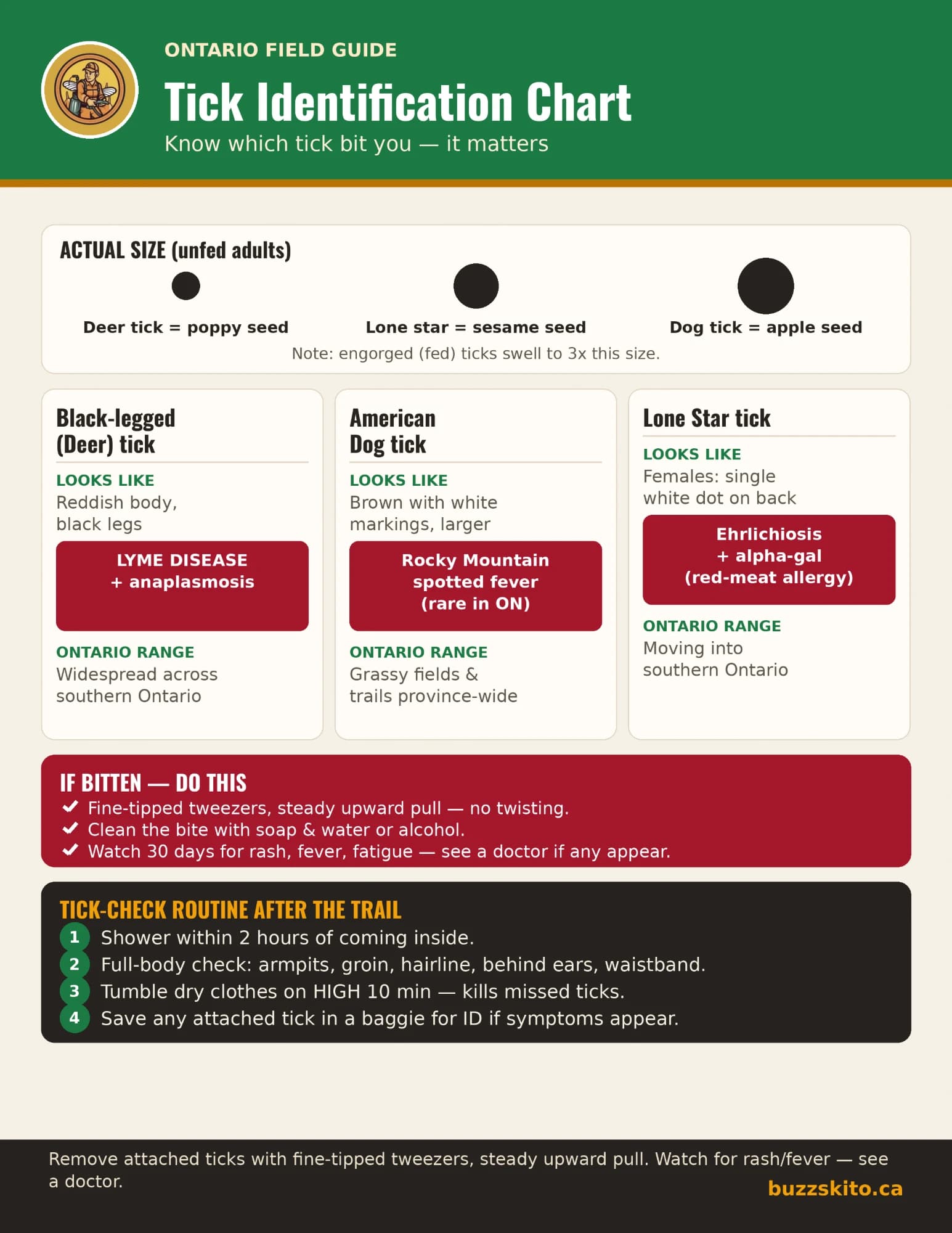
At least 15 tick species occur in Illinois, but only a few are likely to be met by people, according to the Illinois Department of Public Health's guide to common ticks: the American dog tick, the lone star tick, the blacklegged (deer) tick, the brown dog tick and the winter tick. The same page says about 75 percent of the ticks submitted to department staff over several years were American dog or lone star ticks.
Four species are known disease carriers with established populations in the state, according to a 2026 study of Illinois tick-borne disease cases by University of Illinois researchers: the blacklegged tick, the American dog tick, the lone star tick and the Gulf Coast tick. An Illinois Extension article from June 2026 says lone star ticks are most common in the south, deer ticks in the north and center, and dog ticks in the center and south, although all three are probably present in every county.
| Tick | Where in Illinois | Active season in Illinois | What it can spread |
|---|---|---|---|
| American dog tick, Dermacentor variabilis | Recorded in all 102 counties; most common in central and southern Illinois | Adults in April, May and June; rarely seen by September | Rocky Mountain spotted fever, tularemia and possibly ehrlichiosis |
| Lone star tick, Amblyomma americanum | Established in 68 counties; most common in the south | April through the end of July | Ehrlichiosis, tularemia and, less often than the dog tick, Rocky Mountain spotted fever; linked to alpha-gal syndrome |
| Blacklegged (deer) tick, Ixodes scapularis | Established in 63 counties; most common in the north and center | Larvae and nymphs in spring and early summer; adults in spring and fall | Lyme disease, anaplasmosis, babesiosis and other infections (see below) |
When and what: the state health department; alpha-gal: Illinois Extension; anaplasmosis: CDC's record of its germ in Illinois blacklegged ticks. Where: CDC ArboNET Tick Module county tables through 2025 (American dog tick, lone star tick, blacklegged tick) and Illinois Extension.
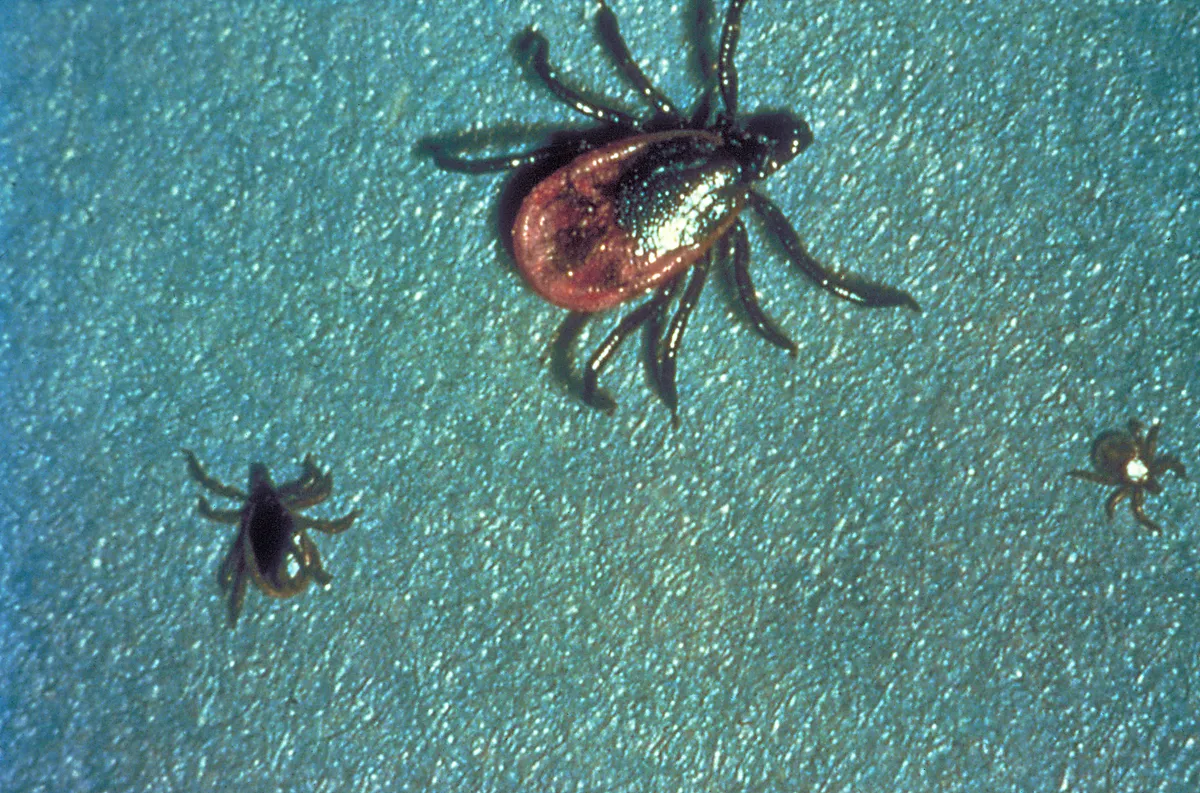

The fourth carrier, the Gulf Coast tick, is not on the health department's list of ticks people commonly meet, but the state's tick surveillance program collected 6 in 2019, 774 in 2020 and 97 in 2021 (a count still being processed), according to the state's 2022 Lyme program status report.
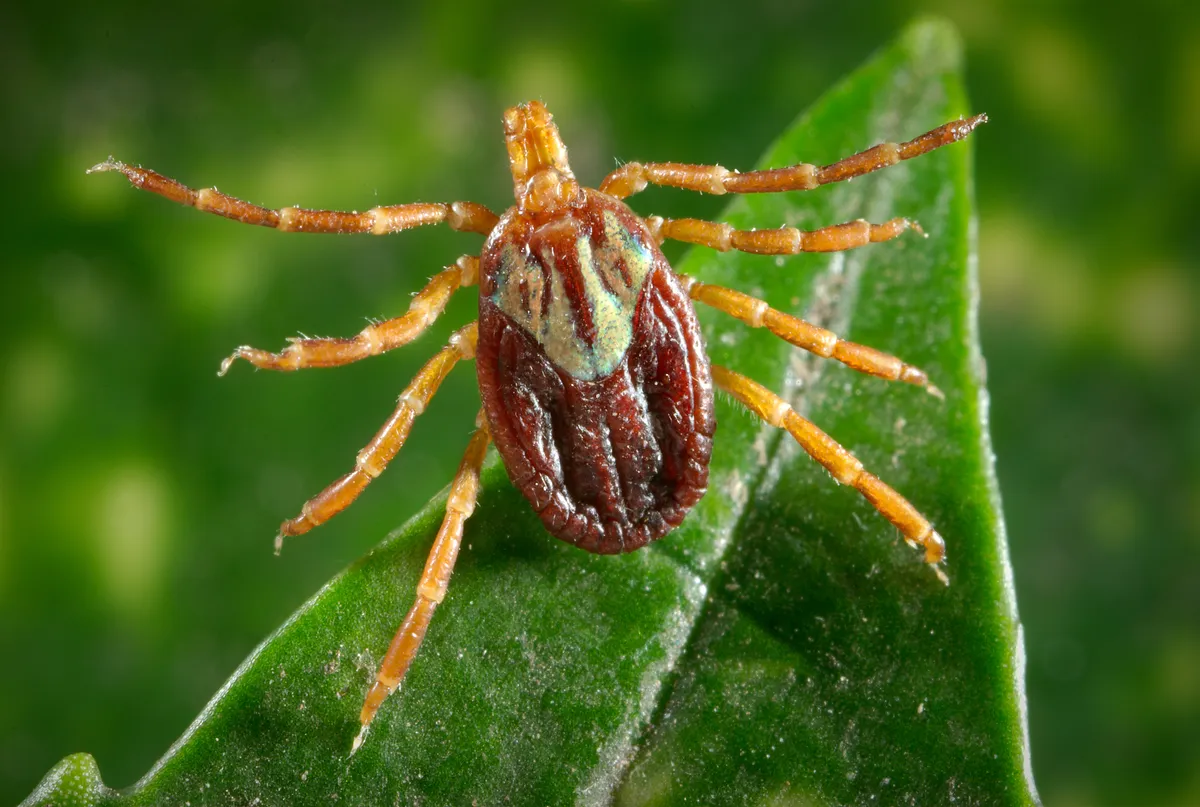
Two others matter less. The brown dog tick rarely bites people and can breed indoors in kennels and homes with dogs, but does not survive Illinois winters outdoors. The winter tick spends its life on one large animal such as a deer, so hunters may find many on carcasses; the state says it is not known to transmit disease to people. For sizes and markings, see how to tell the common US ticks apart.
Where are blacklegged ticks found in Illinois?
In most of the state. CDC's county surveillance table, which runs through December 31, 2025, lists blacklegged ticks as established in 63 of Illinois's 102 counties and reported in 26 more; 13 have no record. Established means six or more ticks of one life stage, or more than one life stage, were collected in a county within 12 months; reported means fewer than six of one stage. To compare other states, see tick maps and Lyme data for every state.
Blacklegged (deer) tick status by county, Illinois, through 2025
- Established
- Reported
- No record
Show the list
Established (63): Adams, Boone, Brown, Bureau, Carroll, Cass, Champaign, Clark, Coles, Cook, De Witt, DeKalb, DuPage, Fayette, Fulton, Grundy, Hancock, Henderson, Henry, Iroquois, Jersey, Jo Daviess, Kane, Kankakee, Kendall, Lake, LaSalle, Lawrence, Lee, Logan, Macon, Macoupin, Marshall, Mason, McDonough, McHenry, McLean, Menard, Monroe, Montgomery, Morgan, Ogle, Peoria, Piatt, Pope, Putnam, Rock Island, Saline, Sangamon, Schuyler, Scott, Shelby, Stark, Stephenson, Tazewell, Union, Vermilion, Wabash, Warren, Whiteside, Will, Winnebago, Woodford
Reported (26): Bond, Christian, Crawford, Cumberland, Douglas, Edgar, Effingham, Franklin, Gallatin, Hamilton, Jackson, Jasper, Johnson, Knox, Livingston, Madison, Mercer, Moultrie, Perry, Pike, Pulaski, Randolph, St. Clair, Wayne, White, Williamson
No record (13): Alexander, Calhoun, Clay, Clinton, Edwards, Ford, Greene, Hardin, Jefferson, Marion, Massac, Richland, Washington
The established counties reach from the Wisconsin border to Pope, Saline and Union counties in far southern Illinois. The 13 counties without a record are Alexander, Calhoun, Clay, Clinton, Edwards, Ford, Greene, Hardin, Jefferson, Marion, Massac, Richland and Washington, most of them in the southern half of the state.
The map has filled in as the state has looked harder. Before 2018 Illinois relied mostly on ticks that people sent in; in 2019 the health department began active surveillance with the Illinois Natural History Survey's Medical Entomology Lab. Its 2022 status report counts 37 counties with established blacklegged ticks and 59 with no data in 2018, and 56 established and 28 with no data after the 2021 season. The state's July 2026 health alert adds that the expanding range of several tick species, the blacklegged tick among them, has contributed to rising case counts and to wider risk where these illnesses were once uncommon.
The health department's common-ticks page still describes the deer tick as common only in limited areas, mostly in northern Illinois, and notes that residents may also meet it on trips to Michigan, Minnesota, Wisconsin or the northeastern states, where it is very common in places.

Which germs have been found in Illinois ticks?
CDC also records where each germ has been found in host-seeking blacklegged ticks, meaning ticks hunting for a host rather than feeding on one. Like the tick table, it is cumulative, and a county without a record is not proof the germ is absent.
| Germ | Illness | Illinois counties with a record |
|---|---|---|
| Borrelia burgdorferi | Lyme disease | 51 |
| Borrelia miyamotoi | Hard tick relapsing fever | 26 |
| Babesia microti | Babesiosis | 5: Carroll, Lake, Ogle, Peoria and Winnebago |
| Anaplasma phagocytophilum (human-active variant) | Anaplasmosis | 3: Cook, Lake and Ogle |
| Ehrlichia muris eauclairensis | Ehrlichiosis | 1: Lake |
| Powassan virus | Powassan virus disease | None in CDC's table; found in two counties in 2025 (see below) |
| Borrelia mayonii | Lyme disease | None |
Source: CDC ArboNET Tick Module, pathogen table through December 2025. The Powassan finds come from a 2026 CDC journal report.
State testing points the same way. By 2021 its program had found the Lyme bacterium in blacklegged ticks from 36 counties, and its 2022 status report lists 351 positive out of 1,667 tested for it, about 21% (our calculation); 53 of 1,687 for the anaplasmosis germ and 11 of 1,689 for Babesia microti. The program favors counties with more human Lyme cases, so those shares are not a statewide average.
Is the lone star tick in Illinois?
Yes, in most counties. CDC's lone star tick surveillance lists it as established in 68 Illinois counties and reported in 25 more through 2025, leaving 9 without a record. The established counties include Cook, DuPage, Lake and Will in the Chicago area. CDC cautions that a county often becomes established because it was sampled and documented for the first time, so a change in status does not by itself show the tick moving.
Lone star tick status by county, Illinois, through 2025
- Established
- Reported
- No record
Show the list
Established (68): Adams, Alexander, Bond, Brown, Bureau, Calhoun, Cass, Christian, Clark, Clay, Clinton, Cook, Crawford, De Witt, DuPage, Effingham, Fayette, Franklin, Fulton, Gallatin, Greene, Grundy, Hamilton, Hancock, Hardin, Henderson, Iroquois, Jackson, Jasper, Jefferson, Jersey, Johnson, Lake, Lawrence, Logan, Macon, Macoupin, Madison, Marion, Mason, Massac, McDonough, Menard, Monroe, Montgomery, Morgan, Moultrie, Perry, Piatt, Pike, Pope, Pulaski, Randolph, Saline, Sangamon, Schuyler, Scott, Shelby, St. Clair, Tazewell, Union, Vermilion, Wabash, Washington, Wayne, White, Will, Williamson
Reported (25): Champaign, Coles, Cumberland, DeKalb, Douglas, Edwards, Henry, Jo Daviess, Kane, Kankakee, Kendall, Knox, LaSalle, Lee, McHenry, McLean, Mercer, Ogle, Peoria, Putnam, Richland, Rock Island, Stark, Whiteside, Winnebago
No record (9): Boone, Carroll, Edgar, Ford, Livingston, Marshall, Stephenson, Warren, Woodford
The health department's common-ticks page describes the lone star tick as found mainly in the southern half of Illinois and only occasionally farther north. Illinois Extension says the south still has the most, and its commercial agriculture specialist describes the tick as moving north across the state. The department says the pinhead-size nymph is the stage most often found on people, and that people sometimes mistake lone star ticks for deer ticks.

The state says the lone star tick is not believed to transmit the Lyme bacterium; the infections it can spread are in the species table above. It is also associated with alpha-gal syndrome, which can trigger allergic reactions to red meat and other mammal products, Illinois Extension notes; see what alpha-gal syndrome is and how it is diagnosed.
When did the Asian longhorned tick reach Illinois?
In April 2024. The first one was found on April 12, 2024, in Morgan County during routine surveillance funded by a state health department grant, and two more turned up in the area on April 24. Entomologists at the National Veterinary Services Laboratory confirmed the species, making Illinois the 20th state to find it, the health department announced in May 2024.
It has kept turning up: as of June 2026 it was in at least six Illinois counties, Illinois Extension reported. The 2024 announcement describes it as light brown and often smaller than a sesame seed, and says a female can lay up to 2,000 eggs at a time without mating. The state veterinarian said livestock deaths have been reported in some severe infestations; the tick's role in human infections was yet to be determined.

How do you report an Asian longhorned tick in Illinois?
The health department's 2024 announcement asks anyone who thinks they have found one on an animal to put it in a jar of isopropyl alcohol and contact the Illinois Department of Agriculture at 217-782-4944. County Extension offices also identify ticks for free (see below), and Illinois Extension advises livestock owners to work out a tick management plan with their veterinarian.
How much Lyme disease does Illinois have?
Illinois reported 372 Lyme disease cases in 2023, a rate of 2.9 per 100,000 residents, according to CDC's Lyme disease surveillance data. CDC's 2022 surveillance report counts Illinois among low-incidence states; neighboring Wisconsin, a high-incidence state, reported 6,283 cases and a rate of 106.9 in 2023.
Reported Lyme disease cases in Illinois, 2008 to 2023
Cases per year, by state of residence
Show the numbers
| Confirmed and probable cases | |
|---|---|
| 2008 | 108 |
| 2009 | 136 |
| 2010 | 135 |
| 2011 | 194 |
| 2012 | 204 |
| 2013 | 337 |
| 2014 | 233 |
| 2015 | 287 |
| 2016 | 237 |
| 2017 | 273 |
| 2018 | 276 |
| 2019 | 395 |
| 2020 | 295 |
| 2021 | 540 |
| 2022 | 259 |
| 2023 | 372 |
Under the definition that took effect in 2022, high-incidence states can count cases from lab evidence alone, but low-incidence states such as Illinois still need supporting clinical information, and their probable cases now require objective signs of infection, the CDC report explains. Illinois's 2022 count of 259 was 17.8% below its 2017 to 2019 average of 315, and CDC says the change rules out robust comparisons with earlier years.
The newest state figure is higher: a July 2026 health alert from the state health department gives a provisional count of 440 Lyme cases for 2025. Over the longer run, the 2026 University of Illinois study counted 6,423 tick-borne disease cases reported to the state from 2004, when reporting began, to 2022. Every county reported at least one, and the yearly total rose by an average of 23 cases, with large swings such as 645 in 2021 and 343 in 2022.
How does Illinois compare with its neighbors?
Lyme disease is far more common north of the state line: Wisconsin's 2023 rate was about 37 times Illinois's (our calculation).
| State | Lyme cases, 2023 | Cases per 100,000, 2023 |
|---|---|---|
| Wisconsin | 6,283 | 106.9 |
| Iowa | 212 | 6.6 |
| Indiana | 257 | 3.8 |
| Illinois | 372 | 2.9 |
| Kentucky | 120 | 2.7 |
| Missouri | 16 | 0.3 |
Confirmed and probable cases by state of residence, from CDC Lyme disease surveillance data. Wisconsin is a high-incidence state, so under the 2022 definition it can count cases from lab results alone; the other five are low-incidence states. Data through 2023, the latest year CDC had published as of October 2026.
Which Illinois counties have the most Lyme disease?
Relative to population, counties in the north, above all the northwest corner. Jo Daviess County averaged about 48 cases per 100,000 residents a year from 2019 to 2023, about 16 times the statewide average of about 2.9, and it reported between 7 and 16 cases in each of those years. Carroll, Fulton and McHenry counties also averaged 10 or more, as did two small counties with few cases, Putnam and Schuyler. The map shows every county's five-year average, calculated by BuzzSkito from CDC's county-level Lyme data and the Census Bureau's county population estimates.
Average yearly Lyme disease cases per 100,000 residents by county, Illinois, 2019 to 2023
- 10 or more
- 5 to 9.9
- Under 5
- No cases reported
Show the list
10 or more (6): Carroll, Fulton, Jo Daviess, McHenry, Putnam, Schuyler
5 to 9.9 (9): Boone, Bureau, Lake, Lee, Ogle, Wabash, Warren, Whiteside, Winnebago
Under 5 (56): Adams, Bond, Cass, Champaign, Coles, Cook, De Witt, DeKalb, Douglas, DuPage, Edgar, Edwards, Effingham, Fayette, Franklin, Greene, Grundy, Hancock, Henderson, Henry, Iroquois, Jackson, Jefferson, Jersey, Kane, Kankakee, Kendall, Knox, LaSalle, Lawrence, Livingston, Logan, Macoupin, Madison, Marshall, Mason, McDonough, McLean, Menard, Mercer, Morgan, Peoria, Piatt, Rock Island, Saline, Sangamon, St. Clair, Stark, Stephenson, Tazewell, Union, Vermilion, Washington, Will, Williamson, Woodford
No cases reported (31): Alexander, Brown, Calhoun, Christian, Clark, Clay, Clinton, Crawford, Cumberland, Ford, Gallatin, Hamilton, Hardin, Jasper, Johnson, Macon, Marion, Massac, Monroe, Montgomery, Moultrie, Perry, Pike, Pope, Pulaski, Randolph, Richland, Scott, Shelby, Wayne, White
| County | Part of the state | Lyme cases, 2019 to 2023 | Average per 100,000 a year |
|---|---|---|---|
| Jo Daviess | Far northwest | 53 | 48.1 |
| Carroll | Northwest | 11 | 14.0 |
| Fulton | West-central | 20 | 12.0 |
| McHenry | Northeast | 162 | 10.4 |
| Ogle | North | 18 | 7.0 |
| Bureau | North-central | 11 | 6.7 |
| Lee | North | 11 | 6.5 |
| Whiteside | Northwest | 17 | 6.1 |
| Winnebago | North | 86 | 6.1 |
| Lake | Northeast | 190 | 5.3 |
| Boone | North | 14 | 5.3 |
The 11 counties with 10 or more cases from 2019 to 2023 and an average of 5 or more per 100,000 residents a year. Rates are BuzzSkito's calculation; sources as for the map.
Raw counts follow population instead. In 2023 Cook County had the most cases, 107, followed by Lake (51), DuPage (39), Kane (25) and McHenry (23). Cook and its five collar counties (DuPage, Kane, Lake, McHenry and Will) reported 261 of the state's 372 cases, about 70%, and held about 66% of its residents that year (our calculation from CDC and Census figures).
One caution applies to every county figure: cases are counted where the patient lives, which may not be where the bite happened, as CDC's Lyme case map page notes. A Chicago-area count can include bites picked up on trips elsewhere.
Which other tick-borne diseases occur in Illinois?
Spotted fever rickettsiosis and ehrlichiosis come next, and they follow the lone star and American dog ticks south. The 2026 study found hotspots of the diseases tied to those two ticks in southern Illinois and of blacklegged tick diseases in northern Illinois, with higher incidence in rural counties and in those with larger deer harvests or lower median household income.
| Disease | Ticks the state links to it | Illinois cases, 2019 to 2022 |
|---|---|---|
| Lyme disease | Blacklegged tick | 1,488 |
| Spotted fever rickettsiosis, including Rocky Mountain spotted fever | American dog tick; lone star tick | 199 |
| Ehrlichiosis | Lone star tick; possibly American dog and blacklegged ticks | 175 (174 E. chaffeensis, 1 E. ewingii) |
| Anaplasmosis | Blacklegged tick | 66 |
| Tularemia | American dog tick; lone star tick | 17 |
| Babesiosis | Blacklegged tick | 6 (state's own count: 22) |
Cases by county of residence, 2019 to 2022 combined, from CDC's county-level tick-borne disease data, which leaves out cases with no county and notes that not every disease is reportable everywhere every year. Three more cases were undetermined ehrlichiosis or anaplasmosis. Tick links: the state health department; anaplasmosis: CDC's record of its germ in Illinois blacklegged ticks.
Has Powassan virus been found in Illinois?
Yes, since 2025. A CDC journal report published in September 2026 describes the state's first known human case, in a Tazewell County resident in 2025, although the exposure may have happened out of state. Researchers then dragged for ticks at 21 sites in 14 counties in October and November 2025 and found the virus in adult blacklegged ticks at one site each in Jo Daviess and Winnebago counties, near the Wisconsin border, where about 6% of the adult ticks tested carried it. CDC's pathogen table, which runs through 2025, lists no Illinois county with Powassan virus.
When is tick season in Illinois?
Spring and early summer carry the most risk, but a mild winter day is not tick-free. The state health department gives these peaks for Illinois and says ticks can be active on winter days when ground temperatures are about 45°F.
| Tick | Most active in Illinois | Stage people meet most |
|---|---|---|
| American dog tick | Adults in April, May and June; by September adults are inactive and rarely seen | Adults; larvae and nymphs feed on mice, birds and other small animals |
| Lone star tick | April through the end of July | Nymphs, about the size of a pinhead |
| Blacklegged (deer) tick | Larvae and nymphs in spring and early summer; adults in spring and fall | All three active stages feed on people; nymphs are the hardest to see |
Source: the state health department, as of October 2026; nymph visibility: CDC.
Illness follows the same calendar. The state's July 2026 health alert says cases of mosquito- and tick-borne disease typically start rising in late spring and continue through early fall. Illinois Extension adds that milder winters and earlier springs help ticks survive the winter, and that cold does not kill a tick attached to a warm-blooded animal.
Where can you get a tick identified or tested in Illinois?
Two University of Illinois programs identify ticks for free, as of October 2026. The INHS Medical Entomology Lab takes photos or mailed samples from Illinois residents and visitors and shares the identification if you give contact details; the lab is at 1816 S. Oak Street in Champaign, and samples are archived rather than returned. It tests only some submitted ticks, for surveillance.
County Extension offices also take ticks for free identification and send them to a lab, Illinois Extension says. Unattached ticks can go in right away; keep a tick that bit you for at least a month, labeled with the date and place, in case it helps a diagnosis, and submit it after 30 days without symptoms, in a sealed plastic bag with a cotton ball soaked in isopropyl alcohol. The state health department's advice is to put a tick in a leak-proof container of rubbing alcohol, note the date and place, and contact your local health department.
Testing the tick is not a way to find out whether you were infected. The INHS lab passes on CDC's advice against using tick test results for treatment decisions: a positive tick does not necessarily mean you were infected, a negative one can give false assurance, and symptoms usually appear before results would. For people, the state's July 2026 health alert says its labs do not routinely test for tick-borne diseases and that commercial labs should be used for diagnosis.
What should you do after a tick bite in Illinois?
Remove the tick right away, keep it, and watch your health for the next several weeks. CDC's guidance for clinicians on caring for patients after a tick bite describes removal this way:
- Grasp the tick with fine-tipped tweezers as close to the skin's surface as possible.
- Pull upward with steady, even pressure, without twisting or jerking the tick.
- Clean the bite area and your hands thoroughly with rubbing alcohol or soap and water.
- Put a live tick in rubbing alcohol or a sealed bag or container and save it: its species and how engorged it is help a provider decide about preventive treatment.
For more detail, see a step-by-step tick removal guide. Speed matters: in most cases a tick must be attached for more than 24 hours before it can pass on the Lyme bacterium, and removing it within 24 hours greatly reduces the chance of infection, CDC says.
A single dose of the antibiotic doxycycline may lower the risk of Lyme disease in certain circumstances, which CDC's clinician guidance lists: the bite happened in a high-incidence state or an area where more than 20% of ticks carry the Lyme bacterium; the tick was an adult or nymphal blacklegged tick, attached an estimated 36 hours or more; the dose can start within 72 hours of removal; and nothing rules out doxycycline for that person. Illinois is a low-incidence state and Wisconsin a high-incidence one, and CDC points to local health departments for tick infection rates in an area. The dose has not been shown to prevent other tick-borne diseases. A provider decides whether it fits.
Then watch for symptoms. Early Lyme disease symptoms begin 3 to 30 days after the bite, CDC's Lyme symptoms page says. The erythema migrans rash appears in about 70 to 80 percent of infected people, on average about 7 days after the bite; it can reach 12 inches or more across and does not always look like a bull's-eye. Fever, chills, headache, fatigue, muscle and joint aches and swollen lymph nodes can come with it or without it. The stages of Lyme disease symptoms covers what can follow if it goes untreated.

How do you prevent tick bites in Illinois?
Use repellent, treat clothing with permethrin, stay out of the brush and check often. The state health department's 2024 Asian longhorned tick announcement and its common-ticks guide recommend these steps:
- Use an EPA-registered repellent containing DEET, picaridin, IR3535, oil of lemon eucalyptus, para-menthane-diol or 2-undecanone, and follow the product instructions.
- Treat gear, not skin, with permethrin. The department recommends 0.5% permethrin for boots, clothing and camping gear, where it lasts through several washings, but not on skin.
- Dress for ticks. Wear long sleeves and long pants tucked into socks; ticks show up better on light colors. Walk in the center of trails so weeds do not brush against you.
- Check every few hours. Check yourself and your family every two to three hours outdoors, and use a mirror for a full check afterward, even after time in your own backyard.
- Shower and dry. Showering within two hours of coming indoors has been shown to reduce the risk of Lyme disease, and high heat in a dryer for at least 10 minutes kills ticks on dry clothing.
- Keep the yard tidy. Ticks are seldom a problem in well-maintained lawns, the department says: mow, cut weeds, and clear spilled birdseed and old woodpiles that draw rodents. On small patches of high weeds that cannot be mowed, insecticides labeled for ticks can be used as the label directs.
For a head-to-toe routine, see how to do a full-body tick check. Pets carry ticks home too: the department says free-roaming dogs and cats meet far more ticks than pets kept at home, and that owners who find ticks on a pet should ask a veterinarian about treatment. What to do about ticks on dogs covers where to look.
This guide is general educational information, not medical advice. If you have symptoms or concerns after a bite or exposure, contact a healthcare provider.
Use any pesticide exactly as its label directs. The label is the law, and what is registered and sold varies by state.
Frequently Asked Questions
Are ticks active in Illinois in the winter?+
They can be. The Illinois Department of Public Health says ticks can be active on winter days when ground temperatures are about 45°F, and Illinois Extension notes that cold does not kill a tick attached to a warm-blooded animal. Most activity comes in spring and early summer: adult American dog ticks peak from April to June and lone star ticks from April through July, while adult blacklegged ticks are active in both spring and fall. Check for ticks after time outdoors on mild winter days.
Is Lyme disease common in Illinois?+
Less common than in Wisconsin or the Northeast, but not rare. Illinois reported 372 Lyme disease cases in 2023, a rate of 2.9 per 100,000 residents, and CDC classes it as a low-incidence state; Wisconsin's rate that year was 106.9. Blacklegged ticks are now established in 63 of Illinois's 102 counties, and the state's provisional count for 2025 was 440 cases as of July 2026. Rates are highest in northern counties such as Jo Daviess, Carroll and McHenry, based on CDC and Census figures.
Can I get a tick tested for Lyme disease in Illinois?+
Not in a way that should guide treatment. The University of Illinois's INHS Medical Entomology Lab identifies ticks for free and tests only some of them, for surveillance. It passes on CDC's advice that tick test results should not be used for treatment decisions, because a positive tick does not prove you were infected and a negative one can falsely reassure you. If you feel ill after a bite, see a health care provider rather than waiting for a tick result.
Which Illinois county has the most Lyme disease?+
It depends on whether you count cases or rates. Cook County had the most cases in 2023, 107, because so many people live there. Relative to population, Jo Daviess County in the far northwest was highest, averaging about 48 cases per 100,000 residents a year from 2019 to 2023, based on CDC county counts and Census estimates. Cases are counted where patients live, not where they were bitten, so a county's figures can include bites picked up elsewhere.
What should I do if I find an Asian longhorned tick in Illinois?+
The state health department asks people who think they have found one on an animal to put it in a jar of isopropyl alcohol and contact the Illinois Department of Agriculture at 217-782-4944. County Extension offices also identify ticks for free. The species was first found in Morgan County in April 2024 and was in at least six counties by June 2026. It can carry diseases that affect cattle, and its role in human illness was yet to be determined when it arrived.
Should I see a doctor after a tick bite in Illinois?+
See a health care provider if a rash, fever, chills, headache, fatigue, or muscle and joint aches appear in the weeks after a bite, and mention the tick. CDC says a single dose of doxycycline may lower Lyme disease risk in certain circumstances: an adult or nymphal blacklegged tick, attached an estimated 36 hours or more, in a high-incidence state or an area where more than 20% of ticks are infected, with the dose started within 72 hours of removal. Illinois is a low-incidence state, so ask your provider.
Sources
- Lyme Disease Surveillance Data — Centers for Disease Control and Prevention
- Lyme Disease Case Maps (county-level data, 2001 to 2023) — Centers for Disease Control and Prevention
- Surveillance for Lyme Disease After Implementation of a Revised Case Definition, United States, 2022 — Centers for Disease Control and Prevention, Morbidity and Mortality Weekly Report
- Tick Surveillance Data Sets — Centers for Disease Control and Prevention (ArboNET Tick Module)
- Lone Star Tick Surveillance — Centers for Disease Control and Prevention (ArboNET Tick Module)
- American Dog Tick Surveillance — Centers for Disease Control and Prevention
- Geographic Distribution of Tickborne Disease Cases — Centers for Disease Control and Prevention
- County Population Totals and Components of Change: 2020-2025 — U.S. Census Bureau
- How Lyme Disease Spreads — Centers for Disease Control and Prevention
- Signs and Symptoms of Untreated Lyme Disease — Centers for Disease Control and Prevention
- Guidance for Clinicians: Caring for Patients after a Tick Bite — Centers for Disease Control and Prevention
- Powassan Virus in Ixodes scapularis Tick Populations, Illinois, USA, 2025 — Emerging Infectious Diseases (Centers for Disease Control and Prevention)
- Tick-borne diseases in Illinois (USA): A retrospective case analysis — Ticks and Tick-borne Diseases (Elsevier), via PubMed
- Common Ticks — Illinois Department of Public Health
- Lyme Disease Prevention and Protection Act Status Reports — Illinois Department of Public Health
- Reported Tickborne Cases 2012-2022 — Illinois Department of Public Health
- Asian Longhorned Tick Confirmed in Illinois (May 6, 2024) — Illinois Department of Public Health
- 2026 Season Kick-Off Health Alert (July 14, 2026) — Illinois Department of Public Health (copy hosted by the Illinois Chapter, American Academy of Pediatrics)
- Free Tick Identifications — Illinois Natural History Survey Medical Entomology Lab, University of Illinois
- Tick concerns are growing: What Illinois residents need to know (June 30, 2026) — University of Illinois Extension
How this guide was made: it was researched and drafted with AI assistance from the sources listed above. A second, independent AI pass then checked each factual claim against those sources. Found an error? Email support@buzzskito.ca.