
Published by BuzzSkito Mosquito & Tick Control
Published October 16, 2026 · Drafted with AI assistance and fact-checked against the sources listed below
Which ticks live in New Hampshire?
Mostly two: the blacklegged tick, often called the deer tick, and the American dog tick, both found in every county. UNH Extension's fact sheet on New Hampshire ticks, whose survey map dates from November 2017, called the dog tick the one people meet most often and said the blacklegged tick might soon overtake it.
The blacklegged tick matters most for health. The state health department's tickborne disease page lists five tick-borne illnesses in New Hampshire, Lyme disease, anaplasmosis, babesiosis, Borrelia miyamotoi infection and Powassan virus, and says the blacklegged tick spreads all five. Ehrlichiosis, tularemia and Rocky Mountain spotted fever, it adds, can be caught when traveling to other parts of the country, including other New England states.
| Tick | Where in New Hampshire | Does it bite people? | What it can spread |
|---|---|---|---|
| Blacklegged (deer) tick, Ixodes scapularis | All 10 counties; historically most abundant in the southeast | Yes; nymphs cause most Lyme infections | Lyme disease, anaplasmosis, babesiosis, B. miyamotoi infection, Powassan virus |
| American dog tick, Dermacentor variabilis | Every county; few in parts of Cheshire, Sullivan, Grafton and northern Coos | Yes; adults bite people and pets | Rocky Mountain spotted fever (rare in New England); not Lyme |
| Woodchuck (groundhog) tick, Ixodes cookei | Every county | Yes; also common on small and medium-sized mammals | Powassan virus; not Lyme |
| Winter tick, Dermacentor albipictus | Commonest in the north; found as far south as Durham, Nottingham, Wilton and Roxbury | Rarely; feeds on moose, deer and horses | Nothing that causes disease in people |
| Lone star tick, Amblyomma americanum | Rare; may hitchhike from farther south | Yes; nymphs and adult females bite most | Ehrlichiosis, tularemia; not Lyme |
Sources: UNH Extension's tick fact sheet (survey map from November 2017); the five illnesses, state health department; lone star bites, CDC; blacklegged county status, CDC ArboNET Tick Module through December 2025.

Dog ticks are bigger and patterned: UNH puts an adult at about 1/8 inch long, brown and tan with an obvious mottled back, and a fully fed female at almost the size of a dime. The Lyme bacterium has been found in dog ticks, but UNH says tests show they cannot pass it on. For sizes and markings side by side, see how to tell the common US ticks apart.

Do winter ticks and woodchuck ticks bite people?
Winter ticks rarely do. UNH says this tick completes its whole development on one large animal, often a moose, deer or horse, from fall to spring, does not commonly bite people and does not transmit agents that cause disease in people. Hunters in the woods in October and November sometimes sit or put a hand on a cluster of its larvae, and as many as 50 have been found on a glove or pant leg afterward. Its real toll is on moose: heavy infestations sometimes kill them, and UNH reports New Hampshire research showing winter ticks limiting the moose population, with especially high calf deaths. More in the winter tick guide.
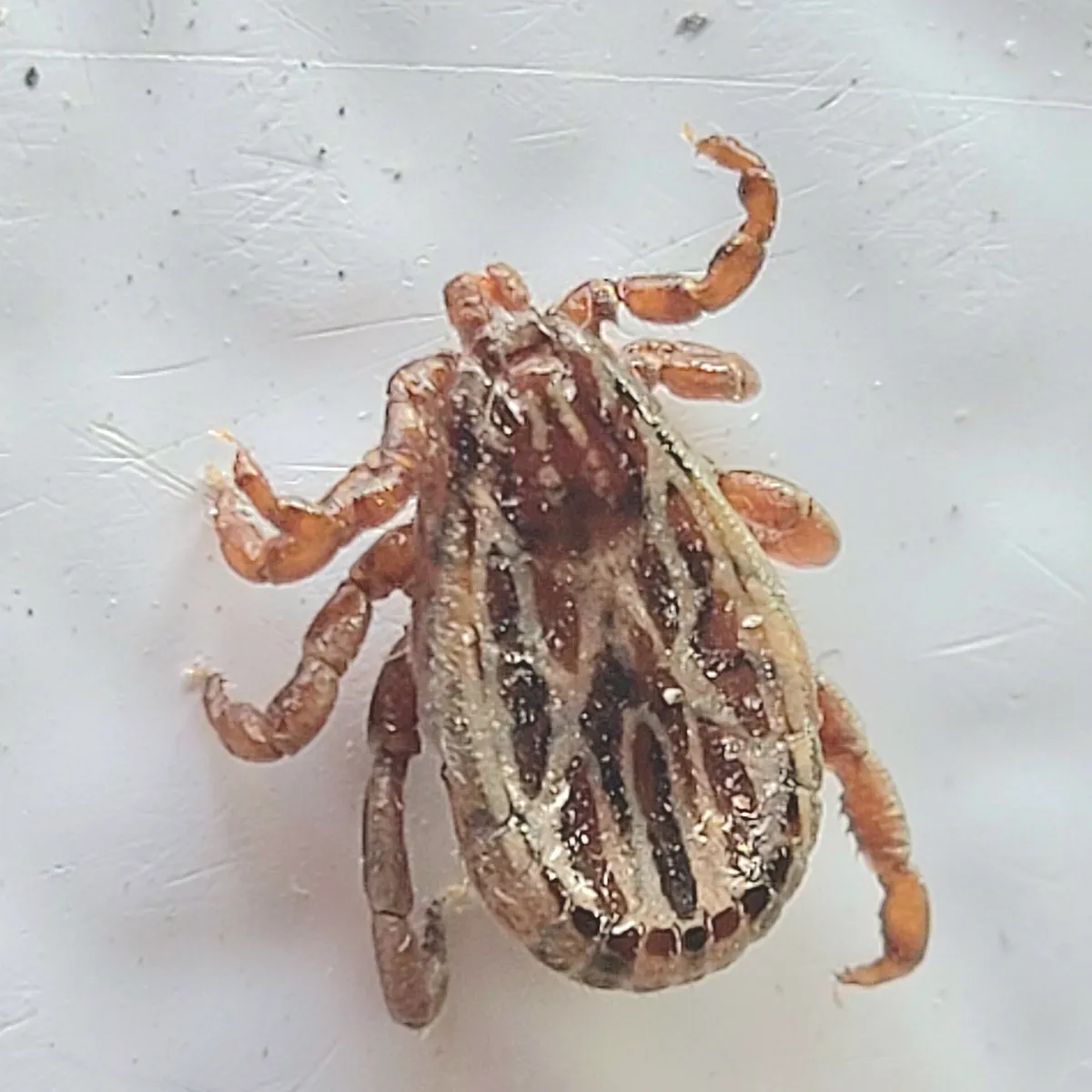
The woodchuck, or groundhog, tick lives in every county and is commonly found on small and medium-sized mammals and on people. It does not spread Lyme disease, but UNH notes that it is a vector of Powassan virus, a rare and serious infection first found in New Hampshire in Hillsborough County in 2013. See the groundhog tick guide for how to recognize it.
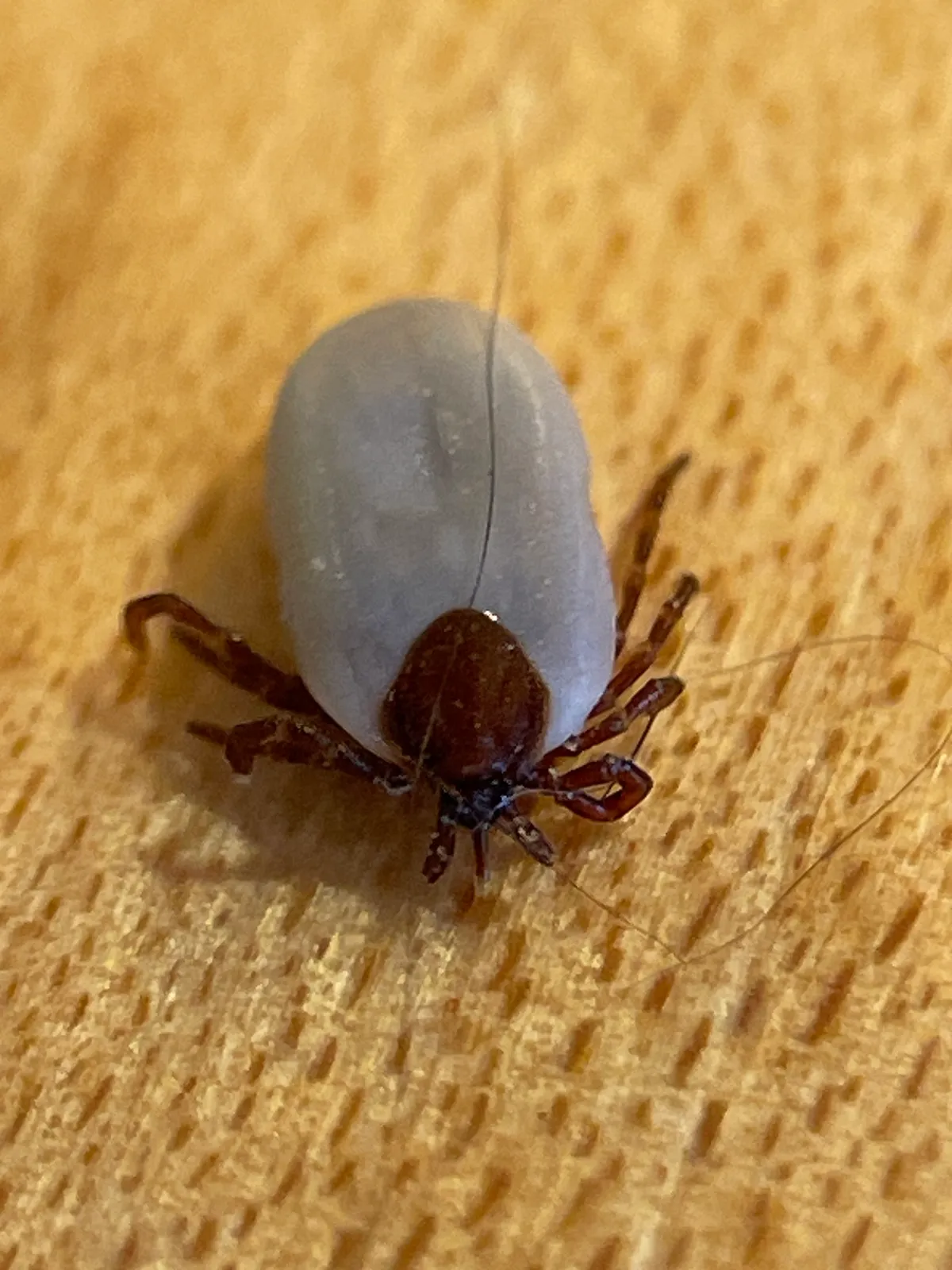
Has the Asian longhorned tick reached New Hampshire?
Not as an established population. USDA's national situation report of December 4, 2025, lists infested counties in 25 states and Washington, D.C., including Maine, Massachusetts and New York, but none in New Hampshire or Vermont. The state's free identification service, described below, can name any tick you do not recognize, and the Asian longhorned tick guide shows what to look for.
Where are deer ticks found in New Hampshire?
In every county. CDC's county surveillance table, which runs through December 31, 2025, lists blacklegged ticks as established in all 10, meaning six or more ticks of one life stage, or more than one life stage, were collected in a county within 12 months. CDC credits the listing of Coos County, at the northern tip, to data submitted in 2023; the other nine rest on older records. To compare other states, see tick maps and Lyme data for every state.
They are not spread evenly. UNH's fact sheet found them most abundant in the southeast: about 85% of the population was within 35 miles of the coast in 2007, and 67% of its survey data points were within 40 miles in 2015. In the west, numbers were higher near the Connecticut River than farther away. UNH cautions that its map leans toward places near the university, where more people submit ticks.
Which germs have been found in New Hampshire ticks?
The germs behind Lyme disease, anaplasmosis and babesiosis have been found in host-seeking blacklegged ticks, meaning ticks looking for a host rather than feeding on one, in all 10 counties, according to CDC's companion pathogen table.
Germs found in host-seeking blacklegged ticks by county, New Hampshire, through 2025
- Lyme, anaplasmosis, babesiosis, B. miyamotoi and Powassan virus
- Lyme, anaplasmosis, babesiosis and B. miyamotoi
- Lyme, anaplasmosis and babesiosis
Show the list
Lyme, anaplasmosis, babesiosis, B. miyamotoi and Powassan virus (2): Rockingham, Strafford
Lyme, anaplasmosis, babesiosis and B. miyamotoi (4): Belknap, Carroll, Hillsborough, Merrimack
Lyme, anaplasmosis and babesiosis (4): Cheshire, Coos, Grafton, Sullivan
| Germ | Illness | New Hampshire counties with a record |
|---|---|---|
| Borrelia burgdorferi | Lyme disease | All 10 |
| Anaplasma phagocytophilum (human-active variant) | Anaplasmosis | All 10 |
| Babesia microti | Babesiosis | All 10 |
| Borrelia miyamotoi | Borrelia miyamotoi infection (hard tick relapsing fever) | 6: Belknap, Carroll, Hillsborough, Merrimack, Rockingham, Strafford |
| Powassan virus | Powassan virus disease | 2: Rockingham, Strafford |
| Borrelia mayonii, Ehrlichia muris eauclairensis | Lyme disease (a rarer cause); ehrlichiosis | None |
Source: CDC ArboNET Tick Module, pathogen table through December 31, 2025.
How many ticks carry the Lyme germ? The state's latest figures are more than a decade old. UNH reports that in state health department sampling, nearly 60% of adult blacklegged ticks carried Borrelia burgdorferi in 2007 to 2010, and the share stayed close to 60% in 2013 and 2014. For what that means for a single bite, see what share of ticks carry Lyme disease.
Is the lone star tick in New Hampshire?
Only rarely, and the records are thin. CDC's lone star tick surveillance, which runs through 2025, lists the tick as established in Merrimack County and reported in Rockingham County, with no record elsewhere; no record does not mean no ticks. CDC's data file credits both entries to published literature rather than surveillance data, and notes that the Rockingham record, from a 2014 compilation, was a tick removed from a person, a kind of record CDC no longer uses because the person's travel history may be unknown.
CDC defines established the same way for lone star ticks as for deer ticks, and keeps the status in later years. UNH's fact sheet, whose map dates from 2017, describes a rare visitor: lone star ticks rarely turn up in the state, and it is unclear whether those found survived the winter or hitchhiked from farther south. They cannot spread Lyme disease but are the main carrier of ehrlichiosis, which the state lists among infections that can be caught when traveling; UNH says the 28 cases reported in New Hampshire from 2010 through 2014 were most likely linked to travel. The lone star tick guide shows how to recognize one.
How much Lyme disease does New Hampshire have?
New Hampshire residents reported 1,573 Lyme disease cases in 2023, according to CDC's Lyme disease surveillance data. That count ranked 13th among states, but relative to population New Hampshire ranked seventh, at 113.4 cases per 100,000 residents, behind Rhode Island, Vermont, Maine, West Virginia, Massachusetts and Pennsylvania.
Reported Lyme disease cases in New Hampshire, 2008 to 2025
Cases per year, by place of residence
- CDC count, 2008 to 2023
- State count, 2024 and 2025
Show the numbers
| CDC count, 2008 to 2023 | State count, 2024 and 2025 | Total | |
|---|---|---|---|
| 2008 | 1,601 | – | 1,601 |
| 2009 | 1,415 | – | 1,415 |
| 2010 | 1,339 | – | 1,339 |
| 2011 | 1,299 | – | 1,299 |
| 2012 | 1,450 | – | 1,450 |
| 2013 | 1,687 | – | 1,687 |
| 2014 | 724 | – | 724 |
| 2015 | 529 | – | 529 |
| 2016 | 891 | – | 891 |
| 2017 | 1,381 | – | 1,381 |
| 2018 | 1,428 | – | 1,428 |
| 2019 | 1,710 | – | 1,710 |
| 2020 | 299 | – | 299 |
| 2021 | 397 | – | 397 |
| 2022 | 1,085 | – | 1,085 |
| 2023 | 1,573 | – | 1,573 |
| 2024 | – | 1,496 | 1,496 |
| 2025 | – | 1,806 | 1,806 |
Why are some years so low?
Mostly because of how cases were counted. Staffing vacancies and eliminated positions left the state unable to investigate suspected cases reported in 2014, 2015 and 2016, its 2011 to 2016 Lyme report explains, so it estimated those years from the reports received and historical data. Its 2017 to 2021 report estimated 2020 and 2021 the same way. CDC's figures sit far below those estimates:
| Year | Cases in CDC's data | State's estimate at the time |
|---|---|---|
| 2014 | 724 | 1,416 |
| 2015 | 529 | 1,371 |
| 2016 | 891 | 1,480 |
| 2020 | 299 | 1,027 |
| 2021 | 397 | 1,563 |
State estimates from its reports dated July 25, 2017, and November 7, 2022. The state's current monthly report lists 401 cases for 2021 and calls that year's Lyme surveillance incomplete.
A second break came in 2022, when a revised national case definition let high-incidence states such as New Hampshire report cases on laboratory evidence alone. CDC's report on the change says cases in high-incidence states rose 72.9% in 2022 over their 2017 to 2019 average, likely because of the new method rather than a change in risk, and that the changes rule out detailed comparisons with earlier years. New Hampshire did not jump: its 1,085 cases in 2022 were below its 2017 to 2019 average of about 1,506 (BuzzSkito's calculation from CDC data).
The state's monthly infectious disease report, dated September 28, 2026, carries the count forward: 1,496 cases in 2024 and 1,806 in 2025, the most in its 2021 to 2025 table, plus 418 for 2026 through August 31, a partial year. It last updated full-year totals on February 25, 2026, and says its 2020 to 2023 data must be interpreted with caution because pandemic-era effects on health care and reporting are not fully understood.
How does New Hampshire compare with its neighbors?
All three of its neighbors had higher Lyme rates in 2023, and the rates in Vermont and Maine were nearly twice New Hampshire's.
| State | Lyme cases, 2023 | Cases per 100,000, 2023 |
|---|---|---|
| Vermont | 1,445 | 223.3 |
| Maine | 2,942 | 213.4 |
| Massachusetts | 9,715 | 138.9 |
| New Hampshire | 1,573 | 113.4 |
Confirmed and probable cases by state of residence, from CDC Lyme disease surveillance data. Data through 2023, the latest year CDC had published as of October 2026.
Which New Hampshire counties have the most Lyme disease?
Relative to population, the western counties along the Connecticut River. In 2023, Sullivan County recorded about 202 Lyme cases per 100,000 residents, followed by Grafton (about 160) and Cheshire (about 155), while Coos County in the far north had the lowest rate, 32. The map shows every county's 2023 rate, calculated by BuzzSkito from CDC's county-level Lyme data and the Census Bureau's county population estimates.
Lyme disease cases per 100,000 residents by county, New Hampshire, 2023
- 150 or more
- 100 to 149
- 50 to 99
- Under 50
Show the list
150 or more (3): Cheshire, Grafton, Sullivan
100 to 149 (4): Belknap, Carroll, Merrimack, Strafford
50 to 99 (2): Hillsborough, Rockingham
Under 50 (1): Coos
| County | Lyme cases, 2023 | Cases per 100,000 |
|---|---|---|
| Sullivan | 89 | 202.2 |
| Grafton | 148 | 159.5 |
| Cheshire | 120 | 154.5 |
| Merrimack | 227 | 144.7 |
| Strafford | 169 | 126.5 |
| Belknap | 79 | 121.5 |
| Carroll | 53 | 101.1 |
| Hillsborough | 410 | 95.9 |
| Rockingham | 259 | 80.8 |
| Coos | 10 | 32.0 |
All 10 counties, highest rate first. Sources as for the map.
Raw counts follow population instead. Hillsborough County, the most populous, had the most cases in 2023 (410), followed by Rockingham (259) and Merrimack (227), yet Hillsborough's and Rockingham's rates were below the statewide figure.
The burden has shifted west and north. In 2008, Hillsborough, Rockingham and Strafford counties had 87% of the cases CDC could place in a county; in 2023 they had 54%, though home to about 63% of residents. Cases in Cheshire, Coos, Grafton and Sullivan counties rose from 70 to 367 over the same years. These are BuzzSkito's calculations from CDC county counts and Census estimates; case definitions changed in between, so the shift in shares says more than the raw totals.
Two cautions apply. Cases are counted where patients live, not necessarily where they were bitten, as CDC's case map page notes. And small counties swing fast: in Sullivan County, with about 44,000 residents, each additional case adds more than 2 per 100,000 to the rate.
Which other tick-borne diseases occur in New Hampshire?
Anaplasmosis and babesiosis, both spread by the blacklegged tick, come next. The state's monthly report counted 276 anaplasmosis cases and 57 babesiosis cases in 2025, but it flags its surveillance for both as incomplete in 2024 and 2025, so neither year can be read as a decline.
| Disease | 2024 | 2025 | 2026, through Aug. 31 |
|---|---|---|---|
| Lyme disease | 1,496 | 1,806 | 418 |
| Anaplasmosis | 209 (incomplete) | 276 (incomplete) | 302 |
| Babesiosis | 64 (incomplete) | 57 (incomplete) | 72 |
| Powassan virus disease | 3 | 4 | 2 |
| Ehrlichiosis | 1 (incomplete) | 4 (incomplete) | 2 |
| Spotted fever rickettsiosis | 0 | 1 (incomplete) | 1 |
State counts by the date closest to the start of illness, from the monthly report dated September 28, 2026; 2026 data were complete as of September 25. Ehrlichiosis includes undetermined Ehrlichia or Anaplasma infections. No tularemia was reported from 2021 through August 2026. State counts may not match CDC's.
Ehrlichiosis and spotted fever stay rare, in line with the state's description of them as infections that can be caught when traveling. For symptoms and treatment, see the guides to anaplasmosis and babesiosis.
How common is Powassan virus in New Hampshire?
Rare, but more frequent lately. CDC's Powassan virus data, finalized on September 16, 2026, count 16 cases in New Hampshire residents from 2004 through 2025, all of them neuroinvasive, meaning the virus reached the brain or the membranes around it: one each in 2013, 2016 and 2017, two in 2019, four in 2023, three in 2024 and four in 2025. The state's monthly report also lists a 2021 case that is not in CDC's file, and two cases in 2026 through August 31.
CDC's Powassan symptoms page says many infected people never feel sick, but about 1 in 10 people with severe illness die, about half of survivors have lasting health problems, and no medicine treats the infection. In ticks, CDC's pathogen table credits both New Hampshire records of the virus, from Rockingham and Strafford counties, to 2025 data. The Powassan virus guide has more on symptoms.
When is tick season in New Hampshire?
Any day above 40°F without snow cover, with the most activity from April through November. That is how the state health department's tickborne disease page puts it, adding that exposure can happen year-round and that blacklegged nymphs, the stage most likely to give people a tick-borne disease, are most active from late spring through summer, most often May through August.
| Time of year | Blacklegged (deer) tick | Other ticks |
|---|---|---|
| Winter (December to February) | Adults seek hosts on mild days above 40°F with no snow cover | Winter ticks stay on moose, deer and horses |
| Spring (March to May) | Adults from late March through May; nymphs from mid-May | American dog ticks most active from May |
| Summer (June to August) | Nymphs most active until early or mid-July | American dog ticks most active through July |
| Fall (September to November) | Adults most active from early October to late November | Winter tick larvae seek hosts once cold weather returns |
Sources: UNH Extension's tick fact sheet and the state health department's tickborne disease page.
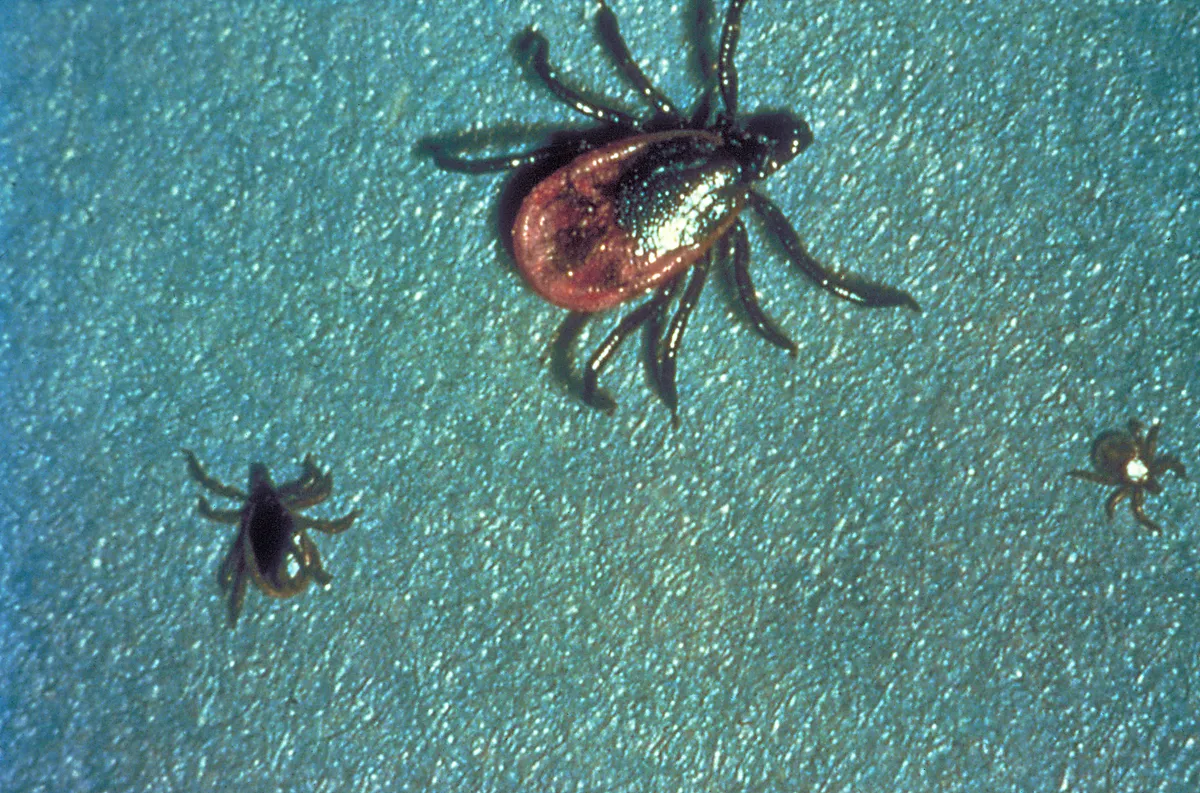
UNH's fact sheet says most Lyme infections in the state are picked up from late May through mid-July, when nymphs are out, and that nymphs cause most human cases because they are small and easily overlooked. Adults return in fall, so keep checking for ticks after the leaves turn. See when tick season starts and ends across the US.
Where can you get a tick identified or tested in New Hampshire?
As of October 2026, the state identifies ticks free but does not test them: the health department says the Department of Agriculture, Markets and Food identifies ticks for free for New Hampshire residents, to map where each species lives, and does not test them for any disease. The department's identification page says its entomologists work under a microscope or from a reasonably sharp photo sent with its online form, though photos and ticks missing their mouthparts may be identified only to genus. To send a tick:
- Make sure it is dead; if not, put it in the freezer for a day.
- Place it in a vial or other crush-proof container; ticks crushed in the mail or covered in tape cannot be identified.
- Fill out the department's tick identification form.
- Mail both to the NH Department of Agriculture, Markets and Food, Division of Plant Industry, State Lab Building, 29 Hazen Drive, Concord, NH 03301, or leave them in its drop box at the Health and Human Services building in Concord.
For testing, UNH Extension's tick testing service charges a fee for each tick and emails results as early as 3 days after the lab receives it. Blacklegged and other Ixodes ticks are tested for Borrelia burgdorferi, Borrelia miyamotoi, Anaplasma phagocytophilum, Babesia microti and Powassan virus; dog ticks and other species for Ehrlichia muris, Francisella tularensis, Rickettsia rickettsii and Powassan virus.
Use a result with care. The UNH page tells anyone with medical issues to consult a medical professional, and CDC's after-a-bite guidance generally does not recommend tick testing. CDC says results should not be used for treatment decisions, a positive tick does not prove you were infected, a negative one can falsely reassure someone bitten by another, infected tick, and treatment for someone who becomes ill should not wait for a result.
What should you do after a tick bite in New Hampshire?
Remove the tick right away, without waiting to see a provider, then watch for a rash or fever. CDC's after-a-bite guidance describes removal this way:
- Grasp the tick as close to the skin's surface as possible with clean, fine-tipped tweezers.
- Pull it away from the skin with steady, even pressure, without twisting or jerking. If mouthparts stay behind and will not come out easily, leave them; the skin will push them out as it heals.
- Do not use petroleum jelly, heat, nail polish or other substances to make the tick let go.
- Clean the bite and your hands with soap and water, rubbing alcohol or hand sanitizer, and never crush a tick with your fingers.
The step-by-step tick removal guide covers the details, and a full-body tick check shows where ticks hide.
Speed matters. In most cases a tick must be attached for more than 24 hours before it can transmit the Lyme bacterium, and removing it within 24 hours greatly reduces the chance of Lyme disease, according to CDC's page on how Lyme disease spreads. The state health department adds that other tick-borne diseases can spread with shorter attachment times.
New Hampshire is one of the high-incidence states for Lyme disease, and CDC's Lyme prevention page says a single dose of the antibiotic doxycycline after a tick bite in an area where Lyme disease is common may, in certain circumstances, lower the risk of Lyme disease. It advises asking your healthcare provider whether antibiotics after a tick bite are appropriate for you.
Then watch for symptoms. CDC's Lyme symptoms page says early signs appear 3 to 30 days after a bite: fever, chills, headache, fatigue, muscle and joint aches and swollen lymph nodes, with or without a rash. The erythema migrans rash occurs in about 70% to 80% of infected people, begins at the bite after about 7 days on average, expands over several days to 12 inches or more across, may feel warm but is rarely itchy or painful, and sometimes clears into a bull's-eye. A small bump or redness that appears right away at a bite, like a mosquito bite, is common. The stages of Lyme disease symptoms explains what can follow untreated infection.

The state health department advises watching for signs and symptoms of tick-borne disease for 30 days after a bite and contacting a healthcare provider if symptoms develop. CDC says to see a doctor if you develop a rash or fever within several weeks of removing a tick, and to say when the bite happened and where you most likely picked up the tick.
How do you prevent tick bites in New Hampshire?
Cover up, use repellent, treat clothing with permethrin and check for ticks every day. The state health department's tickborne disease page recommends these steps:
- Dress for ticks. Wear light-colored clothes that cover your arms and legs, and tuck your pants into your socks before heading into wooded or grassy areas.
- Put repellent on exposed skin. The state suggests 20% to 30% DEET; CDC also lists picaridin, IR3535, oil of lemon eucalyptus, para-menthane-diol and 2-undecanone among EPA-registered options. Follow the label.
- Use permethrin on clothing, not skin. The state calls permethrin highly effective at repelling ticks on clothing and says it is not meant for skin; CDC recommends clothing and gear treated with 0.5% permethrin.
- Stay on the path. Avoid tick-infested areas when you can and keep away from brush; the state says outdoor workers in New Hampshire are at particular risk.
- Check, shower and dry. Check for ticks daily, especially behind the knees and ears, in the groin and belly button, and on the back and neck; shower soon after coming indoors; and dry clothes on high heat for 10 minutes, or an hour if they are wet or damp.
- Protect pets. Check pets for ticks daily and ask a veterinarian about tick preventives; the guide to ticks on dogs shows where to look.
Around the house, CDC's prevention page suggests a 3-foot-wide barrier of wood chips or gravel between lawns and wooded areas, keeping grass mowed, removing leaf litter and clearing tall grasses and brush.
This guide is general educational information, not medical advice. If you have symptoms or concerns after a bite or exposure, contact a healthcare provider.
Use any pesticide exactly as its label directs. The label is the law, and what is registered and sold varies by state.
Frequently Asked Questions
Are ticks active in New Hampshire in the winter?+
Yes, on mild days. The New Hampshire Department of Health and Human Services says ticks are active any time the temperature is above 40 degrees Fahrenheit and they are not covered by snow, and that exposure can happen year-round, although ticks are most active from April through November. UNH Extension says adult deer ticks keep seeking hosts in mild winter weather when there is no snow cover, so check for ticks after time in woods or brush even in December or March.
Which New Hampshire county has the most Lyme disease?+
It depends on whether you count cases or rates. Hillsborough County had the most cases in 2023, 410, because so many people live there. Relative to population, Sullivan County was highest at about 202 cases per 100,000 residents, followed by Grafton and Cheshire counties, while Coos County was lowest, based on CDC county counts and Census estimates. Cases are counted where patients live, not where they were bitten, and small counties can swing sharply from year to year.
Can I get a tick tested for Lyme disease in New Hampshire?+
Yes, but not by the state. As of October 2026, the state Department of Agriculture, Markets and Food identifies ticks free for residents but does not test them, while UNH Extension tests ticks for the Lyme bacterium and other germs for a fee. CDC generally does not recommend tick testing, because a positive tick does not prove infection and a negative result can falsely reassure. If you feel ill after a bite, see a healthcare provider rather than waiting for a result.
Why do New Hampshire's Lyme numbers drop in some years?+
Mostly because of how cases were counted. Staffing vacancies left the state unable to investigate suspected cases reported in 2014, 2015 and 2016, and it estimated 2020 and 2021 from the reports it received and historical data, so CDC's counts for those years are far below the state's estimates. A revised case definition took effect in 2022, letting high-incidence states count cases on laboratory evidence alone, so recent years are not directly comparable with earlier ones.
Are lone star ticks in New Hampshire?+
Rarely. CDC's surveillance data list the lone star tick as established in Merrimack County and reported in Rockingham County, but both records come from published literature, and the Rockingham one was a tick removed from a person. UNH Extension's fact sheet, whose map dates from 2017, says the tick rarely turns up in the state and may hitchhike from farther south. Lone star ticks do not spread Lyme disease, though they can spread ehrlichiosis, which the state lists among infections that can be caught when traveling.
How long does a tick have to be attached to spread Lyme disease?+
Usually more than 24 hours, according to CDC, which says removing a tick within 24 hours greatly reduces the chance of Lyme disease. The New Hampshire health department adds that other tick-borne diseases can spread with shorter attachment, so remove any tick right away with fine-tipped tweezers. CDC also says that in certain circumstances a single dose of doxycycline after a bite in an area where Lyme disease is common may lower the risk; ask a healthcare provider whether it is right for you.
Sources
- Lyme Disease Surveillance Data — Centers for Disease Control and Prevention
- Lyme Disease Case Maps (county-level data, 2023) — Centers for Disease Control and Prevention
- Surveillance for Lyme Disease After Implementation of a Revised Case Definition - United States, 2022 — CDC Morbidity and Mortality Weekly Report
- Tick Surveillance Data Sets — Centers for Disease Control and Prevention (ArboNET Tick Module)
- Lone Star Tick Surveillance — Centers for Disease Control and Prevention (ArboNET Tick Module)
- Historic Data (2004-2025), Powassan Virus — Centers for Disease Control and Prevention (ArboNET)
- County Population Totals and Components of Change: 2020-2025 — U.S. Census Bureau
- What to Do After a Tick Bite (June 9, 2026) — Centers for Disease Control and Prevention
- How Lyme Disease Spreads (September 24, 2024) — Centers for Disease Control and Prevention
- Signs and Symptoms of Untreated Lyme Disease (May 15, 2024) — Centers for Disease Control and Prevention
- Preventing Lyme Disease (May 21, 2026) — Centers for Disease Control and Prevention
- Symptoms of Powassan (June 23, 2026) — Centers for Disease Control and Prevention
- Tickborne Diseases — New Hampshire Department of Health and Human Services
- Reportable Infectious Diseases in New Hampshire, 2021-2026 (monthly report for August 2026, dated September 28, 2026) — New Hampshire Department of Health and Human Services, Bureau of Infectious Disease Control
- Reported Cases of Lyme Disease in New Hampshire, 2011-2016 (July 25, 2017) — New Hampshire Department of Health and Human Services, Bureau of Infectious Disease Control
- Reported Cases of Lyme Disease in New Hampshire, 2017-2021 (November 7, 2022) — New Hampshire Department of Health and Human Services, Bureau of Infectious Disease Control
- Insects, Spiders and Ticks — New Hampshire Department of Agriculture, Markets and Food, Division of Plant Industry
- Biology and Management of Ticks in New Hampshire (fact sheet; survey map dated November 2017) — UNH Cooperative Extension
- Tick Testing — UNH Extension
- Asian Longhorned Tick Situation Report (summary of USDA's national report as of December 4, 2025) — Texas A&M AgriLife, The Tick App (reports produced by USDA's Animal and Plant Health Inspection Service)
How this guide was made: it was researched and drafted with AI assistance from the sources listed above. A second, independent AI pass then checked each factual claim against those sources. Found an error? Email support@buzzskito.ca.
