
BuzzSkito Mosquito & Tick Control Specialists · Published July 21, 2026
What Is the Best Bed Bug Trap in Canada?
For the overwhelming majority of Canadian homes, the best bed bug trap is a passive double-well interceptor cup — the Aspectek and ClimbUp-style pitfall traps that slip under each bed leg. That is not a fashion choice; it is the tool urban entomologists reach for first, the one used in most of the published field research, and the cheapest reliable way to answer the only question that matters at the start of a bed bug scare: do I actually have them, and where? An interceptor needs no power, no pesticide, and no refills. You are the attractant — the bug walks to feed on you, climbs the leg, and drops into a moat it physically cannot climb out of.
But “best” depends on the room. The one situation where a passive cup fails is an empty room: with no sleeper to intercept, the cup catches nothing and tells you nothing. That is exactly where an active lure trap earns its place — it makes its own heat, CO₂, and scent, so it keeps hunting in a vacant suite, a storage unit, an office, or a room you have just treated and cleared of furniture. The two trap families are not rivals; they cover different halves of the problem, which is why this roundup names a best pick in each.
Check current Canadian availability of the main trap types:
How Passive Interceptors Work — and Why They Come First
An interceptor is a small two-ring plastic cup that exploits a hard limit of bed bug physiology: bed bugs cannot fly, cannot jump, and cannot climb smooth vertical plastic. Every bug that wants to feed on a sleeper in an isolated bed has to walk the floor and climb a bed leg — and the interceptor turns that mandatory climb into a one-way pitfall. The textured outer wall lets the bug climb toward the bed; at the top it drops into a moat with polished, slippery inner walls its tarsal claws can find no purchase on, and there it stays until you find it in the morning.
The double-well design is the genius part. A second moat rings the bed leg itself, so the cup catches bugs travelling in both directions. That gives you direction data no other trap style provides: outer-well catches were walking toward the bed from elsewhere in the room; inner-well catches were coming down off the bed, which means the mattress, box spring, or frame itself is infested. For the full detection protocol — the 14-night discipline, how to read inner versus outer wells, and how to isolate a bed properly — our companion deep-dive on bed bug interceptor traps in Canada covers it step by step. This roundup’s job is to help you pick the right type of trap; that guide runs the passive protocol in detail.
Aspectek and the Budget Interceptor Question
The ClimbUp Insect Interceptor is the research-standard cup, but it is not the only good option, and for outfitting a whole home the price per leg matters. Aspectek is one of the most widely stocked interceptor brands on amazon.ca, typically sold in 4- and 8-packs, and it is a sensible budget-to-mid choice built on the same double-well pitfall design. A one-bedroom monitoring setup needs six to eight cups — four under the bed, two to four under nearby seating — and a landlord or a whole-house setup can need twenty or more, so a multi-pack is the cost-effective route.
Whatever brand you choose, three quality checks separate a working interceptor from a decorative one. First, the inner well must be genuinely glossy — run a finger around it, because any texture is an escape ladder. Second, the cup must sit dead flat on the floor, or a rocking gap lets bugs bypass it. Third, the plastic must be thick enough not to crack under a loaded bed leg. Aspectek and generic multi-packs pass these checks often enough to be worth the savings, but they are worth verifying on arrival rather than assuming.
Active Lure Traps: When the Bed Isn’t the Answer
Passive traps have one blind spot, and it is a big one: they need a person in the bed. Take away the sleeper — a vacant apartment between tenants, a spare room nobody uses, a storage locker, an office, a hotel room being inspected, or a room you have just treated and stripped of furniture — and an interceptor has nothing to intercept. This is the gap active lure traps fill. An active monitor generates its own attraction: gentle warmth to mimic a body, a puff of CO₂ from a chemical or sugar-yeast reaction, and often a pheromone or kairomone lure, so it pulls host-seeking bugs from across an empty room whether or not anyone is there.
That makes the active trap the right tool for three jobs specifically. Pre-move-in surveillance: before you carry furniture into a new rental, run an active monitor for a fortnight to catch any residents the previous tenant left behind. Post-treatment verification: after a heat or chemical treatment, an active trap in the emptied room confirms whether survivors remain before you move everything back. Large open spaces: where you cannot practically line every furniture leg with a cup, one active trap covers ground a passive setup cannot. The trade-off is cost and upkeep — active traps run more than a handful of cups and need power or lure and CO₂ refills — and they are not more sensitive than a well-run interceptor under an occupied bed. Use them where the passive cup cannot go, not as a blanket upgrade.
What About Glue Boards and Sticky Traps?
Sticky monitors show up cheap and everywhere, and they are the weakest option for bed bugs specifically. Bed bugs walk over and around adhesive surprisingly well, ordinary household dust kills the tack within days, and in side-by-side comparisons glue boards catch a fraction of what a pitfall cup catches. They are not useless — a sticky strip along a baseboard can occasionally flag activity — but they are a crude presence check, not a measurement tool, and they give you no direction data. If you are choosing where to spend, put the money into interceptors first and treat any glue board as a supplement. Save the serious glue boards for mice.
How to Choose: Matching the Trap to Your Situation
Bed bug traps span a modest price range, and the right pick is driven less by budget than by the room. Work through these questions in order:
- Is someone sleeping in the room? If yes, passive interceptors are the answer — you are the lure, and they are cheaper and maintenance-free. If no, you need an active lure trap to supply the attraction the empty room lacks.
- Can you isolate the bed or furniture legs? Interceptors need discrete legs to sit under. Solid platform beds, wall-mounted headboards, and mattresses on the floor defeat them — add riser legs, move to a legged frame for the monitoring period, or switch to an active trap.
- How wide are the legs? Slim metal frames take a standard cup; chunky wooden posts and sofa feet need an XL interceptor so the leg seats fully and leaves no climbing bridge.
- How many surfaces need covering? A single bed is four cups; a bedroom with seating is six to eight; a whole home or rental is a multi-pack decision where Aspectek-style value packs pull ahead on cost.
- Do you need direction data? If you want to know whether bugs are coming from the bed or from elsewhere (crucial in apartments, where a neighbour’s unit can be the source), only a double-well interceptor tells you. Single-well and glue traps do not.
Read that as a spending map: most households buy one style of interceptor and are done. You only reach for an active trap when there is no sleeper to work with, and you only size up to XL when the furniture demands it. Spend on cups and coverage, not on features that do not change what the trap catches.
Running a Trap-Based Detection Protocol
A trap is only as good as the discipline behind it, and the rules are the same across trap types. Run any monitoring setup for a minimum of 14 consecutive nights before you conclude a room is clear — bed bugs feed only every three to seven days, so a light infestation can produce zero catches across the first week purely by chance, and fourteen nights spans at least two full feeding cycles. For passive interceptors, the single most important rule is that the bed must become an island: pull it at least 15 cm off the wall, remove the skirt, tuck in overhanging blankets, and clear under-bed storage and cables that bridge floor to frame. Keep sleeping in the bed — that feels wrong and is essential, because you are the attractant.
Check every morning with a flashlight and log the date, which cup, which well, the count, and the life stage. Nymphs (1.3–4.5 mm, translucent to tan) matter more than adults: they cannot walk in from far away, so they signal eggs hatching nearby and an established, breeding population rather than a lone hitchhiker. And after any treatment, keep the traps down for four to six weeks — zero catches across that window, not the calendar and not the absence of bites, is the accepted all-clear standard, because survivors and late-hatching eggs surface in the traps long before you would ever see them. Our how to check for bed bugs guide covers the flashlight-and-card visual inspection that runs alongside the traps.
What We Won’t Recommend to Canadians
The traps themselves are regulation-free — interceptors and most active lure monitors contain no pesticide, so they fall outside the Pest Control Products Act entirely, with no PMRA registration and no border complication. The caution is narrow but real: some US-marketed traps and DIY kits bundle an insecticide component — a dust, a strip, or a treated pad. Any pesticide sold for domestic use in Canada must be PMRA-registered, and importing or using an unregistered one violates federal law. We will not recommend the bundled-insecticide kits, and neither should any honest Canadian guide.
What Canadians can legally combine with traps is the whole non-chemical layered response: a certified mattress and box-spring encasement to trap and starve whatever is living in the bed, steam at the seams and frame joints to kill eggs and adults on contact, hot laundering and drying of all fabric, and — only where the trap evidence points — PMRA domestic-class registered products. Our bed bug spray Canada guide lists what is actually registered here and what each product can realistically do. If the trap evidence points to an established infestation — nymphs, multiple rooms, persistent inner-well catches — budget realistically for professional treatment; our Canadian pest control cost guide breaks down what licensed bed bug work costs.
Traps Are the Instrument Panel, Not the Engine
The honest limit of any bed bug trap, passive or active, is that it removes some host-seeking bugs but never reaches the eggs cemented into fabric or the adults harbouring in wall voids and frame joints. Field studies that achieved elimination always paired traps with encasements, steam, hot laundering, and — where evidence pointed — targeted registered treatment. Traps alone show reduction, not elimination. Think of them as the instrument panel of a bed bug job: they tell you whether you have a problem, how big it is, which direction the bugs are moving, and whether whatever you did next actually worked. Buy the right trap for your room, run the protocol with discipline, and let the trap data drive every treatment decision that follows.
Frequently Asked Questions
What is the best bed bug trap in Canada in 2026?+
For most Canadian homes the best bed bug trap is a passive double-well interceptor cup — the Aspectek and ClimbUp-style pitfall traps that sit under each bed leg. They exploit a hard limit of bed bug physiology (bed bugs cannot fly, jump, or climb smooth vertical plastic), need no pesticide, no power, and no refills, and are the exact tool used in most published university field trials. Active lure traps that add heat, CO₂, or a chemical attractant catch bugs away from the bed and are the better pick for rooms with no isolatable bed or for whole-room surveillance, but they cost more, need refills or power, and are not more sensitive than a well-run interceptor. A trap detects and suppresses — it never eradicates on its own.
What is the difference between a passive and an active bed bug trap?+
A passive trap has no attractant of its own — it simply intercepts bugs that are already travelling to feed on you. Interceptor cups are the classic passive trap: the sleeper is the lure, and the cup catches anything climbing the bed leg. An active trap generates its own attraction: warmth, a puff of CO₂ from a chemical or sugar-yeast reaction, and often a pheromone or kairomone lure, so it pulls host-seeking bugs from across a room whether or not anyone is sleeping there. Passive traps are cheaper, maintenance-free, and ideal under an occupied bed; active traps shine in empty rooms, storage units, offices, and for confirming a room is clear before you move furniture back in.
Do bed bug traps actually work?+
They work as detection and suppression tools, not as a cure. Passive interceptors reliably catch host-seeking bugs and, in published Rutgers field studies, confirmed low-level infestations in apartments where trained visual inspection had found nothing. Active lure traps catch bugs in unoccupied spaces where a passive trap has no sleeper to work with. What no trap does is reach the eggs cemented into mattress seams and frame joints, or the harbouring adults deep in wall voids. Traps tell you whether you have bed bugs, how many, and whether a treatment is working — treat them as your instrument panel, not the engine.
How many interceptor traps do I need per bed?+
Four at a minimum — one under each bed leg. If the room also has an upholstered chair, a recliner, or a second bed, add cups under those legs too, because bed bugs will harbour in any soft-furniture seam and travel from there. A typical one-bedroom monitoring setup runs six to eight cups. Interceptors only work if every route to the sleeper crosses a cup, so also pull the bed at least 15 cm off the wall and stop bedding, skirts, and charging cables from bridging the gap to the floor.
Are Aspectek bed bug interceptors any good?+
Yes — Aspectek is one of the most widely stocked interceptor brands on amazon.ca and a sensible budget-to-mid pick, usually sold in 4- and 8-packs. The design is the standard double-well pitfall: a textured outer ramp the bug climbs and a slick inner moat it cannot climb back out of. The quality checks that matter for any interceptor apply here too — confirm the inner well is genuinely glossy (any texture is an escape ladder), that the cup sits dead flat, and that the plastic is thick enough not to crack under a loaded bed leg. For outfitting a whole home on a budget, a multi-pack of Aspectek-style cups is the cost-effective way to reach the 6–8 cups a bedroom needs.
When should I use an active lure trap instead of interceptors?+
Reach for an active trap when there is no bed to isolate or no one sleeping in the room. Interceptors depend on a person in the bed as the attractant; in a vacant apartment, a guest room, a storage unit, an office, or a room you have just treated and cleared of furniture, there is nothing for a passive cup to intercept. An active trap with its own heat, CO₂, and lure keeps working in an empty space, which makes it the right tool for pre-move-in surveillance, for confirming a treated room is truly clear, and for large open areas where you cannot line every furniture leg with a cup.
How long should I leave a bed bug trap down before deciding?+
Run any monitoring setup for a minimum of 14 consecutive nights before concluding you are clear. Bed bugs feed only every three to seven days at room temperature, so a light infestation can plausibly produce zero catches across the first week purely by chance. Fourteen nights spans at least two full feeding cycles. If you are monitoring after a treatment, extend to four to six weeks of continuous zero catches before calling a room clear — survivors and late-hatching eggs show up in traps long after visual inspection and biting have stopped.
Can bed bugs escape from a trap?+
From a well-maintained interceptor, rarely. Escapes happen when the slick inner well gets dusty, scratched, or greasy enough for tarsal claws to find grip, so wipe the wells clean weekly, dust a very light film of unscented talc, and replace any cracked cup. The more common failure is not escape but a bridge: a bed skirt, a dangling sheet, an under-bed storage bin, or a wall contact point lets a bug bypass the trap entirely. Isolating the bed properly matters more than any feature printed on the packaging.
Do bed bug traps need talc or anything added to the wells?+
A very light dusting of unscented talc in the wells is the standard technique for interceptors — it makes the walls slicker so trapped bugs cannot climb out. Avoid water (it evaporates, breeds odour, and can wick), and avoid oils or grease (dust sticks to them and forms an escape ramp). Many name-brand interceptors ship pre-dusted and need nothing. Active lure traps use their own lure cartridge or attractant refill instead of talc; follow the product directions and replace the lure on the schedule it specifies, because a spent lure is just an empty cup.
Are bed bug traps legal to buy and use in Canada?+
Passive interceptor traps and most active lure monitors contain no pesticide, so they fall outside the Pest Control Products Act entirely — no PMRA registration, no domestic-class restriction, no border complication. That is one of the few areas of bed bug control where Canadian buyers face zero regulatory friction. Be cautious only with US-marketed active traps or kits that bundle an insecticide dust or strip: any pesticide component must be PMRA-registered for domestic sale in Canada, and importing an unregistered pesticide is illegal. Stick to the trap-only devices, which are freely and legally sold on amazon.ca.
Will a bed bug trap get rid of bed bugs on its own?+
No, and no honest guide will claim it does. Traps intercept and suppress some host-seeking bugs and measurably reduce bites, but they do not reach eggs glued into seams or adults harbouring inside the mattress, box spring, and frame. Field studies that achieved elimination paired traps with encasements, steam, hot laundering, and — where evidence pointed — targeted PMRA-registered treatment. Traps alone show reduction, not elimination. Use them to confirm the problem, measure its size, and verify that whatever you do next actually worked.
What can I mistake for a bed bug in a trap?+
The usual false alarms are carpet beetle larvae (fuzzy, bristled, segmented), adult spider beetles (globular, long-legged, reddish-brown), and immature cockroaches. True bed bugs are flat, oval, wingless, and rusty-brown at 4.5–5.5 mm as adults; nymphs are 1.3–4.5 mm and translucent to tan, turning red-brown after feeding. Nymphs in your trap are the more important find — they cannot walk in from far away the way dispersing adults can, so they signal eggs hatching nearby and an established, breeding population. Photograph anything you catch before discarding it; most Canadian public health units will confirm a clear photo for free.
Related Reading
- Bed Bug Interceptor Traps Canada — The 14-Night Detection Protocol
- Best Bed Bug Detector Canada — Monitors, Lures, and Dogs
- How to Check for Bed Bugs in Canada — Room-by-Room Inspection
- Bed Bug Mattress Encasements Canada — What Actually Qualifies
- Best Bed Bug Steamer Canada — Heat That Kills the Eggs
- Best Sealed-HEPA Vacuum for Bed Bugs & Fleas Canada
- Bed Bug Control Canada — The Complete Hub
- Best Pest Control Equipment Canada — The Device Buyer’s Guide
Keep reading
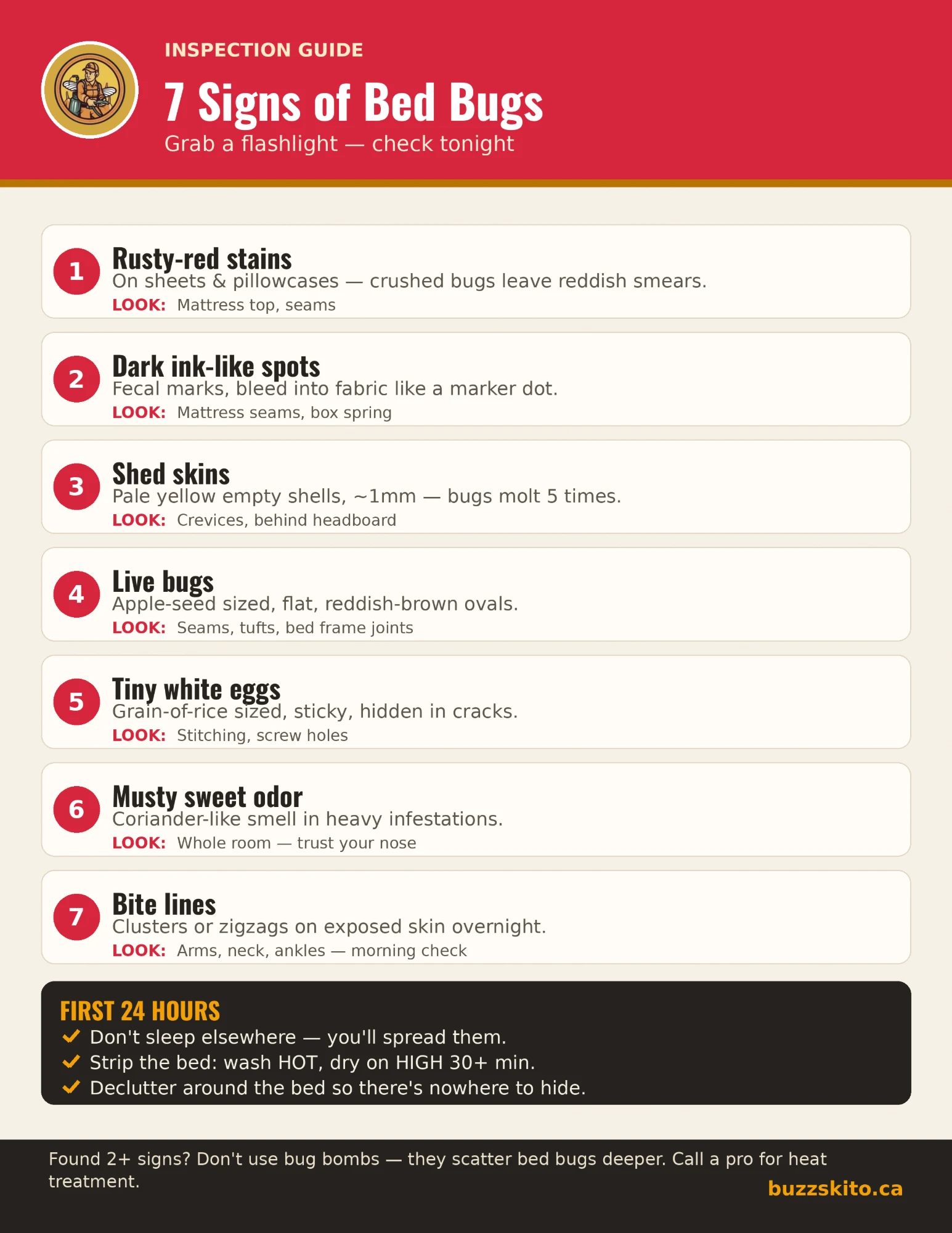 Signs of Bed Bugs: A 7-Point Checklist to Run TonightThe seven signs of bed bugs, from live bugs and ink-like spots to bites, with where to look tonight, what each is…
- Best Bed Bug Powder Canada 2026 — Silica Gel vs Diatomaceous Earth ComparedThe best bed-bug powders in Canada compared: silica gel (CimeXa) vs food-grade diatomaceous earth (Doktor Doom), how…
- How to Get Rid of Bed Bugs, and How Fast It Can Really Be DoneA step-by-step bed bug elimination plan built on EPA and university extension guidance: the temperatures, timelines and…