
BuzzSkito Mosquito & Tick Control Specialists · Published July 21, 2026
The Short Version: Good Chemistry, Wrong Country
MGK Crossfire Bed Bug Concentrate has a strong reputation among American pest-control operators, and it deserves it. It was built to solve the single hardest problem in bed-bug work — that the insects are now widely resistant to the pyrethroids that dominated the market for decades — by combining more than one class of active ingredient in one bottle. It is EPA-registered, it is a professional product, and in the United States it is a legitimate tool in a trained applicator’s kit.
None of that helps you if you live in Canada. Crossfire is not registered with Health Canada’s Pest Management Regulatory Agency (PMRA), and that single fact ends the conversation for a Canadian homeowner. A pesticide without a Canadian registration number has no legal use pattern here, no Canadian label to guide dilution and safety, and no lawful import path for use. This review exists to say that plainly — and then to point you at the products that are legal and that actually get the job done.
Check current Canadian availability of the tools we recommend instead:
What Crossfire Actually Is
Crossfire is a liquid concentrate, meaning it ships as a small bottle of active ingredient that a professional dilutes with water at a label-specified ratio and loads into a sprayer. The reason a concentrate exists at all is economics and precision: a licensed operator treating many units wants to mix exactly the volume needed at exactly the right strength, rather than buying gallons of pre-mixed ready-to-use spray. That is a professional’s workflow, not a homeowner’s.
The product’s headline feature is that it does not rely on a single mode of action. It pairs a faster-acting knockdown component with a slower, longer-lasting one so that a bed bug which survives the first hit still absorbs a lethal dose over time — and, crucially, so that insects genetically resistant to one chemical class are still exposed to another. That multi-active approach is the modern answer to resistance, and it is why professionals in the U.S. reach for products like this rather than the old single-ingredient pyrethroid sprays. As a piece of chemistry, it is well designed. The catch is entirely regulatory, and it is not one you can engineer around.
Why the PMRA Registration Gap Is the Whole Story
It is tempting to treat “not registered in Canada” as red tape — a paperwork difference between two similar countries. It is not. PMRA registration is the process by which Health Canada reviews a pesticide’s safety, efficacy, and label for Canadian use before anyone is allowed to apply it. A product that has cleared that review carries a PCP (Pest Control Products) registration number on a bilingual Canadian label that tells you the legal dilution, the surfaces it may be used on, the protective equipment required, and the re-entry intervals.
A product without that number has none of those things for you. Even if it went through the U.S. EPA’s review, that assessment was for U.S. use patterns and a U.S. label — it does not transfer across the border. When you apply an unregistered concentrate in your bedroom, you are mixing and spraying a nerve-active insecticide with no Canadian guidance on how much, where, or how safely. And under the Pest Control Products Act, using or importing an unregistered pesticide is an offence. The gap is not a formality; it is the line between a legal treatment and an illegal one, and it is exactly the reason we will not recommend the product to a Canadian reader.
The Grey-Market Import Trap
Because Crossfire is easy to find on U.S. retail and marketplace sites, Canadians routinely ask whether they can simply order it across the border. The honest answer is no. Concentrated insecticides are regulated at the border precisely because they are pesticides, and bringing an unregistered one into Canada for use violates the same Act that governs their sale. Listings that appear to ship U.S. pro concentrates to Canadian addresses are the definition of a grey-market channel — the very thing the registration system exists to prevent.
Beyond the legal exposure, the practical risk is real. A grey-market bottle may arrive with a label you cannot fully rely on for Canadian safety guidance, no local recourse if the product is counterfeit or degraded, and no assurance the dilution instructions match what PMRA would have required. For a chemical you are applying near where you sleep, “probably fine” is not a standard worth accepting when fully legal, better-suited tools are on the shelf.
What to Buy in Canada Instead
Here is the good news that makes skipping Crossfire painless: for a do-it-yourself bed-bug fight, the Canada-legal toolkit is not a weaker substitute — for a homeowner it is genuinely better than chasing a liquid concentrate. Bed bugs are one of the few pests where the non-chemical tools out-perform sprays for an untrained user, and where the best legal chemical is one resistance cannot touch.
- A silica desiccant dust (your residual backbone). This is the tool in our verdict box above. Amorphous silica gel kills by stripping the waxy layer off the insect’s shell so it dehydrates — a physical mechanism, not a nerve toxin, which means bed bugs cannot evolve resistance to it. A barely visible film in cracks, outlet boxes, and bed-frame voids stays lethal for months, and it is PMRA-registered. Our CimeXa review covers the leading silica dust in Canada, and our bed-bug powder guide compares it against food-grade diatomaceous earth.
- Heat and steam (the egg-killer). Sprays struggle with bed-bug eggs because they are cemented to fabric; heat does not care. A dry-vapour bed-bug steamer kills every life stage on contact along seams and tufts, and a bed-bug heater decontaminates whole items like luggage and bedding. Heat has no resistance and no residue.
- A sealed-HEPA vacuum (the removal step). A sealed-HEPA vacuum physically pulls live bugs and debris out of harbourages before you treat, without blowing them back into the room.
- Encasements and interceptors (protect and monitor). A mattress encasement traps anything left inside and denies new bugs a home, while interceptor traps under the legs catch travellers and let you measure whether the population is actually falling.
- A registered ready-to-use spray, if you want one. If you specifically want a liquid for contact knockdown on visible bugs, choose one that shows a Canadian PCP number — our reviews of Konk Bed Bug Killer, EcoRaider, and Ortho Home Defense sort the genuinely Canada-available options from the U.S.-only ones, and our bed bug spray and killer guide for Canada lays all of them out in one legal-vs-not-legal table.
How to Choose: What You Are Actually Paying For with a Concentrate
Set the legality aside for a moment and ask what a concentrate like Crossfire is really selling, because the answer explains why it is the wrong shape of tool for a homeowner even where it is legal. A pro concentrate charges a premium for three things: multi-active chemistry aimed at resistance, a low per-treatment cost once diluted across many jobs, and the flexibility to mix exactly what a large job needs. All three are professional advantages — they pay off when you are treating dozens of units and can calibrate a sprayer correctly.
For a single household, none of those advantages land the way they do for a pro, and one of them turns into a liability. The per-treatment economy only matters at volume; you are treating one home, once. The mixing flexibility becomes a hazard: get the dilution wrong and you either waste the product or over-apply a nerve-active insecticide where you sleep. And the resistance-beating chemistry, impressive as it is, still cannot do the one thing a bed-bug residual most needs — reliably reach the cemented eggs and the deep harbourages that heat and a long-residual dust handle far better. In other words, you would be paying for a professional’s toolset to solve a homeowner’s problem, and paying in risk as well as money. The desiccant-plus-heat approach costs less, carries almost no toxicity, cannot be outrun by resistance, and is legal. That is not a compromise; for DIY it is the upgrade.
Where a Liquid Spray Does and Does Not Belong
To be fair to the whole category: liquid residual sprays, applied by a professional with the right registered product, do have a place in bed-bug work — as a crack-and-crevice and spot treatment of harbourages, never as a broadcast coat across a sleeping surface. The problem is not that liquids are useless; it is that the specific liquid this page reviews cannot be used in Canada, and that a homeowner is generally better served by heat, dust, and mechanical tools than by trying to replicate a professional’s spray workflow. If you do want to run a legal spray as one part of the plan, our fogger guide and heat-vs-chemical comparison explain where sprays help and where they fall short, and our sprayer hardware guide covers the equipment side.
Our Verdict on Crossfire for Canada
MGK Crossfire is a well-engineered professional product that we cannot recommend to a Canadian reader, for one decisive reason: it is not PMRA-registered, so there is no legal way to use or import it here. The right move is not to hunt for a grey-market bottle — it is to build the Canada-legal plan that actually works better for a homeowner anyway. Start with a PMRA-registered silica desiccant dust for the long residual, add steam and a heater for the egg kill, encase the mattress, and monitor with interceptors. For the full step-by-step, our how to get rid of bed bugs in Canada guide and the bed-bug control hub tie the whole protocol together, and the pest-control equipment hub covers every device in the kit.
Frequently Asked Questions
Is MGK Crossfire Bed Bug Concentrate legal to use in Canada?+
No — MGK Crossfire is an EPA-registered professional insecticide sold for the U.S. market, and it is not registered with Canada’s Pest Management Regulatory Agency (PMRA). In Canada it is illegal to use, store, or import a pesticide that does not carry a valid PMRA registration number and a Canadian (bilingual) label. That applies even to a product that is perfectly legal one border south, and it applies whether you buy it in person, ship it across, or order it online. Practically, that means Crossfire is off the table for a Canadian homeowner: there is a Canada-legal way to solve a bed-bug problem, and importing a U.S. concentrate is not it.
What is MGK Crossfire and how is it supposed to work?+
Crossfire Bed Bug Concentrate is a professional-grade liquid you dilute with water and spray. Its selling point is that it pairs more than one class of active ingredient in a single bottle — a fast-acting knockdown component alongside a slower, longer-residual component — so that bed bugs that shrug off ordinary pyrethroids still take a lethal dose. It is marketed to licensed U.S. pest-control operators as a tool against pyrethroid-resistant strains, which are now the norm rather than the exception. On paper the chemistry is genuinely modern. The problem for a Canadian reader is not whether it works in a Texas apartment — it is that none of that matters if the product cannot legally be used where you live.
What does “not PMRA-registered” actually mean for me?+
Health Canada’s PMRA reviews every pesticide sold or used in Canada for safety, efficacy, and label accuracy before granting a registration number. A product without that number has not been assessed for Canadian conditions and is not lawful to apply here — there is no legal use pattern, no Canadian label telling you the correct dilution and safety precautions, and no recourse if something goes wrong. “Not PMRA-registered” is not a technicality or a paperwork gap you can wave away; it is the line between a legal treatment and an illegal one. When you shop, look for a PCP (Pest Control Products) registration number on the label. If it is not there, the product is not meant for Canada.
Can I just buy Crossfire on Amazon.ca or import it from the U.S.?+
You should not, and in most cases you cannot do so legally. Concentrated insecticides are restricted at the Canadian border precisely because they are regulated pesticides, and bringing an unregistered one into the country for use is a violation of the Pest Control Products Act. Marketplace listings that appear to offer U.S. pro concentrates to Canadian addresses are exactly the grey-market channel the rules exist to stop — and relying on one leaves you applying an unlabeled chemical in your bedroom with no Canadian safety guidance. The responsible path is to choose from products that carry a Canadian PCP number, which is what the rest of this guide focuses on.
What are the Canada-legal alternatives to Crossfire?+
For a do-it-yourself Canadian, the most reliable chemical tool is a PMRA-registered silica (amorphous silica gel) desiccant dust, which kills by dehydration rather than by a nerve toxin — so resistance is essentially not a factor and the residual lasts for months in dry, undisturbed cracks. Alongside it, several ready-to-use bed-bug sprays carry Canadian registration for on-contact and light residual work. But the honest headline is that the single most dependable answer for bed bugs is not a chemical at all: heat and steam kill every life stage including the eggs, with no resistance and no residue, which is why our whole cluster leans on a steamer, a heater, and a sealed-HEPA vacuum as the core of a real plan.
Does Crossfire really kill pyrethroid-resistant bed bugs?+
The multi-active design is aimed squarely at resistance, and U.S. field reports and manufacturer data suggest it performs better on resistant strains than a plain pyrethroid spray. That is the legitimate reason professionals in the U.S. reach for it. But two caveats matter even setting aside the legality: first, no liquid spray reliably reaches the deep harbourages and cemented eggs that a residual has to survive weeks to catch; and second, resistance is a moving target, so “beats resistance” is a claim with a shelf life. Desiccant dusts and heat sidestep the resistance question entirely, which is a big part of why we steer Canadian readers toward them.
How is a pro concentrate like Crossfire actually applied?+
In professional use, a concentrate is measured precisely, diluted into water at a label-specified ratio, loaded into a calibrated sprayer, and applied as a crack-and-crevice and spot treatment to harbourages — never broadcast across a mattress surface a person sleeps on. That precision is the point of the professional label, and it is also why a concentrate is a poor fit for an untrained homeowner: get the dilution wrong and you either waste the product or over-apply a nerve-active insecticide in a bedroom. If you want the sprayer-and-concentrate workflow for a legal Canadian product, our backpack-sprayer guide covers the hardware, but for bed bugs specifically a dust and heat are the safer DIY route.
Is a chemical concentrate even the best way to kill bed bugs?+
For a homeowner, usually not. Bed bugs are one of the few pests where the non-chemical tools genuinely out-perform sprays for a DIY user: heat and steam kill on contact including the eggs, a desiccant dust gives a months-long residual with no resistance, encasements and interceptors starve and monitor the population, and a sealed-HEPA vacuum physically removes what you can reach. Liquid sprays have a role for a professional working harbourages with the right product, but the DIY win comes from the mechanical and heat tools plus one PMRA-registered residual — not from chasing a stronger and stronger liquid.
Crossfire versus a desiccant dust like CimeXa — which should I choose?+
For a Canadian DIY user, the desiccant dust wins on every axis that matters to you: it is PMRA-registered and legal, it kills by physical dehydration so bed bugs cannot evolve resistance to it, and a light film in cracks, outlet boxes, and bed-frame voids stays lethal for months. Crossfire may have more sophisticated chemistry, but you cannot legally use it, its residual is shorter, and resistance can erode it. A properly applied silica dust — a barely visible film, not a pile — is the most reliable long-residual tool a homeowner can legally buy in Canada.
What about heat and steam instead of any spray?+
Heat is the closest thing to a silver bullet bed bugs have. Sustained temperatures above roughly 50°C kill every life stage, including the cemented eggs that survive most sprays, and there is no resistance and no residue. A dry-vapour steamer treats seams, tufts, and folds on contact; a bed-bug heater or heat chamber decontaminates whole items like luggage, shoes, and bedding. For most Canadian households the strongest plan is heat and steam for the kill, a desiccant dust for the residual, and encasements plus interceptors to protect and monitor — with liquid sprays a minor supporting player at most.
Will any single product get rid of bed bugs on its own?+
No — and any product that promises a one-and-done cure is overselling. Bed bugs hide in dozens of cracks a single treatment never reaches, and their eggs are protected against most sprays, so eradication always takes a combination applied repeatedly over several weeks. The realistic protocol is: heat or steam the obvious harbourages, dust the cracks and voids with a registered desiccant, encase the mattress and box spring, set interceptors under the legs, and re-treat on a schedule until interceptors stay empty for weeks. No concentrate — Crossfire included — changes that.
So what should I actually buy in Canada right now?+
Skip the U.S. concentrate. For a Canadian DIY plan, start with a PMRA-registered silica desiccant dust as your long-residual backbone, add a steamer and a bed-bug heater for the heat kill that handles the eggs, encase the mattress and box spring, and set interceptor traps to monitor. If you want a ready-to-use spray for contact knockdown, choose one that shows a Canadian PCP registration number on the label. That kit is legal, resistance-resistant, and covers every part of the job a single liquid never could.
Related Reading
- Best Bed Bug Spray & Killer in Canada — Every PMRA-Legal Option Compared
- CimeXa Review Canada — The PMRA-Registered Silica Dust
- Best Bed-Bug Powder Canada — Silica Dust vs Diatomaceous Earth
- Heat vs Chemical Bed-Bug Treatment in Canada
- Best Bed-Bug Steamer Canada — Heat That Kills the Eggs
- Konk Bed Bug Killer Review — A Canada-Registered Spray
- How to Get Rid of Bed Bugs in Canada — The Full Protocol
- Best Pest-Control Equipment in Canada — The Device Hub
Keep reading
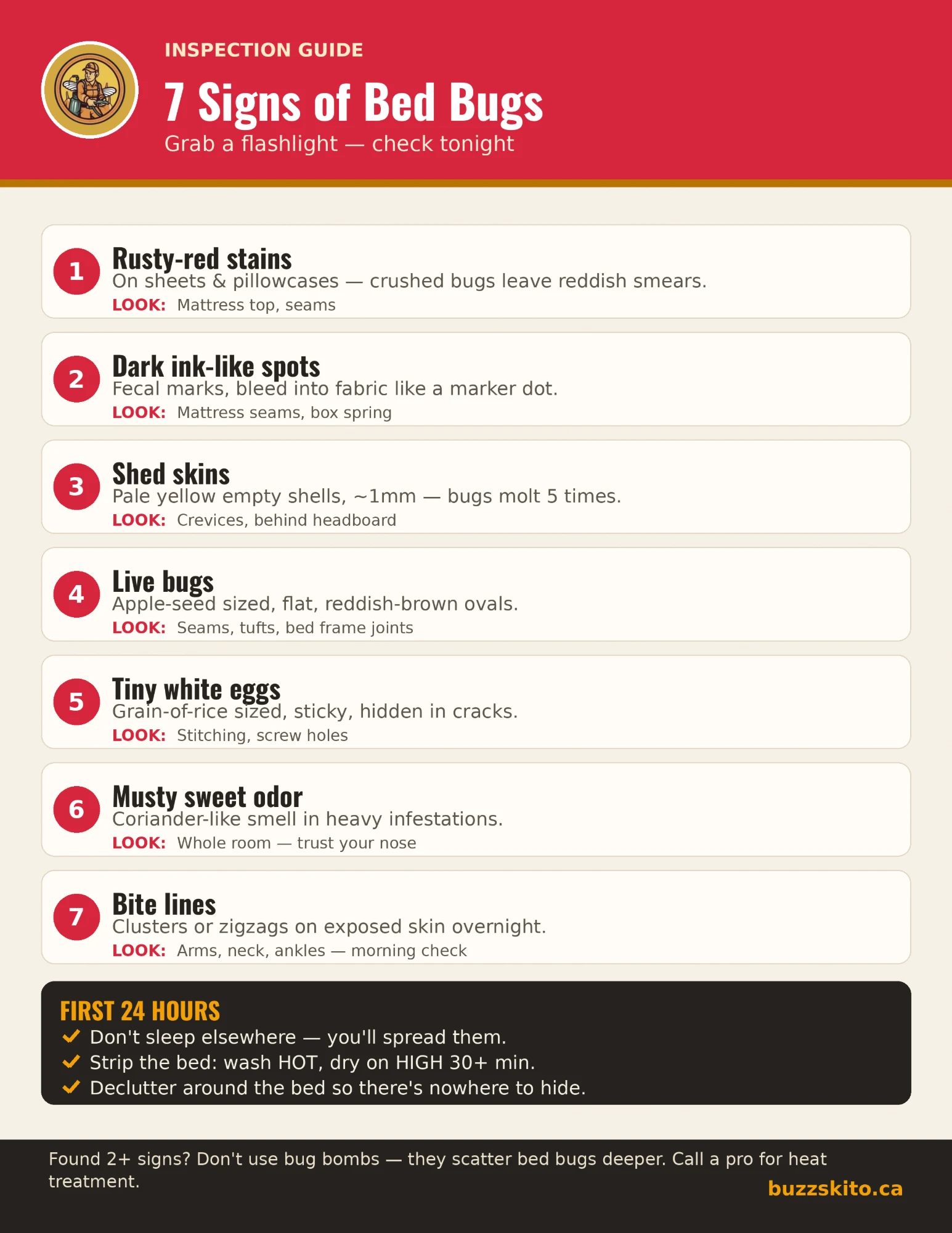 Signs of Bed Bugs: A 7-Point Checklist to Run TonightThe seven signs of bed bugs, from live bugs and ink-like spots to bites, with where to look tonight, what each is…
- McCulloch MC1275 Steamer Review Canada 2026 — Is the Budget Heavy-Duty Steamer Worth It…An independent Canadian review of the McCulloch MC1275 steam cleaner: is the budget heavy-duty boiler steamer worth it…
- Best Bed Bug Heater Canada 2026 — Heat Chambers That Kill Every Life StagePortable heat chambers kill bed bug adults, nymphs, and eggs in one cycle — no pesticide, no PMRA grey zone. ZappBug…