
BuzzSkito Mosquito & Tick Control Specialists · Published July 21, 2026 · Updated October 28, 2026
What Is the Best Bed Bug Fogger in Canada?
If you have landed here typing “best bed bug fogger” or “bug bomb Canada,” the most useful thing we can tell you is that there is no longer a legal one to buy for home use. Health Canada’s re-evaluation of pyrethrins, published March 2, 2023, cancelled domestic total-release foggers “since health risks or value were not shown to be acceptable”; the Doktor Doom and Konk consumer foggers that used to fill this aisle had a last date of sale of March 2, 2024 and a last date of use of September 2, 2024. And every one of them shared the same two fatal flaws against this pest, which no brand escaped.
Those two flaws are simple. First, the mist cannot reach where bed bugs live. Second, the insecticide the mist carries is chemistry most bed bugs have already evolved to survive. Understanding both is the difference between wasting weeks and actually clearing an infestation, so the rest of this guide walks through them and then lays out the plan that works.
Check current Canadian availability of the products this page discusses (look for a PCP registration number on any pesticide before you buy it):
Bug Bombs in Canada: What Health Canada Cancelled
Here is what happened to the foggers Canadians used to buy, from Health Canada’s pesticide registry and its re-evaluation decision on pyrethrins (RVD2023-06). The decision cancelled “Domestic-class pressurized product application using total release foggers (including lock-valve mechanism)” and “Domestic handler applications using handheld and stationary foggers”.
| Product (registration) | Active ingredients | Status in the registry | Last retail sale | Last legal use |
|---|---|---|---|---|
| Doktor Doom Total Release Fogger II Reg. No. 33939, domestic | Pyrethrins 0.40%, piperonyl butoxide 2.00% | Historical; cancelled in RVD2023-06 | March 2, 2024 | September 2, 2024 |
| Go Green Doktor Doom Total Release Fogger Reg. No. 28912, domestic | Pyrethrins 0.4%, piperonyl butoxide 2.0% | Historical; cancelled in RVD2023-06 | March 2, 2024 | September 2, 2024 |
| Konk Complete Release Fogger Reg. No. 32676, domestic | Pyrethrins 0.40%, piperonyl butoxide 2.00% | Historical; cancelled in RVD2023-06 | March 2, 2024 | September 2, 2024 |
| Knockdown Total Release Fumigator-Water Based Reg. No. 34692, domestic | Pyrethrins 0.40%, piperonyl butoxide 2.0% | Historical; cancelled in RVD2023-06 | March 2, 2024 | September 2, 2024 |
| Raid Fumigator Fumigating Fogger Reg. No. 25167, domestic | Permethrin 12.6% | Historical | August 26, 2021 | Registration expired August 26, 2022 |
| Konk 403 Total Release Fumigator Reg. No. 27678, commercial | Pyrethrins 0.40%, piperonyl butoxide 2.00% | Still registered, for licensed applicators; bed bugs are not among its listed pests | — | — |
Sources: Health Canada, Re-evaluation Decision RVD2023-06, Pyrethrins (March 2, 2023) and its factsheet Changes to the registration of pyrethrins pesticides (last date of sale March 2, 2024 and of use September 2, 2024 for the cancelled domestic products); Health Canada Pesticide Label Search and Pesticide Registry, read October 28, 2026. Searching the registry for registered domestic products named fogger, total release, fumigator or bomb found only outdoor products: patio and yard foggers and a wasp spray.
Why Foggers Cannot Reach Bed Bugs
Bed bugs are experts at hiding, and that single fact is what defeats every fogger. During the day they retreat into the tightest, most protected spaces they can find: the piping and seams along the edge of a mattress, the folds and staples of a box spring, the cracks and screw holes of a wooden bed frame, behind loose baseboards and wallpaper, inside electrical outlet boxes, and deep in the joints of nightstands and dressers. They emerge only briefly to feed, then vanish back into harbourage. The eggs, meanwhile, are cemented in place inside those same crevices and never move at all.
A total-release fogger works by discharging its entire contents into the open air of a room. The aerosol drifts through the space and then, being heavier than air, settles downward onto exposed horizontal surfaces — the top of the mattress, the middle of the floor, the flat surfaces of furniture. Crucially, it never pushes into a crack under pressure the way a directed spray straw does. So the droplets coat the surfaces the bugs are not on, and leave the sheltered voids the bugs actually occupy completely untreated. A landmark Ohio State University study put three popular foggers to the test against bed bugs and found little to no effect, precisely because of this geometry. You can empty a dozen cans and the colony inside the mattress seam will barely notice.
The Resistance Problem
Even the unlucky bugs caught in the open often survive, and this is the second failure. The active ingredients in consumer foggers are almost always pyrethrins or synthetic pyrethroids. Bed bugs have made a global comeback over the last two decades in large part because populations have developed widespread genetic resistance to exactly this class of chemistry — through mutations that desensitize their nervous system and through enhanced enzymes that break the insecticide down before it can act. Studies sampling wild bed-bug populations routinely find high levels of pyrethroid resistance.
The practical upshot is grim for the fogger buyer: you are delivering a resisted chemical, by a method that misses the target, at a dose that is often sub-lethal by the time it settles. And sub-lethal exposure is worse than useless — it is the exact selection pressure that breeds still-tougher survivors. This is why heat-based tools matter so much: a bed bug cannot evolve resistance to being cooked. A steamer or a heater kills by physics, not chemistry, so resistance is irrelevant.
The PMRA-Registered vs Grey-Market Trap
The one rule you must not break is legality. In Canada every pesticide — including every fogger, spray, and dust — must be registered with Health Canada’s Pest Management Regulatory Agency (PMRA) and carry a Pest Control Products (PCP) registration number printed on the label. That number is your proof the product was assessed for use in Canadian homes. For total-release foggers the home-use list is now empty: the re-evaluation cancelled the domestic Doktor Doom and Konk foggers along with the rest of the category. Doktor Doom still has registered bed bug sprays, and the full Doktor Doom line-up explained shows where each can genuinely belongs.
The trap is the grey market. Many of the most heavily advertised American “bed bug bombs” — the names you see all over US-focused search results — are formulated and registered for the American market and are not registered for sale in Canada. When they appear on cross-border listings or third-party marketplace sellers shipping into Canada, buying and using them means applying an unregistered pesticide in your home, which is not legal and carries no Canadian safety assessment. Before you buy any pesticide, find the PCP number on the can. No number, no purchase. For bug bombs the answer is now the same whatever the listing says: no domestic total-release fogger has a Canadian registration, so none is one you can legally use at home.
How a Fogger Can Make Things Worse
Foggers do not merely fail neutrally — they can actively enlarge the problem, which is the part most people never hear until it is too late. The irritant mist flushes bugs, and flushing has a nasty side effect: disturbed insects move away from the treated zone. A contained bedroom infestation can scatter into adjacent rooms, deeper into wall voids, and through shared walls in an apartment, turning one manageable hotspot into a dispersed, harder-to-find whole-home problem. For apartment dwellers especially, this is how a unit-level issue becomes a building-level one.
Layer the resistance issue on top and you have a lose-lose: you have spread the population geographically and dosed it sub-lethally with a chemical it already tolerates, selecting for the toughest individuals. This combination — scatter plus selection — is why professional exterminators almost universally advise against foggers for bed bugs and reach instead for targeted, contact-lethal methods. If you want the full walkthrough of a plan that contains rather than scatters, our guides to getting rid of bed bugs in Canada and, for renters, getting rid of bed bugs in an apartment lay it out step by step.
Fogger Safety: Flammability and Label Limits
The one thing foggers are genuinely potent at is starting fires, and this deserves real respect. A total-release fogger discharges its entire pressurized, solvent-carried contents at once, filling a room with a flammable aerosol. Every year across North America there are house fires and even explosions caused by someone setting off cans in a space where a pilot light, stove burner, water-heater flame, or other ignition source was still running. Overloading a room with more cans than the label allows — the classic “more must be better” mistake — multiplies the risk.
If you still have a can from before the cancellation, do not set it off: the last date of use was September 2, 2024. Fogging was never casual even when it was allowed: every open flame and pilot light out, anything that could spark switched off and unplugged, all people and pets out (fish tanks covered or removed), food and food-contact surfaces covered, only the number of cans the label specified for the room’s size, the full waiting period, and thorough ventilation before re-entering. The safety math alone was a strong argument for skipping the fog and using non-flammable, targeted tools instead.
How to Choose: What You Are Actually Paying For
Because bed-bug tools span a wide price range, it is worth being blunt about where a dollar does the most work. If you rank the options by cost-per-real-result, the fogger sits at the bottom, and the money is far better allocated up the list. Prioritise your spending in roughly this order:
- Heat (pay for this first). A dry-vapour steamer for on-contact kill in seams, and a heater or heat chamber for portable items and whole rooms. Heat reaches harbourage and cannot be resisted — it is the highest-value spend by a wide margin.
- Encasements (cheap and high-leverage). A mattress and box-spring encasement traps whatever is inside the bed and starves it, while making future inspection trivial.
- A residual crack-and-crevice spray (a useful chemical step). A directed, PMRA-registered residual injected into cracks keeps working for weeks — the chemical tool that actually earns its place, unlike a fog.
- A desiccant dust (cheap, long-lasting). Diatomaceous earth or a silica dust blown into wall voids and along baseboards kills mechanically over time and is immune to resistance.
- Interceptor traps (monitoring). Under each bed leg, so you can actually measure whether numbers are falling week over week.
- A fogger (off the list). Not an option for home use in Canada since the 2024 cancellation, and the least useful item here before that.
Read that as a spending map. Almost anything on the list buys more real progress per dollar than a case of foggers. If your entire budget is one purchase, buy the steamer, not the bomb.
Buyer’s Checklist: What to Buy Instead of a Bug Bomb
- A PCP number on every pesticide. “Reg. No. ____ P.C.P. Act” on the label; no total-release fogger for home use has one now.
- Bed bugs listed on the label, with the use sites you need. Labels differ: Doktor Doom Pro Max (Reg. No. 34126), for example, says for bed bugs “DO NOT apply to the mattress, headboard, footboard or furniture” and directs you to cracks and crevices, baseboards and the floor beneath the bed.
- A steamer for mattress seams and folds, where bed bugs and their eggs sit.
- Mattress and box-spring encasements so whatever is inside the bed stays there.
- A registered dust labelled for bed bugs for wall voids and along baseboards; check the PCP number on the bag.
- Interceptor traps under each bed leg so you can see whether the numbers are falling.
- In an apartment, the landlord first. Bed bugs move between units, so report it in writing before you treat on your own.
Is a Fogger Ever Worth Buying?
Not in Canada any more, for home use. There used to be a narrow case for a single registered fogger: a large open room, a quick knockdown of visibly exposed insects as one early step inside a proper plan, and the label followed to the letter. Health Canada closed it. The domestic Doktor Doom and Konk total-release foggers were cancelled in the 2023 pyrethrins decision, and the last date to use one was September 2, 2024.
What a fog never was is the plan itself. The way people got burned — sometimes literally — was buying a stack of foggers, treating them as the cure, and discovering weeks later that the population had grown and scattered. Put the money into heat, encasements, targeted residuals, dust, and monitoring. If the infestation is established or you are in a multi-unit building where it can spread through shared walls, our bed-bug control hub maps out the full containment-first approach, and the pest-control equipment hub compares the devices that actually reach the bugs.
Frequently Asked Questions
What is the best bed bug fogger in Canada in 2026?+
There is no longer one you can legally buy for home use. Health Canada cancelled domestic total-release foggers in its re-evaluation of pyrethrins (RVD2023-06), and its registry now lists the Doktor Doom and Konk consumer foggers as historical, with a last retail sale on March 2, 2024 and a last date of use of September 2, 2024. Little was lost: an Ohio State University study found three popular foggers had little, if any, effect on field-collected bed bugs, because the mist never reaches the seams, cracks and voids where they hide, and most populations resist the chemistry. Spend the money on heat, steam, a registered crack-and-crevice spray and dust.
Do bed bug foggers and bug bombs actually work?+
Not for eliminating bed bugs, no. This is the single most important thing to understand before you buy one. Independent university research — including a well-known Ohio State University study — found that total-release foggers had little to no effect on bed bugs, because the insects shelter deep inside mattress seams, cracks, electrical outlets, and furniture joints where the fine mist simply cannot penetrate. On top of that, most bed-bug populations today carry genetic resistance to the pyrethroid and pyrethrin active ingredients that foggers rely on, so even the bugs that do get dusted often survive. A fogger can knock down a few exposed bugs and flush others out of the open, but it leaves the hidden population — and every glued-down egg — completely untouched.
Are bed bug foggers even legal to buy in Canada?+
Not for home use any more. Every pesticide sold in Canada must be registered under the Pest Control Products Act and carry a registration number on its label. Health Canada’s 2023 re-evaluation of pyrethrins cancelled “Domestic-class pressurized product application using total release foggers (including lock-valve mechanism)” because health risks or value were not shown to be acceptable. The consumer foggers on its cancellation list, including Doktor Doom’s and Konk’s, had a last date of sale of March 2, 2024 and a last date of use of September 2, 2024, and the registry lists no domestic total-release fogger today. US "bed bug bomb" brands such as Hot Shot bed-bug foggers are not registered here either.
Why can't a fogger reach the bed bugs?+
Because of how bed bugs live and how aerosols behave. Bed bugs spend the overwhelming majority of their time tucked into tight, protected harbourage — the piping and seams of a mattress, the folds of a box spring, cracks in the bed frame, screw holes, behind baseboards, inside electrical outlets, and in the joints of nearby furniture. A total-release fogger fills the open air of a room with a fine mist that drifts and then settles downward onto exposed horizontal surfaces. It does not push into cracks or crevices under pressure, so the droplets land on the top of your mattress and the middle of the floor but never reach the deep, sheltered spots where the colony lives and where the eggs are cemented in place.
What actually kills bed bugs if a fogger does not?+
Heat and direct-contact treatments do the real work. A steamer delivers heat deep into seams and folds and kills bed bugs and their eggs on contact; a bed-bug heater or heat chamber cooks portable items or whole rooms to a lethal temperature the insects cannot survive; a residual crack-and-crevice spray applied directly into harbourage keeps working for weeks; and an inert desiccant dust like diatomaceous earth or a silica-based product spread into voids abrades the bugs' waxy coating so they dehydrate. Interceptor traps under the bed legs monitor progress and cut off the bed. Those tools reach where a fogger cannot and, in the case of heat, are not defeated by insecticide resistance. A fogger, at most, is a minor add-on for flushing exposed insects out of the open.
Is a total-release fogger dangerous to use indoors?+
It has real safety requirements that people routinely ignore. Total-release foggers discharge their entire contents at once and are flammable — every year fires and even explosions are caused by people setting off too many cans in a space with a pilot light, stove, or other ignition source still on. You must extinguish all open flames and pilot lights, unplug and switch off anything that sparks, cover food and dishes, remove pets and people (and fish tanks), leave for the labelled time, and ventilate thoroughly before re-entering. Using more cans than the label specifies for the room size is both dangerous and illegal. In Canada the question is now settled for home use: Health Canada cancelled domestic total-release foggers, and the last date to use one was September 2, 2024.
How many foggers do I need for a room?+
In Canada, none: domestic total-release foggers were cancelled, with a last date of use of September 2, 2024. When they were registered, each label stated the square footage or cubic footage a single can treats, and using more than the label directed was unsafe and against the law. The common and dangerous mistake is thinking that if one can is good, three is better; overloading a space with aerosol raises the flammability risk sharply. But there is a deeper point here: adding cans does not fix the fundamental problem that the mist cannot reach the harbourage. You cannot brute-force a fogger into working against bed bugs by using more of it. Put your effort into heat, steam, residual sprays, and dusts that actually reach the bugs.
Can a fogger make my bed bug problem worse?+
Yes, in two ways that surprise people. First, the flushing action that seems useful can scatter the infestation: bugs disturbed by the irritant mist may move away from the treated area and spread into adjacent rooms or deeper into wall voids, making the problem larger and harder to find. Second, blanketing surfaces with a sub-lethal dose of a pyrethroid the population is already resistant to applies exactly the kind of selection pressure that breeds even tougher survivors. So a fogger can turn one contained bedroom into a whole-home problem while doing little to reduce numbers. This is a big reason pest-control professionals steer people away from foggers for bed bugs and toward targeted, direct treatments instead.
What is the difference between a fogger and a crack-and-crevice spray?+
Delivery is everything. A total-release fogger disperses insecticide as an untargeted aerosol into open air, so you have no control over where it lands and it settles onto exposed surfaces. A crack-and-crevice spray uses a directed nozzle or straw to inject product precisely into the seams, cracks, screw holes, and joints where bed bugs actually shelter, and a residual formula keeps killing for weeks as bugs travel across the treated surface. For bed bugs specifically, targeted delivery beats a fog every time, because the whole challenge is reaching insects that hide. If you are going to use a chemical step at all, a PMRA-registered residual spray applied into harbourage is far more useful than any fogger.
Should I fog before or after other bed bug treatments?+
Neither, in Canada: domestic total-release foggers are no longer registered (the last date of use was September 2, 2024), and the plan works without one. Put that effort into the treatments that matter — heat, steam, targeted residual spray into cracks, and desiccant dust in voids. A fog was never a finishing move anyway, and fogging over a residual could disturb and degrade that deposit. The sequence that works is prep and declutter, encase the mattress and box spring, vacuum, steam the seams, apply residual product and dust into harbourage, set interceptor traps, and monitor for weeks. A fogger does not earn a place in that sequence for most people.
Where can I buy a PMRA-registered bed bug fogger in Canada?+
You can’t any more. Health Canada cancelled domestic total-release foggers, and its registry lists the Doktor Doom and Konk consumer foggers as historical, with a last retail sale on March 2, 2024 and a last date of use of September 2, 2024. A listing that still offers one is old stock or an import, and third-party listings shipping US-market "bed bug bombs" are not registered for Canada either. The money is far better spent on a steamer, a heater, a registered residual spray, and a desiccant dust that actually reach the bugs.
If foggers barely work, what should I spend my money on instead?+
Spend it on tools that reach harbourage and are not defeated by resistance. In rough priority: a bed-bug steamer for on-contact kill of bugs and eggs in seams; a heater or heat chamber to treat portable items and whole rooms with lethal heat; mattress and box-spring encasements to trap and starve what is inside the bed; a PMRA-registered residual crack-and-crevice spray injected into cracks; an inert desiccant dust for wall voids and under baseboards; and interceptor traps to monitor and protect the bed. That kit costs more than a can of fog but it is the difference between actually clearing an infestation and spending weeks fogging while the population quietly grows.
Are bug bombs banned in Canada?+
For home use, in effect yes, although Health Canada’s word is cancelled. Its 2023 re-evaluation of pyrethrins cancelled domestic total-release foggers “since health risks or value were not shown to be acceptable”: existing stock could be sold until March 2, 2024 and used until September 2, 2024, and the registry lists no domestic total-release fogger now. Some commercial-class fumigators are still registered for licensed applicators; one of them, Konk 403 Total Release Fumigator (Reg. No. 27678), does not list bed bugs among its pests.
Do bed bug bombs work in an apartment?+
No. In the Ohio State University study (Jones and Bryant, 2012), three popular foggers had little, if any, effect on field-collected bed bugs, and even a susceptible lab strain was unaffected under a thin layer of cloth. In an apartment, bugs disturbed by a fog can also move through shared walls into the next unit. And in Canada, domestic bug bombs are no longer registered at all. Tell your landlord or building manager in writing, and protect the bed with an encasement, interceptors and heat.
Related Reading
- Best Pest-Control Equipment Canada — The Device Hub
- Best Bed-Bug Steamer Canada — Heat That Kills on Contact
- Bed-Bug Heater Canada — Whole-Room and Portable Heat
- Best Bed-Bug Powder Canada — Desiccant Dusts That Work in Voids
- Best Bed-Bug Spray Canada — Including Sprays Labelled for Mattresses
- Heat vs Chemical Bed-Bug Treatment — Which Wins
- How to Get Rid of Bed Bugs in an Apartment
- Bed-Bug Interceptor Traps — Monitor and Protect the Bed
Keep reading
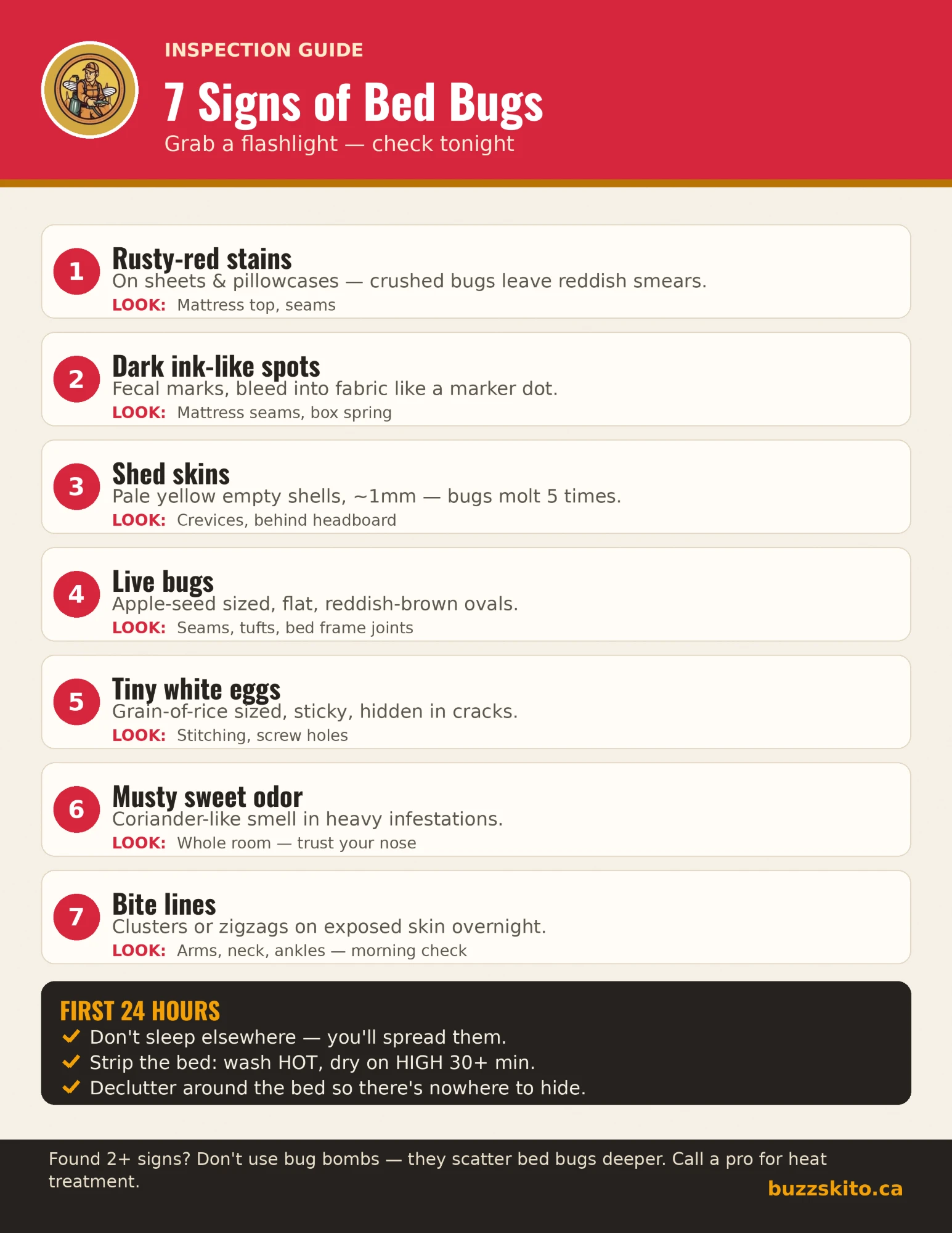 Signs of Bed Bugs: A 7-Point Checklist to Run TonightThe seven signs of bed bugs, from live bugs and ink-like spots to bites, with where to look tonight, what each is…
- DIY Bed Bug Heat Treatment Canada 2026 — The Temperatures, Gear & Protocol That Actually…A complete DIY bed bug heat treatment guide for Canada: the exact lethal temperatures and dwell times, portable heat…
- Black Bed Bugs: Are Bed Bugs Black, or Is It Something Else?Bed bugs are reddish brown, not black. Why a fed bug looks dark, what the black spots on a mattress are, and the small…