
BuzzSkito Mosquito & Tick Control Specialists · Published July 21, 2026
Is the McCulloch MC1275 Worth It? The Short Version
The McCulloch MC1275 is worth it for the buyer who wants the most steamer for the least money and is willing to do a small amount of homework on where it is shipping from. It is the machine that keeps getting named in DIY bed-bug threads because it hits the two specs that matter for pest work — a hot, low-moisture boiler and a long continuous run — at a price that undercuts the premium brands. For a Canadian household on a budget fighting a caught-early infestation, that combination is hard to argue with. The one honest asterisk is that it is a US-market unit, so the frictionless local-warranty experience you get from a domestic brand is not guaranteed; you trade a little support certainty for real savings.
What follows is our independent take: why the steamer category matters for pest work at all, the two specs that actually separate a good steamer from a useless one, the US-ship caveat in plain language, the technique that decides whether steaming works, the real downsides, and how to decide whether the MC1275 is the right pick for you or whether the premium is worth paying.
Check current Canadian availability and seller:
Why a Steamer Belongs in a Bed-Bug Kit
The reason steam matters comes down to a biological fact that trips up most DIY attempts: bed-bug eggs are the hard part. A female cements her eggs to fabric with a coating that ordinary suction cannot break, so even a thorough vacuuming lifts the adults and nymphs while leaving a mattress studded with viable eggs that hatch days later and restart the cycle. Chemical sprays struggle here too, because eggs are relatively resistant and because bed bugs have widespread resistance to many common insecticides. Heat is the honest answer — sufficiently hot temperatures kill bed bugs at every life stage, eggs included, and they do it by physics rather than chemistry, so there is no resistance to develop and no residue to worry about. Our guide to heat vs chemical bed-bug treatment works through that trade-off in detail.
That is what a low-moisture boiler steamer delivers: a stream of very hot, dry-ish steam you can drive into the exact seams, folds, and joints where bugs and eggs hide. It reaches into fabric where a vacuum nozzle only skims, and it does so without soaking the mattress the way a wet garment steamer would. In a non-chemical protocol, the sequence is vacuum first to physically remove the live insects, then steam to kill the eggs and hidden bugs the vacuum could not lift — a combination covered in depth in our best bed-bug steamer guide. The MC1275 is one specific, budget-friendly machine within that boiler-steamer category.
The Two Specs That Actually Matter: Heat and Run Time
Ignore most of the marketing bullet points and focus on two things, because they are what separate a steamer that works for pests from one that just makes fabric damp.
Temperature at the tip. McCulloch builds the MC1275 around a pressurized boiler that heats water well past boiling and releases it as high-temperature, lower-moisture steam. The number on the box is the boiler temperature; what matters to a bed bug is the temperature at the fabric, which is always lower and drops with distance and the wrong nozzle. This is why a hot boiler is necessary but not sufficient — you need the heat and the technique to deliver it. The MC1275 runs hot enough to give you that headroom; a lukewarm handheld does not, no matter how carefully you work. Always confirm the current specification on the live listing before buying, since manufacturers revise their lineups.
Continuous run time. This is the spec that most changes the day-to-day experience, and it is where the MC1275 pulls decisively ahead of cheap handhelds. Flash-heat pod steamers give you a few minutes of steam and then sputter into a refill-and-reheat cycle, which turns treating a single mattress into a stop-start ordeal that tempts you to rush — and rushing is fatal to results. The MC1275’s large tank delivers steam continuously long enough to work an entire mattress, box spring, and frame in one uninterrupted pass. This is the single biggest reason it beats the impulse-buy handhelds for real bed-bug work, and it is a large part of why the DIY community keeps coming back to it. Our steamer vs heater comparison covers how that surface-heat approach differs from whole-item heating.
The US-Ship Caveat, in Plain Language
Here is the one thing this review exists to flag clearly, because most US-focused buyer guides never mention it. The McCulloch MC1275 is designed and sold for the US market. On Amazon.ca it frequently shows up through third-party sellers who ship the unit across the border rather than as a domestically-stocked Canadian product. In practical terms that can mean a US-style plug, a warranty that is awkward or effectively impossible to claim from Canada, longer shipping windows, and the occasional customs handling step. To be clear, none of that touches how well the machine kills bed bugs — the MC1275 is a real workhorse and the electrical spec is compatible with Canadian outlets — but it does change the ownership experience if something goes wrong a year in.
So the rule for a Canadian buyer is simple: before you click buy, read the listing carefully. Confirm who the seller is, where it ships from, what plug you will receive, and what the warranty terms actually are for a Canadian address. If those check out and the price is right, the MC1275 is a superb value. If you would rather not do that homework and you want a warranty you can claim locally without friction, a Canadian-made steamer like the Dupray Neat removes the entire question — at a higher price. We put the two head to head in our Dupray vs McCulloch comparison so you can see exactly what the premium buys. It is worth stressing that this caveat is commercial, not regulatory: because a steamer is an appliance and not a pesticide, there is no Health Canada or PMRA registration involved either way, unlike the grey-market imported sprays and concentrates where the compliance stakes are real.
The Technique That Makes or Breaks It
Here is the part no spec sheet tells you: even the MC1275 will fail if you wave it around. Steam kills by transferring heat into the fabric, and heat transfer needs contact time. Get the technique right and this steamer is genuinely effective; get it wrong and you have an affordable fabric-dampener.
- Vacuum first. Run a crevice tool along every seam and edge to physically remove live insects and loose debris before you steam — our sealed-HEPA vacuum guide covers this step.
- Go slowly — really slowly. Move the nozzle at roughly a slow crawl, a few centimetres per second, so the heat penetrates the seam rather than skating over it. This is the single most common thing people get wrong.
- Keep the tip close. Hold the nozzle within a couple of centimetres of the fabric so the steam is still hot when it arrives; heat bleeds off fast with distance.
- Use the right attachment. A concentrated nozzle for seams and joints; a cloth-covered wide tool for broad mattress surfaces so you do not blast bugs off into the air.
- Hit every harbourage. Mattress seams and piping top and bottom, box-spring edges and staples, bed-frame joints and bolt holes, headboard cracks, and the baseboards around the bed.
- Do not soak. Low-moisture steam should leave surfaces warm and lightly damp, not wet. If fabric is getting soaked you are moving too slowly or the moisture setting is wrong.
Finish by putting the rest of the kit to work — interceptor traps under the bed legs let you monitor, week over week, whether the numbers are actually falling. Steam gives you the kill; monitoring tells you whether it worked.
The Honest Downsides
A review that only lists strengths is an advertisement, so here are the real trade-offs. First, the Canadian availability and support story: as a US-market unit the MC1275 often reaches you through third-party cross-border sellers, so warranty claims and returns can be more awkward than with a domestic brand — verify the terms before you buy. Second, it is a deliberate corded tool, not grab-and-go: a boiler unit needs a few minutes to build pressure and keeps you tethered to an outlet, so it rewards planned treatment sessions rather than quick swipes. Third, and most important, it cannot end an infestation on its own. Steam reaches only what the nozzle touches — bugs hidden inside a wall void, deep in a hollow metal frame, or in the room next door are simply out of range. Anyone selling you a steamer as a one-and-done cure is overselling it.
Those limits are exactly why the steamer lives inside a plan. For whole items you cannot steam into — a suitcase full of clothes, bedding, soft toys — a portable heat chamber or bed-bug heater brings the entire object up to a lethal temperature and reaches interiors the nozzle never will. The ZappBug heater is the best-known consumer example of that category. Steam and heat chambers are complementary, not competing.
How to Choose: Is the MC1275 the Right Steamer for You?
Because this is a meaningful purchase, it is worth matching the machine to the job honestly rather than defaulting to either the cheapest or the priciest option. Sort yourself into one of these:
- Budget-conscious buyer with an active bed-bug scare, comfortable checking a listing. This is the MC1275’s sweet spot. You get boiler-grade heat and run time for less money, and you accept a few minutes of due diligence on the seller and warranty. Buy it.
- You want zero import friction and a warranty you can claim in Canada. Pay the premium for a domestically-supported brand like the Dupray Neat. The performance is comparable; you are buying peace of mind and support.
- Frequent, large-scale, or multi-room treatment. Look at a heavier commercial-class boiler with an even longer run time; the MC1275 can do it but you will refill more often than you would like.
- One-time minor scare, tight budget, no interest in reusing it. A flash-heat handheld or even a rental may be the right call — just accept the short run time and work in patient sections, and do not expect handheld heat to match a full boiler.
- You only want to freshen fabric and clothes. Any pest-grade boiler is overkill; a garment steamer does that job for a fraction of the cost.
The way to overspend is to buy far more steamer than your use justifies; the way to underspend is to buy a lukewarm handheld for a real infestation and then wonder why the bugs came back. For the large budget-minded middle group who want genuine boiler capability at the lowest sensible price — and are willing to read a listing carefully — the MC1275 is the value answer. If your situation is big enough that DIY feels like it is losing, our Canadian pest-control cost guide lays out what professional bed-bug work runs so you can weigh the two paths.
What You Are Actually Paying For — and Saving On
It helps to be explicit about where the MC1275’s low price comes from, because it is not from cutting the parts that matter for pest work. The core mechanism — a pressurized boiler producing hot, low-moisture steam over a long run — is present and genuinely capable. What you save on, relative to the premium Canadian brands, is largely the domestic support infrastructure: the local warranty desk, the guaranteed correct plug in the box, the reassurance of a company with a Canadian presence standing behind the unit. For a lot of buyers that is a rational trade — the steamer still kills bed bugs and eggs exactly as well, and the savings are real. For others, especially anyone who dreads dealing with a cross-border warranty claim during a stressful pest problem, that support layer is worth paying for. Neither choice is wrong; the point is to make it with open eyes rather than assuming the cheaper unit is cheaper because it performs worse. It is not. It is cheaper because you are shouldering a little more of the ownership risk yourself.
Frequently Asked Questions
Is the McCulloch MC1275 good for bed bugs?+
Yes — the McCulloch MC1275 is a genuinely capable heavy-duty steam cleaner for bed-bug work, and it is one of the most recommended budget units in North American DIY circles for a reason: it is a corded, boiler-style machine that produces hot, low-moisture steam and holds a long continuous run on a full tank. Heat is one of the few things that reliably kills bed bugs and their glued-down eggs that a vacuum cannot lift, so a machine that runs hot and long enough to treat a whole mattress, box spring, and frame in one session is exactly the tool you want. The catch for a Canadian buyer is not performance — it is availability and support, since the MC1275 is a US-market unit and does not always ship domestically with the local warranty and correct plug you get from a Canadian brand. It is still one tool in a plan, paired with a vacuum and monitoring.
What is the catch with buying the MC1275 in Canada?+
The catch is import friction, not the machine itself. The McCulloch MC1275 is designed and marketed for the US market, so on Amazon.ca it frequently appears through third-party sellers who ship it across the border. That can mean a US-style plug, 120V wiring that is fine for Canada but paired with a warranty that is awkward or impossible to claim from here, longer shipping, and occasional customs handling. None of that makes the steamer worse at killing bed bugs — it is a real workhorse — but it does mean you should confirm the seller, the plug, the shipping origin, and the warranty terms on the live listing before you buy, rather than assuming a domestic-brand experience. If flawless local support matters more to you than saving money, a Canadian-made steamer removes that friction entirely.
MC1275 vs Dupray Neat — which should I buy?+
They occupy different corners of the same category. The MC1275 is the budget heavy-duty pick: a big-tank, long-running boiler steamer that costs noticeably less, which is why it dominates DIY bed-bug forums. The Dupray Neat is the premium Canadian-made pick: similar dry-vapour capability with reliable Amazon.ca stock, a correct plug, and reachable local warranty support, at a higher price. If you want maximum steamer for the least money and you are comfortable checking the seller and warranty terms yourself, the MC1275 is the value champion. If you want zero import friction and a warranty you can actually claim in Canada, the Neat is worth the premium. We break the two down head to head in our dedicated Dupray vs McCulloch comparison.
What temperature does the McCulloch MC1275 reach?+
McCulloch markets the MC1275 as producing high-temperature steam from a pressurized boiler — the water is heated well past the boiling point and released as low-moisture vapour. As with every steamer, the number that matters is not the boiler temperature on the box but the temperature of the steam when it reaches the fabric, which is always lower and drops with distance and the wrong nozzle. The MC1275 runs hot enough to raise a mattress surface into the lethal range for bed bugs when you use it correctly — tip close, slow pass, right attachment. Confirm the current specification on the live listing, since manufacturers revise their lineups, but the practical point holds: a hot boiler gives you the headroom; your technique delivers the heat.
How long does the MC1275 run on one tank?+
A long continuous run is one of the MC1275’s headline strengths and the biggest practical reason it beats cheap flash-heat handhelds for bed-bug work. Handheld pod steamers give you a few minutes of steam before they sputter into a refill-and-reheat cycle; a full-size boiler like the MC1275 carries a large tank and delivers steam continuously long enough to work an entire mattress, box spring, and frame without constant stops. Stopping to refill tempts you to rush, and rushing is fatal to steaming results, so the long run time is not a luxury — it is what makes a thorough treatment actually achievable. Check the live listing for exact tank-capacity and run-time figures before buying.
Does steaming actually kill bed bug eggs?+
Heat is one of the few things that reliably kills bed-bug eggs, and that is the whole reason a steamer earns its place in the kit. Bed-bug females cement their eggs to fabric with a coating that suction simply cannot break, so a vacuum removes adults and nymphs but leaves most eggs behind to hatch days later. Sufficiently hot steam, applied slowly enough to transfer real heat into the seam or fold, kills both the eggs and the hidden bugs the vacuum missed. The catch is dwell and contact: you must move the nozzle slowly, think a slow crawl rather than a wave, and keep the tip close so the heat penetrates instead of skimming the surface. Fast passes are the single most common reason DIY steaming under-delivers.
Is the MC1275 a dry-vapour steamer or a wet steam mop?+
The MC1275 belongs to the boiler-driven, lower-moisture steam-cleaner category — the right class for pest work — not the wet garment or floor-mop category. A garment or floor steam mop pushes out high-moisture steam meant to relax wrinkles or wet a floor, which is exactly what you do not want on infested bedding you would rather not soak. The MC1275 heats water in a pressurized boiler and releases hotter, lower-moisture steam that carries the heat needed to kill bugs and eggs while leaving surfaces far less wet, so a mattress dries quickly and you avoid trapping moisture that could feed mould. For pest control you specifically want this boiler-driven class, and the MC1275 sits firmly inside it.
What are the downsides of the McCulloch MC1275?+
Three honest ones. First, the Canadian availability and support story: as a US-market unit it often ships from third-party cross-border sellers, so warranty claims and returns can be more awkward than with a domestic brand, and you should verify the seller and terms before buying. Second, it is a deliberate corded tool, not grab-and-go: a boiler steamer takes a few minutes to build pressure and tethers you to an outlet, so it rewards planned treatment sessions rather than quick swipes. Third, and most important, it cannot end an infestation by itself — steam reaches only the surfaces the nozzle touches, so bugs inside a wall void, deep in a hollow bed frame, or in the next room are out of range. It is an excellent, affordable kill-and-remove tool for accessible surfaces, and it must be paired with vacuuming and monitoring.
Can I use the MC1275 for regular household cleaning too?+
Yes, and that dual use is a big part of its value case. Outside of a pest emergency the same machine chemical-free-cleans grout, tile, sealed floors, oven interiors, bathroom fixtures, stovetops, upholstery, and car interiors, because high-temperature low-moisture steam cuts grease and sanitizes without detergents. The MC1275 ships with a range of attachments aimed at exactly that kind of general cleaning, so you buy it to help with a bed-bug scare and then keep using it for kitchen and bathroom deep-cleaning for years. If your only conceivable use is a single one-time bug problem, a cheaper handheld or a rental may make more sense — but as an appliance you will actually reuse, the MC1275 earns its keep at a lower price than most of its rivals.
Is the MC1275 legal to use for pest control in Canada?+
Completely — because a steamer is an appliance, not a pesticide. Health Canada’s Pest Management Regulatory Agency (PMRA) registers chemical pest-control products, and heat-based tools like steamers fall entirely outside that system, so there is no registration barrier and no restriction on using one for bed bugs. That is one of the quiet advantages of the whole steam-and-heat approach: it is chemical-free, resistance-proof physics, and it sidesteps the compliance questions that surround imported sprays and concentrates. The only caveat with the MC1275 is commercial, not regulatory: confirm the seller, plug, and warranty on the listing, since it is a US-market unit sold into Canada rather than a domestically-supported brand.
How do I actually steam a bed for bed bugs with the MC1275?+
Vacuum first with a crevice tool to physically remove live insects and loose debris, then steam the same ground. Fit a concentrated nozzle or a cloth-covered wide tool, keep the tip within a couple of centimetres of the fabric, and move slowly — roughly a slow crawl of a few centimetres per second — so the heat actually penetrates the seam. Work every mattress seam and piping top and bottom, box-spring edges and staples, bed-frame joints and bolt holes, headboard cracks, and the baseboards around the bed. Do not soak the fabric: low-moisture steam should leave surfaces warm and lightly damp, not wet. Then place interceptor traps under the bed legs to monitor, week over week, whether the population is actually dropping.
Should I buy the MC1275 or just call a professional?+
It depends on the size of the problem and your appetite for the work. For a caught-early, single-room bed-bug scare, a disciplined DIY protocol — vacuum, steam, encase, monitor with interceptors — genuinely knocks a population down, and the MC1275 is a reusable, affordable appliance you keep afterward. For a widespread or long-established infestation across multiple rooms, professional treatment reaches wall voids and structural harbourage that no consumer steamer can, and trying to DIY it alone often just prolongs the problem. A sensible middle path is to steam and monitor while getting a professional quote. Our Canadian pest-control cost guide lays out what that professional work typically runs so you can weigh the two paths.
Related Reading
- Dupray vs McCulloch Steamer Canada — Head to Head
- Dupray Neat Steamer Review Canada
- Best Bed-Bug Steamer Canada — Heat That Kills the Eggs
- Steamer vs Heater for Bed Bugs Canada
- Heat vs Chemical Bed-Bug Treatment Canada
- Best Sealed-HEPA Vacuum for Bed Bugs & Fleas Canada
- Best Bed-Bug Heat Chamber Canada
- Best Pest-Control Equipment in Canada — The Full Device Kit
- Pest Control Cost in Canada — What You’ll Actually Pay
Keep reading
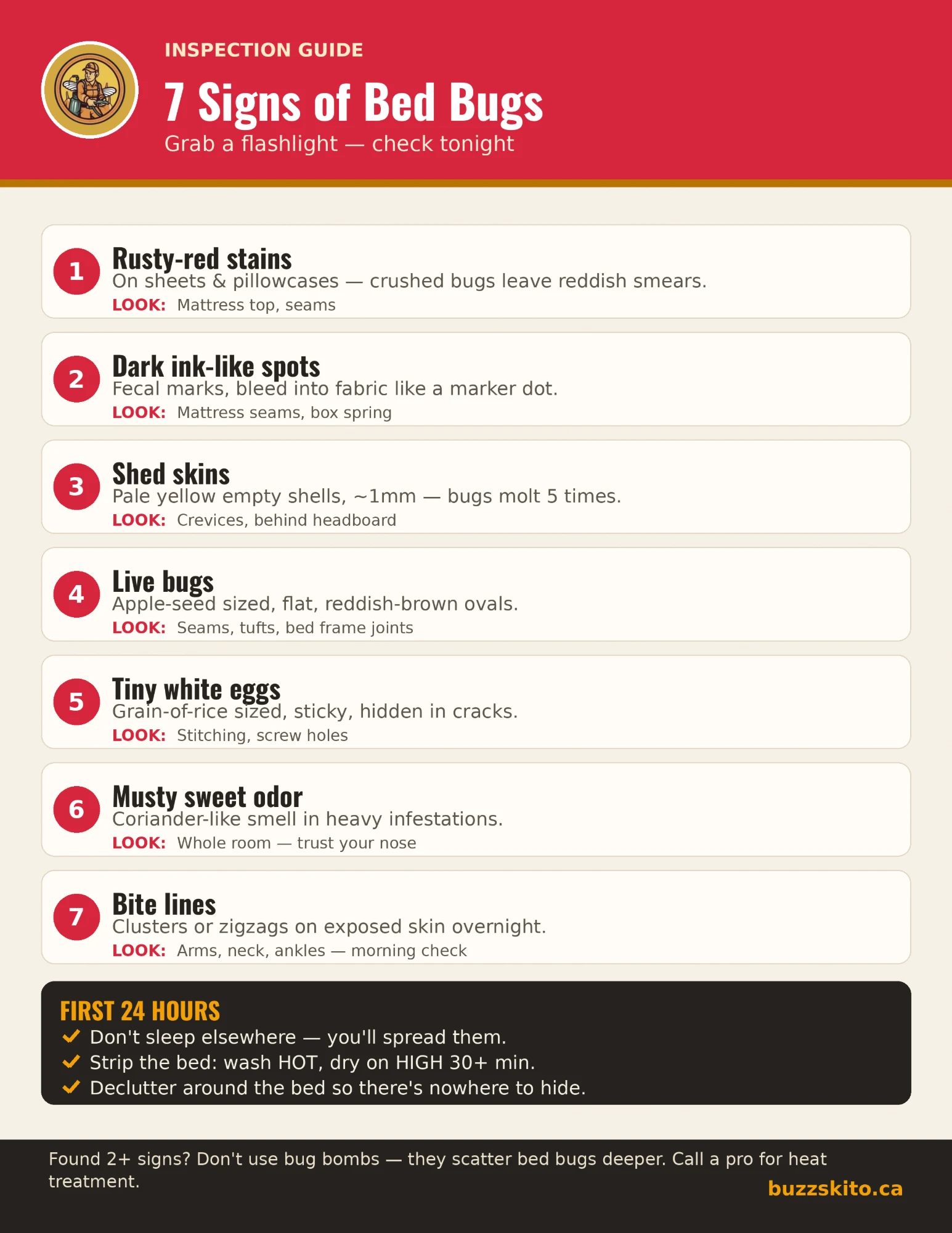 Signs of Bed Bugs: A 7-Point Checklist to Run TonightThe seven signs of bed bugs, from live bugs and ink-like spots to bites, with where to look tonight, what each is…
- Bed Bug Bites vs Mosquito Bites — Five Tells That Separate Them, and What to Do About EachBed bug bites vs mosquito bites: five tells that separate them — pattern, timing, where on the body, season and the…
- Best Bed Bug Trap Canada 2026 — Passive Interceptors vs Active Lure Traps ComparedThe best bed bug traps in Canada for 2026: passive interceptor cups (Aspectek, ClimbUp-style) vs active heat/CO₂ lure…