
BuzzSkito Mosquito & Tick Control Specialists · Published July 21, 2026
Steamer vs Heater for Bed Bugs: The Short Version
The single most useful thing to understand before you spend a dollar is that a steamer and a heater chamber are not competing answers to the same question — they are two tools that solve two different halves of a bed-bug problem, and the honest recommendation for most people is that you will eventually want both. A steamer such as the Dupray Neat is a surface weapon: you aim a nozzle and drive intense, on-contact heat into the seams of your mattress, the joints of your bed frame, the cracks of a headboard, and the run of baseboard around the room. A heater chamber such as the ZappBug is a bulk-item weapon: you load clothing, bedding, luggage, shoes, and books inside, close it, and let dry heat soak the entire enclosed load until nothing alive remains — eggs included.
So the “which is better” question really becomes “which do I need first,” and the answer there is clear. Buy the steamer first, because the bed and the area right around it are where a bed-bug population concentrates, and none of that furniture will ever fit inside a heater. The rest of this guide explains exactly why each tool covers the gap the other leaves — and how to use them together.
Check current Canadian availability for each tool:
How Each One Kills: Contact Heat vs Enclosed Heat
Both machines exploit the same biological fact — bed bugs and their eggs die when they are held above roughly 50–60°C (122–140°F) for long enough — but they get there in opposite ways, and that difference is the whole story. A steamer boils water far past that threshold and delivers a short, ferociously hot blast at the surface. For the second or two the vapour stays hot against the fabric, it is lethal on contact, which is why steaming technique is all about slow, deliberate passes that keep each spot visibly steaming. The heat is intense but shallow and fleeting: it kills what the nozzle touches and cools almost immediately after you move on.
A heater chamber does the reverse. Instead of a hot, brief blast it applies a modest, sustained warmth to an entire enclosed volume — often air in the 50–60°C range at the item — and holds it there for hours. That patience is the point: given enough time, heat penetrates to the centre of a packed suitcase, into the spine of a book, through the folds of a jacket, and into the seams where eggs are cemented, places a nozzle could never reach. Steam is hot and fast; a heater is warm and patient. One trades penetration for intensity, the other intensity for penetration — which is precisely why they suit different targets.
What a Steamer Treats That a Heater Cannot
The steamer’s domain is everything you cannot enclose or move. Your mattress is the obvious example: it is the primary harbourage in almost every infestation, and it is far too large for any consumer heater. Methodical steaming of every seam, tuft, fold, and the piping around the edge is the best DIY tool available for treating it in place. The same goes for the box spring’s fabric and staples, the joints and bolt holes of the bed frame, the cracks in a wooden headboard, upholstered furniture, carpet edges, and the baseboards that ring the room — a primary bed-bug travel route between harbourage and host.
None of that fixed structure can be picked up and dropped into a box, which is why steam is irreplaceable here. The trade-off you accept is reach: steam kills where the vapour lands and a short distance into fabric, but it will not raise the temperature deep inside a thick mattress core. That is fine — bed bugs harbour in the seams and surface layers, not the foam centre — but it is why serious treatments pair steaming the bed with a quality mattress encasement, so anything that survives deep inside is sealed in and starves. For the full technique and which machines hold their heat best, see our dedicated best bed-bug steamer in Canada guide and our Dupray steamer review.
What a Heater Treats That a Steamer Cannot
The heater’s domain is the loose contents of a room — the pile of stuff a steamer can only ever crawl across the surface of. Clothing, bedding, curtains, backpacks, shoes, stuffed animals, books, and above all luggage: a heater reaches inside every one of these and holds the whole object above the kill threshold, penetrating pockets, folds, and seams that a nozzle would skip entirely. Try to steam a packed suitcase and you treat the outer shell while the bugs sit safely in the lining; put the same suitcase in a heater and the entire thing is sterilized from the inside out.
Dry heat is also gentler on many of these items than steam would be. Books, delicate fabrics, and luggage that steam moisture would soak or warp come out of a heater bone dry and undamaged. That is the ZappBug’s core value: it decontaminates everything a steamer cannot enclose, without adding a drop of water. There are limits — heat-sensitive items like candles, crayons, vinyl records, pressurized cans, cosmetics, and anything with electronics or adhesives must stay out — but for the ordinary contents of a bedroom it is the definitive bulk tool. Our ZappBug heater review and broader bed-bug heater guide cover loading technique and cycle times, and if travel is your concern a luggage-sized heater is the portable version of the same idea.
The Dryer Loophole: Why You Can Wait on the Heater
Here is the practical nuance that decides purchase order. A heater chamber’s main job — killing bugs and eggs in laundry-safe fabrics — overlaps heavily with something you almost certainly already own: a clothes dryer. A hot dryer cycle reaches temperatures comparable to a heater chamber and will reliably kill bed bugs and eggs in anything you can safely tumble — clothing, bedding, towels, and soft toys. That means in the early days of a treatment you can decontaminate the bulk of your washable items for free, sealing them in bags afterward to keep them clean.
What a dryer cannot take is the reason a heater still earns its place: luggage, shoes, books, framed items, electronics-adjacent bags, and delicate fabrics that would be ruined by tumbling. A heater handles all of those. But because the dryer bridges the biggest chunk of the heater’s workload, you can comfortably start with the steamer alone and add the heater later — whereas nothing bridges the steamer’s job, since you cannot put a mattress in anything. That asymmetry is the entire argument for buying the steamer first.
Attention, Time, and Moisture: The Day-to-Day Differences
Beyond what each tool treats, they feel completely different to use, and that matters for whether you will actually do the work properly. A heater is hands-off but slow: you load it, switch it on, and walk away for several hours while heat penetrates the load, then let it cool. The time cost is real but the attention cost is near zero — you can run a cycle overnight or while you are at work. A steamer is hands-on and slow: killing bed bugs with steam means disciplined inch-per-second passes over every seam and joint, and a single bed can take a long, focused session. It demands your full concentration and a steady hand from start to finish.
Then there is moisture. Steam adds water to whatever it touches, so you must resist over-wetting a mattress — a soaked mattress is slow to sleep on again and a genuine mould risk — and you must never steam live electrical outlets or switch plates. A heater adds no moisture at all, which is exactly why it is safe for books and luggage. Neither of these is a dealbreaker, but they shape how you plan a treatment: run the heater in the background while you spend your active hours steaming the bed, and let steamed surfaces dry fully before you remake anything.
How to Choose: What You Are Actually Paying For
Both of these are high-ticket purchases, and it is worth being clear-eyed about which capabilities earn their cost for your situation. Read the following as a spending map rather than a ranking, because the right answer genuinely depends on what you need to treat:
- A steamer, if the bed and room structure are your problem (buy this first). You are paying for the only tool that can treat a mattress, frame, and baseboards in place. Nothing else does this job, which is why it tops the priority list for essentially everyone.
- A heater, if you have a lot of belongings to decontaminate (buy this second, or first if you travel constantly). You are paying for hands-off, dry, whole-object heat that reaches inside luggage, books, and shoes a dryer cannot take. Frequent travellers may reasonably flip the order.
- Boiler quality and dry-vapour output on the steamer (pay for this). A hotter, drier, longer-running boiler holds a killing temperature at the fabric surface through a whole-room job. This is where a premium steamer earns its price for pest work specifically.
- Chamber size and even heat distribution on the heater (pay for this). A bigger chamber that heats evenly lets you treat more per cycle and avoids cold pockets where eggs survive. Loading loosely matters as much as the spec.
- A concentrator nozzle (steamer) and a reliable thermometer/timer (heater) — confirm both are included. These are cheap but essential: the nozzle drives heat into seams, and the temperature readout is how you know the cycle actually hit lethal levels.
If you can only afford one right now, the map points the same way it has all along: the steamer treats the epicentre, the dryer covers most of what the heater would, and the heater is the upgrade you add when your budget and your pile of un-tumbleable belongings both justify it. For a broader look at where both tools sit among every bed-bug device, see our heat vs chemical treatment guide and the full pest control equipment hub.
The Verdict — and How to Use the Winner
For a single first purchase, the steamer wins, because it is the only tool that treats the one thing you cannot put in a box: the bed itself. But “wins” here means “buy first,” not “buy instead” — the heater covers a real gap the steamer leaves, and a thorough treatment uses both. Whichever you start with, remember that heat is only the kill step in a larger loop. Vacuum first with a sealed-HEPA vacuum to physically remove live adults, nymphs, and debris from the seams. Apply heat second — steam the fixed surfaces slowly and gently, and run laundry through a hot dryer or a heater chamber. Then place interceptor traps under the bed legs so you can see, week over week, whether the numbers are actually falling.
If you are still deciding between two heaters rather than steamer-vs-heater, our PackTite vs ZappBug comparison breaks down the leading chambers head-to-head. And if you are choosing between two steamers, the Dupray vs McCulloch guide covers that matchup in detail.
As an Amazon Associate I earn from qualifying purchases. Price shown on Amazon.ca, at no extra cost to you.
🏆 Buy First — Best Single Bed-Bug Heat Tool
9.0/10· BuzzSkito ratingFor a first purchase, the steamer wins the head-to-head — not because it is better than a heater, but because it is the only tool that treats the infestation epicentre: the mattress, box spring, frame, headboard, and baseboards that will never fit inside any consumer heater. Its intense, on-contact vapour kills bugs and eggs in every seam and fold, and a hot dryer covers most of what a heater would in the interim. Add a ZappBug heater second for luggage, books, and delicates a dryer cannot take — a thorough treatment uses both.
Pros
- Treats the bed itself — the one thing no heater can hold
- Intense on-contact heat kills bugs and eggs in seams
- No cold-pocket risk on the surfaces it treats
- A dryer bridges most of the heater’s job while you save
Cons
- Hands-on — demands slow, focused passes
- Adds moisture; will not treat loose belongings in bulk
Frequently Asked Questions
Steamer or heater for bed bugs — which should I buy?+
They are not really rivals; they treat different halves of the problem. A steamer like the Dupray Neat kills bed bugs and eggs on the surfaces you cannot put in a box — the mattress, box spring, bed frame, headboard, and baseboards — by driving hot dry vapour into every seam. A heater chamber like the ZappBug kills everything inside a sealed enclosure — clothing, bedding, luggage, books, shoes, and small belongings — by holding the whole load above the lethal temperature for hours. If you can only buy one to start, buy the steamer, because the bed itself is the infestation epicentre and it is the one thing that will never fit in a heater. Most serious DIY treatments end up owning both.
What is the actual difference between a steamer and a heater for bed bugs?+
It comes down to how the heat is delivered and what it can reach. A steamer applies intense, localized heat to a surface — you aim a nozzle and the vapour cooks the bugs and eggs in that spot before it cools. It is precise and immediate but only treats what you touch, and it adds moisture. A heater chamber applies gentle, whole-object heat — you load items inside, close it, and the entire enclosed volume is raised past the kill threshold and held there for hours, so heat penetrates into folds, pockets, book spines, and seams you could never reach with a nozzle. Steam is a surface tool; a heater is a bulk-item tool. That difference decides which job each is right for.
Can a steamer kill bed bugs deep in a mattress the way a heater does?+
Only where the steam reaches. Steam kills on contact and penetrates a short distance into fabric, so it is excellent along mattress seams, piping, tufts, and the top layer — exactly where bed bugs harbour. But it will not raise the temperature deep inside a thick mattress core the way placing a whole item in a heater would, and a mattress is too big for any consumer heater anyway. That is the honest limit: for the bed itself, methodical slow steaming of every seam and fold is the best DIY tool available, and you accept that you are treating harbourage surfaces rather than sterilizing the entire object. Pair it with an encasement so any survivors deep inside are trapped and starve.
Does a ZappBug heater actually kill bed bug eggs?+
Yes — heat is one of the few methods that reliably kills bed bug eggs, and a heater chamber is built for exactly that. Eggs die when they are held at roughly 50–60°C (122–140°F) long enough for the heat to penetrate the egg. A heater chamber holds an entire load above that threshold for a sustained cycle, so heat soaks through fabric layers and into the seams and folds where eggs are cemented. The critical detail is loading loosely and running the full cycle: pack items too tightly and cold pockets form where eggs can survive. Used correctly, a heater is genuinely egg-lethal across everything inside it, which is its biggest advantage over sprays that cannot reach eggs at all.
If I can only afford one, which do I buy first?+
Buy the steamer first. The reasoning is simple: the bed and the area immediately around it are where a bed-bug population concentrates, and none of that — the mattress, box spring, frame, headboard, or baseboards — will ever fit inside a heater. The steamer is the only tool that treats the epicentre. A heater is invaluable for decontaminating the pile of clothing and bedding around the bed, but you can handle much of that in the interim with a hot dryer cycle, which reaches similar temperatures for laundry-safe items. You cannot put a mattress in a dryer. Start with the steamer for the bed, add the heater when budget allows for the belongings a dryer cannot take.
What can a heater treat that a steamer cannot, and vice versa?+
A heater treats things you can enclose: suitcases, backpacks, shoes, stuffed animals, books, electronics-free bags of clothing, curtains, and delicate items that steam moisture would damage. It reaches inside those objects in ways a nozzle never could. A steamer treats things you cannot enclose or move: the mattress in place, the bed frame, the headboard bolted to the wall, upholstered furniture, carpet edges, and baseboards. Each covers the exact gap the other leaves. That complementarity is why professional and thorough DIY treatments use both — the steamer for the fixed structure of the room, the heater for the loose contents.
What temperature does each one need to hit to kill bed bugs?+
Both aim past the same biological threshold — bed bugs and eggs die at roughly 50–60°C (122–140°F) held long enough — but they get there differently. A steamer boils water far above that and delivers a surface blast that is lethal on contact for the second or two the vapour stays hot, so the technique is slow passes that keep each spot steaming. A heater works the opposite way: modest air temperature (often in the 50–60°C range at the item) held for a long cycle so the heat has time to penetrate to the centre of the load. Steam is hot and fast; a heater is warm and patient. Both kill; they just trade intensity for penetration.
How long does a heater cycle take versus steaming a whole room?+
A heater cycle is mostly hands-off but slow: you load it, switch it on, and let it run for several hours so heat penetrates to the core of the load, then let it cool. You can walk away during the cycle. Steaming a room is hands-on and also slow: methodical inch-per-second passes along every seam, fold, joint, and baseboard mean a single bed and frame can take a long, careful session, and a whole room longer. Neither is a five-minute job. The practical difference is attention: a heater runs itself while you do something else, whereas steaming demands your full focus and a steady hand the entire time.
Which is safer for my belongings — steam or a heater?+
It depends on the item. A heater is gentler on most things because it applies even, moisture-free warmth — ideal for books, shoes, delicate fabrics, and luggage that steam could soak or warp. But a heater can damage heat-sensitive items: candles, crayons, some cosmetics, vinyl records, pressurized cans, and anything with adhesives or electronics should stay out. Steam is safe for the bed structure and hard surfaces but adds moisture, so you must avoid over-wetting a mattress (mould risk) and never steam live electrical outlets. Read each device manual: match the method to the material, and when in doubt, a hot dryer handles laundry-safe fabrics and a heater handles the rest.
Are steamers and heater chambers legal to use in Canada without a licence?+
Yes. Both a steam cleaner and a heater chamber are appliances, not pesticides, so neither carries any PMRA (Health Canada Pest Management Regulatory Agency) registration requirement, and anyone can buy and use them. That is a genuine advantage over many chemical bed-bug products — some of which are US-market formulations not registered for sale or use in Canada. Heat is a non-chemical kill method with no residue and no re-entry interval, which is why both steam and enclosed heat are first-line DIY tools for Canadian households. Buy the Canadian 120V listing on Amazon.ca so you get the correct plug, voltage, and warranty support rather than a grey-market US unit.
Do professionals use steam, heat, or both?+
Both, and usually alongside other tools. Professional heat treatments raise an entire room or home to a lethal temperature with industrial heaters — a scaled-up version of what a chamber does for a single load — while technicians simultaneously use handheld steamers to treat surfaces and drive heat into spots the ambient air is slow to reach, and to knock down harbourages before the room comes up to temperature. The consumer versions mirror that logic at a smaller scale: a heater chamber for your belongings, a steamer for the fixed surfaces. Neither professionals nor careful DIYers rely on a single tool, because each method leaves a gap the other covers.
Do I still need a vacuum and interceptor traps if I own both a steamer and a heater?+
Yes. Heat tools kill, but they do not remove debris or tell you whether you are winning. You vacuum first with a sealed-HEPA vacuum to physically strip live adults, nymphs, shed skins, and loose eggs out of the seams so your steam is not just cooking a crowd. You steam and heat-treat second for the eggs and hidden bugs. Then you place interceptor traps under the bed legs to monitor, week over week, whether the population is actually dropping and to intercept any survivors trying to reach the bed. Vacuum, heat, monitor — that is the full non-chemical loop, and skipping the monitoring step is the usual reason a DIY treatment quietly stalls.
Related Reading
- Best Bed-Bug Steamer Canada — The Full Field Compared
- Bed-Bug Heater Canada — Heat-Treat the Whole Room
- ZappBug Heater Review Canada
- Dupray Steamer Review Canada
- PackTite vs ZappBug — Which Heater Chamber Wins
- Heat vs Chemical Bed-Bug Treatment Canada
- Best Sealed-HEPA Vacuum for Bed Bugs & Fleas Canada
- Best Pest Control Equipment Canada — The Device Hub
Keep reading
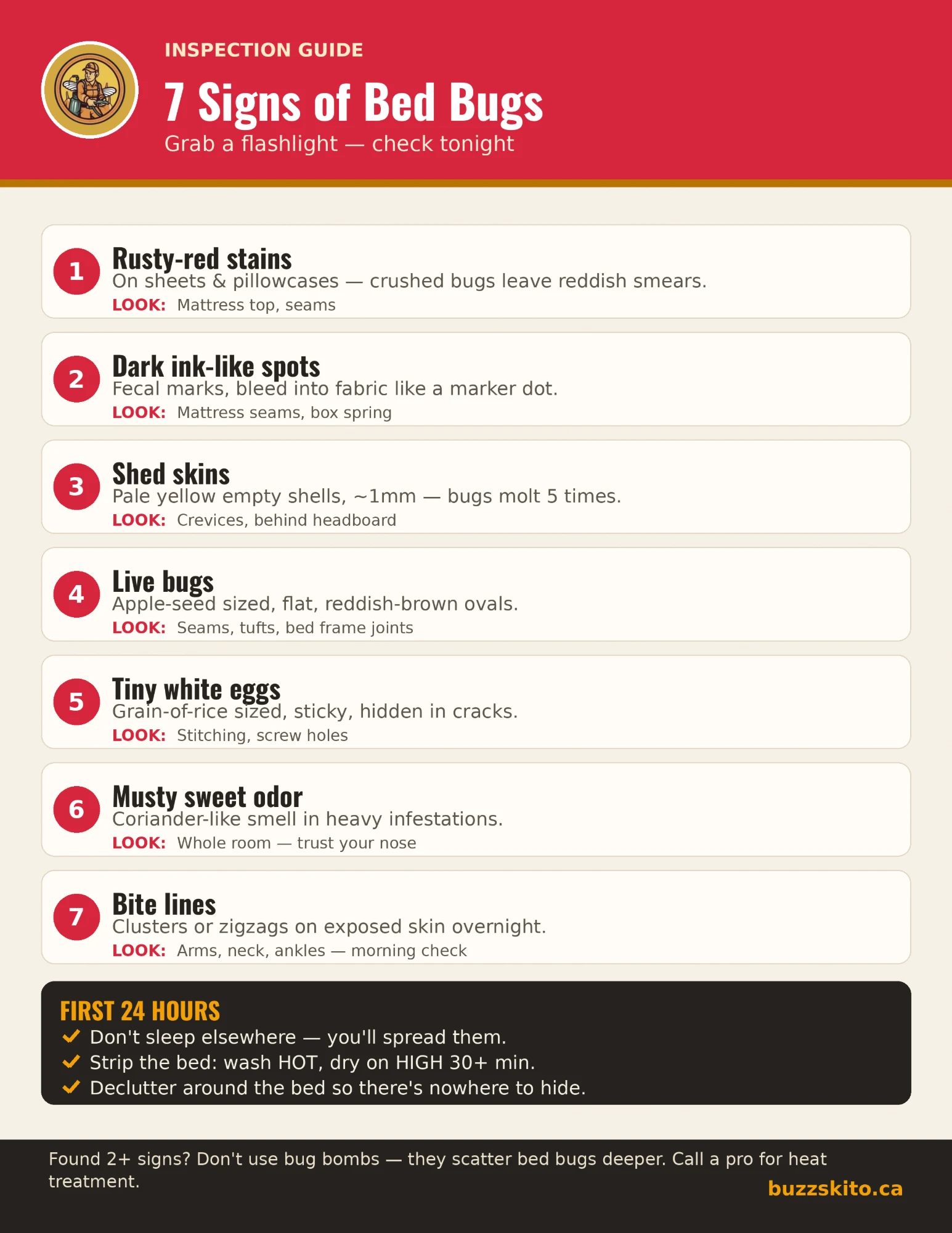 Signs of Bed Bugs: A 7-Point Checklist to Run TonightThe seven signs of bed bugs, from live bugs and ink-like spots to bites, with where to look tonight, what each is…
- ZappBug Room Review Canada 2026 — Is the Whole-Room Bed-Bug Heater Worth It?Independent Canadian review of the ZappBug Room whole-room bed-bug heater — how the large fabric enclosure reaches…
- Best Bed Bug Powder Canada 2026 — Silica Gel vs Diatomaceous Earth ComparedThe best bed-bug powders in Canada compared: silica gel (CimeXa) vs food-grade diatomaceous earth (Doktor Doom), how…