BuzzSkito Mosquito & Tick Control Specialists · Published July 30, 2026
Why This Particular Comparison Is So Hard
Because both insects do the same thing to you. A mosquito and a bed bug both pierce skin, inject saliva containing anticoagulants so the blood keeps flowing, and take a meal. What you see afterwards is not the wound — it is your own immune system reacting to foreign proteins in that saliva. Two different insects, one histamine response, and the response is dominated by your individual immunology rather than by which insect caused it.
That is why guides built around photographs disappoint people. The photograph shows one person’s reaction, and yours will differ. It is also why the useful signals are all contextual: where the marks are, when they appeared relative to the exposure, what the arrangement looks like, and what else is in the room. Those you can actually check.
We should be upfront about our vantage point. BuzzSkito is a licensed mosquito and tick control company in Mississauga serving 19 GTA cities — mosquitoes are the pest we are actually out in yards treating every week from May to September, and we do not treat bed bugs. So the mosquito half of this page is our day job, the bed bug half is independent research, and we will happily tell you when neither of the products we could sell you is the right answer.
Check current Canadian availability of the two items that settle the question:
Tell 1 — The Pattern on Your Skin
The best-known separator is the arrangement. Bed bug bites frequently appear in a rough line or a tight zigzag cluster of three to five welts on one patch of skin — the pattern sometimes nicknamed “breakfast, lunch, dinner”. The mechanism is worth knowing, because it explains the exceptions: a feeding bed bug is easily disturbed by a sleeper shifting, and it will withdraw and probe again a short distance away, so a single insect can leave several marks in one night. The line also tends to trace an edge — the hem of a sleeve, the line where the duvet fell, a waistband — because that is where accessible skin ended.
Mosquito bites have no geometry. A mosquito bites, is noticed or is not, and flies off; the next one lands somewhere unrelated. You get scattered singles on whatever was uncovered.
Trust this signal moderately. A line is a strong reason to inspect your bed. Its absence is not an all-clear: single, scattered bed bug bites are entirely normal, especially early in an infestation when there are few insects.
There is one other biter that produces clustered welts tracing a clothing edge, and it is worth naming here because it is the thing most often mistaken for the bed bug pattern by travellers: chigger larvae bite where fabric presses tight against skin — sock line, waistband, behind the knees — a few hours after time in tall grass or brush. Two things separate them from a bed bug: the outing came first, and one exposure produces one crop of welts that then stops, whereas bed bug bites keep arriving night after night. If you were bitten in the US South or Midwest rather than at home, our guide to chigger bites and their look-alikes covers the distribution and the flea comparison — in most of Canada, established chigger populations are rare enough that another biter is usually the real answer.
Tell 2 — How Fast It Showed Up
This is the tell that most people never think to use, and it is one of the stronger ones. A mosquito welt rises within minutes — often you feel the bite, slap at nothing, and watch the bump form while you are still standing there. It typically fades within a day or two.
A bed bug bite can take from hours up to 14 days to appear, according to the CDC. That delay causes an enormous amount of confusion, because it detaches the mark from the event. People wake up on the fourth day of a trip and blame the hotel they were in last night, or come home from holiday and blame the flight, when the bites are a fortnight old. The same lag is why bites often seem to “start” suddenly — a population that had been feeding quietly for weeks crosses your personal reaction threshold all at once.
If you can date the exposure — you were outdoors on Saturday evening, you slept in a strange bed on Tuesday — this tell does real work. If you cannot, skip it.
Tell 3 — Where They Landed on Your Body
Bed bugs feed on a sleeping body and go to whatever skin the bedding leaves out, which is why the classic map is face, neck, shoulders, upper arms, and hands. Someone who sleeps in a t-shirt and shorts gets a different map from someone in long pyjamas, so read the pattern against what you actually wear to bed rather than against a diagram.
Mosquitoes bite whatever was uncovered outdoors, and in Canadian yards that skews heavily to ankles and lower legs — partly because several container-breeding species that live around houses tend to fly and bite low, and partly because ankles are the part of a gardener that stays exposed. If your bites are exclusively below the knee and you have been outside, that is a poor fit for an insect that feeds on a body under a duvet. We wrote about the specific reason people get hit around the ankles in why mosquitoes bite your ankles.
Tell 4 — The Calendar and the Backstory
In Canada, the season does a great deal of work for free. Adult mosquitoes are not biting you in a Toronto January. Fresh welts appearing every morning in the middle of winter, with the windows closed, effectively remove the mosquito from the list — and that single observation resolves more cases than any amount of squinting at a photograph.
The backstory matters as much. Bed bug bites that begin within a few weeks of a hotel stay, a move, a second-hand mattress or couch, a stay with family, a student returning from residence, or a piece of furniture from a curb are the archetypal presentation. Mosquito bites cluster around specific outdoor time: a cottage weekend, evenings on the deck, a stretch of humid weather after heavy rain filled every container in the yard.
One overlap deserves naming, because it is the case that causes the most confusion: bites at night, indoors, in summer. Several mosquito species are crepuscular — most active at dusk and dawn — and one that comes in through a torn screen at nightfall will feed while you sleep and leave welts by morning, which looks exactly like the bed bug story. The separator is persistence and evidence: a mosquito indoors gives you a few scattered bites and nothing to find in the mattress, whereas a bed bug population keeps going regardless of whether a window is open and leaves physical traces. If this is you, screen the door and set interceptors — do both, and stop guessing.
Tell 5 — The Evidence in the Room (This Is the One That Counts)
Everything above narrows the odds. Only this confirms. If you take one thing from this page, take this: stop reading your skin and start reading your bed.
Four kinds of physical evidence, roughly in order of how often they are found first:
- Fecal spotting. Dark specks, like the tip of a fine felt pen, along mattress seams and piping, on the box spring, and where the headboard meets the wall. The confirming test is that they smear rusty-brown on a damp cotton bud, because that is digested blood rather than dirt. This is the most reliable and most common evidence.
- Shed skins. Hollow, papery, correctly bed-bug-shaped shells. A bed bug moults five times before adulthood, so cast skins outnumber live insects and are frequently the first thing anyone spots.
- Eggs. About a millimetre, pearly white, rice-shaped, cemented into cracks and seams in small clusters. They do not brush away.
- Live bugs. Adults are apple-seed sized and reddish-brown. The immature stages are much easier to miss — translucent and around a millimetre when newly hatched, showing a dark red centre once fed. Our guide to baby bed bugs and nymphs covers the size-by-stage chart and the look-alikes, because carpet beetle larvae send a lot of people down the wrong road.
Search with a bright, narrow-beam flashlight held almost flat against the fabric — the low angle throws shadows and makes a millimetre-long insect visible when a ceiling light will not. Work the seam, then the piping, then the tag, then the box spring corners, then the frame joints and screw holes, then behind the headboard, then the baseboard behind the bed. The full routine is in how to check for bed bugs in Canada.
And if you would rather not conduct a search at all, the low-effort version genuinely works: put interceptor cups under all four bed legs, pull the bed a few centimetres off the wall, keep the bedding from touching the floor, and read the cups each morning for a fortnight. The insects do the reporting for you.
If the Answer Is Bed Bugs
Three things not to do, first, because each is common and each makes it worse. Do not throw out the mattress — the population is also in the box spring, the frame and the baseboards, so a new mattress in the same room is re-infested within days, and hauling an infested one through a corridor spreads it. Do not move to the couch or the spare room — bed bugs follow the sleeper, and this is the most reliable way to turn a one-room problem into a whole-home one. Do not buy a fogger — total-release products deposit on open surfaces while the insects are inside seams, voids and frame tubing.
A fourth caution belongs beside those three, because it is the one people find on a forum at two in the morning: do not import a US professional concentrate. The most-recommended one, MGK Crossfire, is EPA-registered for use in the United States but carries no Health Canada PMRA registration number, so there is no Canadian label to follow — our Crossfire concentrate review for Canada sets out what is registered here instead. And if what you actually want is speed, which is the natural question after a night of this, what kills bed bugs instantly ranks the few things that do kill on contact — steam, sustained heat, a direct hit while the surface is wet — against the many that only look like they do, and explains why none of them ends an infestation on their own, since most of the population is inside seams, screw holes and voids the moment you stop looking.
What to do instead: isolate the bed and set interceptors, run the bedding through a hot dryer cycle (the dryer does the killing, not the wash), vacuum the seams and empty the canister into a sealed bag in an outdoor bin immediately, and encase the mattress and box spring. Then follow a proper plan on a schedule rather than a single heroic afternoon — ours is the Canadian bed bug control hub. If you rent, report it in writing before you buy anything: in most Canadian jurisdictions treating a pest infestation in a rental is the landlord’s responsibility, and unit-by-unit DIY in a multi-unit building rarely holds.
If the Answer Is Mosquitoes
This is the half we do for a living, so here is the version we give people on the phone, including the part that costs nothing.
Find the water first. Every mosquito biting you in your own yard grew up in standing water somewhere near it, and the containers people overlook are absurdly small — a plant saucer, a folded tarp, the tray under an air conditioner, a clogged eavestrough, a wheelbarrow, a kid’s toy, a birdbath left a week too long. Some of the species that bite around houses can complete a generation in a container the size of a bottle cap. A ten-minute lap of the property with a bucket, repeated weekly, outperforms anything you can buy for the same money, which is zero. For water you cannot tip — a rain barrel, a pond, a chronic low spot — Bti is the targeted answer: a naturally occurring bacterium that kills mosquito larvae in the water without treating your whole yard.
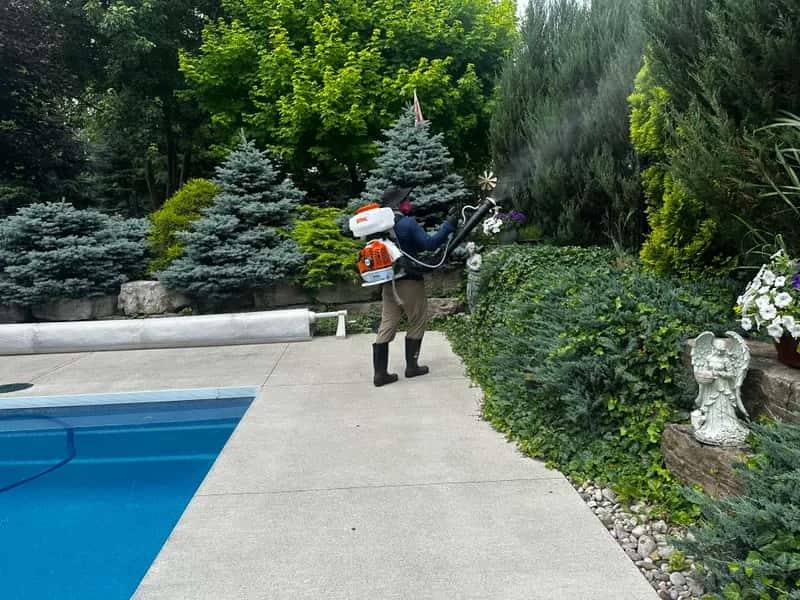
Then deal with where the adults spend the day. Adult mosquitoes do not hover in open sun; they rest in shaded, humid vegetation — the undersides of shrub leaves, dense hedging, ivy, fence lines, the cool damp margins of a yard. Treating those resting surfaces is what a professional barrier spray actually is, and it is the part that is genuinely difficult to replicate with a consumer pump sprayer, both because of coverage and because of what a licensed operator may legally apply. For the hours you are actually sitting outside, a portable patio device protects the zone around it, and a magnetic screen door stops the ones getting in every time you carry plates to the barbecue.
And the honest limit on all of it: nothing on the market makes a yard mosquito-free, and anyone promising that is selling you something. What good yard work does is take the pressure from unbearable to unnoticed. If you are in the GTA and want the resting vegetation handled properly, that is our actual job — and the assessment is free. If you are not in the GTA, the two paragraphs above are still the whole playbook.
Relief, and the Part That Actually Matters Medically
For either insect, the symptom care is the same and it is not complicated: a cool compress, an over-the-counter oral antihistamine, or a plain hydrocortisone or calamine preparation. Both kinds of bite generally resolve on their own.
The thing worth taking seriously is not the bite — it is the scratching. In Canada the realistic medical risk from both bed bugs and mosquitoes is a secondary bacterial skin infection caused by broken skin, and that is entirely within your control. See a doctor if you develop spreading redness, warmth, pus, fever, or severe swelling; if you have any signs of a serious allergic reaction; or, after outdoor exposure, if you develop fever, headache and severe fatigue — the West Nile symptoms worth mentioning to a physician. Our when to worry about a mosquito bite guide covers the specific thresholds, and mosquito bite relief covers what genuinely helps the itch.
What we would not do is spend much on this end of the problem. Relief products are a comfort purchase, not a solution — and if you are buying them weekly, the bites are telling you to fix the cause instead.
Frequently Asked Questions
How do I tell bed bug bites from mosquito bites?+
Five things separate them, in order of reliability. Pattern: bed bug bites tend to appear in rough lines or tight clusters of three to five on one patch of skin, while mosquito bites are scattered singles. Timing: a mosquito welt rises within minutes and usually fades in a day or two, whereas a bed bug bite can take from hours up to 14 days to appear, according to the CDC. Location: bed bug bites land on skin left exposed during sleep — face, neck, shoulders, arms, hands — while mosquito bites follow whatever was uncovered outdoors, very often ankles and lower legs. Context: waking up with new marks in a Canadian February points away from mosquitoes entirely. And evidence: only fecal spotting, shed skins, eggs, or live bugs in the room actually confirms bed bugs. No bite is diagnostic on its own.
Can bed bug bites look exactly like mosquito bites?+
Yes, and often do — that is why this comparison exists rather than a photo. A single bed bug bite on a person with a mild reaction is a small raised itchy welt, which is exactly what a mosquito leaves. Reactions vary so widely that two people sleeping in the same infested bed can wake with completely different skin: one covered in welts, the other with nothing at all. Because of that, the individual mark is the least reliable input you have. Weight the pattern, the timing, and above all the physical evidence in the room over how any single bite looks.
Do bed bug bites itch more than mosquito bites?+
Usually yes, and for longer — many people describe the itch as peaking in the morning and again in the evening and being persistent enough to disrupt sleep on its own, whereas a mosquito welt tends to be intense briefly and then settles within a day or two. But this is a tendency, not a test. Individual immune response drives itch far more than the species does, and plenty of people get a fierce reaction to mosquitoes and a mild one to bed bugs. Do not make a decision about tearing your bedroom apart on the strength of how much something itches.
Why do I only get bitten at night?+
Because two very different situations produce the same complaint. Bed bugs are nocturnal and feed on a sleeping host, so bites appear overnight and are found in the morning. But several mosquito species are also crepuscular — most active at dusk and dawn — and a single mosquito that follows you indoors at nightfall will feed while you sleep and leave welts by morning. The separator is the pattern and the room: a mosquito indoors leaves a small number of scattered bites on whatever was uncovered, night after night only if new mosquitoes keep getting in, whereas bed bug activity persists and typically escalates whether or not a window has been opened.
Which one is more dangerous?+
In Canada, the mosquito, and it is not especially close. Bed bugs are not known to transmit disease to humans — both the CDC and Health Canada state this — so the harms are secondary: skin infection from scratching, allergic reactions in sensitised people, and real sleep loss and anxiety. Mosquitoes in Ontario carry a small but genuine West Nile virus risk; most infected people never develop symptoms, but a minority develop illness, and a small number become seriously unwell. That said, "more dangerous" and "more disruptive" are different questions: a bed bug infestation costs far more money, time, and peace of mind than a summer of mosquito bites, which is why people quite reasonably fear the less dangerous insect more.
How do I confirm it is bed bugs and not mosquitoes?+
Stop reading skin and start reading the room, because the bite will never confirm anything. Look for four kinds of physical evidence: dark specks along mattress seams and piping that smear rusty-brown when touched with a damp cotton bud (fecal spotting, the most reliable of the four); hollow papery shed skins, which outnumber live bugs because each insect moults five times; pearly white eggs about a millimetre long, cemented into cracks and seams; and live bugs, from apple-seed-sized adults down to translucent millimetre-long nymphs. If you would rather not hunt, put interceptor cups under all four bed legs, pull the bed away from the wall, keep bedding off the floor, and check them each morning for a couple of weeks.
What if the bites are on my ankles and lower legs?+
That pattern leans strongly toward mosquitoes, and in a GTA backyard it often means a specific one. Several mosquito species that breed in containers around houses tend to bite low and during the day, which is why so many people report being bitten around the ankles while gardening or standing on a patio. Bed bugs can certainly reach an ankle if that is what was exposed under the covers, but a run of bites confined to the lower legs after time spent outdoors, with nothing on the arms, face, or neck, is a poor fit for an insect that feeds on a sleeping body.
Do bed bug bites appear in a line of three?+
Often, and the reason is worth knowing because it explains the exceptions. A single bed bug is easily disturbed by a sleeper shifting, and it will probe and refeed a short distance away — so one bug can leave two to five marks in a rough line or zigzag in one night, and the line tends to trace the edge where fabric met exposed skin. The "breakfast, lunch, dinner" pattern is real but it is not universal, and its absence proves nothing: scattered single bed bug bites are perfectly common. Treat a line as a reason to inspect the bed, never a diagnosis by itself, and never treat scattered bites as an all-clear.
If it turns out to be mosquitoes, what actually reduces the bites?+
Two things, in this order. First, remove standing water on your property, because that is where the mosquitoes biting you were produced — a saucer under a planter, a clogged eavestrough, a tarp fold, a forgotten bucket, a birdbath left a week too long. Some species that bite around houses complete their life cycle in a container the size of a bottle cap of water, so this is not a token gesture; it is the highest-value action available, and it costs nothing. Second, treat the shaded resting vegetation adults sit in during the day — the underside of shrub leaves, dense hedging, fence lines, the cool damp edges of a yard. That is the part a professional barrier spray does, and it is the part that is very hard to replicate with a consumer sprayer.
Should I buy an anti-itch cream for either one?+
It will help you sleep and it will not change anything else, so buy it if you want relief and understand what you are buying. For most people a cool compress, an over-the-counter antihistamine, or a plain hydrocortisone or calamine preparation handles the symptom, and the strongest advice is the least commercial: stop scratching, because the genuine medical risk from both insects in Canada is a secondary skin infection you cause yourself. See a doctor for spreading redness, warmth, pus, fever, or any severe swelling — and treat the underlying cause rather than restocking cream every week.
Can I have both at once?+
Yes, and it is more common in summer than people expect, which is exactly why a mixed picture is so confusing. A household can be running a low-level bed bug population in the bedroom while everyone also collects mosquito bites in the backyard every evening, and the two sets of marks land on the same body in the same week. When the picture is mixed, stop trying to sort the bites and split the investigation by place: interceptors and a seam inspection settle the indoor question, and a walk around the yard for standing water settles the outdoor one. They are independent problems with independent fixes.
Does BuzzSkito treat bed bugs?+
No. BuzzSkito is a licensed mosquito and tick control company serving 19 cities in the Greater Toronto Area, and mosquitoes and ticks are the only pests we treat. That is precisely why this page exists in the shape it does: we can speak with genuine authority about the mosquito half, and for the bed bug half we publish independent research and point you to the tools and the licensed exterminators that handle it. If it turns out your bites are coming from the backyard rather than the mattress, that is our actual job and the assessment is free.
Related Guides
- Bed bug bites in depth: Bed Bug Bites — What They Look Like, How Long They Last & How to Tell for Sure
- Baby Bed Bugs in Canada — What Nymphs Look Like at Each Stage
- How to Check for Bed Bugs in Canada — Hotel, Apartment & Used Furniture
- Bed Bug Control Canada — The Complete DIY Treatment Hub
- Tick Bite vs Mosquito Bite — The 9-Point Chart
- Tick vs Bed Bug — How to Tell Them Apart
- Mosquito Bite vs Spider Bite
- Why Mosquitoes Bite Some People More Than Others
- When to Worry About a Mosquito Bite
- Pest Control Cost Canada — What Professionals Charge