
Published by BuzzSkito Mosquito & Tick Control
Published October 20, 2026 · Drafted with AI assistance and fact-checked against the sources listed below
How do you tell a kissing bug from a look-alike?
Check four things together: a long, cone-shaped head, a straight beak, thin legs with no spines or swellings and, on most US species, red, orange or yellow stripes around the edge of the body. Texas A&M AgriLife Extension's guide to kissing bug identification describes the head as stick-like but tapering, with the eyes bulging from the sides, the beak as stout and straight, and the legs as thin and tapering, and it says only an insect with all of these features is likely to be a kissing bug.
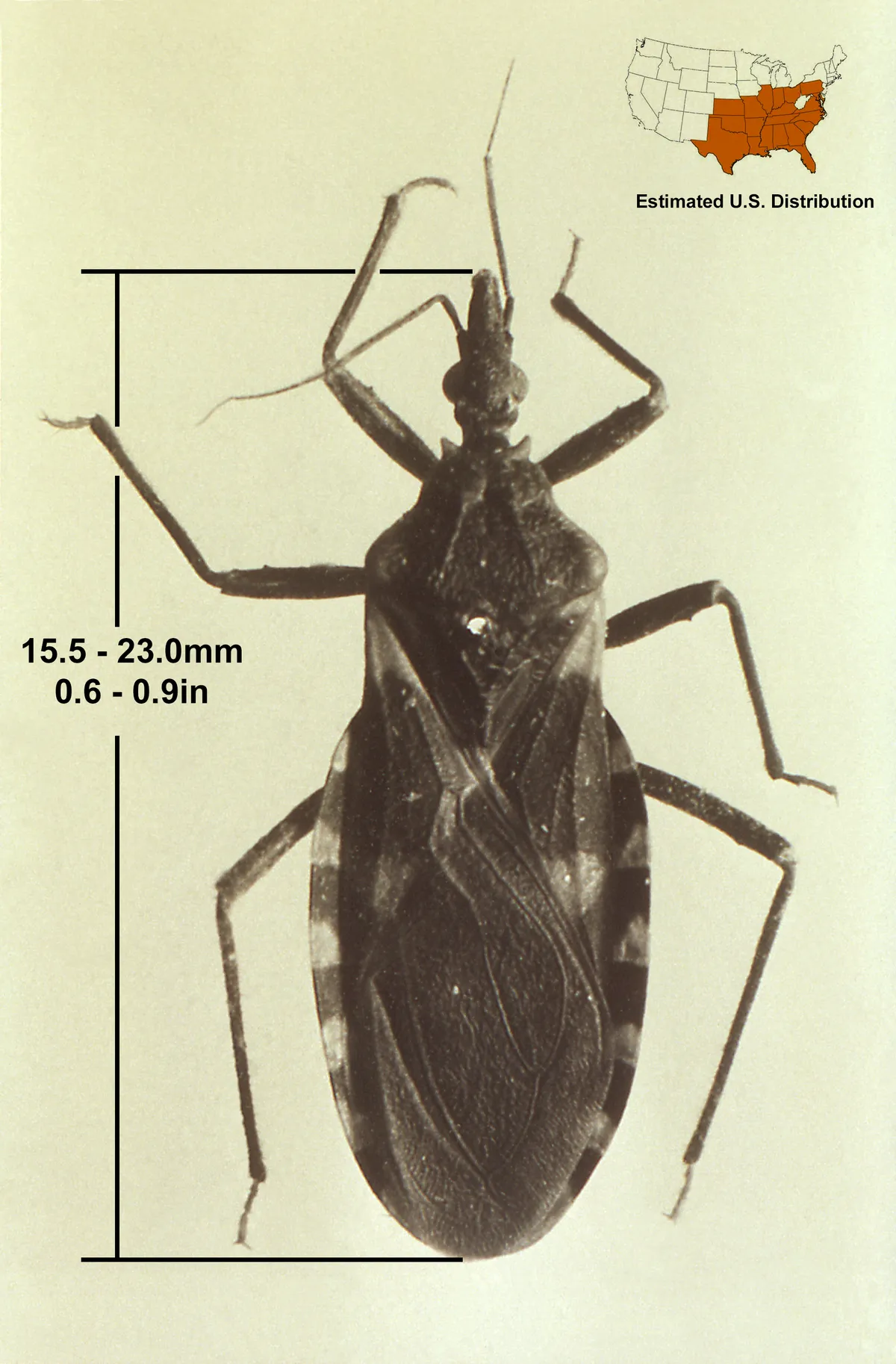
Color and size help less than shape. Texas A&M's Kissing Bug program describes the US kinds as mainly black or very dark brown with red, orange or yellow stripes around the edge, a pattern several look-alikes share, and Texas A&M AgriLife puts grown kissing bugs at 1/2 inch to over 1 1/4 inches. Run the checks in this order:
- The head. A short or triangular head rules out a kissing bug. Texas A&M says the squash bug's head is short and triangular, not long and cylindrical, and Utah State University says the masked hunter's head is shorter and less pointed.
- The beak. Look from the side. A stout, curved beak points to an insect-hunting assassin bug such as a wheel bug, and thin mouthparts held against the underside point to a plant feeder such as a squash bug or stink bug, Texas A&M says; a kissing bug's beak is straight.
- The legs. Swollen or leaf-like hind legs mean a leaf-footed bug, the group that includes the western conifer seed bug. Texas A&M describes kissing bug legs as thin and tapering, with no spines or spikes.
- The back and the edge. A spiny crest on the back means a wheel bug. An all-black bug with no striped edge may be a masked hunter, and red eyes with orange stripes mean a boxelder bug.
- Where and when. Western conifer seed bugs, boxelder bugs and stink bugs come indoors in fall to spend the winter. CDC says kissing bugs hide in walls and roofs by day and come out at night to feed on blood.
What do real kissing bugs look like, and where do they live?
CDC counts 11 kissing bug species in the southern United States. CDC's page on triatomine bugs in the United States lists the eastern kissing bug (Triatoma sanguisuga) at 0.6 to 0.9 inch, with orange-red to yellowish bands on the abdominal segments, reported from Texas to Pennsylvania. It gives T. gerstaeckeri, found in New Mexico and Texas, as 0.9 to 1.1 inches with yellow markings, and T. protracta, recorded in seven states from California to Texas, as 0.5 to 0.9 inch and dark brown to black overall.
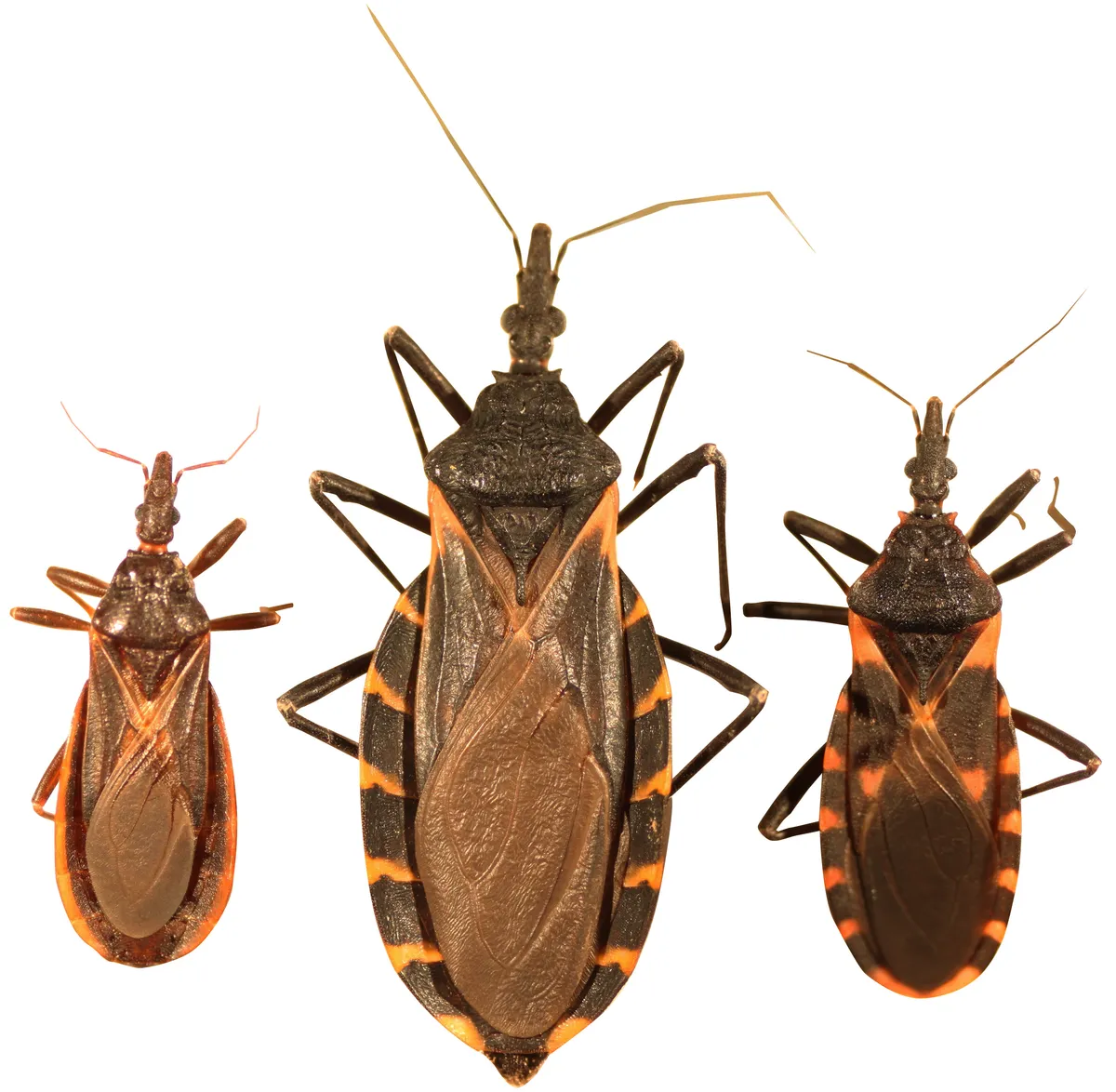
Most species live in the Southwest. Penn State Extension's kissing bug page says Texas has eight species and Arizona seven, that only two are widespread in the eastern US, and that the eastern kissing bug is the one met most often there; Pennsylvania is near the northern edge of the range. The Washington State Department of Health says no kissing bugs are known to live in Washington.
Outdoors, CDC's page on how Chagas disease spreads says they live under porches, between rocks, in wood and brush piles, in rodent nests and burrows, in outdoor dog houses and kennels and in chicken coops. CDC says they rarely infest US homes, which are well sealed, but finding them indoors, especially young wingless ones, may point to an infestation, often near where pets sleep, where rodents live or around beds. A much smaller, flat bug in the bed may be a bed bug instead, which Texas A&M AgriLife describes as only 3/16 inch long when grown, oval, flattened and reddish brown, usually in clusters near beds or couches.
The young look like small adults without wings: Utah State University Extension gives western conenose nymphs as 0.1 to 0.5 inch long, without fully formed wings. The kissing bug guide covers each US species and where it has been found.
Is it a wheel bug or a kissing bug?
It is a wheel bug if it has a spiny crest like part of a cog wheel on its back, the feature Texas A&M uses to tell the two apart. The Missouri Department of Conservation's wheel bug page calls it North America's largest assassin bug, up to 1 1/2 inches long and usually gray or brownish, and notes that only adults have the crest. Texas A&M adds that its beak is stout and curved, where a kissing bug's is straight.
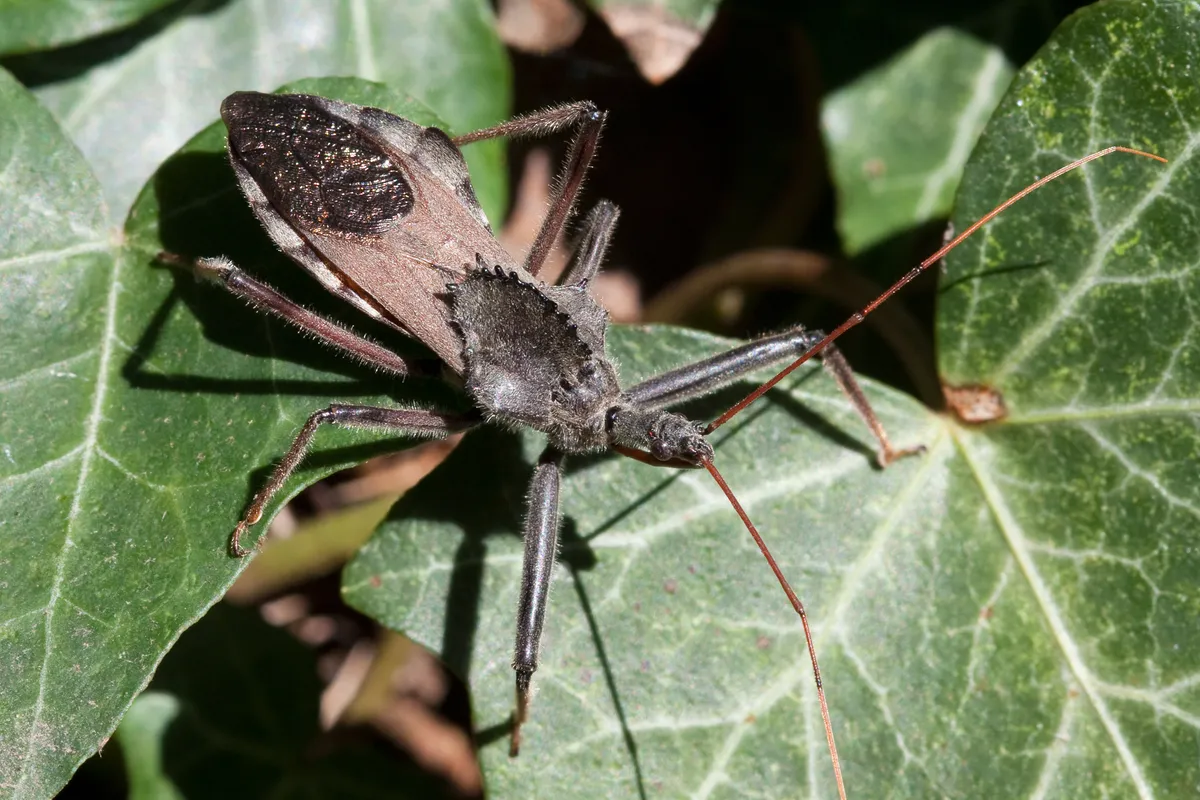
Young wheel bugs have no wheel. MDC describes the nymphs as red with black legs, able to look rather spiderlike or antlike, and says wheel bugs hunt other insects in gardens, trees and grassy areas. CDC lists the wheel bug among the bugs often confused with triatomine bugs and says these bugs do not carry the parasite that causes Chagas disease.
Leave it alone. MDC says handling wheel bugs is not recommended because they can inflict a very painful bite, and that crushing or slapping at one generally makes it bite. The wheel bug guide covers the species.
Which other assassin bugs look like kissing bugs?
The masked hunter is the one Utah State's diagnostic lab receives most often as a possible kissing bug. Kissing bugs belong to the same family as these assassin bugs, the Reduviidae, as the Washington State Department of Health notes, and CDC also names the western corsair among the look-alikes that do not carry the Chagas parasite.
How do you recognize a masked hunter?
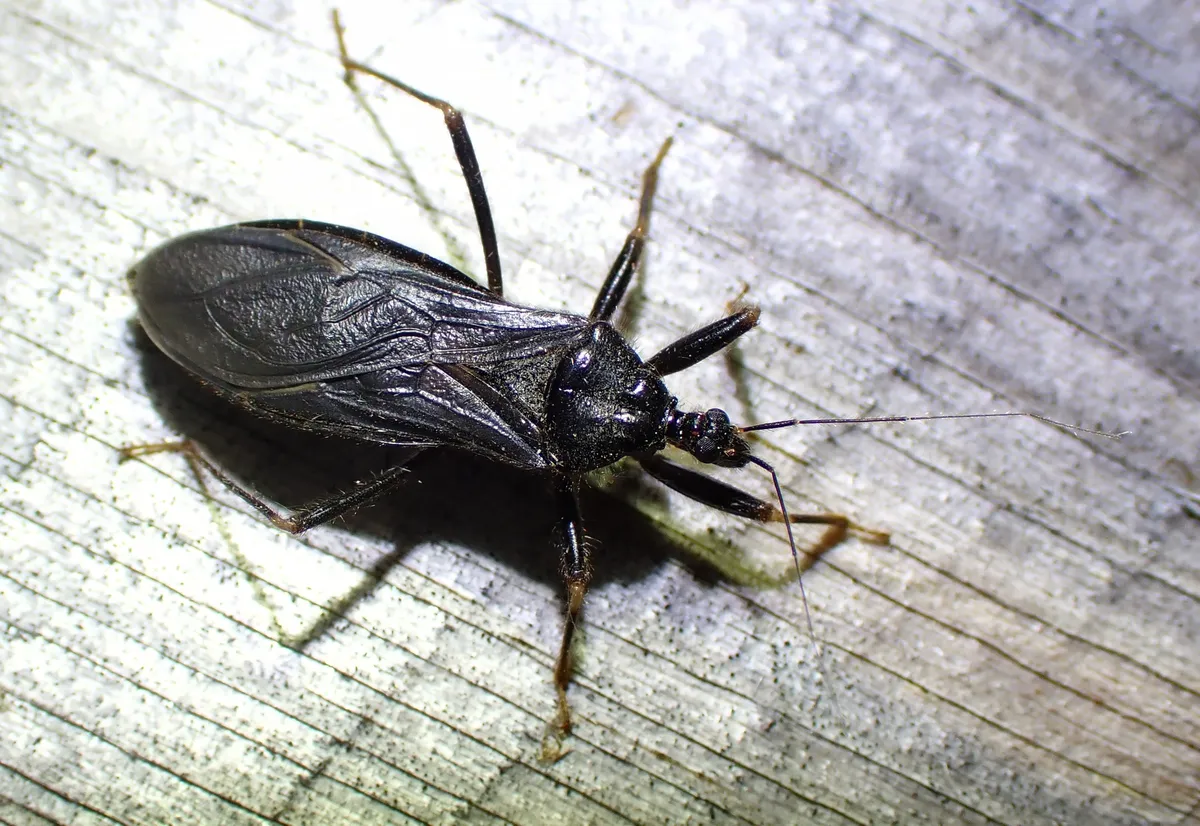
Look for an all-black bug with no striped edge. Utah State University Extension says the masked hunter is about the same size as a kissing bug, roughly 1/2 inch (Penn State gives 0.6 to 0.8 inch), but less robust, with wings that usually cover the tip of the abdomen and a head that is shorter and less pointed. Penn State says young masked hunters are often covered in dust.
It is not a disease risk. Utah State says the masked hunter does not spread human parasites and is of no health concern, although it can inflict a painful bite if threatened. Colorado State University Extension says the bite of these assassin bugs can produce immediate pain that soon subsides, while a kissing bug feeds at night with a bite that is painless.
What is the orange and black bug with very long legs?
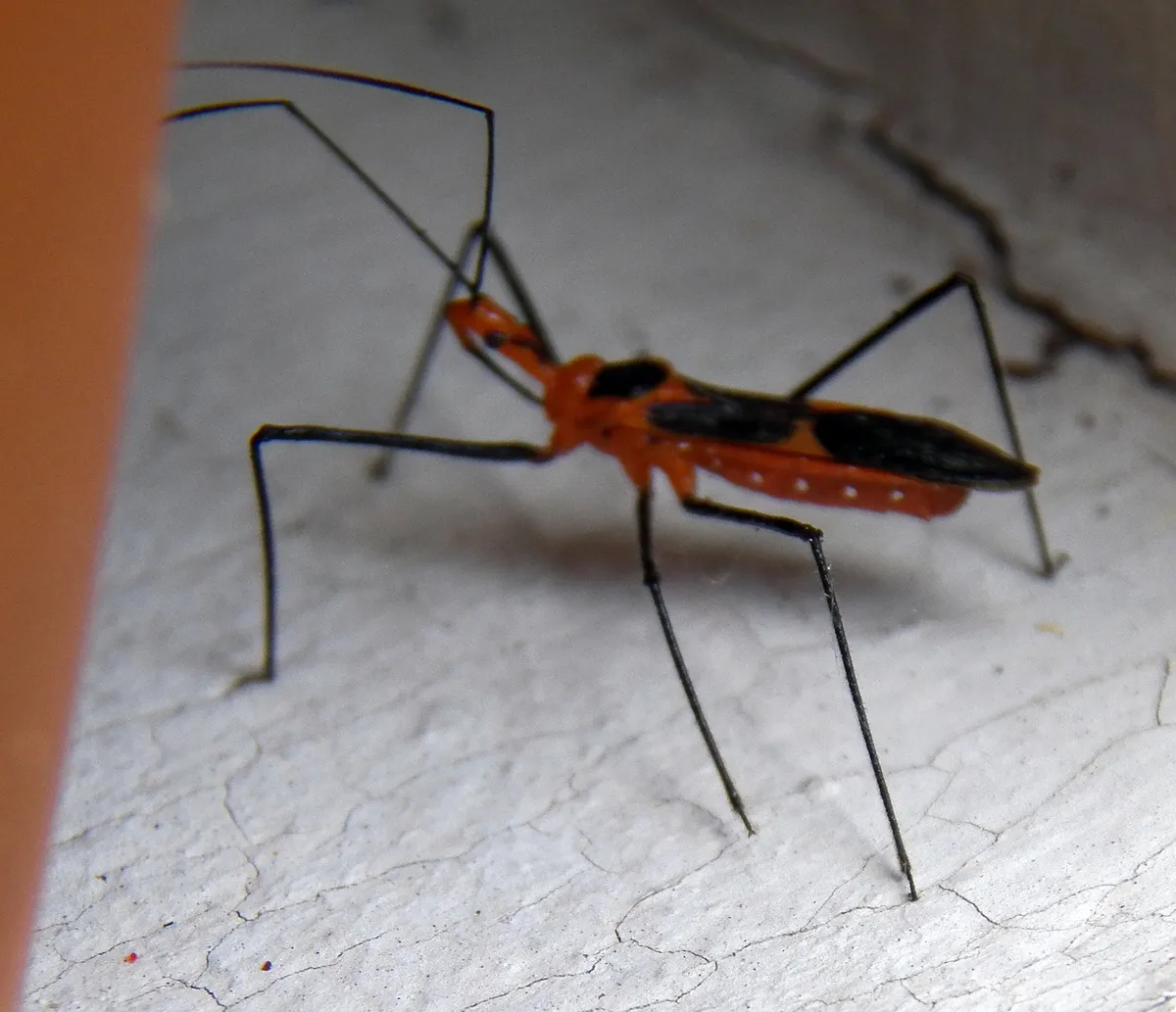
In the South and Southwest it may be a milkweed assassin bug (Zelus longipes), which Texas A&M's Kissing Bug program lists among the bugs that are not kissing bugs. UF/IFAS's Featured Creatures profile describes US populations as orange and black with long, hairy legs, about 16 to 18 mm (5/8 to 3/4 inch) long, living in the Gulf Coast and South Atlantic states, southern California and southwestern Arizona, where it hunts insects in gardens and fields. UF says it is not a threat to people, but if handled improperly it can bite, causing a burning sensation and swelling that may last several days.
Penn State adds the black corsair: adult females are entirely black, while males have a red underside and a red top edge to the abdomen.
Is it a western conifer seed bug or a kissing bug?
A brown bug about 3/4 inch long with a flat, leaf-like flare on each hind leg, found indoors in fall, is probably a western conifer seed bug. Penn State Extension's western conifer seed bug page describes adults as reddish brown to dark brown, with alternating yellow or light orange and black patches along the edge of the abdomen and more of that pattern under the wings, and says flying adults make a loud buzz. Penn State's kissing bug page adds cream to white marks along the sides of the abdomen.
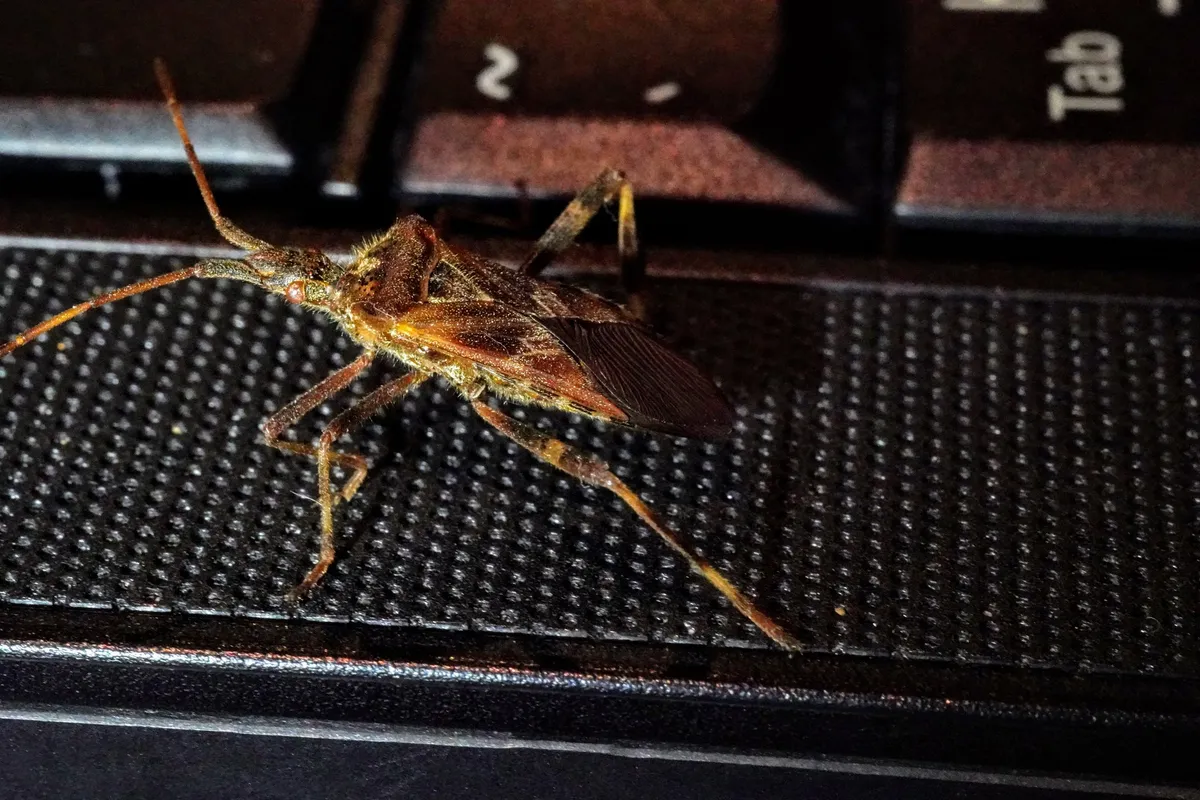
It feeds on ripening seeds until early fall, then looks for a sheltered place to spend the winter, including houses: CSU says it is usually found indoors from September through November, and Penn State says large numbers may fly around on warm fall and spring days. Native to the Pacific Coast, it began spreading east in the 1950s and reached Pennsylvania by 1992, Penn State says. The Washington State Department of Health calls it a common insect that is often confused with a kissing bug.
Penn State says it does not generally bite people and is not considered a medical risk. The western conifer seed bug guide has more, and the guide to bugs that come indoors in winter sorts it from the other fall invaders.
How do leaf-footed bugs and squash bugs differ from kissing bugs?
A leaf-footed bug has swollen or flattened hind legs, sometimes shaped like a leaf, and a squash bug has a short, triangular head; a kissing bug has neither. Texas A&M says leaf-footed bugs can be as large as kissing bugs or larger. UC IPM's leaffooted bug page gives the three common western species as about 3/4 to 1 inch long with a narrow brown body and a white zigzag pattern across the wings, faint on Leptoglossus occidentalis, the western conifer seed bug.
Leaf-footed bugs feed on plants, and UC IPM says the adults spend the winter in groups in woodpiles, barns and other buildings. CDC lists the leaf-footed bug among the look-alikes that do not carry the Chagas parasite. The leaf-footed bug guide covers the garden damage.
Squash bugs are gray-brown and mottled, Utah State says, and common around homes and in gardens. Texas A&M points to the short, triangular head and the thin mouthparts held close to the body, and says neither squash bugs nor leaf-footed bugs bite.
Are boxelder bugs kissing bugs?
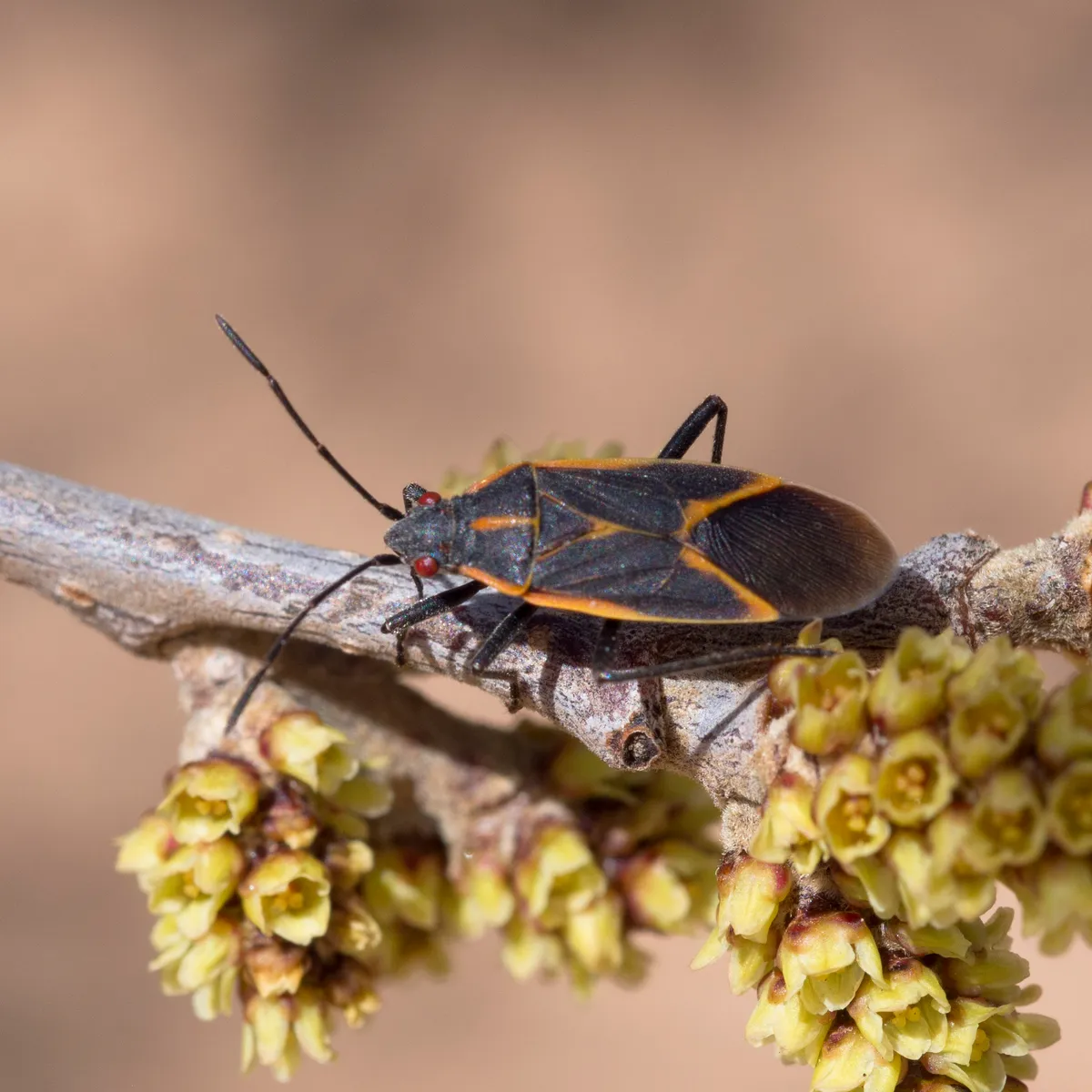
No. Penn State's kissing bug page describes boxelder bugs as up to 1/2 inch (12 mm) long, dark gray, with red eyes and orange stripes on the area behind the head and on the wings. Texas A&M adds that a boxelder bug is smaller than most kissing bugs, with wing markings and no bands around the edge of the abdomen, the edge where a kissing bug carries its stripes. Penn State says boxelder bugs do not bite people.
The red and black bugs guide sorts boxelder bugs from their own look-alikes, and a step-by-step boxelder bug guide covers getting them out of a house.
Is it a stink bug or a kissing bug?
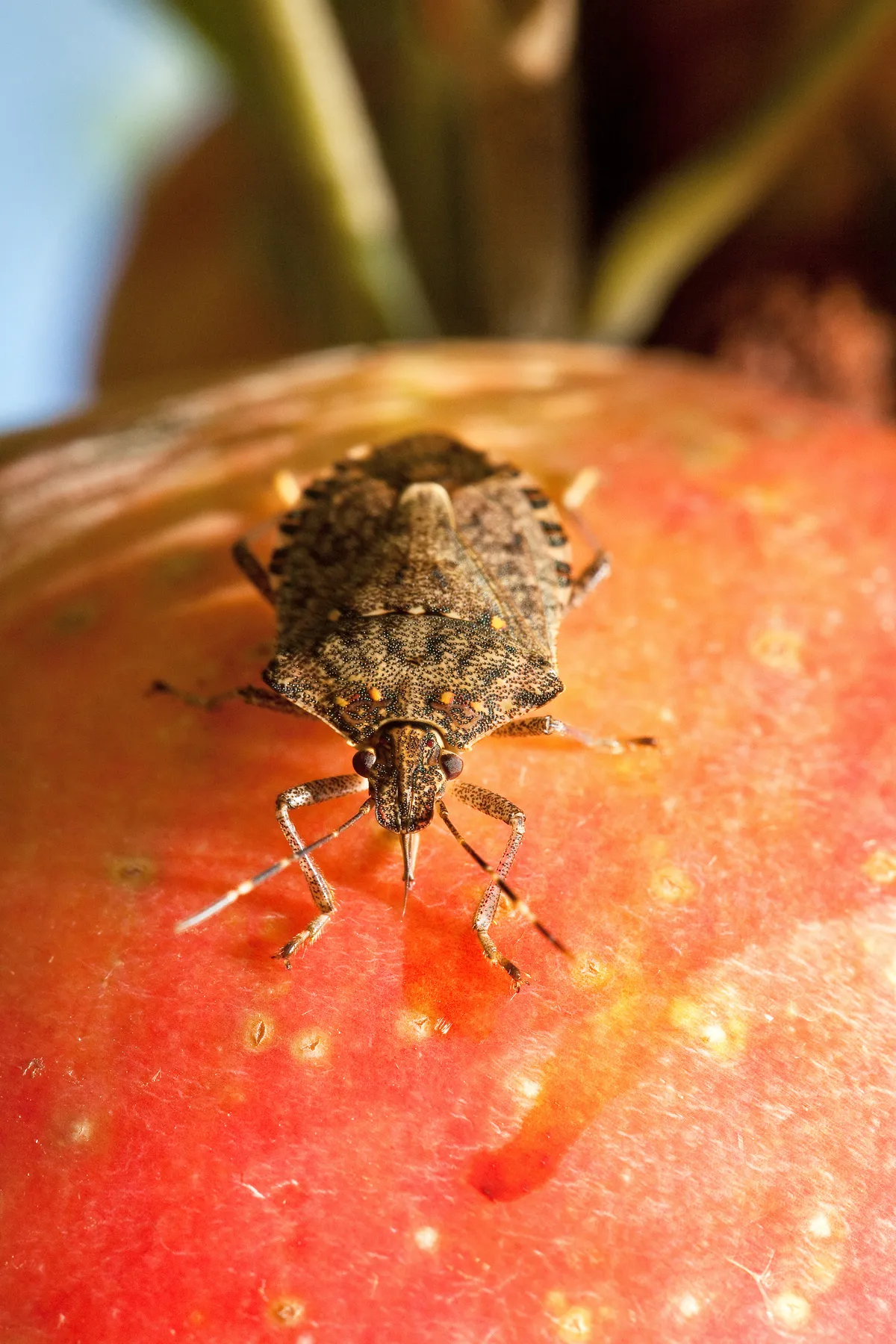
Check the beak and the outline. Texas A&M's comparison uses the bark stink bug: smaller and less elongated than a kissing bug, with slender mouthparts held against the body and spines along the front edge of the shield behind the head. A kissing bug's beak is straight and stout.
The brown marmorated stink bug is the one that moves into buildings in early fall, by the hundreds or thousands where it is established. The EPA gives it as 14 to 17 mm (about 9/16 to 2/3 inch) long, roughly the size of a dime, with light and dark bands on the edges of the abdomen and on the last two segments of each antenna. That banded edge invites the mix-up. The EPA says these stink bugs do not bite people or pets and are not known to transmit disease. The stink bug guide covers getting them out.
Commonly confused with
- Wheel bugA spiny, cog-like crest on the back and a curved beak; up to 1 1/2 inches
- Western conifer seed bugAbout 3/4 inch, with a leaf-like flare on each hind leg; comes indoors in fall
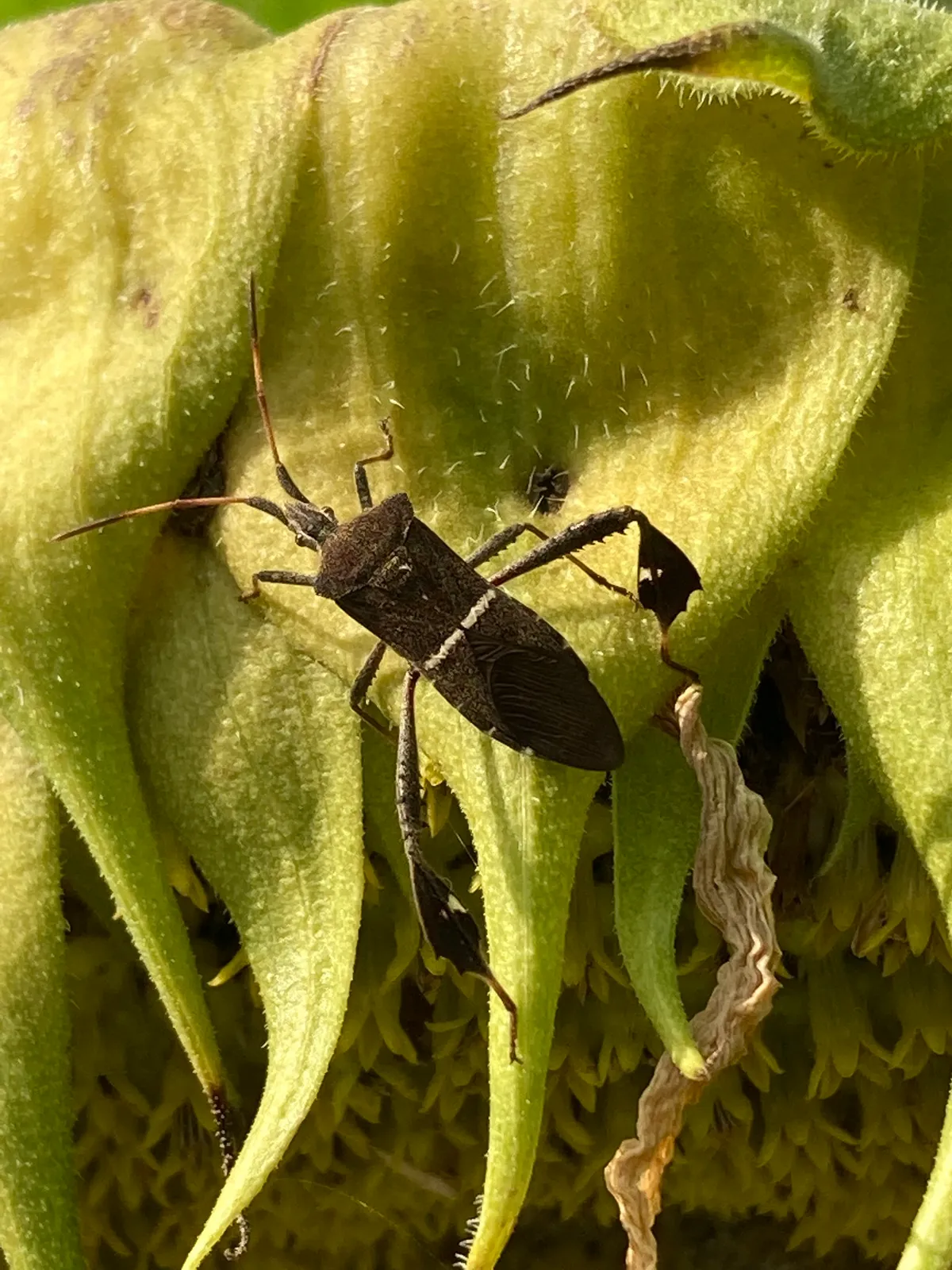 Leaf-footed bugSwollen or leaf-shaped hind legs; as large as a kissing bug or larger
- Boxelder bugUp to 1/2 inch, with red eyes, orange stripes and no banded edge
- Brown marmorated stink bugAbout 9/16 to 2/3 inch, with light and dark bands on the antennae and body edge
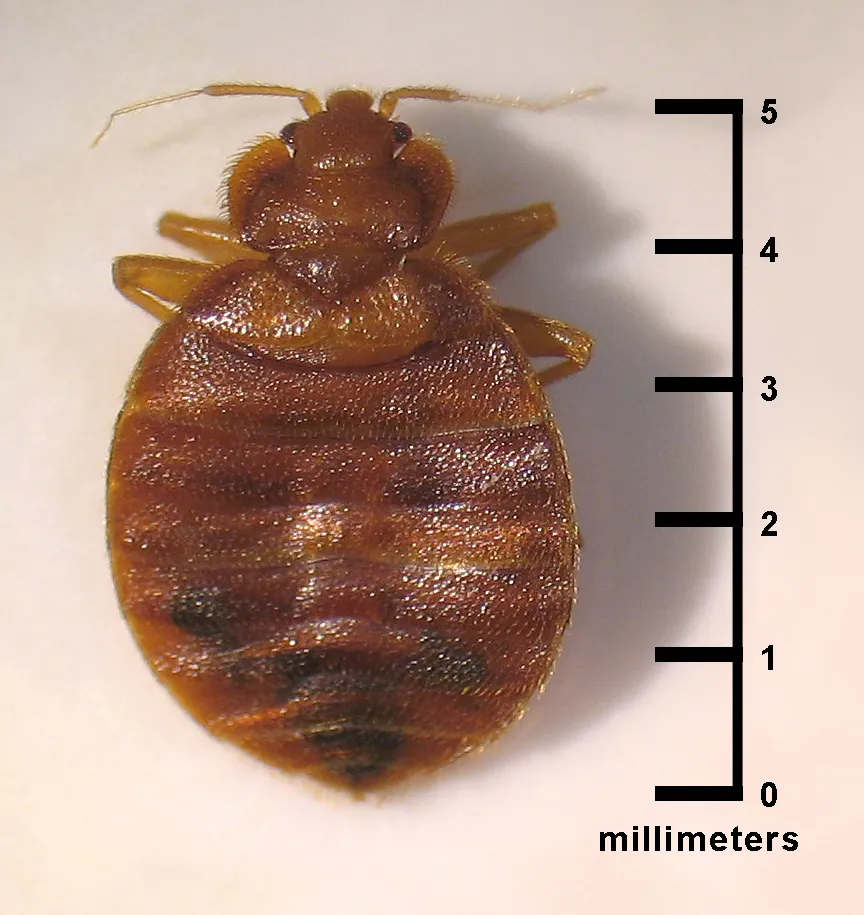 Bed bugOnly about 3/16 inch, oval and flat; found in clusters near beds and couches
Photos: Wheel bug: Ryan Kaldari, Public domain, via Wikimedia Commons, public domain. Western conifer seed bug: no rights reserved, via iNaturalist, CC0 1.0. Leaf-footed bug: no rights reserved, via iNaturalist, CC0 1.0. Boxelder bug: no rights reserved, via iNaturalist, CC0 1.0. Brown marmorated stink bug: U.S. Department of Agriculture, Public domain, via Wikimedia Commons, public domain. Bed bug: CDC/ CDC-DPDx; Blaine Mathison (CDC Public Health Image Library, phil.cdc.gov), public domain.
What should you do if you find a kissing bug?
Do not touch it with bare hands, contain it and get it identified. Texas A&M's Kissing Bug program gives these steps:
- Collect it without touching it. Use a glove or a small plastic bag, then keep the bug in a closed plastic bag, a vial or another small container.
- Kill it. Put the container in the freezer for a few hours, or leave it closed outside in the sun until the bug dies.
- Write down the details. Note the date, the time of day, whether it was indoors or outdoors and any possible bites on people or animals.
- Send photos. The program accepts photos of a possible kissing bug for identification.
- If you already squashed it, do not touch it with bare hands: pick it up with a small plastic bag, throw it away where people and animals cannot reach it, and consider cleaning the spot with a bleach solution, following the label.
In Texas, the Department of State Health Services tests kissing bugs for the parasite free of charge for Texas residents, but only bugs implicated in a human exposure; it asks for a photo before shipping and for no alcohol or other preservatives in the container. Texas A&M says its own research lab mostly tests bugs that are not linked to bites.
The chance of infection from a kissing bug in the US is low. CDC says Chagas disease mainly spreads through the bugs' droppings, which can enter through broken skin, the eyes or the mouth, and CDC's overview of the disease says it is present in the United States but not regularly spread here by the bugs. In a 2019 CDC report, health officials called the likelihood of infection from contact with a kissing bug in the US low, even when the bug is infected.
Only a healthcare provider can diagnose Chagas disease, CDC says; talk with one if you have symptoms, especially after time in an area where Chagas disease is widespread. Separate guides cover kissing bug bites and Chagas disease, and what bed bug bites look like if the bites came from something else.
To keep kissing bugs out, CDC's prevention page suggests sealing cracks and gaps, screening doors and windows, moving yard lights away from the house, clearing wood, brush and rock piles near it and keeping pets indoors at night. It says no insecticides are approved specifically for triatomine bugs in the US and advises talking with a pest control expert before using one.
This guide is general educational information, not medical advice. If you have symptoms or concerns after a bite or exposure, contact a healthcare provider.
Frequently Asked Questions
What bugs look like kissing bugs but aren't?+
The usual ones are wheel bugs and other assassin bugs such as the masked hunter, western conifer seed bugs and other leaf-footed bugs, squash bugs, boxelder bugs and stink bugs. CDC names the wheel bug, the western corsair and the leaf-footed bug among the bugs often confused with kissing bugs and says they do not carry the parasite that causes Chagas disease. Texas A&M's Kissing Bug program says no insects other than kissing bugs are known to carry it.
Are assassin bugs and kissing bugs the same?+
Not quite. Kissing bugs belong to the assassin bug family, the Reduviidae, as the Washington State Department of Health notes, but they feed on blood. Assassin bugs such as wheel bugs and milkweed assassin bugs hunt other insects, according to the Missouri Department of Conservation and UF/IFAS, and they can bite painfully when handled, while Colorado State University Extension says a kissing bug bite at night is painless. Texas A&M says no insects other than kissing bugs are known to carry the Chagas parasite.
How can you tell a kissing bug from a stink bug?+
Look at the head and the beak. A kissing bug has a long, cone-shaped head and a straight beak, while Texas A&M AgriLife Extension describes the bark stink bug as smaller and less elongated, with slender mouthparts held against the body. The brown marmorated stink bug is about 9/16 to 2/3 inch long, about the size of a dime, with light and dark bands on its antennae and abdomen edge, according to the EPA, which says it does not bite people or pets.
Is a wheel bug dangerous?+
Not as a disease risk: CDC lists the wheel bug among the look-alikes that do not carry the parasite that causes Chagas disease. It can hurt, though. The Missouri Department of Conservation says handling wheel bugs is not recommended because they can inflict a very painful bite, and that crushing or slapping at one generally makes it bite. Adults reach 1 1/2 inches and carry a spiny crest on the back, the feature that tells them from kissing bugs.
What should I do if I find a kissing bug in my house?+
Do not touch it with bare hands. Texas A&M's Kissing Bug program says to collect it with a glove or small plastic bag, keep it in a closed container, kill it in the freezer and send photos for identification, noting where and when you found it. CDC says finding kissing bugs indoors, especially young wingless ones, may point to an infestation. Texas residents with a human exposure can have the bug tested by the state health department.
Can you get Chagas disease from a kissing bug bite?+
Not from the bite itself. CDC says Chagas disease mainly spreads through the bugs' droppings, which can get into broken skin, the eyes or the mouth, for example when a bite is scratched. In the United States the disease is present but not regularly spread by the bugs, and a 2019 CDC report called the likelihood of infection from contact with a kissing bug low, even when the bug is infected. Only a healthcare provider can diagnose it.
Where do kissing bugs live in the United States?+
Mostly in the South and Southwest. CDC counts 11 species in the southern United States, and Penn State Extension says Texas has eight species and Arizona seven, while only two are widespread in the East, where Pennsylvania is near the northern edge of the range. Outdoors they live under porches, in rodent nests, wood and brush piles, dog kennels and chicken coops, according to CDC. The Washington State Department of Health says none are known to live in Washington.
What does a baby kissing bug look like?+
Like a smaller adult without full wings. Utah State University Extension describes western conenose nymphs as 0.1 to 0.5 inch long, without fully formed wings. CDC says finding young wingless kissing bugs indoors may point to an infestation. A small bug covered in dust and lint is more likely a young masked hunter, which Penn State says is often coated in dust, and which Utah State says does not spread human parasites.
Do boxelder bugs look like kissing bugs?+
At a glance they can, because both are dark with orange or red markings. Penn State Extension describes boxelder bugs as up to 1/2 inch long and dark gray, with red eyes and orange stripes behind the head and on the wings. Texas A&M AgriLife Extension says they are smaller than most kissing bugs and have no bands around the edge of the abdomen, where a kissing bug carries its striped edge.
Is a masked hunter dangerous?+
Not as a disease risk. Utah State University Extension says the masked hunter does not spread human parasites and is of no health concern, although it can inflict a painful bite if threatened, and Colorado State University Extension says the pain soon subsides. It is about 1/2 to 3/4 inch long and entirely black, with no red or orange edge, and it is the look-alike Utah State's lab receives most often as a possible kissing bug.
Sources
- Triatomine Bugs in the United States — Centers for Disease Control and Prevention
- How Chagas Disease Spreads — Centers for Disease Control and Prevention
- About Chagas Disease — Centers for Disease Control and Prevention
- Preventing Chagas Disease — Centers for Disease Control and Prevention
- Notes from the Field: Identification of a Triatoma sanguisuga 'Kissing Bug', Delaware, 2018 (MMWR 68(15):359) — Centers for Disease Control and Prevention
- Kissing bug identification requires closer look (Insects in the City) — Texas A&M AgriLife Extension
- Found a Bug? (Kissing Bugs and Chagas Disease) — Texas A&M University
- Triatomine Submission and Testing — Texas Department of State Health Services
- Kissing Bugs — Penn State Extension
- Western Conifer Seed Bug — Penn State Extension
- Western Conenose Bug (Kissing Bug) — Utah State University Extension
- Conenose Bugs ('Kissing Bugs') and Insects of Similar Appearance in Colorado — Colorado State University Extension
- Wheel Bug — Missouri Department of Conservation
- Milkweed Assassin Bug, Zelus longipes (Featured Creatures EENY489) — University of Florida IFAS Extension
- Pest Notes: Leaffooted Bug (UC ANR Publication 74168) — University of California Statewide IPM Program
- Brown Marmorated Stink Bug — U.S. Environmental Protection Agency
- Chagas Disease — Washington State Department of Health
How this guide was made: it was researched and drafted with AI assistance from the sources listed above. A second, independent AI pass then checked each factual claim against those sources. Found an error? Email support@buzzskito.ca.