BuzzSkito Mosquito & Tick Control Specialists · Published July 13, 2026
As an Amazon Associate I earn from qualifying purchases. BuzzSkito only points to products we would genuinely use or recommend, at no extra cost to you.
Why “Red Tick” Is Almost Always a Case of Mistaken Identity
There is no common tick species that is bright, uniform red. A clover mite is about 0.75 mm (roughly 1/32 inch) and vivid scarlet, while a tick is 1–10 mm (about 1/16 to 3/8 inch) and brown to rust-brown. A red speck smaller than a pinhead, moving fast on a sunny wall, is a clover mite, not a tick.
Thousands of people every month search for a “red tick,” “tiny red tick,” or “bright red tick” after spotting a vivid crimson speck on a wall, a windowsill, or their own skin. The reassuring news is that there is no widespread tick species that is a clean, uniform red. When the colour red enters the picture, one of three things is nearly always going on: you have found a clover mite, you have found a tick that turned reddish after feeding, or you have found a genuine tick species that happens to have a reddish-brown body, like the lone star tick. Knowing which one you are looking at takes just a few seconds once you know what to check.
1. Clover Mites — the Real Answer Most of the Time
Clover mites are tiny plant-feeding mites about 0.75 mm long (roughly 1/32 inch), bright brick-red, with eight legs and one extra-long forward-pointing front pair. They swarm sunny walls, windowsills, and pavement in spring and fall. They do not bite people or pets and carry no disease. A crushed clover mite leaves a red plant pigment, not blood.
If the red bugs are tiny — pinhead-sized or smaller — moving quickly, and appearing in the dozens or hundreds on sunny brick, siding, windowsills, patios, or concrete, you have clover mites (Bromobia praetiosa). They are true mites, distant relatives of ticks and spiders, but they are not ticks and they behave nothing like them.
That family resemblance is not a coincidence. Ticks and clover mites both sit in Acari, the mite branch of the arachnids, which is why a tick is an arachnid and not an insect despite being lumped in with bugs in everyday speech.
What they look like: A clover mite is about 0.75 mm across, a bright rusty red to reddish-brown, with a rounded body and eight legs. The front pair of legs is noticeably long and points forward, which people sometimes mistake for antennae. Crush one and it leaves a small red stain — that pigment, not blood, is why they smear red on light-coloured walls and curtains.
Why they show up: Clover mites feed on grass, clover, and other plants. They surge in spring and again in fall, and they wander indoors through the smallest gaps around windows and foundations, especially on homes with lush, well-fertilized lawns growing right up to the wall. Hot, dry summer weather kills them off. The same window gaps admit the larger autumn invaders, so if what you found was shield-shaped and fingernail-sized rather than a moving red speck, start with the stink bug removal and sealing guide instead.
The most important fact: clover mites are completely harmless. They do not bite people or pets, do not draw blood, and carry no disease. They are purely a nuisance driven by their numbers. For a broader photo rundown of look-alikes, see our guide to bugs that look like ticks.
2. Engorged Ticks — Real Ticks That Turned Red
An engorged tick is an ordinary tick swollen with blood, not a separate red species. Unfed ticks are 1–5 mm (about 1/16 to 3/16 inch) and dark brown or black; a fully fed tick reaches 4–10 mm (about 3/16 to 3/8 inch) and turns rust-red, grey, or reddish-brown. Remove it with fine-tipped tweezers, pulling straight out.
The second common source of “red tick” confusion is a tick that has already been feeding. An unfed blacklegged (deer) tick, Ixodes scapularis, is small and dark. But as a tick feeds, its body balloons with blood and the colour shifts to grey, tan, rust, or reddish-brown. A swollen, reddish, grape- or bean-shaped bug attached to your skin or your pet is not a special “red” species — it is an ordinary tick that is engorged and actively feeding.
This is the version of “red tick” that actually matters for your health, because an attached, feeding tick is exactly the situation that can transmit disease. Blacklegged ticks are the main carriers of Lyme disease in Ontario and much of North America; the risk climbs the longer a tick stays attached, which is why prompt, correct removal is the whole game. Grip the tick with fine-tipped tweezers as close to the skin as possible and pull straight out with steady pressure — no twisting, no matches, no petroleum jelly. A dedicated fine-tipped remover makes this far cleaner than fingernails. Check tick-removal tools on Amazon →
As an Amazon Associate I earn from qualifying purchases. Price shown on Amazon.ca, at no extra cost to you.
🏆 Our Top Pick for Tick Removal
8.6/10· BuzzSkito ratingIf the red bug turns out to be an attached, engorged tick, a purpose-made fine-tipped remover grips right at the skin and lifts the tick straight out without squeezing its body — cleaner and safer than fingernails or household tweezers. Keep one in the first-aid kit and one in the car for post-hike checks.
Pros
- Grips flush at the skin to avoid crushing
- Pocket-sized for hikes and pet checks
- Reusable and easy to clean
Cons
- Tiny — easy to misplace
- Still requires steady, straight-out technique
For step-by-step guidance, see how to remove a tick safely, and to picture the unfed versus fed stages, our guide to what ticks look like shows the colour changes in detail.
3. True Red-Bodied Ticks — Lone Star and Gulf Coast
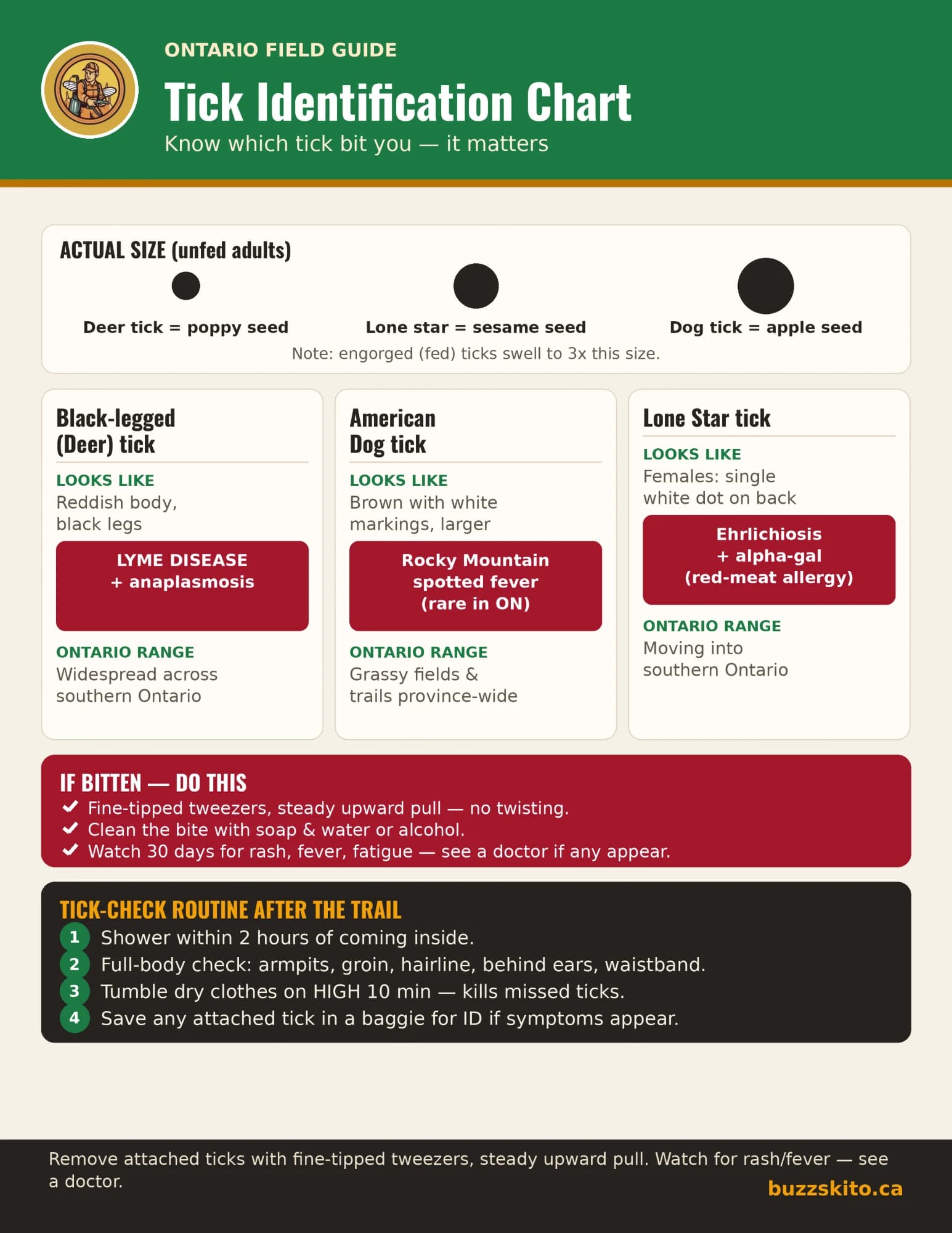
Two true tick species are naturally reddish-brown: the lone star tick, whose adult female carries a single white dot on her back, and the Gulf Coast tick, which has ornate silvery markings. Adults of both measure roughly 3–6 mm (about 1/8 to 1/4 inch). The CDC maps both mainly to the United States rather than Canada.
A handful of genuine tick species do have naturally reddish-brown bodies, which is the third reason “red tick” searches happen. These are real ticks that bite people, so they are worth recognizing.
Lone star tick (Amblyomma americanum): Reddish-brown, and the adult female carries a single bright white or silvery dot in the centre of her back — the “lone star.” It is an aggressive biter of humans, and per the CDC its range covers much of the southeastern and eastern United States and is pushing northward, with occasional detections in southern Canada. Its bite is associated with alpha-gal syndrome (a red-meat allergy) and with ehrlichiosis rather than Lyme disease.
Gulf Coast tick (Amblyomma maculatum): A reddish-brown to dark tick with ornate silvery markings, found mainly along the U.S. Gulf and Atlantic coasts. It can transmit a spotted-fever-group Rickettsia. It is uncommon in Canada but sometimes turns up in travellers’ searches.
Neither of these looks like the tiny scarlet dots on your windowsill. They are tick-sized (a few millimetres), eight-legged, brown with reddish tones, and found in grass and brush — not swarming your siding. To compare the ticks you are most likely to meet in Ontario, see our breakdown of the blacklegged (deer) tick.
How Big Is a Clover Mite Compared to a Tick?
A clover mite is about 0.75 mm long — roughly 1/32 inch, smaller than the head of a pin. A tick is much bigger: 1–5 mm (about 1/16 to 3/16 inch) unfed, and 4–10 mm (about 3/16 to 3/8 inch) once engorged. If you can make out individual legs without magnification, it is a tick.
What Are the Tiny Red Bugs on My Windowsill?
Tiny bright-red bugs appearing by the dozens on sunny windowsills, brick, siding, patios, and concrete are clover mites. Each one is about 0.75 mm (roughly 1/32 inch), has eight legs, and moves quickly in loose groups. They feed on lawn grass and clover, not on blood, and they cannot bite people or pets.
Why Do Clover Mites Leave a Red Stain When Crushed?
The red smear a crushed clover mite leaves behind is plant pigment from its own body, not blood. Clover mites feed on grass and clover sap and never take a blood meal, so the stain is vegetable in origin. That is why vacuuming beats swatting: crushing them marks light walls, curtains, and carpet.
Clover Mites vs Chiggers — Which Tiny Red Mite Actually Bites?
Only chiggers bite. A clover mite is about 0.75 mm (roughly 1/32 inch), feeds on plant sap, and swarms sunny walls; a chigger is a larval mite roughly 0.25 mm that attaches to skin where clothing is tight and causes intensely itchy welts. The CDC notes chigger bites in North America itch severely but do not spread disease.
Clover Mites vs Red Spider Mites — What Is the Difference?
Clover mites and red spider mites are both tiny red plant-feeding mites, but they turn up in different places. Clover mites are about 0.75 mm and swarm the sunny outside walls and windowsills of a house; red spider mites are a similar size but live on plant leaves, cause pale stippling, and spin fine webbing. Neither bites people.
How to Get Rid of Clover Mites Around the House
Vacuum clover mites rather than crushing them, then seal the gaps around windows, doors, and utility penetrations they use to get inside. Keep a 45–60 cm (18–24 inch) plant-free strip of gravel or mulch between the lawn and the foundation. Because clover mites are harmless, indoor pesticides are rarely warranted.
If the red bugs turned out to be clover mites, control is simple and does not require indoor pesticides:
- Vacuum, do not crush. Crushing leaves red stains; vacuuming removes them cleanly. Empty the canister or bag afterward.
- Seal entry points. Caulk gaps around windows, doors, and where utility lines enter the wall — this is how they get inside.
- Create a plant-free border. Keep a 45–60 cm (18–24 inch) strip of mulch, gravel, or bare soil between the lawn and the foundation. Clover mites cluster in the thick grass that touches the house, so this strip removes their launch pad.
- Wait out the season. Clover mites die back in hot, dry summer weather and are naturally seasonal in spring and fall.
What to Do if It Really Is a Tick
Remove an attached tick immediately with fine-tipped tweezers: grip as close to the skin as possible and pull straight out with steady pressure, without twisting. Clean the bite, save the tick in a sealed bag, and note the date. The CDC and the Government of Canada advise watching for rash, fever, or aches over the following weeks.
If the red bug is attached to skin, larger than a pinhead, or found crawling alone in grass, treat it as a tick, not a mite. Remove it promptly and correctly, save it in a sealed bag or photograph it, and note the date. Over the following weeks, watch for an expanding “bull’s-eye” rash (erythema migrans), fever, fatigue, or joint aches, and see a doctor if any appear. Public health guidance from the Government of Canada on Lyme disease and from the CDC covers symptoms and when to seek care.
Because attached ticks are picked up in grass and leaf litter, the best long-term defence is reducing tick habitat in your own yard — mowing short, clearing leaf litter along the edges, and treating the shaded borders where ticks quest.
That work is also the hour you are most likely to pick one up, because raking an edge puts your ankles exactly where ticks quest. Two things are worth having on before you start: trousers tucked into socks, and a repellent that carries a Canadian PCP registration number on the label — DEET or icaridin (picaridin) are the conventional actives here, and the label, not the front of the bottle, sets how often you reapply. Permethrin in Canada comes bonded into the fabric at the factory rather than as a consumer spray, so treated socks and trousers are bought already treated rather than sprayed at home. Check price on Amazon.ca →
When Are Clover Mites Most Active?
Clover mites peak twice a year: in spring as lawns green up, and again in fall as temperatures drop. They enter homes on warm, sunny days during those two windows and die back in hot, dry summer weather. Numbers are highest where a well-fertilized lawn or dense ground cover grows right against the foundation.
How Long Does a Tick Have to Be Attached to Transmit Lyme Disease?
A blacklegged tick generally must stay attached for 24 hours or more before it can transmit the bacteria that cause Lyme disease, and the CDC notes the risk rises substantially after 36 to 48 hours. Daily tick checks and same-day removal are the most effective precaution. A clover mite never attaches to skin, so it carries no such risk.
When Should You See a Doctor After Finding a Red Bug on Your Skin?
See a doctor if an expanding circular or bull’s-eye rash, fever, headache, fatigue, or joint aches appear in the days or weeks after a tick bite. The Government of Canada lists these as early signs of Lyme disease. A clover mite cannot cause any of them, because clover mites do not bite or attach to skin.
Are Clover Mites Common in Ontario and the GTA?
Yes. Clover mites occur throughout Ontario, including Toronto, Mississauga, Brampton, and the rest of the GTA, and they gather most often on south- and west-facing brick or siding that warms early in the day. Ontario homeowners who see swarming red specks on a sunny wall in April or September are almost always looking at clover mites, not ticks.
Blacklegged ticks in Ontario live in long grass, leaf litter, and woodland edges rather than on house walls, which is why yard-edge treatment is the part of tick control that actually changes your risk.
Quick Recap
- Tiny, bright red, on a sunny wall or window, in swarms → clover mite. Harmless, does not bite, vacuum it up.
- Reddish and swollen, attached to skin or fur → engorged tick. Remove it promptly and watch for symptoms.
- Reddish-brown, tick-sized, in grass or brush, maybe with a white dot → a true tick such as the lone star tick. Identify and remove.
What Actually Stops the Next Swarm
Clover mites return on the same two schedules every year, so the work worth doing is the work you only do once. Closing the gaps they walk through beats reacting to them indoors: caulk around window frames, under door thresholds, and at the point where utility lines pass through the wall. That same seal shuts out the larger autumn invaders that arrive on the same warm afternoons, so it pays for itself twice. A tube of exterior-grade sealant and a basic caulking gun is the entire kit — check exterior caulk and sealant on Amazon.ca →
For the mites already inside, suction beats swatting every time. A crushed clover mite leaves plant pigment on whatever it was crushed against, and those marks are far harder to remove from a painted sill or a light curtain than the mites were. Keeping a small cordless handheld vacuum near the sunny windows during the April and September peaks turns a cluster into a ten-second job instead of a tissue and a stain — empty the canister outdoors afterwards so they do not simply walk back in. check handheld vacuums on Amazon.ca →
Related Reading
- Bugs That Look Like Ticks (Photo Guide)
- What Ticks Look Like — Identification Guide
- Blacklegged (Deer) Tick Identification
- How to Remove a Tick Safely
- BuzzSkito Tick Control Service
Frequently Asked Questions
Is there such a thing as a red tick?+
Not really — there is no common tick species that is bright, uniform red. When people search for a "red tick," they are almost always looking at one of three things: a clover mite (a tiny, bright-red plant mite, not a tick at all), an engorged tick that has turned reddish-brown or grey after feeding on blood, or a true tick with reddish markings such as the lone star tick (Amblyomma americanum) or Gulf Coast tick. A genuinely scarlet, six-legged speck on a windowsill or sunny wall is a clover mite, not a tick.
What are the tiny red bugs on my window sill or patio?+
Tiny bright-red bugs that appear by the dozens on sunny windowsills, brick walls, patios, and concrete in spring and fall are clover mites (Bromobia praetiosa). They are about 0.75 mm — smaller than a pinhead — have eight legs, and leave a red stain if crushed. Clover mites are harmless: they do not bite people or pets, do not spread disease, and feed only on plants. They are not ticks, though their red colour and eight legs cause constant confusion.
How do I tell a clover mite from a tick?+
Size and setting are the fastest clues. A clover mite is roughly 0.75 mm (pinhead-sized), bright brick-red, moves quickly, and swarms sunny walls, windowsills, and pavement — never attached to skin. A tick is larger (2–10 mm depending on stage and feeding), brown, tan, or reddish-brown, moves slowly, and is found in grass and leaf litter or attached to a person or pet. If the red speck is on your window frame in a group and moving fast, it is a clover mite. If it is crawling on your leg alone or embedded in skin, treat it as a tick.
Why does my tick look red or reddish-brown?+
A tick that has already fed can look red, reddish-brown, or grey because it is engorged with blood. Unfed blacklegged (deer) ticks are dark, but as they feed their body balloons and the colour shifts. Some species — notably the lone star tick and Gulf Coast tick — also have naturally reddish-brown bodies with distinctive markings. A tick found attached and swollen with a red or rust colour is an engorged, feeding tick and should be removed promptly with fine-tipped tweezers.
Are clover mites dangerous or do they bite?+
No. Clover mites do not bite humans or animals, do not suck blood, and transmit no diseases. They feed exclusively on plant sap — grasses, clover, and lawn. The only nuisance is their sheer numbers and the reddish stain they leave when crushed against light-coloured walls, curtains, or carpet. Because they are harmless, control focuses on sealing entry points and creating a plant-free border around the foundation rather than on any medical concern.
What is the lone star tick and is it red?+
The lone star tick (Amblyomma americanum) is a reddish-brown tick whose adult females carry a single white or silvery dot on the back — the "lone star." It is aggressive about biting humans and is expanding its range northward; the U.S. CDC tracks it across the southeastern and eastern United States, with occasional detections in southern Canada. Its bite is linked to alpha-gal syndrome (a red-meat allergy) and to ehrlichiosis. It is a true tick, not a clover mite, and its reddish body is a common reason people search for a "red tick."
How do I get rid of tiny red clover mites in my house?+
Vacuum them up rather than crushing them (crushing leaves red stains), then empty the vacuum. Seal cracks around windows, doors, and the foundation where they enter, and keep a 45–60 cm (18–24 inch) plant-free, mulch-or-gravel border around the foundation, since clover mites cluster in the dense grass and vegetation that touches the house. They peak in spring and fall and die off in hot, dry summer weather. Because they are harmless and seasonal, indoor pesticides are rarely warranted.
Should I be worried if I find a red bug attached to my skin?+
If a small bug is embedded in your skin, treat it as a tick regardless of colour, because clover mites never attach to skin. Remove it with fine-tipped tweezers, gripping as close to the skin as possible and pulling straight out, then clean the area. Save the tick and note the date. Watch for an expanding "bull's-eye" rash (erythema migrans), fever, or aches over the following weeks and see a doctor if they appear, as these can signal a tick-borne illness such as Lyme disease.
How big is a clover mite compared to a tick?+
A clover mite is about 0.75 mm long (roughly 1/32 inch, smaller than a pinhead), while a tick runs 1–5 mm (about 1/16 to 3/16 inch) unfed and swells to 4–10 mm (about 3/16 to 3/8 inch) once engorged with blood. Size alone settles most cases: if you can make out individual legs without magnification, you are looking at a tick, not a clover mite. Clover mites are so small that most people notice the swarm before they notice any single mite.
Clover mites vs chiggers — which tiny red mite actually bites?+
Only chiggers bite. A clover mite is about 0.75 mm (roughly 1/32 inch), feeds on plant sap, and swarms sunny walls and windowsills; a chigger is a larval mite roughly 0.25 mm that attaches to skin where clothing is tight and causes intensely itchy welts hours later. The U.S. Centers for Disease Control and Prevention notes that chigger bites in North America cause severe itching but do not spread disease. If the red specks are on your wall, they are clover mites; if the itching started after time in tall grass or brush, suspect chiggers.
Why do crushed clover mites leave a red stain?+
The red smear is plant pigment from the mite's own body, not blood. Clover mites feed only on the sap of grass, clover, and other plants and never take a blood meal, so nothing they leave behind came from you or your pet. This is the practical reason to vacuum rather than swat: crushed clover mites mark light-coloured walls, window frames, curtains, and carpet, and those stains are far easier to prevent than to remove.
What is the difference between clover mites and red spider mites?+
Clover mites and red spider mites are both tiny red plant-feeding mites, but they live in different places. Clover mites are about 0.75 mm (roughly 1/32 inch) and swarm the sunny exterior walls, windowsills, and pavement around a house; red spider mites are a similar size but stay on plant leaves, where they cause pale stippling and spin fine silk webbing. Neither one bites people or pets, and neither one is a tick.
When are clover mites most active?+
Clover mites peak twice a year — in spring as lawns green up, and again in fall as temperatures drop. They push indoors on warm, sunny days during those two windows and die back in hot, dry summer weather, which is why the problem seems to vanish in July and return in September. Numbers are highest around well-fertilized lawns and dense ground cover growing right up against the foundation wall.
How long does a tick have to be attached to transmit Lyme disease?+
A blacklegged tick generally has to stay attached for 24 hours or more before it can transmit the bacteria that cause Lyme disease, and the U.S. Centers for Disease Control and Prevention notes the risk rises substantially after 36 to 48 hours of attachment. Daily tick checks and prompt removal are the single most effective precaution. A clover mite carries no equivalent risk at all, because clover mites never attach to skin and never feed on blood.
When should you see a doctor after finding a red bug on your skin?+
See a doctor if an expanding circular or bull's-eye rash, fever, headache, fatigue, or joint and muscle aches develop in the days or weeks after a tick bite. The Government of Canada lists these as early signs of Lyme disease. A clover mite cannot cause any of them, because clover mites do not bite, do not attach, and do not feed on blood — so symptoms following a red-bug encounter point to a tick, not a mite.
Are clover mites common in Ontario and the GTA?+
Yes. Clover mites are found throughout Ontario, including Toronto, Mississauga, Brampton, Oakville, and the rest of the GTA, and they show up most often on south- and west-facing brick or siding that warms early in the day. Ontario homeowners who find swarming bright-red specks on a sunny wall in April or September are almost always looking at clover mites, not ticks — blacklegged ticks in Ontario live in long grass, leaf litter, and woodland edges, not on house walls.