
Spider Identifier: What Kind of Spider Is This?
7 quick questions about where you found it, its web, size and markings, what it did and where you live. You get the best match and any close ones (up to three in all), a real photo of each, how to confirm it and how to tell the few dangerous ones apart.
Published by BuzzSkito Mosquito & Tick Control · October 23, 2026 · Drafted with AI assistance and checked against the sources listed below
Question 1 of 7
Where did you find it?
Pick the closest match.
How this works: each answer adds points to the spiders it fits, using what university extension services, the Missouri Department of Conservation, CDC and the other sources below say about each one, and the result shows the reasons. It cannot see your spider, and some spiders can only be told apart under a microscope, so treat the result as a place to start. Your answers are not saved with your name; the site counts which answers are picked, through Google Analytics, to improve the tool.
Have a bite but no spider? Try the bug bite identifier. Think it might be a tick? Try the tick identifier.
Which spiders are dangerous, and when a bite needs a doctor
Most spiders are harmless to people: the jaws of most are too small to bite through an adult’s skin (UC IPM). CDC’s page on venomous spiders in the US names two, the black widow and the brown recluse. Know these, and these signs:
Dangerous spiders and spider bites
The few spiders to leave alone
- Black widows: shiny black and round, with a red or orange hourglass on the female’s underside, often split in the northern black widow (UC IPM; Missouri Dept. of Conservation)
- Brown widows: mottled tan and brown, with an orange-red mark underneath and spiky egg sacs; their bite is milder (UC IPM; US Army Public Health Center)
- Recluses: plain tan to dark brown, with six eyes in three pairs and plain legs without spines, in the central and southern US and the desert Southwest (UC IPM)
- Never pick one up. A photo is the safest way to get an ID; to keep one for an expert, trap it under a jar and slide paper underneath (UC IPM)
After a bite, get medical care right away if
- A widow or a recluse may have bitten, or you are not sure what bit
- There is severe pain, stomach cramping or a wound that keeps growing
- There is trouble breathing or swallowing
- Redness or red streaks spread from the bite
From CDC, Mayo Clinic, UC IPM, the Missouri Department of Conservation and the US Army Public Health Center (see sources). US Poison Help: 1-800-222-1222. In Canada, call your provincial poison center (the Ontario Poison Centre lists them). In an emergency, call 911 in the US or Canada. This tool gives general information, not medical advice.
Common spiders compared
Compare the web, the size with the legs, the markings and where it turned up. No single clue settles it: the violin mark misleads, and some funnel weavers can only be told apart under a microscope (UC IPM).
| Spider | Web | Size, legs included | What it looks like | Where you find it |
|---|---|---|---|---|
| Common house spider | Messy cobweb; almost never leaves it | About a nickel | Brown and tan with darker patterns; round abdomen; ringed legs | Corners, windows, basements, crawl spaces |
| Cellar spider | Loose, irregular web near the ceiling or floor | About a half-dollar | Pale gray to light tan; tiny body on very long, thin legs | Basements, cellars, crawl spaces |
| Wolf spider | None | Pencil eraser to about a silver dollar | Gray or brown, usually with stripes or spots; hairy legs | On the ground; often wanders indoors |
| Jumping spider | None; silk shelters only | About a dime | Often dark with white markings; big front eyes | Sunny walls, windows, fences and plants |
| Orb weaver | Round web of circles and spokes | Pencil eraser to a little over a silver dollar | Some plain brown, many colorful; yellow garden spider yellow and black | Gardens and porches, especially late summer |
| Grass spider | Flat sheet with a funnel at one side | About a quarter | Brown with lengthwise gray or tan stripes; long spinnerets | Lawns, ground covers, bushes; indoors in fall |
| House funnel weavers | Flat sheet with a funnel retreat | Hobo 1 to 1 3/4 inches; giant house spider up to 4 inches | Brown, often with chevrons or mottling; long legs | Basements, garages, window wells |
| Yellow sac spider | No web; a silk sac in a corner | About a nickel | Pale yellow to cream; dark jaws and leg tips | Walls and ceilings at night |
| False widow | Tangled cobweb | Body about 3/8 inch | Shiny, chocolate brown, round; never red | Indoors: washrooms, cupboards, under appliances |
| Black widow | Tough, tangled cobweb near the ground | Body about 1/2 inch | Shiny black, round; red hourglass underneath | Woodpiles, rock piles, garages, sheds |
| Harvestman (not a spider) | Never | Body up to 1/2 inch; very long legs | One oval body; two eyes | Leaf litter, tree bark |
| Fishing spider | None | A little over a silver dollar; some 4 inches | Brown with darker patterns; banded legs | Near ponds and streams; sometimes far from water |
| Brown recluse | Small retreat web, out of sight | About a quarter | Plain tan to dark brown; violin on the front half; six eyes in pairs | Boxes, closets, attics, in central and southern states |
| Parson spider | None | Body about 1/2 inch | Dark, with a white band on the abdomen | Floors at night; indoors in fall |
| Woodlouse spider | None; a silk retreat | About a nickel | Red-orange front and legs; pale gray rear; big fangs | Under rocks and logs; sometimes indoors |
| Brown widow | Irregular cobweb | Body about 3/8 inch | Mottled tan, brown and gray; orange-red mark underneath; spiky egg sacs | Fences, patio furniture; the South and Southern California |
| Southern house spider | Flat, woolly web around a crack | Female body 1/2 to 3/4 inch | Female charcoal gray; male khaki with long legs | House walls, windowsills, eaves in the South |
| Green lynx spider | None | Body 1/2 to 7/8 inch | Bright green, often red-spotted; spiny legs | Shrubs and flowers in the South |
| Tarantula | No catching web; a silk-lined burrow | Up to 6 inches | Large, hairy, brown | The Southwest and south-central states |
| Camel spider (not a spider) | Cannot spin silk | 3/4 to 1 1/2 inches long | Yellowish brown; huge jaws | Dry parts of the West and Southwest, at night |
Coin sizes with the legs stretched out are the University of Kentucky’s; the other sizes and the rest of the table come from that chart, UC IPM, UC Riverside, Penn State, the University of Minnesota, the Missouri Department of Conservation, Washington State, Colorado State, UF/IFAS, Texas A&M AgriLife and the US Army Public Health Center (see sources). “Body” means the body without the legs. Scroll sideways on a phone to see every column.
How to tell spiders apart
Six clues do most of the work. The questions above ask about each one.
The web
A messy cobweb points to cobweb spiders (house spiders, widows, false widows) or cellar spiders; a flat sheet with a funnel at one side to grass spiders and other funnel weavers; a round web of circles and spokes to orb weavers (UC IPM; University of Minnesota). Wolf, jumping and fishing spiders build no web to catch prey (Missouri Dept. of Conservation; UC IPM).
The eyes
Most spiders have eight eyes. Recluses have six, in three pairs, and woodlouse spiders six, in two groups of three (UC IPM). Jumping spiders have two big eyes facing forward on a flat face (University of Kentucky). At night, a flashlight held beside your own eyes makes a wolf spider’s eyes shine back (Missouri Dept. of Conservation).
The legs
Recluses have legs of one even color, with fine hairs and no spines; bands, stripes or thick spines rule a recluse out (UC IPM; UC Riverside). Very long, thin legs on a tiny body point to a cellar spider, or to a harvestman if the body is one oval piece (University of Kentucky; Missouri Dept. of Conservation).
Color and markings
Markings help but can mislead: people see violins on many harmless brown spiders (UC IPM). A red or orange hourglass on the underside of a shiny black, round spider is the black widow’s mark (UC IPM). The common bold jumping spider is fuzzy and usually black, often with white spots (Missouri Dept. of Conservation).
Where and when
Brown recluses are established only in 16 central and southern states (Penn State), fishing spiders live near water (University of Minnesota), and orb weavers turn up on porches and in gardens, especially in late summer (University of Kentucky). Big spiders that appear indoors are often males searching for females (UC IPM).
Is it a spider at all?
Spiders have eight legs and two body parts, and no wings or antennae (UC IPM). A harvestman has one oval body and two eyes (Missouri Dept. of Conservation), and a camel spider has huge jaws and leg-like palps (UC IPM): neither is a spider.
Spider photos to compare
Real, credited photos. Each card opens a guide that covers that spider; a card without a link is a guide still being written.
Six spiders to know, side by side
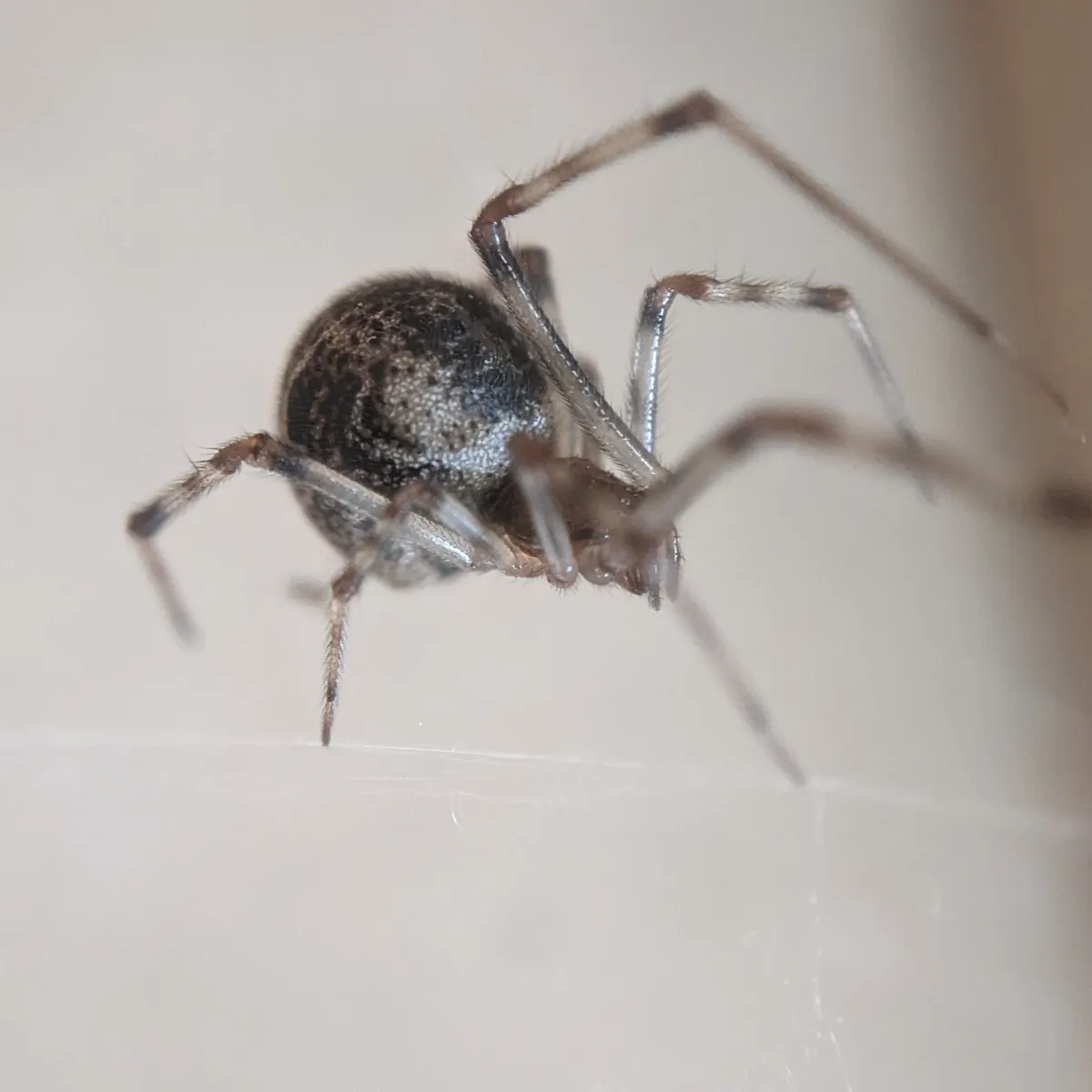 Common house spiderSmall and brown with a round, mottled body; stays in a messy cobweb
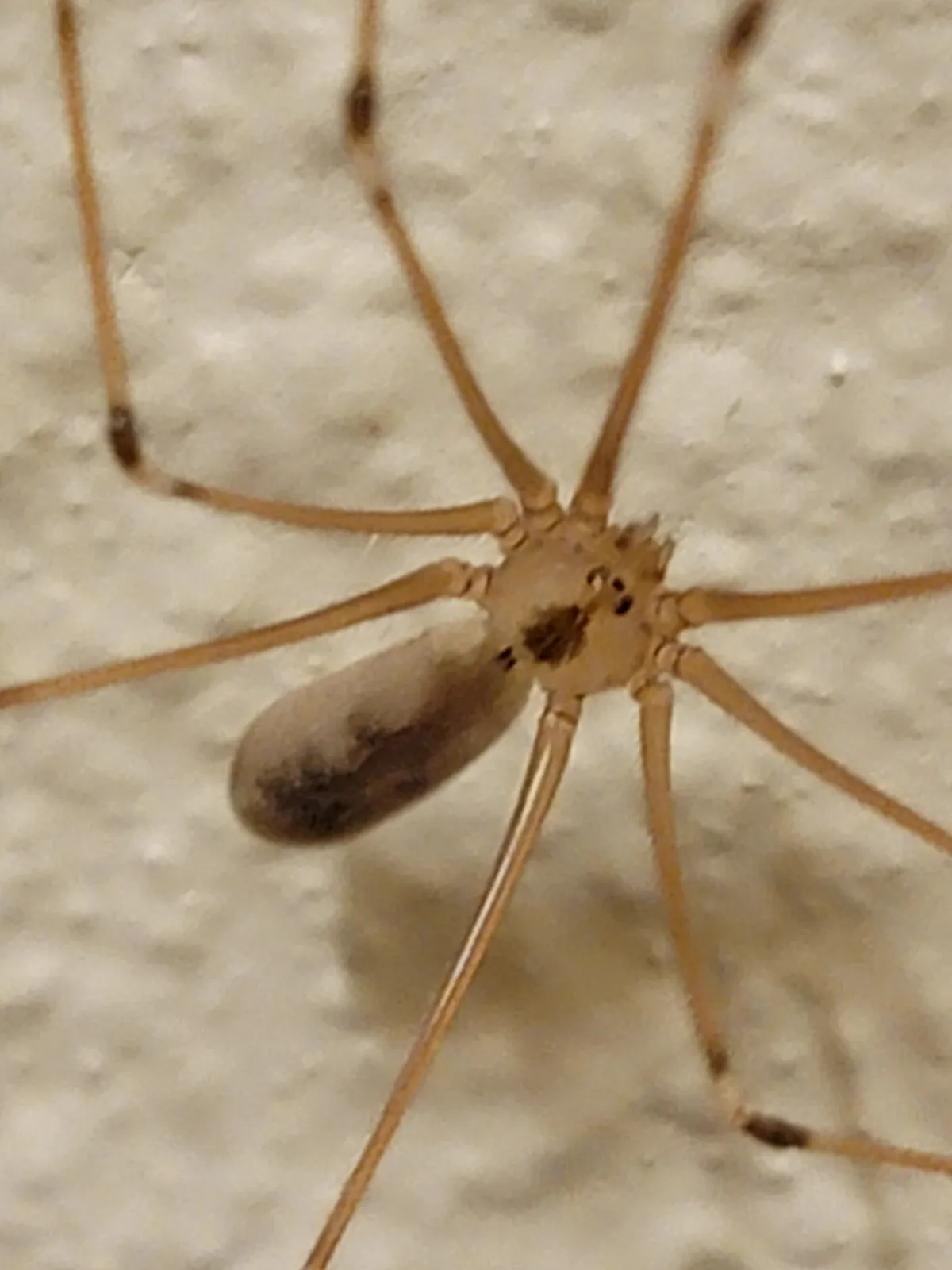 Cellar spiderTiny pale body on very long legs; whirls in its web when disturbed
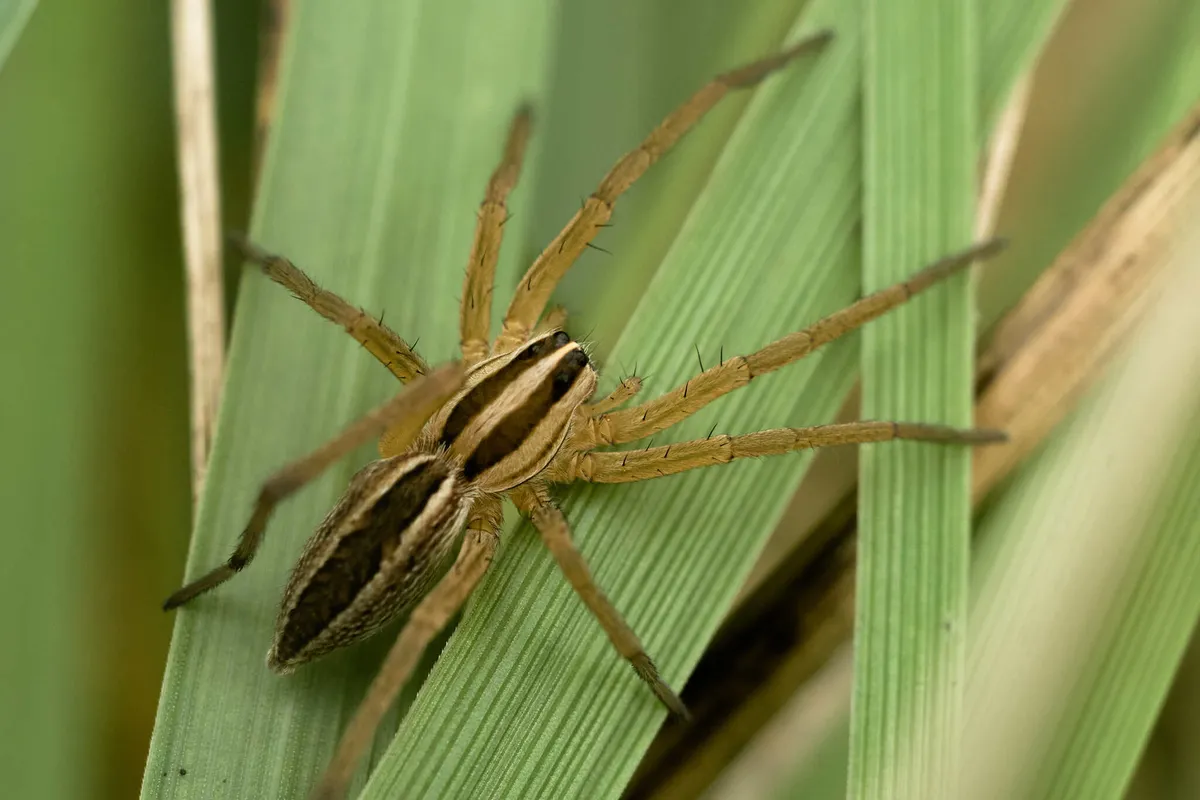 Wolf spiderHairy, striped and fast, with no web and two big forward-facing eyes
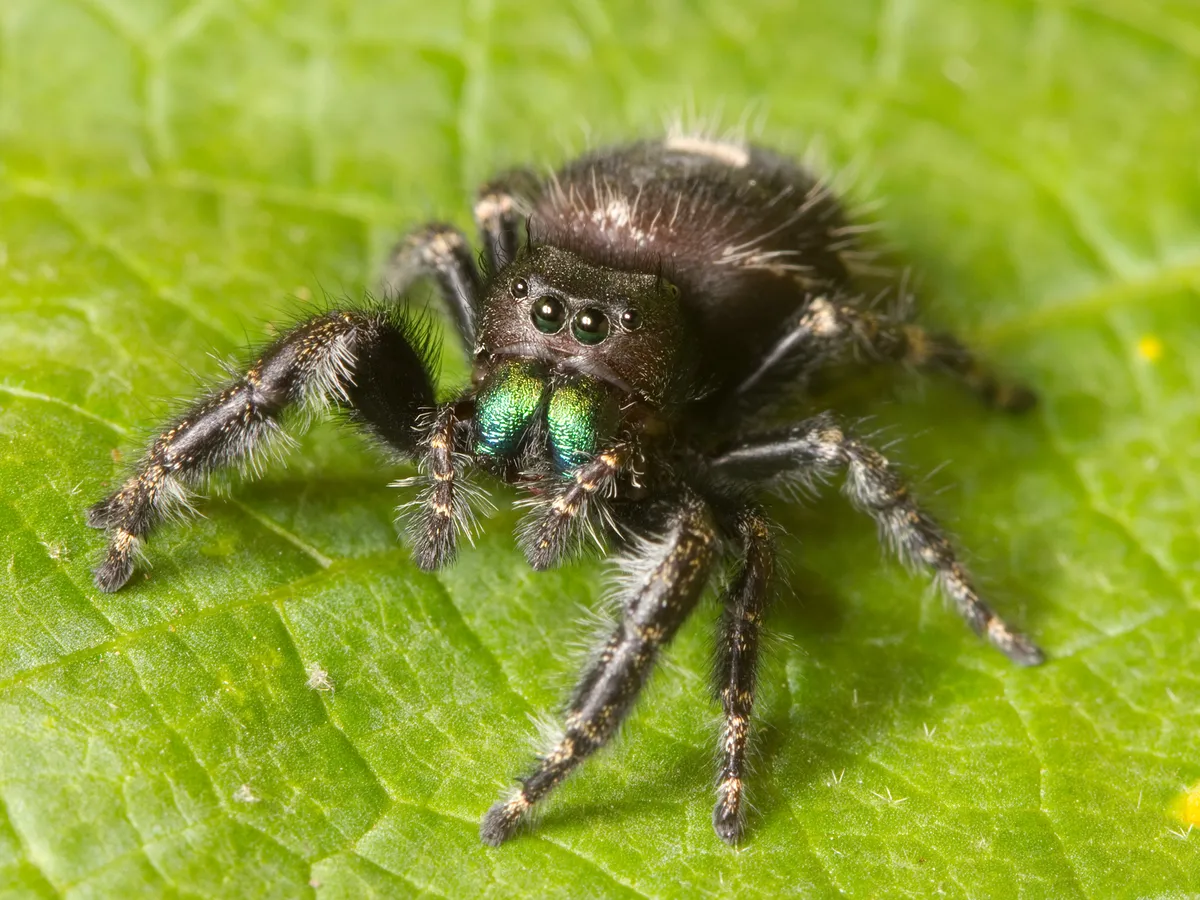 Bold jumping spiderFuzzy and black, often with white spots, and big front eyes; it jumps
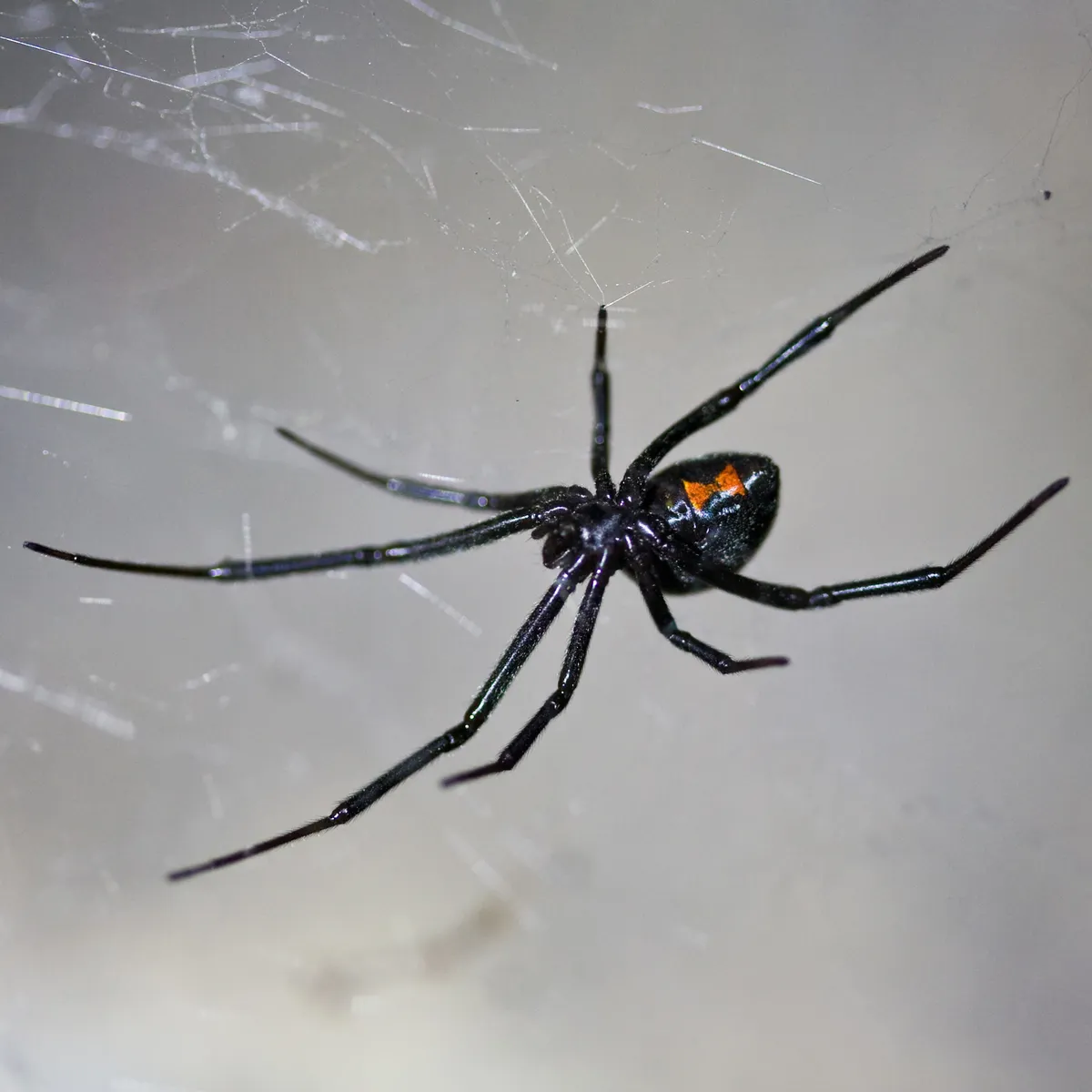 Black widowShiny black and round, with a red or orange hourglass on the underside
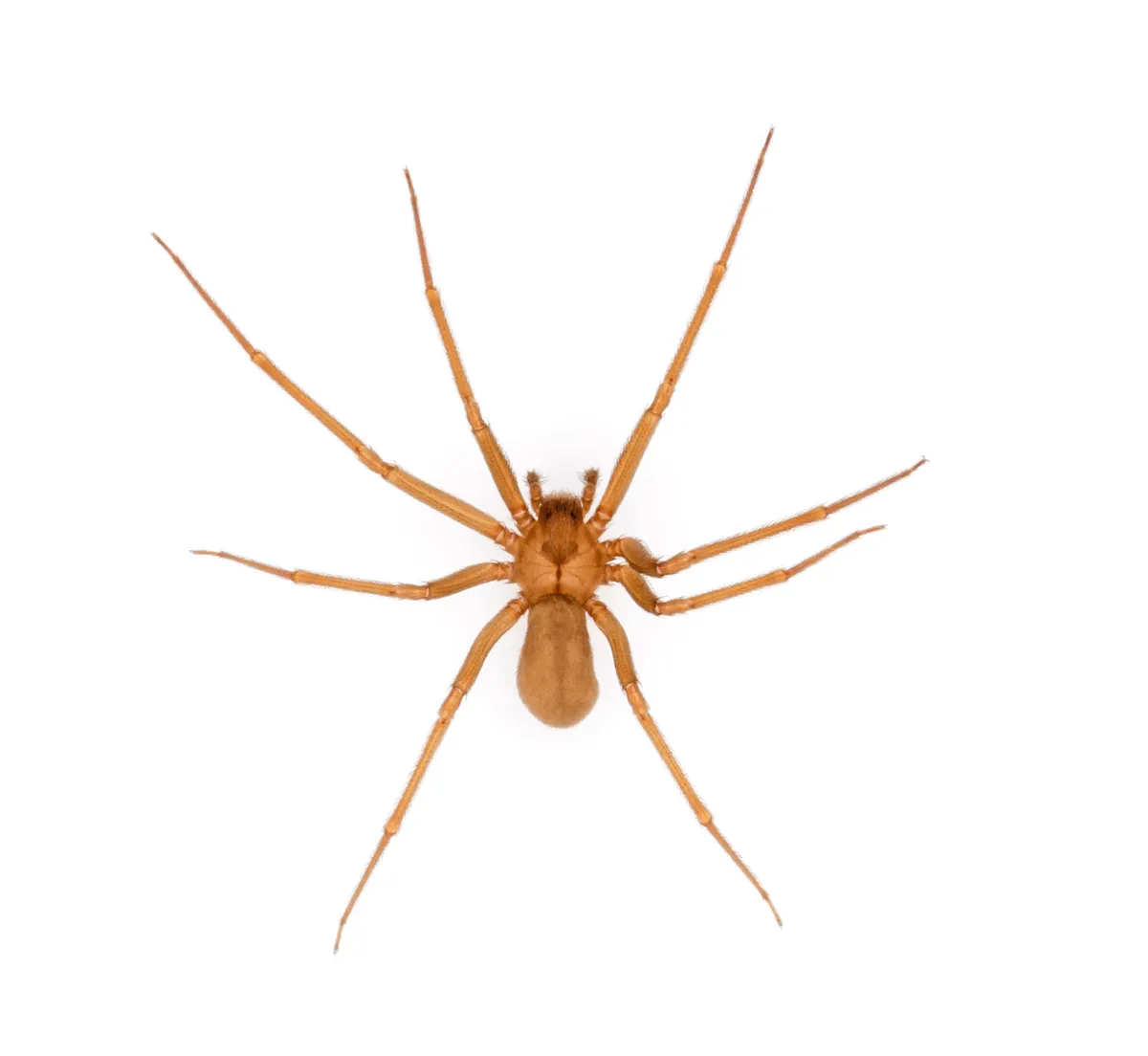 Brown reclusePlain tan with legs of one color and six eyes in pairs; a violin alone is no proof
Photos: Common house spider: no rights reserved, via iNaturalist, CC0 1.0. Cellar spider: no rights reserved, via iNaturalist, CC0 1.0. Wolf spider: no rights reserved, via iNaturalist, CC0 1.0. Bold jumping spider: Kaldari, CC0, via Wikimedia Commons, CC0 1.0. Black widow: (c) Ken-ichi Ueda, some rights reserved (CC BY), via iNaturalist, CC BY 4.0. Brown recluse: Insects Unlocked, CC0, via Wikimedia Commons, CC0 1.0.
Already know which spider it is?
Go straight to the guides for that spider.
Common house spider
A small brown spider with a round, patterned abdomen that stays in a messy cobweb in a corner, a window or the basement.
Cellar spider (daddy longlegs spider)
A pale spider with a tiny body on very long, thin legs, hanging in a loose web in a corner of a basement or ceiling.
Wolf spider
A hairy brown or gray hunter, often striped, that runs fast across the ground or the floor and builds no web.
Jumping spider
A compact, often fuzzy spider with big front eyes that hunts by day on walls, windows and plants, and jumps.
Orb weaver (garden spider)
A web-sitting spider, often large and colorful, in a round, wheel-shaped web in a garden or on a porch, most noticeable in late summer.
Grass spider (a funnel weaver)
A fast, striped brown spider that waits in the funnel of a flat sheet web on lawns and low plants, and sometimes comes indoors in the fall.
House funnel weaver (giant house, hobo or barn funnel weaver)
A big, long-legged brown spider that builds sheet webs with a funnel in basements, garages and window wells; wandering males run across floors.
Yellow sac spider
A small, pale yellow spider with dark jaws that roams walls and ceilings at night and hides by day in a silk sac in a corner.
False widow (false black widow)
A shiny, chocolate-brown spider with a round body like a widow’s but no red hourglass, common inside homes.
Black widow
A shiny black spider with a round abdomen and a red hourglass underneath, in a messy web low down in a sheltered spot. Its bite needs medical care.
Harvestman (daddy longlegs): not a spider
A spider relative with one oval body and very long legs. It has two eyes, makes no silk and has no venom.
Fishing spider
A very large, hairy brown spider found near water, on rocks, logs and tree trunks, that can run on water. It builds no web.
Brown recluse (or another recluse)
A plain tan to dark brown spider, about the size of a quarter with its legs out, that hides in clutter, boxes and closets. Its bite can need medical care.
Parson spider
A dark ground spider with a white band on its abdomen that runs fast across floors at night, often indoors in the fall.
Woodlouse spider
A red-orange spider with a pale grayish rear and big, forward-pointing fangs, found under rocks and logs and sometimes indoors. It builds no web.
Brown widow
A mottled tan, brown and gray widow with an orange hourglass underneath and spiky egg sacs, common outdoors in the South and Southern California.
Southern house spider
A southern spider: the dark gray female hides in a crack inside a flat, woolly web on the house, and the tan, long-legged male is often mistaken for a brown recluse.
Green lynx spider
A bright green hunting spider with long, spiny legs that leaps among shrubs and flowers in the southern United States.
Tarantula
A very large, hairy brown spider of the Southwest and south-central US. The ones seen out in the open are usually males looking for mates.
Camel spider (windscorpion): not a spider
A fast, yellowish-brown arachnid of dry western and southwestern areas, with huge pincer-like jaws and leg-like palps that make it look ten-legged. It has no venom.
Spider identification questions
How do I tell what kind of spider I have?
Start with four clues: the web it was in, where you found it, its size with the legs and its markings. A messy cobweb, a flat sheet with a funnel and a round web of circles and spokes each point to different families (UC IPM; University of Minnesota), and hunters such as wolf and jumping spiders build no web to catch prey. Then look closer: a recluse has six eyes in three pairs and plain legs without spines (UC IPM). The questions above score these clues and show how to confirm each answer.
More: Common House Spiders: How to Identify Them and Why They Come Inside
Can I identify a spider from a picture?
Often, if the photo is sharp. Take one from above and one of the face, with a coin or ruler beside the spider, and do not handle it to get the shot. Photo apps and community sites such as iNaturalist and BugGuide can suggest a name, but treat any answer as a lead: telling a hobo spider from its relatives takes a microscope (UC IPM), and a recluse’s six eyes are easiest to see with a good hand lens (UC IPM).
Is there a free spider identifier?
Yes, this page: seven questions about the place, the web, the size, the markings and the behavior give the most likely spiders, with real photos and the reason behind each suggestion. For a confirmed identification, ask your county Cooperative Extension office; in California, UC IPM sends readers to theirs, which can forward a spider to an arachnologist. Keep the spider whole, because a crushed one is hard to identify (UC IPM).
How can you tell if a spider is dangerous?
CDC’s page on venomous spiders in the US names two: the black widow and the brown recluse. An adult female black widow is shiny black with a red or orange hourglass on her underside (UC IPM). A recluse is plain tan to dark brown, with six eyes in three pairs and plain legs without spines (UC IPM). The brown widow of the South and Southern California has a much milder bite (UC IPM). The jaws of most other spiders are too small to bite through an adult’s skin (UC IPM).
How do you identify a brown recluse?
Look for all five features together: six eyes in three pairs, a plain abdomen covered in fine hairs, no spines on the legs, legs of one even color, and a body no more than 3/8 inch long (UC IPM). The violin mark on the front half is not reliable on its own, because people see violins on many harmless spiders (UC IPM). Then check where you are: brown recluses are established only in 16 central and southern states (Penn State), and none live in Canada (Canadian Family Physician; UC IPM).
More: Spiders That Look Like Brown Recluses: How to Tell Them Apart
How do you identify a black widow?
The adult female is shiny black with a round abdomen and a red or orange hourglass on her underside, which can be split, faint or, rarely, missing (UC IPM). The northern black widow often has red spots down her back (Missouri Dept. of Conservation). Western black widow males and young are tan or gray with white stripes (UC IPM). Widows hang upside down in a tough, messy web, usually within 3 feet of the ground (UC IPM), in places such as woodpiles, rock piles and garages (University of Kentucky).
What is the big brown spider running across my floor?
Usually a wolf spider or a funnel weaver. Wolf spiders hunt on the ground without a web and often wander into homes (University of Kentucky), and a female may carry her egg sac or her babies (Missouri Dept. of Conservation). Funnel weavers such as the giant house spider and the barn funnel weaver live in sheet webs, but the males wander and run very fast (Washington State University; Colorado State University). In the central and southern US, check a smaller, plain brown one for a recluse’s six eyes (UC IPM).
Why are there so many spiders in my house in the fall?
Many are males out looking for mates. UC IPM says large hunting spiders found in homes are often mature male wolf spiders or tarantulas searching for females, and male giant house spiders are especially mobile from mid-summer to early fall (Washington State University). Others come in from outside: hunting spiders may wander in by accident, particularly in the fall (University of Minnesota), and Penn State says grass spiders come indoors in autumn as temperatures fall. Those hunting spiders do not survive well indoors and usually do not breed there (University of Minnesota).
Are daddy longlegs spiders?
Two different animals share the name. Harvestmen are not spiders: they have one oval body, two eyes, no silk and no venom glands (Missouri Dept. of Conservation). Cellar spiders are true spiders, with two body parts, usually eight eyes and silk webs (UC Riverside). The old story that daddy longlegs carry deadly venom but cannot bite does not hold up: harvestmen have no venom, and no cellar spider bite has been recorded causing harm (UC Riverside).
Are there brown recluses in Canada?
No. A review in Canadian Family Physician concluded that brown recluse spiders are not found in Canada, and UC IPM notes that none has ever been found north of the 48 contiguous states. Canada does have black widows, in the south: the northern black widow in the southeast (US Army Public Health Center) and the western black widow in southern British Columbia, Alberta and Saskatchewan (Environment and Climate Change Canada), which adds that only a very few spider species are potentially dangerous to people.
Sources
- Venomous Spiders at Work — CDC National Institute for Occupational Safety and Health (NIOSH)
- Spider Bites: Symptoms and Causes — Mayo Clinic
- How Dangerous Is a Black Widow Spider Bite? — Poison Control, National Capital Poison Center
- Canadian Poison Centres — Ontario Poison Centre, The Hospital for Sick Children
- Spiders (Pest Notes 7442) — University of California Statewide IPM Program (UC IPM), R. S. Vetter
- Widow Spiders and Their Relatives (Pest Notes 74149) — UC IPM, R. S. Vetter
- Brown Recluse and Other Recluse Spiders (Pest Notes 7468) — UC IPM, R. S. Vetter
- Hobo Spider (Pest Notes 7488) — UC IPM, R. S. Vetter
- Windscorpion (Pest Notes 7495) — UC IPM, E. J. Perry
- How to Identify and Misidentify a Brown Recluse Spider — UC Riverside Department of Entomology, Rick Vetter
- Daddy Long Legs — UC Riverside Department of Entomology
- Arachnids Submitted as Suspected Brown Recluse Spiders: Loxosceles Spiders Are Virtually Restricted to Their Known Distributions but Are Perceived to Exist Throughout the United States — Journal of Medical Entomology (Vetter, 2005), PubMed record
- An Approach to Spider Bites: Erroneous Attribution of Dermonecrotic Lesions to Brown Recluse or Hobo Spider Bites in Canada — Canadian Family Physician (Bennett and Vetter, 2004), PubMed Central
- Brown Recluse Spiders — Penn State Extension
- Common House Spider — Penn State Extension
- Longbodied Cellar Spider — Penn State Extension
- Agrarian Sac Spider and Longlegged Sac Spider — Penn State Extension
- Grass Spiders — Penn State Extension
- Wolf Spiders — Penn State Extension
- Parson Spider — Penn State Extension
- Woodlouse Hunter Spider — Penn State Extension
- Urban Spider Chart — University of Kentucky Entomology, Blake Newton and Lee Townsend
- Nursery-Web and Fishing Spiders of Kentucky — University of Kentucky Entomology, Blake Newton
- Spiders — University of Minnesota Extension
- Wolf Spiders — Missouri Department of Conservation
- Bold Jumper — Missouri Department of Conservation
- Black-and-Yellow Garden Spider — Missouri Department of Conservation
- Black Widow Spiders — Missouri Department of Conservation
- Dark Fishing Spider — Missouri Department of Conservation
- Daddy Longlegs (Harvestmen) — Missouri Department of Conservation
- Giant House Spider — Washington State University Extension, Pestsense
- Barn Funnel Weaver (Colorado Arthropod of Interest) — Colorado State University
- Windscorpions (Sunspiders) of Colorado — Colorado State University Extension
- Southern House Spider, Kukulcania hibernalis (EENY144) — University of Florida IFAS Extension (UF/IFAS)
- Green Lynx Spider, Peucetia viridans (EENY-249) — UF/IFAS Extension
- Golden Silk Spider, Trichonephila clavipes (EENY229) — UF/IFAS Extension
- Spiny Orb Weaver Spider, Gasteracantha cancriformis (EENY-167) — UF/IFAS Extension
- Joro Spider: Trichonephila clavata (Circular 1273) — University of Georgia Cooperative Extension
- The Jorō Spider (HGIC 2517) — Clemson Cooperative Extension, Home & Garden Information Center
- Texas Tarantula Tango: Understanding Their Annual Hunt for Food, Love — Texas A&M AgriLife Extension, Insects in the City
- Tarantula — University of Arkansas Arthropod Museum
- Brown Tarantula — Oklahoma Department of Wildlife Conservation
- Spiders (Backyard Gardener #177) — University of Arizona Cooperative Extension
- Widow Spiders (Fact Sheet 18-030-0818) — US Army Public Health Center
- Wild Species 2010, chapter 10 (spiders) — Environment and Climate Change Canada
How this page was made: the questions, results and text were researched and drafted with AI assistance from the sources listed above, and a second, independent AI pass checked each factual claim against those sources. The photos come from CDC’s Public Health Image Library, iNaturalist, Wikimedia Commons and other sources that allow reuse, with each credit shown under the photo. BugGuide and iNaturalist are named as places to ask for an identification, not as sources of facts. This page gives general information, not medical advice. Found an error? Email support@buzzskito.ca.
BuzzSkito treats mosquitoes and ticks in the Greater Toronto Area. Our spider guides are independent research: we do not treat spiders.