
BuzzSkito Mosquito & Tick Control Specialists · Published July 21, 2026
Why a Couch Gets Bed Bugs in the First Place
Bed bugs are not loyal to beds; they are loyal to hosts. They settle wherever a person stays still for long stretches, and a couch qualifies just as much as a mattress does — people nap on it, watch television for hours, and in plenty of Canadian homes someone sleeps on it every night. That steady supply of a warm, breathing host turns upholstered furniture into prime harbourage. The bugs tuck into the seams and piping, wedge under the cushions, hide in the folds of the arms and back, and colonize the staple lines and joints of the frame underneath where you never look.
The practical consequence is important: treating only the bedroom while ignoring the living-room couch simply hands the infestation a place to relocate and rebuild. If you have bed bugs anywhere, the couch is a suspect, and if the couch is the epicentre, the nearby baseboards, outlets, and the seams of adjacent chairs are almost certainly involved too. That is why the protocol below treats the couch and the room around it, not the sofa in isolation.
Check current Canadian availability of the core couch-kit tools:
Step 1 — Confirm and Contain Before You Touch Anything
Before you treat, verify you are actually dealing with bed bugs and then stop the couch from seeding the rest of the house. Work in good light with a flashlight and a magnifier: remove every cushion, inspect both faces, and run a stiff card along the seams and piping to flush bugs into the open. You are looking for live bugs (flat, reddish-brown, apple-seed sized), pinhead-pale eggs, dark ink-like fecal dots, shed amber skins, and rusty smear stains. Check the arm folds, the underside where fabric meets frame, the staple lines, and any recliner or sofa-bed mechanism. Our how to check for bed bugs guide walks the full inspection.
Containment comes next and it matters as much as any spray: stop moving the couch or its cushions between rooms, don’t sleep on it and then climb into a clean bed, and set interceptor monitors under the couch legs and the nearest bed legs so you can see whether bugs are travelling. Bag and hot-wash then high-heat-dry every throw, blanket, and removable cover. Vacuum a wide perimeter and seal the vacuum contents in a bag in an outdoor bin immediately.
Step 2 — Vacuum Every Seam and Crevice
Fit the narrow crevice tool, not the wide floor head, and work slowly. Press the tool firmly into the mattress-style piping, the cushion seams, the folds of the arms and back, and the frame joints underneath, so the airflow reaches into the crease rather than skimming across it. Scraping the hard edge of the tool along a seam first dislodges bugs that grip the fabric, so the suction can carry them off. Vacuuming delivers an immediate population drop — it removes adults, nymphs, and loose debris fast — but be clear-eyed that it will not lift the cemented eggs, which is precisely why the steam step exists. For the fine detail work a sealed-HEPA handheld is easier to control; our guide to the best HEPA vacuums for bed bugs explains why a sealed body and bagged disposal matter here.
Step 3 — Steam the Whole Couch (This Is the Part That Kills Eggs)
Heat is the heart of a couch treatment because it is one of the very few things that reliably kills bed-bug eggs, and eggs are what everything else leaves behind. A dry-vapour steamer drives the fabric surface well past the roughly 50°C (122°F) lethal point for every life stage, penetrating into seams and folds where nothing else reaches. The technique is unforgiving of shortcuts:
- Move slowly — about 2.5 cm (1 inch) per second. A fast pass heats the surface but never penetrates, leaving survivors deep in the fabric. Slow is the whole trick.
- Use a low-moisture “dry steam” machine so you kill bugs without soaking the cushion foam, which then invites mould.
- Work every surface methodically: both faces of each cushion, all the seams and piping, the tufts, the arm and back folds, and the underside of the frame including the staple lines.
- Fit a narrow concentrator nozzle for the seams and a cloth-covered wide head for open panels, so the heat drives in instead of blasting bugs across the room.
- Overlap your passes. Missed strips are missed eggs; treat the whole couch as a grid you cover completely.
If you are choosing a machine, our Dupray steamer review and the broader best bed-bug steamer guide cover which units actually sustain the temperature and dwell time an upholstered couch demands. If you would rather understand the trade-off against a heat chamber, steamer vs heater for bed bugs lays it out — for a couch you cannot fit in a box, the steamer wins by default.
Step 4 — Apply a PMRA-Registered Residual Spray
Steam kills on contact but leaves no residual, so the moment it evaporates the couch is unprotected against bugs that were sheltering in cracks the heat did not reach. A residual spray closes that gap by leaving a surface that keeps killing for a couple of weeks. For furniture you sit on, a lower-toxicity botanical residual such as EcoRaider is a common upholstery choice — not because it hits hardest, but because it is labelled for use around living spaces and carries a genuine residual.
Two rules matter more than the brand. First, buy Canadian-registered chemistry: the label must carry a PMRA/PCP registration number. Many of the most-hyped US bed-bug products — certain Crossfire and Temprid formulations — are not registered for sale or home use in Canada and reach buyers only as grey-market imports, which is both a legal and a safety problem. Second, spray into cracks and seams, not over the surfaces you sit on: target the frame joints, the underside staple lines, and the deep piping, follow the label’s upholstery directions exactly, and let everything dry fully before anyone uses the couch. For a wider comparison of what is worth buying, see our bed-bug spray Canada guide, and if you prefer to think in terms of heat versus chemistry overall, heat vs chemical bed-bug treatment frames the decision.
Step 5 — Encase, Dust the Voids, and Monitor
You cannot steam or spray the inside of a foam cushion core or the sealed voids of the frame, so containment finishes what treatment starts. Slip removable cushions into bite-proof, escape-proof zippered encasements (the same design used for mattresses, in cushion sizes) and, where practical, cover the couch body. Anything sealed inside eventually starves; anything outside cannot get back in. Leave encasements on for at least a year, because bed bugs can survive many months without a meal, and inspect the zipper seams for tears.
For the deep frame voids that resist everything else, a barely-visible film of diatomaceous earth or an amorphous-silica powder into the joints and staple lines gives a slow, long-lasting mechanical kill — apply a film, never a pile, keep it out of the fabric you sit on and away from anyone’s lungs. Then monitor honestly: interceptor cups under the legs and a weekly magnifier check of the seams tell you whether the numbers are actually dropping.
Repeat Weekly — Why One Treatment Never Finishes
The single most common reason a couch infestation comes back is treating once and declaring victory. Bed-bug eggs hatch over roughly one to two weeks, and neither a residual spray nor a single steam pass catches every egg on the first attempt. So you repeat the full vacuum-steam-spray sequence weekly, re-dusting voids and re-checking monitors, until you have gone two to three consecutive weeks with zero live bugs, zero fresh shed skins, and zero new bites. Plan on three to six weeks of this cycle. It is tedious, and the discipline of showing up every week is exactly what separates a couch that clears from one that limps along for months. The related whole-home bed-bug removal guide and the DIY heat-treatment walkthrough put this couch protocol in the context of the rest of the house.
How to Choose Each Tool — What You Are Actually Paying For
The couch kit spans a wide range of price and quality, and it is worth being deliberate about where the money goes. Spend in this order:
- The steamer (pay for this). It is the only tool that kills eggs, so it is the one purchase you cannot substitute. Buy a dry-vapour machine that sustains temperature and steam volume rather than a cheap unit that spits and cools — a weak steamer moved too fast is the classic path to a treatment that fails. This is where premium is justified.
- The registered spray (pay for the registration, not the hype). A modest, PMRA-registered residual applied correctly beats an expensive grey-market product that is illegal to use at home. You are paying for legal, living-space-appropriate chemistry with a real residual, not for the strongest label.
- The encasements (buy right, buy once). Cheap covers with weak zippers tear and defeat the purpose. A quality bite-proof cushion encasement is a one-time cost that protects the couch for years — the value is in the zipper and the fabric integrity, not the brand.
- The powder and monitors (cheap essentials, don’t skip). Both cost little and each does a job nothing else does — the powder finishes voids, the monitors tell you the truth about whether you are winning. Include them.
- A dedicated vacuum (only if you don’t already own one). Any vacuum with a crevice tool helps; a sealed-HEPA machine is better for allergen control but is a nice-to-have, not the load-bearing purchase. Don’t let it crowd out the steamer.
Read that as a spending map: the steamer earns the premium, the spray earns your care about registration, and everything else is inexpensive but essential. The way to waste money here is to buy four cheap tools that each half-work; the way to succeed is to buy a real steamer and use the whole protocol consistently.
Can You Save the Couch, or Should You Replace It?
In most cases, save it. A couch with bed bugs is treatable, and throwing furniture out prematurely tends to spread the infestation rather than end it — a discarded sofa dragged through a hallway or apartment building seeds bugs along the whole route, and a replacement set down in an untreated room simply gets re-infested within weeks. Treat first, and give the protocol the three-to-six-week run it needs before you judge it.
Replacement makes sense only in specific cases: a couch so heavily infested that treatment repeatedly fails, one that is structurally worn out and due for replacement anyway, or a situation where the couch is porous, multi-void furniture you genuinely cannot treat thoroughly. If you do discard it, be a good neighbour and a responsible Canadian: cut or spray-paint the upholstery and label it “bed bugs” so no one takes it home and restarts the cycle. And do not buy a replacement until the room itself is clear, or you will just feed the bugs a fresh couch.
When to Call a Professional
DIY genuinely works for a contained, single-couch problem when you run the full protocol consistently. But escalate to a licensed exterminator when the infestation has spread beyond the couch into the bed, walls, and baseboards; when you live in a multi-unit building where a neighbour is a constant re-infestation source; when several weeks of careful DIY have not broken the cycle; or when you simply want the certainty of a professional whole-room heat treatment and stronger registered products. There is no failure in escalating — bed bugs are notoriously stubborn, and a job done right beats a cheaper attempt that drags on for months. If cost is your deciding factor, our Canadian pest control cost guide lays out what professional bed-bug work typically runs.
Frequently Asked Questions
How do you get rid of bed bugs in a couch?+
The reliable way to clear bed bugs from a couch in Canada is a three-part protocol: vacuum every seam and crevice first, then steam the entire couch slowly with a dry-vapour steamer to kill bugs and eggs on contact, then apply a PMRA-registered residual spray (such as EcoRaider) into the cracks the steam could not reach. Repeat weekly for three to four weeks because eggs keep hatching. A zippered furniture or cushion encasement seals what you cannot fully treat — the couch frame or a mattress-style cushion — so trapped bugs die and new ones cannot get in. Steam does the killing, spray does the residual holding, and the encasement does the containment. No single one of them clears a couch on its own.
Can you save a couch that has bed bugs, or do you have to throw it out?+
In most cases you can save it. Bed bugs in a couch are treatable with heat and residual chemistry, and throwing furniture out prematurely often spreads the infestation — a discarded couch dragged through a hallway or apartment building seeds bugs along the route, and a replacement placed in an untreated room simply gets re-infested. Treat first. Consider replacing the couch only if it is heavily infested, structurally worn out anyway, or if repeated treatment fails after several weeks. If you do discard it, cut or spray-paint the fabric and label it "bed bugs" so no one else takes it home and restarts the cycle in another Canadian household.
Does steaming a couch actually kill bed bugs and their eggs?+
Yes — heat is one of the few things that reliably kills bed bug eggs, which most sprays and vacuuming leave behind. A dry-vapour steamer delivers surface temperatures well above the roughly 50°C (122°F) lethal threshold for all bed-bug life stages, including the cemented eggs suction cannot lift. The catch is technique: you must move the steamer head slowly — about 2.5 cm (1 inch) per second — so the heat penetrates the fabric rather than skimming the surface, and you must work every seam, tuft, fold, and the underside of the frame. A fast pass leaves survivors. Use a low-moisture "dry steam" machine so you are not soaking the cushions.
What is the best spray for bed bugs in a couch in Canada?+
For a couch you sit on, a lower-toxicity residual matters. EcoRaider and similar PMRA-registered botanical residual sprays are popular for upholstered furniture because they carry a residual that keeps killing for a couple of weeks yet are labelled for use around living spaces. Whatever you choose, buy a product with a Canadian PMRA/PCP registration number on the label — many effective US bed-bug products (certain Crossfire and Temprid formulations) are not registered for sale or home use in Canada and are grey-market imports. Always read and follow the label for upholstery, spray into cracks and seams rather than saturating cushion surfaces, and let it dry fully before anyone sits down.
How long does it take to get rid of bed bugs in a couch?+
Plan on three to six weeks of a weekly cycle. Bed bug eggs hatch over roughly one to two weeks, and a residual spray plus a single steam pass will not catch every egg on the first attempt, so you repeat the vacuum-steam-spray sequence weekly until you have gone two to three weeks with zero live bugs, shed skins, or fresh bites. Rushing — one treatment and done — is the single most common reason a couch infestation comes back. Interceptor-style monitors near the couch legs and a magnifier check of the seams each week tell you honestly whether the numbers are dropping.
Do I need to encase or cover the couch?+
A zippered encasement is the containment step that makes the rest stick. You cannot fully treat the inside of a couch frame or the foam core of a cushion, so an encasement seals bugs inside where they eventually starve and die, and stops new bugs from establishing in the spots you cannot reach. Cushion-sized encasements (the same bite-proof, escape-proof zippered bags used for mattresses) fit removable couch cushions; a full furniture cover or a plastic couch cover works for the body. Leave encasements on for at least a year — bed bugs can survive many months without feeding — and inspect the zipper seams for tears.
Why are bed bugs in a couch and not just the bed?+
Bed bugs go wherever a host rests for long stretches, and a couch is a second bed — people nap, watch TV, and fall asleep on it, so it becomes prime harbourage, especially in homes where someone sleeps on the couch regularly. They tuck into the seams, under the cushions, in the folds of the arms, along the zipper piping, and inside the frame joints and staple lines underneath. Because a couch is used day and night, an infestation there can be as entrenched as one in a mattress, and treating only the bedroom while ignoring the living room lets the population simply relocate and rebuild.
How do I check a couch for bed bugs?+
Work in good light with a flashlight and, ideally, a magnifier. Remove every cushion and inspect both sides, then run a stiff card along the seams and piping to flush bugs out. Look for live bugs (flat, reddish-brown, apple-seed sized), pale translucent eggs the size of a pinhead, dark ink-like fecal spots, shed amber skins, and rusty smear stains on the fabric. Check the folds of the arms and back, the underside where fabric meets frame, the staple lines, and inside any recliner or sofa-bed mechanism. Our companion guide on how to check for bed bugs walks through the full inspection, room by room.
Can I use diatomaceous earth or a powder on a couch?+
Yes, as a supporting layer rather than a front-line tool. A light dusting of an amorphous silica or food-grade diatomaceous-earth powder into the couch frame voids, along the underside staple lines, and into cracks the steam and spray cannot reach gives a long-lasting mechanical kill — bugs crawling through it dry out and die over days. Apply a barely visible film, not a pile; a thick layer bugs will simply walk around. Keep powder out of the fabric you sit on and away from anyone with respiratory sensitivity, and never inhale it during application. It is a slow, patient finisher, not a same-day fix.
Is it safe to sit on the couch during treatment?+
Once each treatment has fully dried it is generally fine to use the couch, and continuing to use the room is actually part of the strategy — an occupied couch draws bugs out of hiding and into contact with your residual treatments and monitors. That said, follow every product label to the letter for re-entry and drying times, keep children and pets off until sprays are dry, and do not seal yourself onto a freshly steamed, still-damp cushion. If bites persist, that is a sign the treatment is not yet complete, not a reason to abandon the couch to the bugs.
Should I just call a professional for bed bugs in a couch?+
DIY works for a contained, single-couch problem if you follow the full vacuum-steam-spray-encase protocol consistently for several weeks. Call a licensed exterminator when the infestation has spread beyond the couch to the bed and walls, when you are in a multi-unit building where neighbours are a re-infestation source, when weeks of careful DIY have not worked, or when you simply want the certainty of professional heat treatment. Professionals bring whole-room heat and stronger registered products. There is no shame in escalating — bed bugs are notoriously stubborn, and getting it done right beats a cheaper attempt that drags on for months.
How do I stop bed bugs from spreading from the couch to the rest of the house?+
Contain before you treat. Stop moving the infested couch or its cushions between rooms, do not drag them through the home to discard, and avoid sleeping on the couch and then getting into a clean bed. Vacuum a wide perimeter around the couch and seal the vacuum contents in a bag in an outdoor bin immediately after every session. Bag and hot-wash then high-heat-dry any throws, blankets, and cushion covers. Put interceptor monitors under the couch legs and the nearest bed legs so you can see if bugs are travelling. Treat the whole room the couch sits in, not just the couch, because bugs harbour in nearby baseboards and outlets too.
Related Reading
- Best Bed-Bug Steamer Canada — Heat That Kills the Eggs
- EcoRaider Bed-Bug Spray Review Canada
- Bed-Bug Mattress & Cushion Encasements Canada
- Heat vs Chemical Bed-Bug Treatment — Which Wins?
- Steamer vs Heater for Bed Bugs Canada
- Best HEPA Vacuum for Bed Bugs & Fleas Canada
- How to Get Rid of Bed Bugs — The Whole-Home Guide
- Best Pest Control Equipment in Canada — The Full Device Hub
Keep reading
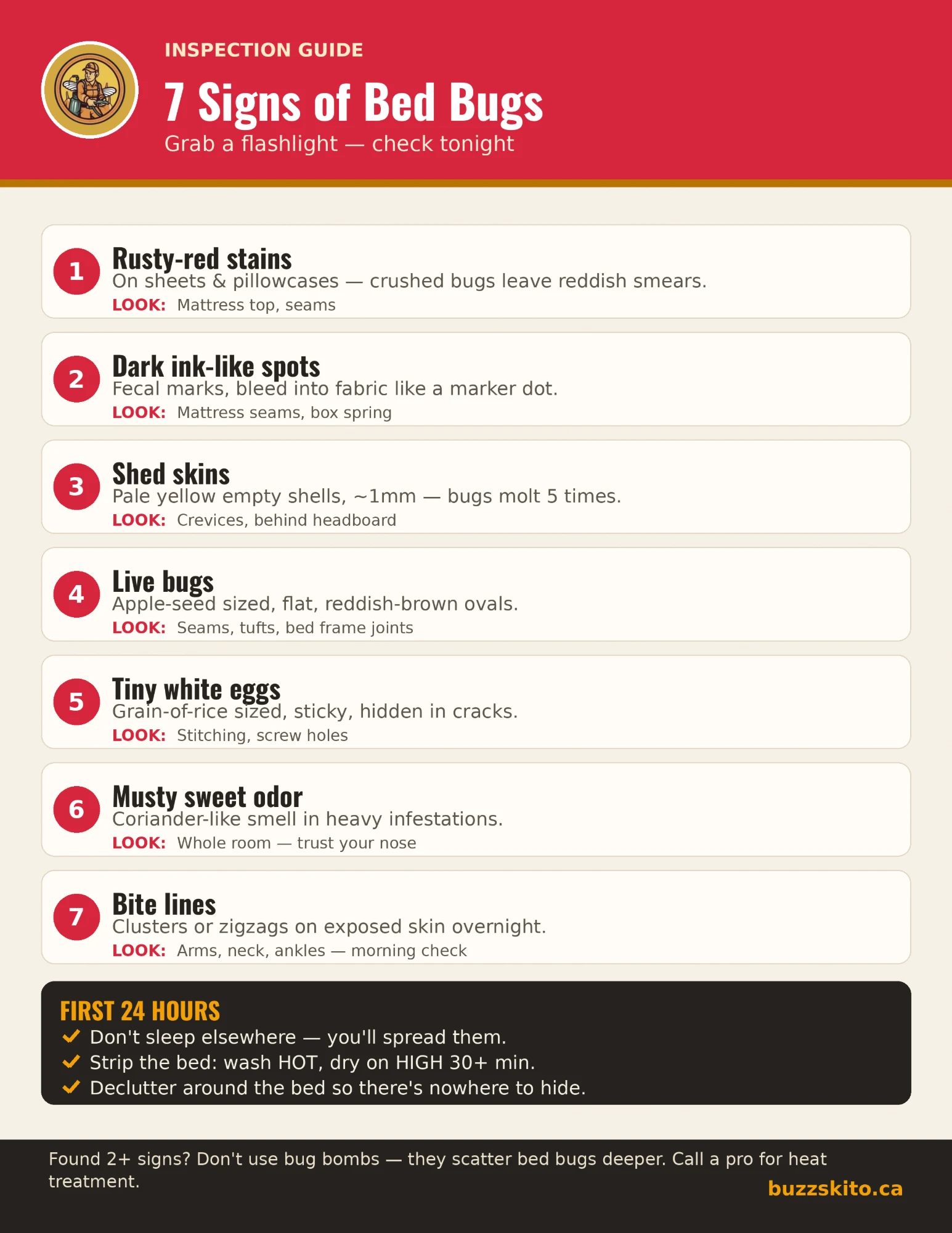 Signs of Bed Bugs: A 7-Point Checklist to Run TonightThe seven signs of bed bugs, from live bugs and ink-like spots to bites, with where to look tonight, what each is…
- Where Do Bed Bugs Hide? Hiding Places From the Mattress OutwardBed bugs hide in box springs, mattress seams, headboards and bed frames first. Here is how far they roam, when they…
- Best Bed Bug Fogger Canada 2026 — PMRA-Registered Total-Release Options (and Their Limits)An honest Canadian guide to bed bug foggers and bug bombs: which total-release products are PMRA-registered, why…