BuzzSkito Mosquito & Tick Control Specialists · Published July 30, 2026
Why a Canadian Brand Keeps Winning Canadian Searches
Almost nobody sets out to buy this brand. What happens is this: a homeowner reads an article about carpenter ants, bed bugs, or a perimeter barrier — almost always written for the American market, because that is where most pest content is written — goes looking for the product it names, and discovers it is not sold at Canadian Tire, not at Home Depot Canada, and not legitimately on Amazon.ca. Then the search becomes “what can I actually buy here”, and a small set of Canadian-registered names comes up. Doktor Doom is one of them.
That gap is a regulatory one rather than a retail accident. Under Canada’s Pest Control Products Act, an insecticide sold or used in this country must be registered with Health Canada’s Pest Management Regulatory Agency and carry a Canadian label with a PCP registration number. A product registered by the US EPA has cleared a different regulator against different requirements, and its American label is not a Canadian one. Provincial rules then narrow the field again for outdoor cosmetic use: Ontario permits only a list of lower-risk active ingredients for cosmetic lawn and garden use, and Quebec runs a separate regime under its own Code de gestion des pesticides. The net effect for a homeowner is that the aisle here is genuinely narrower than the one across the border, and the popular American answer is frequently unavailable rather than merely out of stock.
So the honest framing of this brand is not “the strongest thing you can buy”. It is the range that is legally on the shelf, across enough pests that you rarely have to go looking abroad — and that is a real and underrated advantage, because the alternative people reach for is a grey-market import with no Canadian directions behind it.
Check current Canadian availability across the range:
What the PCP Number Buys You — and What It Does Not
It is worth being precise here, because the registration number gets treated online as a quality mark and it is not one.
What it gets you. Legality: the product may lawfully be sold and used in Canada, which an imported can may not. A Canadian label: the pests, use sites, application rates, re-entry intervals for people and pets, and safety directions were reviewed against Canadian requirements. And traceability: a registered product is a known, published formulation, not an unlabelled bottle from a marketplace seller with a photograph of the front only.
What it does not get you. Any promise that it works on your problem. Registration is a regulatory clearance, not a performance rating — a fully registered can is often the wrong tool, and the most common way people waste money on pest control in Canada is buying a perfectly legal product for a job it cannot do. The whole point of the job-mapping table above is that legal and correct are separate questions.
The second thing the number does not tell you is anything about resistance. Consumer insecticides in this category lean heavily on pyrethrin and pyrethroid chemistry, and resistance to that family is widespread in bed bug and cockroach populations. A resistant insect can walk across a fully registered residual and carry on. This is not a knock on one brand — it applies across the domestic-class shelf, and it is the single strongest argument for building any plan around mechanisms insects cannot adapt to: heat, desiccant dusts, physical exclusion, traps, and vacuuming.
The Three Jobs This Brand Is Wrong For
Any guide that recommends a range for everything is not a guide, it is a catalogue. Three household jobs come up constantly and a can is the wrong answer to all of them.
Ants. Spraying a trail is the classic self-defeating move. It kills the foragers you can see — a tiny share of the colony — leaves the queen and the brood untouched, and with some species the disturbance encourages a colony to fragment into satellite nests, which turns one problem into several. Ant control works through bait: a slow-acting toxicant that a forager carries home and shares through the colony. Wiping the trail before you bait is the other common mistake, because the trail is the delivery route. Our Canadian ant guide covers the baiting order, and the ant killer comparison covers which bait format for which species.
Cockroaches. Same logic, more emphatically. Modern cockroach control is gel bait placed into harbourage in many small dots, and spraying a residual near bait placements can drive roaches away from the bait you just paid for. A can has three legitimate roles — a flushing agent, a crack-and-crevice treatment away from bait, and killing the individual you can see — and none of them clears an infestation. See the three jobs worth buying a cockroach can for.
Bed bug eggs. Covered in the FAQ but worth repeating because it causes more failed treatments than anything else: a bed bug egg is cemented to fabric and shelled, and liquid contact sprays penetrate it poorly. This is why a job looks finished and then rebounds about a fortnight later — the eggs hatched into a room whose residue had already faded. Heat kills eggs on the surfaces it touches; a desiccant dust in the harbourage is still lethal at the moment of hatch. Sprays fill the contact-kill role around those two. The full sequencing is in how to kill bed bug eggs in Canada.
There is a fourth, broader one. No product in this range fixes a building condition — a downspout dumping at the foundation, a gap under a garage door, a chronically damp basement, standing water in a yard. A very large share of the aerosol sold in Canada is bought for pests that were really reporting a maintenance problem, and the pests come back on schedule until the condition changes.
What Not to Buy in This Aisle
This page recommends four things and deliberately declines to sell a fifth. The list below is where the money actually leaks out of a Canadian pest budget, and none of it is brand-specific.
- A total-release fogger for a household crawling-insect problem. The physics are wrong, whoever makes it — a fog deposits on open, upward-facing surfaces, and bed bugs, cockroaches and fleas live inside seams, voids and the underside of things. It belongs in the sealed space it was designed for. Our bed bug fogger guide takes the category apart.
- Ultrasonic plug-in repellers. There is no credible evidence for these against any household pest — we went through the category in our ultrasonic pest repeller review.
- A spray bought for an ant or cockroach problem. Both are bait jobs. The can is not a weaker version of the right answer, it is a different answer that works against you.
- Grey-market US concentrates. Not registered for consumer sale here, not lawful to import, and frequently built on the same pyrethroid chemistry resistant populations already survive.
- Pool-grade diatomaceous earth. Calcined, high in crystalline silica, a genuine respiratory hazard, and worse at absorbing insect wax than the registered food-grade product anyway.
- A third can of the same active ingredient. If two correct applications did not move the population, a third purchase of the same chemistry is not a new plan.
How to Use the Two Products Most People Should Actually Buy
The perimeter residual. Three rules decide whether it does anything. Apply at dusk when nocturnal crawling insects are about to move, so the material meets them at full strength rather than after a day of sun. Treat the band, not the lawn: the bottom of the foundation wall, the ground immediately in front of it, thresholds and around window wells. And treat it as a knockdown, not a solution — if the mulch bed, the eavestrough or the drainage is producing the insects, the band buys you weeks, not a season. Our earwig product guide works through this in detail for the pest that most often prompts it.
The diatomaceous earth. This is the item in the range with the best long-run value and the worst application habits. What kills is a barely visible film: insects detect and route around a visible pile, so a heavy application is worse than a light one, and you cannot lay a light one straight from the bag. Buy a bulb or hand duster in the same order. It goes in dry places only — inside wall voids, under appliances and cabinet kick plates, along sill plates, in crawl spaces, under decks the rain does not reach — because it goes inert the moment it is damp. Wear a dust mask while applying, keep it out of the airway, and never substitute pool-grade DE, which is calcined, contains crystalline silica, is a genuine respiratory hazard, and is worse at absorbing insect wax anyway. Grades and brands are compared in our Canadian diatomaceous earth guide.
The Grey-Market Trap
Because this brand exists as an answer to “what can I buy in Canada”, it is worth naming the alternative people take when they get impatient. Pest forums routinely tell Canadians to import American professional-only products — concentrates that are not registered for consumer sale here, cannot lawfully be brought in, can be held at the border, and in several cases rely on precisely the chemistry that resistant populations already survive. Marketplace listings blur the line further: the same product page can show a Canadian-registered can and a US-labelled one depending on the seller.
Two checks, every time, and they take a minute. Confirm the listing is sold and shipped within Canada. Confirm the can that arrives shows a PCP registration number. If it does not, you have an unregistered pesticide in your house with no Canadian directions standing behind how you use it — and no recourse if it damages something or someone reacts to it.
When to Stop Buying Cans
Serial buying is the failure mode this whole page exists to prevent. Three cans of the same chemistry is not a plan, it is the same treatment three times — and it is how people end up spending more than a professional treatment would have cost.
Stop and reconsider when: you have applied a product correctly, at the right time of day, in the right place, twice, and the population has not moved; when the pest is in a wall void, a ceiling, or underground where nothing you can buy will reach it; when the pest is a wasp nest in a wall or in the ground, or anyone in the household is sting-allergic; when you are treating a rental, where in most Canadian jurisdictions pest treatment is the landlord’s responsibility and unit-by-unit DIY does not hold in a multi-unit building; or when the real problem is water, drainage or a gap, in which case the right trade is a contractor rather than an exterminator. Our Canadian pest control cost guide covers what to expect from a quote so you can judge whether the next can or the phone call is the better spend.
Frequently Asked Questions
What is Doktor Doom, and is it a Canadian brand?+
Doktor Doom is a Canadian pest control brand whose consumer products are registered for sale and use in Canada — meaning each one carries a Pest Control Products (PCP) registration number issued by Health Canada’s Pest Management Regulatory Agency on its label. That registration is the entire reason the brand keeps coming up in Canadian searches: an enormous share of the pest advice online is written for the American aisle, and the products those articles recommend are frequently not registered here at all. Doktor Doom is one of the shortlist of names that reliably is, which makes it the practical default when an American guide sends you looking for something you cannot legally buy.
Which Doktor Doom product should I buy for bed bugs?+
Sleep Tight is the one labelled for use on and around a bed — mattress seams, piping, folds, bed frames — and Travel Pro is the packable version for luggage and hotel spot-treatment. Pro Max is the perimeter residual for baseboards, bed legs, and furniture edges rather than the sleeping surface. But treat all three as one layer of a plan rather than the plan: liquid sprays do poorly against eggs cemented into fabric, so the heavy lifting in a real bed bug job is done by heat, a desiccant dust, encasements, and interceptor traps, with the spray filling the contact-kill and spot-treatment role. Read the label on the specific can and follow it exactly — a product labelled for a bed frame is not automatically labelled for a mattress.
Is Doktor Doom safe to use around children and pets?+
It is as safe as the label directions you actually follow, and no safer, which is a genuine answer rather than a dodge. Every registered pesticide in Canada carries directions covering where it may be applied, how much, how long people and pets must stay off treated surfaces, and how to ventilate — and those directions are legally binding, not suggestions. The practical rules that matter most in a household: keep children and pets out of the room during application and until surfaces are fully dry, never treat a sleeping surface unless that surface is named on the label, do not treat food-preparation surfaces, and never use an indoor product outdoors or vice versa. If a household member has asthma or a respiratory condition, prefer physical methods — steam, encasements, traps, vacuuming — over aerosols wherever the job allows.
What does the PCP number on the can actually get me?+
Three concrete things. First, legality: an insecticide sold or used in Canada must be registered, and the PCP number is the proof on the label. Second, a Canadian label — meaning the pests, the surfaces, the rates, the re-entry intervals, and the safety directions were reviewed against Canadian requirements rather than another country’s. Third, recourse and traceability: a registered product is a known formula you can look up, rather than an unlabelled bottle from a marketplace seller. What the number does not get you is efficacy. Registration is a regulatory clearance, not a performance rating — a fully registered product can still be the wrong tool for your pest, and often is.
Does Doktor Doom kill bed bug eggs?+
Assume not, and plan around it. A bed bug egg is cemented to fabric and protected by a shell that liquid contact sprays generally penetrate poorly, which is why infestations that appear beaten so often rebound about a fortnight later when the next generation hatches into a room whose spray residue has already faded. The tools that deal with eggs are heat — a slow pass with a dry-vapour steamer on seams, or a heated chamber for items — and a residual that is still present and lethal at the moment of hatch, which in practice usually means a desiccant dust in the harbourage rather than a liquid on a surface. Use the spray for the contact kill and the perimeter, and let heat and dust handle the eggs.
Is Doktor Doom better than Raid or Ortho in Canada?+
Not meaningfully, and anyone telling you one domestic-class aerosol dramatically outperforms another is overselling. What separates products on a Canadian shelf is mostly the label rather than the potency: which pests it names, which surfaces it may be applied to, and whether it is directed at a structure or at plants. Ortho’s Canadian ECO line, for instance, is largely plant-directed here, which makes it the wrong pick for a foundation band even though it is perfectly legal. Choose by matching the label to your job — the pest on the list and the place on the use sites — not by brand loyalty. Where Doktor Doom genuinely wins is breadth: it covers bed bugs, crawling insects, wasps and a registered diatomaceous earth under one Canadian-registered roof, so you rarely end up importing something.
Can I use Doktor Doom on my lawn or in my garden?+
Only if that specific product’s label names that use, and provincial rules narrow it further. Ontario limits cosmetic lawn and garden use to a permitted list of lower-risk active ingredients, and Quebec runs its own regime under the Code de gestion des pesticides — so the rule is provincial rather than national, and a product perfectly legal to apply around a building may not be legal to apply cosmetically to a lawn. The general shape of it: structural products are labelled for the outside of a building, plant products are labelled for plants, and the two are not interchangeable. Read the use sites on the can and check your own province’s rules before treating turf or ornamentals.
Is the Doktor Doom fogger worth buying?+
For most household jobs, no — and this is the product in the range we would most often talk you out of. A total-release fogger fills a room with a fine mist that settles on open, upward-facing surfaces, which is precisely where the pests are not: bed bugs, cockroaches and fleas spend their lives inside seams, voids, cracks, and the underside of things, and a fog does not travel there. Worse, the disturbance can push a population into adjacent rooms and make the rest of the job harder. Foggers have a legitimate niche in enclosed spaces with flying or exposed insects — a greenhouse being the classic case — and the Doktor Doom Total-Release Fogger is a PCP-registered Canadian option for those. For a bedroom with bed bugs, a can of aerosol, a duster and a steamer will beat it every time.
What should I not use Doktor Doom for?+
Three jobs, all of which people buy a spray for and lose. Ants: spraying a trail kills the foragers you can see and can split a colony into satellites, whereas a bait is carried home and reaches the queen — so the bait is the tool, not the can. Cockroaches: gel bait in the harbourage is the mechanism that clears an infestation, and spraying near bait can make roaches avoid the bait you paid for. Bed bug eggs: covered above — that is heat and dust territory. The brand also cannot fix a moisture problem, a gap under a door, or standing water, and a great deal of money gets spent on aerosols for pests that were really telling you about a building condition.
Where can I buy Doktor Doom in Canada?+
It is a mainstream Canadian brand sold through hardware and garden retail, grow shops, and online including Amazon.ca. Two checks before you order, regardless of where you buy: confirm the listing is sold and shipped within Canada, and confirm the can you receive shows a PCP registration number. Marketplace listings routinely blur borders, and a US-labelled can shipped north is an unregistered pesticide here with no Canadian directions standing behind it — no matter how familiar the brand on the front looks.
Does Doktor Doom work on mosquitoes and ticks in a yard?+
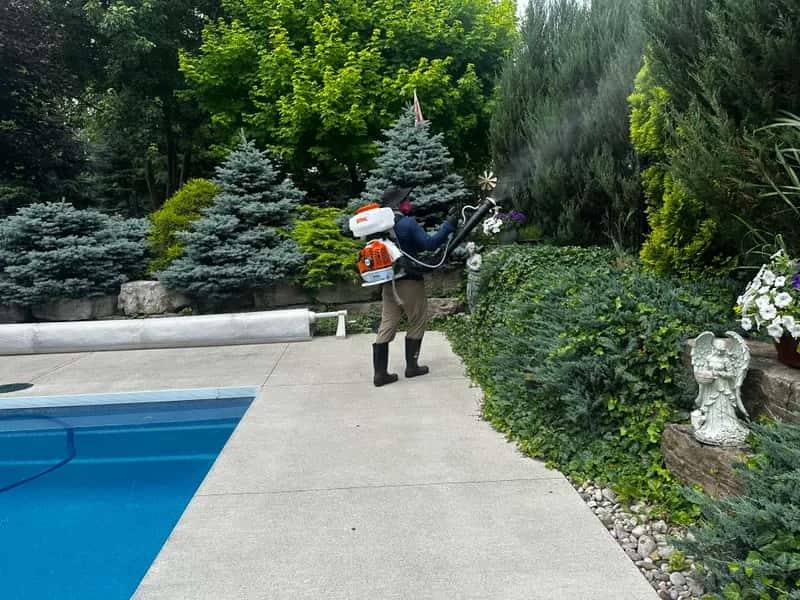
Consumer aerosols are not the tool for a yard, whatever the brand. Yard-scale mosquito and tick work is about treating the specific surfaces the insects rest on — the undersides of shrub leaves, dense hedging, fence lines, the shaded humid margins of a property, and for ticks the lawn-to-woods transition and leaf litter — with equipment that puts material on those surfaces evenly, and in Ontario the products that do the job properly at that scale are applied by licensed operators. A can from a shelf treats what you point it at for as long as it stays wet. If mosquitoes or ticks in a GTA yard are the actual problem, that is the one pest on this site we treat ourselves, and the assessment is free.
Related Guides
- The single-product deep dive: Doktor Doom Sleep Tight Review Canada — The PMRA-Registered Mattress Spray
- Diatomaceous Earth in Canada — Which Brands Are PMRA-Registered
- Ortho Home Defense Canada — What You Can Actually Buy Here
- Bed Bug Control Canada — The Complete DIY Treatment Hub
- How to Kill Bed Bug Eggs in Canada — Why Heat Wins and Sprays Miss
- How to Get Rid of Ants in Canada — Why Baiting Beats Every Spray
- Cockroach Spray in Canada — The Three Jobs Worth Buying a Can For
- Earwig Traps and Killers in Canada — What to Buy
- Best Bed Bug Fogger Canada — And Why Foggers Barely Dent an Infestation
- Pest Control Cost Canada — What Professionals Charge