
Published by BuzzSkito Mosquito & Tick Control
Published October 16, 2026 · Drafted with AI assistance and fact-checked against the sources listed below
How do you identify a wolf spider?
Check three things: the eyes, the web and what a female is carrying. A wolf spider has two large eyes facing forward above a row of four small ones, it hunts on the ground without a web, and a female may be carrying a round egg sac at the rear of her abdomen or a load of spiderlings on her back. The Missouri Department of Conservation's (MDC) wolf spider page describes athletic, long-legged spiders, usually gray, brown, black or tan with dark markings, especially stripes, that run their prey down instead of catching it in webs.
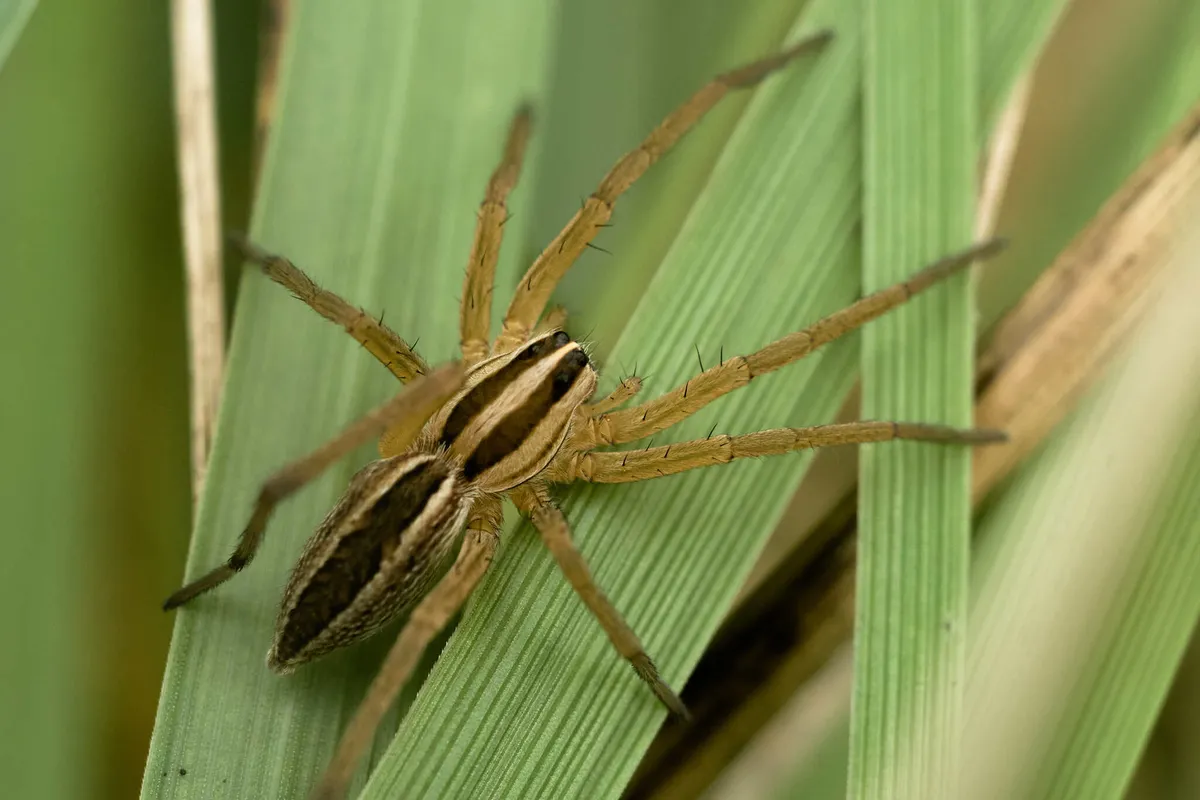
Trap the spider under a clear jar and run these checks.
Checks for a spider in a jar
- Eyes. Use a magnifying glass. Two large eyes above a row of four small ones mean a wolf spider; six eyes in three pairs, possibly a recluse; eight eyes of similar size in two rows, a look-alike such as a fishing spider or a grass spider.
- Web. A spider sitting in a flat sheet web with a funnel is a grass spider or another funnel weaver; a wolf spider hunts with no web.
- Egg sac or young. A silk ball at the tip of the abdomen, or spiderlings on the back, marks a female wolf spider; a fishing spider holds its sac in its jaws.
- Size. Measure the body without the legs against a ruler marked in inches: most wolf spiders run 1/4 inch to 1 inch, and a body over 1/2 inch rules out a brown recluse.
- Markings. Dark stripes on the front body section are common on wolf spiders and are not a recluse's violin-shaped mark.
- Movement. A wolf spider runs smoothly; a jumping spider moves in jerks and leaps.
What do a wolf spider's eyes look like?
Two large, dark eyes face forward above a straight row of four small ones, and a third pair sits farther back on top of the head, the pattern UC IPM's Pest Note on spiders describes. MDC notes that jumping spiders also have two enlarged center eyes, but wolf spiders run smoothly over the ground and often hunt at night, while jumping spiders hunt in plants by day, move jerkily and jump great distances.
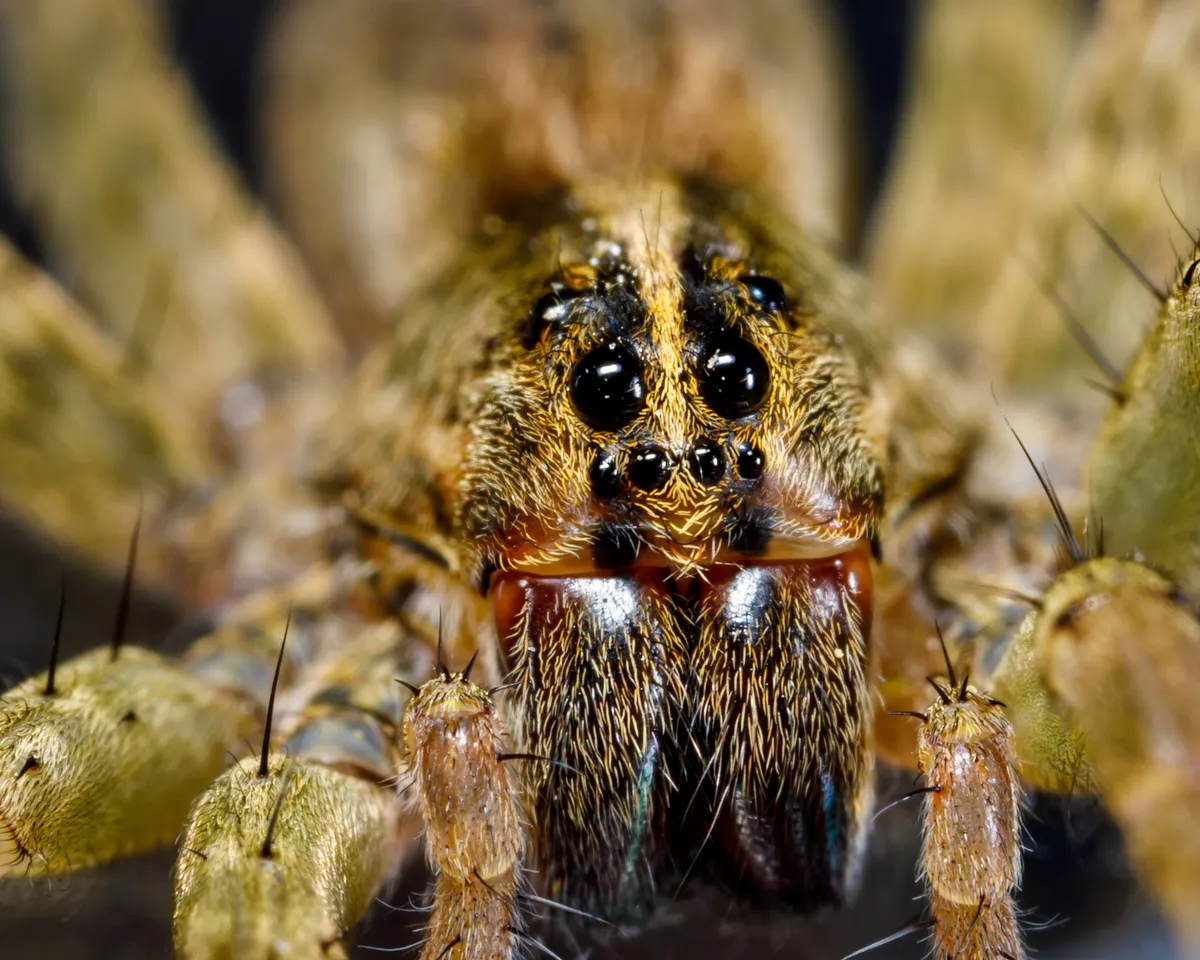
Those eyes make wolf spiders easy to find after dark. Hold a flashlight beside your head at night and their eyes shine back like a cat's, MDC says, and UC IPM says they reflect green. In summer, a flashlight shone into roadside grass can show dozens of tiny points of light reflected from wolf spiders' enlarged eyes, according to Texas A&M AgriLife Extension's guide to spiders.
What is the white ball a wolf spider carries?
It is her egg sac. A female wolf spider attaches the pea-sized silk sac to her spinnerets, the silk-making organs at the tip of the abdomen, and goes about her life with it held there, MDC says. She may act aggressively while carrying it and searches frantically if the two are separated. Colorado State University's fact sheet calls the habit unique to wolf spiders.
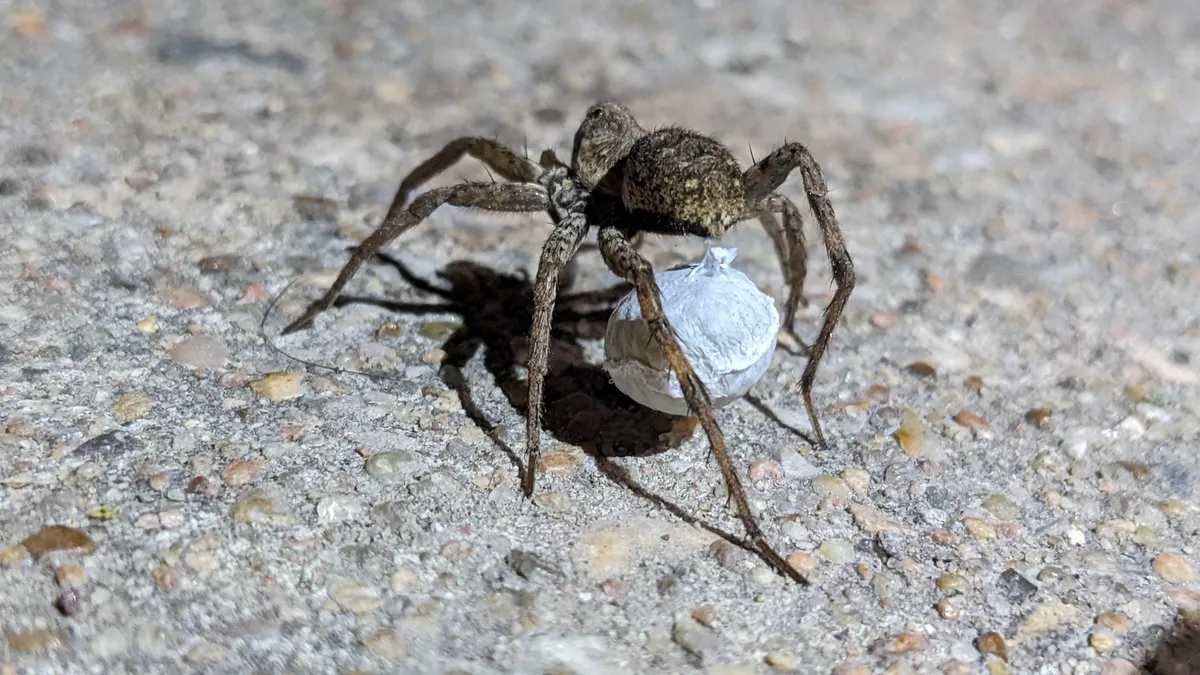
Not every sac is white: MDC pictures a rabid wolf spider's baby-blue sac, about the size of a green pea, and Agriculture Canada's 1990 monograph on the wolf spiders of Canada and Alaska describes pill-shaped sacs, often bluish or greenish, in the thin-legged wolf spiders. Fishing spiders and nursery web spiders carry egg sacs too, but in their jaws, the monograph notes. A guide to spider egg sacs sorts the sacs people find on walls, webs and plants.
Why does a wolf spider have babies on its back?
Because the mother carries her young after they hatch. The spiderlings climb onto her abdomen and stay there for up to two weeks or more, until they are ready to be on their own, MDC says. The department's 2026 guide to Missouri's common spiders adds that they cling to special hairs on top of her abdomen for protection and climb off gradually over several days while she keeps hunting.
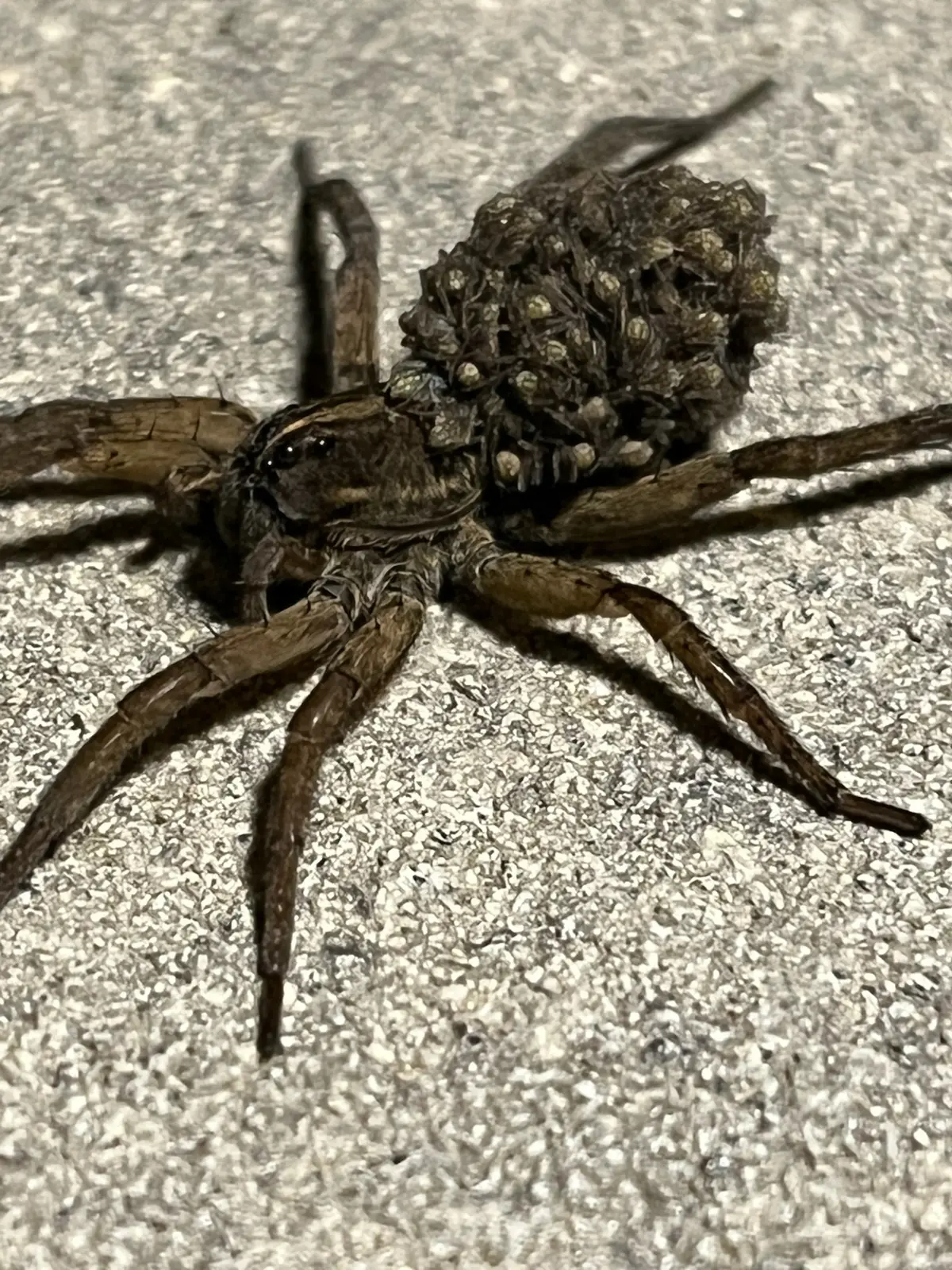
Fishing spiders, which can look similar, do not carry their babies on their backs, MDC says.
How big do wolf spiders get?
Most have a body 1/4 inch to 1 inch long, not counting the legs, and males are usually smaller than females, MDC says; University of Minnesota (UMN) Extension's spider page gives the same range. The legs make them look far bigger. The University of Colorado Museum of Natural History describes the Carolina wolf spider, Colorado's largest, as having a body 1 inch long and a leg span of almost 3 inches.
Size varies a great deal by kind. In Agriculture Canada's monograph, three female Carolina wolf spiders measured 20 to 30 mm (about 3/4 inch to just under 1 1/4 inches) in body length, while the thin-legged wolf spiders, which MDC says seem to prefer moist habitats or places near water, measured 3.8 to 10.7 mm, all under 1/2 inch. Size is also a quick brown recluse check, covered below.
Which wolf spiders live in the US and Canada?
MDC counts nearly 250 species in North America north of Mexico, more than 40 of them in Missouri, and Agriculture Canada's 1990 monograph listed 107 species in 14 genera as known or thought to occur in Canada and Alaska. Some can be told apart only under a microscope, MDC's 2026 guide notes. The table sorts the kinds into six groups, including the rabid, dotted and tiger wolf spiders, which MDC calls three common Missouri species.
| Group | Body length | Where it lives | What to look for |
|---|---|---|---|
| Carolina wolf spider (Hogna carolinensis) | Females about 3/4 inch to just under 1 1/4 inches (20 to 30 mm) | Burrows up to about 4 3/4 inches (12 cm) deep, topped with a turret; Oregon and Wyoming to southernmost Ontario and Maine, south to Baja California, Texas and Florida | Large, gray to brown, black underneath |
| Tiger and wetland giant wolf spiders (Tigrosa) | Tiger wolf spider females about 5/8 to 7/8 inch (16 to 23 mm) | Woodland leaf litter; the wetland giant also in moist fields and at marsh edges; north to southern Ontario | Narrow pale stripe down the front body section; banded legs |
| Rabid and dotted wolf spiders (Rabidosa) | Rabid wolf spider females about 5/8 to 13/16 inch (16 to 21 mm) | Prairies, fields, woodland edges and leaf litter | Broad dark band down the abdomen, with pale slanted marks in the rabid wolf spider |
| Lance and other grassland wolf spiders (Schizocosa) | Mostly medium, roughly 1/4 to 1/2 inch | Prairies, fields and lawns | Tan stripe down the front body section |
| Burrowing wolf spiders (Geolycosa) | About 9/16 to 11/16 inch (14 to 18 mm) | Burrows in sandy fields, dunes and beaches, which they seldom leave | Hairy, with powerful legs |
| Thin-legged wolf spiders (Pardosa) | Under 1/2 inch (3.8 to 10.7 mm) | Grassy or stony ground, marshes and fields, often near water, north to the tundra | Long, slender legs; pill-shaped, often bluish or greenish egg sac |
Body length without legs. Sizes, ranges and burrows are from Agriculture Canada's 1990 monograph (Dondale and Redner), which filed the tiger, wetland giant and rabid wolf spiders under Hogna; the Schizocosa size is MDC's medium class; other details are from the monograph, MDC and its 2026 guide.
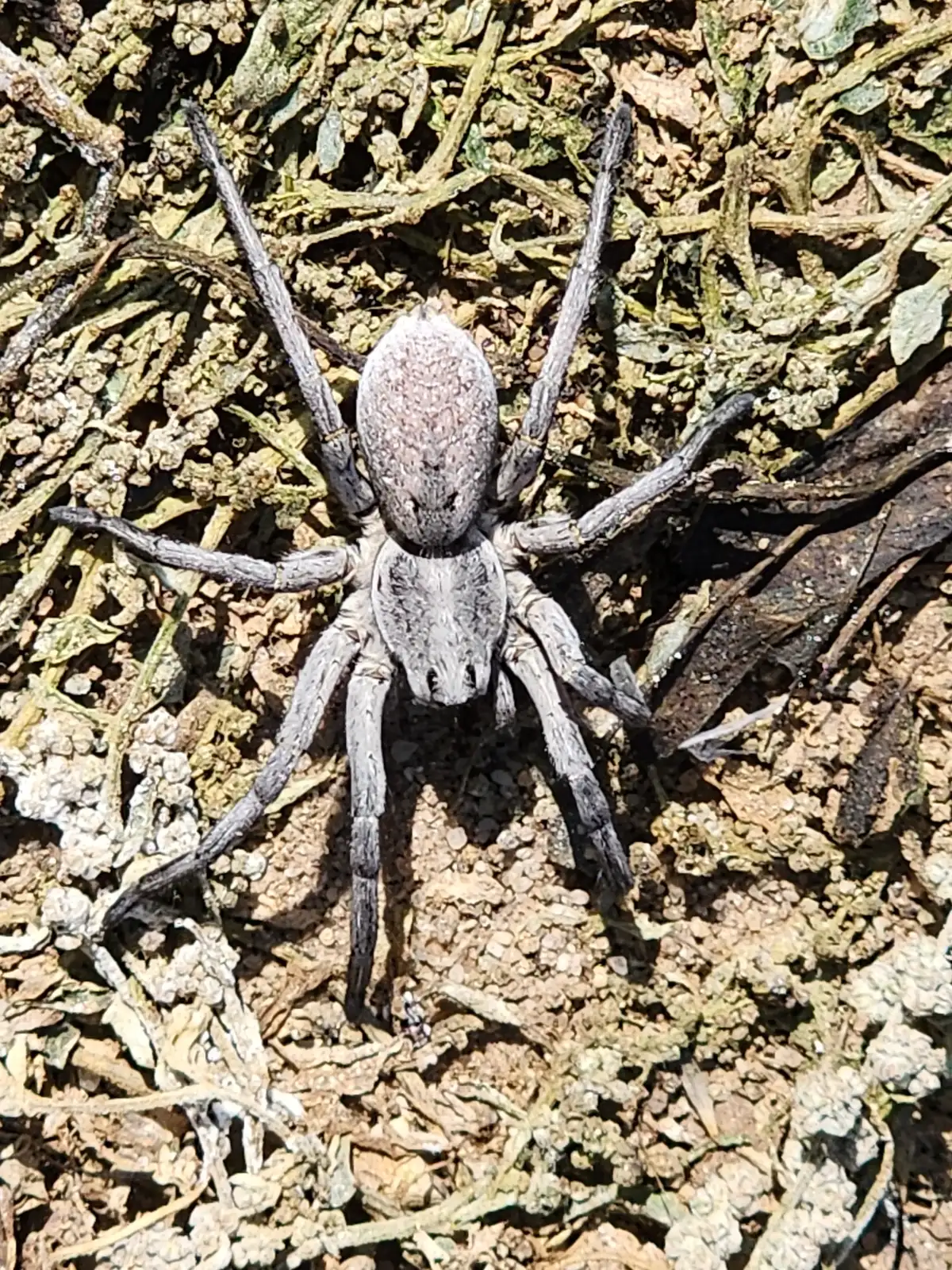
MDC's 2026 guide says the Tigrosa wolf spiders occasionally wander into houses, and its field guide says the rabid wolf spider sometimes gets into houses. Despite its name, the rabid wolf spider cannot transmit rabies and is harmless to people, the 2026 guide says.
Is it a wolf spider or a brown recluse?
Count the eyes: a wolf spider has eight, two of them large, while a brown recluse has six small eyes in three pairs. Rick Vetter's guide to identifying and misidentifying the brown recluse at UC Riverside lists the other recluse traits: legs of one light color with fine hairs and no spines, an abdomen of one color, small retreat webs hidden behind objects, never out in the open, and a body about 3/8 inch long. A spider whose body is longer than 1/2 inch is not a recluse, he says.
Wolf spiders fail several of those checks at once. Texas A&M AgriLife Extension says they typically have dark stripes on the front body section, lack the recluse's fiddle-shaped mark and have a large pair of eyes on top of the head, and many are well over 1/2 inch long. Small wolf spiders overlap a recluse in size, so check the eyes and legs on those. The brown recluse look-alikes guide runs the full test with photos, and the brown recluse guide covers where recluses live.
What other spiders look like wolf spiders?
Grass spiders and other funnel weavers, fishing spiders and, for the biggest wolf spiders, tarantulas. Colorado State University says wolf spiders are probably most often confused with funnel weavers, and that the enlarged pair of eyes at the front of the head and the lack of a web separate them. It adds that the larger wolf spiders are sometimes mistaken for tarantulas, which MDC says are much larger and heavier.
| Spider | Eyes | Web | Other clues |
|---|---|---|---|
| Wolf spider | Two large eyes above a row of four small ones; two more on top of the head | None for catching prey | Female carries her egg sac at the tip of the abdomen, then spiderlings on her back |
| Grass spider and other funnel weavers | Six or eight, about the same size, in two rows | Flat sheet that narrows into a funnel | Two long spinnerets easily seen from above |
| Fishing spider | Eight of similar size, in two rows | None | Holds its egg sac in its jaws; often near water; rests with its long legs stretched out |
| Jumping spider | Two very large eyes in the front row | None | Moves in jerks and leaps; hunts in plants by day |
Sources: MDC and its 2026 spider guide, UC IPM, University of Minnesota Extension and Colorado State University, each linked on this page. The brown recluse is compared in its own section above.
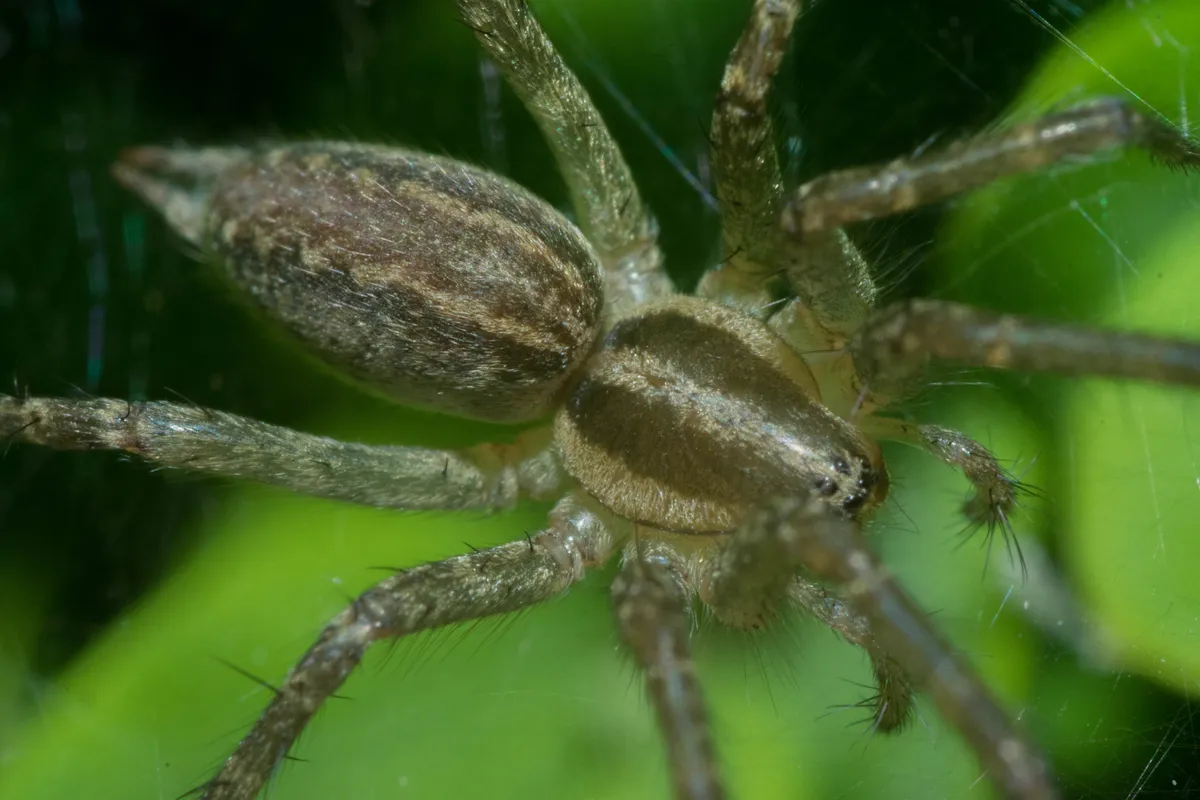
A grass spider sits in its web: MDC's 2026 guide says grass spiders build sheet webs narrowing into a silk tunnel and rarely leave them. The grass spider guide has more, and funnel weavers that run across floors indoors, such as the giant house spider, are in the guide to common house spiders.
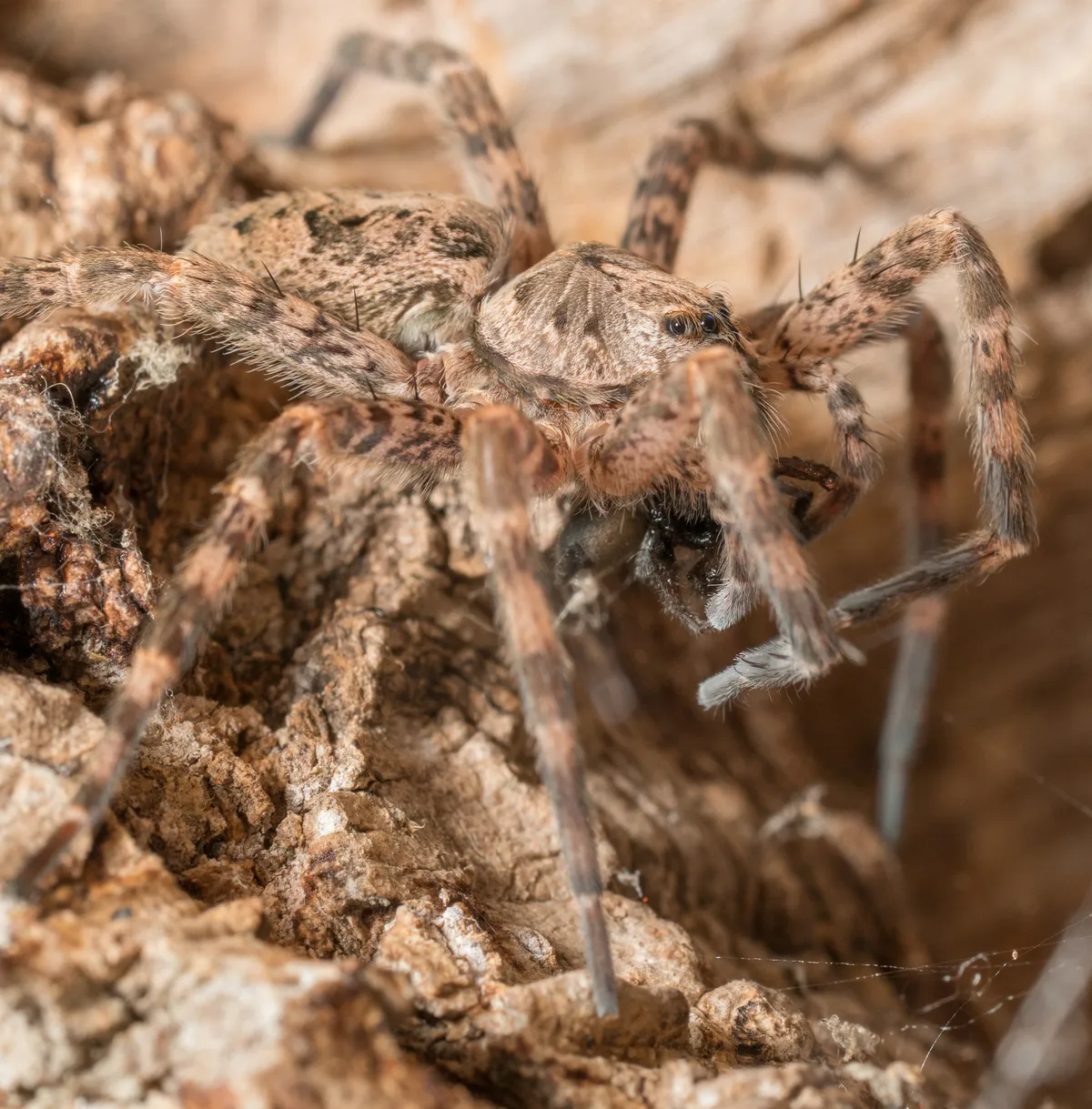
A dark fishing spider can pass for a big wolf spider, MDC's guide says. It lives on tree trunks and logs near water but may hide by day in garages, sheds and woodpiles, and UMN says some fishing spiders cover as much as 4 inches with legs spread and some turn up far from water. The fishing spider guide has more.
The egg sac test has one catch: MDC shows a rabid wolf spider that dropped her sac when disturbed and grabbed it in her jaws to run off, so check the eyes as well.
Why are wolf spiders in my house?
Most wandered in by accident, and they usually do not stay to breed. UMN says hunting spiders such as wolf spiders live outdoors but may enter homes accidentally, particularly in fall, and that they do not survive well indoors and usually do not reproduce there. Texas A&M adds that hundreds to thousands of wolf spiders may live in an average backyard lawn, and that because they are so plentiful, they commonly get into homes under gaps in doorways.
UC IPM gives two more reasons. The large hunting spiders found in homes and garages are often fully grown males searching for females, and new houses in developments may be invaded by wolf spiders that have lost their usual outdoor homes. The more insects a building has, the more likely it is to have spiders. Colorado State University's fact sheet, by contrast, says wolf spiders rarely enter buildings.
Why do wolf spiders show up in winter?
A wolf spider seen in winter is usually a young one or an adult female. MDC's 2026 guide says the wolf spiders seen during warm spells in winter are usually juveniles or adult females, which can live for several years, and that young hatched in late summer or fall shelter through the winter in leaf litter, small burrows and under rocks and logs. The guide to bugs found indoors in winter covers the other winter visitors.
One wolf spider is unlikely to mean an infestation. The spiders that live and breed indoors are mostly web builders, some of which UMN says can survive and reproduce well inside; common house spiders and how to tell them apart are covered separately.
Is a wolf spider bite dangerous?
No: wolf spiders can bite if provoked, but MDC says the bites of North American wolf spiders are harmless. Cleveland Clinic's page on wolf spider bites says their venom is not dangerous to people. A bite may look like a bug bite, a red bump with swelling and sometimes fang marks, and it may hurt and itch; the symptoms should clear up on their own within a few days, it says.
A study of confirmed bites points the same way. In a 2004 study of 45 wolf spider bites in Australia, in which an arachnologist identified each spider, every bite was painful, 11 of them severely, with the pain lasting a median of 10 minutes. Redness was common, three people had minor effects such as nausea or headache, and no bite caused a dying-tissue ulcer; the authors judged the effects minor, no more severe than most other spiders' bites. Those were Australian species; MDC's statement covers North American ones.
Wash a bite with soap and water and cool it with an ice pack or a cold, damp cloth, Cleveland Clinic advises. It says to see a healthcare provider if symptoms get worse or do not go away after a few days of self-care, or if you develop symptoms such as cramping or muscle pain around the bite, a spreading rash, a severe headache, dizziness, nausea, weakness, trouble breathing or signs of infection such as fever or discharge. Signs of an allergic reaction, such as swelling of the face or mouth, a hive-like bump that keeps growing or a red line spreading from the bite, call for medical attention, and anaphylaxis calls for emergency care.
Do not assume a sore is a wolf spider bite. Cleveland Clinic says no test can tell what kind of spider bit you and that seeing the spider is the only way to know, and UMN says people, and even doctors, over-diagnose spider bites from redness, swelling and even dying-tissue wounds that usually have other causes, such as bacterial skin infections. What spider bites look like covers the look-alikes, and the guide to venomous spiders in the US covers the widows and recluses, whose bites can matter.
How do you get a wolf spider out of the house?
Catch it and put it outside, then close the gaps it came through. UC IPM says pesticides are not generally needed for spiders.
- One spider. Put a jar over it, slide a sheet of paper underneath and release it outdoors, as UC IPM suggests, or vacuum it up; UC IPM says a spider's soft body usually does not survive the trip through the hose.
- Doorways. Texas A&M says wolf spiders commonly come in under gaps in doorways. UMN advises caulking or sealing cracks and gaps around the foundation, doors and ground-level windows and replacing screens that fit poorly.
- Around the house. UMN suggests removing piles of bricks, firewood and other debris near the house, keeping grass next to buildings cut short and reducing outdoor lighting, which draws the insects that spiders eat.
- Monitoring. Sticky traps along walls and under furniture show where spiders are active, UMN says; UC IPM says to put them where pets and children cannot reach them.
- What to skip. UMN says surface treatments and fogs are not effective against spiders indoors.
The guide to getting rid of spiders covers control in more depth, keeping spiders out of the house walks through sealing, and a step-by-step plan for clearing spiders from a house covers glue boards and door sweeps for wolf spiders.
This guide is general educational information, not medical advice. If you have symptoms or concerns after a bite or exposure, contact a healthcare provider.
Frequently Asked Questions
Are wolf spiders aggressive?+
No. University of Minnesota Extension says wolf spiders alarm people because of their size and speed but are not aggressive, and Cleveland Clinic says they usually bite only when they feel threatened, such as when trapped or touched by accident. One exception is worth knowing: the Missouri Department of Conservation says a female carrying her egg sac may behave aggressively. Leave her alone or move her outside in a jar.
Do wolf spiders make webs?+
Not to catch prey. The Missouri Department of Conservation says wolf spiders run their prey down instead of spinning webs, and UC IPM says they make a small, thick web where they rest. They also use silk for egg sacs and, in some kinds, for burrows: Agriculture Canada's 1990 monograph describes burrowing wolf spiders that reinforce the upper part of the burrow with silk. A spider sitting in a sheet web is more likely a grass spider.
How long do wolf spiders live?+
It depends on the kind. The Missouri Department of Conservation says some wolf spiders can survive for nearly two years, and its 2026 spider guide says adult females can live for several years. Many wolf spiders hatch in late summer or fall, spend the winter sheltering in leaf litter, small burrows or under rocks and logs, and then mature, mate and lay eggs from summer into fall, the guide says.
Are wolf spiders dangerous to dogs and cats?+
Texas A&M AgriLife Extension says wolf spiders are generally not dangerous to people or pets. A pet that grabs one may still be bitten, since wolf spiders bite when they feel threatened. If your dog or cat has swelling or pain, or seems unwell after an encounter with a spider, call your veterinarian, and take a photo of the spider if you can do so safely.
Should you kill a wolf spider in the house?+
There is no need to. The Missouri Department of Conservation says wolf spiders eat many insect pests, and University of Minnesota Extension advises tolerating spiders when possible and simply capturing and removing the few that wander inside. UC IPM suggests trapping a spider under a jar, sliding a sheet of paper underneath and releasing it outdoors, or vacuuming it up.
Do wolf spiders live in Canada?+
Yes. Agriculture Canada's 1990 monograph on the wolf spiders of Canada and Alaska lists 107 species in 14 genera known or thought to occur there, including 46 thin-legged wolf spiders, many of them characteristic of marshes, fields and tundra. The Carolina wolf spider reaches southernmost Ontario, and the rabid and tiger wolf spiders southern Ontario, the monograph says. The Missouri Department of Conservation says the bites of North American wolf spiders are harmless.
Sources
- Wolf Spiders — Missouri Department of Conservation
- A Guide to Missouri's Common Spiders (David J. Bruns, 2026) — Missouri Department of Conservation
- Spiders — University of Minnesota Extension
- Spiders (Pest Notes Publication 7442) — University of California Statewide IPM Program (R. S. Vetter, UC Riverside)
- Wolf Spiders — Colorado State University, Department of Bioagricultural Sciences and Pest Management
- Spiders (E-408) — Texas A&M AgriLife Extension (Wizzie Brown and Mike Merchant)
- The Wolf Spiders, Nurseryweb Spiders, and Lynx Spiders of Canada and Alaska (The Insects and Arachnids of Canada, Part 17) — Agriculture Canada (Dondale and Redner, 1990), via Government of Canada Publications
- Object of the Month, October 2007: Wolf Spider (Hogna carolinensis) — University of Colorado Museum of Natural History
- How to Identify and Misidentify a Brown Recluse Spider — UC Riverside Department of Entomology (Rick Vetter)
- Wolf Spider Bite: Symptoms & Treatment — Cleveland Clinic
- Australian wolf spider bites (Lycosidae): clinical effects and influence of species on bite circumstances — Journal of Toxicology: Clinical Toxicology (Isbister and Framenau, 2004), abstract on PubMed
How this guide was made: it was researched and drafted with AI assistance from the sources listed above. A second, independent AI pass then checked each factual claim against those sources. Found an error? Email support@buzzskito.ca.