
Published by BuzzSkito Mosquito & Tick Control
Published October 29, 2026 · Fact-checked against the sources listed below
What is a southern house spider?
It is a crevice weaver, Kukulcania hibernalis, a large spider of the family Filistatidae that lives in cracks in buildings. The University of Florida's southern house spider profile (UF) calls it common throughout Florida and much of the southern US where people live, and gives two other names: the southern crevice spider and, from its 1842 description, Filistata hibernalis.
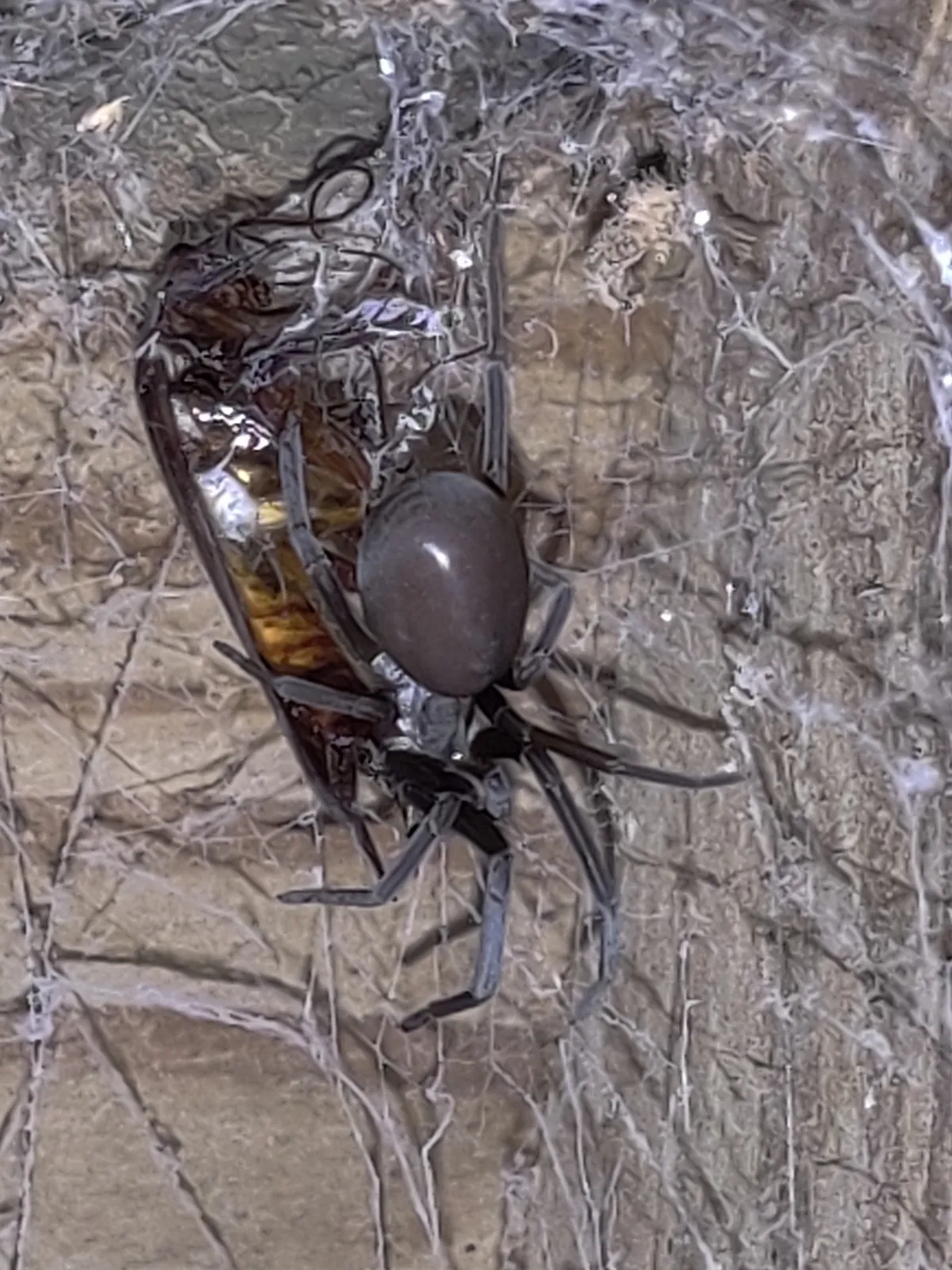
The sexes look like two different spiders: a stout, dark female that stays in her web and a lanky, light brown male that wanders. UF says males are often mistaken for brown recluses because of their color and general shape. In a 2022 report in the journal Toxicon: X, arachnologist Richard Vetter of UC Riverside writes that these spiders are common in homes, especially in the southeastern US, hence the name.
It is not the common house spider, Parasteatoda tepidariorum, a much smaller cobweb spider whose females are about 3/16 to 1/4 inch long (5 to 6 mm), says Penn State Extension. The guide to common house spiders sorts the other spiders found indoors.
What does a female southern house spider look like?
Stout, dark and velvety. UF describes females as charcoal gray and 1/2 to 3/4 inch long (13 to 19 mm), often with dusky patches on the front body section, and an elongated oval abdomen that can swell considerably after a meal or when she carries eggs. UF's introduction to Florida spiders calls them velvety dark brown, and Vetter adds stocky legs and a robust abdomen that make them look like small tarantulas.
She seldom leaves her web. UF says these spiders hide by day in the crevice the web spreads from and sit on the web at night. A female lays about 200 eggs, loosely wrapped in a silk ball about 5/8 inch (15 mm) across, keeps them with her in the nest and may live up to eight years, UF says; the guide to spider egg sacs compares other species' sacs.
What does a southern house spider web look like?
A flat, tangled mat of silk spreading from a crack, often littered with debris and insect parts. UF says this unkempt web easily identifies the spider, which builds it on the surface around a sheltered crevice. Texas A&M's urban entomology program describes webbing radiating out from a central lair in a hole or cavity, and UF's Florida spider guide calls the webs thick and messy, often built in urban spots such as the corners of window eaves.
The silk holds prey without glue. UF says the spider combs it from a spinning plate, the cribellum, with bristles on its hind legs, so it looks woolly under a microscope. Lacking sticky droplets, it snags insects' claws, bristles and spines like a hook-and-loop fastener, and the tangle holds them.
Small young spiders can build in the crease where a wall meets a ceiling, UF says, but larger ones seem to need a real retreat: a hole, a gap between boards or a space under a fixed object.
What does a male southern house spider look like?
Lanky and light brown. UF describes males as khaki to amber, about 3/8 inch long (9 to 10 mm), with long, slender legs and long palps, the feelers beside the mouth. UF's Florida spider guide says the palps are so long they almost look like an extra pair of legs.
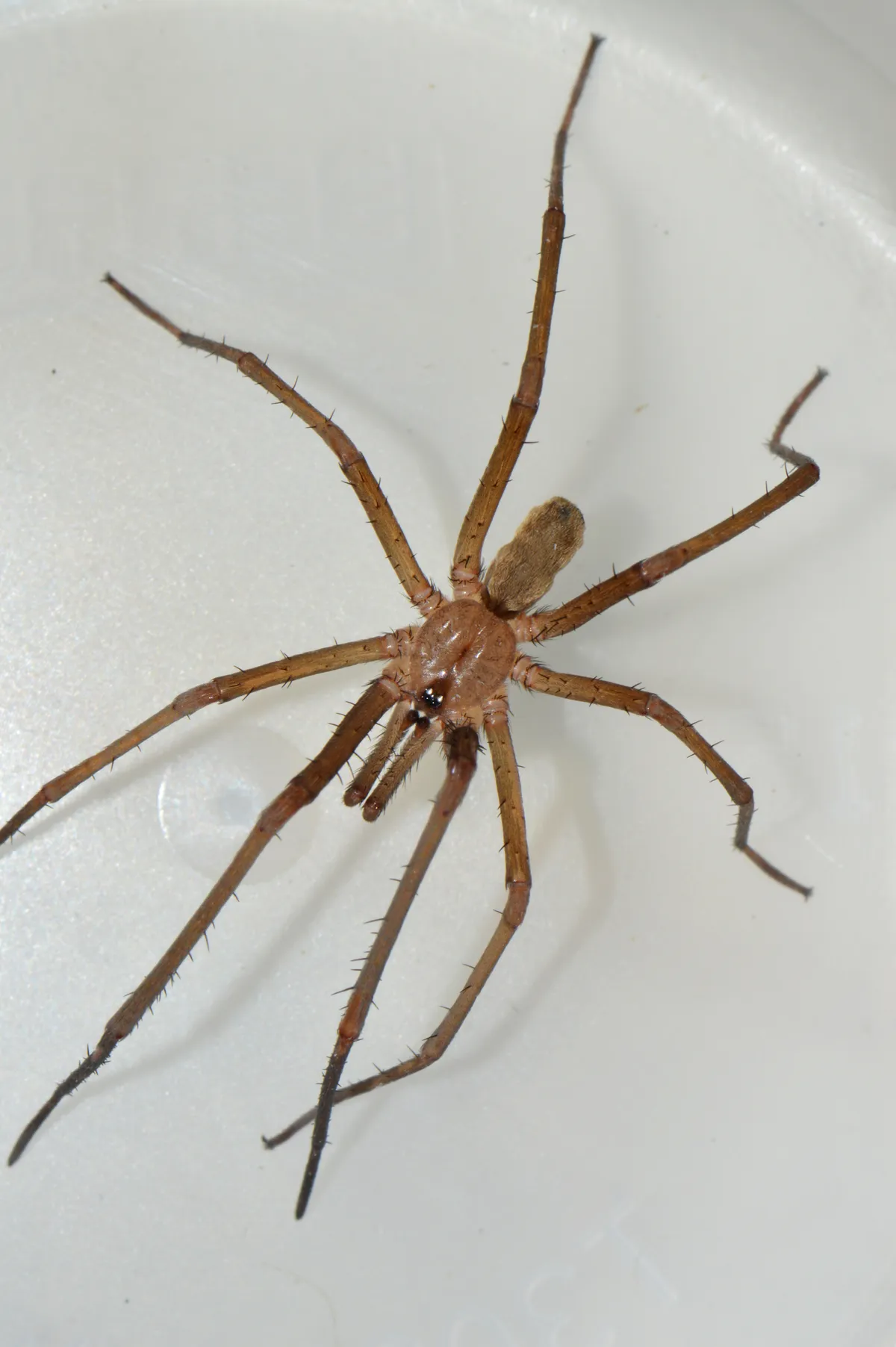
Look at the head. The male's eight eyes sit bunched on a raised bump at the front, and a brown stripe behind them quickly narrows to a thin line down the middle of the front body section, UF says. Vetter's guide to identifying and misidentifying the brown recluse adds black spines on the legs.
Adult males build no web. UF says they wander in search of females, and that wandering males are easily caught in a vial, while females usually have to be trapped on the web. Four of the five verified bites in Vetter's 2022 report came from males.
Why is the male mistaken for a brown recluse?
Because of his color and general shape, UF says. Up close, with the spider in a clear jar and a magnifying glass, four checks separate them:
Male southern house spider or brown recluse?
- Eyes. Eight, clumped on a small turret, against a recluse's six eyes in pairs set in a U, with a space between the front pair and the side pairs (Vetter, 2022).
- Leg spines. Many conspicuous spines on the male's legs; a recluse has none, only fine hairs lying flat. Vetter's UC Riverside guide says thick spines rule out a recluse.
- Palps. Very long on the male, almost a fifth pair of legs; short on a recluse, UF's Florida guide says.
- The mark. The male's stripe narrows to a thin line behind the eyes; a recluse's violin is conspicuously wider and reaches the back edge of the front body section (UF). UF's Florida guide calls the violin too inconsistent to rely on.
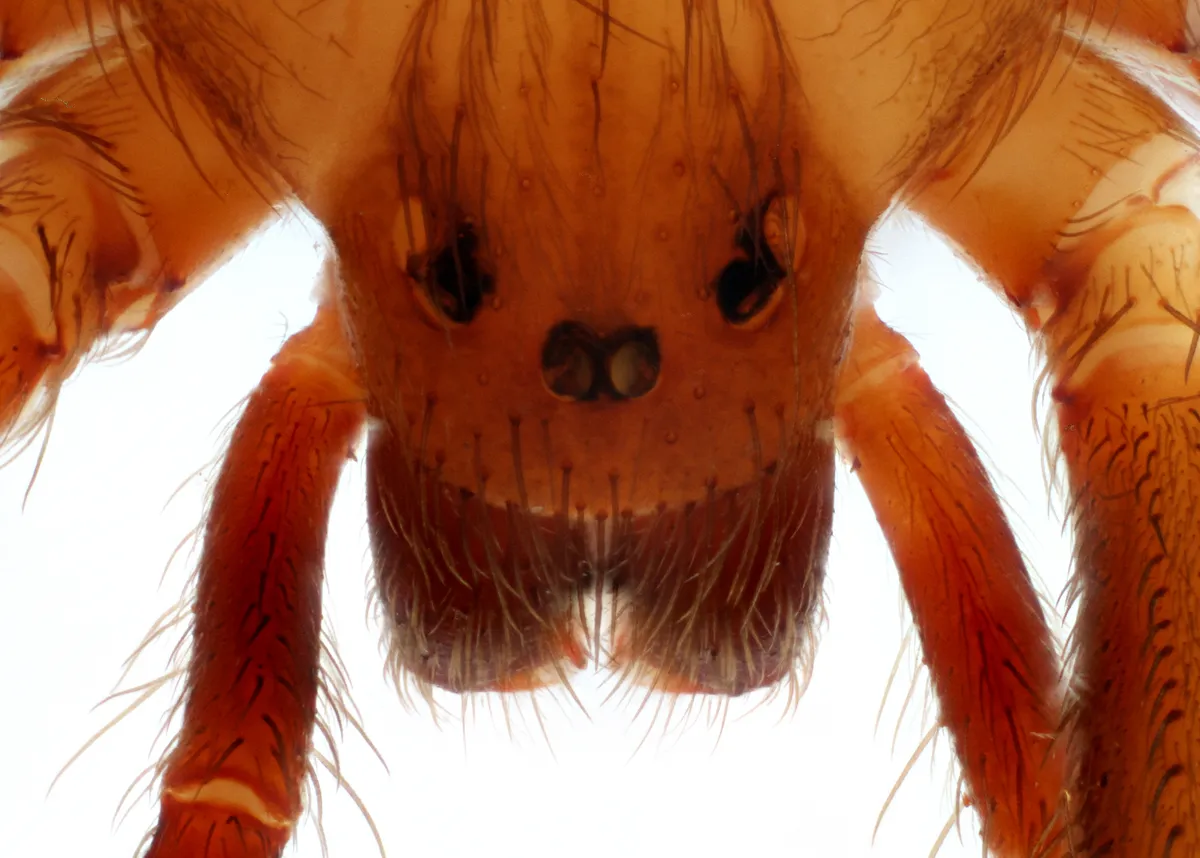
Size does not settle it: UF says males are generally larger than brown recluses, but both are around 3/8 inch, and by size alone Vetter rules out a recluse only when the body is longer than 1/2 inch.
Place helps. Penn State Extension lists 16 states with established brown recluse populations, among them Texas, Georgia and Alabama, where this spider also lives; Florida has only isolated finds, and UF's Florida guide finds no scientific evidence that any recluse is established there.
Even professionals get it wrong. When Vetter offered to identify any spider people suspected was a recluse, crevice weavers made up 122 of the 1,773 sent in, and his 2022 report says they have been misidentified as recluses as teaching specimens at a Texas medical school and by a Georgia physician and a Virginia nurse. The brown recluse look-alikes guide compares the recluse with other spiders, and the spider identifier can narrow down one you have caught.
What other spiders look like a southern house spider?
Besides the brown recluse, the dark female is sometimes taken for a small tarantula. The cellar spider, another long-legged house spider, is easy to tell apart.
Tarantulas
Utah State University Extension says crevice weaver females are sometimes mistaken for small tarantulas. Tarantulas are far bigger: Texas A&M AgriLife entomologist Wizzie Brown says Texas species reach up to 6 inches from front leg tips to back leg tips, and the same AgriLife article says they burrow in the soil. The tarantula guide covers them.
Cellar spiders
A cellar spider is smaller and paler, on very long, thin legs, and it hangs in its web. Penn State Extension gives the female longbodied cellar spider a body about 5/16 inch long (7 to 8 mm), front legs about 2 inches (50 mm) and a habit of vibrating rapidly in its irregular web when threatened; it is not known to bite people. The cellar spider guide has more.
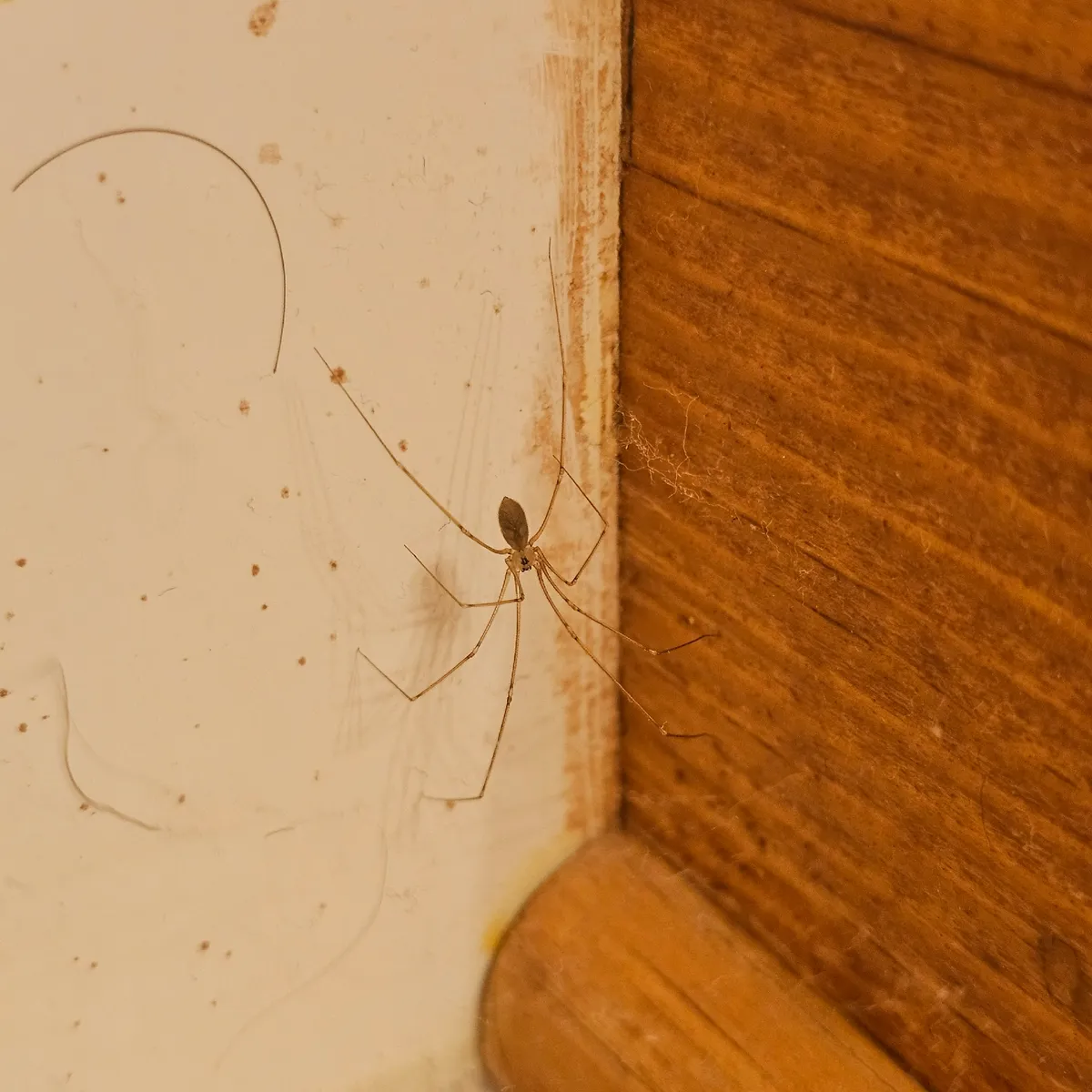
Commonly confused with
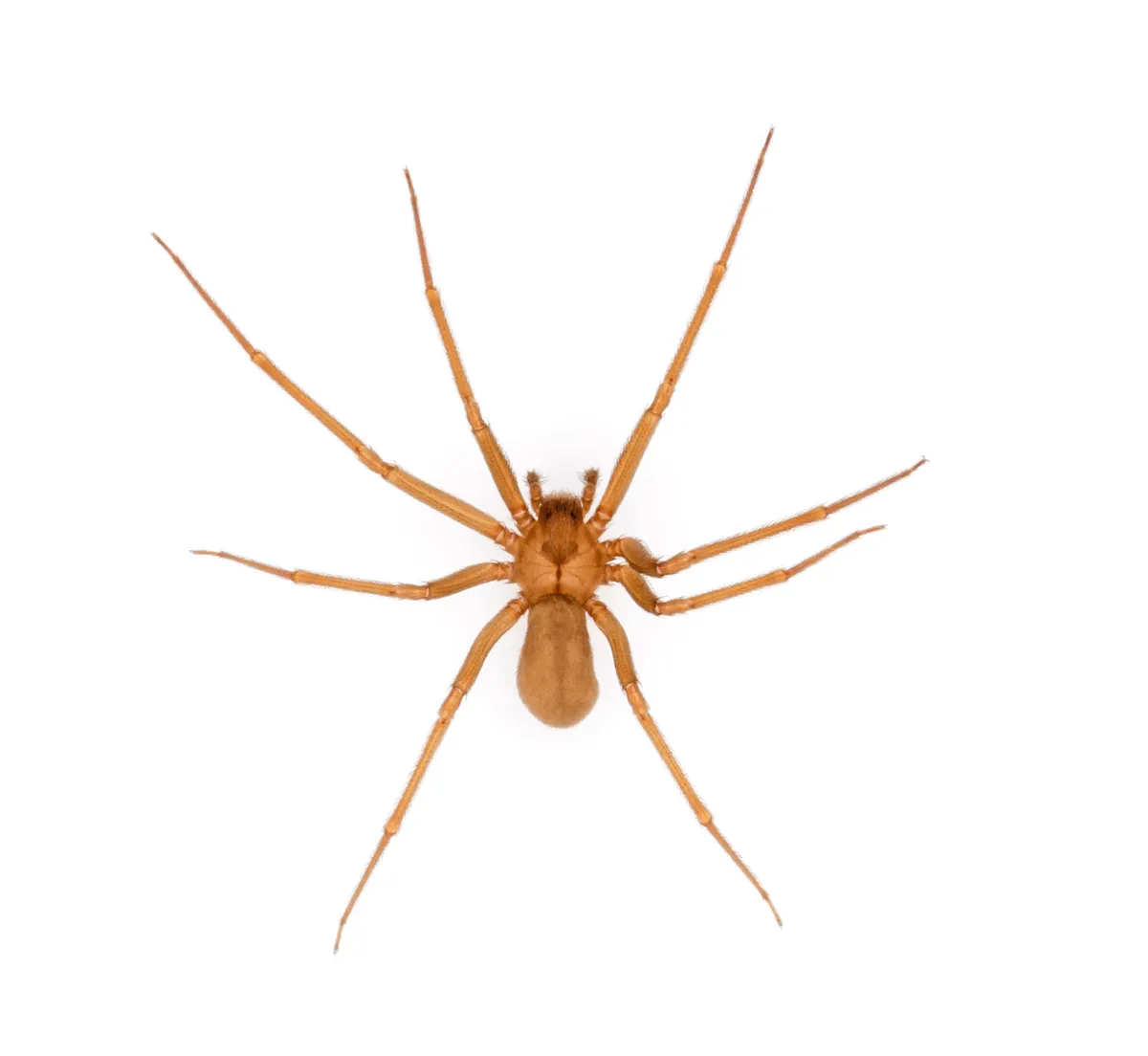 Brown recluseSix eyes in three pairs, short palps and legs with no spines; body never over 1/2 inch
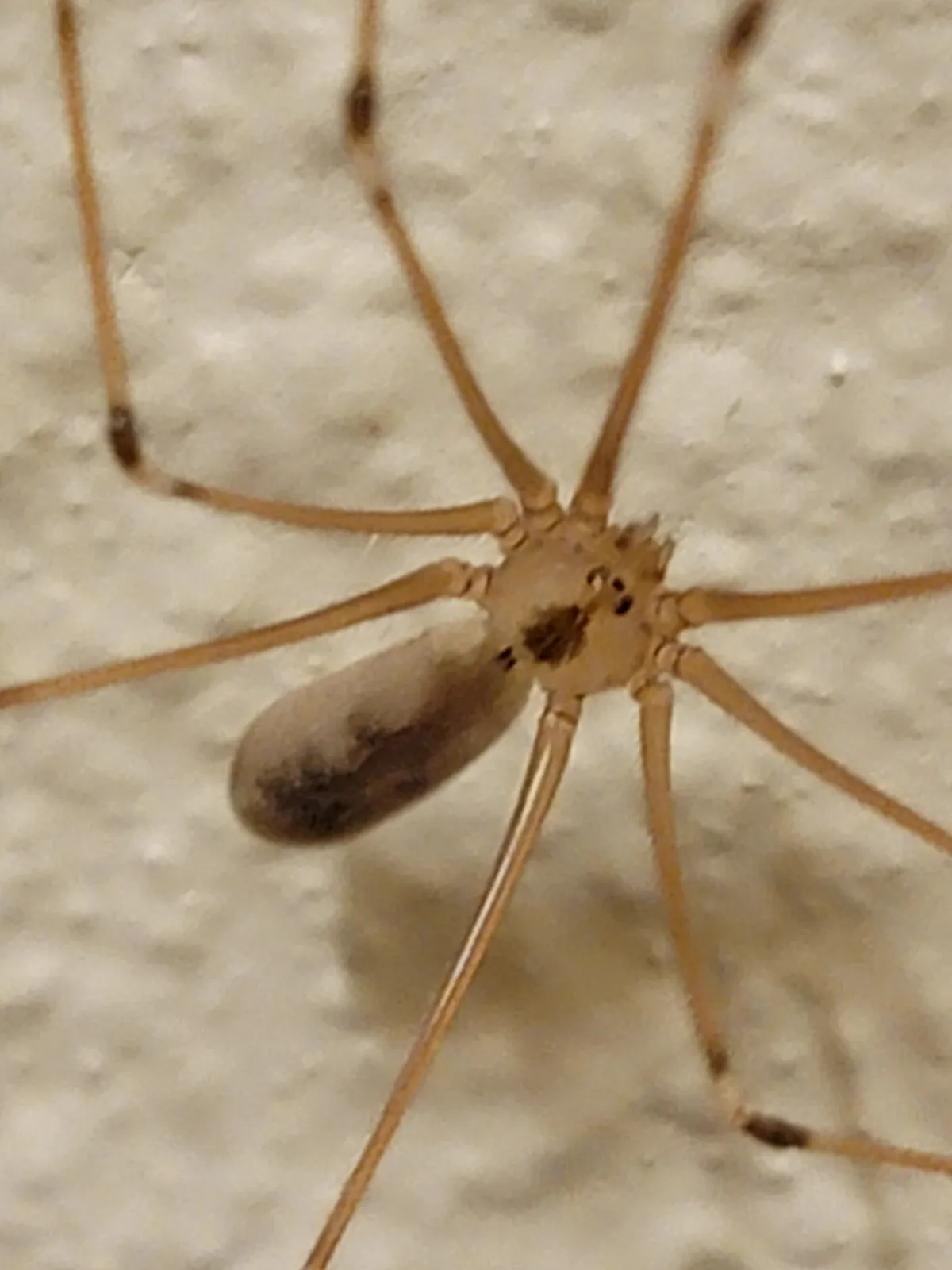 Cellar spiderSmall, pale body on very long, thin legs; hangs in a loose web and vibrates when disturbed
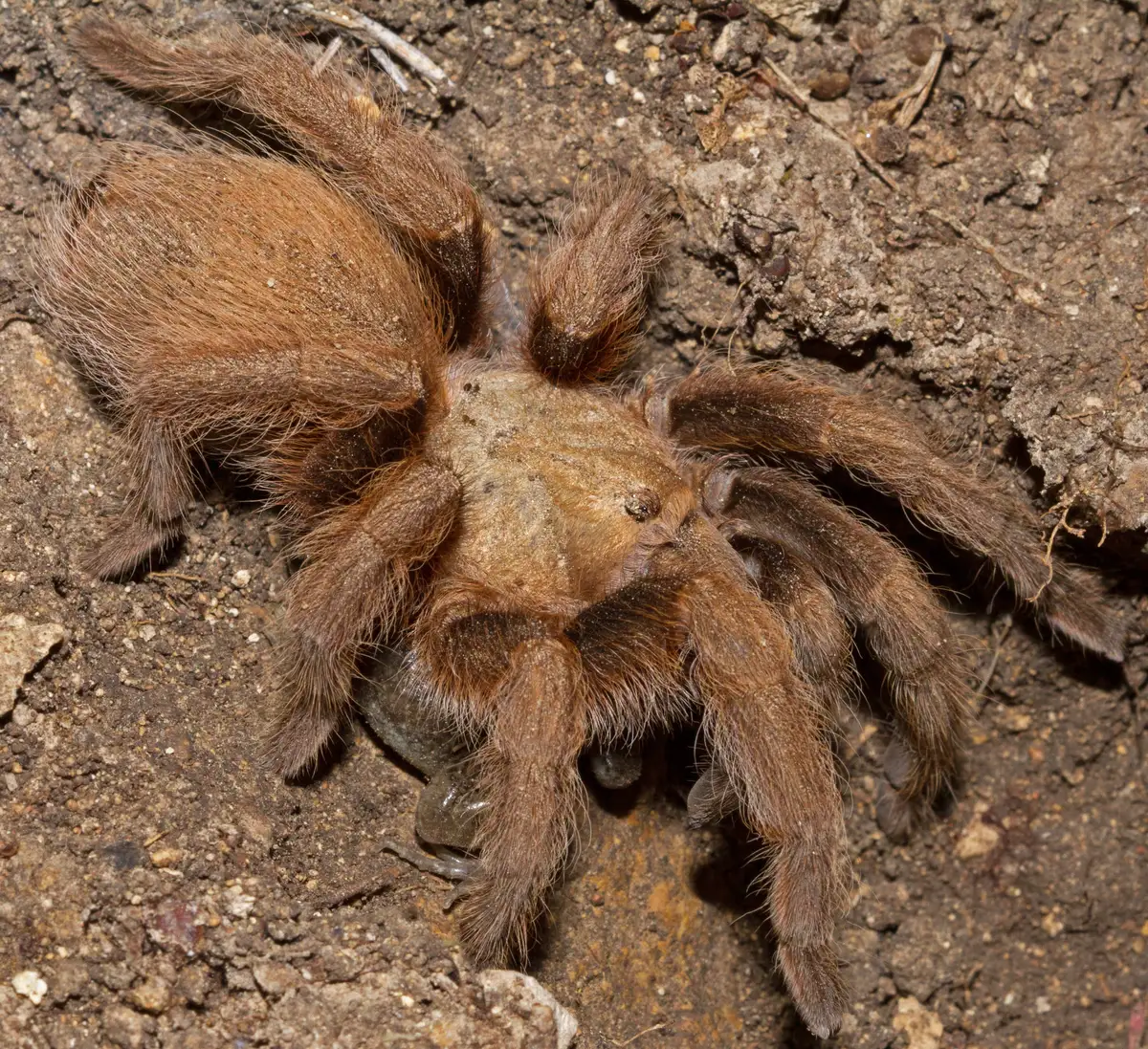 TarantulaFar bigger and hairier, up to 6 inches across the legs in Texas; lives in a burrow in the soil
Photos: Brown recluse: Insects Unlocked, CC0, via Wikimedia Commons, CC0 1.0. Cellar spider: no rights reserved, via iNaturalist, CC0 1.0. Tarantula: no rights reserved, via iNaturalist, CC0 1.0.
Where do southern house spiders live?
Across the southern United States, often on and in buildings. UF calls it common throughout Florida and much of the southern US in populated areas, and Vetter places its genus throughout the southern third of the country. The catalog of Texas spiders compiled by D. Allen Dean of Texas A&M lists it from 36 Texas counties, including Harris, Bexar and Travis.
UF says it favors gaps in the masonry of buildings, especially the dark recesses of windowsills, shutters and overhangs, with webs on houses, barns, bridges and other structures and occasionally under tree bark. Texas A&M finds it in old barns and undisturbed buildings, and the Texas catalog's records include bedrooms, garages, cellars, warehouses, an elementary school and the back of a TV.
In the desert Southwest, related crevice weavers live too: Vetter's bite report includes Kukulcania arizonica from Arizona and California, and Utah State says crevice weavers are more common in southern Utah. The guide to spiders in Florida and the guide to spiders in Texas cover those states' other common spiders.
Why do southern house spiders come inside?
For shelter, food and, for males, mates. UF says spiders often gather around buildings to prey on insects drawn to lights, and this one catches house flies, horse flies, mud daubers, cockroaches and May beetles. Males roam in search of females; the verified bite by a male southern house spider in Vetter's report happened in a hotel bed.
Expect them in any month: UF says all life stages seem to be present year-round in Florida, the Texas catalog has males from every month but August and females from every month, and two of Vetter's five verified crevice weaver bites came in November and December. Fittingly, hibernalis is Latin for winter, the catalog notes.
If one turns up indoors, look outside: Utah State advises inspecting the exterior walls for webs at a hole or crack.
Is a southern house spider bite dangerous?
No dangerous bite is known. UF says the southern house spider is not known to have a dangerous bite, though two reported bites caused pain and swelling for up to two days. UF's Florida spider guide says most spiders are venomous but few have venom of concern to people, and CDC's page on venomous spiders at work names the black widow and the brown recluse, not this spider.
The best evidence is Vetter's 2022 report of five crevice weaver bites, each spider collected right after the bite and identified by an arachnologist; none caused more than minimal, self-limiting signs. The one southern house spider, a male in a hotel bed in northwest Georgia, gave a bite that was felt but not painful; by morning the spot was red, swollen and itchy, and by the ninth day it had healed to barely noticeable. Only that man, who had other health problems, contacted a medical provider.
The other bites ranged from redness and itching gone within hours to swelling, itching and burning that eased over about six days. They happened in bed, underfoot, at school and while toweling off, which fits CDC's note that most spider bites happen because a spider is trapped or touched.
The bigger risk is a wrong name: Vetter warns that taking one of these spiders for a recluse could lead to unwarranted, overzealous treatment, such as cutting away tissue (debridement) that should not be done.
What should you do if a southern house spider bites you?
Clean it, cool it and watch it. MedlinePlus, the National Library of Medicine's health site, says most spider bites are harmless and may look like a bee sting, with redness, pain and swelling. Its first aid:
- Wash the area well with soap and water.
- Apply an ice pack or a wet compress.
- Take an over-the-counter pain reliever if needed, and consider an antihistamine for severe swelling.
Keep the spider if that is safe: MedlinePlus's page on insect bites and stings suggests bringing it when you go for treatment so it can be identified, and CDC says to identify a spider only if it can be done safely.
Do not assume a sore is a spider bite. Mayo Clinic says many skin sores look like spider bites but have other causes, such as a bacterial infection, and UF's Florida guide says such infections are commonly misdiagnosed as recluse bites. If you never saw what bit you, the bug bite identifier asks six questions about a bite.
What should you do about southern house spiders?
Often nothing: UF calls this harmless spider beneficial for the pests its webs catch. To keep it out, UF and Utah State suggest:
- Seal cracks and gaps in window casings, above and below doors and where water pipes and electrical lines enter (UF), and along the outside walls (Utah State).
- Keep screens on windows, doors and chimneys in good repair, to keep out the insects spiders follow indoors (UF).
- Vacuum along baseboards, under furniture and in other undisturbed spots near the floor to remove webs, nests and egg sacs (UF).
- Change the outdoor lights to sodium vapor bulbs, as Utah State suggests.
- Clear plants away from the foundation (Utah State) and check firewood for spiders and egg sacs before bringing it in (UF).
- Move a wanderer out under a glass jar and release it outside (Utah State).
Keeping spiders out of the house goes through sealing step by step, the guide to getting rid of spiders covers a bigger problem, and the guide to venomous spiders in the US shows where widows and recluses live. For other spiders and pests, browse more pest identification guides.
This guide is general educational information, not medical advice. If you have symptoms or concerns after a bite or exposure, contact a healthcare provider.
Frequently Asked Questions
Are southern house spiders venomous?+
They have venom, as most spiders do, but it is not known to be dangerous to people. The University of Florida says most spiders are venomous but few have venom of concern to humans, and that the southern house spider is not known to have a dangerous bite; two reported bites caused pain and swelling for up to two days. CDC's page on venomous spiders names the black widow and the brown recluse, not this spider.
Are male southern house spiders poisonous?+
No dangerous bite is known. The University of Florida says the southern house spider is not known to have a dangerous bite, and the male is the same species in a different form: lanky, khaki to amber and about 3/8 inch long. The worry comes from his look, which UF says gets him mistaken for the brown recluse. His eight eyes bunched on a raised bump, instead of a recluse's six eyes in three pairs, settle it. Males do bite when trapped, and the verified bites by males of its genus were minor.
What happens if a southern house spider bites you?+
Usually a minor, local reaction. The University of Florida says two reported bites caused pain and swelling for up to two days, and in Richard Vetter's 2022 report of five verified crevice weaver bites, symptoms ranged from redness that cleared within hours to swelling, itching and burning that eased over about six days. MedlinePlus advises washing a spider bite with soap and water and applying an ice pack or a wet compress, and seeking medical treatment for small children and for adults with severe symptoms.
How can I tell the difference between a male and female southern house spider?+
By build and color. The University of Florida describes females as charcoal gray and 1/2 to 3/4 inch long, and its Florida spider guide calls them velvety with thicker bodies; they live in a web around a crack. Males are khaki to amber and about 3/8 inch long, with long, slender legs and palps so long they almost look like an extra pair of legs. Females stay in their webs and may live up to eight years, while adult males build no web and wander in search of females.
How big can southern house spiders get?+
Females are the big ones: the University of Florida gives their body length as 1/2 to 3/4 inch (13 to 19 mm), and a female's abdomen can swell considerably after a meal or when she carries eggs. Males are about 3/8 inch long (9 to 10 mm), with long, slender legs and palps. Texas A&M says southern house spiders are larger than recluse spiders, whose bodies are about 3/8 inch and never longer than 1/2 inch, according to Richard Vetter of UC Riverside.
What attracts southern house spiders?+
Insects, cracks and, for the males, females. The University of Florida says spiders often live around buildings because they prey on insects drawn to lights, and that this species favors spaces in masonry, such as the dark recesses of windowsills, shutters and overhangs. Adult males roam in search of mates. Utah State University Extension suggests switching outdoor lights to sodium vapor bulbs and sealing cracks and holes in exterior walls, and UF suggests repairing window casings and keeping screens in good repair.
Are southern house spiders friendly?+
They are harmless and useful rather than friendly. The University of Florida calls the southern house spider harmless and beneficial, since its webs catch house flies, horse flies, mud daubers, cockroaches and May beetles. CDC says spiders are usually not aggressive and that most bites happen because a spider is trapped or touched, which fits the verified bites in Richard Vetter's 2022 report: they happened in bed, underfoot, at school and while toweling off. Move one outdoors with a jar rather than by hand.
How long do southern house spiders live?+
Females can live a long time for a spider: up to eight years, according to the University of Florida, citing a 1972 spider guide by B. J. Kaston. UF says that in Florida all life stages seem to be present year-round, and a catalog of Texas spiders compiled at Texas A&M has records of males from every month except August and of females from every month. The sources here give no lifespan for males, which stop building webs as adults and wander in search of females.
Is the southern house spider the same as the common house spider?+
No. The southern house spider, Kukulcania hibernalis, is a crevice weaver of the southern US whose females are 1/2 to 3/4 inch long, according to the University of Florida. The common house spider, Parasteatoda tepidariorum, is a cobweb spider found throughout most of the world; Penn State Extension says its females are about 3/16 to 1/4 inch long, with a dirty-white to brown abdomen marked with gray chevrons and yellow legs ringed darker at the end of each segment.
How do I know if I just got bit by a spider?+
Often you cannot be sure. Mayo Clinic says that unless you actually saw a spider bite you, it is difficult to be certain a wound was caused by one, and that many skin sores look the same but have other causes, such as a bacterial infection; the University of Florida says infections are commonly misdiagnosed as recluse bites. Mayo Clinic advises seeking medical care immediately if you are unsure whether a dangerous spider bit you. Keep any spider you find whole so it can be identified.
Sources
- Southern House Spider, Kukulcania hibernalis (Hentz) (EENY144/IN301; G. B. Edwards and K. McCanless, revised December 2025) — University of Florida IFAS Extension, Featured Creatures
- An Introduction to Some Common and Charismatic Florida Spiders (ENY2080/IN1366; E. C. Powell, L. A. Taylor and S. Wehman Epstein, March 2023) — University of Florida IFAS Extension
- Southern House Spider — Urban and Structural Entomology Program, Texas A&M University
- Verified envenomations by crevice weaver spiders (genus Kukulcania): Bites are of minor expression but the spiders are commonly misidentified as medically important brown recluses (genus Loxosceles) in North America (R. S. Vetter, Toxicon: X 13:100091, 2022) — Toxicon: X, full text in PubMed Central (US National Library of Medicine)
- Catalogue of Texas spiders (D. Allen Dean, 2016) — ZooKeys (Texas A&M University Department of Entomology), full text in PubMed Central
- How to Identify and Misidentify a Brown Recluse Spider (Rick Vetter) — UC Riverside Department of Entomology
- Brown Recluse Spiders (Steve Jacobs, updated September 8, 2025) — Penn State Extension
- Longbodied Cellar Spider (Steve Jacobs, updated January 19, 2026) — Penn State Extension
- Common House Spider (Steve Jacobs, updated January 19, 2026) — Penn State Extension
- Crevice Weaving Spiders (Urban Pest Guide) — Utah State University Extension, Plant Health IPM
- Texas tarantula tango: Understanding their annual hunt for food, love (AgriLife Today, May 13, 2024) — Texas A&M AgriLife Extension, Insects in the City
- Venomous Spiders at Work (reviewed September 28, 2026) — CDC, National Institute for Occupational Safety and Health
- Spider bites: Symptoms and causes (Mayo Clinic Staff, July 30, 2021) — Mayo Clinic
- Spider Bites (last updated March 9, 2023) — MedlinePlus, US National Library of Medicine
- Insect bites and stings (Medical Encyclopedia, reviewed October 14, 2025) — MedlinePlus, US National Library of Medicine
How this guide was made: it was researched and drafted with AI assistance from the sources listed above. A second, independent AI pass then checked each factual claim against those sources. Found an error? Email support@buzzskito.ca.