
BuzzSkito Mosquito & Tick Control Specialists · Published July 21, 2026
How Do You Actually Get Rid of Rats in Canada?
With a sequence, not a product. Every successful rat job — DIY or professional — runs the same four moves in the same order: starve, trap, seal, verify. Cut off the food subsidy that brought rats in; run a pre-baited snap-trap line that respects how suspicious rats are; close every quarter-sized gap with metal they cannot chew; and keep sentinel traps out to confirm the win. The order matters. Trap before you starve them and your bait competes with a buffet. Seal before you trap and you lock rats inside your walls. Poison before anything and — under Canadian rules we will get to — you are probably reaching for products you cannot legally buy anyway. The first move is confirming it really is a rat: rat droppings are blunt-ended capsules of 12–19 mm, whereas mouse droppings run 3–6 mm and taper to a point at both ends, and the whole plan turns on that one observation.
What this guide is not: a mouse guide. Rats are a different animal in every way that matters — ten times the body mass, far warier, harder-jawed, and legally more complicated to poison. If you have not confirmed which rodent you have, start with the sign-reading section below, because mouse hardware deployed against rats is wasted money: a mouse snap trap does not carry enough striking force to kill a Norway rat, and a mouse-sized bait station will not admit one at all. (If it turns out you have mice, our mouse playbook and mouse trap guide are the right tools.)
Norway Rat vs Roof Rat: Which One Is in Your Yard?
Canada effectively has one urban rat east of the Rockies. The Norway rat (also called the brown rat or sewer rat) is a heavy-bodied burrower — blunt snout, small ears, a tail shorter than its body — that lives at or below ground level. In a GTA or Montreal backyard, that means burrows under the deck, under the shed slab, along the foundation, beside the compost, and connections to the sanitary sewer network that most homeowners never suspect. It is an outstanding digger and swimmer and a mediocre climber, which is why Norway rat problems present as burrows, ground-floor gnawing, and basement sightings rather than attic noise.
The roof rat — slimmer, bigger-eared, with a tail longer than its body — is the climber that nests in attics, trees, and ivy. In Canada it is essentially a coastal British Columbia problem (Vancouver, the Island, the Fraser Valley); it is rare to absent across Ontario, Quebec, and the Prairies. And in a uniquely Canadian footnote, Alberta has run an aggressive border control program since the 1950s and remains functionally rat-free — if you think you have rats in Alberta, the province literally wants you to report it.
Why the ID matters: it decides trap altitude. Norway rats are trapped at ground level along walls and burrow lines. Roof rats are trapped on elevated runs — rafters, fence tops, branches. Everything below assumes the Norway rat, because if you are reading this from most of Canada, that is your animal.
Photos of both rats, with the tail, ear, snout and droppings checks that tell them apart, are in our roof rat vs Norway rat guide; it is written for US readers, so its range notes cover the United States.
Reading the Signs: Burrows, Droppings, and Rub Marks
Rats leave a loud paper trail. Before buying anything, walk the property and confirm what you are dealing with:
- Droppings. Rat droppings are capsule-shaped, 1–2 cm long — raisin- or olive-pit-sized. Mouse droppings are 3–6 mm rice grains. Concentrations mark feeding and travel zones; fresh droppings are dark and glossy, old ones grey and crumbly.
- Burrows. The Norway rat signature: clean 5–8 cm round openings with a fan of kicked-out soil, under deck skirting, shed slabs, woodpiles, and dense shrubs. An active burrow has a smooth, packed entrance; stuff it loosely with newspaper and an occupied burrow reopens within a day or two.
- Rub marks. Rats run the same routes so consistently that body grease leaves dark smudges along baseboards, beams, and pipe penetrations. A greasy line is a confirmed highway — and your trap location.
- Gnawing. Paired incisor grooves roughly 4 mm wide in wood, plastic bins, even soft mortar and aluminum. Rats must gnaw continuously to wear down teeth that never stop growing.
- Sound and sightings. Heavy scratching or scampering in walls, ceilings, or under floors at night; a rat seen in daylight often signals a large population competing for food.
Map every sign before you deploy hardware. The map is the plan: traps go on the highways, not where the box looks tidy.
If the signs could belong to either animal, our US guide to telling a rat from a mouse compares the two by size, tail, ears, droppings and gnaw marks, with photos.
Why Bait Alone Fails (and Traps Alone Only Half-Work)
The instinct when rats appear is to buy poison and be done. In Canada that plan fails three ways. First, the legal way: the potent baits that made “throw poison at it” plausible in US forums are commercial-class here — more on that below. Second, the biological way: a rat colony is a production system. A female Norway rat can produce 3–6 litters a year of 6–12 pups; killing individuals without touching food supply and harbourage just opens vacancies that breeding and immigration refill within weeks. Third, the practical way: baited rats routinely die inside wall voids and under floors, and a decomposing rat is a multi-week odour event no bait-station feature prevents.
But traps alone are also only half a strategy. A trap line with an open bird feeder, an accessible compost bin, and an unsealed foundation is a treadmill: you are harvesting the surplus of a rat farm you are still operating. The full loop — food gone, traps out, holes sealed — is what actually ends the problem, and each step makes the next one work better: hungry rats hit traps faster, and sealed buildings turn any survivor into an outdoor problem instead of a tenant.
Check current Canadian availability of the toolkit:
Snap Trapping Done Right: Pre-Baiting Beats Rat Paranoia
Here is the fact that decides whether your trapping succeeds: rats are neophobic. Unlike mice, which investigate new objects within hours, an adult Norway rat treats anything new on its territory with days of suspicion. Put out a set trap tonight and the colony may detour around it for a week — and if one rat gets a near-miss, the whole line is burned. This is why so many Canadians conclude “traps don’t work on rats.” The traps work fine; the schedule was wrong.
The professional protocol, adapted for a home:
- Days 1–7: pre-bait, unset. Place heavy-duty rat snap traps — rat-rated, never mouse traps — directly on the greasy highways and beside burrow entrances, baited with a firm press of peanut butter, but not set. Let rats eat free. You are buying trust.
- Watch the take. When bait is being cleaned off confidently (usually night 3–5, sometimes 7 for a wary colony), the trust is bought.
- One night: set everything. Rebait identically, set every trap the same evening. The first set night should be your biggest harvest of the entire program — often by a wide margin.
- Placement rules. Trigger end touching the wall, traps every 3–5 m along active runs, doubled up at corners and burrow mouths. Outdoors, place traps inside a wooden box, milk crate, or tunnel so you catch rats instead of squirrels, birds, or a neighbour’s cat — and wear gloves throughout, both for scent and hygiene.
- Maintain the line. Clear and rebait daily. When catches stop, do not celebrate yet — run 7–10 quiet nights with fresh droppings absent before declaring victory, then move to exclusion.
Trap selection is simple: modern press-to-set rat traps (Tomcat and Victor both make them) have the spring power a 300–500 g rat requires and set without risking fingers. We compare the specific models — including when the old-school wooden Victor still earns its place — in the best rat trap guide.
The methods table above flags one option that sits outside the snap-trap category entirely: a CO2-powered auto-resetting trap that clears the carcass after each strike and re-arms itself, so it keeps hunting for weeks without a daily visit. That changes the maths on a shed, cottage, or fence line you cannot walk every morning — we put it through its paces in our review of the self-resetting Goodnature A24.
The Goodnature A24: What a Premium Hands-Off Rat Trap Buys You
The Goodnature A24 is the most interesting piece of rat hardware to reach Canadian consumers in years, and it comes with real credentials: it was engineered in New Zealand for conservation projects that clear rats from entire island ecosystems. The mechanism is a CO2-powered striker. A rat, drawn by a long-life lure pouch, pushes its head into the baited chamber, trips a leaf trigger, and a piston delivers an instant killing blow. The body drops to the ground below (or into a catch tray), and the trap resets itself — up to 24 kills per CO2 canister, with no rebaiting, no checking, no handling between them. An optional counter tallies strikes so you can read the score without ever seeing a rat.
Where it shines in a Canadian context: sheds, detached garages, under-deck spaces, barns, and cottages — locations you do not visit daily, where a self-resetting, toxin-free device quietly works all season with zero secondary-poisoning risk to the owls, foxes, dogs, and cats that scavenge rat carcasses. Mounted at the manufacturer’s height on a tree or wall, it is out of reach of most non-target wildlife, and Goodnature’s own protocol includes a pre-feed step — a dab of lure with the trap inactive — that maps neatly onto the neophobia problem above. Do not skip it; an A24 deployed cold hits the same wall of suspicion any trap does.
The honest trade-offs: it is a premium-tier purchase — several times the cost of a full snap-trap line — plus recurring CO2 canisters and lure pouches, so it makes most sense where its automation genuinely replaces labour. And Canadian retail stock fluctuates; check current availability and pricing rather than assuming, and verify you are buying the rat/stoat model with the Canadian accessories you need.
Bait Stations: Monitor First, Poison Last
Tamper-resistant bait stations — the black lockable boxes you see behind restaurants — have two jobs for a Canadian homeowner, and the less obvious one is more useful. Loaded with rodenticide-free monitoring blocks, a station is an intelligence tool: place a few along fence lines, beside sheds, and near suspected burrows, and gnawed blocks tell you exactly where rats are travelling before you commit traps. That feeding map is worth more than any single kill.
The second job — housing actual rodenticide — comes with rules. Any legal consumer bait in Canada must be deployed in a tamper-resistant station if children, pets, or wildlife could reach it, and the station is the easy part: the hard part is that the bait itself is tightly restricted, which is the next section. Our bait station guide covers station selection and placement in depth; the short version is buy a station with a key lock and internal rods, anchor it so it cannot be flipped, and treat baiting as the last tool you reach for, not the first.
The Canadian Rodenticide Reality: Check the PCP Number
This is where Canadian rat control genuinely diverges from the American internet. The second-generation anticoagulant rodenticides (SGARs) — brodifacoum, bromadiolone, difethialone — that anchor US advice threads are not sold as domestic-class products in Canada. Health Canada’s PMRA restricts them to commercial-class use by licensed applicators, and British Columbia went further in 2023, permanently banning most SGAR uses over secondary-poisoning deaths in owls and hawks. What remains for Canadian consumers is a short list: certain first-generation anticoagulants and bromethalin products, generally packaged in or for tamper-resistant stations.
The practical takeaway is a habit: before buying any rodenticide, look for the PCP (Pest Control Products) registration number on the label. Every pesticide legally sold in Canada carries one; a listing without a visible PCP number — common among cross-listed US products on marketplaces — is a product you should not buy, both because it may be illegal to use here and because you would have no Canadian label directions to protect you or your pets. We keep a current map of what is and is not legal, product by product, in the rat poison legality guide. Meanwhile, note what needs no registration at all: traps, the A24, empty stations, and exclusion mesh are devices, not pesticides — the zero-paperwork core of Canadian rat control. This is also, incidentally, why plug-in gadget shortcuts are tempting; unfortunately the evidence says ultrasonic repellers do not work on rodents, so the boring hardware remains the whole game.
Exclusion: The Quarter Test and the Metal-Only Rule
Once the trap line goes quiet, seal the building — this is the step that converts a good month into a permanent result. The audit standard is the quarter test: an adult rat passes through any gap of about 2 cm, and unlike a mouse it can gnaw a marginal gap into a usable one through wood, vinyl, plastic, and soft mortar. Walk the foundation at dusk with a flashlight held flat against the wall and check, in rough order of frequency:
- Utility penetrations — gas, AC, cable, and plumbing entries with degraded sealant
- Garage and man-door sweeps, especially chewed corners
- Deck and porch skirting, and the soil line beneath it (burrow central)
- Dryer and exhaust vents with broken or missing flaps
- Weeping vents in brick, and gaps where siding meets foundation
- Floor drains and, in older houses, the sewer lateral — a broken clay lateral is the classic hidden source of sudden indoor rats
The materials rule is absolute: metal or nothing. Galvanized 1/4-inch hardware cloth screwed over vents and skirting gaps, stuffable copper or stainless mesh packed into pipe penetrations and backed with sealant, sheet-metal kick plates on gnawed door corners. Expanding foam by itself is bedding material with a chew-through time measured in minutes; use it only as a weather seal behind metal. For burrows, collapse them after trapping quiets — an active colony just reopens them overnight. The complete shopping list and step-by-step sealing order is in our rodent exclusion kit guide, and the same principles protect smaller targets too — see winter mouse-proofing and even keeping rodents out of parked cars.
The Neighbour Problem: Bylaws, Bird Feeders, and the 50-Metre Truth
Here is the part no product page tells you: a Norway rat colony works a territory of roughly 25 to 50 metres from the burrow, and in Canadian cities that radius almost never fits inside one property line. You can run a flawless program and be re-invaded monthly from an untouched burrow under a neighbour’s shed, an overflowing feeder two doors down, or a derelict garage across the fence. Rats are a block-level problem wearing a single-house disguise.
Two tools help. The first is diplomacy: most neighbours have no idea their bird feeder is a rat feeder, and a friendly heads-up plus a shared trapping window beats years of silent re-invasion. The second is the bylaw layer: most Canadian municipalities — Toronto, Mississauga, Vancouver, and others — have property-standards or pest-related bylaws requiring owners to eliminate rodent harbourage, and cities investigate complaints, inspect, and can issue orders against properties that farm rats onto the block. Document what you see (burrows, sightings, attractants), report persistent off-property sources through 311 or your municipal portal, and keep your own yard defensible: feeders on baffled poles with seed trays, enclosed compost with no cooked food, garbage in bins with latched lids, pet food indoors, woodpiles up on racks, and ivy cut back from foundations.
When to Call a Professional
DIY wins most backyard and garage rat problems. Escalate to a licensed pro when the pattern says structural or block-level: catches continuing beyond 2–3 weeks with no taper, rats inside living space or audible in walls, burrows that reopen immediately after collapse, sudden indoor rats in an older home (sewer lateral until proven otherwise — pros can smoke-test the line), or a neighbouring source that bylaw complaints have not yet moved. Professionals bring the commercial-class rodenticides consumers cannot buy, drain testing, and exclusion crews with sheet-metal skills. Expect a program of visits rather than a single treatment, and sanity-check any quote against our Canadian pest control cost guide before signing.
Frequently Asked Questions
How do I get rid of rats in Canada?+
The proven sequence is: confirm it is rats (not mice), remove food and water sources, pre-bait heavy-duty snap traps unset for 3 to 7 days so the rats accept them, then set every trap on the same night, and seal every entry point larger than about 2 cm once catches stop. Traps kill the rats you have; exclusion stops the replacements. Skipping either half is why most DIY rat jobs fail. Poison is a last resort in Canada — the potent second-generation baits US websites recommend are restricted to professionals here, and poisoned rats often die inside wall voids.
What kind of rats live in Canada?+
Almost every rat an Ontario, Quebec, or Prairie homeowner meets is the Norway rat (Rattus norvegicus) — a heavy-bodied burrower that lives at or below ground level: under decks, sheds, and additions, along foundations, and in sewers. The roof rat (Rattus rattus), a slimmer climber that nests in attics and trees, is essentially a coastal British Columbia problem in Canada. Alberta famously runs an active rat-control program and remains functionally rat-free. Knowing which rat you have decides where traps go: ground level and burrow lines for Norway rats, elevated runs for roof rats.
How do I know if I have rats or mice?+
Size the evidence. Rat droppings are capsule-shaped and 1 to 2 cm long — the size of a raisin or olive pit — while mouse droppings are 3 to 6 mm, like dark rice grains. Rats leave greasy rub marks along walls and beams, gnaw marks with visible paired tooth grooves about 4 mm wide, and Norway rats dig open burrows 5 to 8 cm across with fresh soil kicked out. You may also hear heavy scratching in walls or under floors at night. This matters because the hardware is different: a mouse trap physically cannot kill a rat, and using one just educates the rat.
Why is my rat trap not catching anything?+
Almost always neophobia — rats have a strong, well-documented suspicion of new objects in their territory, and an adult rat may avoid a freshly placed trap for a week or more. The fix is pre-baiting: place traps along walls where you see droppings, baited but UNSET, for 3 to 7 nights until the bait is being taken confidently, then set all of them at once. Other common failures: traps in open floor instead of tight against walls, too few traps, mouse-sized traps instead of rat-sized, and human scent — wear gloves.
Is rat poison legal in Canada?+
Some is, most of what the internet recommends is not. The second-generation anticoagulants (brodifacoum, bromadiolone, difethialone) that dominate US advice are restricted to commercial-class use in Canada, and British Columbia has banned most of their uses outright. Consumer options are limited to certain first-generation anticoagulants and bromethalin products, generally sold in tamper-resistant stations. Any legal product must carry a PCP registration number on the label — check for it before buying, and treat any listing without one as a red flag. Our rat poison legality guide covers the full picture.
Does the Goodnature A24 really work on rats?+
Yes — it is the most credible hands-off rat trap on the market. Developed in New Zealand for conservation-scale rat eradication, the A24 is a CO2-powered striker: the rat enters a baited chamber, trips a leaf trigger, and a piston kills it instantly; the body drops out and the trap automatically resets, up to 24 kills per CO2 canister. The trade-offs are a premium purchase price plus recurring CO2 canisters and lure pouches, and — like every trap — it still loses to neophobia if you skip the manufacturer’s pre-feed step. Check current Canadian availability before planning around it, as stock fluctuates.
What attracts rats to my yard in Canada?+
Calories and cover. The big four are: bird feeders (spilled seed is the number-one urban rat subsidy), open compost with cooked food or grains, pet food and dog waste left outside, and unsecured garbage. Cover means junk piles, wood stacked on the ground, dense ivy against foundations, and the sheltered voids under decks and sheds — prime Norway rat burrow real estate. Fruit trees that drop fruit and standing water (bird baths, leaky taps) complete the package. Remove the subsidy and harassment tools like traps start winning; leave it and you are farming rats.
How small a gap can a rat fit through?+
An adult rat can squeeze through a gap of about 2 cm — roughly the diameter of a quarter — and can gnaw a smaller opening into a bigger one through wood, vinyl, and even soft mortar. Priority points on a Canadian house: gaps where pipes and AC lines enter, weeping-vent openings, deteriorated door sweeps (especially garage doors), the gap under deck skirting, and dryer vents with broken flaps. Seal with rat-proof materials — galvanized hardware cloth, stainless or copper mesh backed with sealant, or sheet metal. Foam alone is a snack, not a barrier.
Do ultrasonic repellers work on rats?+
No. The evidence for ultrasonic devices against rats is as poor as it is for mice: rodents habituate to the sound within days, ultrasound does not pass through walls or furniture, and regulators have repeatedly challenged manufacturers over unsupported claims. No Canadian municipality or public-health rat program recommends them. Money aimed at a rat problem is far better spent on a pre-baited snap-trap line and a roll of hardware cloth. We reviewed the published studies in detail in our ultrasonic pest repeller evidence review.
Are rats my responsibility or my neighbour’s?+
Legally, usually whoever’s property harbours them — most Canadian municipalities, including Toronto and Mississauga, have property-standards bylaws requiring owners to keep land free of rodent harbourage, and neighbours can file complaints that trigger inspection and orders. Practically, a Norway rat colony works a territory of 25 to 50 metres, which almost always spans multiple lots. You can trap perfectly and still be re-invaded from an untouched burrow two doors down. The winning play is coordination: talk to neighbours, trap and exclude simultaneously, and report persistent off-property sources (hoarding, derelict buildings) to your city.
When should I call a professional for rats?+
Call a licensed exterminator when: you are catching rats for more than 2 to 3 weeks without the evidence tapering, rats are inside living space or you hear them inside walls, burrows keep reopening after you collapse them, the source is structural (broken sewer lateral — a classic hidden cause of sudden indoor rats), or the property next door is the engine and bylaw complaints are in motion. Professionals bring commercial-class rodenticides, sewer-line smoke testing, and exclusion crews. Expect a multi-visit program rather than a one-shot treatment; our Canadian pest control cost guide covers typical pricing.
How do I safely clean up after rats?+
Never dry-sweep or vacuum droppings — dust from rodent waste can carry pathogens. Public-health guidance in Canada is: ventilate the area 30 minutes, wear disposable gloves (a fitted N95 adds margin in enclosed spaces), soak droppings, nests, and dead rats with a 1:10 bleach solution or household disinfectant for 5 minutes, wipe up with paper towels, double-bag everything, and seal it in an outdoor bin. Wash hands thoroughly afterward. For heavy accumulations in attics or crawl spaces, follow your local public health unit’s cleanup guidance or hire a remediation service.
Related Rodent Guides
- Best Rat Trap Canada — Models Compared
- Rat Poison in Canada — What Is Actually Legal
- Rodent Exclusion Kit Canada — Seal the House Step by Step
- Bait Stations in Canada — What’s Legal and When to Use Them
- How to Get Rid of Mice in Canada — Full Playbook
- Best Mouse Trap Canada — Snap vs Electronic vs Catch-and-Release
- Victor Electronic Mouse Trap Review — Canada
- Best Rodent Repellent for Cars in Canada
- Ultrasonic Pest Repellers — Do They Actually Work?
Keep reading
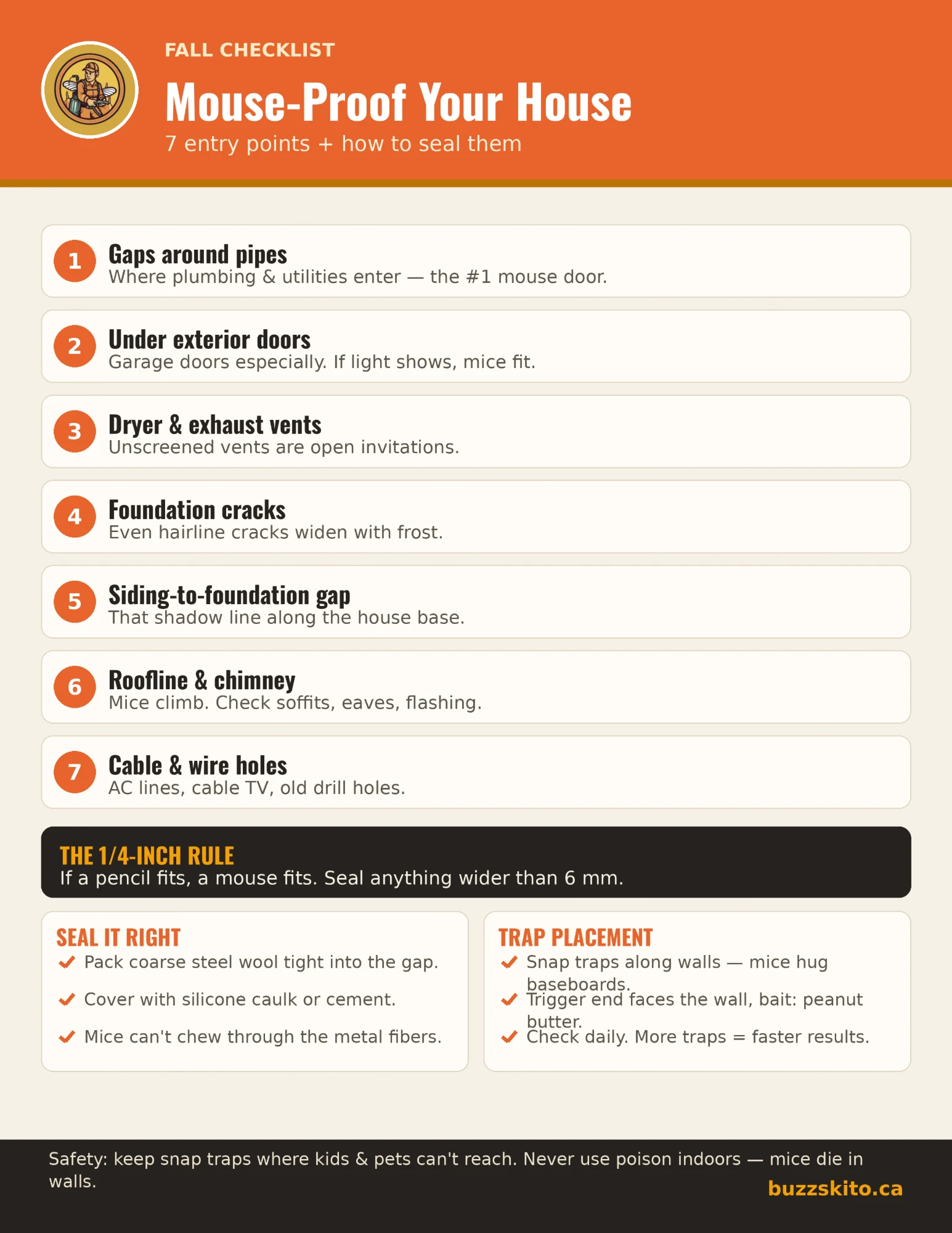 How to Mouse-Proof Your House: A Fall ChecklistA fall checklist for mouse-proofing a house: the 7 entry points to seal, the 1/4-inch rule, the materials that last,…
- Rat Poison in Canada 2026 — What's Actually Legal (and What Isn't)Second-generation anticoagulant rat poisons are commercial-only in Canada. What the PMRA allows consumers, BC's SGAR…
- Baby Mice: What Pups Look Like, How Fast They Grow, and What a Nest MeansBaby mice are called pups. See what they look like from day 1 to week 3, how many a litter holds, how soon they breed,…