
BuzzSkito Mosquito & Tick Control Specialists · Published July 21, 2026 · Updated October 16, 2026
Why Mice Move Into Cars (and Why Yours Qualifies)
From a mouse’s point of view, a parked car is the best real estate in the neighbourhood. The engine bay is a dark, enclosed cavity that holds heat for hours after a drive, sits a short climb up a tire from the ground, and is protected from owls, cats, and weather by a steel hood. It comes pre-furnished with sound-deadening insulation, air-filter media, and seat stuffing — all premium nesting material — and, in a distressing number of cases, stocked with granola-bar crumbs and a bag of dog food in the trunk. A mouse does not need an invitation. It needs about six millimetres of gap, and a car has hundreds of them by design.
Then there is the wiring. Rodent incisors grow continuously, so mice must gnaw to survive, and harness insulation is exactly the right hardness for the job. Since the 2000s, many automakers have used soy-based and other bio-plastic wire coatings, and the “soy wiring” story became famous through class-action lawsuits against Toyota, Honda, Subaru, and others alleging the material is tastier to rodents than the old petroleum-based insulation. The automakers’ defence — that mice chewed distributor caps and cloth-wrapped looms decades before anyone put soy in a wire — is fair, and no peer-reviewed study has settled the palatability question. But notice what the market did while the lawyers argued: manufacturers started selling capsaicin-treated rodent tape through their own parts counters. Whatever the cause, the industry treats chewed harnesses as a routine, expected failure mode. You should too.
The stakes are what make this the highest-value rodent problem in your life. Your house can absorb a mouse for a week with no permanent damage. Your car cannot: a modern vehicle is a $30,000-and-up asset whose nervous system is copper, and a single night of enthusiastic gnawing can take out sensor circuits that cost more to diagnose than to fix — and harnesses are often replaced as complete units rather than spliced, which is how a mouse turns into a four-figure invoice.
The Signs: A Two-Minute Weekly Hood Check
Every defence on this page works better the earlier you catch activity, and the inspection costs nothing. Pop the hood every week or two — every visit, for a stored vehicle — and scan for:
- Droppings on the engine cover. Dark grains of rice, 3–6 mm long, usually on the flat top of the engine cover, the battery tray, or in the corners of the bay. This is the single most common first sign.
- Nest material. A wad of shredded insulation, leaves, paper, or fabric packed into a corner, an airbox, or on top of the engine. Mice gather tinder and park it on a heat source — one more reason not to ignore it.
- Chewed insulation and bare copper. Look along accessible harness runs, especially where looms bend around the back of the engine and near the firewall.
- Grease rub marks and paw prints in dust along the edges mice travel.
From the driver’s seat, the later-stage tells are a check-engine light or a misfire after the car has been sitting, a dusty, musty, or ammonia smell from the vents when the fan first runs (mice love the HVAC intake and cabin-air filter), scratching sounds after you park, and — in the endgame — a car that simply will not start. If you are already at droppings-plus-nest, skip ahead to the trapping section: deterrents do not evict tenants.
Check current Canadian availability of the three picks:
Layer 1: Parking Strategy — the Free Fix That Changes Why Mice Pick Your Car
Mice colonize vehicles that sit still in quiet, dark, food-adjacent places. Change those variables and you have done more than any gadget can:
- Drive the car. A hot, vibrating, moving engine bay is uninhabitable. Weekly is the minimum for a rarely used vehicle; a 20-minute drive also keeps the battery honest. The classic infestation story is always the same: the cottage car, the summer convertible, the RV, the truck that sat from October to April.
- Park in light and activity. Open pavement beats grass; a streetlit driveway beats a dark corner; a garage with a light on a timer and regular foot traffic beats a silent one. Mice are neophobic and predator-wary — human activity is a genuine deterrent.
- Starve the site. No wrappers, crumbs, or snacks in the cabin; no dog food, bird seed, or grass seed stored in the trunk or anywhere near the parking spot. Bird feeders and compost bins within a few metres of a parked car are mouse commissaries — move one or the other.
- Cut the cover. Trim grass and weeds around a stored vehicle, pull the woodpile away, and leave a strip of open ground mice must cross. For long storage, some owners leave the hood propped open in a secure garage — it feels wrong, but it destroys the dark-cavity appeal that makes an engine bay a nest site.
Layer 2: Capsaicin Rodent Tape — the Fix Honda Made Famous
When wire-chewing complaints piled up in the 2010s, Honda’s parts network began selling a roll of harness tape laced with capsaicin — the compound that gives chili peppers their heat — and the “Honda rodent tape” story went viral precisely because it was an automaker quietly acknowledging the problem. The idea is elegant: instead of trying to make the whole car smell bad (which fades) or sound bad (which mice tune out), you make the wire itself punishing to bite. A mouse that gnaws through the wrap gets a strong irritant response at the exact moment and place of the crime, and in most reported experience it moves on to literally anything else.
Aftermarket capsaicin tapes are now widely available, and application is a wrap-what-you-can-reach job: the main accessible harness runs across the top and back of the engine, battery cables, wiring near the firewall grommets, and the ledges and cable channels mice use as highways into the bay. Wear disposable gloves — capsaicin does not distinguish between mouse mouths and human eyes — and expect a roll or two to cover the reachable runs on a typical vehicle. Its honest limits: you cannot wrap the loom buried behind the intake manifold, it deters chewing rather than expelling an established nest, and it protects wiring, not your cabin-air filter.
One Canadian compliance note, because this category is murkier than traps: tape, traps, and strobe lights sold purely as physical deterrent devices do not need pesticide registration, but any product that claims to kill or repel pests as a pesticide is regulated by Health Canada’s PMRA and must carry a PCP registration number on its label. Capsaicin-treated tapes sit near that line and marketing claims vary by brand — so read the label of the specific product you buy, check for a PCP number if the packaging makes repellent claims, and treat any listing that promises “guaranteed rodent-proof” with the skepticism it deserves. We keep a deeper product-by-product breakdown in our companion guide to the best rodent repellents for cars in Canada.
Layer 3: Under-Hood Repellers — What the Strobe Does and the Ultrasound Doesn’t
Battery- or vehicle-powered under-hood units combining ultrasonic sound with flashing LED strobes are the best-selling “mice in car” product online, so let us be precise about what you are buying. The ultrasonic half rides on weak evidence: decades of testing show rodents habituate to constant or patterned ultrasound within days, the sound does not bend around engine components, and regulators have repeatedly challenged manufacturers’ claims — we walk through the studies in our ultrasonic repeller evidence review, and nothing about mounting the same technology under a hood changes the biology.
The strobe half is more defensible, for a mechanistic reason: mice choose engine bays because they are dark, enclosed, and predictable, and a bright intermittent flash inside that cavity attacks the exact feature they came for. It is not a force field — a determined mouse in a cold snap can decide a flashing nest beats a frozen one — but as one layer on a stored vehicle it has a logic that pure ultrasound lacks. Buy a unit for the strobe, treat the ultrasound as free packaging, choose a battery model unless you are comfortable wiring an always-on accessory to a stored battery, and put a battery check on the same schedule as your trap checks.
Layer 4: The Trap Line — Non-Negotiable for Stored Vehicles
Everything above deters. Traps are the only layer that reduces the number of mice, and for a vehicle in a garage they are the backbone of the defence. The good news is that trapping around a car is easier than trapping a whole house, because mouse behaviour funnels beautifully: mice run wall lines, not open floor, so a mouse heading for your car almost always travels the garage perimeter first and approaches across open concrete only for the final metre.
Set classic wood snap traps with the trigger end touching the baseboard every 2–3 metres along the garage walls, doubling up in the corners nearest each wheel, with a pea-sized smear of peanut butter pressed into each trigger. Six traps is a sensible minimum around a stored vehicle; set them all on night one, since a fresh trap line usually takes its biggest catch in the first night or two, before the survivors turn cautious. If activity is clearly inside the cabin, add a trap on a floor mat overnight — and leave yourself a note on the steering wheel so it is gone before you drive. The full placement science, bait notes, and the electronic no-touch option are in our best mouse trap guide; if the droppings you are finding are over a centimetre long, you have a bigger tenant, and the rat playbook is the right page instead.
When mice are most active, and what that means for setting a trap line and checking it, is covered in our North American guide to whether mice are nocturnal.
After the traps go quiet — 7 to 10 nights with no catches and no fresh droppings — clean before you deter. Wear disposable gloves, wet droppings and nest material with disinfectant before wiping (never dry-sweep or vacuum them; dust from rodent droppings can carry pathogens), double-bag the debris, and replace the cabin-air filter, which doubles as both nest site and pathogen reservoir. Then apply the tape and strobe layers to keep the vacancy permanent.
The cabin-air filter is the part of that cleanup people put off, and it is the one that keeps the smell. It sits in a housing reachable from the fresh-air intake, which is precisely why mice nest in it, and a filter that has held a nest is both the source of the musty draught from the vents and a reservoir you cannot disinfect — it gets replaced, not cleaned. On most vehicles it is a glovebox-drop job of ten minutes with no tools; look up the filter by your year, make and model rather than by size.
What About Steel Wool and Sealing? (The Honest Limits)
Home rodent-proofing gospel says: find every 6 mm gap and seal it with steel wool and sealant. That gospel mostly does not translate to vehicles, and it is worth being clear about why. A car’s engine bay is open to the ground by design — it has to breathe, drain, and shed heat — and the cabin connects to it through the fresh-air intake at the base of the windshield, the cabin-filter housing, and a firewall full of deliberate grommet holes. You cannot caulk a car.
What sealing can do is protect a vehicle in storage: stainless-steel mesh stuffed into the exhaust tips and secured over the fresh-air intake closes the two most inviting tunnels while the car sits. Two rules make it safe: use stainless mesh rather than regular steel wool (which rusts into the exhaust), and make forgetting impossible — a bright tag on the steering wheel and a note taped over the ignition, because starting a car with blocked exhaust is a genuinely expensive mistake. For the house-and-garage side of the same job — which absolutely does reward sealing — our rodent exclusion kit guide and the winter mouse-proofing playbook cover materials and technique, and keeping mice out of the garage is, of course, the outermost layer of keeping them out of the car parked in it.
One material note decides whether that storage trick helps or costs you money: use stainless steel mesh or wool, not the ordinary grade sold in the cleaning aisle. Plain steel wool rusts, and rusting steel wool left in an exhaust tip over a damp winter is a repair rather than a precaution. Stainless holds its shape, stays put in a tailpipe or over a fresh-air intake, and comes out in one piece in spring — which matters, because the whole plan depends on you remembering to remove it. Tag the steering wheel the moment you push the first piece in.
For sealing the house and garage, our North American guide to steel wool for mice covers which kind to buy, how to pack it into a gap and lock it in with caulk, and where it fails.
The Peppermint Paragraph (Because You Were Going to Ask)
Peppermint oil is the most-recommended and least-effective fix in this entire category. The kernel of truth: concentrated peppermint vapour genuinely irritates rodent nasal passages at close range. The problem is dose and time — in an open engine bay the vapour disperses within days, faster outdoors, and a mouse crossing a faded scent gradient toward a warm nest site simply keeps walking. Controlled studies of essential-oil rodent repellents consistently find short-lived, partial effects, never protection. Sachets in a cabin are harmless and make the car smell nice; relying on them to protect a stored vehicle through a winter is how people end up reading the trapping section of this page in April. Spend the peppermint budget on a roll of capsaicin tape instead.
Our North American guide to what smells mice hate rates peppermint alongside ammonia, vinegar, dryer sheets and predator urine, one by one, against the published evidence.
The Insurance Angle: Check Comprehensive Before You Pay Cash
If prevention fails and you are staring at a harness quote, read your auto policy before reading your credit-card limit. Rodent damage to vehicle wiring is generally treated like other animal damage and falls under the comprehensive portion of an auto policy — not collision — in both Canada and the US, subject to your deductible. Modern harness repairs routinely land between several hundred and several thousand dollars, so the claim math often works, but two caveats apply: weigh the quote against your deductible and any renewal impact, and know that insurers can push back on damage that accumulated over months of neglect in storage. Policy wording varies by insurer and by province or state, so a five-minute call to your broker beats every internet generalization, including this one. And if the infestation extends beyond the car into the garage and house, our pest control cost guide shows what professional rodent work typically runs so you can sanity-check quotes there too.
The October Checklist: Storing a Vehicle Mouse-Free
Fall is when this page earns its keep — mice are seeking winter quarters at exactly the moment seasonal vehicles stop moving. The full sequence for any car, RV, boat, or motorcycle going into storage:
- Empty and clean the interior — vacuum crumbs, remove every food item including emergency snacks, and take out anything nest-worthy you do not need (blankets, paper).
- Wrap accessible harness runs and entry ledges with capsaicin rodent tape.
- Block the exhaust and fresh-air intake with stainless mesh, and tag the steering wheel so it comes out before the first start.
- Ring the walls with snap traps — six or more along the garage perimeter, doubled at corners near the wheels — and put trap checks in your calendar.
- Hang a strobe unit in the engine bay and check its batteries at each trap visit.
- Leave the hood open in a secure garage to kill the dark-cavity appeal, and put the battery on a tender.
- Visit every week or two. Two minutes with a flashlight — engine cover, corners, trap line — is the entire maintenance load, and ideally the visit ends with a 20-minute drive.
Frequently Asked Questions
How do I keep mice out of my car?+
Layer four things: parking strategy, deterrents, traps, and inspection. Park in a bright, high-activity spot and drive the car at least weekly — an unmoved vehicle is the number-one risk factor. Strip every food source from the cabin, including wrappers, crumbs, and dog food in the trunk. Wrap vulnerable harness sections and known entry ledges with capsaicin rodent deterrent tape, and run a snap-trap line along the garage walls around the vehicle. Then pop the hood every week or two and look for droppings on the engine cover — catching activity in week one instead of month three is the difference between a cleanup and a four-figure wiring repair.
Why do mice chew car wires?+
Three reasons stack up. First, rodents must gnaw constantly to wear down incisors that never stop growing, and wire insulation is exactly the right hardness. Second, a parked engine bay is a warm, dark, predator-free cavity — a ready-made nest site — and mice routinely clear "doorways" through whatever is in the way, wiring included. Third, since the 2000s many manufacturers have used soy- and other bio-based wire insulation, and a long-running class-action argument has been fought over whether it is more palatable to rodents. Courts have not settled the science, but the practical takeaway is not disputed: modern harnesses get chewed, and repairs are expensive because harnesses are often replaced as complete units.
Is it true that soy-based wiring attracts mice?+
Treat it as plausible but unproven — and act as if it does not matter. Automakers moved toward soy-based and other bio-plastic insulation for cost and environmental reasons, owners filed class actions against Toyota, Honda, Subaru, and others alleging the coating attracts rodents, and manufacturers have responded that rodents chewed cars long before soy insulation existed, which is also true. No peer-reviewed study has cleanly settled the question. What is certain: rodents chew modern harnesses regularly enough that manufacturers themselves sell capsaicin-treated "rodent tape" as an accessory. Your defence plan is identical either way — deter, trap, inspect.
What are the signs of mice in a car?+
Pop the hood and look for droppings (dark grains of rice, 3–6 mm) on the engine cover, battery tray, and in corners of the bay; shredded insulation, leaves, or stuffing gathered into a nest wad; chewed or bare-copper wiring; and grease rub marks along edges mice travel. From the driver’s seat, the tell-tales are a check-engine light or misfire after the car sat, a dusty-musty smell from the vents when the fan starts, scratching sounds after parking, and chewed cabin-air filters. Any one of these means mice are visiting; two or more means they have moved in.
Does peppermint oil keep mice out of cars?+
At best briefly, and not reliably. Peppermint oil is a genuine irritant to rodents at very close range, but in an open engine bay the vapour disperses within days — faster outdoors — and mice readily walk past faded scent to reach warmth. Controlled studies of essential-oil repellents consistently show short-lived, partial effects rather than protection. If you like the smell, sachets in the cabin are harmless insurance; just never let peppermint be the only thing standing between a mouse and your wiring harness, and never count it as protection for a car in storage.
Do ultrasonic under-hood rodent repellers work?+
The honest answer: the ultrasonic part has weak evidence, the strobe-light part has somewhat better logic behind it, and neither is a stand-alone fix. Decades of testing on ultrasonic pest devices show rodents habituate to sound within days, and regulators have repeatedly challenged manufacturers’ claims. Under-hood units differ from plug-in house gadgets in one meaningful way: the good ones add bright intermittent LED strobes inside a dark engine bay, which attacks the darkness mice are seeking rather than relying on sound alone. Used as one layer on a stored vehicle — alongside tape, traps, and inspections — a battery-powered strobe unit is a reasonable buy. Used alone, expect disappointment.
What is rodent deterrent tape and does it work?+
It is electrical-style harness tape impregnated with capsaicin — the compound that makes chili peppers hot. Honda made it famous by selling a rodent tape accessory through dealer parts counters after wire-chewing complaints, and aftermarket versions are now widely available. A mouse that gnaws the wrap gets a strong irritant response and, in most reported experience, moves on. Its strengths: it is a physical product on the wire itself, it does not fade like scent sprays, and it works while the car sits. Its limits: you can only wrap what you can reach, it deters chewing rather than expelling mice, and it is a deterrent-style product — check the label and any pest-control registration number for what the maker is actually allowed to claim where you live.
Where do mice get into a car?+
Everywhere — a car cannot be sealed the way a house can. Mice climb tires and suspension arms into the engine bay, which is open to the ground by design. From the bay they can reach the cabin through the fresh-air intake at the base of the windshield, the cabin-air filter housing, wiring and cable grommets in the firewall, and gaps around pedals and steering columns. Trunks are reachable through body drain holes and taillight housings on some models. This is why "seal the entry points" — the core of home rodent-proofing — mostly fails for vehicles, and why deterrence and trapping around the car do the heavy lifting instead.
How do I protect a car in storage from mice?+
Storage is when almost all serious damage happens, so escalate every layer. Wash food out of the cabin and remove anything edible, including emergency snacks. Wrap accessible harness runs and entry ledges with capsaicin rodent tape. Set a perimeter of snap traps along the garage walls — not on the car — and check them on a schedule. Add an under-hood strobe unit if the vehicle will sit for weeks. Stuff the exhaust tips and fresh-air intake with stainless-steel mesh you WILL remember to remove (leave a bright tag on the steering wheel). Ideally, start the car and drive it 20 minutes every week or two; nothing evicts mice like a hot, vibrating, moving engine bay.
Will insurance cover rodent damage to my car?+
Often yes — under comprehensive coverage, not collision. In both Canada and the US, rodent-chewed wiring is generally treated like other animal damage and falls under the comprehensive portion of an auto policy, subject to your deductible. Two caveats decide whether a claim is worth it: harness repairs on modern vehicles routinely run from several hundred to several thousand dollars, so compare the quote against your deductible and any premium impact; and insurers can push back on damage from long-term neglect of a stored vehicle. Read your own policy wording and call your broker before assuming — coverage details vary by insurer and province or state.
Can mice in a car cause a fire?+
It is rare but real. Mice strip insulation down to bare copper, and a bare hot wire grounding against the body or another conductor can short, melt surrounding loom, and in the worst case ignite nesting material the mice conveniently packed nearby — dry leaves, stuffing, and paper are excellent tinder sitting on top of a hot engine. Vehicle-fire investigations periodically attribute fires to rodent-damaged wiring and nests. If you find chewed wiring, do not keep daily-driving the car on the theory that the warning light is minor; have the harness inspected, and clear out every scrap of nest material.
How do I get mice out of a car they are already living in?+
Trap first, then clean, then deter. Set snap traps on the garage floor along the walls near each wheel and, if activity is clearly inside the cabin, a trap on the floor mat overnight (remove it before driving). Expect the first two nights to do most of the catching. Then clean with disinfectant while wearing gloves — public-health guidance is to wet droppings before wiping, never dry-vacuum them, because dust from rodent droppings can carry pathogens — and replace the cabin-air filter, which is a favourite nest site. Only after the car is mouse-free do deterrents like rodent tape and strobes earn their keep; deterrents do not evict an established nest.
Related Rodent Guides
- Best Rodent Repellent for Cars in Canada — Product-by-Product
- Best Mouse Trap Canada — Snap vs Electronic vs Catch-and-Release
- Rodent Exclusion Kits — Sealing the Garage and House
- How to Keep Mice Out of Your House This Winter
- How to Get Rid of Mice in Canada — Full Playbook
- How to Get Rid of Rats in Canada
- Ultrasonic Pest Repellers — Do They Actually Work?
- Pest Control Cost Canada — What Professionals Charge
Keep reading
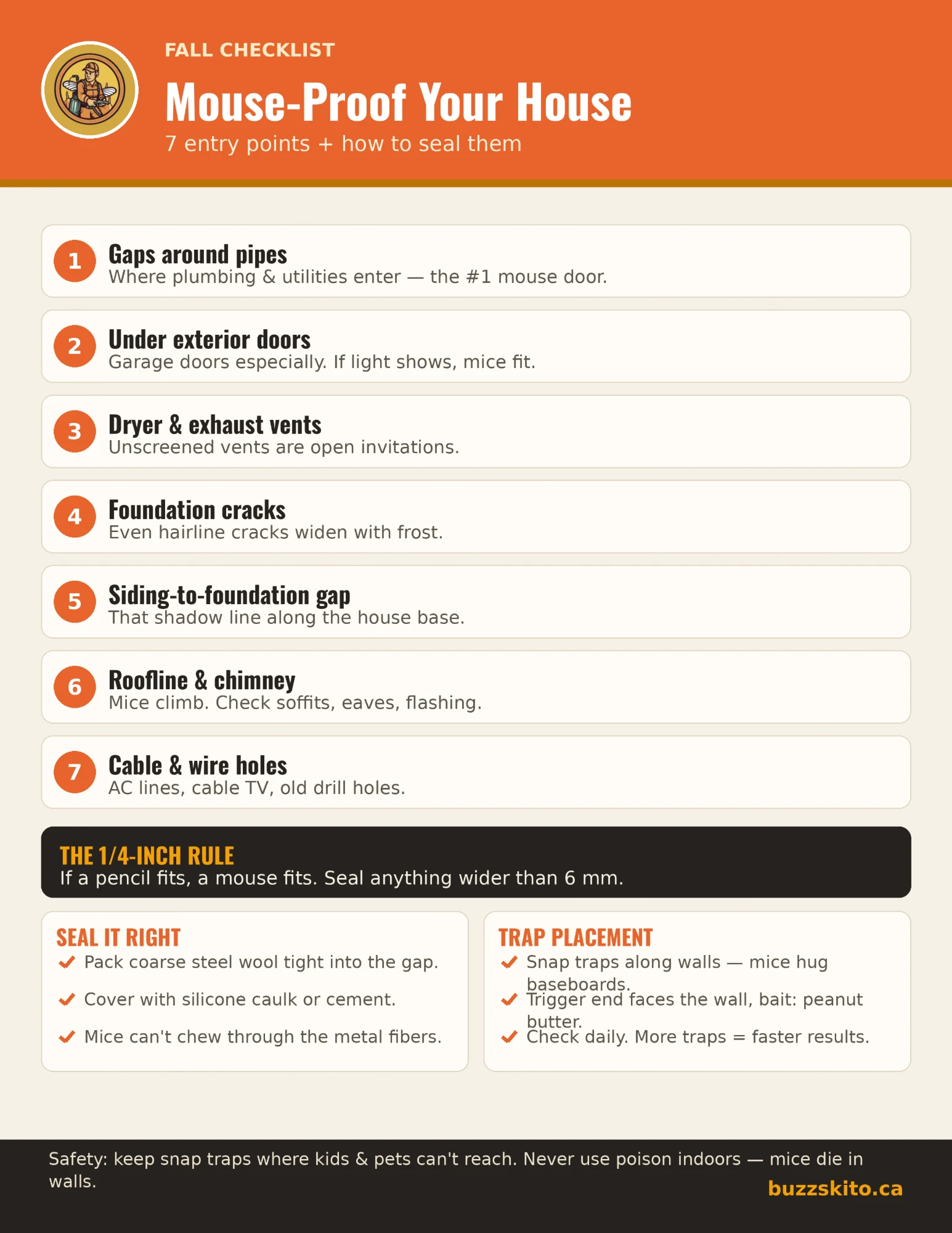 How to Mouse-Proof Your House: A Fall ChecklistA fall checklist for mouse-proofing a house: the 7 entry points to seal, the 1/4-inch rule, the materials that last,…
- What Do Mice Eat? Diet, Water, Gnawing and Why Peanut Butter WorksMice eat mostly seeds and grain, about 1/10 ounce a day in many small nibbles, and can live without drinking water.…
- Do Mothballs Keep Mice Away? What the Label and the Evidence SayMothballs do not reliably repel mice, and using them outside an airtight container is off-label. Why they fail, the…