
BuzzSkito Mosquito & Tick Control Specialists · Published July 21, 2026
What Is the Goodnature A24?
The Goodnature A24 is an automatic, self-resetting rat and mouse trap built around a small compressed-CO₂ cylinder. It is a different category of device from anything in the hardware-store rodent aisle: instead of one kill and a manual reset (snap trap), or a slow poisoned death you never witness (bait station), the A24 delivers an instant mechanical strike, ejects the carcass, and re-arms itself — over and over, for weeks, with no human in the loop. Originally engineered in New Zealand for landscape-scale conservation trapping, it has become the benchmark for hands-off, poison-free rodent control worldwide.
That pedigree matters. Goodnature traps are deployed by the tens of thousands across New Zealand’s national predator-control programs, where reliability and humane kill standards are non-negotiable and traps sit unchecked in remote bush for months. The consumer A24 you can buy in Canada is the same core mechanism, sized for the rats and house mice that get into GTA garages, barns, and foundations.
How Does the A24 Actually Work?
The mechanism is elegant. A rodent, drawn by a long-life lure smeared at the mouth of the trap, pushes up into a chamber sized for its head. That movement trips a leaf-spring trigger, which releases a piston driven by the compressed CO₂. The piston strikes the skull with high energy — a fast, humane kill — then retracts. The dead rodent, no longer holding itself up, simply drops out the bottom of the trap onto the ground (or into whatever you place below), and the trap resets to its armed position in seconds.
The “24” in the name is the strike budget: a single 16-gram CO₂ canister holds enough gas to power up to 24 strikes before it needs replacing. Between the auto-reset and that strike budget, the trap can run genuinely unattended — the exact opposite of a snap trap that is “done” the moment it fires once. Add the long-life lure (formulated to stay attractive for roughly six months) and you have a device you can set on a fence post in May and barely think about until fall.
Check current Canadian availability and pricing:
The Poison-Free Advantage: Why It Matters in Canada
The single most important thing about the A24 is what it does not contain: rodenticide. There is no poison anywhere on the device, which removes an entire class of risk that bait stations carry. A dog or cat cannot reach a toxic bait; a curious child cannot get at pellets; and — the one that keeps wildlife biologists up at night — there is no secondary poisoning. When a rodent eats an anticoagulant bait and then dies slowly outdoors, the poison is still in its body, and the hawk, owl, or fox that scavenges the carcass is poisoned in turn.
That secondary-poisoning chain is exactly why British Columbia moved to permanently ban most second-generation anticoagulant rodenticides in 2023, and why raptor rehabilitation centres across Canada report rodenticide in a large share of the birds they treat. A mechanical trap breaks the chain entirely: the rodent is killed instantly and its body carries no toxin. If you have pets, kids, a backyard chicken flock, or simply do not want to add poison to your local food web, the A24 is the most defensible lethal option on the shelf. Our guide to what rat poison is actually legal in Canada maps how tightly these products are now regulated — and why poison-free tools keep gaining ground.
What Are You Actually Paying For? (Justifying the Spend)
Let’s be direct: the A24 costs many times what a pack of snap traps costs, and that price scares off a lot of buyers who then wonder if it is a gimmick. It is not — but you have to understand what the premium buys, because it buys real things that a $5 trap cannot deliver:
- Labour, not just a device. The auto-reset is the product. A snap-trap line during an active rat infestation demands a person checking, clearing, re-baiting, and re-setting every single morning. The A24 does all of that itself for weeks. On a property with steady pressure, you are paying to delete a daily chore.
- Continuous coverage. A fired snap trap is dead weight until you reset it — and rats keep coming overnight. The A24 is always armed, so it can kill several rodents in a single night. During peak pressure that continuous readiness is worth far more than the raw per-trap price suggests.
- Zero handling. You never touch bait, you never touch a carcass, and you never see a struggling animal. For squeamish households that alone justifies the upgrade.
- Poison-free peace of mind. No rodenticide near pets, kids, or wildlife — a benefit you cannot price but that many buyers value above everything else.
- Durability. This is a rugged, weather-resistant, mount-and-forget instrument built for years of outdoor conservation use, not a semi-disposable plastic clamshell.
Framed that way, the A24 is not competing with a $5 snap trap on price — it is competing with the hours you would otherwise spend tending a trap line, and with the poison you would otherwise put down. On the right property, it wins that comparison comfortably.
How to Choose: Is the A24 Right for Your Situation?
High-ticket does not mean “best for everyone.” The honest way to decide is to match the tool to the size and shape of your problem:
- Buy the A24 if you have recurring or chronic rodent pressure — a rural or semi-rural property, a barn, shed, garage, chicken coop, compost area, or a home that keeps getting re-invaded no matter how many snap traps you set. This is where hands-off, always-armed, poison-free operation pays for itself.
- Buy the A24 if poison-free is a hard requirement — young kids, pets, or a personal objection to rodenticide and its wildlife toll.
- Skip the A24 if you have a single mouse in the kitchen or a one-time incursion. A few well-placed snap traps will solve that for the price of a coffee, and the auto-reset premium is wasted.
- Think twice if your only placement is an unheated space in deep Canadian winter. Sub-zero cold reduces CO₂ pressure and reliability; shoulder-season and heated placements are where the A24 is most dependable.
If you are still triaging what you are even dealing with — mouse versus rat, and how bad — start with our full playbooks on getting rid of rats in Canada and getting rid of mice in Canada, then come back here once you know you have the kind of recurring pressure the A24 is built for.
A24 vs Snap Trap vs Bait Station: The Honest Comparison
Here is how the three main lethal options stack up for a Canadian home. Note what wins where — there is no single “best” that ignores your situation.
| Option | How it works | Resets itself? | Poison / wildlife risk | Best for | Price check |
|---|---|---|---|---|---|
| Goodnature A24 | CO₂-driven strike, auto-clears & re-arms | Yes — up to 24/canister | None — fully poison-free | Chronic rat pressure; hands-off; poison-free homes | Check price on Amazon.ca → |
| Snap trap | Mechanical bar; one kill per set | No — manual reset | None — poison-free | Single rodent or a short, attended trap line | Check price on Amazon.ca → |
| Bait station | Enclosed rodenticide; delayed kill | N/A — refill bait | Poison + secondary-poisoning risk | Heavy exterior infestations where legal | Check price on Amazon.ca → |
The A24 is a mechanical device, not a pesticide, so it needs no PMRA registration — the same frictionless, fully legal status snap traps enjoy. Bait stations, by contrast, put you into the tightening web of Canadian rodenticide rules covered in our rat poison legality guide.
CO₂ and Lure: The Ongoing Cadence
The one thing snap-trap owners are not used to is consumables. The A24 has two: the CO₂ canister and the lure. Neither is expensive, but both need a rhythm so the trap never quietly stops working:
- CO₂ canister — roughly every 6 months, or after ~24 strikes. Even if the strike count is low, a canister slowly bleeds pressure over time, and Canadian cold accelerates it. Swapping on a calendar (spring and fall) is the simplest reliable habit; during an active infestation, check sooner.
- Lure — roughly every 6 months. The long-life lure stays palatable for about half a year, but dried or hardened lure stops attracting rodents entirely. Fresh lure is the biggest single driver of catch rate, so refresh it at the start of your season and after any long cold snap.
- Optional digital counter. The Goodnature Counter clips on and logs every strike with a running total. On a remote or infrequently checked placement — cottage, back shed, rural fence line — it converts guesswork into a maintenance schedule: you know exactly how many rodents you have killed and when to service the trap.
Placement: Getting the Most From Your A24
A premium trap in the wrong spot underperforms a cheap trap in the right one. The rules follow how rats and mice actually move:
- Mount it vertically on a runway. Fix the A24 to a wall, post, joist, or fence about 10–12 cm off the ground, directly where you see droppings, grease rub marks, or worn trails. Rodents run along edges and vertical surfaces, not across open floor.
- Prioritize the pressure points. Foundation lines, shed and garage corners, near burrow entrances, and along a fence close to a compost bin or chicken coop are where activity concentrates.
- Give it a few days. Rats are neophobic — they avoid new objects at first. Leave the trap undisturbed and let them grow comfortable before you expect strikes. Pre-baiting the area with a little extra lure nearby can speed acceptance.
- Manage the carcass drop. Because the rodent falls out the bottom, place the trap where a scavenger (or your dog) will not immediately grab the body — and clear carcasses when you service it.
And remember that trapping is only half the job. Rodents got in through a gap — a rat needs only about a 2 cm hole — and until you seal entry points you are running a catch-and-refill program. Pair the A24 with proper exclusion using our rodent exclusion kit guide so the next rat never reaches the runway in the first place.
Is the A24 Humane?
Among lethal options, it is one of the most humane a consumer can buy. The CO₂-driven piston delivers a fast, high-energy strike to the head, and independent animal-welfare assessments in New Zealand — where these traps run at national conservation scale — have rated the A24 favourably against humane-kill benchmarks. Compare that to the alternatives it displaces: a glue board kills by hours of stress and dehydration, and an anticoagulant poison kills by internal bleeding over days. If a fast, low-suffering kill matters to you, a well-maintained A24 is a genuinely strong ethical choice — far ahead of the methods it replaces.
The Bottom Line
The Goodnature A24 is not for everyone, and any review that pretends otherwise is selling you something. For a single mouse, buy snap traps. But for a Canadian household with recurring rat pressure — a barn, a coop, a compost-fed alley, a foundation that keeps getting breached — who wants a hands-off, poison-free, humane solution that works unattended for weeks, the A24 is the standout instrument on the market. You are paying for deleted labour, continuous coverage, and a food web with no rodenticide in it. On the right property, that is money well spent. If you are weighing DIY tools like this against hiring a professional, our Canadian pest control cost guide breaks down what recurring rodent work runs.
Frequently Asked Questions
What is the Goodnature A24 and how does it work?+
The Goodnature A24 is an automatic, self-resetting rat and mouse trap powered by a small CO₂ cylinder. A rodent enters the trap chamber chasing a long-life lure, triggers a leaf spring, and a piston driven by the compressed CO₂ delivers a fast, humane strike to the head. The dead rodent drops out the bottom and the trap resets itself in seconds — ready for the next one. Because a single 16g CO₂ canister powers roughly 24 strikes, the A24 can keep working unattended for weeks, which is the whole point: you are not re-setting a snap trap every morning.
How many kills do you get per CO₂ cylinder on the A24?+
Goodnature rates the standard CO₂ canister at up to 24 strikes — that is where the "A24" name comes from. In real Canadian use you should treat 24 as a ceiling, not a guarantee: cold garages and sheds reduce CO₂ pressure, and a canister left in place for months slowly loses charge even without firing. A practical cadence is to swap the canister every 6 months regardless of the strike count, and sooner during an active infestation. The optional digital counter accessory shows the exact strike tally so you are never guessing.
Is the Goodnature A24 poison-free and safe around pets and children?+
Yes — this is the A24's single biggest advantage. It uses zero rodenticide, so there is no poison for a dog, cat, child, or wild raptor to reach, and critically no secondary poisoning: nothing eats a poisoned carcass and gets sick, which is the exact wildlife problem that has led British Columbia to ban most second-generation anticoagulant rodenticides. The strike mechanism sits deep inside a chamber sized for a rodent's head, mounted up off the ground, so paws and fingers cannot reach the trigger. It is the closest thing to a genuinely worry-free lethal trap sold in Canada.
Is the Goodnature A24 worth the money versus cheap snap traps?+
It depends on whether you have a one-time mouse or a recurring rat problem. For a single rodent in the kitchen, a $5 snap trap wins on pure math. The A24 earns its premium price when you have chronic pressure — a rural property, a barn or chicken coop, a compost-fed alley, or a home that keeps getting re-invaded — because it keeps killing 24/7 for weeks with no daily resets, no bait touching, and no dead-rodent handling. Over a season of steady rat activity, one A24 quietly does the work of a person checking a dozen snap traps every morning.
Can the A24 be used both indoors and outdoors?+
Yes. It is weather-resistant and designed to mount on a wall, fence post, tree, or joist, which makes it well suited to garages, sheds, barns, crawl spaces, decks, and along exterior foundations where rats run. Mounted 10–12 cm off the ground on a vertical surface, it sits on the runway rats naturally use and stays out of reach of pets. Indoors it works equally well in a basement, utility room, or under a deck. The main outdoor caveat is Canadian cold: sub-zero temperatures cut CO₂ performance, so a deep-winter placement is less reliable than a shed in shoulder season.
Does the Goodnature A24 kill rats, mice, or both?+
Both. The standard A24 is designed and rated for rats and mice, and the strike energy is more than enough for either. Goodnature also sells species-tuned lures — a rodent lure that works broadly, plus specific formulations — so you can bias the trap toward whatever you are fighting. If your problem is clearly mice-only in a dry indoor space, a set of snap traps or an electronic trap may be more cost-effective; the A24's value is highest where rats, or a mix of rats and mice, keep coming back.
How often do you replace the lure on the A24?+
Goodnature's automatic lure pump (ALP) or long-life lure is formulated to stay palatable for roughly 6 months, which is another reason the trap can run unattended — you are not re-baiting every few days like a snap trap. In practice, check the lure at the start of your rodent season, at the mid-point, and after any long cold snap, and replace it if it has dried out or gone hard. Fresh lure is the single biggest factor in catch rate: a perfectly working trap with stale lure simply stops getting visited.
What is the digital strike counter and do I need it?+
The Goodnature Counter is an optional accessory that clips onto the trap and logs every strike, showing the running total and recent activity. You do not strictly need it, but on a remote or infrequently checked placement — a cottage, a back shed, a rural fence line — it turns guesswork into data: you know exactly how many rodents have been killed and roughly when to swap the CO₂ and lure. For a single, easily inspected trap in your own garage it is optional; for anything you cannot eyeball daily it is genuinely useful.
How does the A24 compare to a bait station in Canada?+
A bait station holds rodenticide and relies on the rodent eating enough poison to die later — often inside a wall void where it rots, and always with some secondary-poisoning risk to pets and wildlife. The A24 delivers an instant mechanical kill with no poison at all, drops the carcass where you can see and remove it, and cannot poison a hawk or a dog. Bait stations are cheaper up front and can cover heavy exterior infestations, but if your priority is a poison-free home with no dead-in-the-wall smell, the A24 is the safer instrument. Our rat poison legality guide covers exactly which baits are still legal for Canadian consumers.
Is the A24 humane?+
It is designed to be among the most humane lethal options available. The CO₂-driven piston delivers a fast, high-energy strike to the head, and independent animal-welfare assessments in New Zealand — where Goodnature traps are used at national conservation scale — have rated the A24 favourably against humane-kill standards. That is a meaningfully different proposition from a glue board (a slow death over hours) or an anticoagulant poison (internal bleeding over days). If humane kill is a priority for you, a correctly maintained A24 is one of the strongest choices a consumer can buy.
What are the downsides of the Goodnature A24?+
Three honest ones. First, the up-front price is many times that of snap traps, so for a single rodent it is overkill. Second, it has consumables — CO₂ canisters and lure on a roughly 6-month cadence — so there is a modest ongoing cost that pure snap traps do not have. Third, cold hurts it: Canadian sub-zero temperatures reduce CO₂ pressure and can lower reliability in an unheated space mid-winter. None of these are dealbreakers for the buyer it is built for — someone with recurring rodent pressure who wants a poison-free, hands-off, humane solution — but they are the reasons it is not the right tool for every job.
Where should I place the Goodnature A24 for the best results?+
Mount it on a vertical surface — wall, post, joist, or fence — about 10–12 cm off the ground, directly on an active runway where you see droppings, rub marks, or grease trails. Rats travel along walls and edges, not open floor, so an A24 in the middle of a room catches little. Prioritize the base of foundations, the corners of a shed or garage, along a fence line near a compost or coop, and near burrow entrances. Give it a few days: rats are neophobic and may avoid a new object at first, so leave it undisturbed and let them get comfortable before the strikes start.
Related Rodent Guides
Keep reading
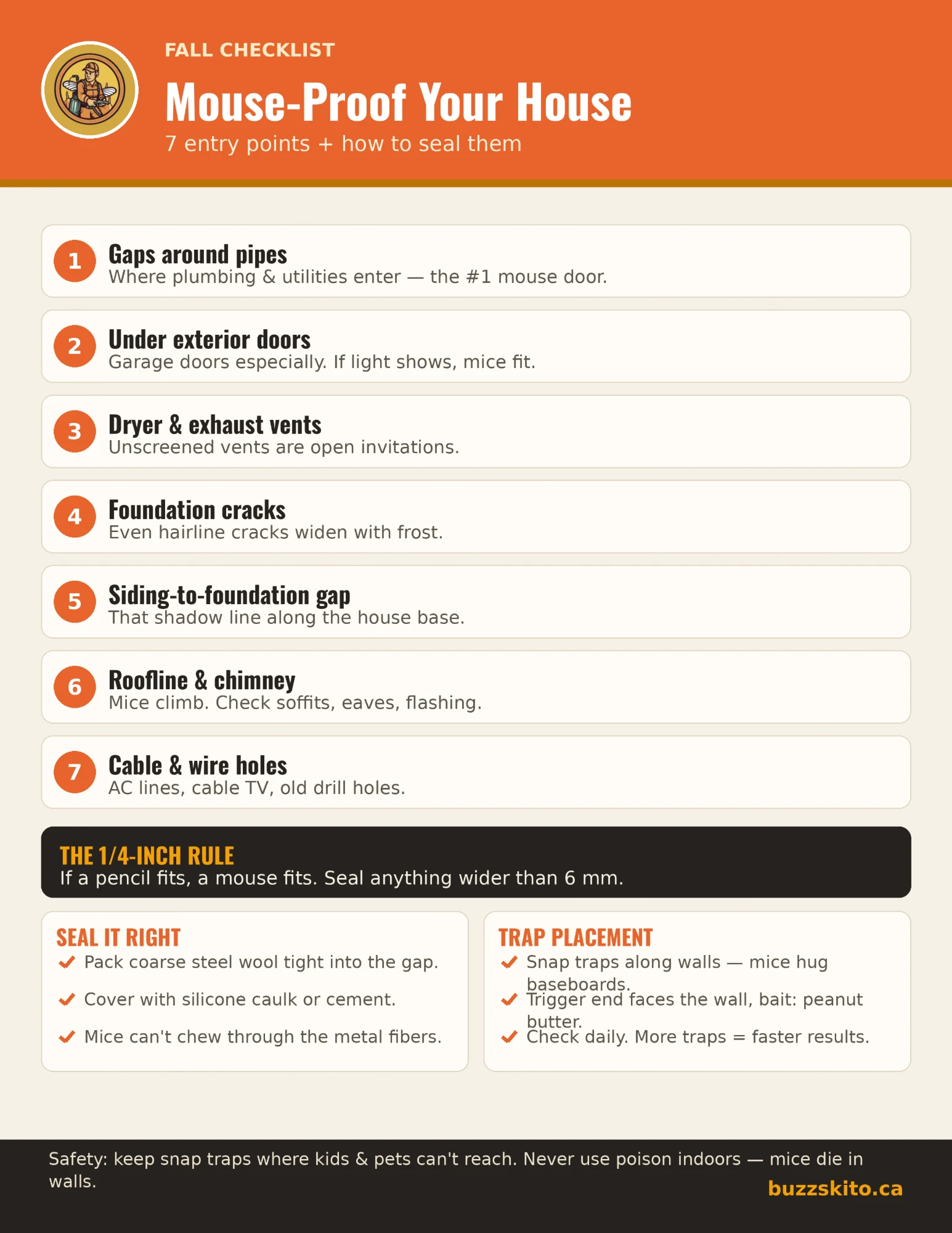 How to Mouse-Proof Your House: A Fall ChecklistA fall checklist for mouse-proofing a house: the 7 entry points to seal, the 1/4-inch rule, the materials that last,…
- What Do Mice Eat? Diet, Water, Gnawing and Why Peanut Butter WorksMice eat mostly seeds and grain, about 1/10 ounce a day in many small nibbles, and can live without drinking water.…
- Do Mothballs Keep Mice Away? What the Label and the Evidence SayMothballs do not reliably repel mice, and using them outside an airtight container is off-label. Why they fail, the…