
BuzzSkito Mosquito & Tick Control Specialists · Published July 16, 2026
Reading from the United States? Product rules and what is sold there differ. See the US edition.
What Is the Best Mouse Trap in Canada?
The Victor M325 wood snap trap is the best mouse trap for most Canadian households — the 1899-vintage design is still the benchmark that electronic and “smart” traps get measured against, and no other option matches its cost per catch. That answer comes with a structure: snap traps win on price and scale, electronic traps win on squeamishness, catch-and-release wins only on ethics (and only when used correctly), and glue boards lose on every axis that matters.
The reason a clear winner exists is arithmetic. Effective mouse control means deploying many traps at once — 6 to 12 for a typical kitchen problem — because a house mouse population compounds fast: a single female can produce 5–10 litters per year, with 5–6 pups per litter that are themselves breeding within 6–8 weeks. At snap-trap pricing you can afford a proper trap line on day one. At electronic-trap pricing, most people buy one unit, place it wrong, and conclude that “traps don’t work.” Before buying twelve of anything, confirm the pest: reading the droppings tells you whether you are dealing with mice, rats or bats, and a rat problem needs entirely different traps.
Snap vs Electronic vs Catch-and-Release vs Glue: How Do They Compare?
Here is how the four trap categories stack up for Canadian homes. Note what is not in this table: poison. Rodenticides are a last resort in Canada for legal and practical reasons we cover below.
| Trap type | Our pick | Kill / capture | Reusable? | Best for |
|---|---|---|---|---|
| Snap trap | Victor M325 (4-pack) | Instant mechanical kill when wall-placed | Dozens of catches per trap | Best overall — cheap enough to deploy 6–12 at once |
| Electronic trap | Victor M250S | High-voltage shock, dead in under 5 seconds | Up to 100 kills per 4×AA battery set | No-see, no-touch disposal; indoor dry areas |
| Catch-and-release | Motel Mouse (2-pack) | Live capture — no kill | Indefinitely reusable | No-kill households willing to release 2+ km away |
| Glue board | Not recommended | Slow death over hours–days | Single use | Nothing — inhumane, catches non-target animals |
Mouse traps are mechanical devices, not pesticides — none of them require PMRA registration, which is exactly why they are the frictionless, fully legal first move for any Canadian household.
Check current Canadian availability of the three picks:
Why Is the Victor M325 Snap Trap Still the Best?
Because mouse control is a numbers game, and the M325 is the only trap cheap enough to win it. The pre-baited, expanded-trigger version of the classic Victor design snaps in milliseconds — a correctly placed snap trap is rated by humane-research groups as one of the fastest, most humane kill methods available to consumers, faster than poison by days and faster than glue by hours. The same trap is the standard tool for voles in a lawn or orchard, though the placement rules differ completely — how to trap voles in their surface runways covers that variant.
The M325’s expanded plastic trigger (versus the old small metal tab) roughly doubles the strike zone, which matters because mice often trigger traps with a paw or shoulder rather than politely biting the bait. Wood-based traps also hold scent from previous catches, which — counterintuitively — attracts mice rather than repelling them. Field studies of trap lines consistently find previously used traps outperform brand-new ones.
Practical notes for Canadian buyers: buy more than you think you need (a 4-pack is a starting point, not a solution), wear gloves when setting to keep human scent off, and throw the trap away without guilt once it looks grimy — at this market price of a few dollars per trap, they are semi-disposable.
Are Electronic Mouse Traps Like the Victor M250S Worth It?
Yes — if your objection to snap traps is seeing or touching the result, the Victor M250S solves exactly that problem. The mouse enters a dark tunnel (mice love enclosed spaces), steps on metal plates, and a high-voltage shock kills it in under 5 seconds. A green blinking light tells you there is a catch; you hold the trap over a garbage bag and tip. No sight, no touch, no blood.
The numbers: up to 100 kills per set of 4 AA batteries, a tunnel design that pets and children cannot reach into, and a kill rate in independent tests that rivals well-placed snap traps. The limits: indoor dry locations only (no garages with condensation, no crawl spaces), one runway covered per unit, and an upfront cost per trap that is 15–20× a wooden snap trap. For a full teardown of long-term reliability, battery life in real Canadian basements, and the common false-trigger complaints, see our Victor electronic mouse trap review.
The smart deployment is hybrid: an M250S in the kitchen where you would rather not meet the result at breakfast, and cheap snap traps everywhere else.
Do Humane Catch-and-Release Traps Actually Work?
They catch mice well — the Motel Mouse two-door design is genuinely effective at live capture — but the “release” half is where the humane promise usually breaks down. Three hard truths the packaging never mentions:
- Check every few hours, not every morning. A mouse trapped without water can die of stress and dehydration overnight — which converts your humane trap into a slow kill trap.
- Release 2 km or more away. House mice have strong homing behaviour over shorter distances; release them at the end of your street and you may re-catch the same mouse within days.
- Winter release is often a death sentence. A house mouse released into a southern-Ontario January faces cold, predators, and no established food cache. Humane organizations acknowledge relocated mice have poor survival odds.
If you accept those constraints — frequent checks, a real drive to a release site, and ideally not mid-winter — catch-and-release is a legitimate no-kill option. If you cannot commit to them, a snap trap is more humane in practice than a neglected live trap.
Should You Use Glue Traps?
No — and this is the one category where we will be blunt. Glue boards catch mice by adhesive, and death typically comes from hours or days of stress, dehydration, or self-injury as the animal struggles. Humane Canada and the BC SPCA both oppose consumer glue-trap use, several Canadian municipalities discourage them in public guidance, and England and Wales banned public use outright in 2022. Glue boards also routinely catch non-target animals — songbirds, snakes, even bats.
The practical case against them is just as strong as the ethical one: they are single-use, they fail in dusty or cold locations (garage floors in a Canadian winter kill the adhesive), and a mouse that escapes one becomes intensely trap-shy. Every job a glue board can do, a snap trap does faster, cheaper per catch, and without the suffering.
Why Traps Before Poison in Canada?
Because the poison aisle Americans read about online largely does not exist here — and that is by design, not accident. The second-generation anticoagulant rodenticides (SGARs) that dominate US recommendations — brodifacoum, bromadiolone, difethialone — are not sold as domestic-class products in Canada. Health Canada’s PMRA restricts them to commercial-class use by professionals, and British Columbia went further, permanently banning most SGAR uses in 2023 over wildlife secondary-poisoning deaths in owls and hawks. Any US website telling Canadians to “just get Contrac or d-CON pellets” is recommending products you either cannot legally buy here or that were reformulated years ago.
What is legal for Canadian consumers: first-generation anticoagulants and bromethalin products in tamper-resistant stations — the Tomcat bromethalin disposable bait station being the main PMRA-registered consumer option. We map the full legal landscape in our guide to what rat poison is actually legal in Canada, and cover enclosed station options in the mouse bait station guide.
But even where poison is legal, traps should come first for mice. Poisoned mice frequently die inside wall voids — the smell of a decomposing mouse behind drywall lasts 2–3 weeks and there is no bait-station feature that prevents it. Traps give you a body count, which is the only honest metric of progress, and they carry zero secondary-poisoning risk to owls, dogs, and cats. Save bait stations for the rare exterior or scale problems traps cannot reach, and if you are weighing DIY against hiring someone, our Canadian pest control cost guide breaks down what professional rodent work runs.
Where Should You Place Mouse Traps? (The Placement Science)
Placement matters more than which trap you buy — a mediocre trap on the right wall outperforms the best trap in the wrong spot. The rules, all grounded in how mice actually move:
- Against walls, always. Mice are thigmotactic — they run with their whiskers brushing a vertical surface and almost never cross open floor. Set the trigger end touching the baseboard, perpendicular to the wall, so a mouse running the wall line in either direction crosses the trigger.
- Every 2–3 metres. Space traps 2–3 m apart along active walls, and double them up (two traps side by side, triggers facing opposite directions) at corners and behind appliances where traffic concentrates.
- Within 3–9 metres of the evidence. House mice forage close to the nest — droppings and gnaw marks tell you where the 9-metre circle is. Trapping a room with no evidence wastes traps.
- Pea-sized peanut butter, pressed in. A small smear forces the mouse to work the trigger; a generous glob lets it lick from the side and leave. In cold months, a cotton ball tied to the trigger exploits nesting drive instead of appetite.
- Mass deployment on night one. Studies of trap lines show the first night out-catches every subsequent night — mice investigate new objects quickly, then turn neophobic. Twelve traps for three nights beats two traps for three weeks.
- Darkness and quiet help. Behind the stove, under the sink, along the furnace room wall. Leave traps undisturbed; checking hourly with a flashlight suppresses activity.
Trapping is half the job. The mice got in somewhere — a gap of 6 mm (a pencil width) is enough — and until entry points are sealed, you are running a catch-and-refill program. Our guides on getting rid of mice in Canada and keeping mice out over winter cover exclusion step by step.
What About Ultrasonic Repellers and Other Shortcuts?
Skip them. Plug-in ultrasonic devices are the most heavily marketed “no-trap” option in Canada, and the evidence is uniformly poor: mice habituate to the sound within days, ultrasound does not pass through walls or furniture, and regulators — including the US FTC, repeatedly since 2001 — have challenged manufacturers over unsupported claims. We went through the published studies in detail in our ultrasonic repeller review; the short version is that the money buys you a night light. If your rodent signs point to something larger than a mouse — droppings over 1 cm, gnaw marks with visible tooth grooves — you are shopping in the wrong aisle entirely: see the best rat trap guide, because mouse traps physically cannot kill rats.
Frequently Asked Questions
What is the best mouse trap in Canada?+
For most Canadian homes, the classic Victor M325 wood snap trap is still the best overall mouse trap: it kills quickly when placed correctly, is reusable dozens of times, and a 4-pack covers a typical kitchen or garage problem for the market price of a coffee run. If you want no-touch, no-see disposal, the Victor M250S electronic trap is the best upgrade — it kills in seconds and manages up to 100 kills per set of 4 AA batteries. Choose a catch-and-release trap like the Motel Mouse only if you are committed to checking it every few hours and releasing mice at least 2 km from your house.
Are electronic mouse traps worth it in Canada?+
Yes, for specific buyers. Electronic traps like the Victor M250S deliver a high-voltage shock that kills in under 5 seconds, then a green indicator light tells you there is a mouse inside — you tip the body into the garbage without seeing or touching it. One set of 4 AA batteries handles up to 100 kills. The trade-offs: a much higher upfront cost than snap traps, they are for indoor dry locations only, and a single unit covers one runway while the same spend buys 15–20 snap traps you can deploy along every wall.
What is the best bait for a mouse trap?+
Peanut butter is the best all-round mouse trap bait in Canada — high fat, high protein, strong smell, and cheap. Use a pea-sized smear pressed into the bait cup; a large glob lets mice lick from the edge without triggering the trap. Good alternatives are chocolate spread, soft cheese worked into the trigger, and in fall and winter, nesting materials like a cotton ball tied to the trigger — pregnant females will fight for it. Skip the cartoon wedge of hard cheese; it dries out and underperforms almost everything else.
Where should I place mouse traps?+
Along walls, with the trigger end touching the baseboard, spaced every 2–3 metres in active areas. Mice have poor eyesight and run with their whiskers brushing a vertical surface, so a trap in the middle of a room catches almost nothing. Prioritize the wall behind the stove and fridge, under the kitchen sink, along the garage perimeter, beside the furnace and hot water tank, and anywhere you see droppings or rub marks. Mice rarely travel more than 3–9 metres from the nest, so cluster traps near the evidence.
How many mouse traps do I need?+
More than you think — under-trapping is the most common reason DIY control fails. A useful rule for an active infestation is one trap every 2–3 metres along walls where you have found droppings, and two or three traps placed side by side at high-traffic corners. For a typical Canadian kitchen that usually means 6–12 traps, not 2. Set them all on night one: research and pest-control field experience both show more mice are caught on the first night than any night after, before the survivors get trap-shy.
Are glue traps legal in Canada?+
Glue boards are legal to buy and use in most of Canada, but they are widely discouraged: humane organizations including Humane Canada and the BC SPCA oppose them because mice can take hours or days to die of stress, dehydration, or self-injury, and they routinely catch non-target animals like birds and snakes. England and Wales banned public glue-trap use in 2022 and several jurisdictions restrict them. Because a properly set snap trap is faster, cheaper per catch, and far more humane, we do not recommend glue traps for Canadian homes.
Do humane catch-and-release mouse traps work?+
They catch mice reliably, but the release part is where most people fail. Live-catch traps like the Motel Mouse must be checked at least every few hours — a trapped mouse can die of stress or dehydration surprisingly fast — and the mouse must be released 2 km or more from your home, because house mice can navigate back over shorter distances. Released mice also face poor survival odds outdoors, especially in a Canadian winter, so a catch-and-release program that ends at the fence line is neither effective nor as humane as it feels.
Is mouse poison better than traps in Canada?+
No — traps first is the right call for Canadian homes. The potent second-generation anticoagulant rodenticides (brodifacoum, bromadiolone, difethialone) that US websites recommend are not sold as domestic-class products in Canada; they are restricted to commercial applicators, and British Columbia has banned most SGAR uses outright since 2023. Poison also means mice frequently die inside wall voids where you cannot retrieve them, and any legal bait must sit inside a tamper-resistant station if kids or pets are around. The one PMRA-registered consumer option worth knowing is the Tomcat bromethalin disposable bait station — covered in our rat poison legality guide — but for mice, a dozen well-placed snap traps almost always solves the problem faster.
How do I know when all the mice are gone?+
Track evidence, not gut feeling. You are likely done when traps go 7–10 consecutive nights with no catches, no fresh droppings appear on a floor you swept clean, no new gnaw marks or scratching sounds show up, and a light dusting of flour along a suspected runway stays footprint-free overnight. Keep 2–3 baited traps in place for a couple of weeks afterward as sentinels, and move straight to exclusion — sealing entry points as small as 6 mm (a pencil width) — so the next mouse never gets in.
Why is my mouse trap not catching anything?+
The usual culprits, in order: the trap is not against a wall (mice run wall lines, not open floor), too much bait (use a pea-sized smear pressed into the trigger), too few traps (deploy 6–12, spaced 2–3 m apart), your scent on the trap (handle with gloves), and trap shyness after a near-miss. A proven fix for shy mice is pre-baiting: set traps out baited but unset for 2–3 nights so mice feed safely, then set them all at once. Also try switching baits — from peanut butter to chocolate or a cotton-ball nesting lure — since a food-rich kitchen can make your bait the least interesting option in the room.
Do ultrasonic repellers work instead of mouse traps?+
No. Health Canada has warned consumers about ultrasonic pest device claims, and controlled studies consistently show mice habituate to ultrasonic sound within days — the US Federal Trade Commission has pursued manufacturers over unsupported claims since 2001. Ultrasound also does not pass through walls or furniture, so the "coverage" figure on the box only applies to open line-of-sight. Money spent on plug-in repellers buys you nothing a trap line and sealed entry points would not do better; see our full ultrasonic repeller evidence review for the study-by-study breakdown.
How do I safely dispose of a dead mouse?+
Do not touch it bare-handed. Public health agencies in Canada recommend wearing disposable gloves, spraying the mouse and trap with a household disinfectant or 1:10 bleach solution and letting it soak 5 minutes, double-bagging the mouse, sealing the bags, and putting them in an outdoor garbage bin. Wash hands thoroughly afterward even though you wore gloves. Avoid sweeping or vacuuming dry droppings — wet them with disinfectant first — because dust from rodent droppings can carry pathogens; if you are dealing with a heavy accumulation, follow your local public health unit’s cleanup guidance.
Related Rodent Guides
- Victor Electronic Mouse Trap Review — Canada
- Best Rat Trap Canada — When Mouse Traps Aren’t Enough
- Mouse Bait Stations in Canada — What’s Legal and When to Use Them
- Rat Poison in Canada — What Is Actually Legal
- How to Get Rid of Mice in Canada — Full Playbook
- How to Keep Mice Out of Your House This Winter
- Ultrasonic Pest Repellers — Do They Actually Work?
Keep reading
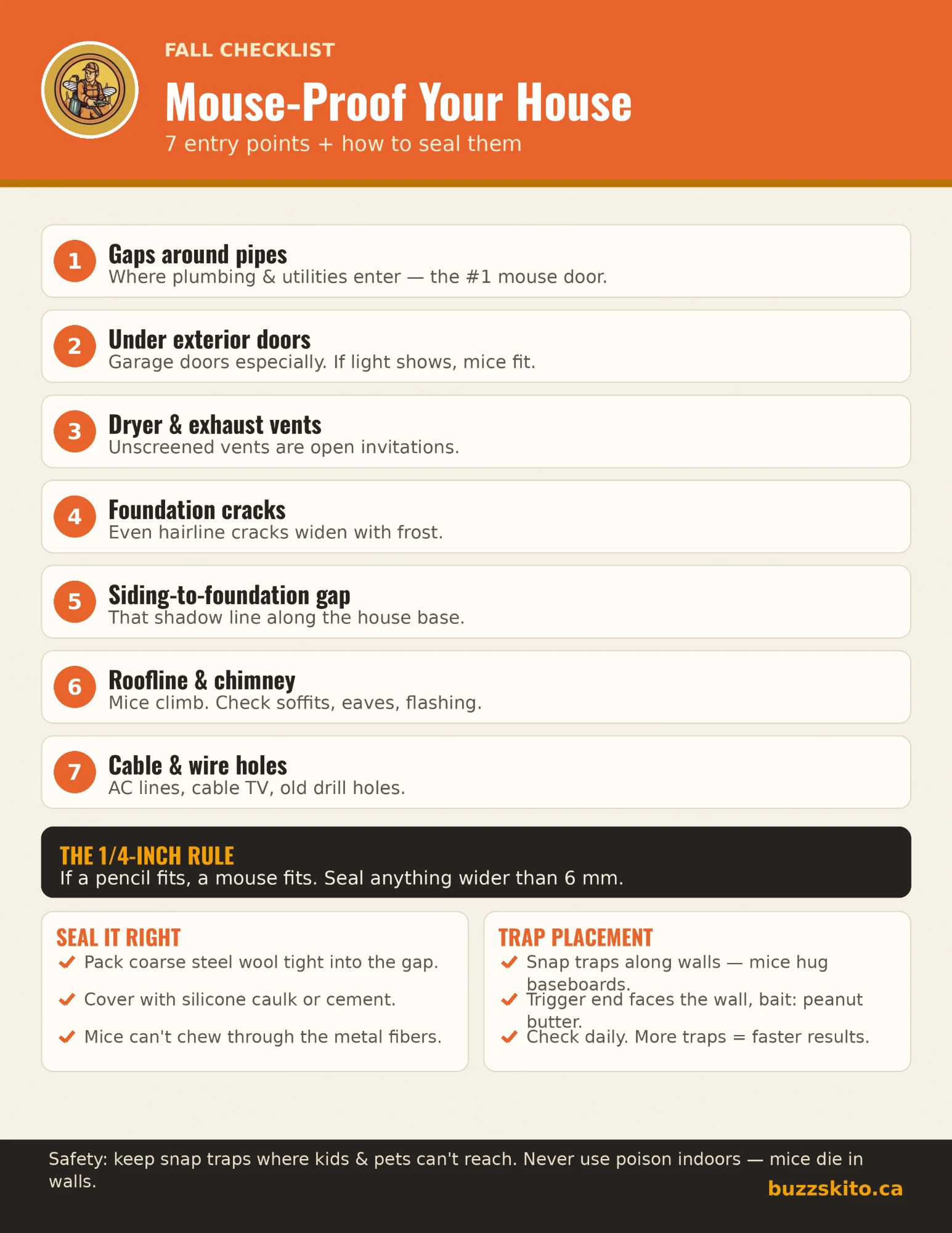 How to Mouse-Proof Your House: A Fall ChecklistA fall checklist for mouse-proofing a house: the 7 entry points to seal, the 1/4-inch rule, the materials that last,…
- How to Get Rid of Mice Humanely: Seal Them Out, Trap Quickly, Clean Up SafelyThe most humane way to get rid of mice is to seal every gap over 1/4 inch, then remove the mice inside with snap traps.…
- Mouse Repellent in Canada — What Actually Repels a Mouse, and What Just Sells WellMouse repellent in Canada: which types have real evidence, why ultrasonic and peppermint fail, and the…