
BuzzSkito Mosquito & Tick Control Specialists · Published July 16, 2026
Reading this from the United States?
This guide was written in Canada and the price-check buttons point at Amazon.ca, because that is the store we are an affiliate of. The rat biology, the trap mechanics and the pre-baiting protocol cross the border unchanged. Four things do not, and each has its own section below:
- Species and placement. Norway rats are nationwide in the US, but roof rats hold the South, Gulf, Pacific Coast and Hawaii — where attic trapping is correct, not a mistake. Which rat do you have in the US →
- Rodenticide law. The EPA restricted second-generation anticoagulants out of US consumer products in 2008, and California went further in 2020 and 2024. US poison law →
- Glue traps. No US statewide ban exists, but four California cities have prohibited them. US glue trap law →
- Model numbers and shelves. M326, BM205, M241, Rat Zapper, Power-Kill, Safe-Set — and where they sit in US stores. US model numbers →
Every metric measurement on this page is converted to imperial in the conversion table near the end.
Compare the three traps this guide recommends on Amazon.ca:
Why Do Mouse Traps Fail on Rats?
Because of mass. An adult Norway rat weighs 200–500 grams; a house mouse weighs 15–30 grams. A mouse trap’s spring bar is engineered to break the neck of a 20-gram animal — against a rat that’s 10–20 times heavier, it delivers a painful pinch instead of a kill. The rat tears free, and now you have a bigger problem than before: a trap-shy rat.
Trap-shyness is the reason sizing matters so much. Rats are intelligent, cautious animals that learn from a single bad experience and transmit avoidance behaviour to the rest of the colony. A rat that survives a mouse-trap strike will refuse to approach anything trap-shaped for weeks — sometimes permanently. Rat traps are built to close the deal the first time: roughly twice the footprint of a mouse trap, with several times the spring force. If you’re actually dealing with mice (3–6 mm pointed droppings rather than 12–19 mm blunt capsules), you want our best mouse trap Canada guide instead — the reverse mistake, rat traps for mice, wastes money and risks a nasty injury to fingers and paws.
Which Rat Trap Should You Buy in Canada?
Three traps cover essentially every home situation, and all three are traps rather than pesticides — rodent traps are not among the devices prescribed in Schedule 1 of the Pest Control Products Regulations, so no PMRA registration applies — and they are safe to use in kitchens, basements, and garages when placed sensibly.
1. Victor Metal Pedal Rat Snap Trap — best overall
The wooden Victor rat trap has been in production since the 1890s for a reason: nothing beats its kill-rate-per-dollar. The metal pedal trigger is sensitive enough for a cautious rat but stiff enough not to false-trigger, the spring bar generates genuine rat-killing force, and each trap survives years of catches. Because they cost so little, you can deploy the 4–6 traps a real infestation demands — the single biggest tactical advantage over pricier options. Downsides: setting the bar takes some hand strength and a little nerve, and disposal means seeing the rat.
2. Victor Electronic Rat Trap — best no-touch, no-see option
The Victor Electronic Rat Trap lures the rat into an enclosed tunnel and delivers a 6,000-volt shock. That figure comes from Victor’s own published M241 FAQ; Victor publishes neither a shock duration nor a time-to-death, so we do not invent either. A green indicator light signals a catch, and disposal is tipping the chamber over the garbage without ever seeing the animal. Four C batteries yield roughly 50 kills. The trade-offs: it costs several times what a snap trap does, it’s indoor-only — Victor’s support FAQ states the M241 cannot be used outdoors because its batteries and electronics cannot be exposed to the elements, and Victor’s weather-resistant Zapper Max (M460UC) is the separate model rated for outside — battery output drops in freezing garages, and one unit handles one rat at a time. It shines for a light infestation — one or two rats — in a kitchen, apartment, or finished basement where squeamishness would otherwise stop you from trapping at all. We reviewed the mouse-sized version separately in our Victor electronic mouse trap review; the rat unit is the same concept scaled up.
3. Tomcat Rat Snap Trap — easiest to set
Tomcat’s moulded-plastic rat snap trap sets with one press of a foot or hand — no fingers near the strike zone — and its interlocking teeth grip rather than relying purely on impact. It’s slightly less powerful than the Victor wood trap on the largest rats but far less intimidating to arm, washable, and it includes a removable bait cup you can fill and click in place before setting. If the Victor’s spring bar has ever snapped on your thumb, this is your trap.
There is a fourth category worth knowing about if your rat problem never really ends: a CO₂-powered trap that strikes, drops the carcass clear, and re-arms itself, so it keeps working unattended instead of being “done” the moment it fires once. It costs many times what any of these three do, which is why it only earns its place against chronic pressure — we work through that maths in our Goodnature A24 review for Canada.
Rat Trap Comparison Table
| Option | Type | Kill method | Reusable | Best for |
|---|---|---|---|---|
| Victor Metal Pedal | Wood snap trap | Spring bar — instant | Yes, for years | Active infestations, multi-trap deployments |
| Victor Electronic | Battery kill chamber | 6,000 V shock, enclosed chamber | ~50 kills per battery set | No-touch, no-see indoor trapping |
| Tomcat Rat Snap | Plastic snap trap | Toothed jaw — instant | Yes, washable | Easy foot-press setting, bait cup |
| Bromethalin disposable station | Rodenticide (PMRA domestic) | Poison bait, 1–2 days | No — sealed single-use | Inaccessible areas; last resort after traps |
| Glue boards | Adhesive | Slow — not recommended | No | Not recommended for rats — escapes + welfare |
Do You Have Norway Rats or Roof Rats?
If you’re in the GTA — or almost anywhere in Ontario — you have Norway rats. Rattus norvegicus is a heavy-bodied, blunt-nosed burrower with a tail shorter than its body. It travels at ground level, digs burrows along foundations, under decks, sheds, and compost bins, and enters homes through floor-level gaps, weeping tile, and sewer connections. Toronto, Mississauga, Brampton, and Hamilton rat complaints are overwhelmingly Norway rats, and construction excavation is a well-documented trigger for neighbourhood-level surges as burrow systems get displaced.
Roof rats (Rattus rattus) — slimmer, larger-eared climbers with tails longer than their bodies — are established in coastal British Columbia but remain rare in Ontario. This matters for trap placement: US websites written for California or Florida tell you to trap in the attic and along rafters. In the GTA, that advice wastes your traps. Place traps low — basement perimeter walls, behind the furnace and appliances, near floor drains, along garage walls, and beside outdoor burrow entrances. If you have persistent attic noise in Ontario, the culprit is more likely squirrels, raccoons, or mice than rats — and if it is mice, our guide on keeping mice out in winter covers the exclusion work.
Which Rat Do You Have in the United States?
The paragraph above is written for Ontario, where the answer is almost always a Norway rat and trapping high wastes your traps. If you are reading this from the United States, the answer branches by region — and in much of the country the attic advice is correct, not a mistake. Norway rats (Rattus norvegicus) occur nationwide across the US. Roof rats (Rattus rattus) hold the lower East Coast, the Gulf states north into Arkansas, the entire Pacific Coast and Hawaii, with documented inland pockets in metros such as Kansas City. Most of the Great Plains and the interior north is roof-rat-free, which is why a Nebraska homeowner and a Fort Lauderdale homeowner should not be given the same placement instruction.
The practical difference is vertical. Norway rats burrow and travel at ground level, so traps go low: basement perimeter walls, behind appliances and the furnace, along garage walls, beside burrow entrances. Roof rats are agile climbers with tails longer than their bodies; they enter along utility lines and overhanging branches and nest in attics, soffits, palms, garages and dense landscaping, so traps go high — on rafters, joists, the tops of fences and wall plates — secured with wire so a trap cannot fall onto someone below. In roof-rat territory, run both: high traps for the climbers, ground-level traps near sewer lines and water for the Norway rats that share the same city.
| Where you are | Species most likely | Trap placement |
|---|---|---|
| Ontario & most of Canada | Norway rat | Low only — basements, garages, burrows |
| US Northeast & Midwest (NY, Boston, Philadelphia, Chicago, Detroit) | Norway rat | Low — basements, alleys, sewers, foundations |
| Great Plains & interior north | Norway rat; roof rats largely absent | Low — outbuildings, grain storage, foundations |
| Southeast & Gulf (FL, GA, AL, MS, LA, TX coast, north into AR) | Roof rat dominant; Norway rat in urban cores | High first — attics, soffits, rafters — then ground level |
| Pacific Coast & Hawaii (CA, OR, WA) | Roof rat in most neighbourhoods; Norway rat near water and sewers | High first — attics, garages, fruit trees, ivy — then ground level |
| Desert Southwest (AZ, NM, NV, UT, inland CA) | Roof and Norway rats, plus packrats (woodrats) | Snap traps for rats; cage traps for packrats — see below |
| Coastal British Columbia | Roof rat established alongside Norway rat | Both heights — the one Canadian region where attic trapping applies |
Packrats are a third animal, and a snap trap is the wrong tool
Across the western US deserts there is a rodent this guide’s three picks are not designed for. Packrats — properly woodrats, genus Neotoma, with roughly 23 species and their greatest diversity in the arid Southwest; the white-throated woodrat (N. albigula) is the common Arizona one — build large stick middens, hoard shiny objects, and are notorious for nesting in the engine bays of parked vehicles and chewing through wiring harnesses. If your problem is a nest of sticks and cholla joints under the hood of a truck that has sat for a fortnight, you do not have a Norway rat problem and a snap trap on the garage floor will not solve it.
The standard approach is a cage-style live trap set on the runway between the midden and the vehicle or structure, combined with habitat work: clearing brush, woodpiles and packrat middens away from buildings, and simply running the vehicle regularly so the engine bay never becomes still. Two cautions. Relocating rodents is restricted or prohibited in many US states and Canadian provinces — check your state wildlife agency before moving anything. And the US Centers for Disease Control and Prevention advises against sweeping or vacuuming rodent nesting material dry; wet it down with a disinfectant solution first, the same protocol the disposal FAQ below describes for rat droppings.
What Is Pre-Baiting — and Why Do Trap-Shy Rats Demand It?
Pre-baiting is the technique that separates people who catch rats from people who conclude traps don’t work. Rats are strongly neophobic — they treat any new object in their territory with suspicion and will detour around it for 3–7 days before investigating. Set a fresh trap on night one and the colony simply waits you out; worse, if a young rat trips it and escapes, the whole colony learns.
The protocol:
- Nights 1–3 (or up to 5): place traps baited but unset along active runways. Let the rats eat freely off the trigger plates.
- Confirm feeding: once bait disappears consistently for two nights running, the traps are now “safe objects” in the colony’s map.
- Arm everything at once: re-bait and set every trap the same evening. The first 24–48 hours after arming typically produce the majority of your total catch — before survivors connect the deaths to the traps.
- Don’t relocate too fast: if a set trap goes untouched, leave it 4–5 more nights before moving it; moving traps daily restarts the neophobia clock.
Bait with a half-teaspoon of peanut butter smeared onto the trigger, or tie a piece of bacon or dried fruit to the trigger with sewing thread so the rat must pull. Wear gloves when handling traps — both for hygiene and because heavy human scent on a brand-new trap adds suspicion.
What Gets Rid of Rats the Fastest?
A pre-baited multi-trap first strike. Leave four to six or more rat-sized snap traps baited but unset for three to five nights, then arm every one of them on the same evening. Most of a small colony falls in the first 24 to 48 hours after arming. Rodenticide is slower — typically three to ten days — and kills inside wall voids.
The counter-intuitive part is that speed comes from simultaneity, not from a better trap. A single trap set on night one is fighting the neophobia window alone: the colony detours around it for the better part of a week, and the first rat to trip it and escape teaches the rest. Six traps armed together after pre-baiting attack a colony that has already accepted the hardware as scenery, and they all fire before the survivors have anything to learn from. That is the whole mechanism behind “the fastest way,” and it is why the cheap wooden trap outperforms an expensive one here — you can afford six of them.
Three things reliably slow the clock down, whatever hardware you buy: a competing food source (open compost, pet bowls, spilled bird seed) that beats your bait, traps placed in open floor rather than tight to a wall, and moving traps every day, which restarts the neophobia clock every time. Fix the food competition before you set anything.
| Method | Typical first catch | Small colony cleared | Catch |
|---|---|---|---|
| Pre-baited snap traps, 4–6 armed together | Night 1–2 after arming (day 4–7 overall) | 1–2 weeks | Requires patience through the unset phase |
| Snap traps set immediately, no pre-baiting | 5–14 days | 3–6 weeks, often never finished | Creates trap-shy survivors |
| Single electronic trap | 3–10 days | Several weeks | One rat per cycle; indoor-only |
| Bucket / multi-catch trap | 3–10 days | 1–3 weeks | Must be checked daily; run dry |
| Consumer rodenticide bait station | 3–10 days to death | 2–4 weeks | Carcasses die out of sight, often in walls |
| Ultrasonic repeller | — | — | Not a control method; rodents habituate |
What Is a Rat’s Biggest Fear?
Anything new. Rats are strongly neophobic: a new object in an established territory gets avoided for three to seven days no matter how good the bait on it smells. That single trait — not intelligence, not strength — defeats most home trapping attempts. It is also the one you exploit, by pre-baiting traps unset until the colony treats them as furniture.
It is worth understanding how specific this is, because it explains why the same trap that fails on a rat works on a mouse the first night. Mice are broadly the opposite: curious, exploratory, likely to investigate a novel object within hours. Rats are conservative about their own established territory in particular — a resident adult that has mapped every object in a basement notices the one that appeared yesterday. Young dispersing rats and animals in a brand-new environment (a fresh construction displacement, for instance) are much less cautious, which is why the odd person does catch one on night one and concludes everybody else is overthinking it.
Two lesser fears are worth knowing, and one common product trades on a third that does not hold up:
- Open ground. Rats are thigmotactic edge-runners — they travel with a wall or object against one flank and cross open floor only under pressure. A trap in the middle of a room is a trap in a place rats deliberately avoid.
- Light and exposure. Activity is overwhelmingly nocturnal. Rats seen moving in daylight usually indicate either a large population competing for food or a disturbed nest, both of which argue for more traps rather than fewer.
- Predator scent — unreliable. Fox, coyote and cat urine products are sold on the premise of an innate fear response. Rodents habituate to a static scent source quickly, and Health Canada’s pesticide registry lists no predator-scent product registered in Canada for repelling rats or mice at all. Do not build a plan around them.
What Bait Is Irresistible to Rats?
None — not to a rat that has not yet accepted the trap. Placement and pre-baiting beat bait choice every time. Among baits, peanut butter is the most reliable: high fat, high protein, strong odour, and impossible to snatch off the trigger. Bacon, hot dog, hazelnut spread, dried fruit and unshelled nuts are the strongest alternatives.
Use a pea-sized amount, or about a half-teaspoon smeared directly into the trigger plate. Overloading the trigger is a classic own goal: a generous blob lets the rat feed from the edge without ever putting weight where the mechanism needs it. Solid baits — a cube of bacon, a slice of hot dog, a dried apricot — should be tied on with sewing thread or dental floss so the animal has to tug rather than lift, which is exactly the motion that fires the trap.
Species matters here, and it is a US-specific point. Norway rats lean strongly to protein and fat, which is why peanut butter and meat work so well in Ontario, the US Northeast and the Midwest. Roof rats — the dominant rat across the US South, Gulf and Pacific Coast — are more frugivorous: dried fruit, nuts, avocado, citrus segments and berries frequently out-pull peanut butter in Florida and coastal California, and a roof rat living in a fruiting tree may simply not be hungry for anything you offer until the fruit is cleared. If a bait is ignored for three or four consecutive nights, switch it rather than waiting it out.
Two extras worth knowing. In cold months, nesting material can outperform food — a wisp of cotton wool, dental floss or shredded paper wound around the trigger appeals to a rat furnishing a winter nest. And handle traps with gloves: heavy fresh human scent on a brand-new object adds one more reason for a neophobic animal to walk around it.
Where Should You Place Rat Traps?
Rats are edge-runners: they travel with a wall or object against one flank, almost never crossing open floor. Read the evidence first — droppings, greasy rub marks at baseboard height, gnawing, and tracks in dust all mark active runways.
- Perpendicular to the wall, trigger end touching the baseboard, so the rat crosses the trigger whichever direction it’s travelling.
- 3–5 metres apart along the active wall — and pairs of traps side by side catch rats that jump the first one.
- Behind and under things: appliances, the furnace, stored boxes, deck edges, shed perimeters, beside burrow openings.
- Away from kids and pets: a rat snap trap can break a finger or seriously injure a paw. In homes with either, place snap traps inside a locked rodent bait/trap station or restrict them to inaccessible zones — our bait station guide explains the station options sold in Canada.
- Remove competing food: secure compost, pet food, bird seed, and garbage first. A rat with easier calories available will ignore the best-baited trap in the country.
How Do the Amish Traditionally Get Rid of Rats?
Bucket traps, barn cats, terriers and disciplined grain storage. The method usually attributed to Amish and other farm households is a five-gallon bucket with a ramp and a rolling or pivoting lid: the rat walks the plank, the lid turns, and the bucket resets itself for the next one. It works because it is multi-catch, not because of anything folkloric.
That is the honest core of a question that gets asked far more often than the answer deserves to be mystified. A snap trap is finished after one rat until somebody resets it, which on a farm with a barn full of grain means it is idle for most of the night. A bucket trap keeps working — the same device can take several rats between one evening and the next morning. Commercial versions of the category are sold in the US as bucket-lid traps (“The Vulcan” is the one most commonly seen in search results) and as roller kits that clamp across the rim; the DIY version is a length of dowel, a soda can and a wire coat hanger. In every version the working principle is identical.
The welfare question is entirely about how you run it. Many bucket-trap instructions online tell you to add several inches of water. The American Veterinary Medical Association classifies drowning as unacceptable, and we will not recommend it. Run the bucket dry, check it every single morning, and have a plan for what happens next — which in most jurisdictions means humane dispatch rather than release, because Norway and roof rats are non-native and relocating them is restricted or prohibited in many US states and Canadian provinces. A bucket trap left unchecked for days is worse than no trap at all.
The other half of the traditional answer is animals and storage. A working barn cat or a terrier genuinely suppresses a small population and, more importantly, keeps a cleared building from being recolonised — but a cat rarely clears an established colony, and an adult Norway rat at 200–500 g (7–18 oz) is more than many cats will take on. The part of the farm approach that transfers best to a suburban house is the least glamorous: metal bins with tight lids, nothing edible stored in bags on the floor, feed and bird seed sealed, spillage swept the same day. Rats follow calories, and the household that removes the calories needs fewer traps.
Trap Types This Guide Hasn’t Covered: Live, Bucket, Tunnel and Multi-Catch
The three picks above cover the great majority of household situations, but they are two categories out of six. Here is the full landscape, including the products a US shopper will see in the shopping carousel above these search results, so you can tell at a glance whether something you have spotted is a genuinely different tool or the same mechanism in a different shell.
| Category | Examples you’ll see | Kills or captures | Self-resets | Best use |
|---|---|---|---|---|
| Wooden snap trap | Victor metal pedal; Victor M326 professional; Victor BM205 Easy Set | Kills | No | Multi-trap first strike — the default |
| Plastic-bodied snap trap | Tomcat rat snap trap; Victor Power-Kill; Victor Safe-Set; Intruder The Better Rodent Trap | Kills | No | Easy, low-risk setting; washable |
| Electronic kill chamber | Victor Electronic Rat Trap (M241); Rat Zapper Classic | Kills | No — one rat per cycle | No-see, no-touch indoor trapping |
| Enclosed / tunnel trap | Dual-entry tunnel traps; professional snap traps in lockable stations (Trapper T-Rex style) | Kills | No | Homes with pets or children; outdoor stations |
| Bucket / walk-the-plank | Bucket-lid traps; roller-bar kits; DIY dowel-and-can | Captures (dispatch separately) | Yes | Barns, sheds, garages, sustained outdoor pressure |
| Multi-catch live cage | Ratinator-style multi-catch cages; single-door cage traps | Captures | Yes | Packrats; situations where kill traps are unsuitable |
| CO₂ self-resetting | Goodnature A24 | Kills | Yes — many strikes per cartridge | Chronic, unattended pressure |
| Glue boards | Large-format adhesive trays | Captures — slowly | No | Not recommended for rats; restricted in some US cities |
A live-trap caution that applies on both sides of the border. Cage traps are the right tool for packrats and for households that will not use kill traps, but catching a rat is the easy half. Norway and roof rats are non-native, and releasing them is restricted or prohibited in many US states and Canadian provinces; a rat released into unfamiliar territory usually dies slowly or becomes a neighbour’s problem. If you are not prepared to dispatch a live-caught rat humanely, a well-placed kill trap is the more honest choice. Check your state wildlife agency or provincial ministry before you buy the cage, not after.
One more distinction worth drawing, because the carousel blurs it: professional-line snap traps such as the Trapper T-Rex and the enclosed stations they sit in are not more powerful than a wooden Victor. What you are buying is a tamper-resistant housing, a trap that can be set and emptied without touching the jaws, and something a technician can service quickly in volume. In a house with a curious dog, that housing is worth more than the extra force it does not have.
Best Rat Traps for Outdoors, Gardens, Sheds and Backyards
A rat-sized snap trap inside a lockable, weather-resistant trap station — never a bare trap on the ground. An exposed snap trap outdoors is a genuine hazard to songbirds, chipmunks, squirrels, cats and curious hands, and rain rusts the spring while wet bait spoils inside a day. Anchor the station so a rat cannot drag it. Bucket traps are the other legitimate outdoor option.
Outdoors is where most electronic traps stop being an option. Victor’s own support FAQ answers it flatly: an electronic trap cannot be used outdoors, because its batteries and electronic components cannot be exposed to the elements. Battery output also falls off sharply in a freezing garage. There is one genuine consumer exception — Victor’s Zapper Max outdoor electronic rat trap (M460UC), which the manufacturer sells as weather-resistant and water-resistant for indoor and outdoor use — so “outdoor electric rat trap” is no longer an empty category. For most yards, a snap trap in a weatherproof station is still the cheaper and more forgiving answer.
Where to put them:
- Against the foundation, in the 15–30 cm (6–12 in) band where rats run — not out in the lawn.
- Beside burrow entrances. An active Norway rat burrow is a smooth-sided hole roughly 5–10 cm (2–4 in) across with a fan of loose earth outside and no cobwebs or debris in the mouth. Set the station a hand’s width to the side of the opening, not over it.
- Along fence lines, retaining walls and the base of raised beds, which function as highways.
- Under decks and raised sheds, at the access points rather than in the middle.
- Beside compost bins, bird feeders and pet feeding areas — but deal with the food first, because a trap next to an open food source is a trap the rats will ignore.
- High, in roof-rat country. On the Gulf and Pacific Coasts add traps along fence tops, in garage rafters and where utility lines meet the building, wired in place so nothing can fall.
Two outdoor realities worth naming. First, sustained outdoor pressure often is not coming from your property — a neighbour’s compost, a restaurant bin, or a construction excavation two streets over can supply rats faster than you trap them, and no amount of hardware fixes that alone. Second, garden trapping never ends the way indoor trapping does: outdoors you are managing a population rather than clearing a closed space, so treat the stations as permanent infrastructure to be checked weekly, not a two-week project.
Victor vs Tomcat vs Electronic — Head to Head
The short verdict: Victor for kill force per dollar, Tomcat for ease and safety of setting, electronic for never having to see the rat. If you want one sentence to act on — buy several wooden Victor traps, because the tactic that clears a colony is deploying six at once, and only the cheap trap lets you.
| Victor wooden snap | Tomcat plastic snap | Victor electronic | |
|---|---|---|---|
| Setting effort | Hand strength and nerve | Foot or hand press — easiest | No setting; bait and switch on |
| Strike force | Highest of the three | Slightly less on the largest rats | N/A — electrical, not mechanical |
| Buy several? | Yes — the point of it | Yes | Rarely — cost per unit |
| Disposal | You see the rat | You see the rat | Tip into the bin, no contact |
| Outdoor use | Only inside a weatherproof station | Only inside a weatherproof station | No — the M241 is indoor only; the outdoor Zapper Max is a separate model |
| Reuse | Years, if kept dry | Years; washable | ~50 kills per battery set |
| Pick it if | You have an active infestation | The spring bar makes you flinch | One or two rats and no appetite for the sight |
Brand-level summary. Victor is the oldest and by far the broadest consumer rodent line — the wooden metal-pedal trap has been in production since the 1890s, and the same brand now spans professional wide-trigger snap traps, plastic-bodied models, enclosed no-touch designs and the electronic chamber. If you want one brand that has a version of nearly every category on this page, it is that one. Tomcat is narrower and plays to a single, real strength: traps that a nervous person can arm without putting fingers anywhere near the strike zone, plus a removable bait cup that keeps peanut butter off your hands. Neither brand has a trap that beats pre-baiting; the brand argument is genuinely secondary to the protocol.
What About Rat Poison — What Is Actually Legal in Canada?
Here’s where Canadian and American advice diverge sharply, and where we refuse to follow the US playbook. The rodenticides most US sites recommend — second-generation anticoagulants like brodifacoum, bromadiolone, and difethialone (the classic “one-feed” green blocks) — are not legal for consumer sale in Canada. Health Canada’s PMRA is explicit that domestic class products containing second-generation anticoagulants (brodifacoum, bromadiolone and difethialone) are prohibited, because of poisoning risk to children, pets, and the owls and hawks that eat poisoned rodents. We checked Health Canada’s own pesticide product registry in September 2026: it lists no current domestic-class registration for any of the three — every one is commercial, restricted or technical class, for professional and agricultural users. US retail sites and marketplace sellers will still happily ship them north. We will not recommend any of those products: importing or using a pesticide that isn’t PMRA-registered for domestic use is illegal under the Pest Control Products Act, and secondary poisoning of raptors is exactly why the rule exists.
What consumers CAN legally buy in Canada: bromethalin (a non-anticoagulant neurotoxicant) in pre-loaded, child-resistant bait stations sold under the Tomcat brand — the registry lists the Tomcat Rat Killer Disposable Bait Station as PCP 31970 and the Advanced Formula station as PCP 34876, both domestic class and both labelled for Norway and roof rats — plus first-generation anticoagulant products (chlorophacinone, diphacinone, warfarin) that remain registered domestic class and that Health Canada requires to be sold and used inside bait stations. Even then, we’d reach for traps first in almost every home scenario — poisoned rats routinely die inside wall voids, and the odour of a decomposing 400-gram rat in a wall lasts weeks. The full legal picture, including what to do about grey-market listings, is in our companion guide: rat poison in Canada — what is actually legal.
Is Rat Poison Legal in the United States? EPA Rules, and Why California Is Different
Some rodenticides are, but not the ones people assume — and American consumers cannot buy second-generation anticoagulants either. Under the US Environmental Protection Agency’s 2008 Risk Mitigation Decision covering ten rodenticides, consumer and residential products may no longer contain brodifacoum, bromadiolone, difenacoum or difethialone. The US and Canada converged on this. They did not diverge.
That is worth stating plainly, because the internet is full of the opposite claim. The EPA decision did three things to the consumer market: it removed the four second-generation anticoagulants from residential-use products, which are now registered only for commercial and structural pest-control channels; it required that consumer products be sold as pre-loaded, tamper-resistant — and for outdoor use, weather-resistant — bait stations rather than loose pellets or blocks; and it capped consumer package sizes at one pound. So the “one-feed green blocks” that older US articles still recommend are, at retail, largely a memory: what is on the shelf at a US hardware store today is a sealed station.
What a US consumer can legally buy: pre-loaded, child- and dog-resistant bait stations, used strictly according to the label. The EPA is specific about what is inside them: the bait in ready-to-use stations currently registered for the consumer market contains one of just three actives — bromethalin, chlorophacinone or diphacinone. Cholecalciferol and zinc phosphide products exist, but for professional, structural and agricultural markets rather than the consumer shelf. That is a close cousin of the Canadian position described above, where PMRA-registered domestic products are dominated by bromethalin in disposable stations.
California is the exception, and it is a large one. Assembly Bill 1788, signed 29 September 2020 and in force from 1 January 2021, banned the four second-generation anticoagulants statewide, with exemptions for agricultural, public-health and certain infrastructure uses. Assembly Bill 2552, signed 25 September 2024, extended the restriction to first-generation anticoagulants including chlorophacinone, diphacinone and warfarin, with penalties reported at up to $25,000 per day and carve-outs for public-health and vector-control agencies. California is now the most restrictive rodenticide jurisdiction in the United States, and a Los Angeles or Sacramento reader should assume the anticoagulant aisle is closed to them and plan around traps. Rodenticide rules change; confirm current status with the California Department of Pesticide Regulation or your own state pesticide agency before buying.
The practical conclusion is the same in Sacramento, Savannah and Scarborough: for a household infestation, traps first. A trapped rat is a rat you can count, remove and dispose of. A poisoned rat is a rat that dies where you cannot reach it, and the odour of a decomposing 400 g (14 oz) rat inside a wall cavity lasts weeks.
Are Glue Traps Legal in the United States?
As of September 2026, there is no statewide glue-trap ban anywhere in the US. Every binding prohibition so far is municipal and in California: West Hollywood was the first city to pass one, with its prohibition in force from 31 May 2024; Ojai adopted its ordinance in March 2024, Culver City followed later that year, and Ventura in 2026 is reported as the largest US city to ban both use and sale. Everywhere else, they remain legal to buy.
Two things are pending rather than law, and it is worth keeping them straight. New York City Council Int. 531, introduced 12 February 2026, would bar the sale of glue traps citywide. The two Albany bills are not the same as each other: Senate bill S.3046 would prohibit glue traps in state-owned and state-leased buildings, while Assembly bill A.10193 would ban their import, manufacture, sale, distribution and use across the whole state. Both remain in committee. At the federal level, the Glue Trap Prohibition Act (H.R. 7018) died with the 118th Congress in January 2025 and would need reintroduction. If you are in Los Angeles County, check your own city — the boundary between a city that has banned them and one that has not can be a single street.
Legality aside, our recommendation does not change by jurisdiction: do not use glue boards on rats. An adult Norway rat is heavy and strong enough to tear free, leaving fur and skin behind, or to drag the board somewhere inaccessible and die slowly. Animal-welfare bodies including the Canadian Veterinary Medical Association oppose them on suffering grounds, and non-target captures — songbirds, snakes, lizards, kittens — are a routine complaint wherever they are used outdoors. A snap trap does the job faster, more reliably, and can be reused; an enclosed electronic trap does it without any visible contact at all.
Do Ultrasonic Repellers Work on Rats?
No — not as a control method. Controlled studies consistently show rodents habituate to ultrasonic emitters within days, and a Canadian registration number on the box proves nothing about whether one works. Devices that repel pests by sound are prescribed devices under Schedule 1 of the Pest Control Products Regulations, so they do carry PMRA registrations — the Tomcat Ultrasonic Rodent Repeller is PCP 33070 — but Health Canada’s registry records them as “device, no guarantee required”, meaning no efficacy claim was ever assessed. Money spent on plug-in repellers is better spent on more snap traps and a tube of exclusion sealant. We break down the research in detail in ultrasonic pest repellers — do they work?
Traps Are Half the Job — Exclusion Is the Other Half
Trapping without exclusion is a treadmill. A Norway rat needs only a 2.5 cm gap — roughly a toonie — to enter a house. While traps are pre-baiting, walk the foundation: seal gaps around utility penetrations with steel wool plus sealant or hardware cloth (rats gnaw through foam and caulk alone), fix damaged window wells and door sweeps, cap floor drains, cut vegetation back from the foundation, and get firewood and clutter off the ground. The same exclusion logic — scaled to a 6 mm gap — applies to mice, and our getting rid of mice in Canada guide covers the full walkthrough. If trapping and exclusion haven’t stopped the activity within 3–4 weeks, or you’re finding burrow networks outdoors, it’s worth pricing a licensed exterminator — see our Canadian pest control cost guide for what rat jobs typically run.
When Do Rats Come Indoors? Seasonality in the US and Canada
Rats push indoors as outdoor food collapses and nights cool — late September through November across most of the US and Canada — and indoor activity peaks November through February. September and October are therefore the prevention window: seal and pre-bait then and you deal with a handful of animals rather than an established colony in January.
The mechanism is simple enough to plan around. Through summer, an outdoor rat population lives comfortably on fallen fruit, spilled bird seed, compost, garbage, garden crops and insects, and has little reason to risk a building. Autumn removes most of that at once: harvest ends, fruit drop finishes, vegetation dies back, and the nights get cold enough that a heated crawl space or an attached garage becomes worth the risk. The rats that come in during that window are not a new population — they are the summer population moving to winter quarters, usually along the same foundation they have been running all year.
Regionally, the pattern splits:
- Canada and the northern US — the migration starts earliest (often early September in Ontario, Minnesota, Michigan, New England) and runs longest, with indoor pressure continuing into a late spring. Attached garages, basements and crawl spaces are the destinations.
- Mid-Atlantic, Midwest and interior South — the classic late-September-to-November curve, with January and February the peak complaint months.
- Gulf Coast, Florida, coastal California and Hawaii — roof rats are active year-round and the seasonal signal is much weaker. What you get instead is a bulge tied to fruit: citrus, avocado, loquat and palm fruit drop drives a late-summer and autumn surge, and clearing fallen fruit does more than any trap you can buy.
- Any region, any month — excavation and demolition displace burrow systems and produce sudden neighbourhood-level surges with no seasonal logic at all.
| Window | Canada & northern US | South, Gulf & Pacific Coast | What to do |
|---|---|---|---|
| Sep–Oct | Migration begins | Fruit-drop bulge | Seal entry points, clear fallen fruit and feeders, pre-bait outdoor stations |
| Nov–Dec | Peak entry | Steady | Arm indoor traps in numbers; check nightly |
| Jan–Feb | Peak indoor activity and complaints | Steady, breeding continues | Full multi-trap deployment; find and seal the entry route |
| Mar–May | Activity moves back outdoors; breeding surge | Breeding surge | Shift to outdoor stations and burrow work |
| Jun–Aug | Lowest indoor pressure | Year-round roof rat activity | Exclusion and yard sanitation — the cheapest month to do it |
US Model Numbers: What the Box Actually Says
American search results for this query are dominated by shopping carousels, and those carousels are SKU-driven — you will see model numbers before you see any description. Here is what the products discussed on this page are usually called on a US shelf, so you can match a carousel tile to the analysis above.
| What this guide calls it | US model numbers and names you’ll see | Notes |
|---|---|---|
| Victor Metal Pedal rat snap trap | Wooden rat trap; the professional expanded/wide-trigger version is the M326; the wide plastic-pedal easy-set consumer version is the BM205 | Model numbers on the wooden line have shifted over the years and vary by pack size and retailer — buy by description (rat-sized, metal or wide pedal) if the number on the shelf doesn’t match |
| Victor Electronic Rat Trap | M241 | The enclosed-chamber unit described above. Victor publishes 6,000 volts and four C batteries for the M241; the current retail revision, the M241B, runs on four AA batteries and is rated to about 35 rats per set |
| Rat Zapper Classic | Rat Zapper — a separate electronic line in the same family | Same category as the M241: enclosed electrical kill, indoor only |
| Victor Power-Kill | Power-Kill rat trap | Plastic-bodied wide-trigger snap trap — the plastic answer to the wooden trap |
| Victor Safe-Set | Safe-Set rat trap | Enclosed trigger and no-touch release — the pick if fingers near the strike zone are the objection |
| Tomcat rat snap trap | Tomcat Rat Snap Trap | Foot-set plastic trap with removable bait cup |
| Professional snap in a station | Trapper T-Rex and similar, usually paired with a lockable station | Tamper resistance and fast servicing, not extra force |
| Multi-catch live cage | Ratinator-style multi-catch cage | Captures several; read the relocation caution above before buying |
| Bucket-lid trap | Bucket-lid traps (“The Vulcan” and similar), roller-bar kits | Self-resetting; run dry and check every morning |
| Large-format glue boards | Catchmaster XL and similar multi-packs | Not recommended for rats; banned in several California cities |
Where to Buy Rat Traps in the United States
Rat traps are a year-round staple of the US hardware aisle in a way they are not in Canada, which is genuinely useful: in most of the country you can have six traps on the floor this afternoon rather than waiting for a delivery. The mainstream shelf is Home Depot, Lowe’s, Ace Hardware and Walmart; Tractor Supply usually carries the widest rural selection, including bucket traps, multi-catch cages and larger station formats that the home-improvement chains skip. Victor sells direct through victorpest.com, and DIY-pest specialists stock the professional lines — enclosed stations, Trapper-style snap traps, weather-resistant boxes — that a homeowner would otherwise only see when a technician opens the van.
To be straightforward about it: BuzzSkito is a Canadian company and every price-check button on this page points at Amazon.ca, because that is the store we are an affiliate of. We are not going to pretend otherwise. If you are reading from the United States, take the product names and the mechanism analysis from this page and buy them wherever you shop — the biology, the pre-baiting protocol and the placement rules are the parts that cross the border, not the storefront. The Canadian shelf, for comparison, is thinner: Canadian Tire, Home Depot Canada, Home Hardware, Rona, Peavey Mart and Amazon.ca, with the professional lines much harder to buy retail.
Metric to Imperial: A Conversion Table for US Readers
This guide was written in metric. Every figure used above is converted here, with an everyday reference where one helps — including the toonie, which is a Canadian two-dollar coin and no use at all as a mental yardstick in Ohio.
| Figure in this guide | Imperial | Everyday reference |
|---|---|---|
| Adult Norway rat: 200–500 g | 7–18 oz (up to about 1 lb) | A can of soup |
| House mouse: 15–30 g | About ½–1 oz | A slice of bread |
| Rat dropping: 12–19 mm, blunt ends | ½–¾ in | A grain of rice, capsule-shaped |
| Mouse dropping: 3–6 mm, pointed ends | ⅛–¼ in | A sesame seed |
| Gap a rat can pass: 2.5 cm | 1 in | About the width of a US quarter (a toonie in Canada) |
| Gap a mouse can pass: 6 mm | ¼ in | A pencil |
| Rat gnaw hole: 5 cm or larger | 2 in or larger | A golf ball |
| Burrow entrance: 5–10 cm | 2–4 in | A golf ball to a tennis ball |
| Trap spacing: 3–5 m apart | 10–16 ft | One to two car lengths |
| Foundation runway band: 15–30 cm | 6–12 in | A hand span from the wall |
| Bleach dilution: 1 part in 9 | About 1½ cups bleach per gallon of water | Per CDC guidance, wet droppings before wiping — never sweep or vacuum dry |
Frequently Asked Questions
What is the best rat trap in Canada?
For most Canadian homes, the classic Victor Metal Pedal rat snap trap is the best combination of kill rate, reusability, and cost — a 2-pack covers a typical basement or garage and each trap can be reused for years. If you don't want to see or handle the rat, the Victor Electronic Rat Trap kills with a 6,000-volt shock inside an enclosed chamber and signals a catch with an indicator light. The Tomcat rat snap trap is the easiest to set by hand or foot and is the best pick if you find the Victor's spring bar intimidating. All three are widely available on Amazon.ca, and because they are traps rather than pesticides — rodent traps are not among the devices prescribed in Schedule 1 of the Pest Control Products Regulations — no PMRA registration applies to them.
Can I use a mouse trap to catch a rat?
No — this is the single most common rat-trapping mistake. An adult Norway rat weighs 200–500 grams, roughly 10–20 times heavier than a house mouse (15–30 grams). A mouse trap's spring bar doesn't generate enough force to kill a rat; it wounds the animal instead. A wounded rat escapes, associates the trap with pain, and becomes trap-shy — after that, it will avoid every trap you set, and rats communicate avoidance behaviour to the rest of the colony. Always use a rat-sized trap, which has roughly twice the footprint and several times the spring force of a mouse trap.
How do I know if I have rats or mice?
Check the droppings first. Rat droppings are 12–19 mm long, capsule-shaped, and blunt-ended; mouse droppings are 3–6 mm with pointed ends — about the size of a grain of rice versus a sesame seed. Rats also leave greasy rub marks along baseboards, gnaw holes 5 cm or larger (mice need only 6 mm), and make audible thumping or scurrying in walls and ceilings at night. If you're seeing small droppings and hearing light scratching, start with our mouse trap guide instead — the traps and tactics are different.
What is the best bait for a rat trap?
Peanut butter is the most reliable rat bait in Canadian homes — high-fat, high-protein, strong smell, and it can't be snatched off the trigger the way solid baits can. Smear about a half-teaspoon directly onto the trigger plate. Strong alternatives: a piece of bacon or hot dog tied to the trigger with thread, hazelnut spread, dried fruit, or unshelled nuts secured with a dab of peanut butter. Norway rats (the dominant GTA species) prefer protein and fat; if a bait is ignored after 3–4 nights, switch. Use a pea-sized amount — an overloaded trigger lets the rat feed without setting off the trap.
How long does it take to trap a rat?
Expect 5–10 days from first trap placement to first catch if you pre-bait properly, and sometimes 2–3 weeks for an established, trap-shy colony. Rats are strongly neophobic — they avoid new objects in their territory for 3–7 days. That's why pre-baiting matters: leave traps baited but UNSET for 3–5 nights until bait is being taken consistently, then set them all at once. Skipping pre-baiting is the number-one reason people conclude a trap 'doesn't work' — a mouse might hit a fresh trap the first night, but a rat almost never will.
Are electronic rat traps worth it in Canada?
Yes, for specific situations. Victor’s published FAQ for the M241 electronic rat trap gives a 6,000-volt shock and up to 50 rats per set of four C batteries. Victor publishes neither a shock duration nor a time-to-death figure, so we do not quote one; retailer listings that cite a two-minute shock cycle are not sourced to Victor. The kill happens inside an enclosed chamber, so you never see the rat and disposal is a tip-into-the-garbage motion — the main reasons people pay 5–8x the price of a snap trap. Limitations: it can't be used outdoors — Victor’s support FAQ says the M241 cannot be exposed to the elements at all — batteries weaken in sub-zero garages, and one unit only kills one rat per cycle. Victor does sell a separate weather-resistant outdoor model, the Zapper Max (M460UC), if outdoor electronic trapping is what you need. For an active infestation, several snap traps working simultaneously usually clear a colony faster than one electronic unit.
Is rat poison legal in Canada?
Some rodenticides are legal for consumers in Canada — but the products most US websites recommend are not. Health Canada’s PMRA states it plainly: domestic class products containing second-generation anticoagulants (brodifacoum, bromadiolone and difethialone) are prohibited. Those actives are registered commercial class only, for professional and agricultural users. The main PMRA-registered consumer option is bromethalin in pre-loaded, child-resistant bait stations sold under the Tomcat brand — Health Canada’s pesticide registry lists the Tomcat Rat Killer Disposable Bait Station (PCP 31970) and the Tomcat Rat Killer Bait Station Advanced Formula (PCP 34876) as current domestic-class registrations for Norway and roof rats. First-generation anticoagulants like chlorophacinone and diphacinone also remain in some domestic products with mandatory tamper-resistant stations. Our rat poison legality guide covers the full rules. For most homeowners, traps are the better first move — no poisoned-carcass odour in walls and no secondary risk to pets or wildlife.
Do I have Norway rats or roof rats in Ontario?
In the GTA and almost everywhere in Ontario, it's a Norway rat (Rattus norvegicus) — a heavy-bodied burrowing rat that travels at ground level, nests in basements, crawl spaces, sewers, and under decks and sheds. Roof rats (Rattus rattus) — slimmer, agile climbers that nest in attics — are established on coastal British Columbia but remain rare in Ontario. Practically, this means GTA trap placement should be LOW: along basement walls, behind appliances, near floor-level entry gaps and outdoor burrows, not up in the attic. Persistent attic noise in Ontario is more often squirrels, raccoons, or mice than roof rats.
How many rat traps do I need?
More than you think — under-trapping is the second most common failure after wrong-sized traps. A useful rule: one trap per suspected rat, plus two or three extra, placed 3–5 metres apart along active runways. For a typical GTA house with basement activity, start with 4–6 snap traps deployed the same night. Rats breed fast (a female can produce 5–7 litters per year, 6–12 pups each), so an aggressive first strike during the pre-baited window beats adding traps one at a time as catches slow down and survivors wise up.
How do I safely dispose of a dead rat?
Wear disposable gloves, double-bag the carcass in sealed plastic bags, and place it in your outdoor garbage — do not touch a rat barehanded. Health Canada says never to sweep or vacuum dry droppings, and to dampen droppings and debris with a bleach solution before wiping up; the US CDC publishes the dilution as about 1 part bleach to 9 parts water (roughly 1½ cups per gallon), sprayed until very wet and left to soak five minutes before wiping with paper towels. Wash your hands thoroughly afterwards. Snap traps can be disinfected the same way and reused — a trap that smells like a previous catch site can actually attract the next rat.
Why is my rat trap not catching anything?
Five causes explain almost every empty rat trap: (1) no pre-baiting — the rats are still in their 3–7 day new-object avoidance window; (2) wrong placement — traps in open floor space instead of tight against walls where rats travel; (3) too few traps for the colony size; (4) human scent or old-catch odour handled without gloves; and (5) a competing food source — an open compost bin, pet food, or bird seed the rats prefer to your bait. Fix the food competition first, wear gloves, move traps perpendicular to walls with the trigger end touching the baseboard, and restart the pre-baiting cycle.
Are glue traps effective or legal for rats in Canada?
Glue boards are legal to buy in Canada, but we don't recommend them for rats. An adult Norway rat is heavy and strong enough to tear free of most glue boards — often leaving fur and skin behind — or to drag the board away and die slowly somewhere inaccessible. Animal-welfare bodies including the Canadian Veterinary Medical Association oppose glue traps because they cause prolonged suffering, and some jurisdictions abroad have banned consumer sale. A quality snap trap kills faster, more reliably, and is reusable; an electronic trap does it without any visible contact.
What gets rid of rats the fastest?
A pre-baited multi-trap first strike. Leave four to six or more rat-sized snap traps baited but UNSET for three to five nights, then arm every one of them on the same evening. Most of a small colony falls in the first 24 to 48 hours after arming. Speed here comes from simultaneity, not from a better trap: one trap set on night one catches one cautious rat in a week or two, while six traps armed together catch several before the survivors connect the deaths to the hardware. Rodenticide is slower — typically three to ten days to death — and the carcasses die inside wall voids.
What bait is irresistible to rats?
No bait is irresistible to a rat that has not yet accepted the trap as a safe object — placement and pre-baiting beat bait choice every time. That said, peanut butter is the most reliable: high fat, high protein, strong odour, and it cannot be snatched off the trigger. Bacon, hot dog, hazelnut spread, dried fruit and unshelled nuts are the strongest alternatives, tied to the trigger with sewing thread so the rat has to pull. Norway rats lean to protein and fat; roof rats — the dominant rat across the US South, Gulf and Pacific Coast — take fruit, nuts and berries more readily. In cold months, nesting material such as cotton or dental floss can out-pull food.
What is a rat's biggest fear?
Anything new. Rats are strongly neophobic: a new object in an established territory gets avoided for three to seven days no matter how good the bait on it smells. That single trait — not intelligence, not strength — defeats most home trapping attempts, and it is also the thing you exploit by pre-baiting traps unset until the colony treats them as furniture. Rats also avoid open ground, travelling with a wall against one flank, which is why traps belong tight against baseboards. Predator scent products trade on a third supposed fear, but rodents habituate to them quickly and they are not registered for efficacy in Canada.
How do the Amish traditionally get rid of rats?
The methods usually attributed to Amish and other farm households are the bucket trap — a ramp, a rolling or pivoting lid, and a five-gallon bucket — plus working barn cats, terriers, and disciplined grain storage. The bucket trap is genuinely effective because it is multi-catch: it resets itself after every rat, so one device can take several in a night where a snap trap is done after one. Its welfare profile depends entirely on how it is run. The American Veterinary Medical Association classifies drowning as unacceptable, so if you use a bucket trap, run it dry and check it every morning rather than filling it with water.
Do I have Norway rats or roof rats in the United States?
Norway rats (Rattus norvegicus) occur nationwide across the US. Roof rats (Rattus rattus) hold the lower East Coast, the Gulf states north into Arkansas, the entire Pacific Coast and Hawaii, with documented inland pockets in metros such as Kansas City; most of the Great Plains and interior north is roof-rat-free. This changes trap placement. In the Northeast, Midwest, Plains and across Ontario, trap LOW — basement walls, behind appliances, beside burrows. In Florida, the Gulf, coastal California, Oregon, Washington and Hawaii, attic and rafter trapping is correct advice, not a mistake: start high, then add ground-level traps for Norway rats near sewers and water.
What is a pack rat and do snap traps work on them?
Packrats — properly woodrats, genus Neotoma, with roughly 23 species and their greatest diversity in the western US deserts (the white-throated woodrat, N. albigula, is the common Arizona one) — are a different animal from a Norway or roof rat. They build stick middens, hoard shiny objects, and are notorious for nesting in the engine bays of parked vehicles and chewing wiring harnesses. Standard rat snap traps are a poor fit: the usual approach is a cage-style live trap plus habitat removal — clearing brush and woodpiles, and running a vehicle regularly. Check your state wildlife rules before relocating anything, because release is restricted in many places.
Is rat poison legal in the United States?
Some rodenticides are, but not the ones people assume. Under the EPA's 2008 Risk Mitigation Decision covering ten rodenticides, consumer and residential products may no longer contain second-generation anticoagulants — brodifacoum, bromadiolone, difenacoum and difethialone — which are now registered only for commercial and structural pest-control markets. Consumer products must be sold as pre-loaded, tamper-resistant bait stations (weather-resistant too for outdoor, above-ground placement), with consumer packaging capped at one pound. In other words the US and Canada converged on this; they did not diverge. California goes further still: AB 1788 (2020) banned the four second-generation compounds statewide, and AB 2552 (2024) extended that to first-generation anticoagulants.
Are glue traps legal in the United States?
As of September 2026 there is no statewide glue-trap ban anywhere in the US. Every binding prohibition so far is municipal and in California: West Hollywood was the first city to pass one, with its prohibition in force from 31 May 2024; Ojai adopted its ordinance in March 2024, Culver City followed later that year, and Ventura in 2026 is reported as the largest US city to ban both use and sale. New York City Int. 531, introduced 12 February 2026, would bar sale citywide but is not law. In Albany, Senate bill S.3046 would bar glue traps in state-owned and state-leased buildings, while Assembly bill A.10193 goes much further and would ban their import, manufacture, sale, distribution and use statewide; both are still in committee. The federal Glue Trap Prohibition Act (H.R. 7018) died with the 118th Congress in January 2025. We do not recommend glue boards for rats regardless of legality.
What is the best rat trap for outdoors?
A rat-sized snap trap inside a lockable, weather-resistant trap station — not a bare trap on the ground. An exposed snap trap outdoors is a non-target hazard to birds, squirrels, chipmunks, cats and curious hands, and rain rusts the spring while wet bait spoils within a day. Anchor the station so a rat cannot drag it, and site it against the foundation, along a fence line, under a deck or raised shed, or beside a burrow entrance. Bucket traps are the other legitimate outdoor option because they are multi-catch and shrug off weather. Most electronic traps are indoor-only — Victor states the M241 cannot be used outdoors at all — but the category is no longer empty: Victor’s Zapper Max (M460UC) is sold as weather- and water-resistant and is rated by the manufacturer for indoor and outdoor use.
When do rats come into houses?
Across most of the US and Canada, rats push indoors from late September through November as outdoor food collapses and night temperatures fall, and indoor activity peaks November through February. September and October are the prevention window — seal entry points and pre-bait then and you deal with a handful of animals instead of an established colony in January. Northern states and Canada start earlier and run later into spring; on the Gulf and Pacific Coasts, roof rats are active year-round and the seasonal signal is much weaker, with fruit and citrus drop driving a late-summer bulge instead.
Victor vs Tomcat — which rat trap is better?
Victor for kill force per dollar; Tomcat for ease and safety of setting. The wooden Victor metal-pedal trap generates the most spring force of the mainstream consumer options and costs little enough to deploy six at once, which is the tactic that actually clears a colony — but arming it takes hand strength and nerve. Tomcat's moulded-plastic rat trap sets with a foot press and grips with interlocking teeth, giving up a little power on the largest rats in exchange for never putting your fingers near the strike zone. If you want neither, the electronic option kills inside a closed chamber.
Where can I buy rat traps in the United States?
Rat traps are a year-round staple in US hardware and home-improvement stores: Home Depot, Lowe's, Ace Hardware, Walmart, and Tractor Supply, which usually carries the widest rural selection including bucket traps and multi-catch cages. Victor sells direct at victorpest.com, and DIY-pest specialists such as Solutions Pest & Lawn stock the professional lines. Note that BuzzSkito is a Canadian company, so every price-check button on this page points at Amazon.ca — that is the store we are an affiliate of. US readers should take the product names and the mechanism analysis from this page and buy them at their own retailers.
How big a gap can a rat get through, in inches?
About one inch (2.5 cm) — roughly the width of a US quarter, or a Canadian toonie. A mouse needs only a quarter inch (6 mm), about a pencil. That difference is why exclusion work has to be measured rather than eyeballed: a gap that stops rats will still let mice in. For the other figures on this page in imperial: an adult Norway rat is 7–18 oz against a house mouse at roughly half an ounce to an ounce, rat droppings run ½–¾ inch with blunt ends versus ⅛–¼ inch and pointed for mice, and traps go 10–16 feet apart along an active runway.
Related Rodent Guides
- Best Mouse Trap Canada — Snap, Electronic & Multi-Catch
- Victor Electronic Mouse Trap Review (Canada)
- Rat Poison in Canada — What Is Actually Legal
- Mouse & Rat Bait Stations in Canada
- How to Get Rid of Mice in Canada
- How to Keep Mice Out of Your House This Winter
- Ultrasonic Pest Repellers — Do They Work?
Keep reading
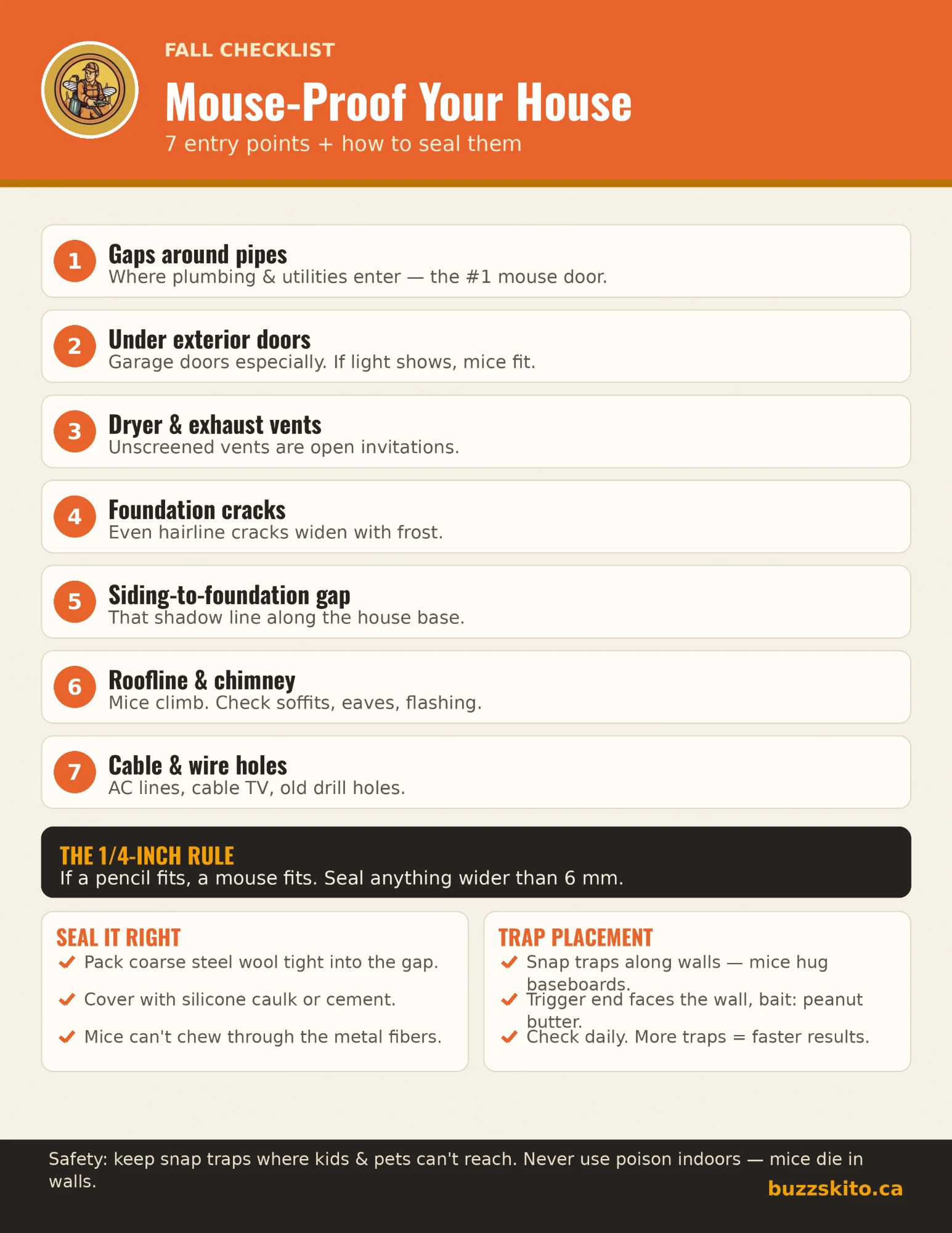 How to Mouse-Proof Your House: A Fall ChecklistA fall checklist for mouse-proofing a house: the 7 entry points to seal, the 1/4-inch rule, the materials that last,…
- How to Get Rid of Rats in Canada (2026) — Traps, Exclusion & What's Actually LegalNorway vs roof rat ID, pre-baited snap-trap technique, the Goodnature A24 auto-trap, rat-proof exclusion, and which…
- Peppermint Oil for Mice: Does It Work, and Is It Safe for Pets?Peppermint oil is a popular mouse remedy, but a research review found plant-compound repellents inconsistent, and CDC…