
BuzzSkito Mosquito & Tick Control Specialists · Published July 16, 2026
Check current Canadian availability of both models:
As an Amazon Associate I earn from qualifying purchases. Price shown on Amazon.ca, at no extra cost to you.
🏆 Our Top Pick
8.9/10· BuzzSkito ratingVictor M250S Electronic Mouse Trap
The best no-touch mouse trap sold in Canada: an enclosed kill chamber that shocks in seconds, delivers up to 100 kills per set of 4 AA batteries, and empties into the garbage without you ever touching or seeing the mouse. A blinking green LED confirms a kill for up to 7 days, and it is a legal, non-pesticide device in every province.
Pros
- No-touch, no-see disposal
- Fast, consistent kill inside an enclosed chamber
- Up to 100 kills per battery set — a full season or more
- Kid- and pet-resistant; circuit cuts when the lid opens
Cons
- Indoor/dry locations only
- Plates need wiping every few kills
- Mouse-sized only — will not kill rats
How Does the Victor M250S Actually Work?
The M250S is a battery-powered kill chamber: a mouse follows the bait scent into a dark tunnel, steps across two metal plates that complete a circuit, and receives a high-voltage shock that kills it in seconds. That is the whole trick — and it is a genuinely good trick, because it fixes the two failure modes of every other consumer trap at once.
First, the enclosed tunnel means the kill geometry is always correct. A snap trap only kills cleanly when the mouse approaches from the right angle; the M250S doesn’t care how the mouse approaches, because it has to walk onto both plates to reach the bait cup at the back wall. Second, Victor’s circuit detects the mouse and sustains the shock long enough that stunned-but-alive escapes — the classic snap-trap and zapper-gadget problem — essentially don’t happen when the plates are clean and the batteries are healthy.
When a kill happens, a green LED on top starts blinking and keeps blinking for up to 7 days. You hold the trap over a garbage bag, tip it, and the mouse slides out. You never touch it, and — the part squeamish owners care about most — you never have to see it. Opening the lid to re-bait automatically cuts power to the plates.
Honest limitations: it is strictly an indoor/dry-location trap (moisture kills the electronics), it needs its plates wiped clean every few kills or the circuit gets unreliable, and it is mouse-sized only. If you are dealing with something bigger, that is a job for the rat-scale hardware in our best rat trap Canada guide.
Is the Victor Electronic Mouse Trap Humane?
Measured against the realistic alternatives, yes — the enclosed kill chamber is one of the two most humane lethal options available to Canadian homeowners. The shock renders the mouse unconscious and dead within seconds, and because the kill happens inside a chamber the mouse fully entered, there is no partial strike. Compare the field of options honestly:
- Electronic kill chamber (M250S/M1): death in seconds, no maiming, no escapes when maintained. The consistency is the humane feature.
- Quality snap traps: also fast when they strike correctly — but misfires happen, and a misfire means a maimed mouse dragging a trap. Placement skill matters enormously.
- Glue boards: the least humane common product — mice die of exhaustion, dehydration, or suffocation over hours to days. We don’t recommend them, full stop.
- Anticoagulant poisons: death over several days from internal bleeding, usually somewhere you can’t retrieve the body — plus secondary poisoning risk to owls, hawks, foxes, and pets.
- Live-catch traps: only humane if checked constantly and released far away in warm weather; a house mouse released outdoors in a Canadian January mostly just dies slower.
So the humaneness case for the M250S is not marketing fluff. If you have decided the mice must die — and in a Canadian house in winter, that is usually the honest decision — the electronic chamber is the option that makes a fast, clean kill the default outcome rather than the best-case one.
How Far Does One Set of Batteries Go?
Victor rates the M250S at up to 100 kills per set of 4 AA batteries, and that number holds up as a season-scale figure. A typical household infestation is a handful to a couple dozen mice; even a bad fall invasion rarely approaches triple digits. In practice you will change batteries because of time and temperature, not kill count — alkaline cells self-drain faster in an unheated garage or cottage in winter, so use lithium AAs in cold locations. A blinking red light (as opposed to the green kill light) means the batteries are low.
Two maintenance habits keep the kill rate at 100%: wipe the metal plates with a dry paper towel every few kills, because grease and debris insulate the circuit; and refresh the bait — a pea-sized smear of peanut butter on the back bait cup — every week or two so it keeps releasing scent.
M250S vs M1 Smart-Kill: Which One Should You Buy?
Buy the M250S unless the trap will live somewhere you don’t. The M1 Smart-Kill uses the same chamber-and-shock design with the same roughly 100-kills-per-set economics, but adds Wi-Fi: it joins your home network and pings the Victor app on your phone the moment it kills. That is not a gimmick in three specific situations:
- Cottages and seasonal properties — you learn about the catch in February instead of discovering it in May.
- Attics and crawl spaces — places you genuinely will not check weekly, where a forgotten carcass becomes a smell problem.
- Rental or multi-unit properties — remote confirmation without scheduling a visit.
For a kitchen, pantry, or main-floor problem you walk past daily, the blinking green light on the M250S is all the notification you need, and the price difference buys you a second M250S — and two traps in two locations beats one connected trap almost every time. One caveat on the M1: it needs 2.4 GHz Wi-Fi coverage wherever it sits, and a concrete-walled cottage basement is exactly where signal dies.
How Does It Compare to Snap Traps and Bait Stations?
Here is the honest matchup across the main mouse-control options Canadians actually buy. (For the full field including live-catch and multi-catch traps, see our best mouse trap in Canada roundup.)
| Option | Kill speed / humaneness | Reusability | Disposal | Best for |
|---|---|---|---|---|
| Victor M250S (electronic) | Seconds · no maiming, no escapes | ~100 kills/battery set · years of service | No-touch, no-see tip-out | Squeamish households · kids & pets homes |
| Victor M1 Smart-Kill (Wi-Fi) | Seconds · same chamber design | ~100 kills/battery set + app alerts | No-touch, no-see tip-out | Cottages · attics · rarely-checked spots |
| Classic wood/plastic snap trap | Fast when placed well · misfires maim | Reusable but often tossed with the mouse | Hands-on — you see and handle it | Budget deployments · high trap counts |
| Bromethalin bait station (Tomcat) | Hours to days · dies out of sight | Disposable single station | Carcass often unrecoverable in walls | Inaccessible voids · supplement only |
| Glue boards | Hours to days · least humane option | Single use | Live mouse on a board — grim | Not recommended |
The honest anti-pitch: if you are comfortable handling dead mice and know to set traps perpendicular to walls, a six-pack of classic snap traps costs less than one M250S and lets you saturate every runway in the house at once — and trap count matters more than trap quality in a heavy infestation. The M250S earns its price on disposal, consistency, and reuse, not on out-killing a well-run snap-trap line. What we would skip entirely: plug-in ultrasonic gadgets, which have a decades-long record of not working — our ultrasonic repeller evidence review covers why.
What About Poison? What Is Actually Legal in Canada
This is where Canadian buyers get led astray by US content. American review sites routinely recommend second-generation anticoagulant rodenticides — brodifacoum, bromadiolone, difethialone — as the “strongest” consumer option. Those products are not sold as domestic-class in Canada. Health Canada’s PMRA restricts second-generation anticoagulants to commercial pest-control use, largely because a single feed can load a mouse with enough toxin to poison the owl, hawk, fox, or family dog that eats it afterwards. Ordering them cross-border or picking them up from a US Walmart is importing an unregistered pesticide — we won’t recommend it, and you shouldn’t risk it.
What a Canadian homeowner can legally buy is narrow and specific: the main PMRA-registered consumer rodenticide is bromethalin in pre-loaded, tamper-resistant disposable bait stations, sold under the Tomcat brand. Bromethalin is a neurotoxin, not an anticoagulant — no multi-day bleeding, but also genuinely dangerous to pets if they chew into a station, which is exactly why domestic-class rules require the tamper-resistant housing. Our what rodenticides are actually legal in Canada guide covers the full regulatory picture, and the mouse bait station guide covers deploying them properly.
Our position for houses: traps first, poison only as a supplement for voids you physically cannot trap. A trap gives you a confirmed, retrievable kill; poison frequently gives you a smell inside a wall cavity and an unquantifiable risk to wildlife. One health note, kept appropriately hedged: Health Canada advises against sweeping or vacuuming dry rodent droppings (deer mice in Canada can carry hantavirus) — wear gloves, wet droppings down with diluted disinfectant, and wipe. See Health Canada’s rodent-cleanup guidance for the full protocol.
Where Should You Place It for Fast Results?
Placement decides success more than the trap does. Mice are wall-huggers with poor eyesight — they travel the same few centimetres of baseboard every night and rarely cross open floor.
- Tight against the wall, entrance facing along the wall or toward it, on a known runway — look for droppings, rub marks, and gnawing.
- Behind and under things: under the kitchen sink, behind the stove and fridge, along the basement sill plate, beside the furnace, in the garage corner where the door seal leaks.
- First 48 hours tell you everything. Mice are curious about new objects (unlike rats). No kill in 2–3 nights means wrong location — move it, don’t wait it out.
- Run more than one trap if you are seeing droppings in more than one room. One trap per active room is the minimum that ends infestations quickly.
And remember the trap is treatment, not cure. Mice enter through gaps as small as 6 mm — the width of a dime — and every mouse you kill can be replaced from outside until the entry points are sealed. Our step-by-step guide to getting rid of mice in Canada covers the full trap-and-seal sequence, and the winter mouse-proofing guide covers the fall exclusion work that stops the annual October invasion in the first place. If the problem has outgrown DIY entirely, our Canadian pest control cost guide breaks down what professional rodent work runs.
Verdict: Is the Victor M250S Worth It in Canada?
Yes — it is the best no-touch mouse trap sold in Canada, and the right first trap for most households. It makes a fast, clean kill the default outcome, it costs pennies per kill over a multi-year service life, and it removes the single biggest reason people procrastinate on a mouse problem: not wanting to deal with the body. Add the M1 Smart-Kill for locations you rarely visit; add cheap snap traps for saturation during a heavy infestation; skip glue boards and grey-market poisons entirely.
Frequently Asked Questions
Does the Victor electronic mouse trap actually work?+
Yes. The Victor M250S is one of the most consistently effective consumer mouse traps sold in Canada. A mouse enters the baited tunnel, steps on two metal plates that complete a circuit, and receives a high-voltage shock that Victor rates as killing in seconds with a claimed 100% kill rate for mice that fully enter the chamber. Real-world failure points are almost always user error: dead batteries, greasy plates that need wiping, bait placed at the entrance instead of the back wall, or the trap placed in open floor space instead of tight against a wall where mice actually travel.
How many mice will the Victor M250S kill on one set of batteries?+
Victor rates the M250S at up to 100 kills per set of 4 AA batteries. In practice, cold rooms (garages, unheated basements in a Canadian winter) drain alkaline batteries faster, so expect somewhat fewer in cold locations. Since a typical house infestation involves a handful to a few dozen mice, one set of batteries usually lasts an entire season or more. The trap has a low-battery indicator, and lithium AAs hold up better than alkalines below freezing.
Is the Victor electronic mouse trap humane?+
By the standards applied to rodent control, yes — it is one of the more humane lethal options. The high-voltage shock causes unconsciousness and death in seconds, and the enclosed kill chamber means the mouse cannot be maimed and escape wounded, which is the main humaneness failure of snap traps (misfires) and the entire problem with glue boards (slow death over hours or days). If your priority is minimizing suffering while still removing mice, an electronic kill trap or a well-placed quality snap trap are the two defensible choices; glue traps are the least humane common option.
What is the difference between the Victor M250S and the M1 Smart-Kill?+
The kill mechanism is essentially the same — baited tunnel, electrified plates, high-voltage shock, roughly 100 kills per battery set. The M1 Smart-Kill adds Wi-Fi: it connects to your home network and sends a notification to the Victor app on your phone when it makes a kill, so you never have to physically check the trap. That matters for cottages, rental properties, crawl spaces, and attics you rarely visit. For a kitchen or main-floor infestation you walk past daily, the cheaper M250S does the same job and its blinking green kill light is all the notification you need.
What is the best bait for the Victor electronic mouse trap?+
Peanut butter or hazelnut spread, a pea-sized amount, smeared on the bait cup at the back wall of the kill chamber. Mice are drawn to high-fat, high-protein foods — peanut butter consistently outperforms the cartoon cheese. Use only a small amount: a big glob lets the mouse feed from the entrance without fully entering and stepping on both plates. Other baits that work well are chocolate spread, oats mixed with peanut butter, and a dab of bacon grease. Refresh the bait every week or two, since dried-out bait stops releasing scent.
Is the Victor electronic mouse trap safe around kids and pets?+
It is much safer than snap traps or any rodenticide, but treat it as pet-resistant rather than pet-proof. The kill plates sit inside a tunnel that fingers and most paws cannot reach, and the circuit deactivates automatically when the lid is opened. A cat or dog nosing the outside of the trap will not be shocked. That said, Victor tells users to place it out of reach of children and pets, and a determined puppy can chew the plastic housing. Compared with the alternative — loose snap traps or poison bait — the enclosed electronic design is the lowest-risk lethal option for a household with kids and animals.
Can I use the Victor electronic mouse trap in a garage or shed?+
Yes, as long as the location is dry. The M250S is an indoor trap — moisture damages the electronics and can short the circuit, so it should never sit outside exposed to rain or snow. A sealed garage, a dry shed, a basement, or a crawl space are all fine, with the caveat that batteries drain faster in the cold; lithium AA batteries handle Canadian winter temperatures in an unheated garage much better than alkalines. For genuinely outdoor mouse control at foundations and exterior walls, a tamper-resistant bait station approach is the better-suited tool.
Will the Victor electronic mouse trap kill rats?+
No. The M250S kill chamber is sized for house mice and deer mice — a rat physically cannot fully enter it, and a partial entry means no kill. Victor makes dedicated electronic rat traps (the M1 Smart-Kill rat version and the M241/M2 series) with a larger chamber and a stronger shock rated for rats. If you are seeing droppings longer than about 12 mm, gnaw marks on wood or wiring, or hearing heavy movement in walls, assume rats and buy the rat-sized unit — an undersized trap just educates the rat to avoid traps.
Why is the green light on my Victor trap blinking?+
A blinking green light is the kill indicator — the trap has caught a mouse since you last emptied it. On the M250S the light blinks for up to 7 days after a kill so you cannot miss it. To empty, open the lid (which automatically cuts power to the plates) or simply hold the trap over a garbage bag and tip — the mouse slides out without you touching or even seeing it. A blinking red light, by contrast, means low batteries. Wipe the plates with a dry paper towel every few kills, since grease and debris on the plates are the most common cause of missed kills.
Are electronic mouse traps legal in Canada?+
Yes, fully legal everywhere in Canada. Electronic kill traps like the Victor M250S and M1 are devices, not pesticides — they contain no active chemical ingredient, so they do not require PMRA (Pest Management Regulatory Agency) registration the way rodenticides do. There are no provincial restrictions on using them inside your own home. This is one reason they are such a clean recommendation for Canadian homeowners: unlike much of the rodenticide aisle on US websites, there is no legal grey area at all.
Is an electronic trap better than mouse poison in Canada?+
For most Canadian households, yes. The strongest consumer rodenticides pushed by US websites — second-generation anticoagulants like brodifacoum and bromadiolone — are not sold as domestic-class products in Canada; Health Canada restricts them to commercial pest-control use because of secondary poisoning risk to pets, owls, hawks, and foxes. The main PMRA-registered consumer option is a bromethalin disposable bait station (sold under the Tomcat brand). Poison also means mice frequently die inside walls and smell for weeks, whereas a trap gives you a confirmed, retrievable kill. Traps first; a legal bait station only as a supplement for inaccessible areas.
How long does the Victor M250S last?+
Owners commonly report 3–5+ years of service from the M250S with basic care: keep it dry, wipe the kill plates clean every few kills, remove batteries during long storage, and refresh bait regularly. There are no moving parts to wear out — the failure modes are corroded battery contacts (from leaking alkalines left in storage) and moisture damage. At a typical Canadian street price in the $35–$55 range, even a three-year service life works out to pennies per kill versus continuously repurchasing disposable options.
Related Reading
- Best Mouse Trap in Canada — Full Roundup
- Best Rat Trap in Canada
- Mouse Bait Stations in Canada — Legal Options & How to Use Them
- Rat Poison in Canada — What Is Actually Legal
- How to Get Rid of Mice in Canada — Step by Step
- How to Keep Mice Out of Your House This Winter
- Ultrasonic Pest Repellers — Do They Actually Work?
Keep reading
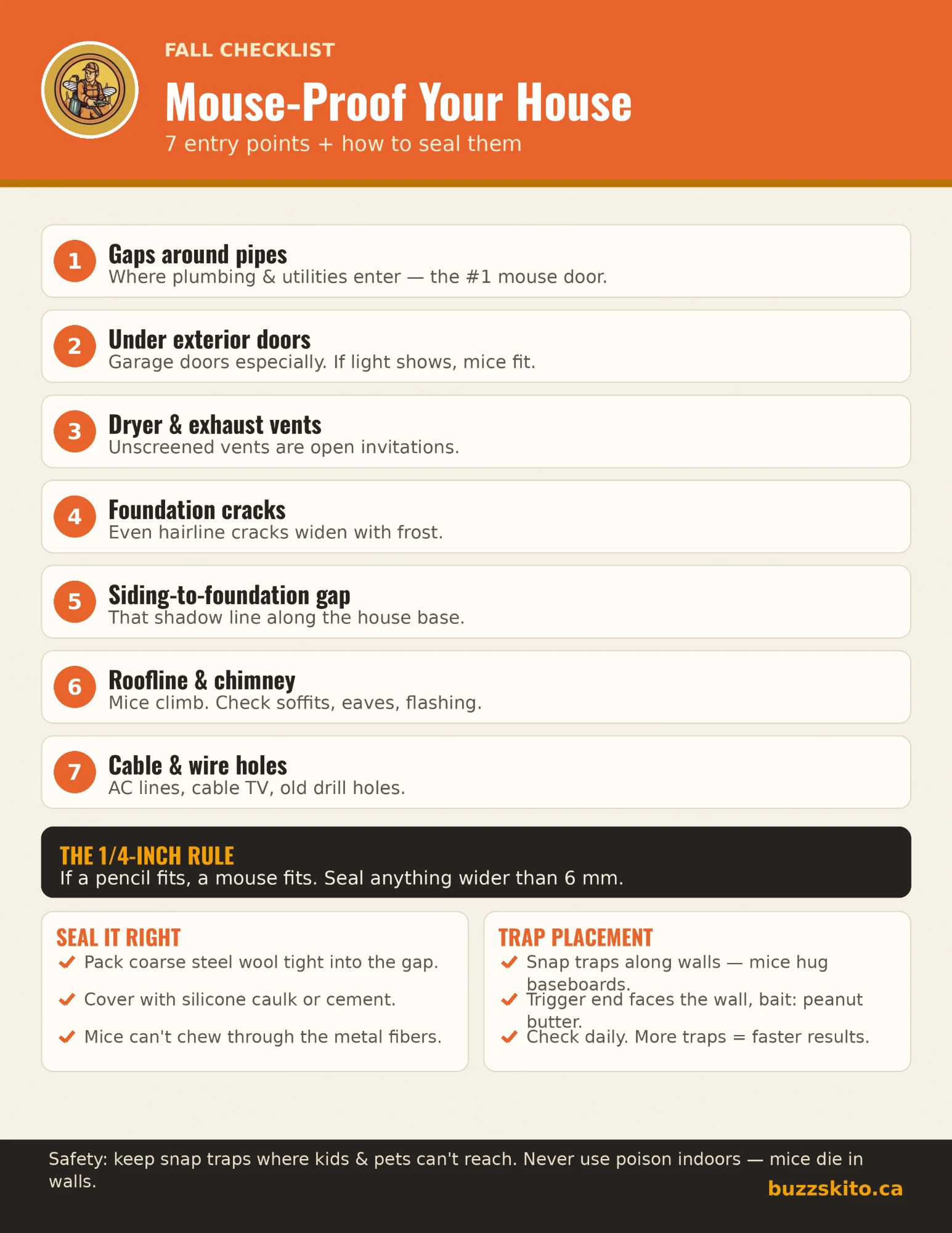 How to Mouse-Proof Your House: A Fall ChecklistA fall checklist for mouse-proofing a house: the 7 entry points to seal, the 1/4-inch rule, the materials that last,…
- Mice Poison: What US Rules Allow, the Risks, and What to Try FirstConsumer mice poison in the US is sold as a bait station with block or paste bait. The ingredient classes, the risks to…
- Types of Mice in the US: How to Tell Which One You HaveHouse mouse, deer mouse or white-footed mouse? Compare size, coat and tail, rule out voles, shrews and young rats, and…