
BuzzSkito Mosquito & Tick Control Specialists · Published July 21, 2026
What Is the Best Rodent Repellent for Cars in Canada?
Capsaicin rodent deterrent tape is the best rodent repellent for cars, and it wins for a structural reason: it is the only product in this aisle that defends the exact thing mice destroy. Mice do not total cars by living in them — they total cars by gnawing wiring harnesses, and a single chewed sensor loom can strand a vehicle and produce a four-figure repair bill. Wrap the vulnerable harness runs in tape whose adhesive is loaded with hot-pepper extract, and the mouse’s first exploratory bite is also its last. Everything else on this page defends the space; the tape defends the wire.
The market structure is easy to see once you sort it by mechanism. Taste deterrents (the tape) punish the chew itself and do not fade into background smell. Light-and-sound units attack the engine bay’s appeal as dark shelter, with honestly mixed evidence. Scent products (peppermint) are aversive but evaporate. And traps do the one thing no repellent can — reduce the number of mice in your garage in the first place. A serious defence, especially for a vehicle heading into Canadian winter storage, stacks the layers rather than betting on one.
This guide is the product-picking companion to our how to keep mice out of your car playbook, which covers the parking habits, food rules, and inspection routine around the gear. Here we rank the gear itself.
Check current Canadian availability of the four picks:
Why Mice Move Into Cars (and Why Canada Makes It Worse)
An engine bay is close to a perfect mouse habitat: enclosed, dark, sheltered from rain, wind, and owls, riddled with cavities that hold nesting material — and, for hours after you park, warm. In a southern-Ontario October, a just-driven engine is one of the warmest objects on the street, and mice are superb heat-seekers. The air filter box, the battery tray, the cowl under the wipers, and the blower-motor housing are the classic nest sites, because they combine shelter with soft material to shred.
The chewing that follows is not feeding. Rodent incisors grow continuously through life, and gnawing is how they are kept ground down — wire insulation, vacuum hoses, and sound-deadening felt happen to be ideal gnawing media. You may have read that modern soy-based wire insulation “attracts” mice; the class-action lawsuits built on that theory were largely dismissed for lack of evidence, and mice chewed petroleum-based looms for decades before soy insulation existed. The practical takeaway is unchanged either way: any parked car is chewable, the risk concentrates in fall and during storage, and in Canada the repair claim — if you are lucky — goes through the comprehensive portion of your auto policy, deductible first.
What mice actually eat, and the other things they gnaw that are not food, from cardboard and soap to insulation, are covered in our North American guide to what mice eat and gnaw.
Capsaicin Deterrent Tape: The Best Overall, and Why It Earned It
The tape has the best origin story in this niche: it was developed for Honda by a Japanese parts supplier after wiring-chew warranty claims became chronic, and it has since spread across the OEM parts world — versions of it are sold at dealer parts counters as an official accessory. Mechanically it is ordinary polyester electrical tape with one addition: the adhesive layer carries capsaicin, the compound that makes chili peppers hot, at a concentration a rodent finds immediately and memorably aversive. Mice test unfamiliar materials with their teeth; the tape turns that test into the deterrent.
What makes it our Best Overall is the failure mode it removes. Scent deterrents fade; sound deterrents habituate; but taste aversion fires at the exact moment of the exact behaviour you are trying to stop, every time, for years. It needs no batteries, survives heat cycles and road spray, and one roll typically covers the exposed harness runs of one to two vehicles.
The honest limits: it protects only what you wrap. Plan a patient hour with the hood up — wrap the exposed loom sections you can reach along the firewall, around the battery and air box, and any harness run with visible previous gnaw marks, overlapping each wrap like hockey tape. Wear disposable gloves and wash your hands afterward; capsaicin transferred to an eye is an experience you only have once. And note what the tape does not do: it will not stop a mouse from nesting on top of your air filter — it stops the expensive part, which is the chew.
Under-Hood Strobe Units: Set-and-Forget, With Honest Fine Print
Battery-powered under-hood units — a small box zip-tied near the top of the engine bay that fires a bright intermittent LED strobe, usually with ultrasound alongside — are the best set-and-forget option for vehicles that sit: the cottage car, the seasonal convertible, the work van parked over the holidays, anything in winter storage.
Here is the fine print, stated plainly because most listings will not. The evidence for ultrasound as a rodent repellent is mixed at best: controlled studies consistently show rodents habituating to ultrasonic sound within days in open settings, which is exactly why we told readers to skip plug-in wall units in our ultrasonic repeller evidence review. Under-hood units deserve a slightly better grade for two specific reasons. First, an engine bay is a small, hard-walled, enclosed space, so the sound pressure a mouse experiences inside it is far higher than anything a plug-in achieves across an open basement. Second — and more importantly — the better units lead with the strobe: a bright, irregular flash inside a cavity whose entire appeal is darkness. Light is a threat cue rodents do not habituate to as readily as sound, because in rodent experience, lit spaces get you eaten.
Buy one with the right expectations: it is a probability-shifter for a parked vehicle, not a force field, and it belongs on top of the tape, not instead of it. Prefer battery models over wired ones (zero parasitic draw on the car battery, no installation), and remember that consumer batteries fade quickly in a deep Canadian cold snap — put a monthly battery check on the same calendar reminder as your storage-trap check.
Peppermint Pouches: The Natural Option, Rated Honestly
Peppermint-oil pouches are the most pleasant product on this page and the weakest, and we are going to say the second part louder than the packaging does. The underlying effect is real: at high concentration in a confined space, peppermint oil is genuinely aversive to rodents, whose survival depends on a sense of smell we can barely imagine. The problem is arithmetic — the effect exists only while the concentration stays high, and essential oils evaporate. In an engine bay that heat-cycles every drive, a sachet can fade from “aversive” to “background” in one to two weeks. Field results are correspondingly inconsistent, and a cold, motivated November mouse will walk straight past a three-week-old pouch.
Where they earn their spot: the cabin and trunk of a stored vehicle, where air exchange is low and scent lingers longest, and where you would rather not put anything that drips, shocks, or snaps. Use them as the third layer, replace them monthly without fail (set the reminder — a faded pouch is a placebo), and if a pouch or spray you are considering makes an explicit rodent-repellent claim, check the label for a PCP registration number before buying; more on that below.
One branded pouch gets its own explainer: our US guide to Vamoose for mice sets out what is in each formula and what the published research on plant-oil rodent repellents shows.
Perimeter Snap Traps: The Backstop Nothing Else Replaces
Every repellent on this page shares a ceiling: none of them reduces the number of mice in your garage. If the population around the vehicle keeps growing, some individual will eventually be hungry, cold, or bold enough to push through the deterrents. That is why the classic Victor wood snap trap — reviewed in full in our best mouse trap guide — earns Best Backstop here, deployed in a specific pattern: around the car, never in it.
Set traps against the garage walls (mice run wall lines, almost never open floor), along the foundation near an outdoor parking pad, and beside the tires — the on-ramps. Pea-sized smear of peanut butter, trigger end to the wall, two traps at high-evidence corners. Do not put snap traps on the engine, where they shift into belts and get forgotten, or in the cabin, where they fire underfoot; a forgotten catch decomposing in a hot engine bay is its own special consequence. Beyond removal, the trap line is also your sensor network: a week of untouched traps tells you the deterrents are holding, while a caught mouse tells you to tighten the perimeter before the wiring pays for the lesson. If catches are frequent or droppings are over a centimetre long, you have graduated to a different problem — see the rat playbook and consider a full exclusion kit for the garage itself.
The Winter-Storage Protocol (Do This Before the Car Sits)
Most catastrophic rodent damage in Canada happens to vehicles that sit — the cottage car in an outbuilding, the summer car in a rented bay, the RV behind the garage. A vehicle that is never disturbed is a vehicle a mouse can furnish. Run this sequence the day you park it for the season:
- 1. Strip the food. Vacuum the cabin, empty the trunk and glovebox, remove every wrapper, fry, and dog biscuit. Food scent is the single strongest recruitment signal a parked car can emit.
- 2. Wrap the harness. Install capsaicin deterrent tape on the reachable loom runs while the engine is cold. This is the layer that works all winter with zero maintenance.
- 3. Block the pipes. Push stainless-steel mesh or coarse steel wool into the exhaust tip(s) and the cold-air intake opening. These are highway-sized entrances for a mouse.
- 4. Tag the wheel. Write every blocker and trap you deployed on a card and zip-tie it to the steering wheel. Starting an engine with a blocked exhaust in spring is the classic self-inflicted injury of this protocol.
- 5. Light the bay. Mount the battery strobe unit under the hood; check its batteries monthly, because deep cold drains them faster than the box promises.
- 6. Scent the cabin. Fresh peppermint pouches in the cabin, trunk, and glovebox; replace monthly when you do the battery check.
- 7. Trap the perimeter. Snap traps along the storage-bay walls and beside the tires, checked on the same monthly visit. Park on pavement rather than grass or gravel if you have the choice — mice prefer approach routes with cover.
- 8. Disturb the peace. If the car can be started and moved a few metres monthly, do it. Vibration, noise, and a hot engine reset the “abandoned shelter” clock — they signal that the space is occupied, which is the one thing a deterrent left sitting in a parked car cannot do.
Eight steps, one afternoon, one monthly ten-minute visit. Compare that to the alternative: a spring start-up that ends with a tow truck and a harness quote.
The PMRA Angle: What Needs a Registration Number and What Doesn’t
Here is the piece of Canadian context that US buying guides skip. Health Canada’s Pest Management Regulatory Agency draws a line between devices and pesticides, and it happens to run straight through this product category. Deterrent tape sold as an automotive part, strobe and ultrasonic units, steel mesh, and snap traps sit on the device side: no registration, no label restrictions, deployable anywhere from a condo parkade to a farm shed. Products with an active ingredient sold with a pest-control claim — which is what a peppermint spray or sachet marketed as a “rodent repellent” is — generally fall under the Pest Control Products Act and should carry a PCP registration number on their Canadian label.
Our advice is the conservative version: we cannot verify the registration status of every listing in a marketplace that changes daily, and neither can you from a product photo. So flip the label — physically or in the listing images — and look for the PCP number before buying any scent product that claims to repel rodents. If a seller cannot show a Canadian label, treat the claim as unverified and put your money in the device aisle, where the question never arises.
And one hard stop: mothballs are not a car product. Naphthalene and paradichlorobenzene mothballs are PMRA-registered for one narrow use — clothes moths, in sealed containers. Tossing them into an engine bay or cabin is off-label use that violates the Act, and the fumes end up circulating through your ventilation system at face level. The internet will keep suggesting it every fall; keep declining.
Why mothballs do not reliably keep mice away, in a car or anywhere else, and what the vapour does to children and pets, is set out in our North American guide to whether mothballs keep mice away.
When Repellents Are Not Enough
Escalate past this page when the evidence says the mice have already won a round: droppings reappearing on the engine cover within days of cleaning, a nest rebuilt after removal, chewed wiring on more than one loom, a check-engine light after the car has sat, or a blower fan that rattles and smells. At that point the sequence is trap-and-evict first (the car playbook walks it step by step), then harden the building the car sleeps in — garage door sweeps, foundation gaps, the full exclusion kit checklist. If droppings are large, gnaw marks show individual tooth grooves, or you hear activity in the garage walls, price out professional help before the damage compounds — our Canadian pest control cost guide shows what rodent work typically runs so you can sanity-check any quote.
Frequently Asked Questions
What is the best rodent repellent for cars in Canada?+
Capsaicin rodent deterrent tape — the Honda-style electrical tape infused with hot-pepper extract — is the best single defence for most Canadian vehicles. You wrap it around the wiring harness sections mice actually chew, and the first bite delivers a mouthful of capsaicin that ends the taste test. It is passive, weather-proof, and works whether the car sits for a night or a winter. Pair it with an under-hood strobe unit for stored vehicles and a small perimeter of snap traps around (never inside) the parking spot, and you have covered taste, light, and population — the three layers that actually move the needle.
Does rodent deterrent tape actually work?+
It is the best-supported deterrent in this niche. The tape was developed for Honda by a parts supplier after chronic wiring-chew warranty claims, and it works on a simple mechanism: the adhesive tape is loaded with capsaicin, the compound that makes chili peppers hot, and rodents that gnaw it get an immediate, strongly aversive mouthful. Unlike scent-based products it does not fade into the background smell of the engine bay within days. Its honest limits: it only protects what you physically wrap, so it defends the harness runs you cover — not the whole car — and installation takes a patient hour with the hood up.
Do ultrasonic or strobe under-hood repellers really work?+
The evidence is mixed, and you should buy them with that understanding. Controlled studies on ultrasonic sound consistently show rodents habituate within days in open settings, which is why we do not recommend plug-in ultrasonic units for houses. Under-hood units are a somewhat better bet for two reasons: the engine bay is a small enclosed space where sound pressure stays high, and the better units add a bright intermittent strobe light, which attacks the darkness that makes an engine bay attractive shelter in the first place. Treat a strobe unit as a useful extra layer for a parked or stored vehicle — not as a standalone solution.
Does peppermint oil keep mice out of cars?+
Weakly, and briefly. Peppermint oil is genuinely aversive to rodents at high concentrations in a confined space, but the effect fades as the oil evaporates — in an engine bay that heats and cools, sachets can fade to background scent within one to two weeks. Field results are inconsistent, and a motivated mouse in a Canadian November will walk past a faded pouch without hesitation. Pouches are worth using as a supplementary layer in the cabin and trunk of a stored vehicle, where scent lingers longer, and they are the most pleasant option for the humans. Just refresh them monthly and do not let them be your only defence.
Why do mice get into car engines in the first place?+
Because an engine bay is close to a perfect rodent shelter: dark, enclosed, protected from wind, rain, and predators, full of nooks that hold nesting material, and — for hours after you park — warm. In a Canadian fall, a recently driven engine is one of the warmest objects on the street, and mice follow the heat. Once inside, they chew wiring insulation not out of hunger but because rodent incisors grow continuously and gnawing is compulsive; soft insulation, hoses, and sound-deadening felt are ideal gnawing material and nest stock.
Is it true modern cars have soy-based wiring that attracts mice?+
Partly. Many manufacturers moved to bio-sourced, soy-based wire insulation in the 2000s, and class-action lawsuits in the US alleged this made wiring more attractive to rodents — those suits were largely dismissed for lack of proof that rodents prefer soy insulation. The honest reading of the evidence: rodents chewed petroleum-based wiring for decades before soy arrived, and they chew because they must gnaw, not because the wire is food. What is not in dispute is the damage: chewed harnesses routinely produce repair bills in the four figures, and that risk is the same whatever your insulation is made of.
Does car insurance cover rodent damage in Canada?+
Usually only if you carry comprehensive coverage. Rodent damage falls under the comprehensive (not collision, not basic liability) portion of a Canadian auto policy, and it is one of the more common comprehensive claims in rural and cottage-country postal codes. Your deductible applies, and a claim may affect future premiums, so minor chews are often cheaper to repair out of pocket. If your car sits outside for long stretches — or goes into winter storage — it is worth confirming with your broker that comprehensive stays active while the vehicle is stored.
Can I put mouse traps inside my car or engine bay?+
Around the car, yes — inside it, we advise against. A snap trap on top of an engine is easy to forget, can shift into belts or linkages, and a forgotten catch decomposing in a hot engine bay is a smell you will not forget. Inside the cabin, a trap can fire underfoot or under a seat rail. The professional pattern is perimeter trapping: snap traps set against the garage walls, along the foundation near the parking pad, or beside the tires — the approach routes — checked on a schedule. If you must trap inside a stored vehicle, use an enclosed-style trap in the trunk, note it on a tag on the steering wheel, and check it weekly.
How do I protect a car in winter storage from mice?+
Layer the defences before the car sits: clean every crumb out of the cabin (food smell recruits mice), wrap vulnerable harness runs in capsaicin deterrent tape, block the exhaust tip and cold-air intake with stainless-steel mesh or coarse steel wool, mount a battery strobe unit under the hood, place refreshed peppermint pouches in the cabin and trunk, and run a perimeter of snap traps along the walls of the garage or storage bay. Park on pavement rather than grass if you can, and leave a written tag on the steering wheel listing every blocker and trap you deployed so nothing gets forgotten at spring start-up.
Do dryer sheets, Irish Spring soap, or mothballs keep mice out of cars?+
No — and the mothball version is actually illegal. Dryer sheets and bar soap have no meaningful evidence behind them; mice routinely nest in contact with both, and any scent effect fades in days. Mothballs are worse: in Canada they are pesticides registered by the PMRA only for use against clothes moths in sealed containers, so scattering them in an engine bay or cabin is off-label use that violates the Pest Control Products Act — and naphthalene fumes drawn through the ventilation system end up in the air you breathe while driving. Skip all three and spend the money on deterrent tape.
Do rodent repellents for cars need PMRA registration in Canada?+
It depends on what the product is. Physical and electronic deterrents — deterrent tape sold as an automotive part, strobe and ultrasonic units, steel mesh, traps — are devices, not pesticides, so they need no Health Canada registration at all. Products sold as repellents with an active ingredient making a pest-control claim — peppermint-oil sprays and pouches among them — generally fall under pesticide rules and should carry a PCP registration number on the Canadian label. Before you buy any spray or sachet marketed as a rodent repellent, flip the label and look for that PCP number; if a listing will not show you a Canadian label, treat the registration status as unverified and choose accordingly.
How do I know mice have already been in my engine bay?+
Pop the hood in daylight and look for droppings (dark grains of rice) on the engine cover and battery tray, shredded insulation or leaves packed into corners — especially around the air filter box and battery — gnaw marks on wire looms and hose surfaces, and a musky ammonia smell when the engine warms up. Two symptoms that send you to a mechanic immediately: a check-engine light plus rough running after the car has sat (classic chewed sensor wiring), and the cabin fan rattling or smelling foul, which usually means nesting material in the blower box or cabin-air filter.
A mouse is already living in my car — repel it or trap it?+
Trap and evict; repellents are for keeping mice out, not for removing one already in residence. A mouse with an established nest and a memorized route will tolerate scent and light deterrents that would have discouraged a first visit. Remove the nest material (gloves on, engine cold), run the perimeter snap-trap protocol until you get seven or more consecutive quiet nights, then deploy the deterrent layers so the next mouse never moves in. If droppings are large — over a centimetre — or the chewing is heavy, you may be dealing with rats, which is a different and more serious playbook.
Related Rodent Guides
- How to Keep Mice Out of Your Car — The Full Playbook
- Best Mouse Trap Canada — Snap vs Electronic vs Catch-and-Release
- Rodent Exclusion Kit Canada — Seal the Building, Not Just the Car
- How to Get Rid of Rats in Canada — When It’s Bigger Than Mice
- Ultrasonic Pest Repellers — Do They Actually Work?
- Pest Control Cost Canada — What Professionals Charge
Keep reading
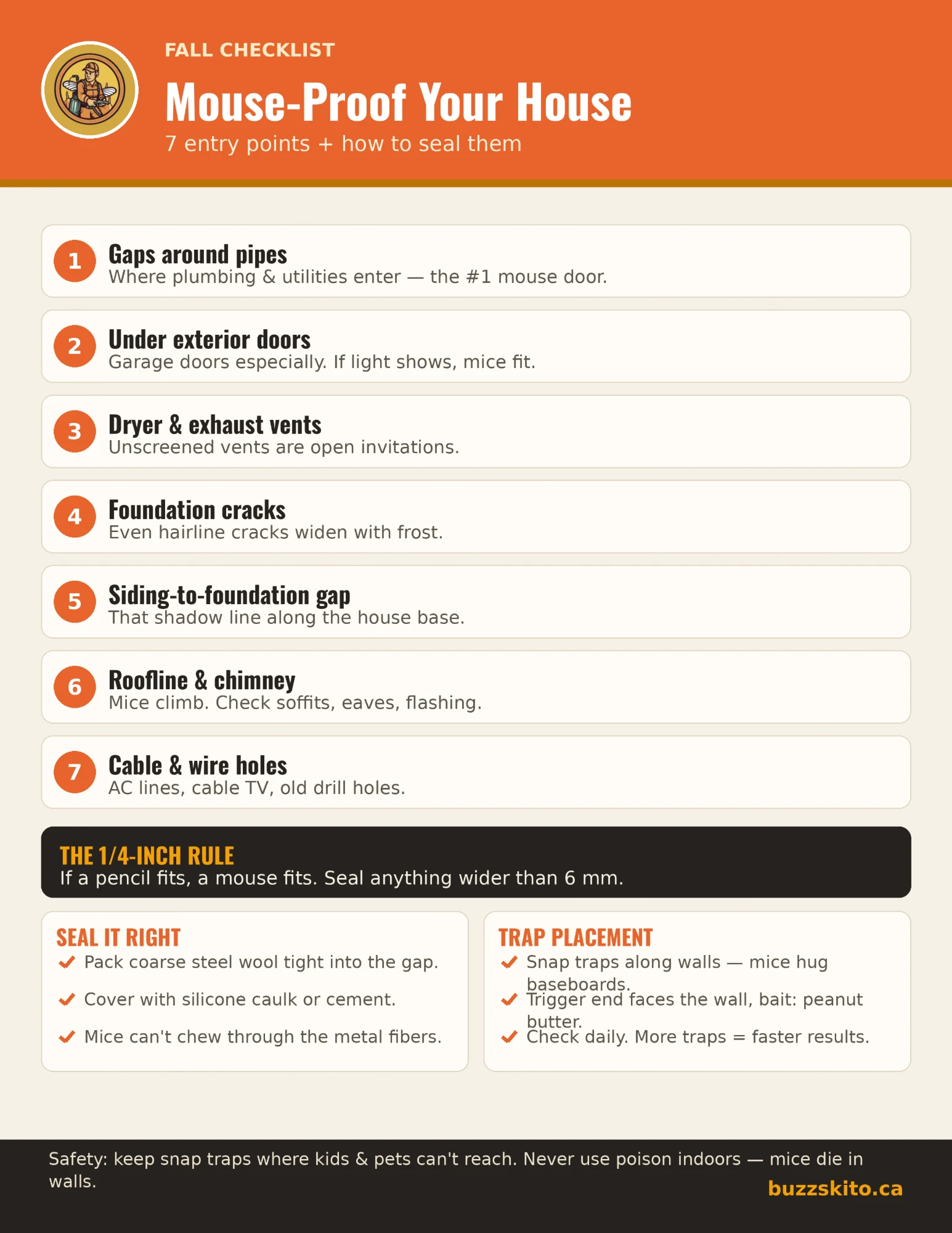 How to Mouse-Proof Your House: A Fall ChecklistA fall checklist for mouse-proofing a house: the 7 entry points to seal, the 1/4-inch rule, the materials that last,…
- How to Get Rid of Voles in Canada — Vole vs Mouse, and Why the Damage Only Shows Up at…Voles in Canada: how to tell a vole from a mouse or a mole, why the runways appear at snowmelt, and the trapping,…
- Rat Poison in Canada 2026 — What's Actually Legal (and What Isn't)Second-generation anticoagulant rat poisons are commercial-only in Canada. What the PMRA allows consumers, BC's SGAR…