
Reviewed by Alex Francisco
Published November 19, 2026 · Fact-checked against the sources listed below
What does fox poop look like?
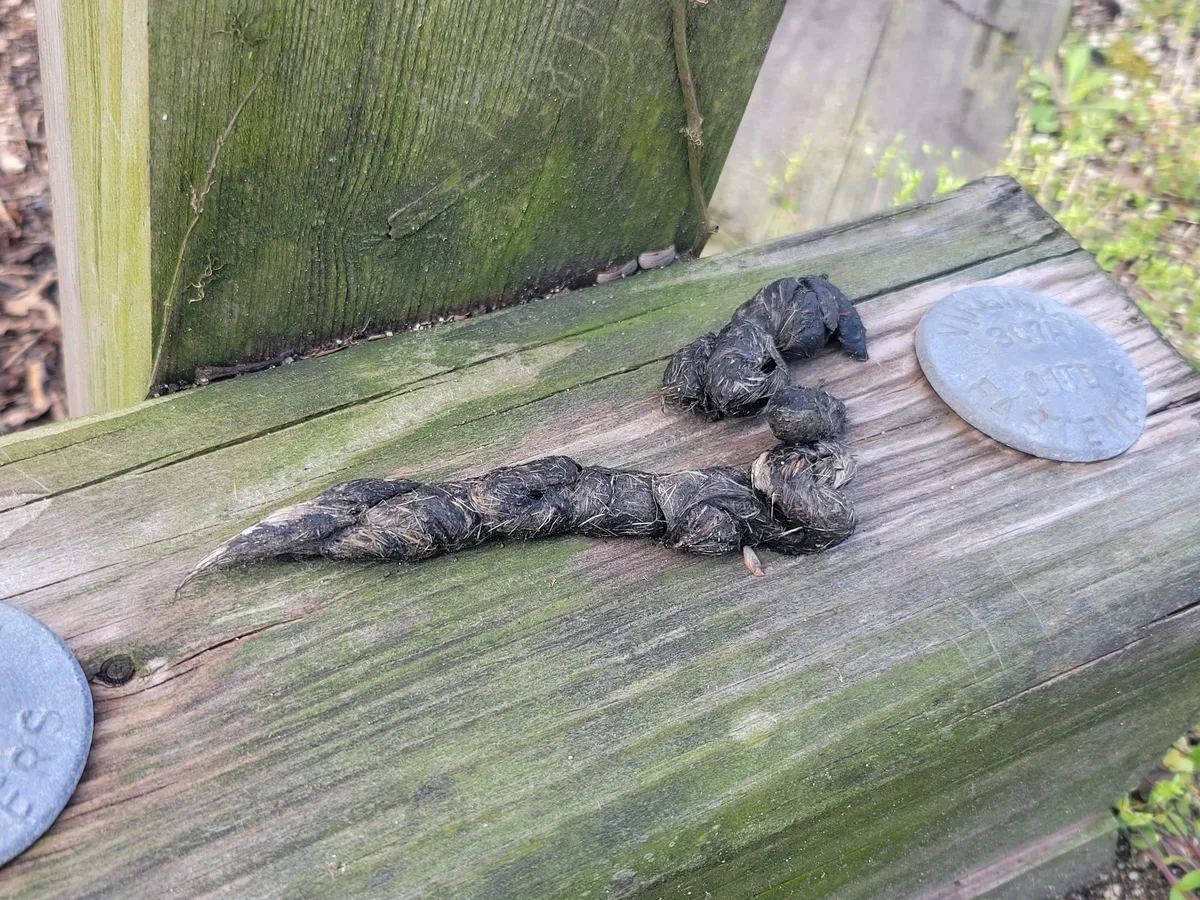
Fox poop looks like a thin, twisted rope: a dropping a couple of inches long, usually in segments, with one or both ends drawn out to a point. The University of Florida IFAS Extension guide to yard wildlife damage puts typical fox and coyote scat at 2 inches by 1/2 inch, segmented, with pointed ends. Alabama Cooperative Extension's fox publication sizes fox scat at 3/8 to 5/8 inch in diameter and roughly 2 inches in length, and the University of Arizona's track and scat glovebox guide calls gray fox scat rope-like, tapered and frequently twisted at one end.
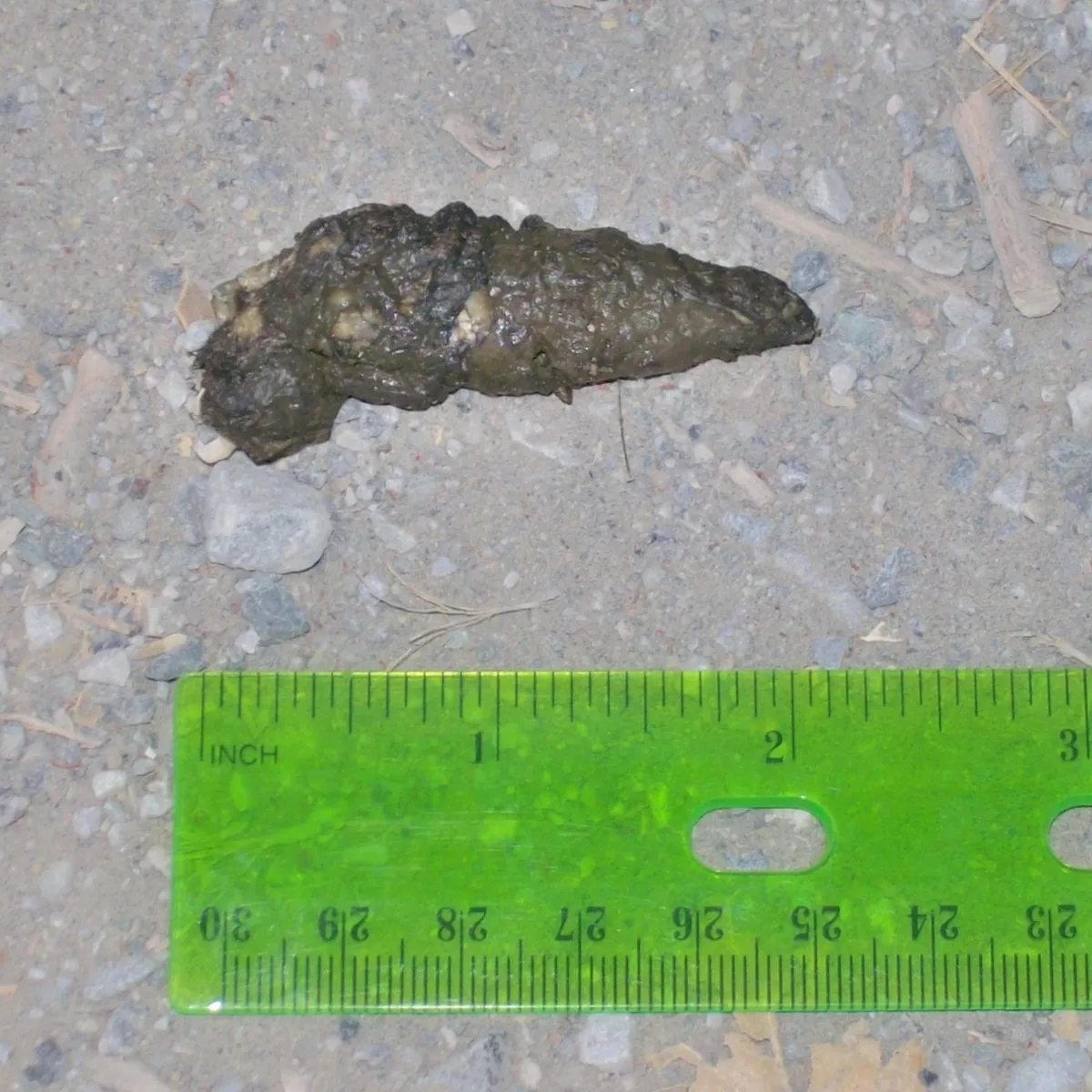
Among other droppings, a fox's is the small version of a dog-family scat. Wildlife Illinois, the wildlife site authorized by the Illinois Department of Natural Resources, says red fox droppings resemble a coyote's but are smaller, and that gray fox droppings look like a small dog's. Shape beats color. By UF/IFAS's account, droppings start out moist and glossy and turn dry, dull and gray with age, and the Arizona guide cautions that what an animal has been eating can transform the color, shape and contents of its droppings, which is why color and texture are seldom used to identify them.
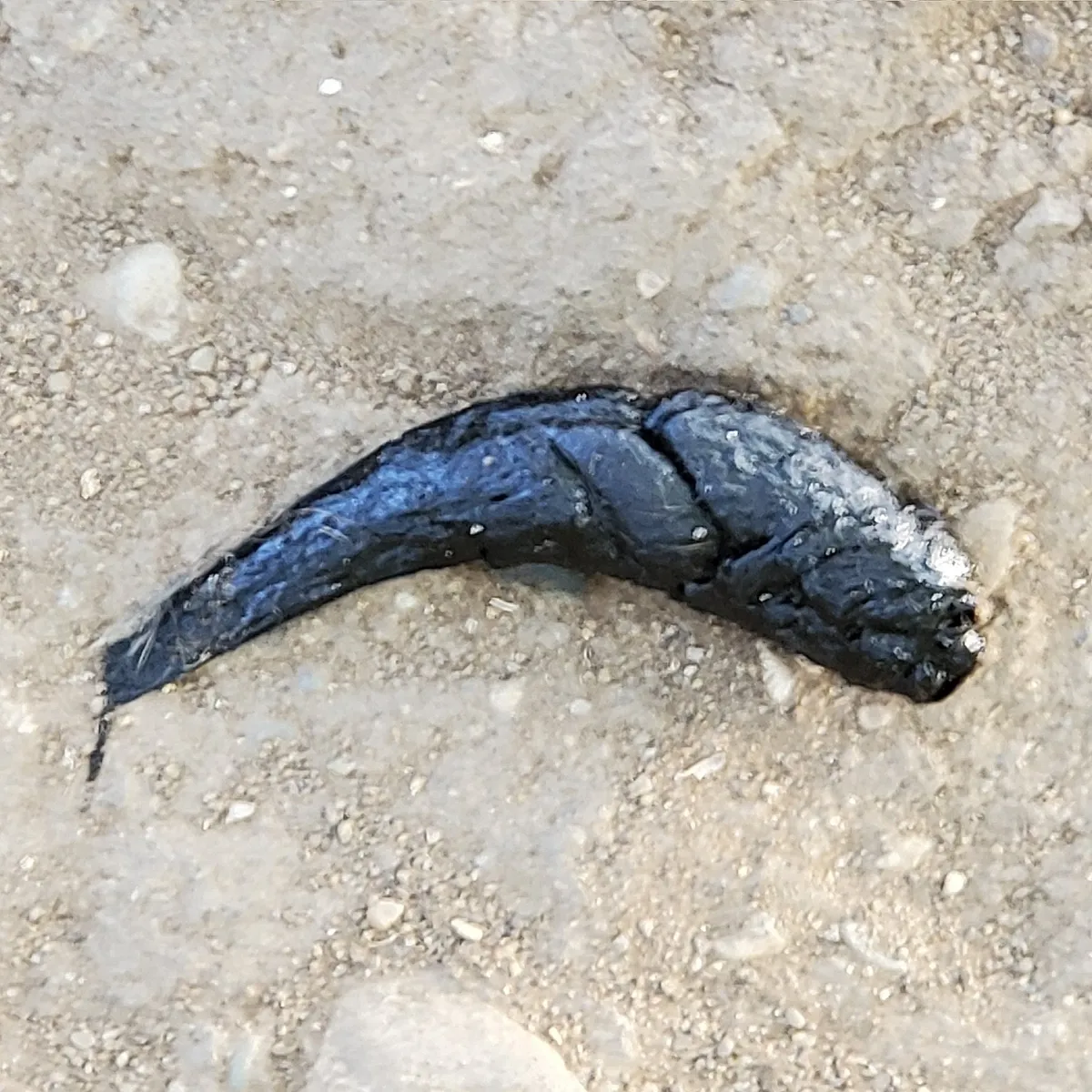
What's in fox poop?
Whatever the fox has been eating, so the contents change through the year. Wildlife Illinois lists bone, fur, feathers and seeds; Alabama Extension says foxes, like coyotes, leave berries, hair and bones in their feces; and UF/IFAS says fox scat usually contains hair and often bits of bone. The menu explains the mix. Alabama Extension says foxes may eat rabbits, mice, birds and their eggs, insects and plants, and the Connecticut Department of Energy and Environmental Protection (CT DEEP) adds fruits, nuts, carrion and garbage.
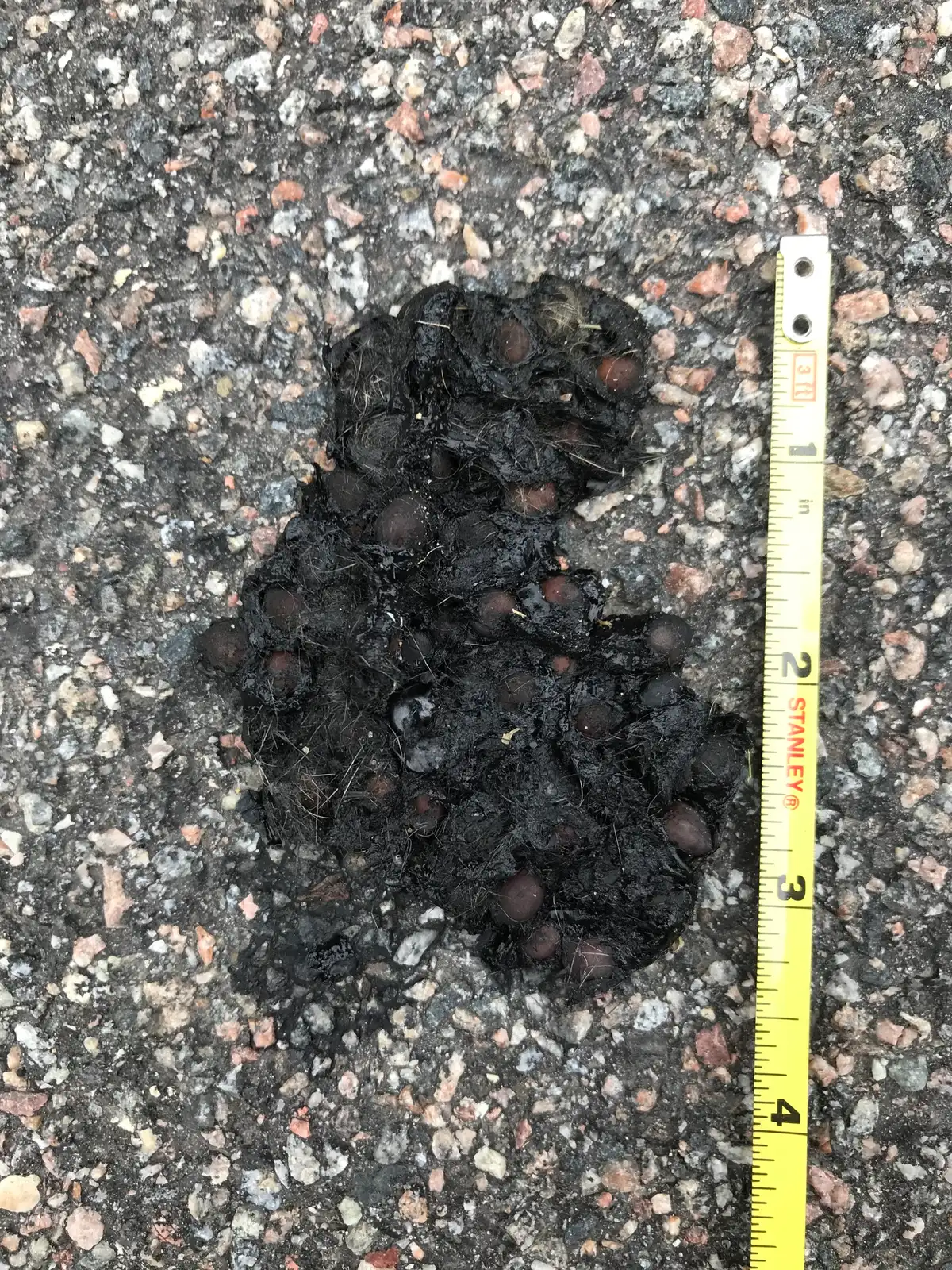
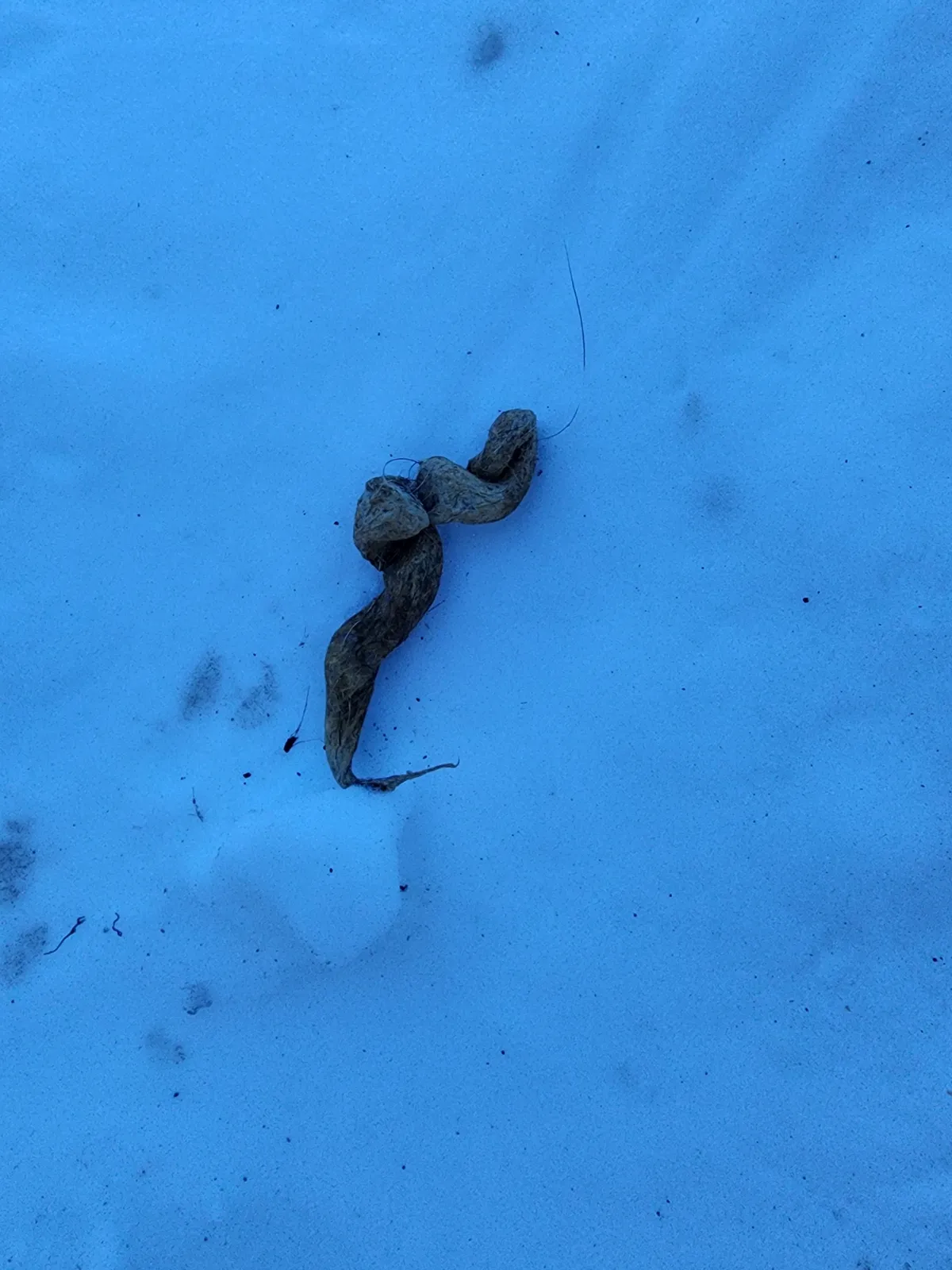
The season tilts it. Wildlife Illinois says rabbits make up most of a gray fox's diet, along with mice, voles, berries and other fruit, and that gray foxes eat fruit and insects heavily in summer; Alabama Extension calls the gray fox the most omnivorous fox in North America. When prey dominates, hair shapes the dropping: the Arizona guide says the twist at one end is most common in rural areas, where foxes eat more birds and mammals, as in the hair-wrapped winter scat below.
Where do foxes poop?
Out in the open, on spots other foxes will notice. The National Park Service (NPS) says male and female red foxes deposit urine and scat on prominent landmarks such as stumps, rocks and trail intersections, and that these chemical signposts tell other foxes the sender's sex, social status and identity. In a productive hunting area a fox may scent-mark up to 70 times an hour, NPS says, while poor territories get little marking. Alabama Extension says gray foxes also mark their territories with feces and urine.
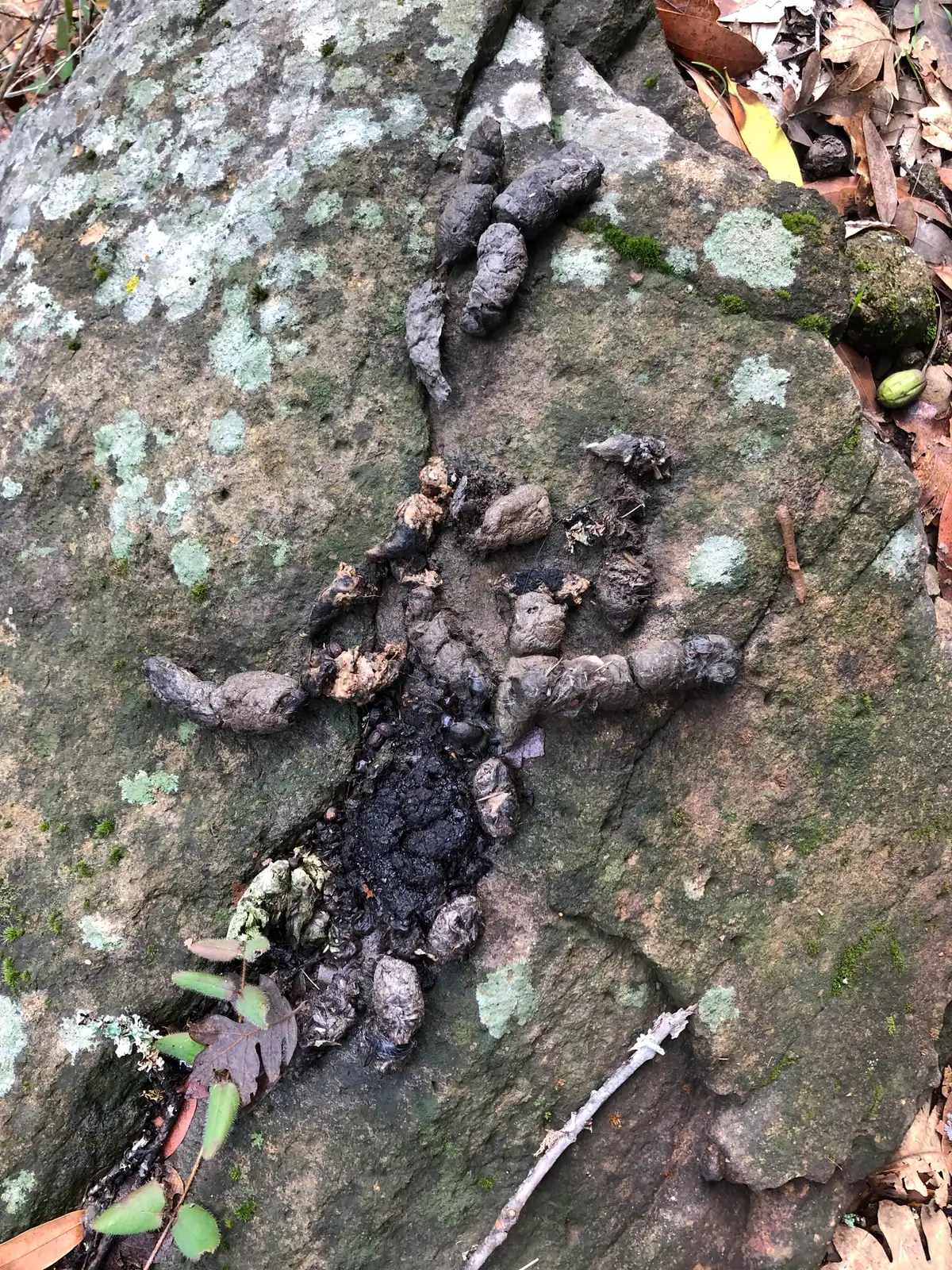
Gray foxes can leave several droppings in one place: a 2015 DNA study of bobcat, coyote and gray fox scats notes, from earlier research, that gray foxes often deposit scats in groups. Around a house, a fox may use a landscape rock or a stump the way it uses landmarks on a trail. A pile of old and fresh droppings that grows week after week on a deck or roof more likely marks a raccoon, covered below.
Why is there fox poop in my yard?
Because a fox lives nearby or passes through, which is normal in towns. CT DEEP says suburban and urban areas are commonly inhabited by red foxes and that the mere presence of a fox should not be seen as a problem, and NPS says red foxes thrive everywhere from wilderness to suburban neighborhoods. The Minnesota Department of Natural Resources (DNR) says the fox you see is often just moving from one hunting area to another, and no action is needed.
Food and shelter turn a visit into a habit. Alabama Extension points to garbage, compost, pet food and bird seed, and advises controlling rodents, which foxes hunt. A den brings a whole family: Wildlife Illinois says red foxes often sleep above ground but use a den to raise their young, born from late March to April. Minnesota DNR covers foxes denning under porches and decks, CT DEEP advises closing off crawl spaces under decks and sheds, and Alabama Extension notes that fox dens can cause unpleasant smells.
Is it red fox or gray fox poop?
Usually you can't tell from the dropping. Wildlife Illinois describes gray fox droppings as similar to a red fox's, and the Arizona guide's figure for gray fox scat, about 2 by 1/2 inch, sits inside the range Alabama Extension gives for foxes in general. Other clues narrow it down:
- Range. CT DEEP says red foxes live over most of North America, from Baffin Island and Alaska to the southern United States; Alabama Extension says gray foxes live across most of the United States except part of the northern Rocky Mountains.
- Habitat. Alabama Extension says red foxes prefer open areas with moderate cover and gray foxes dense cover such as thickets, streamside areas and swamps; Wildlife Illinois places gray foxes in or near deciduous forests, including the edges of towns and subdivisions.
- Climbing. Wildlife Illinois says gray foxes are good at climbing trees and often climb when startled or to hunt.
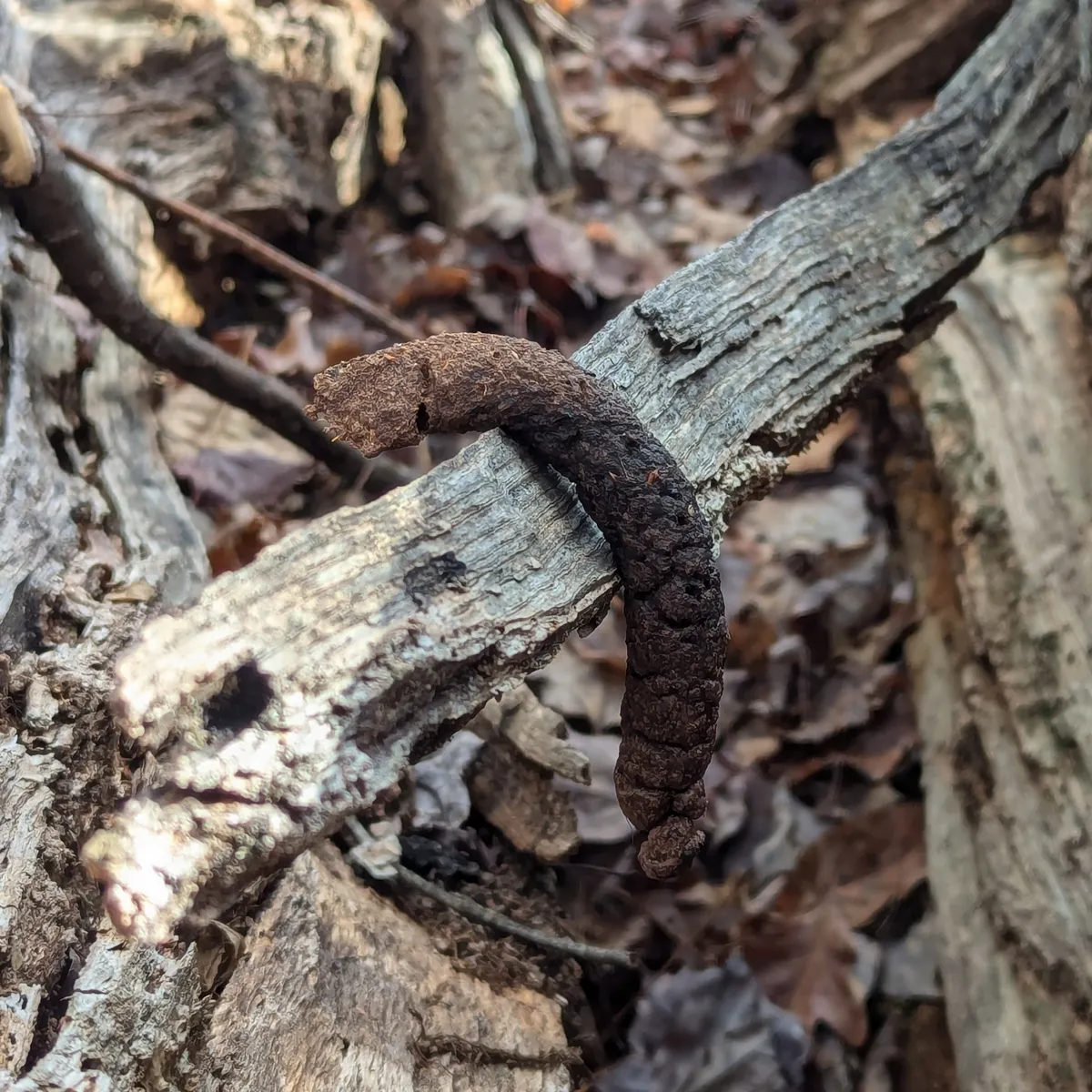
- Diet. A dropping packed with fruit in summer fits a gray fox's diet, but CT DEEP says red foxes eat fruit too, and the berry-filled dropping pictured above was identified as a red fox's.
Tracks beside a dropping can help, though Wildlife Illinois says gray fox tracks can be hard to tell from a red fox's; the guide to animal tracks in snow shows how fox, cat, dog and coyote prints differ.
How do you tell fox poop from raccoon poop?
Look at the ends and count the pile. A fox's dropping tapers to a point and often twists. CDC's page on preventing raccoon roundworm describes raccoon feces as dark and tubular, and UF/IFAS says raccoon scat has blunt ends and an even thickness. In ICWDM's key, raccoon droppings measure 2 to 3 inches by 1/2 inch, often with corn kernels or fruit showing, and raccoons keep returning to one spot, building latrines on roofs, in attics, in sandboxes and in the open.
| Clue | Fox | Raccoon |
|---|---|---|
| The ends | Drawn to a point, often twisted | Blunt |
| Thickness | About 3/8 to 5/8 inch | About 1/2 to 1 inch, even along its length |
| What is inside | Hair, bone and feathers; berries or seeds in season | Corn kernels, fruit or seeds |
| Where it lies | On a prominent spot: a stump, rock or trail crossing | Tree bases and raised spots: logs, stumps, large rocks, woodpiles, decks, rooftops; attics |
| How many | One or a few; gray foxes often leave several together | A latrine: old and fresh droppings in one reused spot |
| Smell | No droppings odor in these sources; male fox urine turns skunk-like in February | Pungent; CDC says usually worse than a dog's or cat's |
| Parasites named in these sources | Fox tapeworm; dog roundworm | Raccoon roundworm |
From UF/IFAS, Alabama Extension, NPS, ICWDM, CDC and the California DNA study, each linked on this page.
The difference matters for cleanup. Raccoon roundworm eggs need at least 2 to 4 weeks after the droppings land to become infective, CDC says, and heat kills them instantly where most chemicals fail, so a latrine calls for CDC's method, laid out in the raccoon poop guide. Opossums muddy things further: according to Nebraska Extension, raccoon and opossum feces are generally about cat-sized and packed with the remains of a mixed diet, and the raccoon's tendency to use the same place is what gives it away. The possum poop guide covers opossums, the guide to raccoon tracks helps confirm a raccoon, and what keeps raccoons out of a yard covers the next step.
How do you tell fox poop from coyote, dog or cat poop?
By thickness, contents and where it lies. If it might be a coyote's, the coyote poop guide shows coyote scat in detail, and the animal poop identification chart lines up a dozen kinds of droppings side by side.
Fox poop vs coyote poop
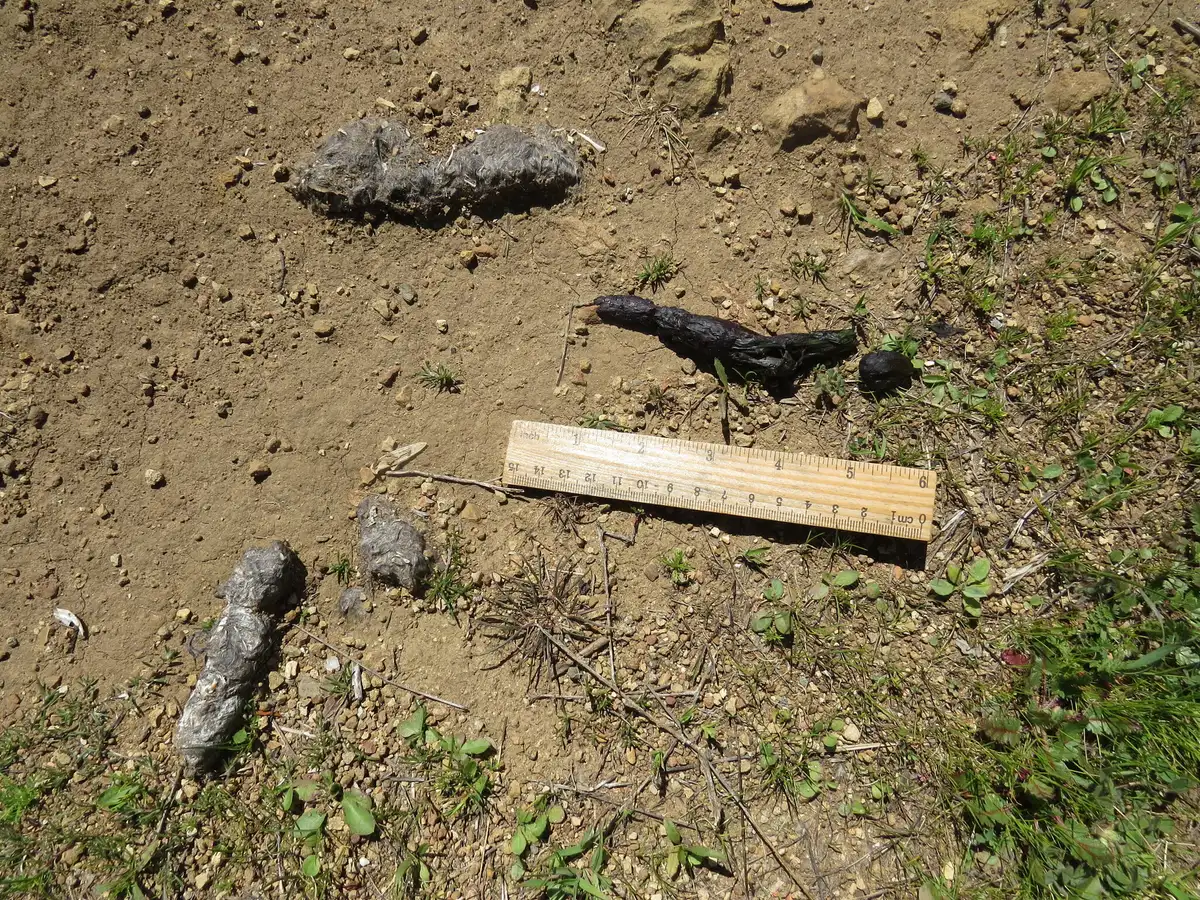
A coyote's is the thicker rope. Alabama Extension puts coyote scat near 1 inch in diameter and up to 4 inches long, against 3/8 to 5/8 inch for a fox, and New York's Department of Environmental Conservation (NY DEC) sets the coyote's at less than an inch across. The 2015 study sorted 110 scats from the central California coast by DNA: gray fox scats averaged 11.5 mm (about 0.45 inch) across and coyote scats 16.45 mm (about 0.65 inch). Still, the study found substantial overlap among the species, a statistical model built on such measurements sorted only 62 percent of scats correctly, and the author concluded that scat shape and size are not generally diagnostic.
Fox poop vs dog poop
Check for hair and bone. Alabama Extension says bone fragments and excessive fur are unlikely in a pet dog's scat, and NY DEC says dog scat is usually more uniform because dogs eat commercial food, and often lacks a tapered end, though softer dog scat can taper. Size rarely settles it, since dogs come in every size and Wildlife Illinois compares gray fox droppings to a small dog's. Place helps: NY DEC says dog scat turns up where people bring dogs, but off-leash dogs can roam widely.
Fox poop vs cat poop
A house cat's droppings are shorter and blunt. The Arizona guide gives domestic cat scat as about 1 1/2 by 1/2 inch, constricted, with blunt ends and breaking into segments as it dries, and a bobcat's as about 3 by 1 inch, also blunt. Where it lies is a clue: CDC's advice on preventing toxoplasmosis is to wear gloves when gardening or handling soil or sand that cat feces may have contaminated, and to cover outdoor sandboxes.
How to tell whose dropping it is, hands off
- Measure it. Set a ruler, a penny or a dollar bill beside it: 3/8 to 5/8 inch thick fits a fox, about 1 inch a coyote, and over an inch, in wolf country, a wolf, though sizes overlap.
- Check the ends. Tapered and twisted fits a fox or a coyote; blunt fits a raccoon, a cat or a bobcat.
- Look inside without touching. Hair, bone or feathers point to a meat-eater such as a fox or coyote, insect parts to a skunk, corn kernels to a raccoon, and an even texture to a pet dog.
- Read the spot. One or a few droppings on a rock, stump or trail crossing suggest a fox; old and fresh droppings heaped in one place on a deck or roof suggest a raccoon latrine; soil or sand suggests a cat.
- Look for tracks. Snow, mud or dust beside the dropping may show who left it.
Is fox poop dangerous?
It can carry parasites, so never handle it bare-handed. The best known is the fox tapeworm, Echinococcus multilocularis, which causes alveolar echinococcosis (AE). CDC's AE page lists foxes, coyotes and dogs as carriers. People pick it up by swallowing the tapeworm's eggs without realizing it, CDC says: on greens, herbs or berries gathered from fields where fox or coyote stool soiled them, or from petting or handling an infected dog or cat. Infections in people are rare, but left untreated they can be fatal, and the cysts grow so slowly that years may pass without symptoms.
CDC's laboratory reference page on echinococcosis, last reviewed in 2019, calls red foxes the primary host and says the eggs can infect as soon as they leave the animal. It places the parasite in North America chiefly in the north-central region, Alaska and Canada, and names voles as the most typical carriers of its larval stage; voles are also fox prey. It has been found farther afield: Kentucky's Department of Fish and Wildlife Resources lists red and gray foxes, coyotes and dogs as hosts and has confirmed the parasite in a coyote from Rowan County.
Roundworms are the other concern. CDC's reference page on toxocariasis says the dog roundworm, Toxocara canis, infects essentially all wild and domestic canids, the family that includes foxes; its eggs leave the body in feces, become infective in the environment after about 1 to 4 weeks, and infect people who swallow them.
Rabies is not a droppings risk. Foxes rank among the animals most often found with rabies in the US, CDC says, but the virus moves mainly through bites and scratches. Under CDC's 2008 recommendations on rabies prevention, touching an animal's blood, urine or feces counts as indirect contact, not an exposure.
Is fox poop dangerous to dogs?
It can pass parasites to them. Kentucky's wildlife agency says to stop dogs from eating the feces of foxes, coyotes or other dogs and from hunting rodents, since rodents can pass the tapeworm to dogs; regular deworming of dogs that may carry it cuts down the eggs they shed. CDC adds: don't let dogs and cats roam freely or catch and eat rodents, and ask your veterinarian about preventive treatment if your pet may have eaten one. A sick fox is a separate risk: Wildlife Illinois says sarcoptic mange can spread to people and pets in close contact with an infected fox, and that a veterinarian can treat infected pets.
How do you clean up fox poop safely?
Wear gloves, use a tool, keep it out of the air and wash up. These steps draw on Kentucky's guidance for contact with wild canid feces, the Arizona guide and ICWDM's droppings key:
- Keep children and dogs away until it is gone; Kentucky's wildlife agency advises keeping dogs from eating fox feces.
- Put on disposable gloves, as Kentucky advises hunters and trappers who may touch wild canid feces.
- Lift the dropping with a shovel or another tool, never bare hands, as the Arizona guide says, and seal it in a bag for the trash.
- Don't pressure-wash the spot: Kentucky tells wildlife workers to avoid methods such as pressure washing that can put fecal material in the air, and the Arizona guide warns that some diseases can spread through airborne particles.
- If droppings of different ages are heaping up in one place, treat it as a possible raccoon latrine: CDC says heat, not most chemicals, kills raccoon roundworm eggs, and the raccoon latrine cleanup steps follow CDC's method.
- Wash your hands thoroughly with soap and warm water afterward, as Kentucky advises after contact with wild canid feces; ICWDM's key also says to wash thoroughly after working near droppings.
Droppings in a vegetable garden call for more care. For commercial produce fields, the Arizona guide says to remove the feces and not to harvest any crops within 5 feet of where they lay. CDC's advice on wild foods points the same way: don't gather or eat wild fruit and vegetables picked straight off the ground, and wash or cook anything wild-picked before eating it.
Fox or something else? Compare these
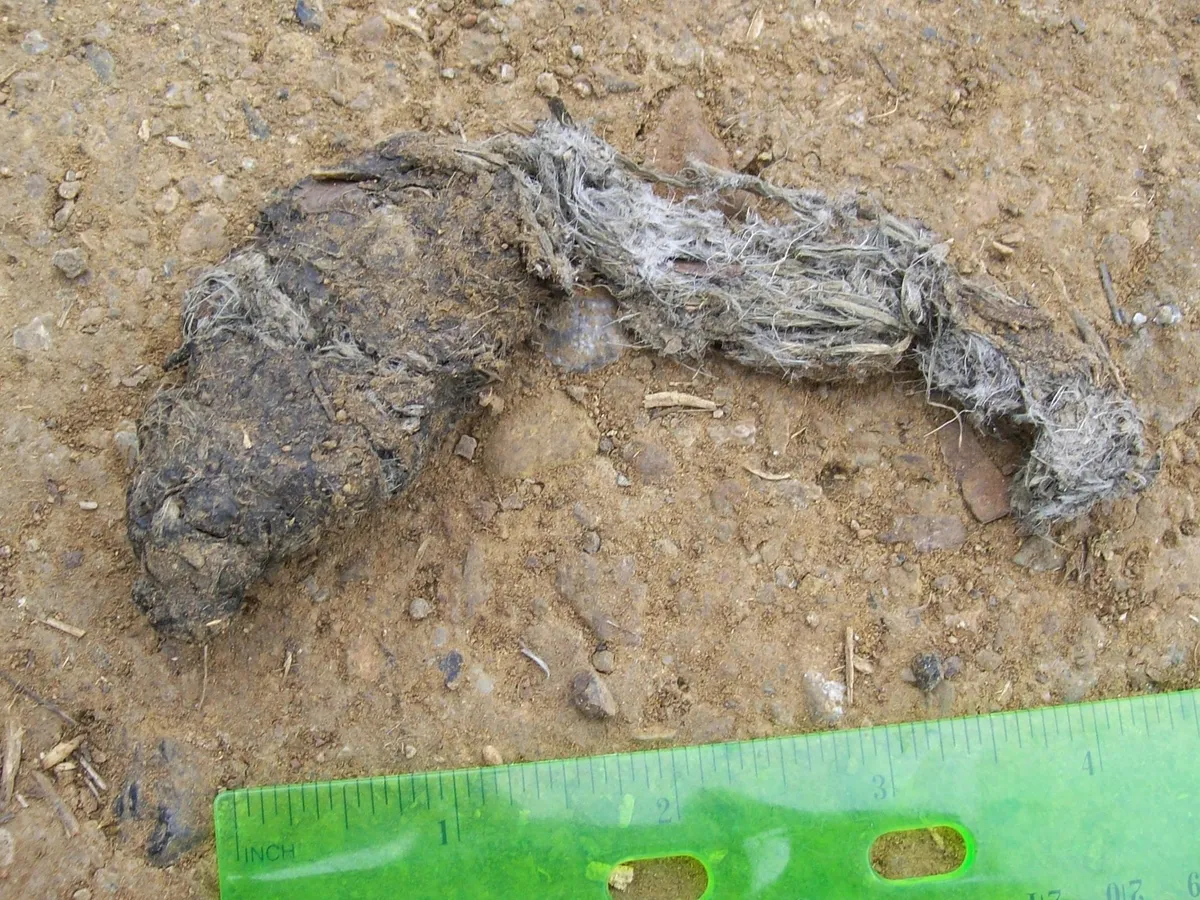 CoyoteUsually thicker, up to about 1 inch across, and often full of hair and bone
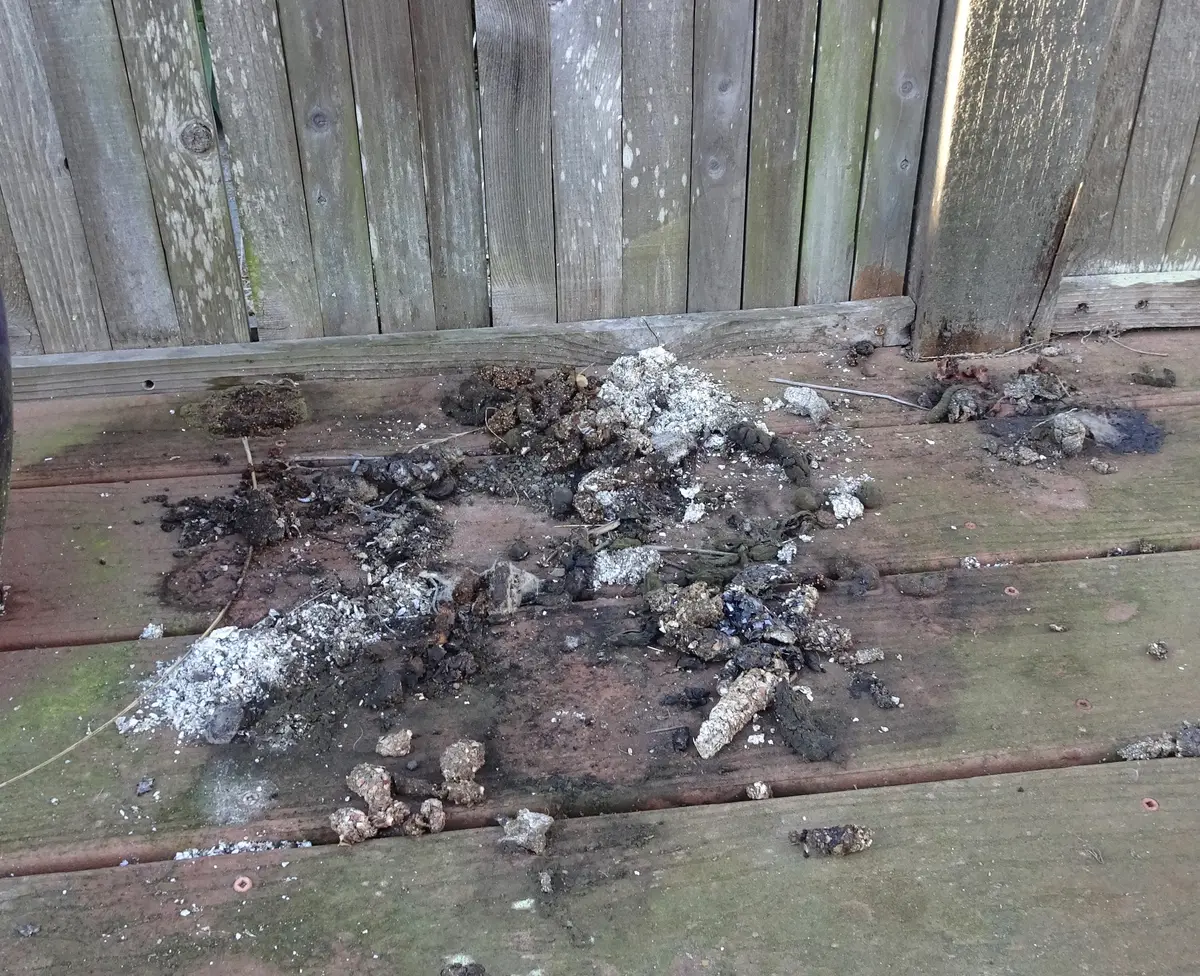 Raccoon latrineBlunt-ended, 2 to 3 inches long, heaped in one spot the raccoon keeps reusing
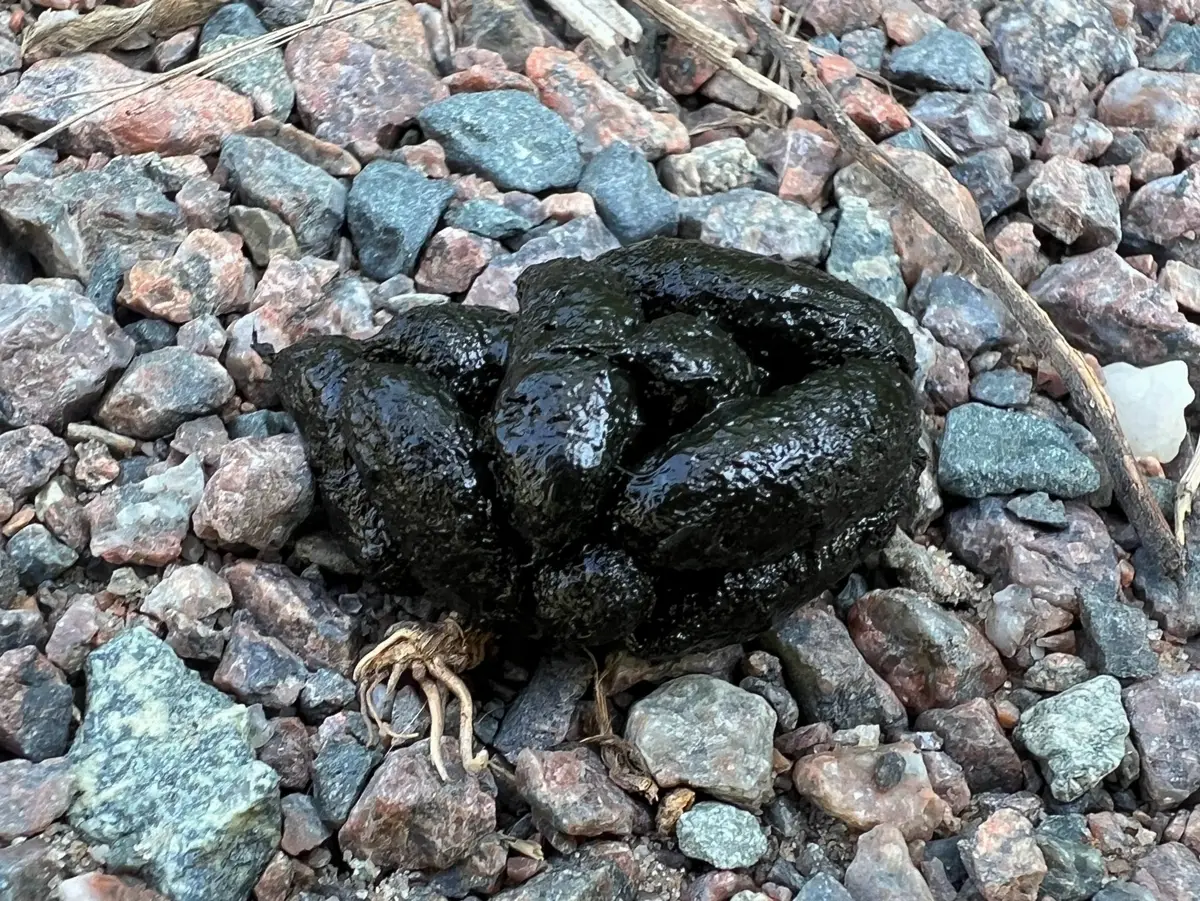 OpossumAbout cat-sized and full of a mixed diet, hard to tell from a raccoon's
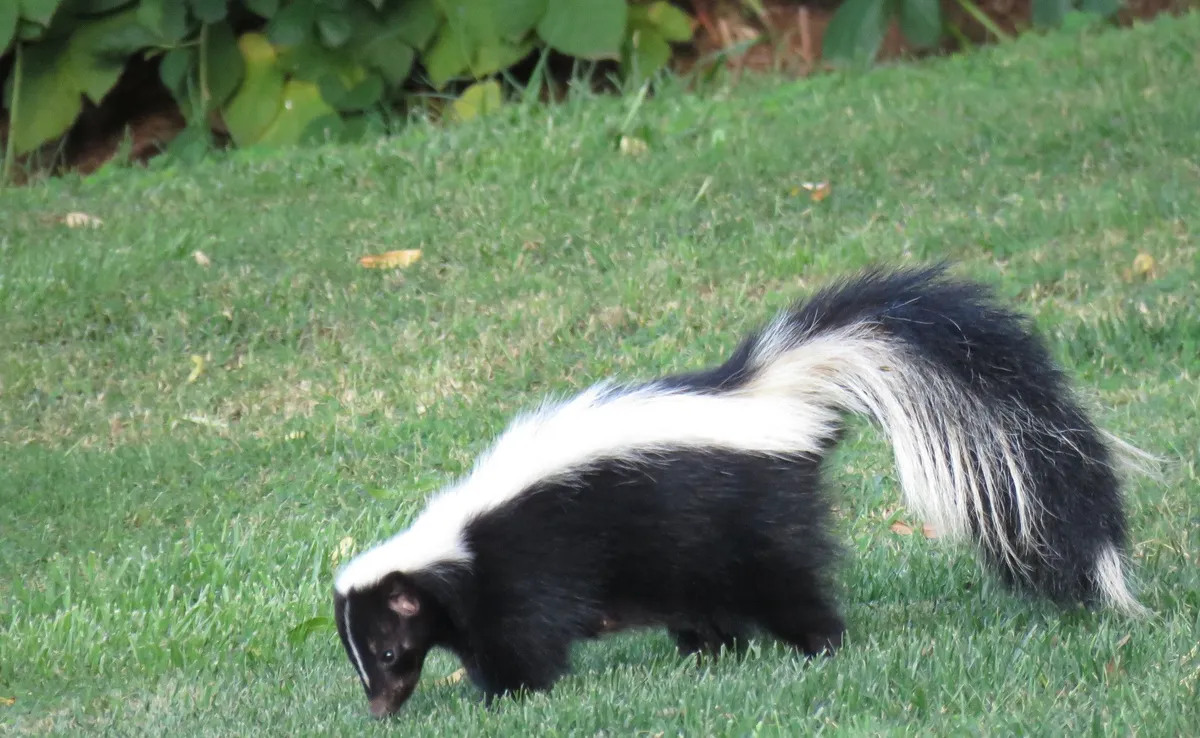 Striped skunkUp to 5 by 1/2 inch, usually black, with insect parts inside
Photos: Coyote: no rights reserved, via iNaturalist, CC0 1.0. Raccoon latrine: (c) Barbara Banfield, some rights reserved (CC BY), via iNaturalist, CC BY 4.0. Opossum: (c) Nova Patch, some rights reserved (CC BY-SA), via iNaturalist, CC BY-SA 4.0. Striped skunk: no rights reserved, via iNaturalist, CC0 1.0.
What should you do once you know it's a fox?
Usually nothing drastic: clean up, take away what draws the fox, and let a den family move on. Agencies advise:
- Leave a passing fox alone. CT DEEP says foxes are seldom aggressive toward people, and Minnesota DNR says they are not dangerous to people except when rabid, which is very rare.
- Remove food. Alabama Extension advises securing garbage, compost, pet food and bird seed, feeding pets indoors, cleaning up spilled seed and controlling rodents; a rodent-proof compost bin covers one of those. CT DEEP says never to feed foxes.
- Watch small pets and poultry. Minnesota DNR says most cats and dogs are not at risk from a fox, but kittens and very small adult cats under 5 pounds could be prey. Wildlife Illinois advises secure poultry fences with the wire buried 12 to 24 inches deep, and doors shut at night.
- Scare it off. Minnesota DNR suggests making loud noises or aiming a garden hose at the fox. Alabama Extension calls motion-activated sprinklers one of the easiest options for yards, but warns that scare tactics may cut fox activity only for a while and advises mixing them at irregular intervals; Wildlife Illinois says frightening devices are typically ineffective against foxes.
- Let a den empty, then close it. CT DEEP says most foxes have more than one den and readily move their young if disturbed. Once the kits have emerged, Minnesota DNR suggests mild harassment, such as loosely packing leaves or soil into the opening, and says to be sure all the kits are out before any permanent exclusion. To keep foxes from denning under a porch or deck, it suggests hardware cloth around the perimeter, buried 12 inches deep with an L-shaped length facing outward; how to close off the space under a deck shows a buried wire footing.
- Don't trap and move it. CT DEEP says live-trapping and relocating foxes is not recommended.
- Report a sick fox. CT DEEP says to avoid animals that seem sick or act abnormally and to call local animal control or the police about a possibly rabid one; Minnesota DNR says to call animal control about a fox that may have mange.
This guide is general educational information, not medical advice. If you have symptoms or concerns after a bite or exposure, contact a healthcare provider.
Frequently Asked Questions
How big is fox poop?+
Usually about 2 inches long and between 3/8 and 5/8 of an inch thick. Alabama Cooperative Extension gives those figures, UF/IFAS Extension puts typical fox and coyote scat at 2 inches by 1/2 inch, and the University of Arizona's glovebox guide gives gray fox scat as 2 by 1/2 inch. When a California study sorted scats by DNA, gray fox scats averaged about 0.45 inch across. A coyote's is closer to 1 inch thick, so measure the thickness.
What color is fox poop?+
Anything from glossy black to dull gray, so color is a weak clue; the photos on this page show black, dark brown and gray fox droppings. Fresh droppings tend to be moist and glossy, and old ones dry, dull and gray, according to UF/IFAS Extension. The University of Arizona's glovebox guide adds that diet can reshape and recolor any animal's droppings, so the thickness, the pointed ends and the hair or bone inside tell you more.
Do foxes poop in the same spot?+
They favor the same kinds of spots, and sometimes the same ones. The National Park Service says red foxes leave urine and scat on prominent landmarks such as stumps, rocks and trail intersections, and a California DNA study notes that gray foxes often leave scats in groups, as on the rock pictured on this page. A pile of old and fresh droppings that keeps growing on a deck or roof, though, more likely marks a raccoon, which uses a latrine.
How can you tell fox poop from dog poop?+
Look for hair, bone and a twisted, pointed end. Alabama Cooperative Extension says bone fragments and excessive fur are unlikely in a pet dog's scat. New York's environmental conservation department adds that a dog's droppings tend to look uniform, thanks to commercial dog food, and often have no tapered end, although softer ones can taper. Size helps less, since Wildlife Illinois compares gray fox droppings to a small dog's. Dog droppings also tend to turn up where people walk dogs.
What does fox poop smell like?+
The agency and extension sources behind this page do not describe a distinctive smell for fox droppings. The strong, skunky odor people link with foxes comes from urine: the National Park Service says male fox urine turns strongly musky and skunk-like during the February mating season. CDC says raccoon feces are the pungent ones, typically smelling worse than a dog's or cat's. Either way, don't sniff droppings; the University of Arizona's guide warns that some diseases can spread through airborne particles.
Do foxes bury their poop?+
None of the sources behind this page describes foxes burying their droppings. The National Park Service describes red foxes placing scat on prominent landmarks, where other foxes will find it. What foxes bury is food: Alabama Cooperative Extension says red foxes sometimes cache food for later, and Connecticut's wildlife agency says they may cover a cache with soil, grass, leaves or snow and mark it with urine.
Can you get sick from fox poop?+
It is possible but uncommon. CDC says the fox tapeworm, carried by foxes, coyotes and dogs, infects people who swallow its eggs without realizing it, for instance on berries or greens soiled by fox or coyote stool, or after handling an infected pet. Such infections are rare in people, though untreated ones can be fatal. CDC also says the dog roundworm infects wild canids such as foxes. Wear disposable gloves to clean up, wash your hands with soap and water, and wash or cook wild-picked food.
Can you get rabies from fox poop?+
No. Under CDC's 2008 rabies prevention recommendations, touching an animal's blood, urine or feces is indirect contact, not a rabies exposure. Foxes rank among the animals most often found with rabies in the United States, CDC says, but the virus spreads mainly through bites and scratches. If a fox bites or scratches you, wash the wound with soap and water at once and get medical care urgently.
What should I do if my dog ate fox poop?+
Ask your veterinarian whether your dog needs deworming. Kentucky's wildlife agency advises keeping dogs away from fox, coyote and dog feces, and says regular deworming of dogs that may carry the fox tapeworm cuts down the eggs they shed. CDC says to consult your veterinarian about preventive treatment if your pet may have eaten rodents, which carry the tapeworm's larval stage. Then pick up any other droppings in the yard with gloves and a tool.
Is it safe to eat vegetables from a garden where a fox pooped?+
Take care with anything near the dropping. For commercial produce fields, the University of Arizona's glovebox guide says to remove animal feces and not to harvest any crops within 5 feet of where they lay. CDC's advice is not to gather or eat wild fruit or vegetables picked straight off the ground, and to wash or cook anything wild-picked before eating it, because fox tapeworm eggs can be swallowed on food soiled by fox stool.
Sources
- Identification and Management of Foxes in Alabama (FOR-2119) — Alabama Cooperative Extension System
- How to Identify the Wildlife Species Responsible for Damage in Your Yard (WEC324/UW369) — University of Florida IFAS Extension
- The Southwest Arizona Track and Scat Glovebox Guide — University of Arizona Cooperative Extension
- Red Fox — Wildlife Illinois (authorized by the Illinois Department of Natural Resources)
- Gray Fox — Wildlife Illinois (authorized by the Illinois Department of Natural Resources)
- The Clever Red Fox — National Park Service
- A morphometric modeling approach to distinguishing among bobcat, coyote and gray fox scats (Reid, Wildlife Biology 21(5), 2015) — Wildlife Biology, via BioOne
- Brown or Black Droppings (droppings identification key) — Internet Center for Wildlife Damage Management
- Preventing Raccoon Roundworm — Centers for Disease Control and Prevention
- Controlling Raccoon and Opossum Damage (NebGuide G1688) — University of Nebraska-Lincoln Extension
- Distinguishing Large Wild Canids in New York State (September 2025) — New York State Department of Environmental Conservation
- Red Fox (Wildlife in Connecticut fact sheet, revised May 2018) — Connecticut Department of Energy and Environmental Protection
- Living with foxes — Minnesota Department of Natural Resources
- About Alveolar Echinococcosis (AE) — Centers for Disease Control and Prevention
- Echinococcosis (DPDx, Laboratory Identification of Parasites of Public Health Concern) — Centers for Disease Control and Prevention
- Echinococcus multilocularis — Kentucky Department of Fish and Wildlife Resources
- Toxocariasis (DPDx, Laboratory Identification of Parasites of Public Health Concern) — Centers for Disease Control and Prevention
- About Rabies — Centers for Disease Control and Prevention
- Human Rabies Prevention, United States, 2008: Recommendations of the Advisory Committee on Immunization Practices — Centers for Disease Control and Prevention, Morbidity and Mortality Weekly Report
- Preventing Toxoplasmosis — Centers for Disease Control and Prevention
Read and approved by Alex Francisco. Found an error? Email support@buzzskito.ca.