
Reviewed by Alex Francisco
Published November 10, 2026 · Fact-checked against the sources listed below
What does bear poop look like?
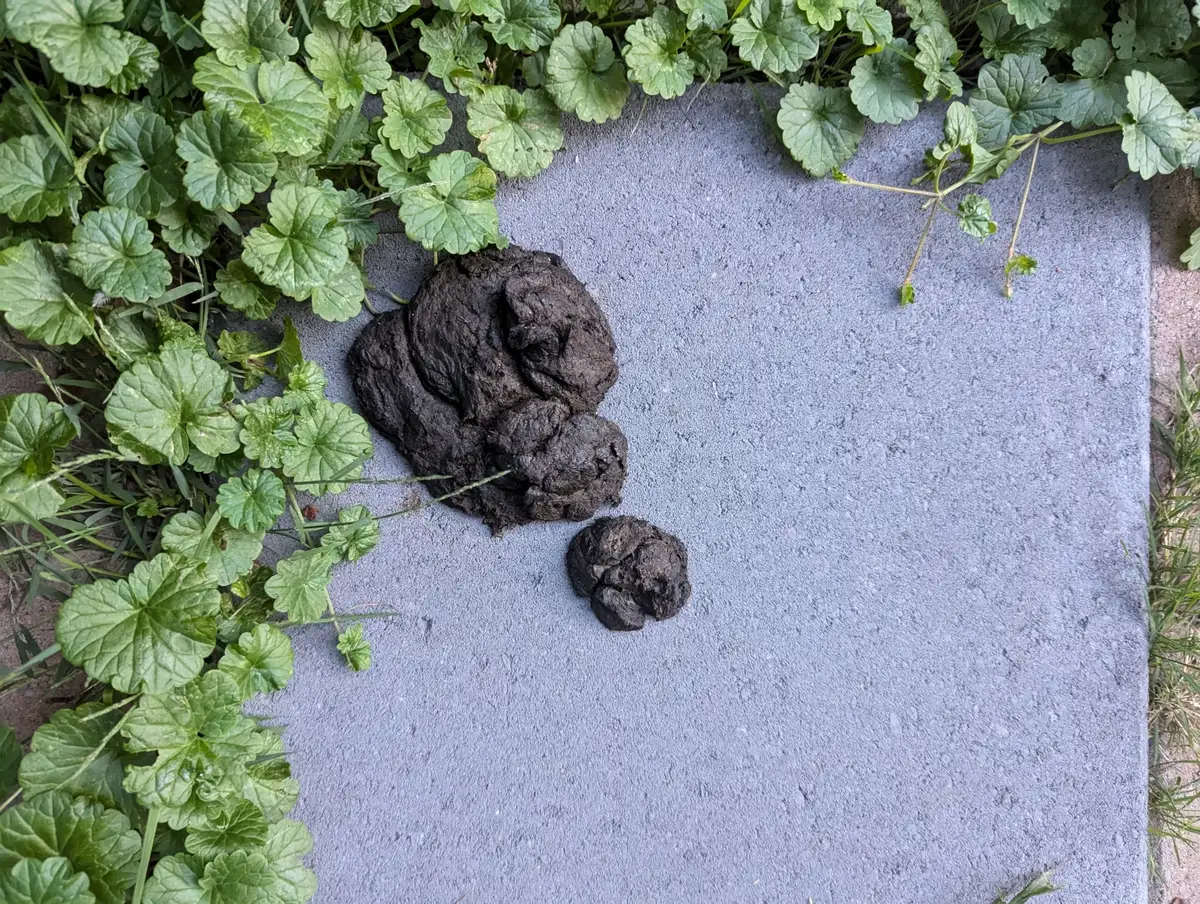
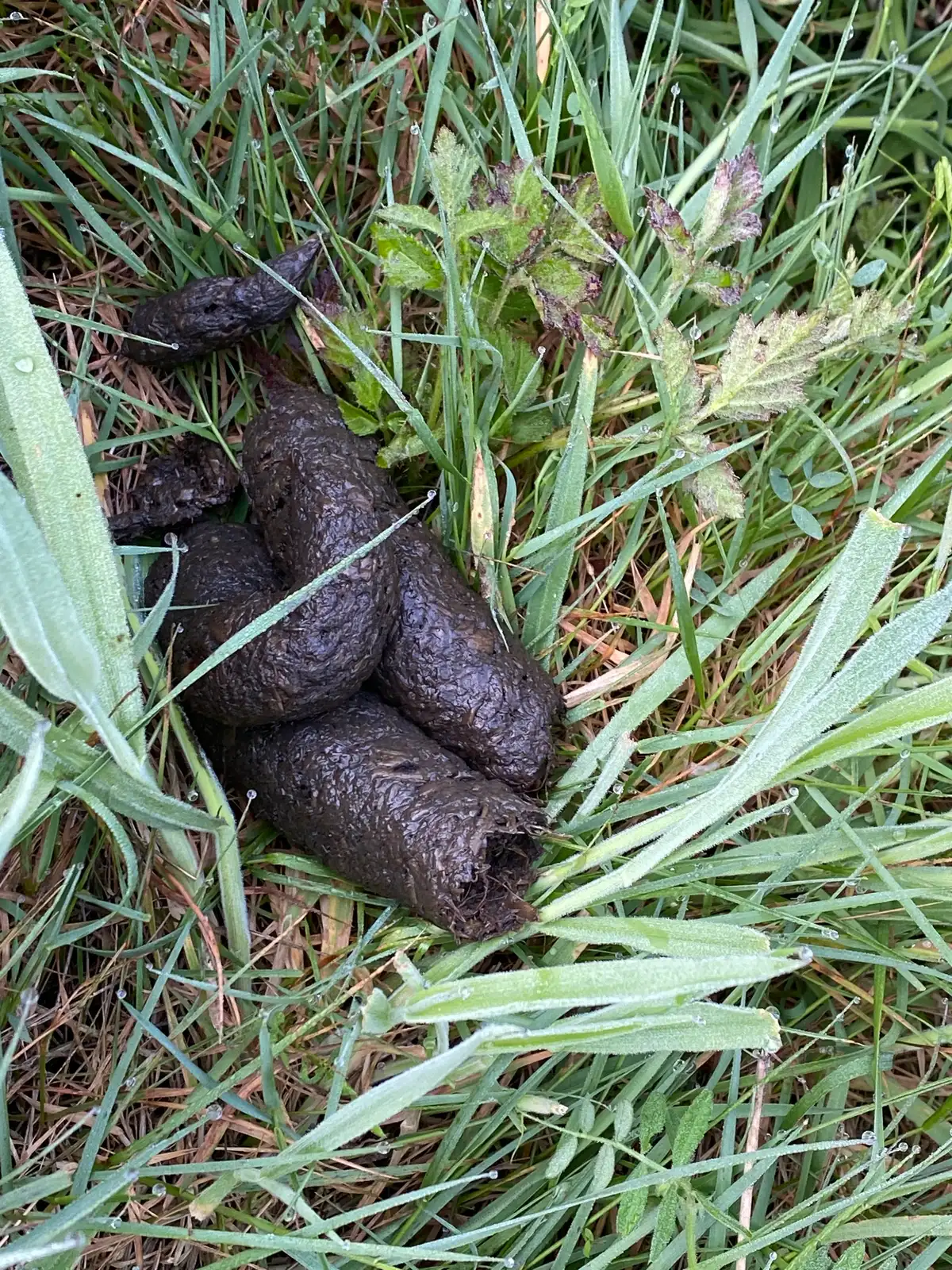
Bear poop comes as thick tubes or as loose piles, and it is made of whatever the bear has been eating. New York's DEC says bear droppings may be over an inch thick and tubular, and that they vary with the season's food. The droppings key of the Internet Center for Wildlife Damage Management (ICWDM) shows black bear scat both as tubes and as globular masses, says the droppings tend to be large (human-sized) and says their color depends on what the bear ate, and the U.S. Forest Service notes that bear scat is shaped much like dog scat.
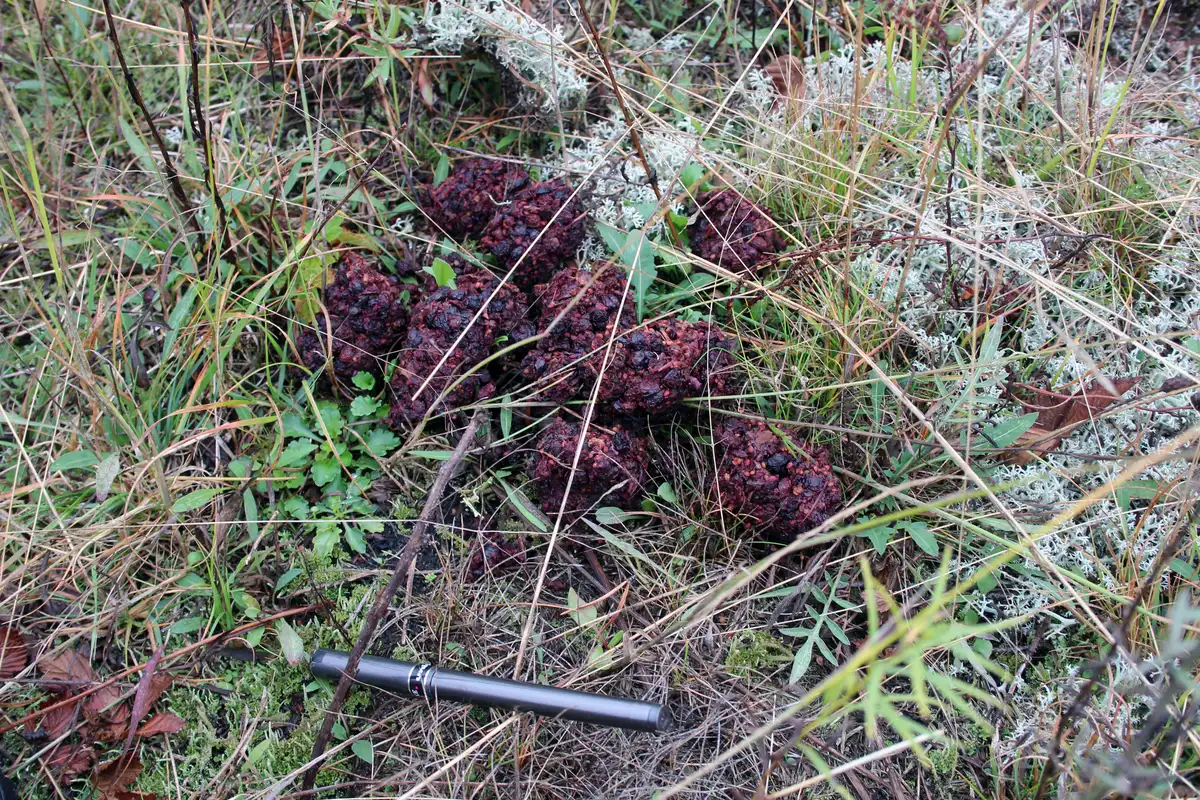
The contents are the best clue. The Interagency Grizzly Bear Committee (IGBC) says bear scat is often quite dark, with partly digested plants, insects and hair showing, and Yosemite's bear team notes that while some foods digest, apple peels, seeds, fur and bones show up in the poop. Missouri's Department of Conservation (MDC) lists bear scat as black, brown or green, in a plop of up to about a pound, and USDA APHIS says it may be loose or well-formed and can hold grasses, seeds, fur, bone or fish scales.
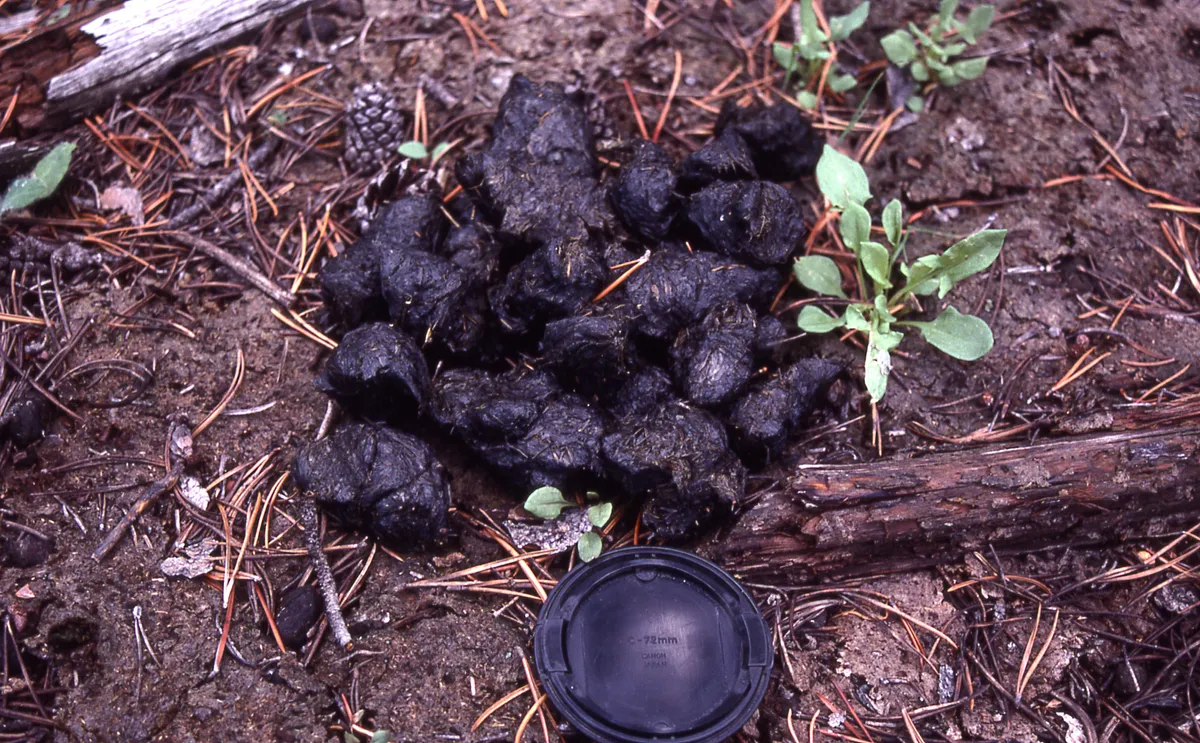
Checks to run on a pile, without touching it
- Size. Black bear droppings can be over an inch thick and a pile can weigh up to about a pound; coyote scat is usually under an inch across.
- Contents. A big pile of grass, berry seeds and skins, nut shells or insect parts points to a bear; mostly hair to a coyote or wolf; cereal matter with no hair to a dog.
- Shape. Thick tubes or big loose plops point to a bear, twisted rope to a coyote, dense segments to a bobcat or mountain lion, pellets to deer.
- Place. Trails, tree bases, meadows and feeding spots are typical; near a house, look for a feeder, garbage can, grill or fruit tree close by.
- Other bear sign. Black bears walk flat-footed, so their tracks show the whole foot with claw marks, APHIS says, and the Forest Service says bear tracks have five toes and a rear print with a heel like a person's.
How does bear poop change through the year?
It follows the menu. Minnesota's Department of Natural Resources says black bears eat green vegetation in spring, ants and ant pupae in June, a variety of berries in summer and nuts, mainly acorns and hazelnuts, in autumn. Most of a black bear's diet is plants, APHIS says, and the berry and nut crops it depends on are not ready in most regions until mid to late summer. Two Minnesota DNR bear biologists put plants at more than 85 percent of the diet and say that in fall a bear may feed up to 20 hours a day, taking in up to 20,000 calories, to fatten for winter.
| Season | What bears eat | What the scat looks like |
|---|---|---|
| Spring, out of the den | Green grass and other plants | Often green and tubular, with grass showing |
| June | Ants and ant pupae | Insect parts can show |
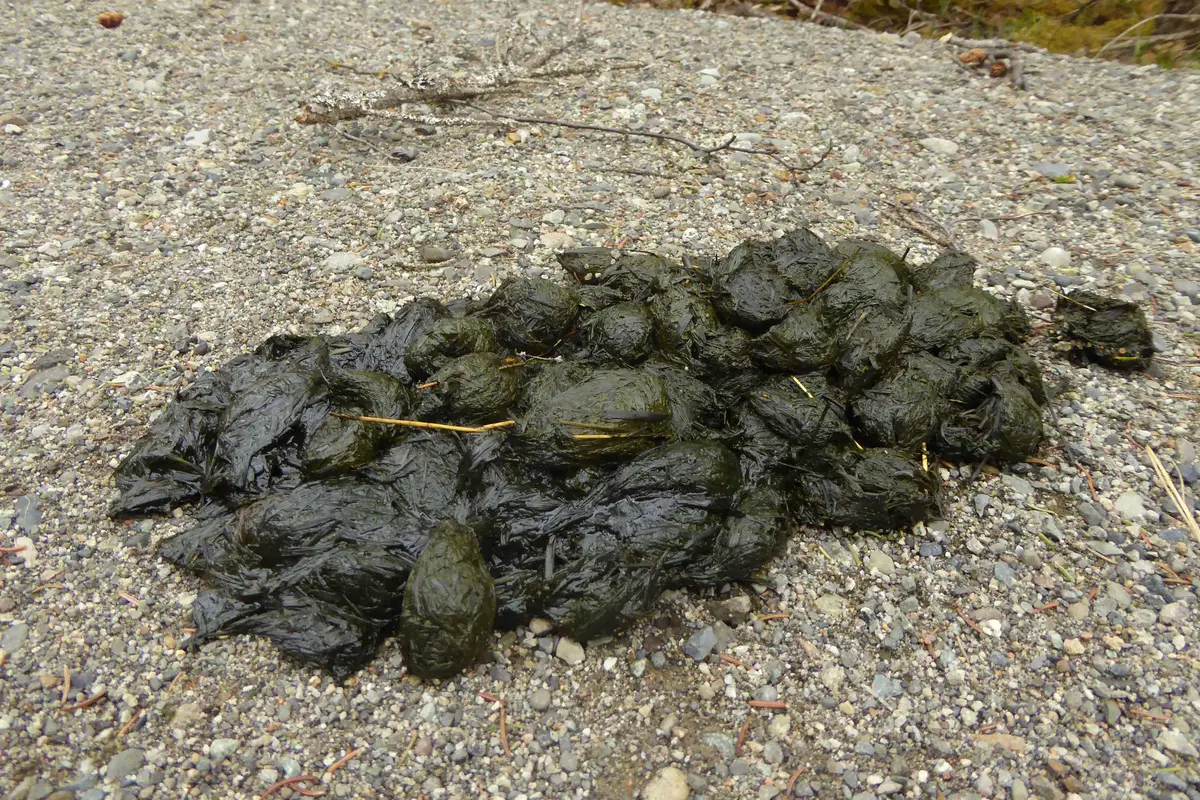
| Mid to late summer | Berries and other soft fruit | Looser, in large plops, with berries and apple pieces showing |
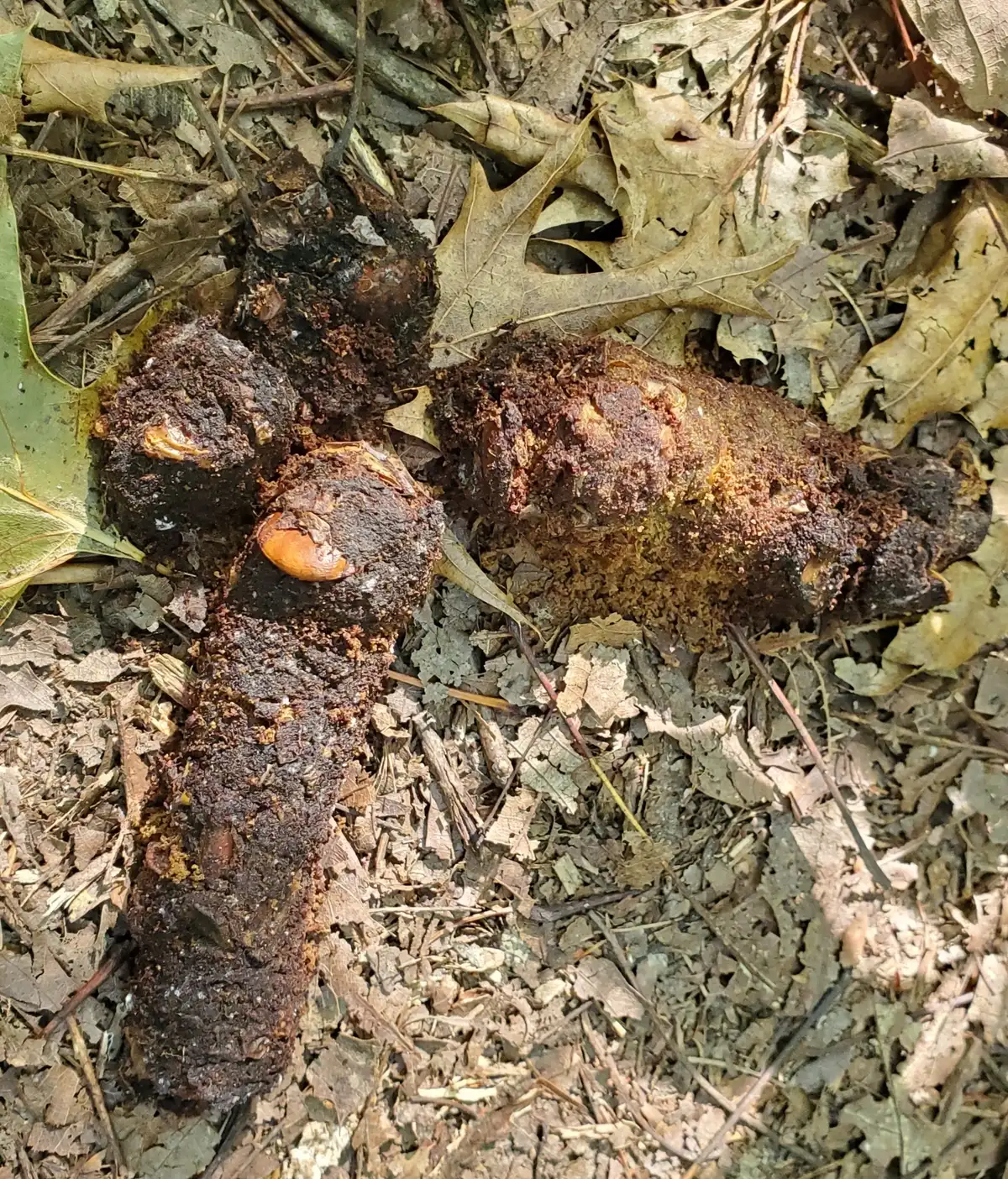
| Fall | Acorns, hazelnuts, hickory nuts and beechnuts | Can be packed with bits of nut shell, as in the photo below |
| Near homes, any season | Birdseed, garbage, pet food and fallen fruit | Seeds, peels and even plastic can show |
| Winter | Nothing while denned | None from denning bears; bears that skip denning keep leaving it |
Diet from Minnesota DNR, APHIS and NY DEC; scat from Yosemite NPS and the IGBC; denning from APHIS. Timing varies by region, and APHIS says berry and nut crops vary widely from year to year.
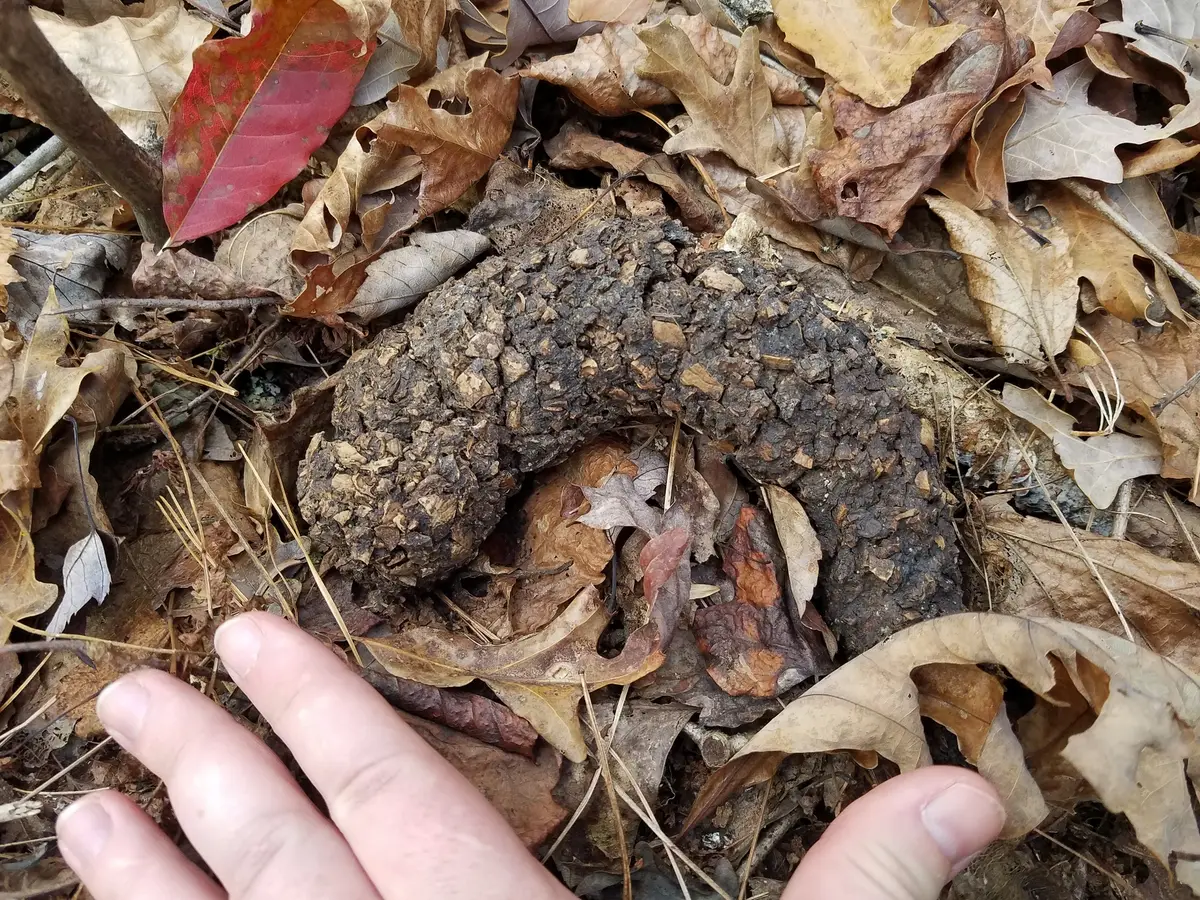
Crops change from year to year, and so does the scat. APHIS says the abundance of berries and nuts varies widely between years, and that many bears only add people's food to their diet when natural foods are unavailable.
Where do bears poop?
Wherever they feed, rest and travel. The IGBC says bear droppings are often found along trails and in open meadows, MDC lists trails and the base of trees, and Glacier Bay National Park's page on bear sign notes that a resting bear's day bed is often ringed by several scats. APHIS adds that bears often use people's trails to move between food sources and that crop fields and kill sites where bears have fed usually hold bear scat. Raccoons, by contrast, go in the same spot over and over, building latrines, Yosemite's bear team says.
Scat on a trail means a bear has used it. APHIS advises against camping where bear scat, other bear sign or a bear's natural foods are present, and the National Park Service says to pay attention to your surroundings and make a special effort to be noticeable in places with known bear activity or a good food source, such as berry bushes.
Why is there bear poop in my yard?
Most likely because a bear found, or smelled, food there. APHIS lists garbage, barbecue grills, bird feeders, gardens, compost piles and pet food among the things that draw black bears to homes, and it reports widespread damage to fruit trees such as apples, pears and plums. BearWise, an education program founded and funded by state wildlife agencies, says a bear can pick up a scent from more than a mile away.
Bird feeders are a rich prize. BearWise counts over 18,000 calories in a typical 7-pound birdseed feeder and 3,200 calories in 32 ounces of hummingbird nectar, and says a feeder a bear cannot reach still draws it by sight and smell. Yosemite's bear team says seeds and peels show up in bear poop, so seeds or hulls in a pile near a feeder are worth noticing.
Garbage leaves its own traces. NY DEC lists bird seed and trash among the human foods bears eat and says bears feeding on garbage may swallow items such as soap and insect repellent, and APHIS notes that even some plastics attract bears. In one national survey APHIS cites, 69 percent of wildlife agencies named poorly stored garbage as a primary cause of bear conflicts.
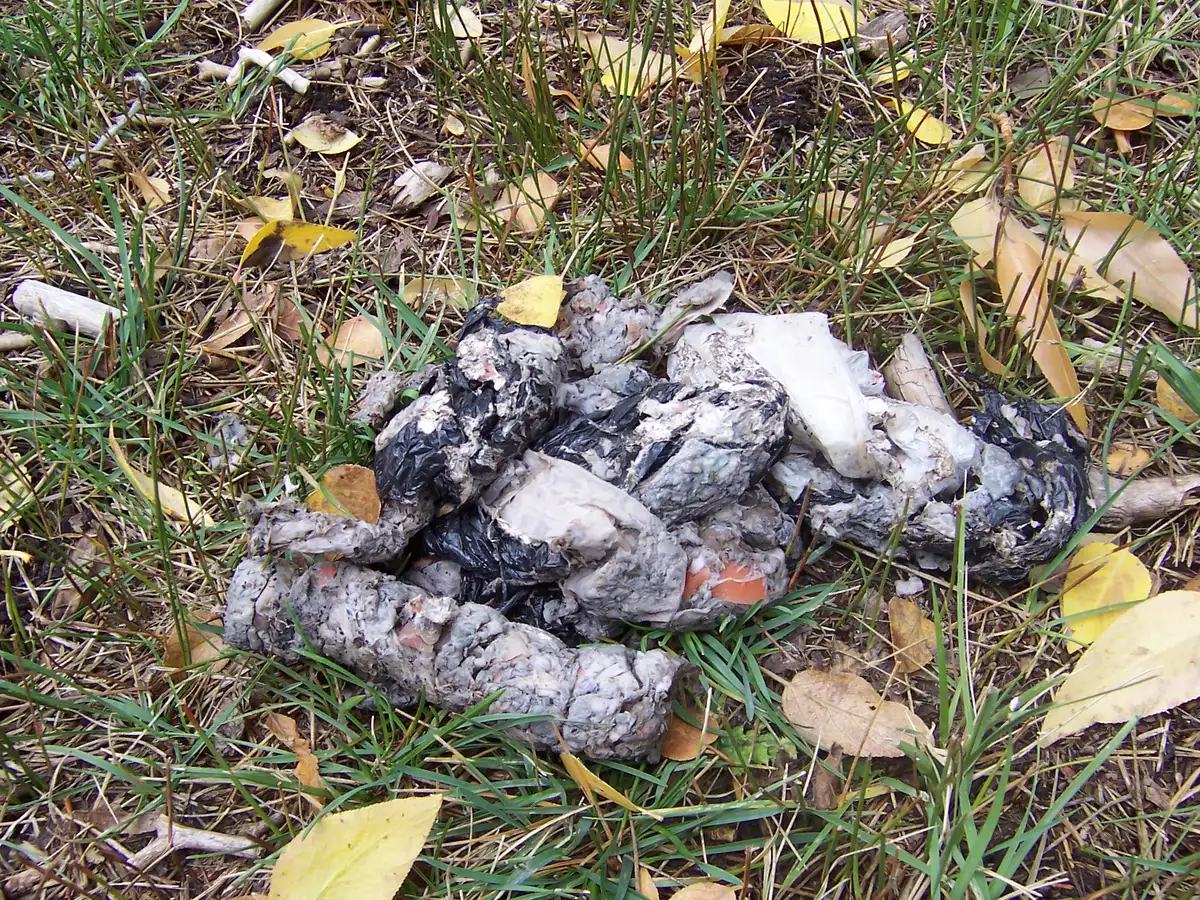
A big pile beside a tipped-over trash can is not always a bear's. In a case MDC describes, a homeowner found huge piles of scat mixed with plastic, knocked-over trash cans and trash spread everywhere, and wondered whether a black bear that had been in the news had left them. MDC staff judged coyotes the likely culprits, citing a lack of bear sightings in the busy suburban neighborhood, several recent coyote sightings, cans that were knocked over rather than mangled, and no bear tracks. Coyotes gorging on garbage can leave extra-large piles, MDC says, while APHIS says trash cans a bear has raided may be overturned or show brute force, such as large holes or crushing.
BearWise warns that anything that attracts dogs or raccoons will attract bears too, so the guide to keeping raccoons away covers some of the same habits; for bears, though, garbage needs a bear-resistant container or a sturdy building.
How do you tell bear poop from dog, coyote, raccoon or deer poop?
Size and contents are the main clues. Yosemite's bear team says coyote, raccoon, bobcat and mountain lion piles are all smaller than a bear's, and APHIS says bear scat can hold a wide variety of plant matter, since plants make up most of a black bear's diet. For other animals' droppings side by side, see the animal poop identification chart.
Bear poop vs dog poop
The two can share a shape: the Forest Service says bear scat looks similar to dog scat. The contents differ. Iowa's Department of Natural Resources says a domestic dog's scat has no hair, lacks the tapered, hairy ends of wolf scat and is full of cereal matter, while a bear's often holds bits of wild food such as grass, berry seeds and skins, nut shells or insect parts and, for black bears, may be over an inch thick, as NY DEC notes.
Bear poop vs coyote or wolf poop
Coyote scat is thinner and hairier: usually less than an inch across and often full of small mammal hair, Iowa's DNR says, and twisted like rope in the description of Yosemite's bear team. MDC lists fur and bones as its contents and trails and territory edges as its places. Wolf scat can be as thick as a bear's, usually over an inch and up to 1.5 inches across and 4 to 7 inches long, but Iowa's DNR says most wolf scat is full of deer, beaver or snowshoe hare hair, with tapered, hair-fringed ends. See what coyote poop looks like for photos.
Bear poop vs raccoon poop
Raccoon droppings are much smaller and come in latrines. ICWDM gives them as 2 to 3 inches long and 1/2 inch wide, found in latrines on roofs, in attics and sandboxes, and in open areas, because raccoons return to the same spot; MDC lists seeds among the clues to look for. The raccoon poop guide shows latrines on decks and logs.
Bear poop vs deer pellets
Deer leave pellets of plant material, black to greenish, MDC says. ICWDM notes that deer scat can be tubular or pelleted, is found in piles, and that in summer the pellets often clump, so look for pellet shapes in the mass. The deer poop guide has more photos.
Bear poop vs bobcat or mountain lion poop
Wild cat scat is segmented and dense, and it holds its shape if you step on it, Yosemite's bear team says, while a bear's late-summer plops are loose.
Is it black bear or grizzly poop?
You can't tell from the scat alone. The Forest Service says only DNA can show whether a grizzly or a black bear left it, and the IGBC says grizzly scat is about 2 inches or so across but size does not always separate the two. Location narrows it down: in the lower 48, APHIS says, black bear and grizzly ranges overlap in parts of Wyoming, Montana, Idaho and Washington, while in Alaska and western Canada the overlap is extensive. The IGBC says you are more likely to see black bears than grizzlies almost everywhere in the lower 48 and in Canada, and APHIS says black bears have reestablished populations in at least 40 states.
To identify the bear itself, the Forest Service points to a grizzly's shoulder hump, dished face, short rounded ears and front claws 2 to 4 inches long, against a black bear's straight face, tall pointed ears and front claws about 1 1/2 inches long; color is not a good guide. Where both live, APHIS advises assuming any bear you see is a grizzly until you know otherwise.
Do bears poop while they hibernate?
No. Bears do not eat, drink or defecate while in the den, APHIS says, and Katmai National Park adds that they recycle their waste instead. In the North, denning can run from as early as October to April or early May, APHIS says, and Minnesota's DNR says its bears can hibernate for as long as six or seven months, so a winter break in fresh scat is normal there, apart from bears that APHIS says sometimes come out to forage in warm spells. In the warmer South only pregnant females may den, and where food lasts all year other bears may not den at all, so scat can turn up in any month.
Is bear poop dangerous?
The disease risk looks low, going by USDA APHIS. It calls diseases passing from bears to people unlikely, though it says bears may carry ticks that spread Lyme disease, anaplasmosis and Rocky Mountain spotted fever, and its one note on trichinellosis concerns eating undercooked bear meat. If you get a rash or fever within several weeks of removing a tick, CDC says to see your doctor; for what to watch for, see the early signs of Lyme disease.
Treat it like any wild animal's droppings anyway. CDC's advice on wildlife is to enjoy it from a distance, to wash with soap and running water after contact with wild animals or their poop, to supervise young children's handwashing and to keep pets leashed outdoors in unfenced areas. On a hike, CDC says to filter and disinfect stream water before drinking, because clear-looking water can still carry wildlife poop.
CDC and the other agencies cited here give no cleanup steps for bear scat. To clear one from a lawn, deck or driveway, borrow the simple parts of CDC's steps for raccoon droppings: wear disposable gloves, lift it with a shovel or an inverted plastic bag, bag it for the trash, and wash your hands with soap and warm running water. CDC's boiling-water and torch steps target the eggs of raccoon roundworm, a parasite whose main host is the raccoon.
Commonly confused with bear poop
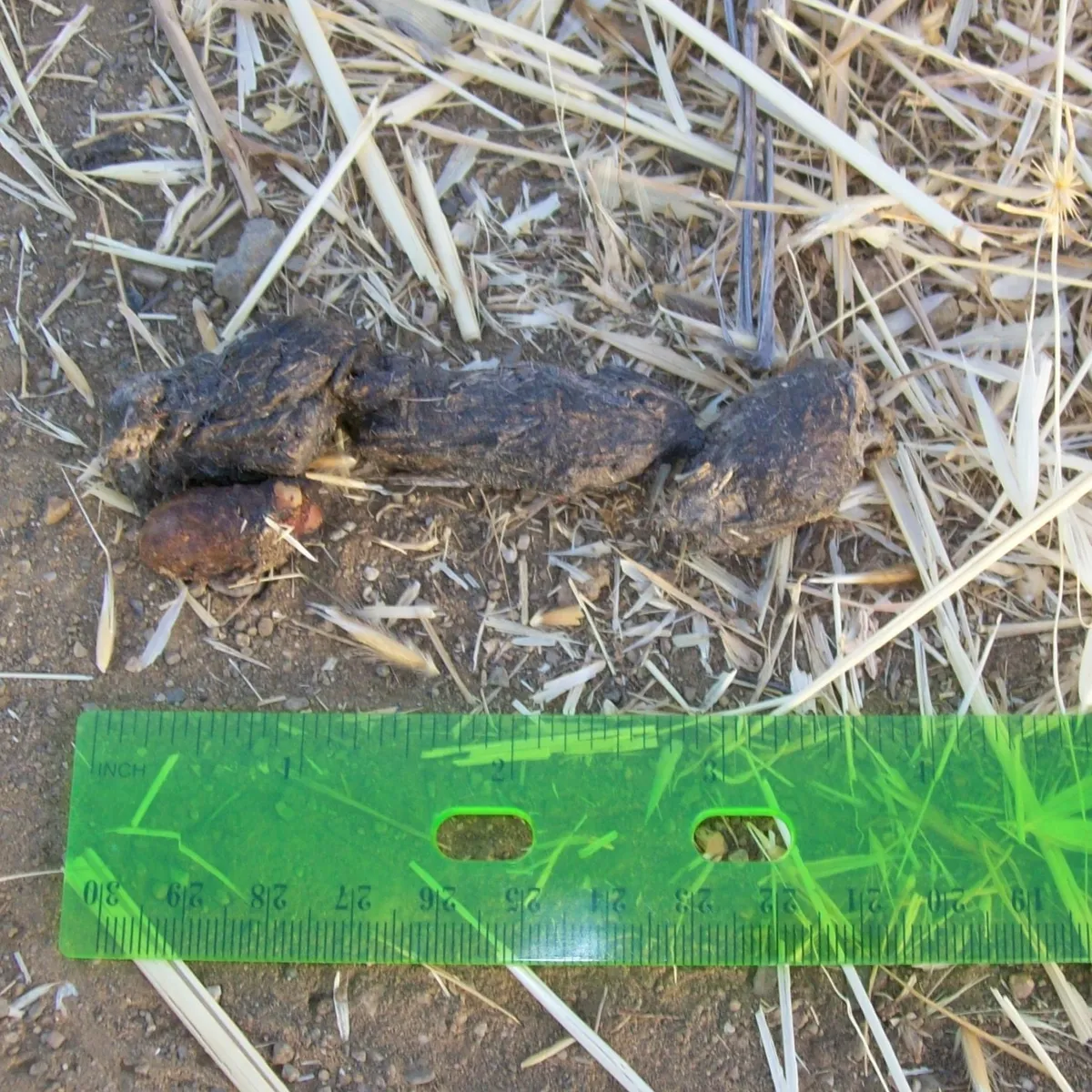 Coyote scatUsually under 1 inch across, often twisted like rope and full of hair
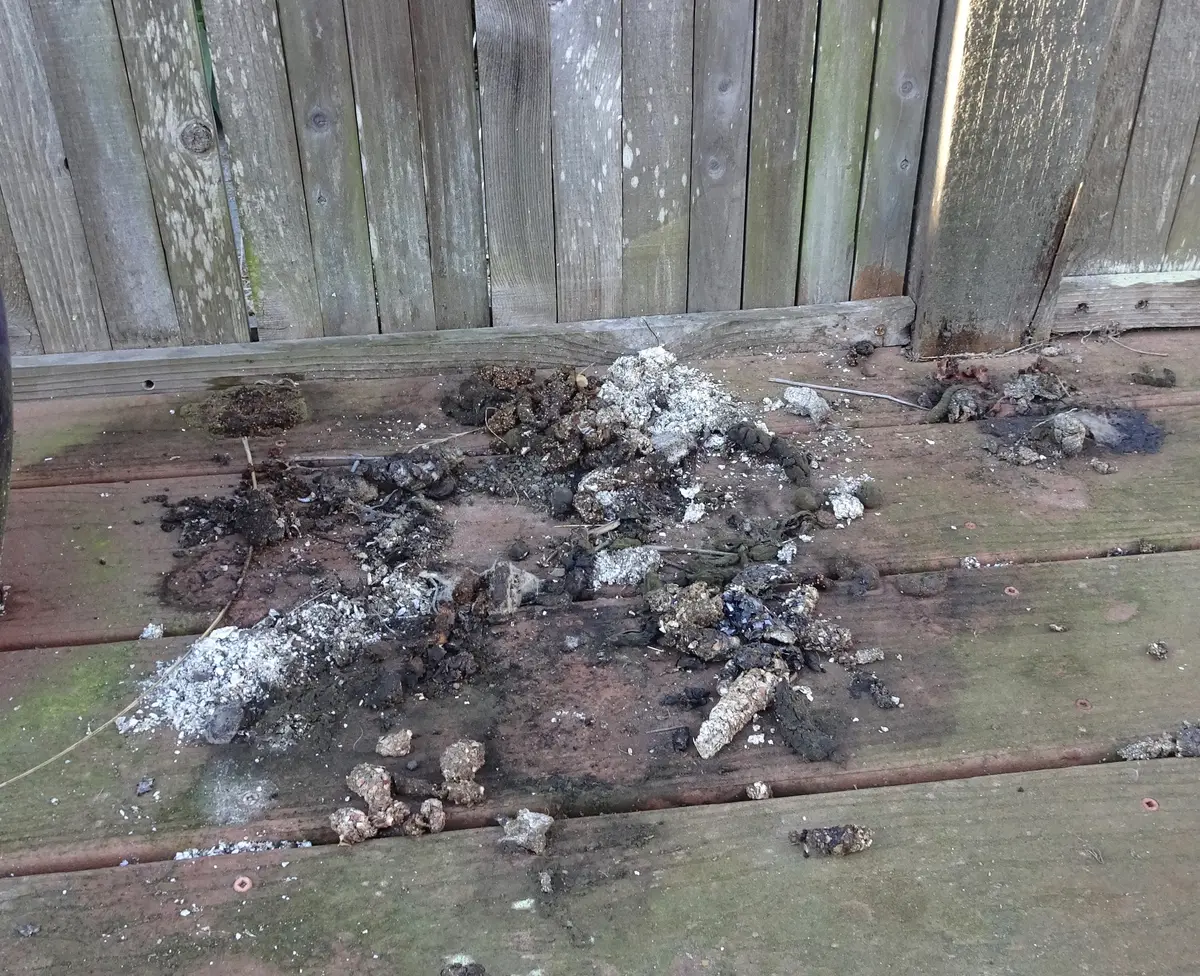 Raccoon latrineOnly 2 to 3 inches long, piled in one spot used again and again
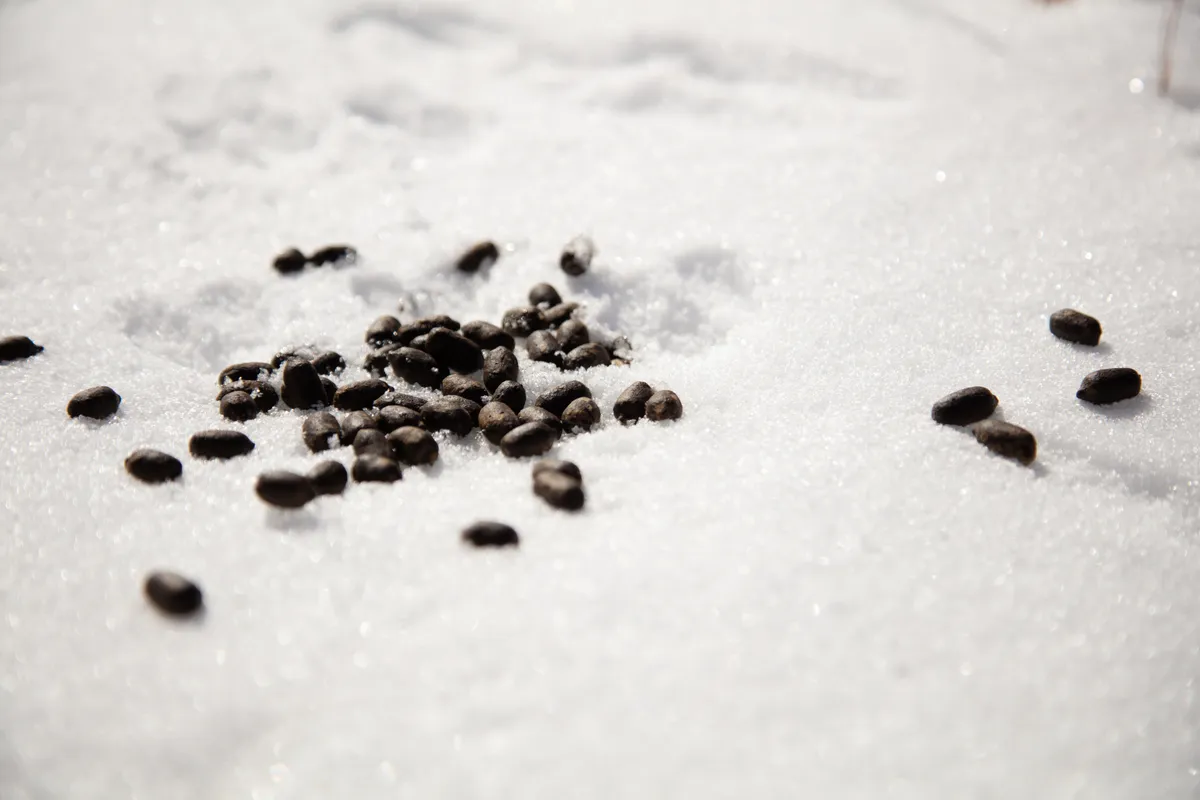 Deer pelletsPellets of plant material that often clump together in summer
Photos: Coyote scat: no rights reserved, via iNaturalist, CC0 1.0. Raccoon latrine: (c) Barbara Banfield, some rights reserved (CC BY), via iNaturalist, CC BY 4.0. Deer pellets: ShenandoahNPS, Public domain, via Wikimedia Commons, public domain.
What should you do once you know it's bear poop?
Treat the scat as a sign that a bear found food nearby, and take that food away. At home, that means the six BearWise basics plus APHIS's advice:
- Check the yard for bears before letting dogs out, and if a bear is still there, make loud noises from a safe distance to scare it off, as BearWise's advice on bear encounters suggests.
- Take bird feeders down while bears are active and clean up spilled seed, which APHIS says should go too; BearWise suggests asking your local fish and wildlife agency when bears are active where you live.
- Keep garbage and recycling in a bear-resistant container or a sturdy building, and put cans out the morning of pickup, never the night before.
- Bring pet food inside, and clean and store grills.
- Pick fruit as it ripens and pick up fallen fruit, as APHIS advises, and keep meat, bones and dairy out of the compost, as BearWise advises.
- Tell your neighbors about the bear.
- Never feed or approach a bear, as BearWise advises, and report bear incidents to local authorities, as APHIS advises.
On a trail or at a campsite
- Make your presence known. APHIS suggests talking or singing in bear country so you don't surprise a bear at close range, and keeping bear spray within reach.
- Camp somewhere else. APHIS advises against camping where bear scat, other bear sign or a bear's natural foods are present, and says to store food and trash in bear-proof containers.
- If you see the bear, the National Park Service says to talk calmly so it knows you are human, not to run, to pick up small children and to keep your distance.
- Keep dogs leashed, as CDC advises outdoors in unfenced areas.
This guide is general educational information, not medical advice. If you have symptoms or concerns after a bite or exposure, contact a healthcare provider.
Frequently Asked Questions
What does black bear poop look like?+
Black bear droppings may be over an inch thick and tubular, New York's Department of Environmental Conservation says, though in berry season they often come as looser, large plops. The Missouri Department of Conservation lists the color as black, brown or green. The contents show the bear's recent meals: grass in spring, insect parts in early summer, berry seeds, skins and apple pieces in late summer, and nut shells in fall. Near homes, birdseed or plastic can show up in it.
How big is bear poop?+
Big enough to stand out. New York's Department of Environmental Conservation says bear droppings may be over an inch thick, the Missouri Department of Conservation says a pile can weigh up to about a pound, and the droppings key of the Internet Center for Wildlife Damage Management says black bear droppings tend to be large, about human-sized. Grizzly scat is about 2 inches or so across, the Interagency Grizzly Bear Committee says, though size does not always separate the two species.
Why is bear poop full of berries?+
Because bears eat a lot of them, and the seeds and skins pass through. Minnesota's Department of Natural Resources says black bears eat a variety of berries in summer, and Yosemite's bear team says late-summer and fall scat is looser and comes in large plops with berries and apple pieces visible, and that while some foods digest, seeds and peels show up in the poop. In fall, Minnesota's bear biologists say, a bear may feed up to 20 hours a day to fatten for winter.
How can you tell bear poop from dog poop?+
Look at what is in it. The U.S. Forest Service says bear scat is similar in shape to dog scat, but Iowa's Department of Natural Resources describes a domestic dog's scat as full of cereal matter, with no hair. A bear's often holds bits of what wild bears eat, such as grass, berry seeds and skins, nut shells or insect parts, and New York's Department of Environmental Conservation says bear droppings may be over an inch thick.
What animal poop looks like bear poop?+
Wolf scat can be as thick as a bear's: Iowa's Department of Natural Resources says it is usually over an inch across, up to about 1.5 inches, with tapered, hair-fringed ends, and that most is full of deer, beaver or hare hair. A dog's has the same general shape as a bear's but is full of cereal matter. Coyote scat is usually under an inch across, and Yosemite's bear team says coyote, raccoon, bobcat and mountain lion piles are all smaller than a bear's.
What does it mean if there is bear poop in my yard?+
A bear has visited, most likely drawn by food. USDA APHIS lists garbage, barbecue grills, bird feeders, gardens, compost piles and pet food among the things that attract black bears to homes. BearWise, a program founded by state wildlife agencies, advises taking bird feeders down while bears are active, securing garbage and recycling, never leaving pet food outdoors, cleaning and storing grills and telling your neighbors. BearWise also says to check the yard for bears before letting dogs out.
Is bear poop dangerous to touch?+
Don't touch it with bare hands. USDA APHIS says diseases passing from bears to people are unlikely, but CDC's advice for any wild animal's poop is to wash with soap and running water after contact. CDC's wildlife advice gives no cleanup steps for bear scat, so to clear it from a yard, borrow the simple steps CDC gives for raccoon droppings: wear disposable gloves, lift it with a shovel or an inverted plastic bag, bag it for the trash and wash your hands.
Can you tell grizzly poop from black bear poop?+
Not reliably. The U.S. Forest Service says DNA is the only way to tell whether a scat came from a grizzly or a black bear. Grizzly scat is about 2 inches or so across, but the Interagency Grizzly Bear Committee says size does not always separate the two. In the lower 48, USDA APHIS says, black bear and grizzly ranges overlap in parts of Montana, Wyoming, Idaho and Washington.
Do bears poop while hibernating?+
No. USDA APHIS and Katmai National Park both say bears do not eat, drink or defecate while in the den, and Katmai adds that they recycle their waste instead. In northern climates, APHIS says, denning can run from as early as October to April or early May. In the warmer South, only pregnant females may den, and where food is available all year, other bears may not den at all, so scat can appear in any month.
What should you do if you find fresh bear poop on a trail?+
Stay alert and make noise. USDA APHIS suggests talking or singing in bear country so you don't surprise a bear, keeping bear spray within reach and not camping where bear scat or other bear sign is present. If you see the bear, the National Park Service says to talk calmly so it knows you are human, not to run, to pick up small children and to keep your distance. Where grizzlies also live, APHIS says to assume a bear is a grizzly until you know otherwise.
Sources
- Black Bear (Wildlife Damage Management Technical Series, March 2020) — USDA Animal and Plant Health Inspection Service, Wildlife Services
- The Scoop on Bear Poop (Yosemite Bear Team, October 2019) — Yosemite National Park, National Park Service
- Black Bear — New York State Department of Environmental Conservation
- The Scat Detective (Tom Meister, Missouri Conservationist, September 2021) — Missouri Department of Conservation
- Bear Identification & Signs (Be Bear Aware) — Interagency Grizzly Bear Committee
- Bear Identification — Custer Gallatin National Forest, USDA Forest Service
- Black bear — Minnesota Department of Natural Resources
- Minnesota Profile: American Black Bear (Minnesota Conservation Volunteer, September-October 2025) — Minnesota Department of Natural Resources
- Brown or Black Droppings (droppings identification key) — Internet Center for Wildlife Damage Management
- Canid Identification: Wolves, Coyotes and Dogs (adapted from Wisconsin DNR) — Iowa Department of Natural Resources
- BearWise: Helping people live responsibly with bears (the six BearWise basics) — BearWise, a program founded and funded by state wildlife agencies
- Remove Bird Feeders When Bears Are Active — BearWise
- BearWise #2: Secure Food, Garbage and Recycling — BearWise
- Bear Encounters: How to behave if you see a bear — BearWise
- Bear Sign — Glacier Bay National Park & Preserve, National Park Service
- Bear Hibernation (November 2013) — Katmai National Park & Preserve, National Park Service
- Staying Safe Around Bears — National Park Service
- Wildlife (Healthy Pets, Healthy People) — Centers for Disease Control and Prevention
- Raccoon Latrines: Identification and Clean-up — Centers for Disease Control and Prevention
- What to Do After a Tick Bite — Centers for Disease Control and Prevention
Read and approved by Alex Francisco. Found an error? Email support@buzzskito.ca.