
Published by BuzzSkito Mosquito & Tick Control
Published October 20, 2026 · Drafted with AI assistance and fact-checked against the sources listed below
How do you identify animal poop?
Use four clues together: size, shape, what is inside and where you found it, including whether the droppings are piled in one spot or scattered. Shape is the first sort: deer and rabbits leave pellets, raccoons leave dark tubes, and mice, bats and insects leave small grains or specks. Then size and contents narrow it down, and the chart above gives the details for 12 kinds of droppings.
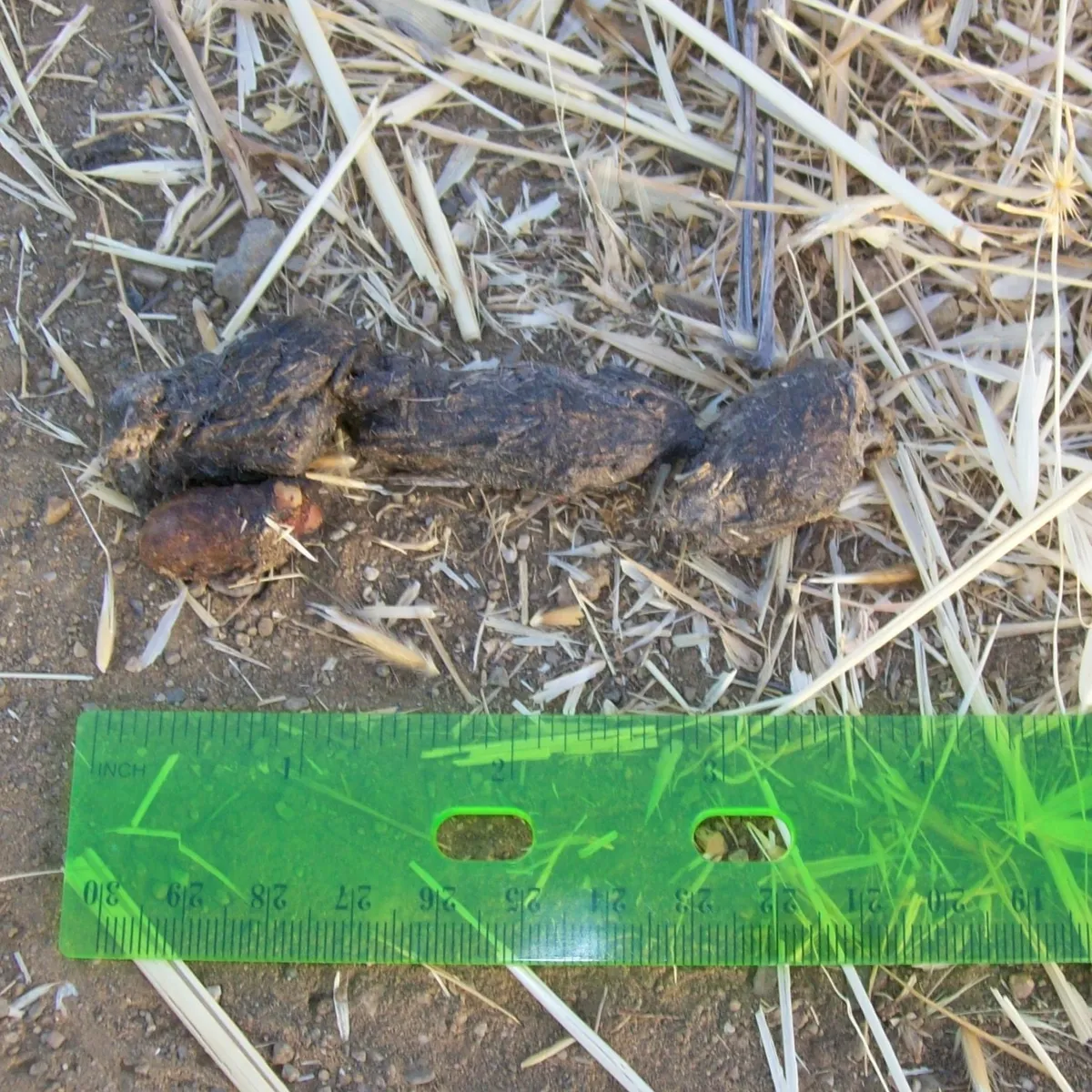
Freshness tells you whether the animal is still around. A UGA Extension article drawing on wildlife specialist Michael Mengak says fresh droppings are black and shiny, while old ones are dry and brown or gray, and Mengak notes that black-and-white droppings can be from a bird, a snake or a lizard. Raccoon latrines mix the two: the California Department of Public Health says older, dry droppings are often mixed with fresh, wet ones because the same spot is used over and over.
Checks to run on a dropping, without touching it
- Measure it. Photograph it beside a ruler: 1/8 to 1/4 inch fits a mouse, about 1/2 inch a roof rat, 3/4 inch or more a Norway rat, and droppings the size of a small dog's or a cat's a raccoon or an opossum.
- Check the shape. Round pellets, longer pellets with a point, blunt-ended tubes, twisted tubes or pepper-like specks each point to a different group.
- Look at what is in it. Seeds point to a raccoon, hair to a coyote, shiny insect bits to bats, and white, chalky uric acid to a bird, snake or lizard.
- Count and map it. One reused pile is a latrine; scattered droppings fit mice; piles under a gap in the siding fit bats.
- Note where you found it. The sections below go place by place: the yard, the deck and roof, the attic, and inside the house.
What animal poop is in my yard?
In a yard or on a lawn, start with five animals: raccoons, opossums, coyotes, deer and rabbits. Raccoon droppings look like small dog droppings, CDPH says: dark, smelly and often full of undigested seeds. A flyer from Santa Barbara County Animal Services adds that fresh ones are tubular with blunt ends and about as thick as a dime or nickel. CDC says raccoons usually go at the base of trees or on raised spots such as fallen logs, stumps and large rocks. More photos and the raccoon-versus-opossum comparison are in the raccoon poop guide.
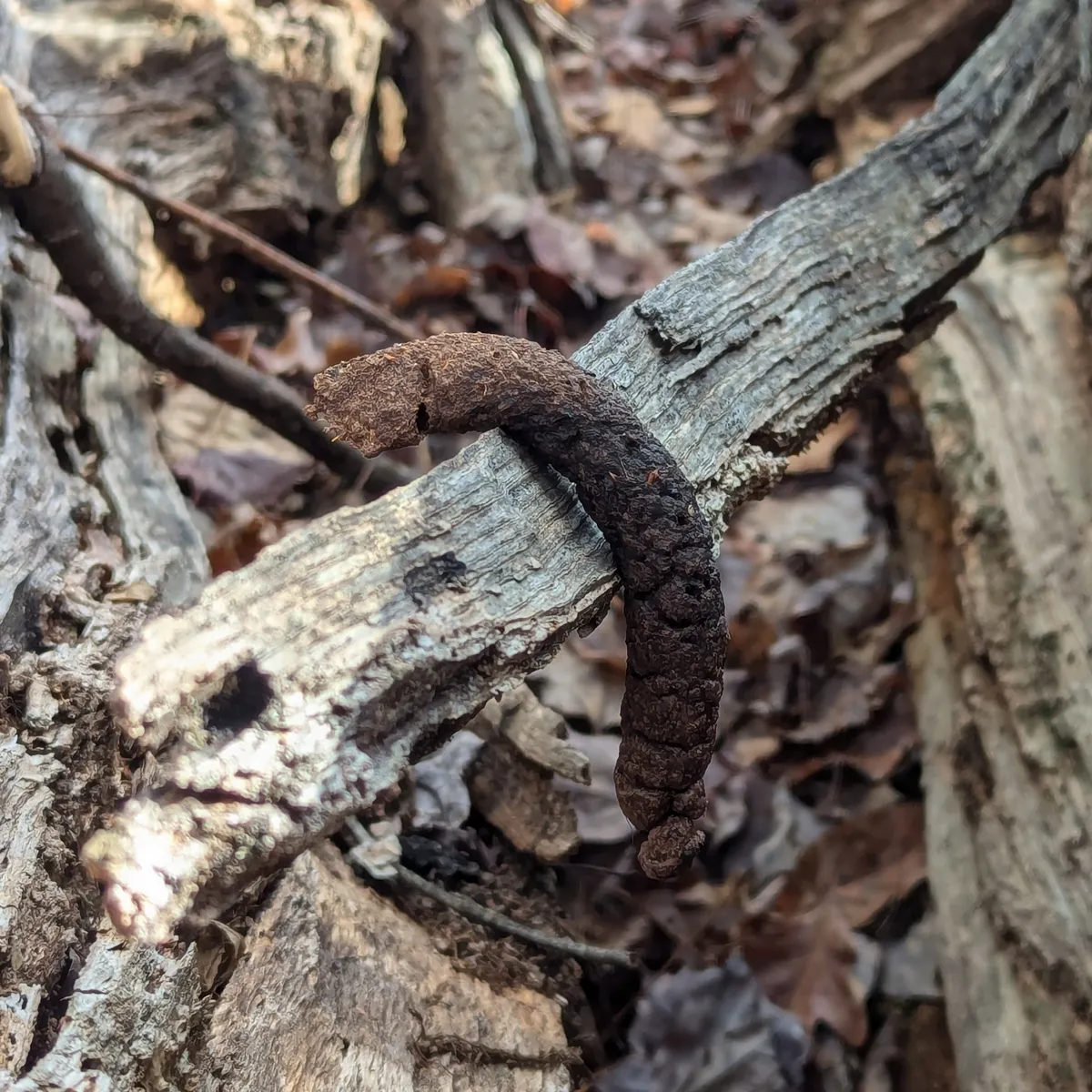
Opossum droppings are easy to mistake for a raccoon's. UNL Extension says the droppings of both animals are generally cat-sized and full of the remains of a varied diet, and that raccoon droppings stand out because raccoons go in the same place again and again. The possum poop guide covers the opossum in detail.
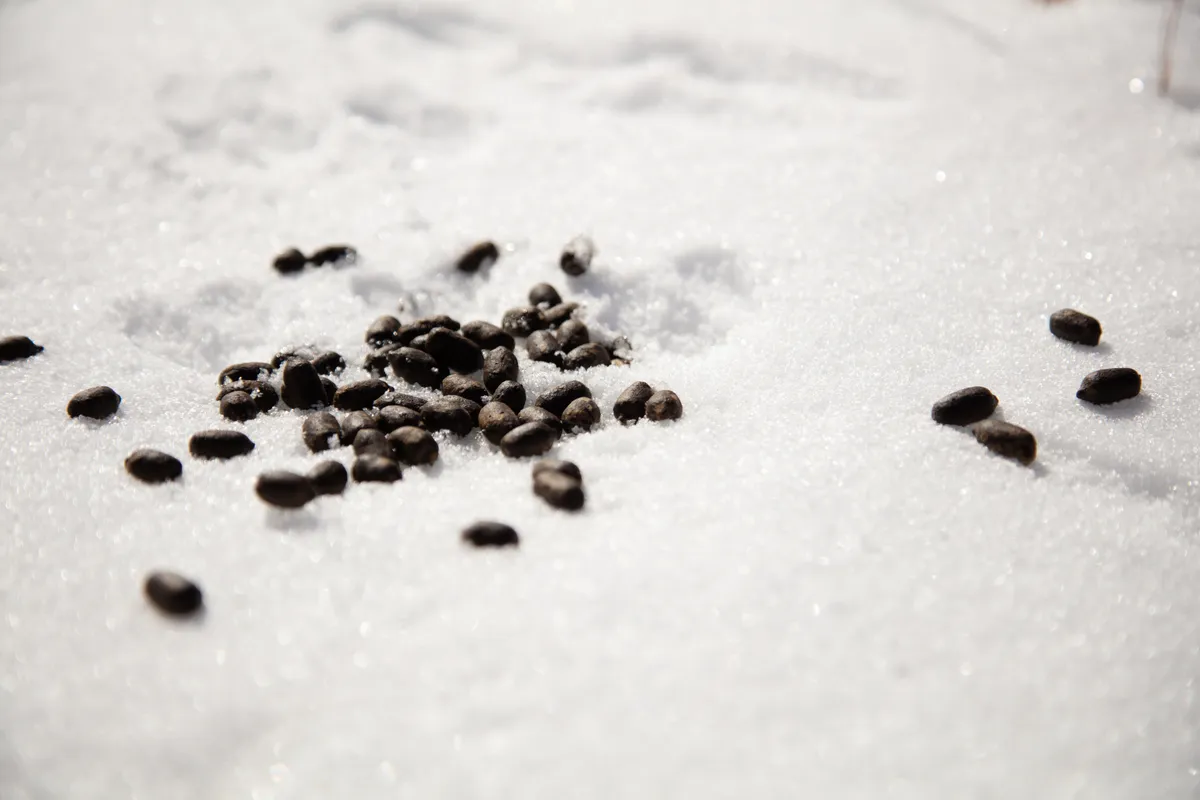
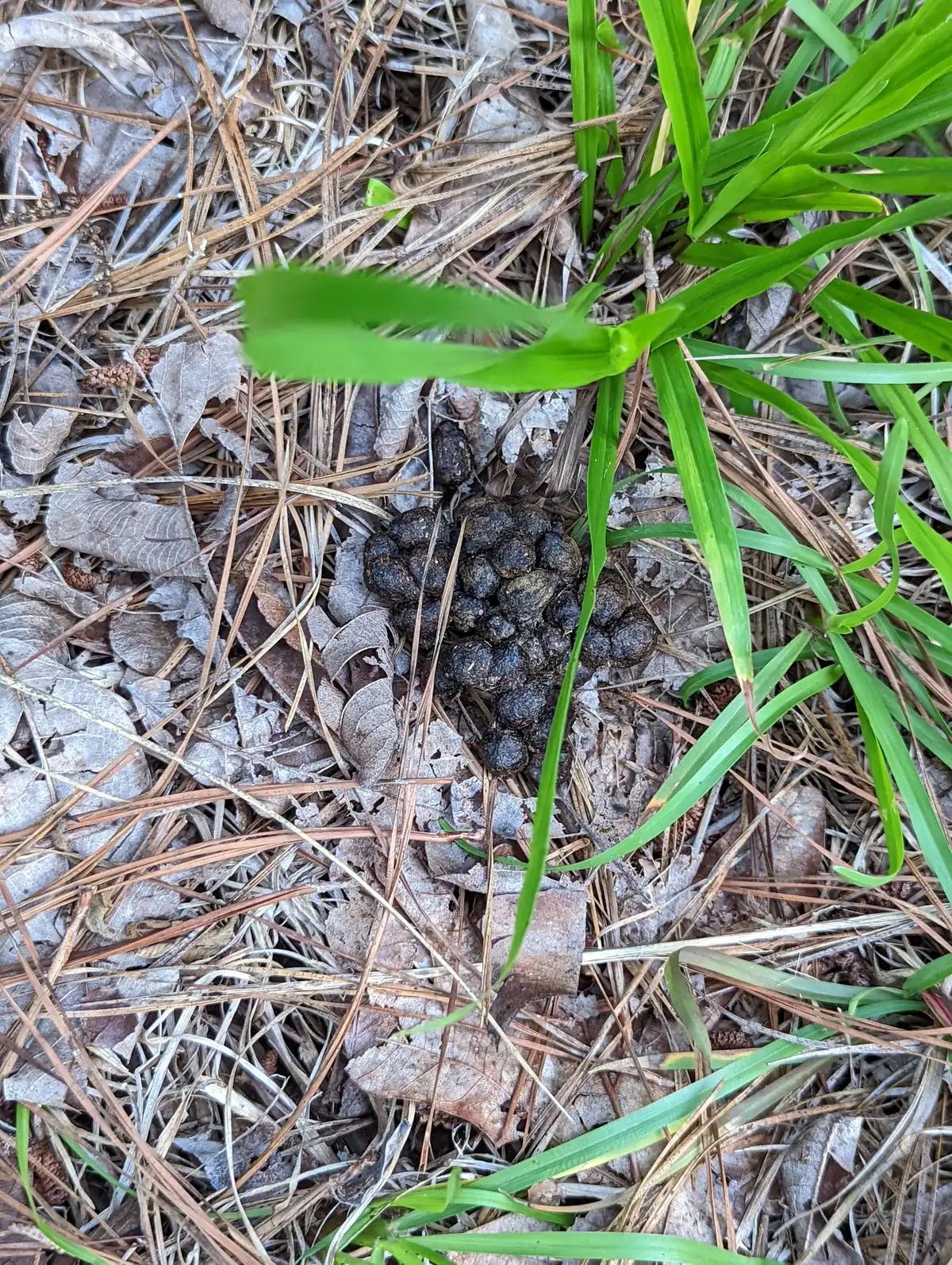
Coyote scat often contains hair and is often left in the middle of a trail or another prominent place, according to the Missouri Department of Conservation. Deer and rabbits leave pellets: WSU Extension describes rabbit droppings as round, about pea-sized and closely grouped, and deer droppings as similar but usually longer, somewhat pointed at one end and more scattered.
If the yard also has fresh holes or torn-up turf, the guide to holes in the yard sorts the diggers, including skunks hunting grubs. None of the extension or agency sources behind this chart gives a size for skunk or gray squirrel droppings, so they are left out of it; the squirrel poop guide covers squirrels.
What is pooping on my deck, roof or porch?
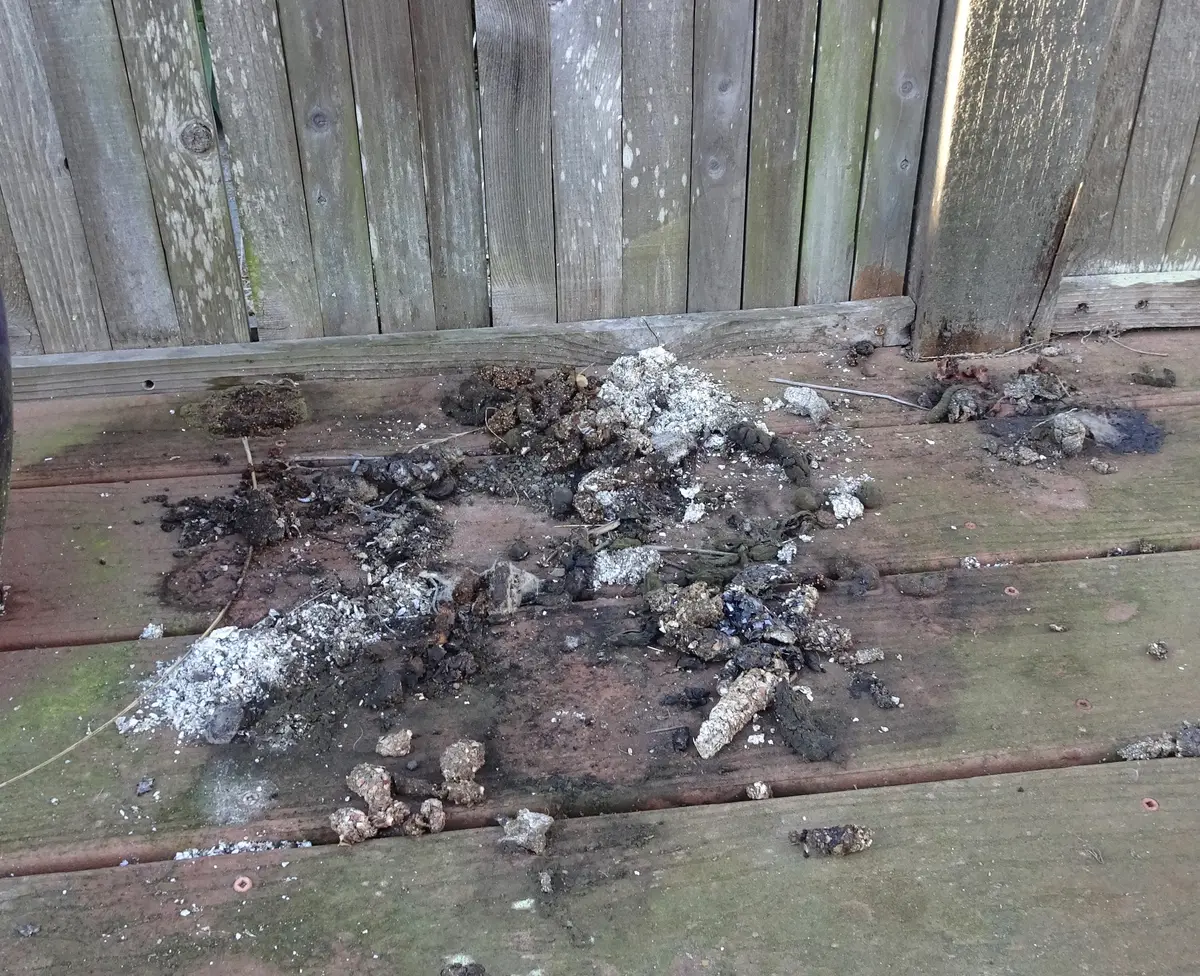
A pile on a deck, porch, roof or woodpile that keeps growing is usually a raccoon latrine. CDC lists woodpiles, decks and rooftops among the places raccoon feces turn up, and CDPH adds porches and fireplaces. To discourage raccoons from using the yard, see the raccoon deterrent guide.
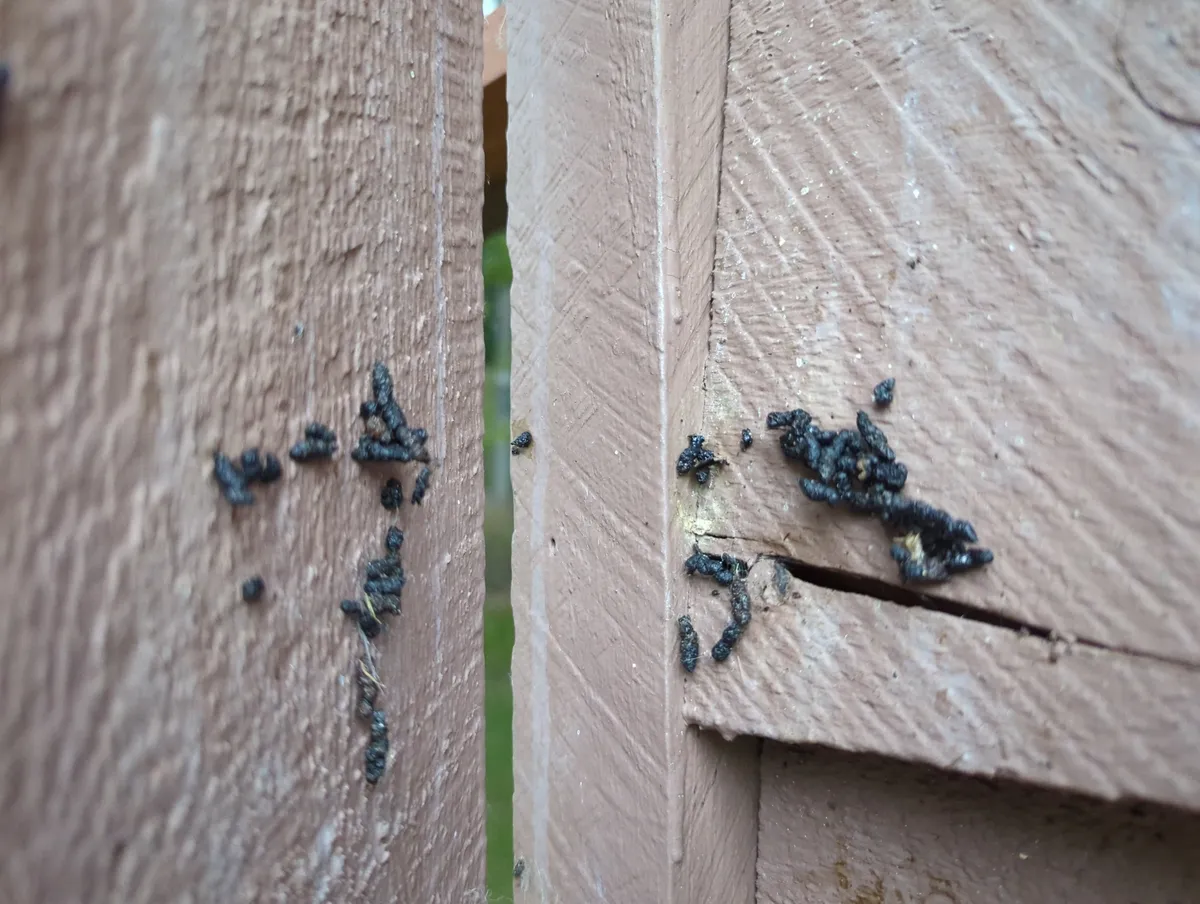
Small, dark droppings stuck to siding or piled below a gap in the trim point to bats. The U.S. Fish and Wildlife Service's 1982 house bat manual says bats nearly always reveal themselves through droppings left beneath entrance holes and below roosts, and that bat droppings crumble easily into shiny bits of undigested insect, while rodent droppings are harder. The bat poop guide compares them with mouse droppings.
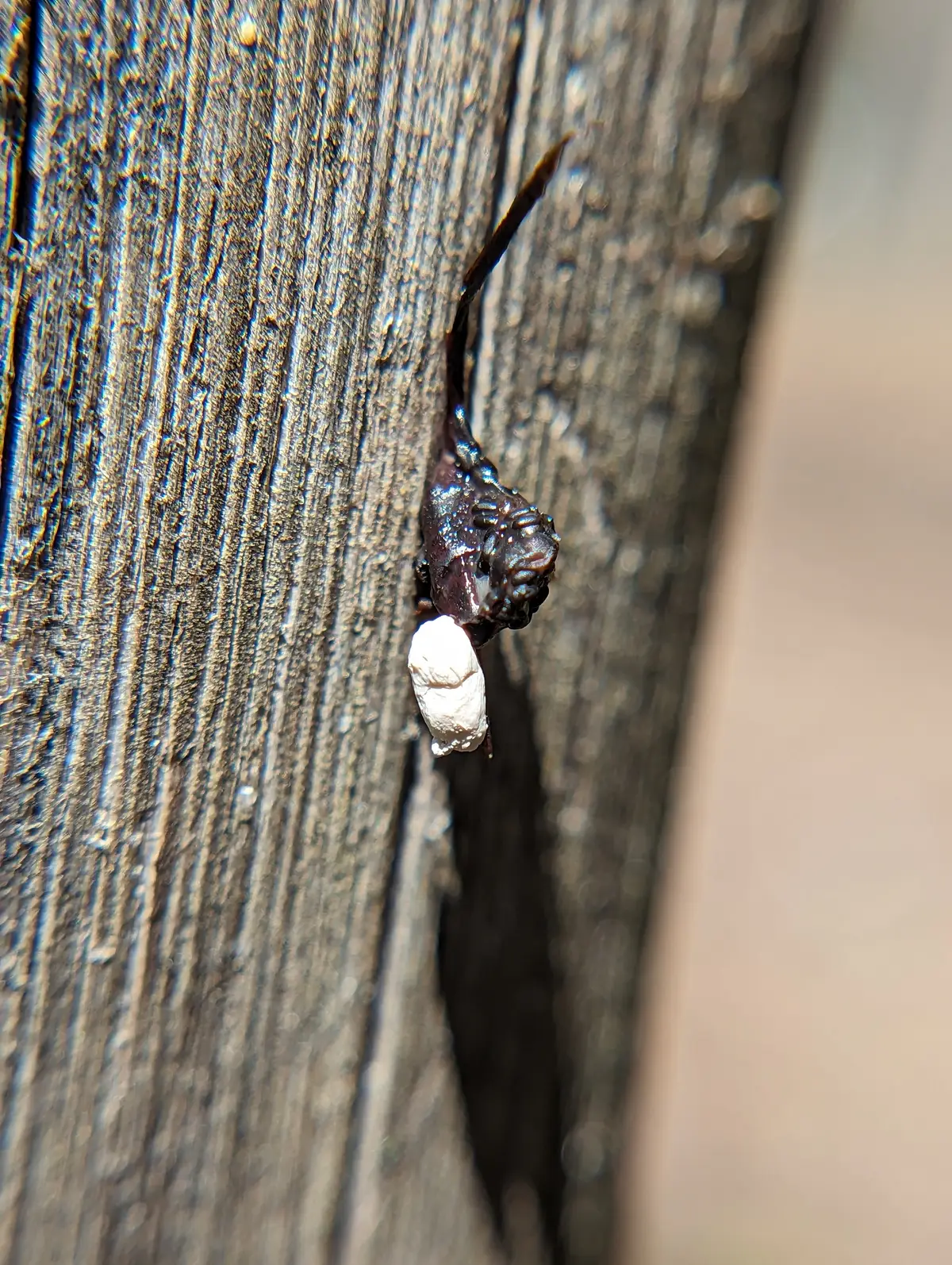
Droppings with chalky white on them can come from birds, snakes or lizards. The USFWS manual explains that birds and lizards that eat insects leave droppings marked with white, chalky uric acid, sometimes mixed in with bat droppings, and that bat droppings never have it.
Whose droppings are in the attic?
In an attic, the likely makers are bats, roof rats, mice and, now and then, a raccoon. Bat droppings pile up under the roost and the entry gap and crumble into shiny insect bits. Roof rats nest in attics and other high spaces, UC IPM says, and Cornell IPM puts their droppings at about 1/2 inch long. CDC lists attics among the places raccoon latrines turn up. To match droppings with the noises you hear overhead, see the guide to noises in the attic at night; rats have their own rat droppings guide.
What droppings turn up in the garage, kitchen or basement?
Indoors, small dark droppings are usually mice, rats or cockroaches. Nebraska Extension says house mouse droppings average 1/8 to 1/4 inch long, are usually black with one or both ends pointed, do not usually collect in piles, and come at a rate of about 50 to 75 a day per mouse. Rat droppings are bigger: about 1/2 inch for a roof rat and 3/4 to 1 inch for a Norway rat, the rat that UC IPM says stays in basements and on ground floors. The mouse poop guide and its US edition go further, and the complete guide to mice covers control.
Mouse urine stains and smell have a guide of their own, including how to check a spot with a black light.
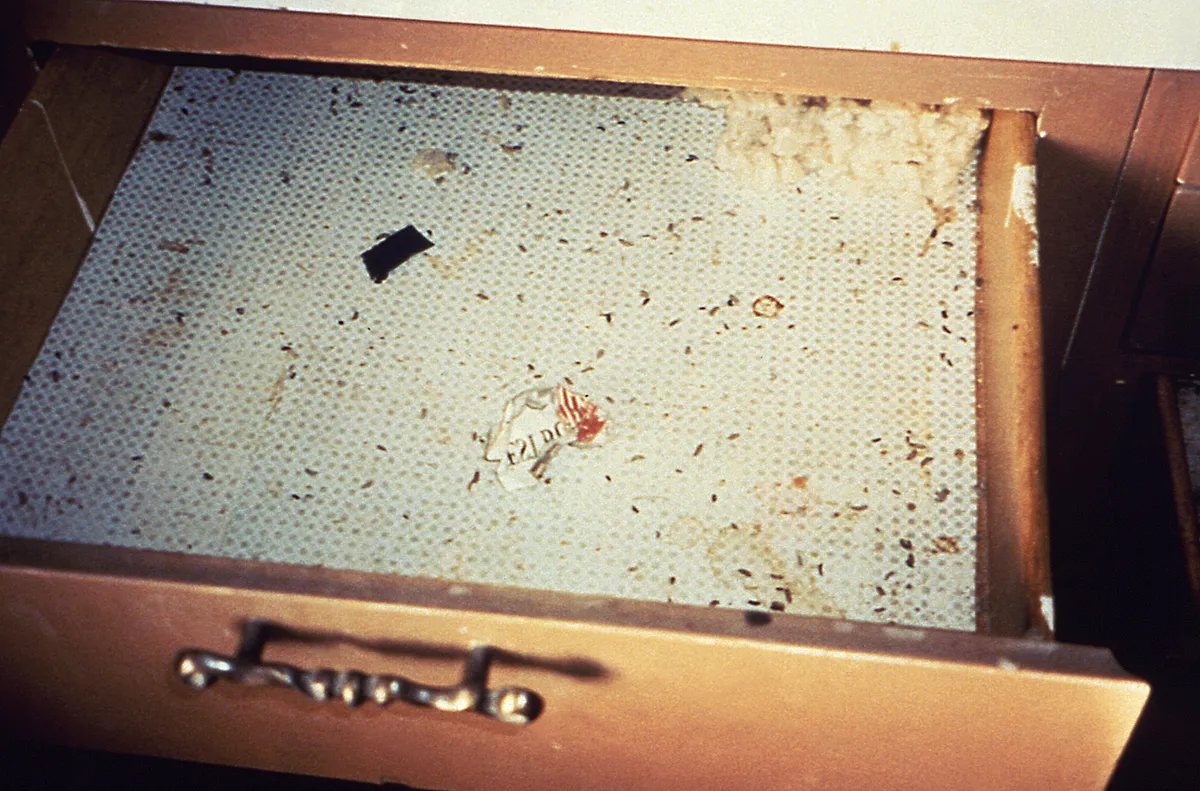
Specks smaller than a mouse dropping point to insects. Texas A&M AgriLife Extension says German cockroach droppings look like crushed pepper and stick to surfaces where the roaches gather, near cracks and crevices in warm spots close to water and food; the cockroach droppings guide and the cockroach guide cover them. Pellets with six sides below tiny holes in wood are drywood termite pellets, which UC IPM calls diagnostic for drywood termites, though it says pellets alone cannot show whether an infestation is still active; see the termite droppings guide. Dark spots on a mattress or bedding are covered in the bed bug stains guide.
What should you do about raccoon poop in the pool?
Close the pool to swimmers right away. CDC's guidance on raccoons and pools says to ask local animal control for its recommendations first; otherwise, put on disposable gloves, lift the poop out with a net, double-bag it, and wash your hands. Pool chlorine kills most germs a raccoon could carry but not raccoon roundworm eggs, so CDC gives two filtering options before reopening. CDC adds that raccoons usually go in the same spots again and again, in pools usually the shallow areas such as the steps.
Is animal poop dangerous?
Some of it carries germs that can make people seriously ill, so treat all droppings as hazardous and keep children and pets away. Raccoon droppings can carry raccoon roundworm: CDC says human infections are rare but can be severe if the parasite invades the eye, organs or brain, that most infections are in children and others likely to put dirt or animal waste in their mouths, and that the eggs take 2 to 4 weeks to become infectious, so prompt removal lowers the risk. If you suspect someone swallowed raccoon feces, CDC advises seeking medical attention immediately. CDC also says to have pets dewormed under a veterinarian's supervision.
Rodent droppings can carry hantavirus. CDC's hantavirus page says people get it from contact with rodents such as rats and mice, especially their urine, droppings and saliva, and that the most common hantavirus that causes hantavirus pulmonary syndrome in the United States is spread by the deer mouse; the deer mouse guide shows how to recognize one. Bird and bat droppings are linked to histoplasmosis, a lung infection from breathing in spores of a fungus that grows in soil mixed with those droppings, and CDC advises avoiding activities that disturb such soil or droppings.
How do you clean up animal droppings safely?
For mouse and rat droppings, follow CDC's rodent cleanup steps: open the doors and windows for 30 minutes, wear rubber or plastic gloves, spray the droppings with disinfectant or a bleach solution of 1.5 cups of bleach per gallon of water until very wet, let it soak for 5 minutes, wipe it up with paper towels, and never sweep or vacuum, which can put tiny droplets carrying viruses into the air.
Raccoon latrines need a different method, because bleach and other household disinfectants will not kill roundworm eggs, CDPH says. CDC's steps are disposable gloves, scrubbable boots or disposable booties, an N95-rated respirator in a confined space, a light mist of water to keep dust down, and removal of the feces and soiled material to be burned, buried or sent to a landfill. Decks, patios and other surfaces can be treated with boiling water or a propane torch, after checking local fire department rules, and local animal control can help. For large amounts of bird or bat droppings, CDC says to use a professional company that specializes in hazardous waste.
Each animal's own droppings guide
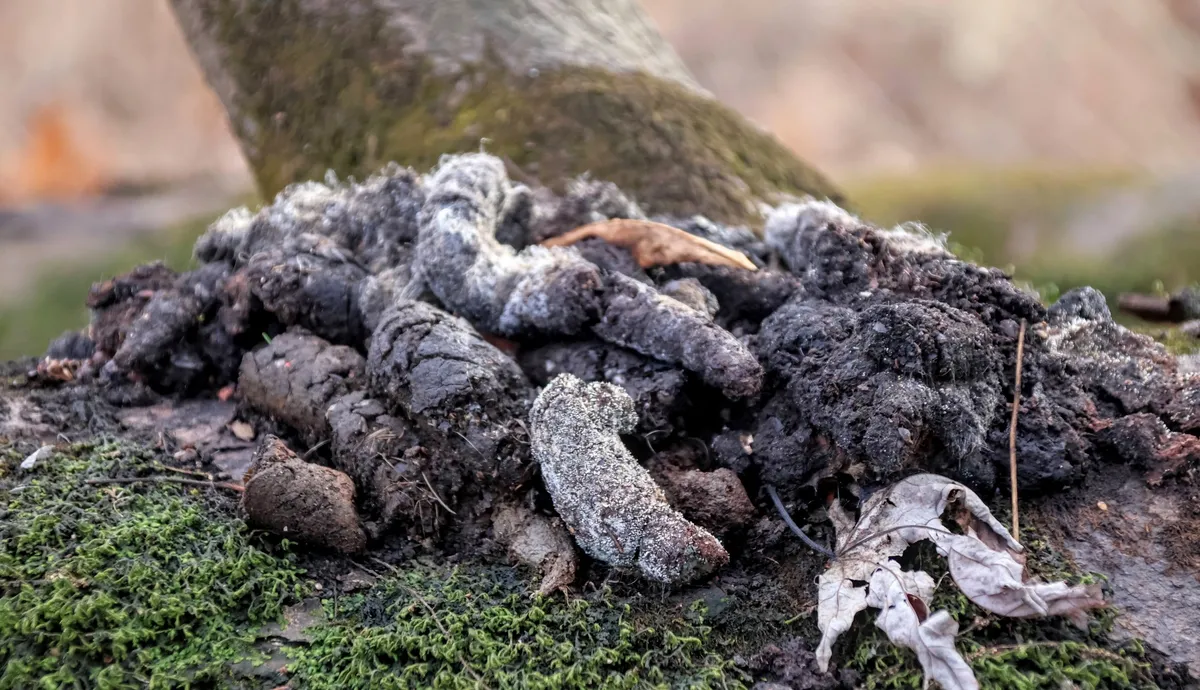 Raccoon latrineDark, tubular droppings piled in one reused spot, often with seeds
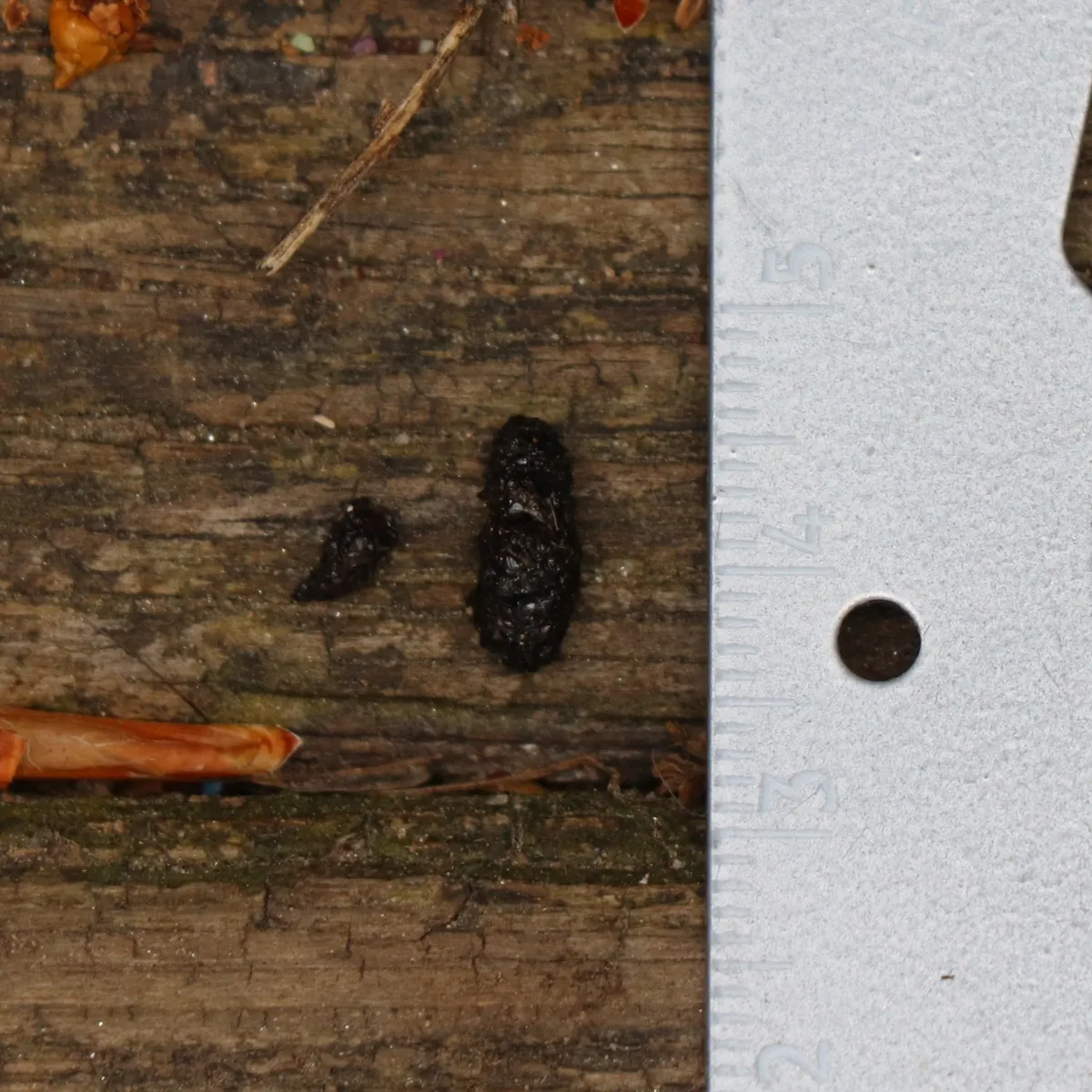 Bat droppingsCrumble into shiny insect bits; piled under roosts and entry gaps
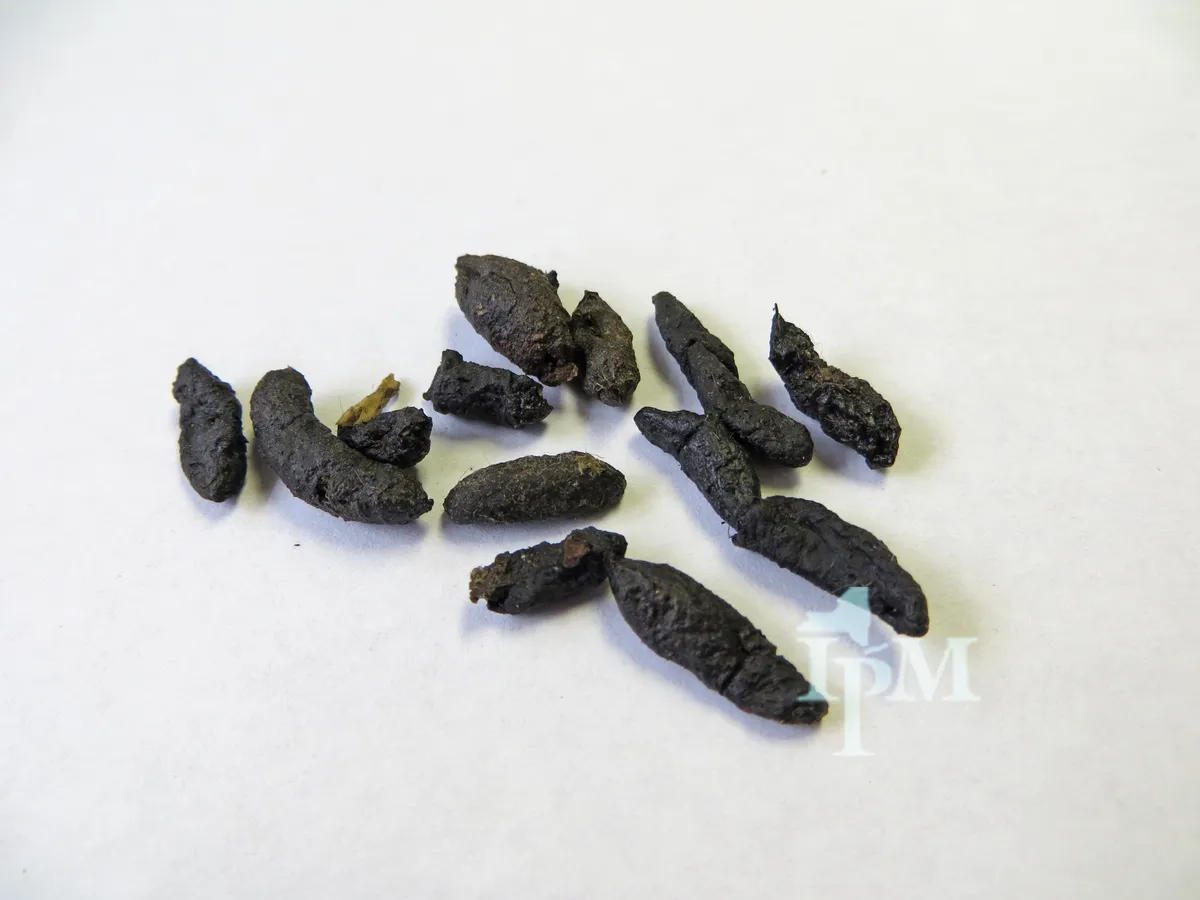 Rat droppingsAbout 1/2 inch for a roof rat, 3/4 to 1 inch for a Norway rat
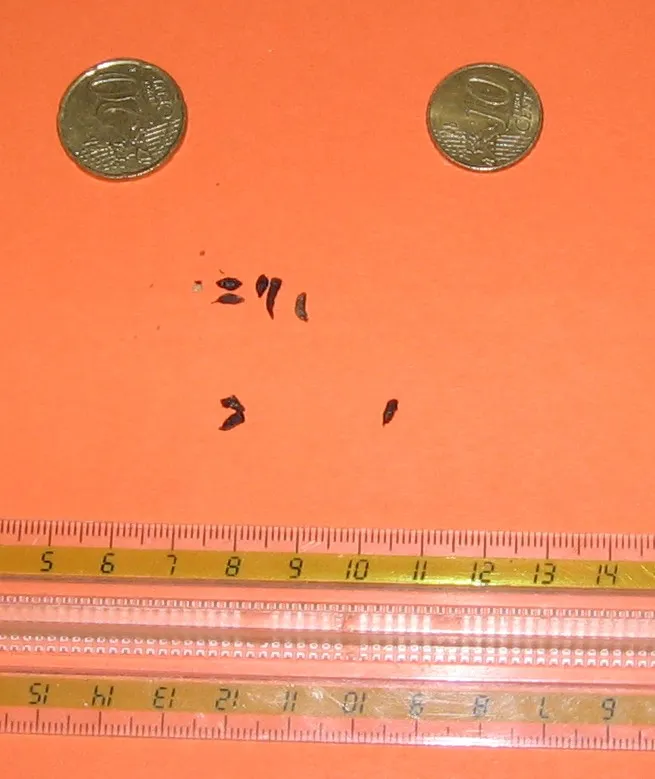 Mouse droppings1/8 to 1/4 inch with pointed ends, scattered rather than piled
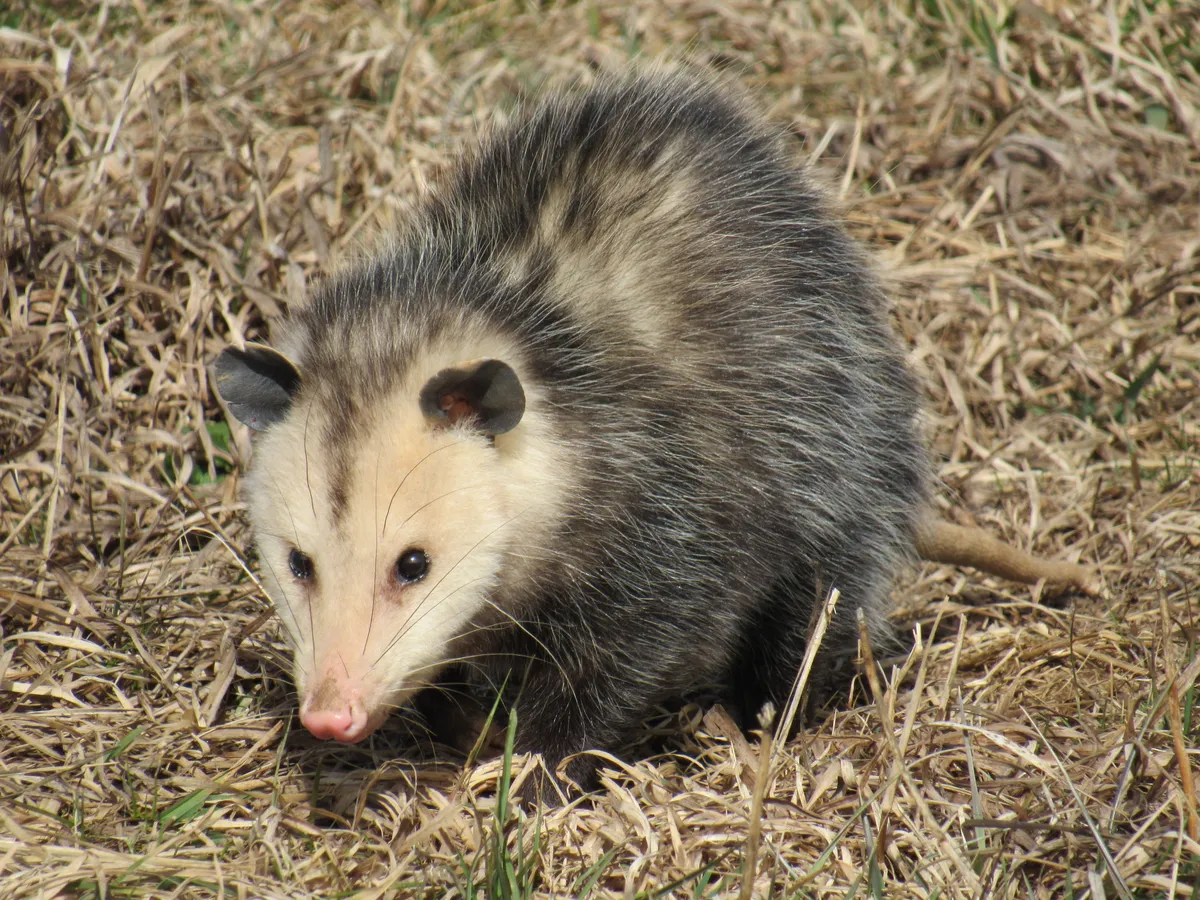 OpossumCat-sized droppings full of bits of its varied diet
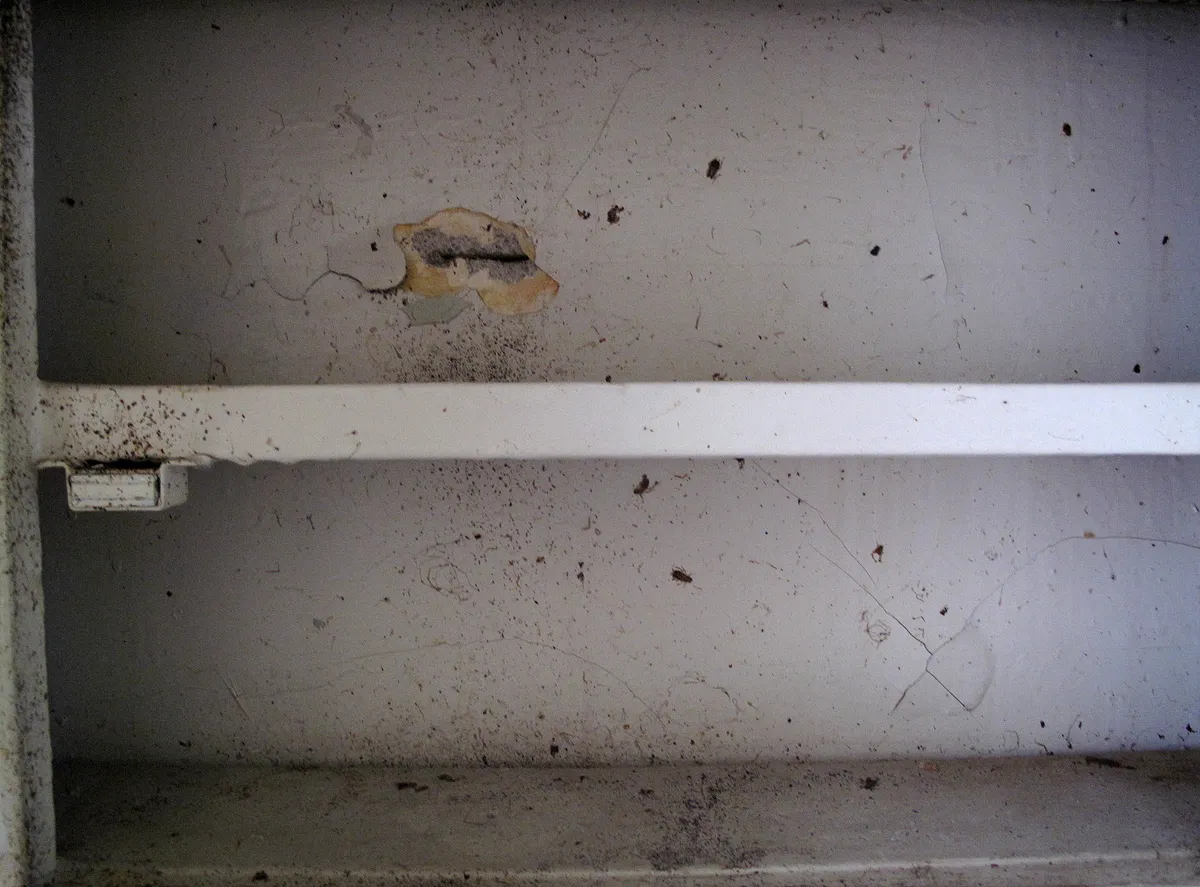 Cockroach droppingsSpecks like crushed pepper stuck around cracks where roaches hide
Photos: Raccoon latrine: (c) cappycollins, some rights reserved (CC BY), via iNaturalist, CC BY 4.0. Bat droppings: (c) Mark Apgar, some rights reserved (CC BY), via iNaturalist, CC BY 4.0. Rat droppings: NY State IPM Program at Cornell University from New York, USA, CC BY 2.0, via Wikimedia Commons, CC BY 2.0. Mouse droppings: Hansmuller, CC BY-SA 4.0, via Wikimedia Commons, CC BY-SA 4.0. Opossum: PookieFugglestein, CC0, via Wikimedia Commons, CC0 1.0. Cockroach droppings: Downtowngal, CC BY-SA 4.0, via Wikimedia Commons, CC BY-SA 4.0.
What should you do once you know whose poop it is?
Match the next step to the animal, and leave wild animals to a licensed wildlife professional or your state wildlife agency.
- Raccoon. Clean the latrine the CDC way, cover sandboxes when they are not in use, since CDC says raccoons sometimes use them as latrines, and see the raccoon deterrent guide to keep them away.
- Mice and rats. Clean up with CDC's rodent steps, then find the way in; the mice guide and the rat droppings guide cover sealing and trapping.
- Bats. Do not disturb the droppings; the guide to animals in the attic explains bat-proofing dates and why the timing matters.
- Cockroaches or termites. Follow the cockroach droppings guide or the termite droppings guide to confirm the species first.
- Anything you cannot name. Photograph it and ask your county extension office or state wildlife agency.
This guide is general educational information, not medical advice. If you have symptoms or concerns after a bite or exposure, contact a healthcare provider.
Frequently Asked Questions
What does raccoon or possum poop look like?+
Raccoon droppings look like small dog droppings: dark, tubular and blunt-ended, about as thick as a dime or nickel, and often full of undigested seeds, according to the California Department of Public Health and Santa Barbara County Animal Services. Opossum droppings are similar: UNL Extension says both animals leave droppings that are generally cat-sized and full of the remains of a varied diet. The clearest difference is that raccoons go in the same spot again and again.
What does coyote poop look like?+
The Missouri Department of Conservation says coyote scat often contains hair and is often left in the middle of a trail or another prominent place. A coyote scat confirmed by DNA in a University of California, Santa Cruz study was brown and twisted, with hair and seeds. Hair in the scat and a spot in the middle of a trail are the clues to look for.
What animal poop has white on it?+
White in droppings points to a bird, a snake or a lizard. UGA Extension wildlife specialist Michael Mengak says black-and-white droppings can come from any of the three, and the U.S. Fish and Wildlife Service's house bat manual says birds and lizards that eat insects leave droppings marked with white, chalky uric acid. Bat droppings never have it, which is one way to tell them apart when the two are found together.
What animal poops in the same spot every night?+
Raccoons. The California Department of Public Health says raccoons often use the same latrine over and over, so older, dry droppings are often mixed with fresh ones, and CDC says raccoons usually go in the same locations repeatedly. Latrines turn up at the base of trees, on fallen logs, stumps and rocks, and on woodpiles, decks, rooftops and in attics. Cleaning them up promptly matters because raccoon roundworm eggs take 2 to 4 weeks to become infectious.
Is animal poop in the yard dangerous to kids and pets?+
It can be, so keep children and pets away from droppings and clean them up safely. CDC says raccoon roundworm infections are rare but can be severe, and that most are in children and others likely to put dirt or animal waste in their mouths. CDC also says to keep sandboxes covered, since raccoons sometimes use them as latrines, and to have pets dewormed under a veterinarian's supervision. Rodent droppings can carry hantavirus.
What small animal poop looks like grains of rice?+
Small dark grains are usually from mice: Nebraska Extension says house mouse droppings average 1/8 to 1/4 inch long, usually black, with one or both ends pointed, and scattered rather than piled. Bat droppings are the usual look-alike, but they crumble easily into shiny bits of insect, the U.S. Fish and Wildlife Service says, while rodent droppings are harder. Roof rat droppings are bigger, about 1/2 inch, and German cockroach droppings are smaller, like specks of crushed pepper.
What animal poop has seeds or berries in it?+
Raccoon droppings often do. CDC describes them as dark and tubular, often with undigested seeds or other food, and Santa Barbara County Animal Services says seeds or shells may be visible. UNL Extension says opossum droppings are also full of the remains of a varied diet. Seeds can turn up in coyote scat too: one confirmed by DNA in a university study held hair and seeds, though the Missouri Department of Conservation's main clue for coyotes is hair.
How can you tell if animal droppings are fresh?+
Fresh droppings are black and shiny, while old ones are dry and brown or gray, according to a UGA Extension article drawing on wildlife specialist Michael Mengak. Santa Barbara County Animal Services says raccoon droppings weather and break down as they age, until old ones may look like dried leaves or debris, and the California Department of Public Health says raccoon latrines often hold older, dry droppings mixed with fresh, wet ones. Fresh droppings suggest the animal is still visiting.
Is it safe to clean up raccoon poop yourself?+
CDC gives steps for homeowners who choose to do it: disposable gloves, scrubbable boots or disposable booties, an N95-rated respirator in a confined space, a light mist of water to keep dust down, and removal of the feces to be burned, buried or sent to a landfill. Bleach does not kill the roundworm eggs, the California Department of Public Health says, while CDC says heat, such as boiling water, does. Local animal control can help.
Sources
- Preventing Raccoon Roundworm — Centers for Disease Control and Prevention
- About Raccoon Roundworm — Centers for Disease Control and Prevention
- What You Need to Know About Raccoon Roundworms: Cleaning Up a Raccoon Latrine — California Department of Public Health
- How to Clean a Raccoon Latrine — Santa Barbara County Animal Services (hosted by the Texas Department of State Health Services)
- Controlling Raccoon and Opossum Damage (G1688) — University of Nebraska-Lincoln Extension
- Coyote (Field Guide) — Missouri Department of Conservation
- Rabbit and Hare Management in Washington State Home Yards and Gardens (FS231E) — Washington State University Extension
- A little wildlife knowledge will help determine who's eating landscape plants — University of Georgia College of Agricultural and Environmental Sciences
- Mouse and Rat Biology and Behavior — Cornell Integrated Pest Management
- Controlling House Mice (G1105) — University of Nebraska-Lincoln Extension
- Rats (Pest Notes, Publication 74106) — University of California Statewide IPM Program
- House Bat Management (Resource Publication 143, 1982) — U.S. Fish and Wildlife Service
- Cockroach Biology and Management (ENTO-037) — Texas A&M AgriLife Extension
- Drywood Termites (Pest Notes, Publication 7440) — University of California Statewide IPM Program
- How to Clean Up After Rodents — Centers for Disease Control and Prevention
- About Hantavirus — Centers for Disease Control and Prevention
- Responding to Raccoons in and around the Pool — Centers for Disease Control and Prevention
- Reducing Risk for Histoplasmosis — Centers for Disease Control and Prevention
How this guide was made: it was researched and drafted with AI assistance from the sources listed above. A second, independent AI pass then checked each factual claim against those sources. Found an error? Email support@buzzskito.ca.