
Reviewed by Alex Francisco
Published November 19, 2026 · Fact-checked against the sources listed below
What do raccoon tracks look like?
Raccoon tracks look like the prints of small, bare human hands and feet: five long, separate toes on every foot, often with a small claw mark at the tip of each toe. The Missouri Department of Conservation's raccoon guide describes them as small bare hands, and the New York State Department of Environmental Conservation's Winter Tracks guide compares a raccoon's track to a human baby's hand.
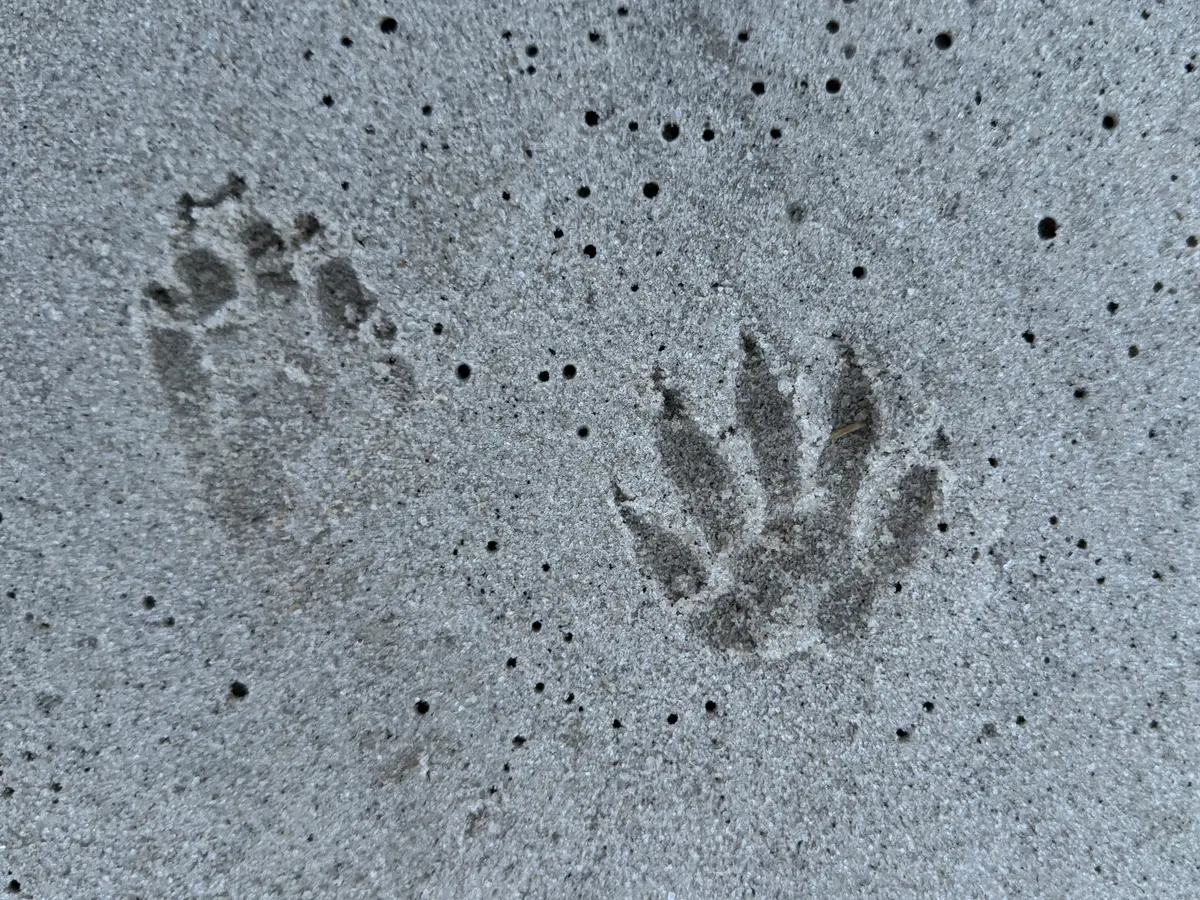
The front and hind prints differ, and seeing both together is a good check. MDC gives the front track as 2 1/2 to 3 inches long and about as wide as it is long, and the hind track as 3 3/4 to 4 inches long, shaped like a small human footprint apart from its long toes. Raccoons walk flat-footed, heels touching the ground like people and bears, MDC says, and Mississippi State University Extension notes that they point all their toes forward.
Up close, the toes are slender with bulbous ends and no webbing, the feature Maryland DNR's key to mammal tracks uses to single out a raccoon among five-toed animals. Don't expect a full heel on every hind print, though: the Internet Center for Wildlife Damage Management's raccoon page says the heel of the hind foot seldom shows except in soft mud or sand.
How big are raccoon tracks?
In most guides a raccoon's front print is about 2 to 3 inches long and its hind print about 3 to 4 1/2 inches, and in every guide the hind print is the longer of the two. The exact figures depend on the guide, as the table shows: compare the MDC mammal tracks chart, WDFW's Living with Wildlife: Raccoons, the University of Michigan's BioKIDS track key and North Dakota Game and Fish's raccoon page. New Mexico State University Extension explains part of the spread: track size varies with an animal's age, sex and the individual.
| Guide | Front print | Hind print |
|---|---|---|
| Missouri Department of Conservation | 2 1/2 to 3 inches long | 3 3/4 to 4 inches long |
| University of Missouri Extension | About 3 inches long, about as wide | 3 1/4 to 4 1/2 inches long |
| Washington Dept. of Fish and Wildlife | 2 to 3 inches long | 3 to 4 inches long |
| New Mexico State University Extension | About 2 1/4 inches long | About 3 1/8 inches long |
| University of Michigan BioKIDS | 1 to 2 1/2 inches long and wide | Up to 4 inches long |
| North Dakota Game and Fish | 1 1/2 inches long, 2 inches wide | 3 inches long, 1 1/2 inches wide |
Figures as each guide gives them; all six put the hind print longer than the front.
What pattern do raccoon tracks make?
A walking raccoon leaves its tracks in pairs: each hind foot lands beside the front foot on the opposite side of the body, so the trail is a string of side-by-side prints. MDC describes the left front track beside the right hind and the right front beside the left hind, and puts the distance between strides at about 12 inches, varying with the raccoon's size and speed; MU Extension gives 14 inches as the average distance between prints of a walking raccoon.
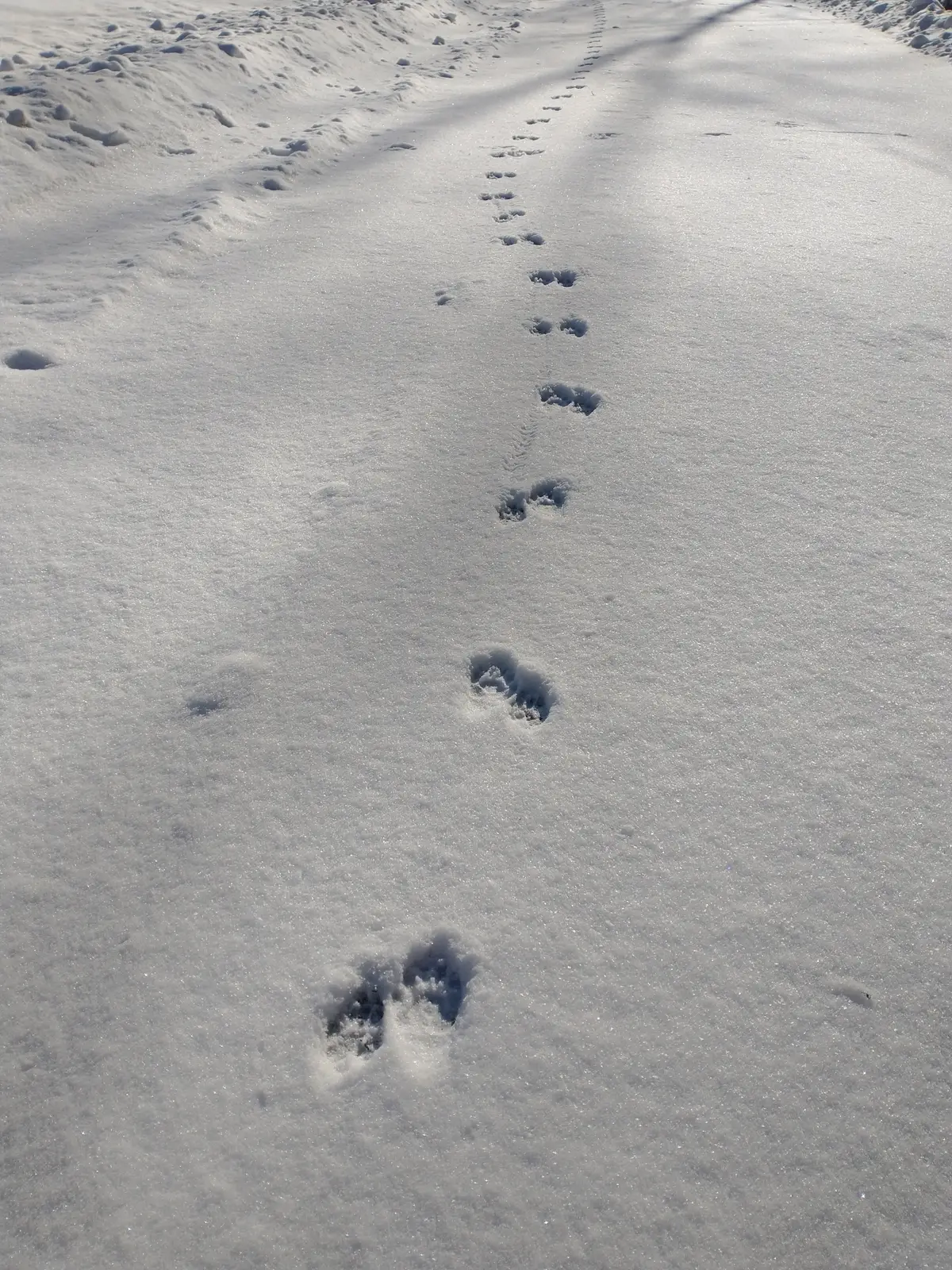
The pairs come from the way a raccoon moves. The University of Wisconsin-Madison Extension's raccoon guide says flat feet, short legs and a robust body give the raccoon a shuffling gait. Maryland DNR groups raccoons with opossums, skunks and other wide-bodied pacers that shuffle along and switch to bounding as they speed up; in a bound, NY DEC explains, the hind feet often land in front of and beside the front feet. MDC adds that raccoons often walk in a meandering line, overturning leaf litter as they hunt for worms.
What do raccoon tracks look like in mud?
Mud holds some of the sharpest raccoon tracks, and the soft edge of a stream, pond or lake is the classic place to find them. MDC says raccoon tracks are especially common in mud along streams, ponds and other shorelines, and WDFW notes that raccoons are particularly fond of food found in water, such as clams, crayfish, frogs, fish and snails, and use trails beside creeks and ponds.
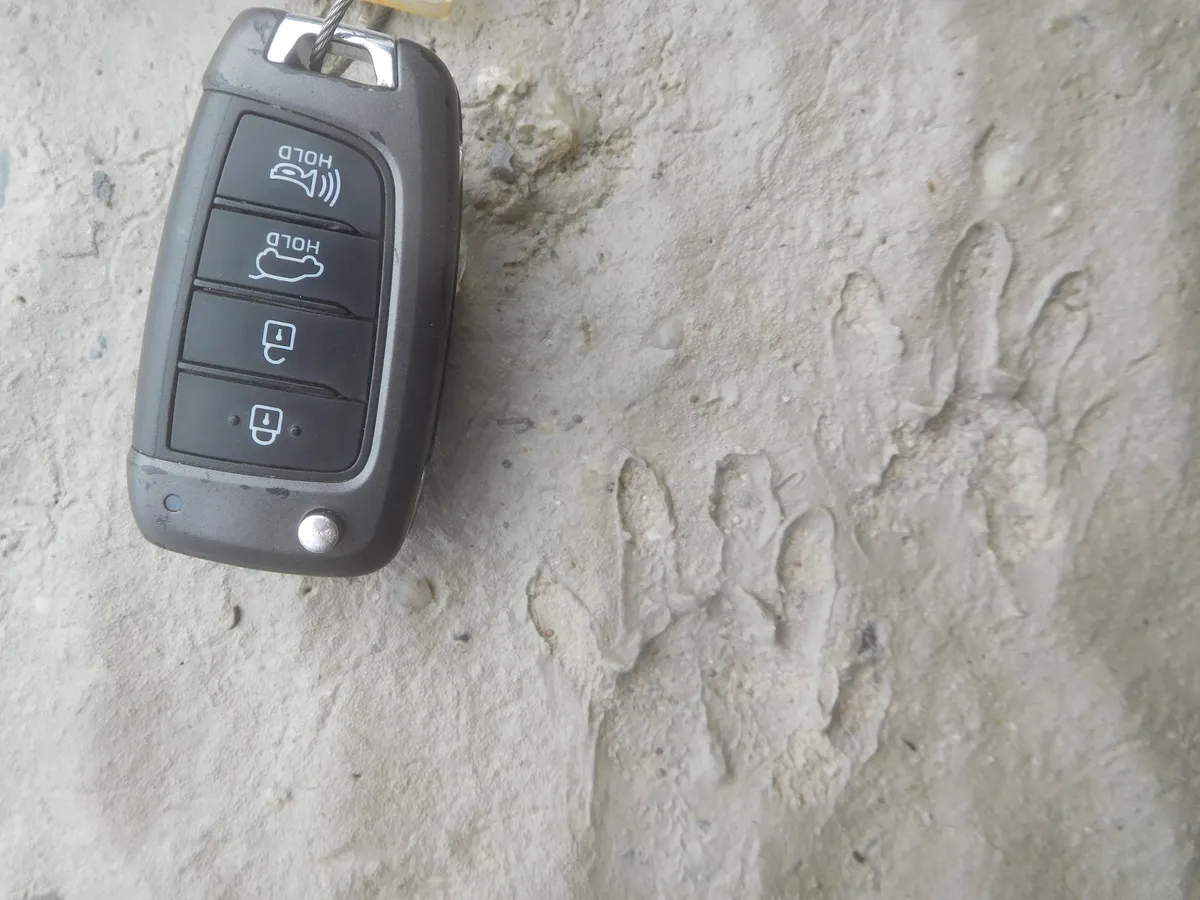
In soft mud you can see everything at once: five finger-like toes, claw marks and the hind heel that ICWDM says rarely shows on firmer ground. WDFW suggests checking the sand, mud or soft soil at both ends of a culvert, since raccoons use culverts to cross safely under roads. NMSU Extension cautions that a track in mud may look different from one in dust or snow, even when the same animal made them, so compare a muddy print with muddy examples.
What do raccoon tracks look like in snow?
In snow, raccoon tracks keep their side-by-side pairs, as the driveway trail above shows, but in dry, powdery snow, which NY DEC says records a less-defined print than wet snow, the toes may blur into rounded hand shapes. How well snow holds a print depends on the snow itself, which the guide to animal tracks in snow explains along with the deer, rabbit, squirrel and coyote prints you may find beside a raccoon's.
Timing matters as much as the print. The UW-Madison Extension guide says a snowfall or temperatures below 20°F (about -7°C) send raccoons into winter dens until warmer weather returns, and that they venture out to feed as temperatures approach freezing; their winter dormancy is not true hibernation. So look for fresh raccoon trails once the temperature climbs back toward freezing. Opossums stay active in winter, MDC says, while raccoons are dormant or inactive, so check any five-toed winter trail for an opossum's thumb.
What do raccoon tracks look like in sand?
Wet sand can hold a raccoon print as crisply as mud, as the pair at the top of this page shows. Maryland DNR counts sand with mud and soft soil among the best surfaces for tracks, and the National Park Service's Everglades sea turtle page, on reading a predator's tracks at a dug-up turtle nest, notes that the ground must be neither too hard nor too soft.
On the coast, WDFW says raccoons forage on shellfish at low tide, even by day, so sand and mud bared at low tide are worth checking. Where sea turtles nest, raccoons are common predators of their eggs: the NPS page explains that a raccoon or fox will dig up a nest and eat the eggs, leaving the shells scattered around the edge of the hole, sometimes with the culprit's own tracks nearby.
Where do you find raccoon tracks around a house?
Around a house, raccoon tracks show up wherever there is food, water or a way to climb. WDFW lists sand, mud and soft soil, deck railings, fire escapes and other surfaces raccoons use to get into buildings, and says that in developed areas raccoons travel along fences, next to buildings and near food.
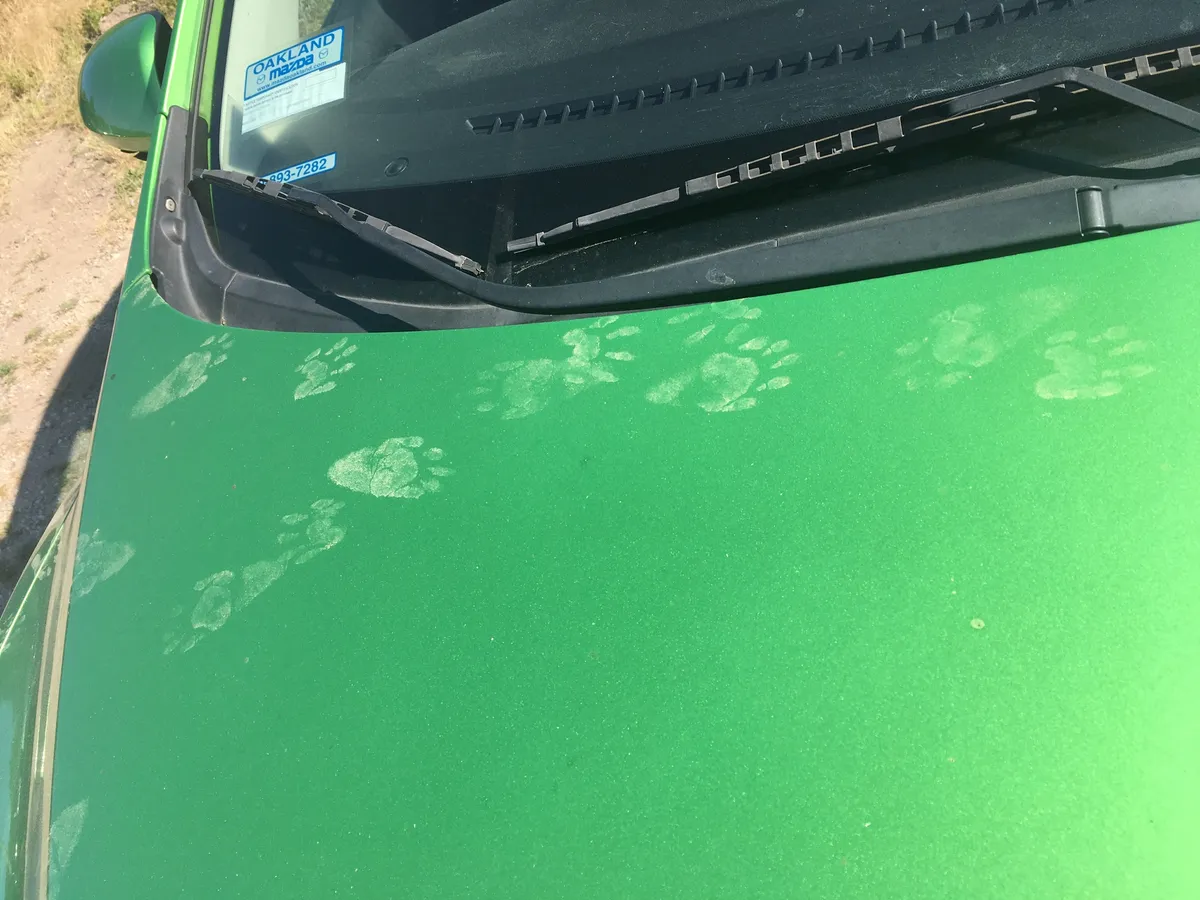
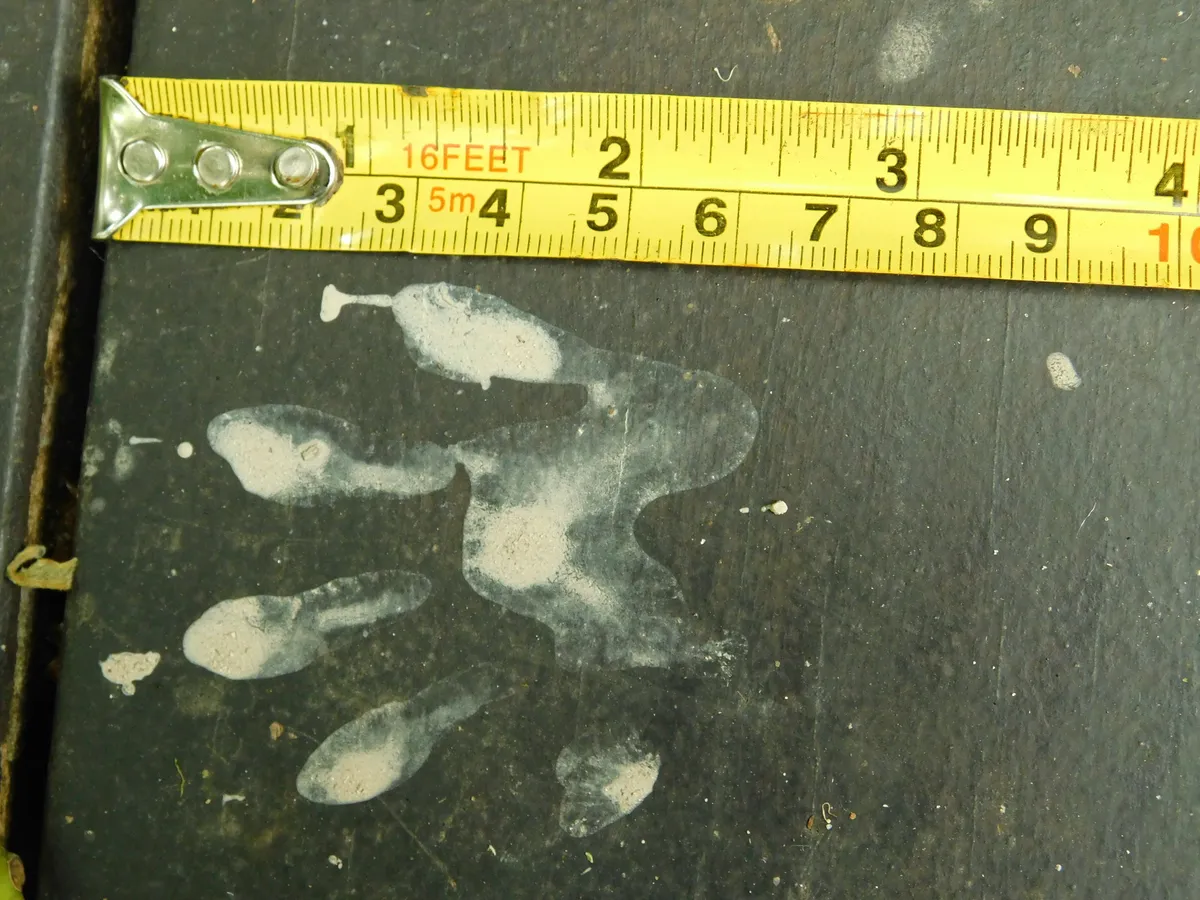
- Car hoods, decks and steps. A raccoon crossing a dusty or wet surface leaves prints like the ones above; the hand shape and the pairs are the clues.
- Downspouts, siding and corners. Nebraska Extension's raccoon and opossum damage guide calls brown smudge marks and fine scratches on a vertical surface key signs of raccoon use, and ICWDM says tracks often turn to smudges where raccoons climb downspouts.
- Garbage cans and pet food. MU Extension lists tipped-over trash cans and scattered trash among the signs of raccoon activity, and WDFW says raccoons living near people often eat garbage and pet food.
- Ponds and water gardens. WDFW says raccoons are drawn to ponds because they associate them with food, so check the muddy edges and any pond plants that have been disturbed.
- Den openings. WDFW says a den entrance is usually at least 4 inches high and 6 inches wide, with wear marks, body oil and hairs around its edges.
How do you tell raccoon tracks from opossum tracks?
Check the hind print for a thumb. The Missouri Department of Conservation's opossum guide says an opossum's hind foot is handlike, its thumb jutting out at a right angle without leaving a claw print; a raccoon's toes all point forward. MDC describes the opossum's front print as star-shaped, about 2 inches long with five fairly evenly spread toes, and notes that the two species' tracks are often confused.
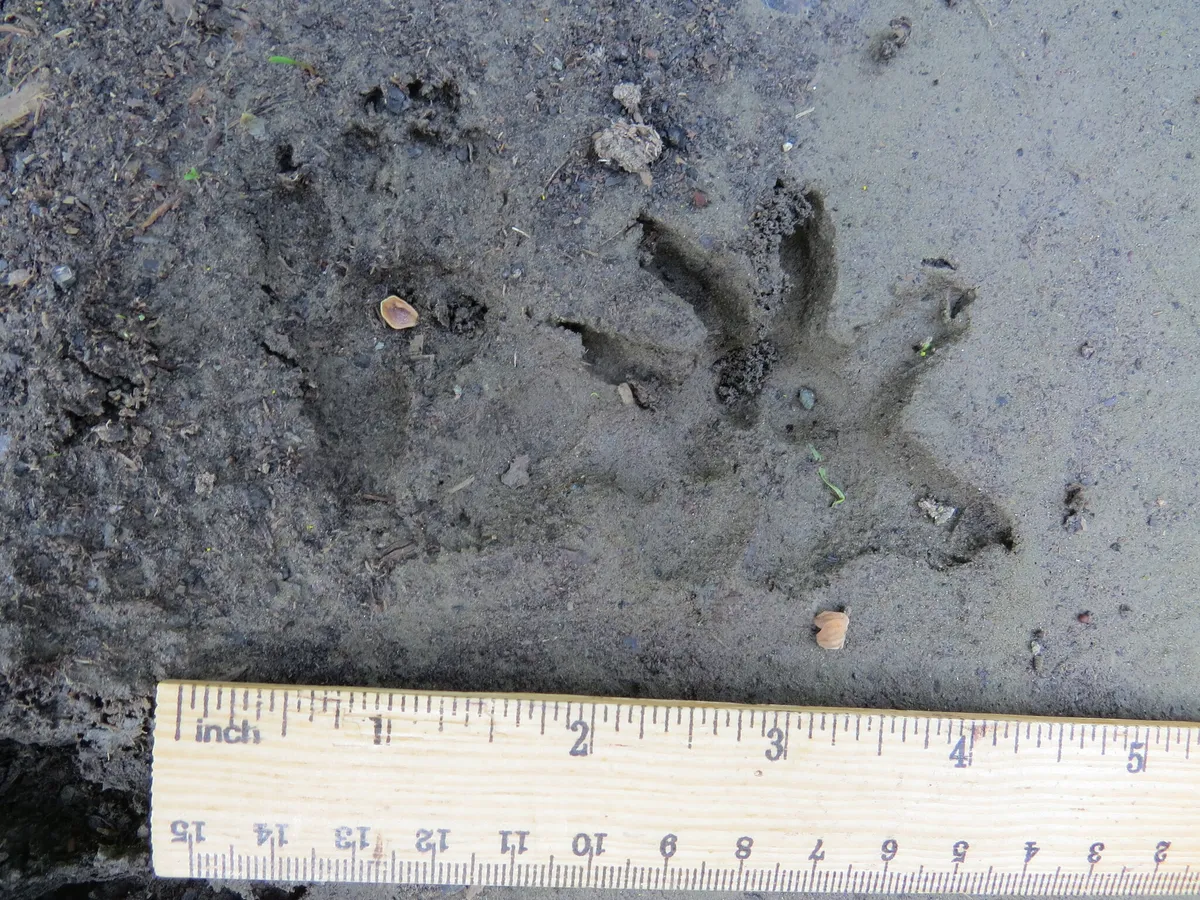
When the thumb does not show, a few more checks help. BioKIDS says an opossum's front foot is wider than it is long and that each hind foot comes up beside the front foot on the same side, while a raccoon, by MDC's description, pairs each hind foot with the opposite front foot. MDC says an opossum's tail often leaves its own undulating mark, most often seen in snow, and gives about 7 inches between an opossum's strides against about 12 for a raccoon. Maryland DNR's key opens its five-toed group with the same test: a hind print whose inner toe sticks out sideways belongs to an opossum. For the animal itself, see possum vs opossum; for its droppings, the possum poop guide.
How do you tell raccoon tracks from skunk, cat and dog tracks?
Count the toes first. NY DEC says cats and the dog family, which includes coyotes and foxes, show four toes on both front and hind feet, while raccoons, opossums and skunks show five. Size and claws settle the rest.
Skunk tracks
Skunk tracks are smaller five-toed prints with long claws out front. MU Extension gives a skunk's hind print as 1 1/4 to 2 inches long and the front as 1 to 1 3/4 inches (MDC's track chart gives a striped skunk's hind and front tracks as 2 3/4 and 1 3/4 inches), Maryland DNR says the nails on the front track are long and well ahead of the toes, and BioKIDS warns that a skunk print may show only four toes because the fifth is much smaller. The skunk smell guide helps if one has moved in under the house.
Cat tracks
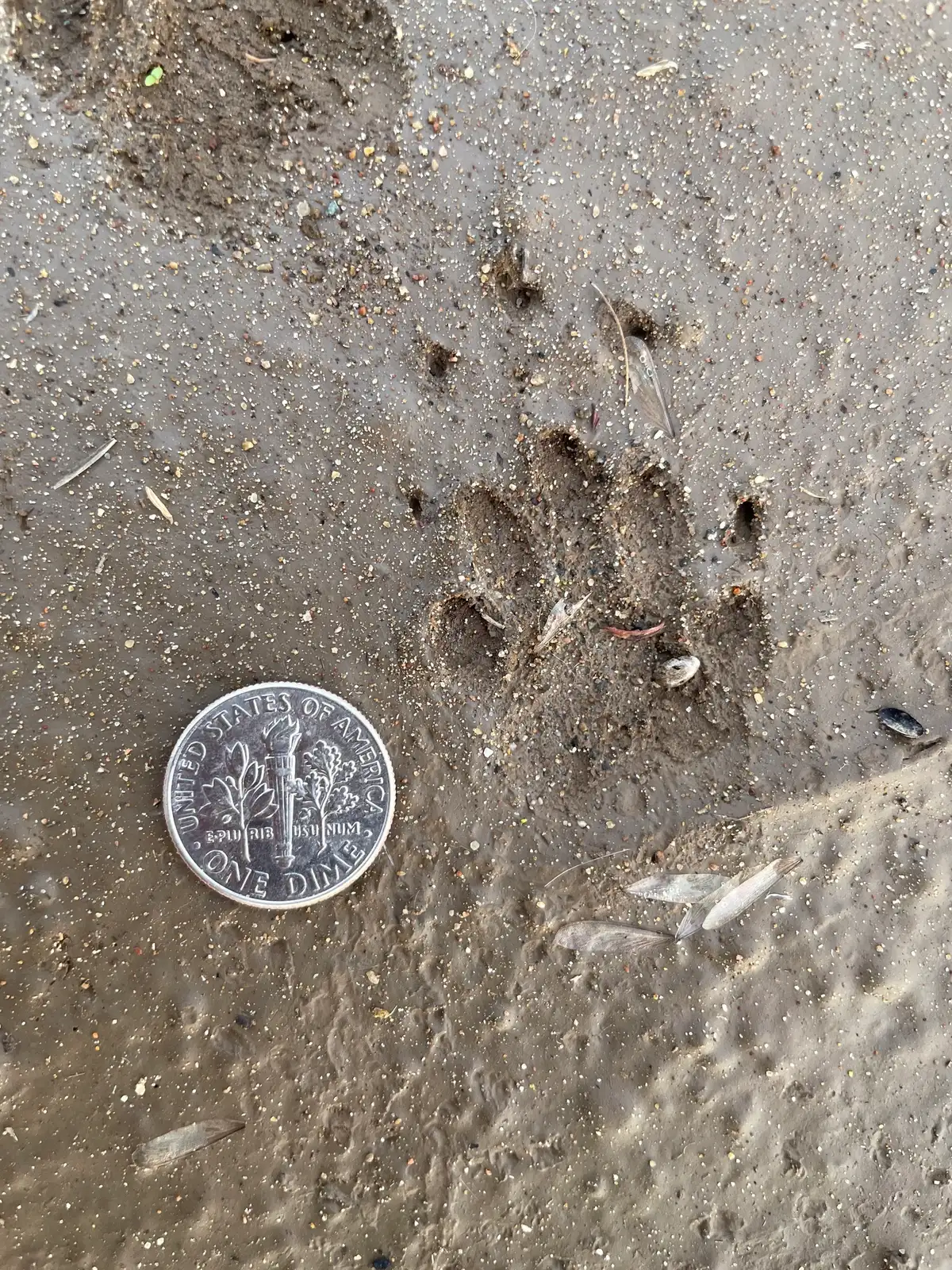
A house cat's print is round and much smaller, with four toes and no claw marks. Cats keep their claws pulled in as they walk, NY DEC says, and the heel pad has three lobes along its bottom edge; Maryland DNR's key caps a house cat's front print at about 1 1/2 inches long by 1 3/8 inches wide. A cat also places each hind foot in the front print, so its trail is a line of single prints rather than pairs.
Dog, coyote and fox tracks
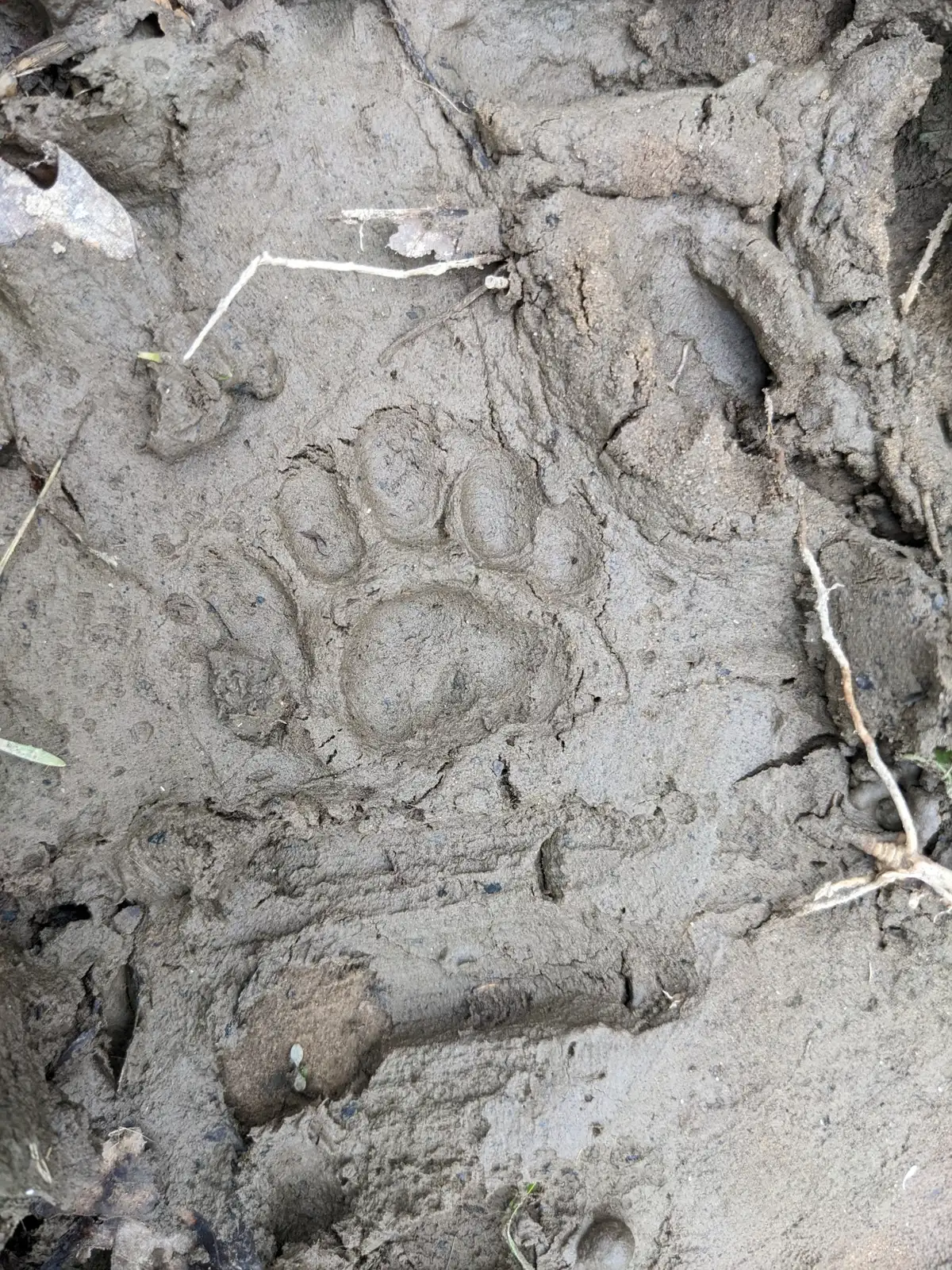
Dog-family prints can be as large as a raccoon's: New Hampshire Fish and Game's pocket track guide gives dog prints as 2 1/4 to 4 inches. But NY DEC says they show four toes, one lobe on the heel pad and usually claw marks. The guide to tracks in snow tells dog, coyote and fox prints apart.
Squirrel tracks
Squirrels have four toes on the front feet and five on the hind, and their tracks come in groups of four rather than pairs. In Maryland DNR's key, a gray squirrel's hind print is under 2 inches long and almost twice as long as it is wide, and NY DEC says squirrels move in jumps, the hind feet often landing in front of and beside the front feet.
Five toes on every foot? Maryland DNR's key, in order
- Inner toe of the hind print sticks out sideways: opossum.
- Front print over 4 inches long: black bear.
- Hind print over 4 1/2 inches long and webbed: beaver.
- Toes slender, with bulbous tips and no webbing: raccoon.
- Hind print over 2 1/2 inches wide, with webbing: river otter.
- Front claws long and printed well ahead of the toes: striped skunk.
- Front and hind prints over 1 1/2 inches long: mink; smaller still, a weasel.
Look-alike tracks and other raccoon signs
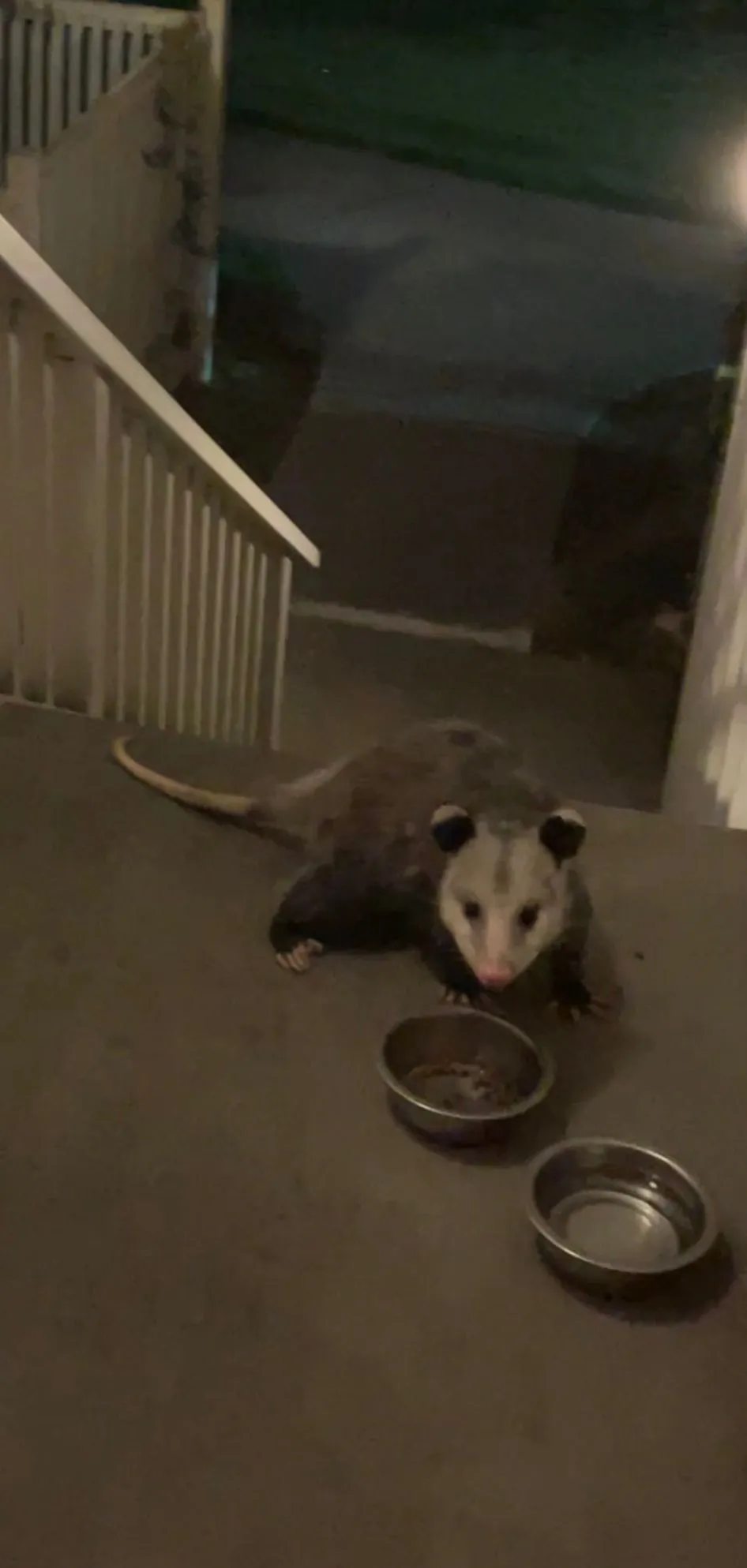 OpossumHind print has a thumb sticking out sideways with no claw mark; the front print looks like a star
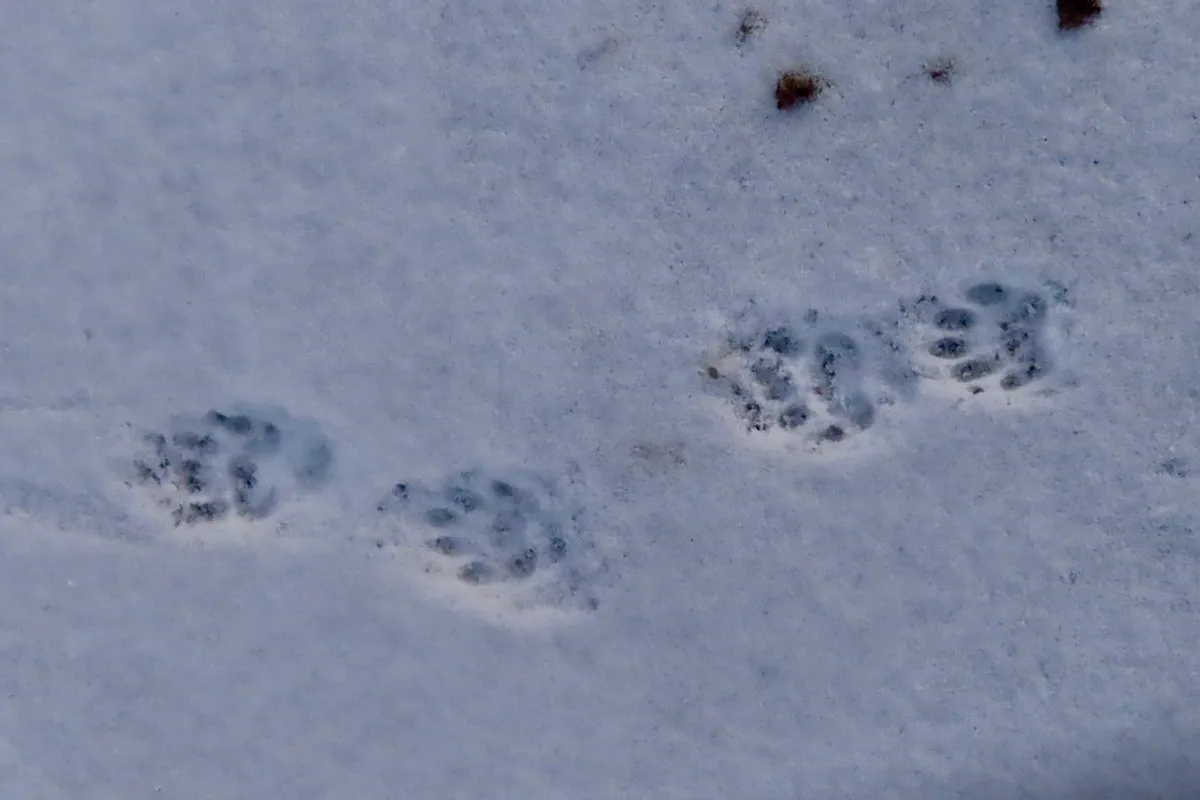 Skunk tracksSmaller prints, the hind 1 1/4 to 2 3/4 inches long, with long front claws printed well ahead of the toes
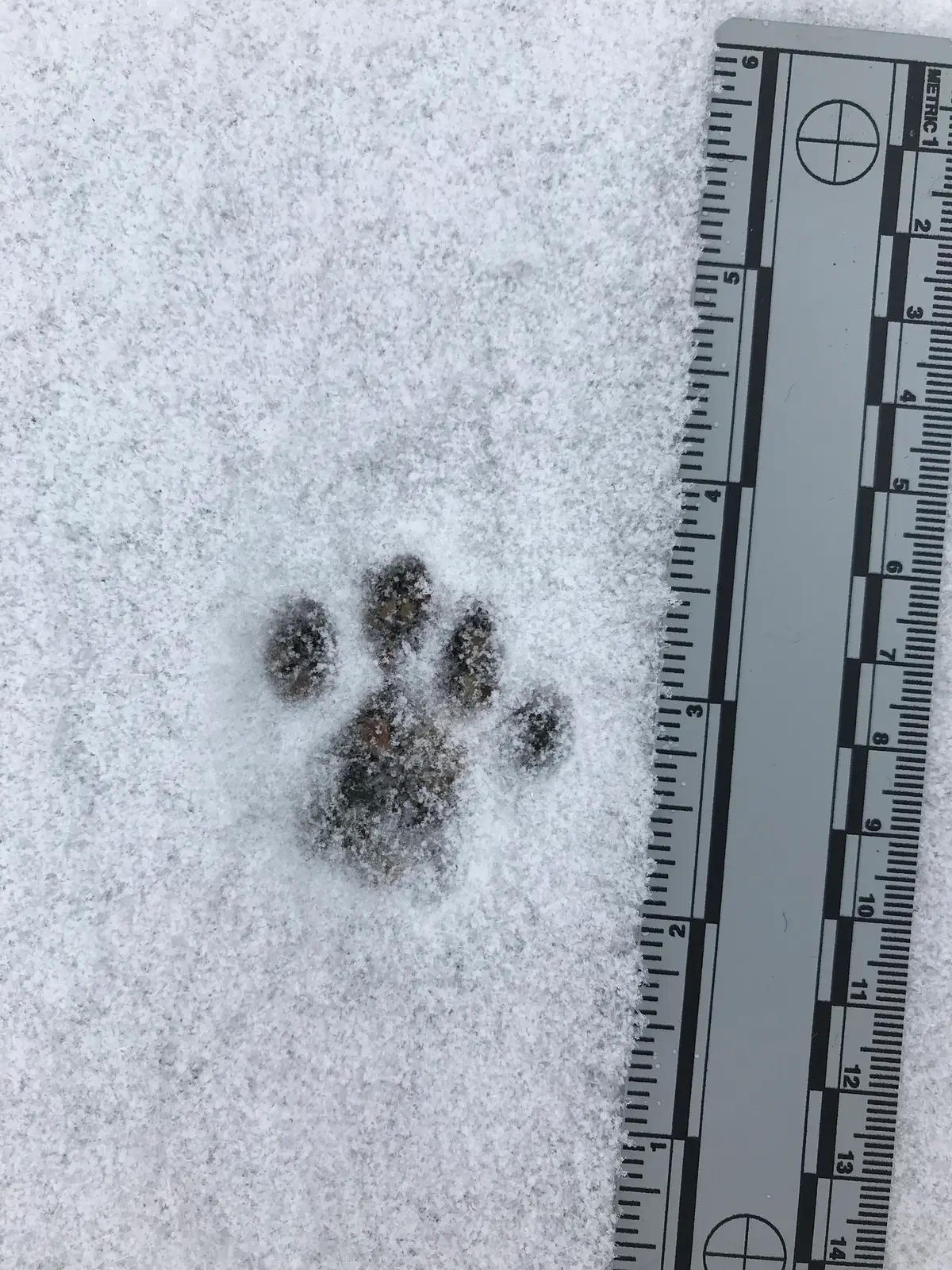 House cat tracksFour round toes and no claw marks; the front print is about 1 1/2 inches long or less
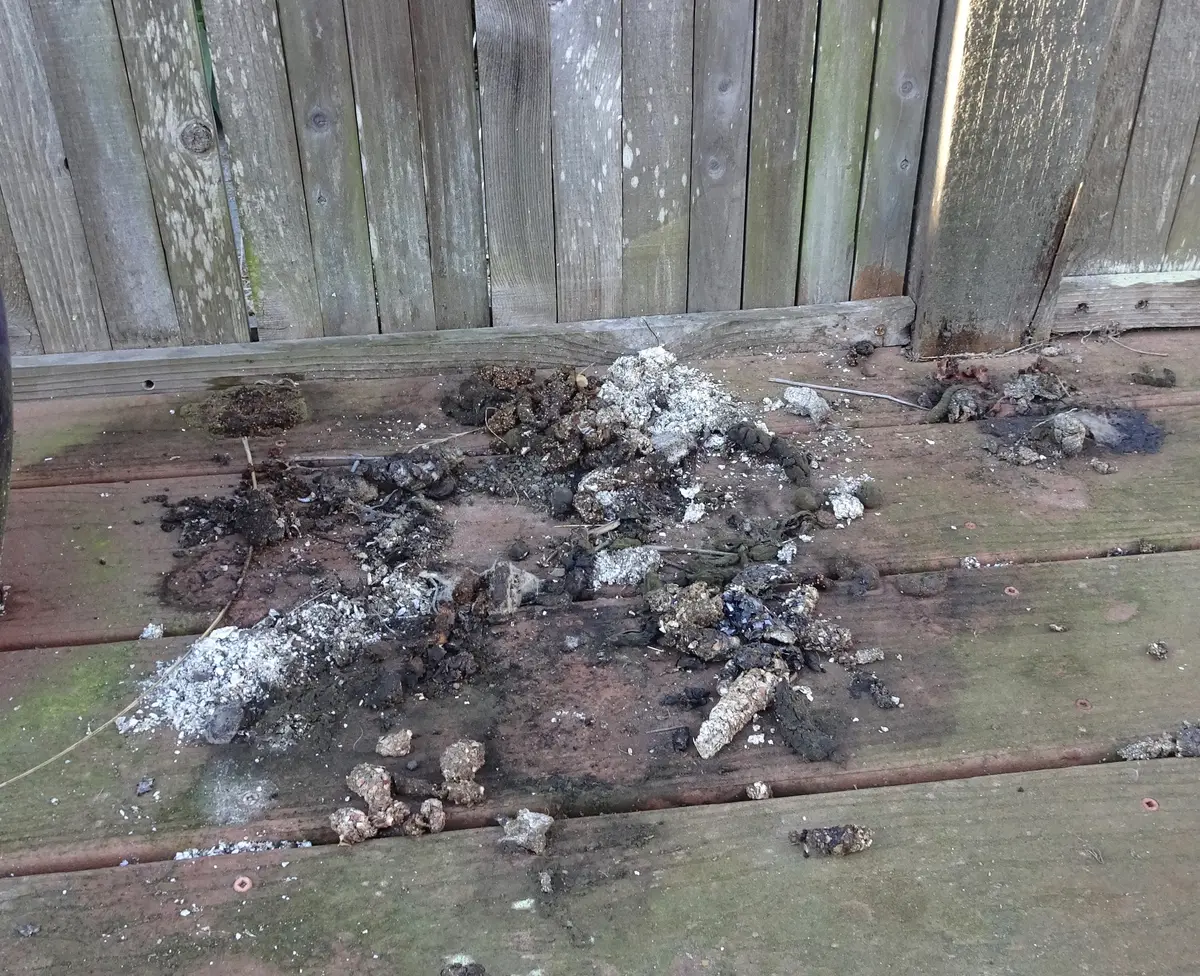 Raccoon latrineDroppings piled in one spot near the tracks mean a raccoon keeps coming back
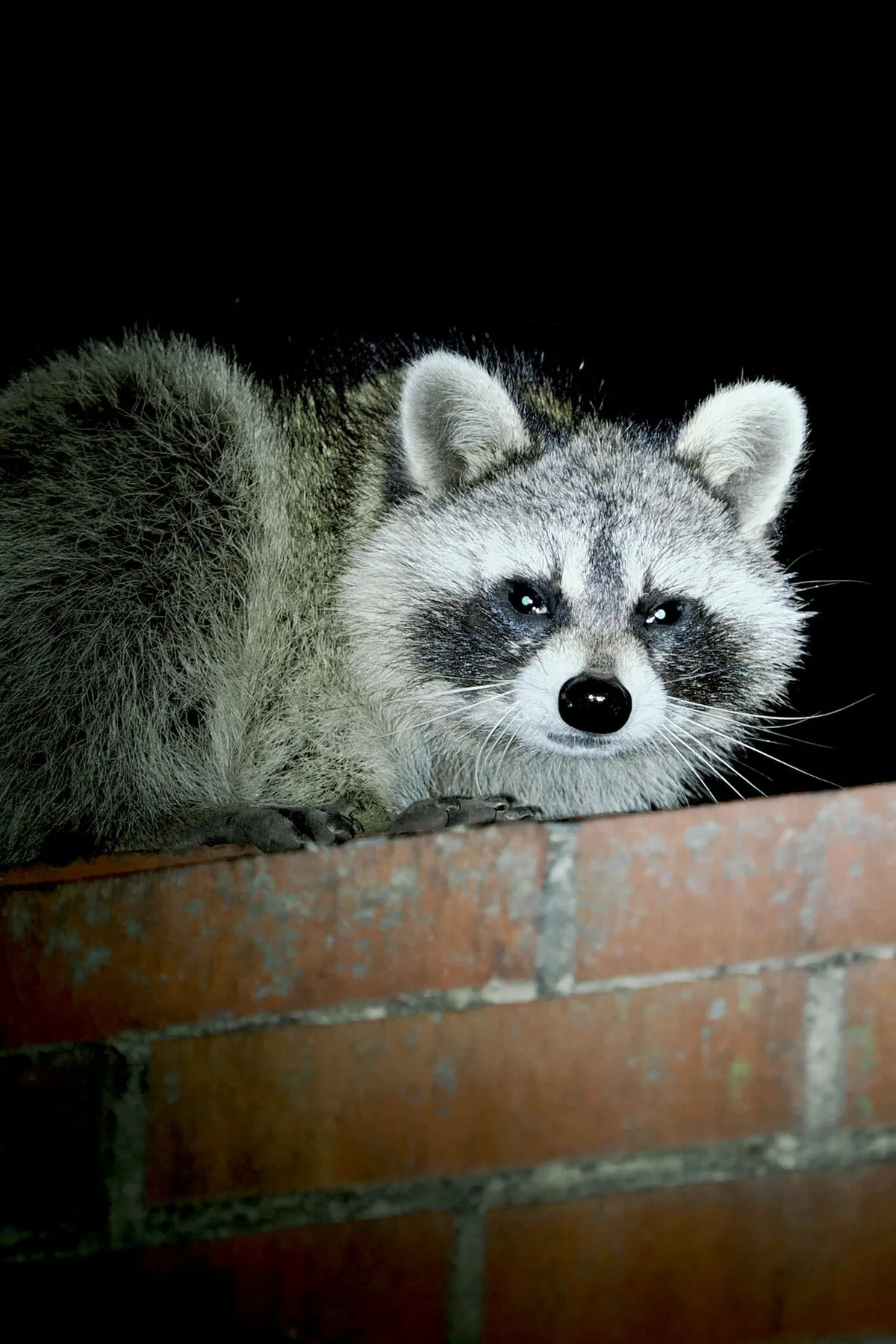 Raccoon on the roofSmudged prints up a downspout plus thumps at night can mean a den in the attic or chimney
Photos: Opossum: no rights reserved, via iNaturalist, CC0 1.0. Skunk tracks: no rights reserved, via iNaturalist, CC0 1.0. House cat tracks: no rights reserved, via iNaturalist, CC0 1.0. Raccoon latrine: (c) Barbara Banfield, some rights reserved (CC BY), via iNaturalist, CC BY 4.0. Raccoon on the roof: no rights reserved, via iNaturalist, CC0 1.0.
What do raccoon tracks near your house mean?
Tracks show where a raccoon travels and feeds; the signs around them tell you whether it is passing through or settling in. WDFW says raccoons usually move to a different den or resting site every few days, and that only a female with young, or an animal holed up in a cold spell, uses one den for any length of time. Raccoons are mostly out at night, though WDFW says they are occasionally seen by day eating, napping in a tree or looking for food.
- Droppings piled in one spot. Raccoons defecate in the same place again and again, Nebraska Extension says, and ICWDM says these latrines tend to be open to the sky, on roofs, in sandboxes and on fallen trees. The raccoon poop guide shows what a latrine looks like and gives CDC's cleanup steps.
- Smudges on a downspout, torn shingles or noises at night. MU Extension lists shingles or fascia boards torn up to reach an attic and chimneys plugged with nest material, and says raccoons in a chimney or attic may whine or growl; the attic noises guide helps confirm which animal is up there.
- Small prints beside large ones from early summer. MDC says most raccoon litters arrive in April or early May, and WDFW says the young start going out with their mother at 8 to 10 weeks old, so a family's trail can mix small and large prints.
- Rolled-back sod or holes in the lawn. The UW-Madison guide says raccoons may roll up newly laid sod to look for grubs and other insects, and Nebraska Extension says raccoons, and rarely opossums, damage lawns hunting worms and grubs. The holes in the yard guide tells the diggers apart.
How can you tell if a raccoon is still under the deck or in the attic?
Let the tracks answer before you close anything, because sealing in an animal, or cutting a mother off from her young, makes the problem worse. Nebraska Extension warns against any repair until you are certain nothing still uses the opening.
- Sprinkle a thin layer of flour across the opening late in the day; MU Extension says flour spread at a damage site reveals tracks from activity during the night.
- Check it the next morning: fresh prints mean the opening is still in use.
- Or stuff the entrance loosely with newspaper or rags. The UW-Madison guide says that if the plug stays undisturbed for two or more days, the entrance can probably be sealed permanently.
- In late spring and early summer, assume young may be inside, as the UW-Madison guide warns. Nebraska Extension says young in a chimney are typically old enough to leave in 6 to 8 weeks, and WDFW says a chimney family leaves on its own after 8 to 10 weeks.
- Close the opening only once it is empty; WDFW suggests hardware cloth with 1/4-inch mesh, boards or metal flashing.
Once the space is empty, raccoon-proofing under a deck walks through the barrier, and raccoon-proof chimney caps shows how the top of a chimney is closed.
How do you make a plaster cast of a raccoon track?
A plaster cast preserves a track you want to keep, and NMSU Extension's tracking circular gives the method:
- Pick a print deep and clear enough to copy, and lift out loose sticks and debris.
- Ring it with a strip of waxed cardboard about 2 1/2 inches wide, such as one cut from a milk carton, press it about 1/2 inch into the ground and fasten the ends with paper clips.
- Mix plaster of Paris with water to the consistency of cream or pancake batter and pour it to about 1 inch below the top of the ring.
- Wait 10 minutes or more for it to set hard, cut around it, lift it from well underneath, and let it harden a day or more before brushing off the soil.
NMSU warns that dry, dusty ground and sand need extra care, and that even a cold plaster mix tends to melt the bottom of a track in snow, so it suggests stirring snow into the mix.
What should you do once you know a raccoon made the tracks?
Most raccoon tracks need nothing done. Act when they lead to garbage, pet food, a pond or an opening in the house, and check your state's rules with its wildlife agency before trapping, as WDFW and the UW-Madison guide both advise.
- Garbage. WDFW suggests securing lids with rope, chain, bungee cords or weights, staking the handles so cans cannot tip, and putting cans out on the morning of pickup.
- Pet food. Feed pets indoors, WDFW says, or pick up bowls and spilled food well before dark.
- Ponds. Give fish hiding places on the bottom, such as cinder blocks or drain tile, and cover small ponds at night, since raccoons are most active after dark, WDFW says.
- Roofs. Trim tree limbs away from the house, WDFW says, and close den openings only after the checks above.
- Repellents and deterrents. The raccoon repellent guide and the raccoon deterrent guide compare what works and what does not.
- Never feed raccoons. WDFW says raccoons fed by people can lose their fear of humans and become aggressive when the food stops.
This guide is general educational information, not medical advice. If you have symptoms or concerns after a bite or exposure, contact a healthcare provider.
Frequently Asked Questions
What animal has tracks that look like a baby's hand?+
A raccoon. NY DEC compares a raccoon's track to a human baby's hand, and the Missouri Department of Conservation says the tracks look like small bare hands, with five long toes on every foot. An opossum's tracks can look handlike too, but its hind foot has a thumb set at a right angle to the other toes, with no claw mark, while all of a raccoon's toes point forward.
How big is a raccoon footprint?+
The Missouri Department of Conservation gives the front track as 2 1/2 to 3 inches long, about as wide as it is long, and the hind track as 3 3/4 to 4 inches long. University of Missouri Extension gives hind prints of 3 1/4 to 4 1/2 inches. Other guides give smaller figures, and NMSU Extension notes that track size varies with an animal's age, sex and the individual, so compare the shape as well as the size.
Do raccoon tracks show claws?+
Usually. University of Missouri Extension says five toes and claws are visible on all feet, the Missouri Department of Conservation says the claws often leave marks, and UW-Madison Extension says each toe bears a short, curved claw. The claw marks are small dots at the tip of each long toe. A house cat's print, by contrast, shows no claw marks, because cats walk with their claws retracted.
How far apart are raccoon tracks?+
At a walk, roughly a foot. The Missouri Department of Conservation puts the distance between strides at about 12 inches, varying with the raccoon's size and speed, and University of Missouri Extension gives 14 inches as the average distance between prints of a walking raccoon. The prints come in side-by-side pairs, each hind foot beside the opposite front foot. Maryland DNR notes that a raccoon switches from this shuffling walk to bounding as it speeds up.
How can you tell raccoon tracks from opossum tracks?+
Look for a thumb on the hind print. The Missouri Department of Conservation says an opossum's hind thumb is angled out sideways, at a right angle to the other toes, with no claw print, and that its front print is star-shaped. All five of a raccoon's toes point forward. BioKIDS adds that an opossum pairs each hind foot with the front foot on the same side, and MDC says its tail often leaves a wavy line in snow.
What is the difference between raccoon and skunk tracks?+
Size and claws. University of Missouri Extension gives a skunk's hind print as 1 1/4 to 2 inches long, against 3 1/4 to 4 1/2 inches for a raccoon; the Missouri Department of Conservation's figures, 2 3/4 inches against 3 3/4 to 4, point the same way. Maryland DNR says a striped skunk's front claws are long and print well ahead of the toes, and BioKIDS notes that a skunk track may show only four toes because the fifth is much smaller. Raccoon toes are long, slender and finger-like.
How do you tell raccoon tracks from cat tracks?+
Count the toes. A house cat shows four round toes and no claw marks, NY DEC says, while a raccoon shows five long toes, usually with claw marks. Maryland DNR's key tops a house cat's front print out at about 1 1/2 inches long, much smaller than a raccoon's hind print. Cats also set each hind foot in the front print, leaving a single line of prints instead of pairs.
Do raccoons leave tracks in the winter?+
Yes, but less often. UW-Madison Extension says a snowfall or temperatures below 20 degrees F send raccoons into winter dens until warmer weather returns, and that they come out to feed as temperatures approach freezing; they do not truly hibernate. The Missouri Department of Conservation says raccoons are dormant or inactive in winter while opossums stay active, so fresh raccoon trails are most likely once temperatures climb back toward freezing.
What do baby raccoon tracks look like?+
Like an adult's, only smaller: the same five long toes and the same hand and foot shapes. NMSU Extension notes that track size varies with an animal's age. The Missouri Department of Conservation says most litters arrive in April or early May, and WDFW says the young begin going out with their mother at 8 to 10 weeks old, so from early summer a family's trail can mix small and large prints.
Why are there raccoon footprints on my car?+
Because a raccoon walked across it. WDFW says raccoons in towns travel along fences, next to buildings and near food, that sharp claws and long toes make them good climbers, and that their tracks turn up on deck railings and other surfaces they use to get into buildings. Dusty or muddy prints with five long toes, in side-by-side pairs, point to a raccoon unless a hind print shows an opossum's sideways thumb; small round prints in a single line point to a cat.
Sources
- Raccoon (Field Guide) — Missouri Department of Conservation
- Mammal Tracks — Missouri Department of Conservation
- Virginia Opossum (Field Guide) — Missouri Department of Conservation
- Managing Raccoon Problems in Missouri (G9453, Robert A. Pierce and Ron McNeely, reviewed October 2022) — University of Missouri Extension
- How to Identify Raccoon and Opossum Tracks (Michaela Parker) — Mississippi State University Extension Service
- Guide to Common Mammal Tracks (October 2023) — Maryland Department of Natural Resources, Wildlife and Heritage Service
- Winter Tracks (reprinted from the New York State Conservationist, February 2015) — New York State Department of Environmental Conservation
- Identifying and Preserving Wildlife Tracks (Circular 561, revised May 2016) — New Mexico State University Cooperative Extension Service
- Tracks Key: Larger Tracks, 5 Toes in Front and 5 in Back (BioKIDS Field Guides) — University of Michigan Museum of Zoology, BioKIDS
- Raccoons — Internet Center for Wildlife Damage Management
- Living with Wildlife: Raccoons (Russell Link, 2004) — Washington Department of Fish and Wildlife
- Raccoon Ecology and Damage Management (G3997-005, Scott Craven and David Drake, 2012) — University of Wisconsin-Extension
- Controlling Raccoon and Opossum Damage (NebGuide G1688, January 2007) — University of Nebraska-Lincoln Extension
- Sea Turtles (Everglades National Park) — National Park Service
- Pocket Guide to N.H. Animal Tracks — New Hampshire Fish and Game Department (copy hosted by Washington State University Extension)
- Raccoon — North Dakota Game and Fish Department
Read and approved by Alex Francisco. Found an error? Email support@buzzskito.ca.