BuzzSkito Mosquito & Tick Control Specialists · Published July 13, 2026
As an Amazon Associate I earn from qualifying purchases. BuzzSkito only points to products we would genuinely use or recommend, at no extra cost to you.
Health note: This guide is for education only and is not medical advice. It cannot diagnose you. If you think you may have Lyme disease, contact a licensed healthcare provider or your local public health unit. Information here is summarized from the Government of Canada, Public Health Ontario, and the U.S. Centers for Disease Control and Prevention.
What Lyme Disease Is
Lyme disease is an infection caused by Borrelia bacteria (most often Borrelia burgdorferi) that spread to people through the bite of an infected tick. In eastern and central North America the culprit is the blacklegged tick, also called the deer tick (Ixodes scapularis); on the Pacific coast it is the western blacklegged tick (Ixodes pacificus). Not every tick carries the bacteria, and an infected tick usually has to stay attached for a day or more before it can pass Lyme on. That biology is the reason symptoms, prevention, and treatment all revolve around timing.
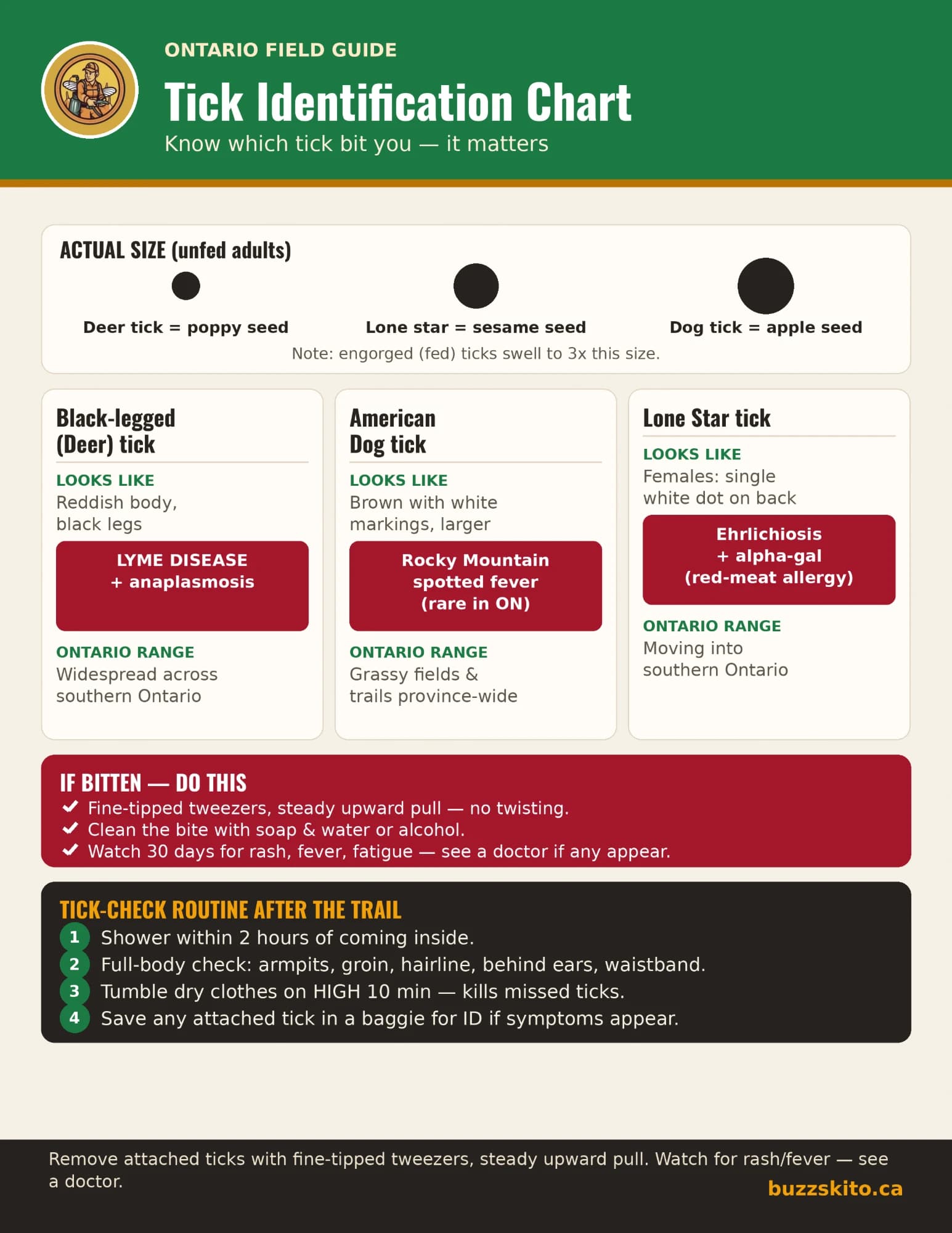
Because the tick that spreads Lyme is tiny — the nymph responsible for most infections is about the size of a poppy seed — many people never remember being bitten. That is why recognizing the symptoms matters as much as spotting the tick.
The Tick-Bite-to-Symptom Timeline
Lyme disease follows a fairly predictable timeline, though it varies from person to person:
- 0–24 hours after the bite: A blacklegged tick generally needs to be attached for 24 hours or more — the CDC cites roughly 36 to 48 hours — before it can transmit the bacteria. Prompt removal during this window is your best defence.
- 3–30 days: Early symptoms appear, most classically the expanding erythema migrans rash (average onset about 7 days) along with flu-like signs.
- Days to weeks: If untreated, the infection can disseminate, causing multiple rashes, facial palsy, or heart and nerve symptoms.
- Weeks to months: Late Lyme can bring arthritis and lingering neurological problems.
Stage 1: Early Localized Symptoms
The first stage centres on the bite site and often mimics a summer flu. According to Public Health Ontario and the Government of Canada, common early symptoms include:
- The erythema migrans rash — an expanding red area at the bite site
- Fever and chills
- Fatigue
- Headache
- Muscle and joint aches
- Swollen lymph nodes
These symptoms can be mild and easy to brush off as an ordinary bug. The combination of an unexplained rash plus flu-like feelings in the warm months — especially after time in grassy or wooded areas — is the pattern worth taking seriously.
What the Erythema Migrans (Bullseye) Rash Really Looks Like
The erythema migrans rash is the single most recognizable sign of Lyme disease, but it is widely misunderstood. Here is what the evidence actually says:
- It expands. It starts small at the bite site and grows over days to weeks, frequently reaching 5 cm (2 inches) or much larger.
- The bullseye is optional. The textbook target — a clear centre ringed by red — is common but far from universal. Many rashes are a solid, evenly red, expanding patch with no ring.
- It is usually not itchy or painful. It may feel warm to the touch, which helps distinguish it from an ordinary itchy bite reaction.
- It can look different on darker skin. On brown and black skin the rash may resemble a bruise, so it is more often missed.
- Not everyone gets one. The CDC estimates the rash appears in about 70 to 80 percent of infected people, and roughly 20 to 30 percent never notice a rash at all.
The practical takeaway: a bullseye is strong evidence of Lyme, but the absence of a bullseye proves nothing. Do not wait for a perfect target ring before seeking care.
Erythema Migrans Day by Day: How the Rash Progresses
What sets erythema migrans apart from an ordinary bite reaction is that it expands over days rather than fading. The general progression described by the Government of Canada and the U.S. CDC:
- Hours to day 2: A small red bump or mild redness at the bite site is usually just a normal reaction to the bite — it appears fast and fades within a day or two. Knowing what a normal tick bite looks like helps you tell the difference.
- Days 3–7: A red area begins spreading outward from the bite. This expanding edge is the earliest reliable sign of erythema migrans; average onset is about 7 days.
- Days 7–14: The patch keeps enlarging, commonly past 5 cm (2 inches), and may develop central clearing that produces the classic bull’s-eye ring — though many rashes stay a solid, evenly red patch.
- Weeks 2–4 and beyond: Left untreated, the rash can grow to 30 cm (12 inches) or larger, and additional rashes may appear elsewhere on the body as the infection spreads.
The single most useful clue is direction: a Lyme rash gets bigger day over day, while an ordinary bite reaction shrinks.
A third pattern confuses people more than either of those: a bite that neither grows nor disappears. For that in-between case, see tick bites that won’t heal and when to worry.
A Lyme Rash With No Remembered Tick Bite
Many people who develop erythema migrans never recall being bitten. The nymph-stage blacklegged tick that causes most infections is only about the size of a poppy seed, and its bite is painless, so it is easily missed. An expanding, warm, usually non-itchy rash 5 cm or larger that shows up during tick season — even with no known bite — should be treated as possible Lyme, particularly after time in grassy or wooded areas. Photograph it, note the date, and see a healthcare provider rather than waiting to confirm a bite you may never have felt.
As an Amazon Associate I earn from qualifying purchases. Price shown on Amazon.ca, at no extra cost to you.
🏆 Our Top Pick — Tick Remover
8.7/10· BuzzSkito ratingFine-Tipped Tick Removal Tool Set
Because fast, clean removal is one of the best ways to lower Lyme risk, a dedicated tick-removal tool belongs in every household and dog-walking kit. A slim, fine-tipped tool grips the tick right at the skin so you can pull straight up without crushing the body — far more reliable than pinching with fingers or all-purpose tweezers.
Pros
- Grips the head close to the skin for a clean pull
- Compact — lives in a first-aid kit, pack, or leash bag
- Works for both people and pets
Cons
- Tiny tools are easy to misplace
- Still requires steady, patient technique
Stage 2: Early Disseminated Symptoms
If early Lyme is not treated, the bacteria can spread through the body over days to weeks. This stage is where the more alarming symptoms appear:
- Multiple erythema migrans rashes at sites away from the original bite
- Facial palsy — a drooping or loss of muscle tone on one or both sides of the face, sometimes mistaken for a stroke
- Neurological signs — severe headaches, neck stiffness, nerve pain, and numbness or tingling in the hands and feet
- Lyme carditis — heart palpitations, an irregular or slow heartbeat, dizziness, or shortness of breath, caused by the bacteria affecting the heart’s electrical system
Some of these are genuinely urgent. The CDC warns that Lyme carditis, though uncommon, can be serious — seek medical care right away for heart palpitations, fainting, or shortness of breath after a possible tick exposure. For a plain-English look at how serious untreated Lyme can become, see our guide to whether Lyme disease can kill you.
Stage 3: Late Lyme Disease
Weeks to months after an untreated bite, Lyme can settle into the joints and nervous system. The hallmark of late Lyme is Lyme arthritis: episodes of marked swelling and pain, most often in one large joint such as a knee. Some people also experience continued neurological issues, including numbness, and problems with memory or concentration. The important message here is one of hope, not fear: even late Lyme is treatable with antibiotics, and most people recover — recovery is simply faster the earlier treatment starts.
When to See a Doctor and Get Tested
Contact a healthcare provider or your local public health unit if you notice any of the following, particularly within a few weeks of a tick bite or time in tick habitat:
- An expanding rash, with or without a bullseye pattern
- Unexplained fever, chills, fatigue, or body aches in tick season
- Facial drooping, severe headache with a stiff neck, or new numbness or tingling
- Heart palpitations, dizziness, or shortness of breath
About testing: Lyme is diagnosed with a two-step blood test — an initial screening test followed by a confirmatory test. But your body needs a few weeks to produce enough antibodies to detect, so a test taken too early can be falsely negative. For this reason, providers often diagnose and treat early Lyme based on the erythema migrans rash and your exposure history rather than waiting for bloodwork. If you are unsure whether you live in a higher-risk area, our Ontario Lyme disease tracker and guide to Lyme risk areas in Ontario map where blacklegged ticks are established.
Exposure history is easier to give a doctor when you know what has actually been reported where you live. For the west GTA, Lyme disease cases in Mississauga and Oakville lays out the published Peel and Halton counts behind that conversation.
Treatment and Recovery
Lyme disease is treated with antibiotics — commonly doxycycline, amoxicillin, or cefuroxime, chosen based on your age, stage, and symptoms. Most people who are treated early recover completely. A minority experience lingering symptoms such as fatigue, aches, or joint pain for weeks or months after finishing treatment, sometimes called Post-Treatment Lyme Disease Syndrome; the medical community continues to study why. None of this replaces a conversation with your own provider, who can weigh your history and prescribe appropriately.
How to Lower Your Risk in the First Place
The surest way to avoid Lyme symptoms is to avoid infected tick bites. Public-health agencies across North America recommend a layered approach:
- Use an approved repellent. Products containing DEET or picaridin on skin are proven to deter ticks. For clothing and gear, permethrin kills ticks on contact.
- Cover up and check. Wear long pants tucked into socks in tick habitat, and do a full-body tick check within a couple of hours of coming indoors — including the scalp, behind the knees, the waistband, and the underarms.
- Shower soon after being outdoors to wash off unattached ticks and make checks easier.
- Manage your yard. Keep grass mowed, clear leaf litter, and create a barrier between the lawn and any woods or tall grass, since ticks quest from vegetation at the yard’s edge.
To recognize the tick that actually spreads Lyme, see our identification guide to the blacklegged (deer) tick in Ontario. And if ticks are already a problem around your home, a professional barrier treatment targets the exact shaded edges and leaf litter where they wait.
Households with a dog have a second exposure route worth understanding, since the same ticks ride indoors on a pet’s coat. Dogs can catch Lyme from those bites too, and their warning signs look nothing like ours — shifting-leg lameness instead of a rash, appearing months after the bite.
Trusted Sources on Lyme Disease
For authoritative, regularly updated information, consult:
- Government of Canada — Lyme disease
- Public Health Ontario — Lyme disease
- U.S. CDC — Lyme disease and CDC — Ticks
Related Reading
- Blacklegged (Deer) Tick — Ontario ID Guide
- What Does a Tick Bite Look Like?
- Tick Bite Symptoms & What To Do
- How to Remove a Tick Safely
- Tick Head Stuck in the Skin? What To Do
- Can Lyme Disease Kill You?
- Alpha-Gal Syndrome (Tick-Bite Red Meat Allergy)
- Lyme Disease Risk Areas in Ontario (2026)
- Ontario Lyme Disease Tracker
- BuzzSkito Tick Control Service
Frequently Asked Questions
What are the early symptoms of Lyme disease?+
Early Lyme disease symptoms usually begin 3 to 30 days after a bite from an infected blacklegged (deer) tick. The most characteristic sign is an expanding erythema migrans rash at the bite site, often described as a bullseye or target. Many people also develop flu-like symptoms: fever, chills, fatigue, headache, muscle and joint aches, and swollen lymph nodes. According to the Government of Canada and the U.S. CDC, these early signs are the best window for treatment, and early Lyme with a clear erythema migrans rash is often treated on clinical signs alone.
What does the Lyme disease rash (erythema migrans) look like?+
The erythema migrans rash starts as a small red area at the bite site and gradually expands over days to weeks, often reaching 5 cm (2 inches) or larger. It may develop the classic bullseye appearance with a clearer centre and a red ring, but many rashes are a uniform expanding red patch with no ring at all. The rash is usually not itchy or painful and may feel warm. On darker skin tones it can look like a bruise, which is why it is sometimes missed. The CDC notes the rash appears in roughly 70 to 80 percent of infected people, so its absence does not rule Lyme out.
How long after a tick bite do Lyme disease symptoms appear?+
Symptoms most commonly appear 3 to 30 days after the bite, with an average of about 7 days for the erythema migrans rash. Later-stage symptoms affecting the joints, heart, or nervous system can appear weeks to months after an untreated bite. Importantly, a blacklegged tick generally needs to stay attached for 24 hours or more (the CDC cites roughly 36 to 48 hours) before it can transmit the bacteria, which is why prompt tick removal and daily tick checks meaningfully lower the risk.
Do all people with Lyme disease get the bullseye rash?+
No. The CDC estimates the erythema migrans rash appears in about 70 to 80 percent of infected people, which leaves roughly 20 to 30 percent who never develop or never notice one, and among those who do, the rash frequently lacks the textbook bullseye ring. Some people also do not recall being bitten, because the nymph-stage tick responsible for most infections is only about the size of a poppy seed. This is why you should not wait for a bullseye: if you develop unexplained fever, fatigue, or aches within weeks of possible tick exposure, especially in a risk area, see a healthcare provider.
Can you have Lyme without a rash?+
Yes. The CDC estimates the erythema migrans rash appears in about 70 to 80 percent of infected people, which means roughly 20 to 30 percent never develop or never notice one, and on darker skin the rash is more easily missed. Because the rash can be absent, a diagnosis does not require it: if you have unexplained fever, fatigue, headache, or joint aches within weeks of possible tick exposure, a healthcare provider can evaluate you on your symptoms and exposure history. Note that early blood tests may be falsely negative, since antibodies take a few weeks to build. Do not rule out Lyme just because there is no rash. This is general information, not medical advice.
What are the first signs of Lyme disease in adults?+
In adults, the first signs of Lyme disease usually appear 3 to 30 days after an infected blacklegged tick bite. The earliest and most specific sign is an expanding erythema migrans rash at the bite site (average onset about 7 days), often alongside flu-like symptoms: fever, chills, fatigue, headache, muscle and joint aches, and swollen lymph nodes. Because these early signs can feel like a summer cold, the Government of Canada and the CDC advise taking the combination of an unexplained rash plus flu-like symptoms during tick season seriously, especially after time in grassy or wooded areas. See a healthcare provider early, since antibiotics work best when started promptly.
What are the later-stage symptoms of Lyme disease?+
If early Lyme is not treated, the bacteria can spread over days to months. Early disseminated symptoms include multiple erythema migrans rashes, facial palsy (drooping on one or both sides of the face), severe headaches and neck stiffness, heart palpitations or an irregular heartbeat (Lyme carditis), and nerve pain or numbness and tingling in the hands or feet. Late Lyme disease can cause arthritis with marked joint swelling and pain, most often in the knees, along with lingering neurological problems. These stages are still treatable, but recovery is faster the earlier treatment begins.
When should I see a doctor or get tested for Lyme disease?+
See a healthcare provider if you develop an expanding rash, unexplained fever, or flu-like symptoms within a few weeks of a tick bite or time spent in tick habitat, and sooner if you notice facial drooping, heart palpitations, or severe headache with a stiff neck. Testing uses a two-step blood test (an initial screening test followed by a confirmatory test), but antibodies take a few weeks to build, so early tests can be falsely negative. Because of this, doctors often diagnose and treat early Lyme based on the erythema migrans rash and your exposure history rather than waiting for bloodwork.
Can Lyme disease be cured?+
Yes. Most people with Lyme disease recover fully after a course of antibiotics, especially when treatment starts early. Doctors commonly prescribe doxycycline, amoxicillin, or cefuroxime depending on your age, stage, and symptoms. A minority of people have lingering symptoms such as fatigue or joint aches for weeks or months after treatment, sometimes called Post-Treatment Lyme Disease Syndrome. This guide is educational only and not a substitute for medical advice; diagnosis and treatment should always come from a licensed healthcare provider.
How do I remove a tick to lower my Lyme risk?+
Use fine-tipped tweezers to grasp the tick as close to the skin surface as possible, then pull straight upward with steady, even pressure. Do not twist, jerk, or squeeze the body, and avoid folk remedies like burning it or coating it in petroleum jelly. Clean the bite and your hands afterward, and note the date. Because a blacklegged tick usually must be attached for a day or more to transmit Lyme, fast, correct removal is one of the most effective things you can do.