
Tick Prevention in Your Yard:
Ontario Guide for Families with Kids (2026)
How to lower tick risk in your Ontario backyard — yard modifications, DIY measures, and professional barrier spray, so children and pets can keep using the yard all summer.
Quick Answer
Professional tick barrier spray is applied according to the product label, and children and pets should stay off treated areas until the spray has dried, as the label directs; combined with yard-edge modifications it gives an Ontario family a layered defence. The highest-risk zone is the 1–3 metre edge where lawn meets vegetation, and nymph season (May–July) is most dangerous.
- Keep children and pets off treated areas until the barrier spray has dried, as the product label directs.
- Ticks concentrate in the first 1–3 metres where lawn meets garden beds, hedges, leaf litter, or fences — not the open lawn.
- Nymphs (poppy-seed-sized, 1–2 mm) are active May–July and carry the same Lyme risk as adults, causing most Ontario cases.
- A full tick season is five treatments, roughly monthly from May through September — enough to cover peak nymph season without a gap and still catch fall adults.
- A 1-metre wood-chip or gravel barrier strip between lawn and wooded edges deters ticks from crossing.
- Picaridin (icaridin) repellent labels permit use on children as young as 6 months, as a second, skin-applied layer.
— BuzzSkito, GTA mosquito & tick control · 150+ five-star Google reviews
As an Amazon Associate I earn from qualifying purchases. BuzzSkito only points to products we would genuinely use or recommend, at no extra cost to you.
BuzzSkito Mosquito & Tick Control Specialists · Published April 7, 2026
Why Ontario Backyards Are the #1 Tick Exposure Site for Children
Most Ontario families assume the biggest tick risk is on hiking trails. The data says otherwise. Research from Ontario public health agencies consistently finds that the majority of Lyme disease exposures happen in or immediately adjacent to residential properties — not on remote trails. For children especially, the backyard is where they spend the most unstructured outdoor time.
This matters because ticks don't roam across open lawn. They quest — clinging to low grass blades and leaf tips with their front legs extended, waiting for a warm body to brush past. The edge of your property — where maintained lawn meets the garden border, the fence line, the hedgerow, the neighbour's naturalized strip — is where children are most likely to make that contact.
Understanding Tick Risk by Life Stage
Ontario has two main tick seasons, corresponding to two active life stages of the blacklegged tick:
| Life Stage | Active Period (Ontario) | Size | Lyme Risk |
|---|---|---|---|
| Nymph | May – July (peak) | Poppy seed (1–2mm) | Highest (hardest to spot) |
| Adult | Mar–May + Oct–Nov | Sesame seed (3–5mm) | High (but visible) |
| Larva | Late summer | Pinhead (<1mm) | Low (rarely infected) |
The nymph stage is the most dangerous for children for three compounding reasons: it is active during prime outdoor play season (May–July), it is small enough to be missed even during careful skin checks, and it carries the same Lyme disease infection rate as adult ticks.
Tick Hotspots on Your Property: Where Children Are Most Exposed
Professional tick treatment works best when it targets the specific zones where ticks aggregate. If you have children, keep them away from these areas without treatment:
- The 1–3 metre lawn edge — the transition between your maintained grass and any garden bed, hedge, fence line, or natural vegetation is the primary tick questing zone
- Leaf litter accumulation — fallen leaves retain moisture and create the humid microclimate ticks need to survive; unmulched leaves against fences or house foundations are a hotspot
- Woodpiles — stacked wood against the house or fence creates tick-friendly habitat and attracts mice (the primary Lyme reservoir host)
- Under decks and porches — shaded, humid, and rarely disturbed — ideal tick habitat
- Low ornamental plantings — dense ground-level shrubs like juniper, euonymus, or boxwood in mulched beds harbour ticks throughout the season
- Play structures near edges — if a swing set or play structure is positioned near a garden border or fence, it places children consistently at the highest-exposure zone
Every one of those zones is at child height for a reason: a tick cannot fly or jump, so it climbs low vegetation and waits with its front legs out, usually within about 30–50 cm of the ground — which puts a toddler’s shoulders and a running child’s legs right in the questing band. Do ticks fly or jump, and how high do they climb? has the measurements.
Physical Yard Modifications That Reduce Tick Risk
These low-chemical measures are complementary to professional treatment and reduce tick survival on your property:
- Mow short and often — ticks avoid dry, sunny, short grass; keeping grass below 7–8cm creates an inhospitable microclimate
- Install a dry barrier strip — a 1-metre band of wood chips, pea gravel, or rubber mulch between lawn and any wooded/naturalized border creates a desiccating zone that ticks are reluctant to cross
- Remove leaf litter — bag and remove fallen leaves from property edges; don't leave them piled against fences through winter
- Move woodpiles — relocate any stacked wood away from the house, play structures, and lawn edges; ideally elevate it off the ground
- Trim low branches and shrubs — reduce shaded, humid zones along fences and borders; increase sunlight penetration to ground level
- Relocate play structures — if possible, move swings and play areas to the sunniest, most central part of the yard, away from borders
The DIY Yard Layer: Treating the Edge Yourself
Mowing, mulch strips, and leaf removal make the property edge less hospitable, but they do not kill the ticks already questing there. If you want to treat the edge yourself between professional visits — or you are not ready to book a technician at all — a cedar-oil yard concentrate that hooks onto a garden hose is the practical DIY option for the 1–3 metre border zone. It is the layer that actually reduces the number of ticks your children can walk into, which is why we put it ahead of anything you spray on skin.
As an Amazon Associate I earn from qualifying purchases. Price shown on Amazon.ca, at no extra cost to you.
🏆 Our Top Pick for the Yard
8.4/10· BuzzSkito ratingWondercide Cedar-Oil Yard Spray (hose-end)
A cedarwood-oil yard concentrate that attaches to a garden hose and covers roughly 465 m² — enough for the perimeter strip on a typical Ontario lot. Cedar oil kills and repels ticks on contact and is the DIY option parents pick most often; follow the label on when children and pets can return to the lawn. Treat the fence line, garden borders, and the base of hedges rather than the open lawn.
Pros
- Treats the actual questing zone, not just your skin
- Cedarwood-oil concentrate
- Hose-end applicator — no mixing or sprayer needed
Cons
- Shorter residual than professional barrier spray — reapply every 3–4 weeks
- Cedar scent is noticeable for a day
For a wider comparison of DIY yard options — granules, concentrates, and tick tubes — see our guide to the best tick repellent for your yard in Canada.
Is Professional Barrier Spray Safe for Children and Pets?
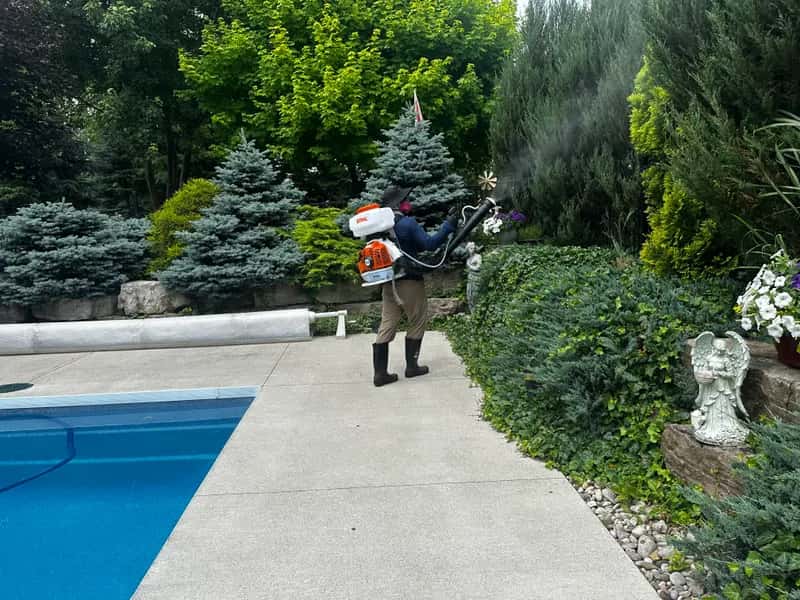
This is the question BuzzSkito gets most often from parents, and it deserves a direct answer: keep children and pets off treated areas until the spray has dried, as the product label directs. Here is how the product is regulated, how it is applied, and what your family should do on treatment day.
Here's the regulatory context. In Canada, pesticides are regulated under the Pest Control Products Act, and every product carries a label with a PCP registration number and directions for use, including when people and pets can return to a treated area. Commercial applicators in Ontario must also hold a provincial licence; BuzzSkito works under Ontario Pesticide Operator Licence L-240-2436835197. The active ingredients in professional tick barrier spray are typically pyrethrins or synthetic pyrethroids like bifenthrin.
Re-entry is set by the product label, not by us. Our products are applied according to label directions, and the label is what tells your family when the treated edge can be used again. If you want to read it before the visit, just ask.
Practical guidance for families:
- Keep children and pets inside or away from treated areas during application
- Stay off treated areas until the spray has dried, as the product label directs
- Rain within 1 hour of your treatment? We come back and re-treat free, on every plan.
- Move toys, pet bowls, and cushions away from the fence line and garden borders before the visit
Recommended Tick Treatment Schedule for Ontario Families
The standard program for a residential property in Ontario with children is five treatments per season — roughly one a month from May through September:
- Early May — the season opener, laying the barrier down at the property edge before nymphs begin questing in earnest
- Late May or early June — targets emerging nymphs before peak activity begins; this is the most important treatment of the year for families with young children
- Late June or early July — holds the barrier through the peak of nymph season, when the poppy-seed-sized stage responsible for most Lyme cases is most active
- Late July or early August — the previous application's residual has worn off by now, and wildlife keeps carrying fresh ticks in from the woodland next door
- Late August or September — targets fall adult tick emergence, which extends risk into October and into November in mild years
The five visits exist for one reason: the acaricide residual is temporary, and your property is continuously restocked with ticks by deer, mice, and birds moving in from the ravine, woodlot, or naturalized strip next door. A spring-and-fall pair of visits leaves a multi-month hole through May–July — exactly the window when nymphs are questing and children are outside every day. Monthly applications close it.
Higher-exposure properties — backing onto conservation land, ravines, creek valleys, or with confirmed deer movement — are where the full five-treatment season matters most. High-risk GTA zones include the Oak Ridges Moraine corridor (Richmond Hill, Vaughan, King City, Caledon), the Humber River valley, Credit River watershed, and any property adjacent to naturalized green space.
If you are in Mississauga, that Credit River line is the one to watch, and the local emergence dates are set out in our Mississauga tick season calendar so you can book the first visit before the nymphs are out rather than after.
BuzzSkito prices a full five-treatment tick season at $597 on its own, or $497 when you add it to any mosquito plan — a $100 saving. A single one-off treatment starts at $99 if you want to try it before committing to the season.
Personal Repellent: The Second Layer for Kids
Yard treatment lowers the tick population where your children play, but a skin-applied repellent adds a second layer for trips to the park, cottage, or trail. For children, picaridin (icaridin) is the pediatric-friendly choice many parents prefer over DEET — its label permits use on children as young as six months, it is odourless, and it will not damage plastics or clothing. Apply it to exposed skin before outdoor play and reapply per the label.
As an Amazon Associate I earn from qualifying purchases. Price shown on Amazon.ca, at no extra cost to you.
🏆 Our Top Pick for the Skin Layer
8.7/10· BuzzSkito ratingPicaridin (Icaridin) Insect Repellent
The pediatric-friendly skin layer many Ontario parents prefer over DEET — picaridin labels permit use on children as young as six months, it is odourless, and it will not damage plastics or clothing. Apply to exposed skin before outdoor play and reapply per the label.
Pros
- Label permits use from 6 months
- Odourless and non-greasy
- Won’t damage plastics, gear, or clothing
Cons
- Skin layer only — not a yard treatment
- Needs reapplication through the day
For a full breakdown of repellent options for kids — including lotions versus sprays and the right concentration by age — see our guide to the best bug spray for kids in Canada.
Post-Outdoor Tick Checks for Children
Even with a professionally treated yard, teaching children and adults to do tick checks after outdoor time is part of a complete prevention strategy:
- Check within 2–3 hours of coming inside (ticks take several hours to attach fully)
- Focus on hairline, behind ears, back of neck, underarms, belly button, groin, and behind knees
- Use a hand mirror or ask a partner to check the back, scalp, and between toes
- Check children and pets before they come inside
If you find an attached tick, use fine-tipped tweezers to grasp as close to the skin as possible and pull upward with steady, even pressure. Don't twist, squeeze the body, or use heat. After removal, clean the site with rubbing alcohol. Monitor for a bullseye rash (erythema migrans) and fever over the next 30 days — and contact a physician if symptoms develop.
A dedicated tick-removal tool or fine-point tweezers kept in the first-aid kit makes clean removal far easier than fumbling with kitchen tweezers, especially on a poppy-seed-sized nymph.
Ticks in the GTA: Cities and Communities Most at Risk
If you live in any of the following areas, your children face elevated tick exposure and professional yard treatment is strongly recommended before peak nymph season:
- Vaughan — Boyd Conservation Area, Kortright Centre, Humber River corridor
- Richmond Hill — Oak Ridges Moraine, Lake Wilcox, Jefferson Forest
- King City / King Township — forest edges throughout, highest confirmed activity in York Region
- Caledon — Oak Ridges Moraine, Credit River upper reaches, rural property edges
- Oakville — Bronte Creek Provincial Park, 16 Mile Creek corridor
- Hamilton — Niagara Escarpment, Cootes Paradise, Spencer Creek
- Markham — Rouge National Urban Park boundary, Don River headwaters
- Brampton — Heart Lake Conservation Area, Etobicoke Creek valley
Related Tick Control Guides
- The Ultimate Tick Control Guide for Ontario Homeowners
- Lyme Disease Prevention in Ontario: A Complete Homeowner Guide
- When Are Ticks Active in Ontario? Seasonal Activity Calendar
- Tick Bite Symptoms & What to Do in Ontario
- Tick Bite vs Mosquito Bite: How to Tell the Difference
- Best Tick Repellent for Your Yard in Canada
- Best Bug Spray for Kids in Canada
FAQ – Tick Prevention for Ontario Families
Is professional tick spray safe for children in Ontario?
In Canada, pesticides are regulated under the Pest Control Products Act, and every product's label sets out how it may be used, including when people can return to a treated area. The practical rule for families: keep children indoors or away from the yard during application, and keep them off treated areas until the spray has dried, as the product label directs. BuzzSkito treatments are applied under Ontario Pesticide Operator Licence L-240-2436835197, and every product is used according to its label directions. If you have a specific health concern about your child, ask for the product label before the visit and talk to your doctor.
Is tick spray safe for dogs and cats?
The same re-entry rule applies to pets as to children: keep dogs and cats inside during application and off treated areas until the spray has dried, as the product label directs. Cats should not walk through wet product. If you have fish ponds or birdbaths, alert your technician so they can maintain the appropriate buffer zone. If your pet has a health condition, ask for the product label before the visit and check with your veterinarian.
What parts of a backyard are highest risk for ticks in Ontario?
Ticks concentrate at the transition zone between maintained lawn and any natural vegetation — the first 1–3 metres where grass meets garden beds, mulched borders, hedges, leaf litter, woodpiles, or the base of fences. Ticks do not thrive in short, dry, sunny grass — they need moisture and humidity. The edges of your property, not the centre of the lawn, are where your children are most likely to encounter a tick.
Can I reduce tick risk without spraying anything?
Yes, but physical yard modifications only go so far. Effective low-chemical measures include: mowing grass short and regularly, removing leaf litter from property edges, placing a 1-metre dry wood-chip or gravel barrier between your lawn and any wooded or naturalized border, moving woodpiles away from play areas, installing deer fencing to reduce deer-carried tick introduction, and trimming low-hanging vegetation where ticks quest from. These reduce risk but do not remove it — on high-risk properties, professional barrier spray adds the layer that treats the questing zone directly.
When is the most dangerous tick season for children in Ontario?
May through July is the highest-risk period — this is when blacklegged tick nymphs are active. Nymphs are the size of a poppy seed: tiny enough that even diligent parents will miss them on a skin check. They carry the same Lyme disease risk as adult ticks. The nymph stage is responsible for the majority of Lyme disease cases in Ontario each year. Adult ticks are also active in spring (March–May) and fall (October–November) whenever temperatures exceed 4°C.
How many tick treatments does a family yard need per season?
A full tick season is five treatments — roughly one a month from May through September. Blacklegged tick nymphs peak May through July, and nymphs are the stage that drives most Lyme transmission because they are poppy-seed sized and easily missed on a skin check. Adults re-emerge and stay active through the autumn, into November in mild years. The acaricide residual is temporary, and wildlife — deer, mice, and birds — continuously reintroduces ticks from adjacent woodland, so repeated applications hold a barrier that a one-off or twice-yearly visit cannot. Monthly coverage also means no multi-month gap is left open in the middle of peak nymph season. BuzzSkito's tick season is $597 on its own, or $497 added to any mosquito plan; a single one-off treatment starts at $99.
What is the best tick prevention strategy for a family with young children?
A layered approach gives the best protection: (1) professional barrier spray on a monthly schedule from May through September, starting before peak nymph season, (2) physical barriers like a mulch or gravel strip at your property edge, (3) regular lawn mowing, (4) tick checks after outdoor play — especially the hairline, behind knees, and in armpits. Teaching children to stay out of tall grass and leaf litter areas also helps. No single measure is 100% effective; combining yard treatment with personal checks is the most thorough approach.
More questions? Call (289) 216-5030 or see our full FAQ.
Get Your Family's Yard Ready for Tick Season
Tick barrier spray applied under Ontario Pesticide Operator Licence L-240-2436835197. Products applied according to label directions. No contracts.
✓ No contracts · ✓ Rain-back guarantee on every plan · ✓ May through September