Quick Answer
Mississauga’s tick season runs from late March through November, with two peaks — nymphs in May–June and adults in August–October — and the Credit River corridor is the city’s highest-pressure tick habitat.
- Blacklegged tick activity begins in late March or early April once temperatures hold above 4°C — earlier than most homeowners assume.
- The May 20–June 21 nymph window is the single most likely time to be bitten in Mississauga.
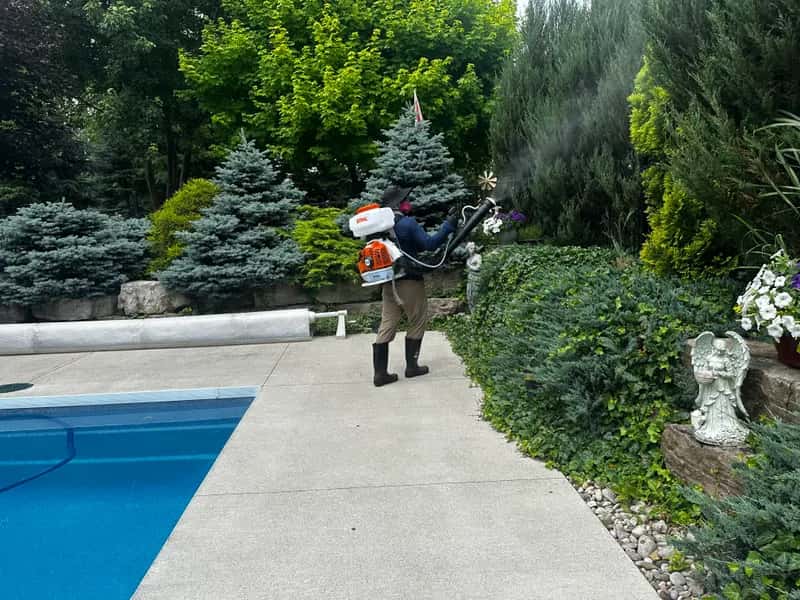
- A single mid-May barrier spray leaves a residual on the shaded edges and leaf litter for a few weeks, then wears off.
- Peel Public Health surveillance confirmed nymph captures along the Credit River as early as the first week of May in 2026.
- Highest-risk neighbourhoods include Lorne Park, Mineola, Erindale, Streetsville, and Sherwood Forrest — all near the Credit River or Rattray Marsh.
- Ticks survive winter while ground temperatures stay above about -10°C and resume questing within hours of a 4–7°C thaw.
— BuzzSkito, GTA mosquito & tick control · 150+ five-star Google reviews
As an Amazon Associate I earn from qualifying purchases. BuzzSkito only points to products we would genuinely use or recommend, at no extra cost to you.
As an Amazon Associate I earn from qualifying purchases. Price shown on Amazon.ca, at no extra cost to you.
🏆 Our Top Pick — For the Two Peaks
8.6/10· BuzzSkito ratingYard treatment handles the ticks on your own property; the ones your family and dog pick up on the Credit River trails come home with you. A fine-tipped remover grips the tick at the skin line and lifts it out in one piece — no squeezing, no mouthparts left behind. Keep one by the back door and one in the glovebox for the trailhead.
Pros
- Grips at the skin line for whole-tick removal
- Works on poppy-seed nymphs and through dog fur
- Cheap enough to keep several around
Cons
- Small enough to misplace
- Still needs a slow, steady straight pull
TL;DR: Mississauga tick season now runs from late March through November, with two distinct activity peaks: nymphs in May-June and adults in August-October. The Credit River corridor is the spine of local tick habitat, and any property within walking distance of Rattray Marsh, Riverwood, Erindale Park, Jack Darling, or the Sawmill Valley Trail should treat itself as elevated risk and book a barrier spray program — not a single spray.
The 2026 Mississauga tick calendar
Most homeowners still picture tick season as a short July-August problem. That model is roughly a decade out of date for Mississauga. Peel Public Health\'s active surveillance program — running drag-cloth sampling along the Credit River, the lakeshore parks, and several ravine systems — has documented a steadily lengthening season since 2018. In 2026, the season looks like this on the ground.
Late March – April: adult ticks resume questing
The first warm days that push air temperatures past 4°C wake up the adult blacklegged ticks that overwintered in leaf litter. These are last year\'s nymphs that didn\'t find a final host before winter. They are hungry, larger than nymphs, and easier to spot — but they\'re also looking for their last blood meal before laying eggs, so they\'re aggressive ambushers along trail edges in places like Erindale Park, Riverwood Conservancy, and the wooded sections of Lakeside Park. Adult activity in April is moderate but real.
May – June: nymph emergence (the highest-risk window)
This is the most dangerous part of the year, and the one most people underestimate. Nymphs — the size of a poppy seed — are nearly invisible on skin or fur, and they carry roughly the same Lyme infection rate as adults in surveillance data. They emerge from eggs laid the previous autumn and become active across Mississauga\'s ravine and waterfront habitat through May, peaking in the first three weeks of June. If a household member is going to get bitten this year, the most likely date is between May 20 and June 21. This is the window professional spraying matters most.
July: a brief moderate lull
Nymphs that successfully fed in May-June drop off, moult into adults, and stay relatively quiet through the hottest, driest weeks of summer. July tick pressure in most Mississauga yards is moderate — present, but not at peak. This is also when many homeowners mistakenly cancel ongoing treatment because "we haven\'t seen any." That\'s the trap: the fall surge is coming.
August – October: adult ticks return (the second peak)
Newly moulted adult blacklegged ticks emerge in mid-to-late August and stay active through October, often into early November depending on how late the first hard frost arrives. This peak is consistently underrated. In recent Peel surveillance, October has produced as many positive Lyme samples as June. Adult ticks are larger and need a bigger host, so they\'re aggressive about climbing tall grass and trail-edge vegetation — exactly where homeowners walk dogs after dinner in early autumn.
November – February: low but not zero
True dormancy only kicks in once ground temperatures stay consistently below freezing. Mississauga\'s mild lakeshore microclimate, combined with increasingly common January-February thaws, means ticks can briefly resume activity any time the air pushes 4°C+. A February dog walk along Lakefront Promenade or Jack Darling Park during a thaw is not a zero-risk activity in 2026.
Why the Credit River corridor concentrates the risk
If you draw a line from where the Credit River enters Mississauga at Eglinton down to where it empties into Lake Ontario at Port Credit, you\'ve traced the single highest-pressure tick corridor in the city. Five reasons.
Continuous host habitat
The Credit corridor — Riverwood, Erindale Park, the Sawmill Valley Trail, the unmaintained sections behind Streetsville, the Lakeside ravines — gives white-footed mice, eastern chipmunks, white-tailed deer, and ground-feeding birds a continuous unbroken movement corridor. Those hosts are exactly what blacklegged ticks need at each life stage. The result is a self-sustaining tick population that doesn\'t crash year over year.
Microclimate humidity
Ticks dehydrate easily and need consistent ground-level humidity above 80% to quest successfully. Riparian leaf litter — the deep layer of partially decomposed maple and oak leaves you see lining the river banks — holds humidity through even dry July weeks. Inland subdivisions with mown lawn and minimal leaf cover are functionally hostile to ticks. The ravine edges are not.
Off-leash dog traffic
Erindale Park\'s off-leash zone, Jack Darling\'s extensive trails, and the informal dog routes along Sawmill Valley move thousands of dogs through tick habitat every week from April through October. Dogs are efficient tick taxis. Some of those engorged ticks drop off in suburban backyards across Mineola, Lorne Park, and Mississauga Road properties — seeding new yard populations.
Lake Ontario migratory bird stopover
Rattray Marsh and the broader Lake Ontario shoreline are designated Important Bird Areas. Spring and fall migrants arrive carrying ticks picked up further south, and many of those ticks drop off into Mississauga habitat. This is how new tick lineages — and new pathogen strains — enter the local population each year.
Backyard adjacency in Lorne Park and Mineola
Homes in Lorne Park, Mineola, sections of Sherwood Forrest, and the older Mississauga Road estates often share a literal fence line with mature deciduous forest or ravine. That puts ticks on the property without the homeowner ever leaving the yard.
Neighbourhood-by-neighbourhood risk read
Not every Mississauga neighbourhood faces the same pressure. A useful working order from highest to lowest 2026 risk:
- Highest: Lorne Park, Mineola, Erindale, Streetsville, Meadowvale (north sections bordering Lake Aquitaine Park), Sherwood Forrest
- High: Port Credit, Lakeview, Clarkson, Credit Valley, Churchill Meadows (west edge), Cooksville (ravine-adjacent streets)
- Moderate: Erin Mills (treed sections), Applewood, central Cooksville, the inland blocks of Lakeview
- Lower (but not zero): Malton, the dense apartment corridors of central Mississauga, fully mown subdivisions with no adjacent greenspace
Each of those tiers has a reason behind it — ravine adjacency, creek corridors, host traffic. We go through them park by park in Mississauga tick hot spots 2026, ranked by neighbourhood.
For a property-specific score, the free Yard Risk Report calculates a 1-100 number for your exact address using local pressure data, water/forest proximity, and lot characteristics.
What to do this month
The practical playbook for a Mississauga homeowner in 2026 is straightforward. First, get the first barrier spray down before the nymph peak — meaning before May 25, or earlier if your property is ravine-adjacent. Second, keep treatments going roughly monthly through June and July — a BuzzSkito tick season is five treatments from May through September. Third, do not cancel mid-summer — keep treatment running through the August adult resurgence. Fourth, do habitat work in parallel: rake leaf litter away from the fence line, install a gravel or wood-chip buffer between lawn and any forest edge, keep grass mown short, and remove brush piles and woodpiles touching the lawn.
If your dog uses the Credit River trails, add a vet-prescribed oral tick preventive and do a hand check within an hour of returning home. Pay attention to the ears, between toes, the groin, and the base of the tail.
A fine-toothed flea-and-tick comb run against the lie of the coat makes that hand check faster and catches unattached ticks a dog’s fur hides completely — two minutes in the driveway after a Sawmill Valley walk is the whole routine. Check price on Amazon.ca →
Same-week tick service across Mississauga
BuzzSkito covers every Mississauga neighbourhood with same-week service: Mississauga tick spray, Mississauga mosquito control, and combined programs that handle both pests with a single technician visit. Quotes are based on your lot size and ravine/water exposure. Most requests get a price the same day. First treatment can usually be scheduled inside seven days, booked into a visit window.
What to keep by the door during the two peaks
As an Amazon Associate I earn from qualifying purchases. BuzzSkito only points to products we would genuinely use or recommend, at no extra cost to you.
Treating the yard reduces the ticks waiting on your own property. It does nothing about the ones your family and your dog collect on the Sawmill Valley Trail, at Erindale Park, or along the Rattray Marsh boardwalk — and during the May 20 to June 21 nymph window, and again through the August-to-October adult peak, those walks are where a lot of Mississauga bites begin. That makes the check when you get home the habit that actually matters, and the check needs a tool behind it. A fine-tipped remover or tick hook grips at the head, right against the skin, and lifts the tick out in one piece instead of leaving mouthparts behind or squeezing the body. On a poppy-seed-sized nymph, or on a dog where you are working blind through fur, that is the difference between a clean removal and a messy one. Keep one by the back door and one in the glovebox for the trailhead. Check tick-removal tools on Amazon.ca →
Related guides
- Lyme Disease Risk Areas Ontario 2026
- Tick Surge Ontario 2026: Complete Yard Control Guide
- Ontario Lyme Disease Tracker 2026
- GTA Mosquito + Tick Pressure Map
Take care out there.
— Alex & The BuzzSkito Team
Frequently Asked Questions
When does tick season start in Mississauga?+
Blacklegged tick activity in Mississauga typically begins in late March or early April once daytime temperatures hold above 4°C — earlier than most homeowners assume. Adult ticks that overwintered in leaf litter become active first, hunting for one last blood meal before laying eggs. The much larger nymph wave follows in mid-May and peaks through June. In 2026, Peel Public Health surveillance has flagged earlier-than-average activity, with confirmed nymph captures along the Credit River as early as the first week of May. Treat April as the start of season, not May.
Are there ticks in Port Credit or Lorne Park?+
Yes — both. Port Credit's waterfront parks, J.J. Plaus Park, and the trails connecting Lakefront Promenade are confirmed tick habitat because they sit at the mouth of the Credit River where deer, mice, and migratory birds concentrate. Lorne Park is even more pressured: the neighbourhood is bounded by Rattray Marsh Conservation Area, Jack Darling Memorial Park, and several wooded ravine sections that all support stable blacklegged tick populations. If your property in either neighbourhood backs onto trees, a ravine edge, or a wooded park, treat it as elevated risk and budget for a barrier spray program — not a single treatment.
Is the Credit River ravine dangerous for dogs?+
Off-leash time along the Credit River corridor — Erindale Park, the Sawmill Valley Trail, Riverwood Conservancy, and the unofficial trail networks behind Streetsville — carries a real and rising tick exposure risk for dogs. The combination of dense leaf litter, deer movement corridors, and tall grass at trail edges creates ideal questing conditions for both blacklegged and American dog ticks. The risk is highest May through July and again from late August through October. If you walk dogs there regularly, talk to your vet about Bravecto, NexGard, or Simparica, do a tick check within an hour of returning home, and treat your own yard so engorged ticks dropping off your dog don't establish a population there.
When should I spray my yard in Mississauga?+
The two highest-leverage spray windows in Mississauga are the third week of May (catching the nymph emergence at the start of its peak) and the third week of August (front-running the adult fall surge). A single mid-May spray places a residual acaricide on the shaded edges and leaf litter for a few weeks, after which it wears off. For season-long coverage, the BuzzSkito tick season is five treatments, roughly monthly from May through September ($597 on its own, or $497 added to a mosquito plan). Waterfront and ravine-adjacent properties — Lorne Park, Mineola, Erindale, sections of Streetsville and Meadowvale — benefit from an earlier first spray in the last week of April.
Can ticks survive Mississauga winters?+
Yes, and increasingly so. Blacklegged ticks survive Mississauga winters by sheltering under leaf litter, in the soil-snow interface, and inside the rotting wood of fallen logs along the Credit River, Etobicoke Creek, and the lakeshore ravines. As long as ground temperatures stay above roughly -10°C, the ticks are alive and the moment a January or February thaw pushes air temperatures into the 4-7°C range, adult ticks resume questing within hours. Mississauga's last three winters have had multiple multi-day thaw events. If your dog goes for a walk on a 5°C February afternoon along the lakefront, a tick bite is genuinely possible.