Quick Answer
A mosquito bite is an itchy, raised welt that appears within minutes and fades in a day or two — and the mosquito is long gone. A tick bite is usually painless and the tick stays attached to your skin; the warning sign is a bull's-eye rash (Lyme disease) appearing 3–30 days later.
- Mosquito bites appear within minutes and usually fade in 24–48 hours.
- Ticks stay attached and feed for hours to days; mosquitoes fly off immediately.
- The Lyme bull's-eye rash (erythema migrans) develops 3–30 days after a bite in about 70–80% of cases.
- Removing a blacklegged tick within 24 hours of attachment significantly lowers Lyme risk.
- In Ontario, mosquitoes carry a small West Nile risk and blacklegged ticks carry Lyme disease.
- Professional barrier spray treats the vegetation where mosquitoes rest and the lawn edges where ticks wait, re-applied on a schedule.
— BuzzSkito, GTA mosquito & tick control · 150+ five-star Google reviews
As an Amazon Associate I earn from qualifying purchases. BuzzSkito only points to products we would genuinely use or recommend, at no extra cost to you.
BuzzSkito Mosquito & Tick Control Specialists · Published April 7, 2026 · Updated July 12, 2026
What to do right now
- If something is still attached, take it off now — this step costs nothing. Grasp it with fine-tipped tweezers as close to the skin as you can and pull straight up with steady, even pressure. Do not twist, squeeze the body, burn it, or smother it in petroleum jelly. Then wash the area, and note today's date — the rash window you are watching for runs 3 to 30 days.
- Keep a fine-tip tick tool where you will actually find it. Household tweezers have a blunt, wide tip that tends to grip the body rather than the mouthparts, which is the hard part on a nymph the size of a poppy seed. A dedicated tool lives in the first-aid kit for the night you need it at 11pm.Check price on Amazon.ca →
- Keep the tick, dated. Drop it into a small screw-top vial or zip bag and write the date and the body location on it in permanent marker. If a rash or fever turns up in the next few weeks, the specimen and the date are the two things your doctor will ask about, and neither can be reconstructed later.Check price on Amazon.ca →
If you cannot get it out, or the mouthparts stay behind, go to a walk-in clinic — GTA clinics do this routinely. This page is general information, not medical advice.
The difference between a tick bite and a mosquito bite comes down to one check you can make immediately: a mosquito is long gone by the time you notice the itchy welt, while a tick is still attached and feeding. Ontario homeowners who spend time outdoors — especially near conservation areas, ravines, or the Oak Ridges Moraine — need that distinction, because while both can cause a red, irritated mark on the skin, the implications are very different. Mosquito bites are usually just itchy nuisances. Tick bites carry a small but real risk of Lyme disease, which is now established throughout the Greater Toronto Area and York Region.
The Key Difference: Mosquitoes Leave, Ticks Stay
The single most reliable way to distinguish a tick bite from a mosquito bite is whether the insect is still attached. Mosquitoes bite and immediately fly away. You may notice the bite minutes later as an itchy welt, but the mosquito is gone. Ticks attach and feed for hours or days. If you find an insect embedded in your skin, it is a tick — not a mosquito. This distinction matters because the sooner you remove a tick, the lower the risk of Lyme disease transmission. Removing a tick within 24 hours of attachment significantly reduces infection risk. The other comparison people arrive at in the middle of the night is bed bug bites versus mosquito bites, which turns on pattern, timing and season rather than on whether anything is still attached.
The reason the two behave so differently is that only one of them can travel to you. A mosquito flies in, feeds for seconds and leaves; a tick has no wings at all and has to be collected by something brushing past its perch. If you have heard that they drop from trees or leap onto passers-by, can ticks fly, jump, or swim? works through each of those claims.
Side-by-Side Symptom Comparison
This table compares the two bites symptom by symptom, from the moment of the bite through the following month. Use it to decide whether you're looking at a harmless mosquito welt or a tick bite that needs watching.
| Symptom / Stage | Mosquito Bite | Tick Bite |
|---|---|---|
| Onset | Within minutes of the bite | Often unnoticed — tick found attached |
| Sensation at the time | Mild sting, then itch | Painless (saliva contains a numbing agent) |
| Appearance | Round, puffy, pink-to-red welt | Small red bump at the attachment point |
| Itchiness | Intense | Mild or none |
| Insect present? | No — flies off instantly | Yes — embedded, feeds for hours to days |
| Day 1–2 | Welt fades and disappears | Bump usually fades too |
| Day 3–30 (watch closely) | Nothing further | Possible expanding bull's-eye rash (erythema migrans) |
| Systemic symptoms | Rare (West Nile Fever) | Possible fever, fatigue, headache, joint pain (Lyme) |
| Ontario disease risk | West Nile Virus (rare) | Lyme disease via the blacklegged tick |
Sources: CDC — Ticks and Public Health Ontario. This article is educational and not a substitute for medical advice.
What a Mosquito Bite Looks Like
A typical mosquito bite:
- Appears within minutes of being bitten as a small, round, raised welt
- Is pale pink to red, slightly puffy, and often has a small puncture mark in the center
- Is intensely itchy — caused by your immune response to the mosquito's saliva
- Fades within 24–48 hours in most people
- May be larger and more inflamed in people with mosquito saliva sensitivities
In Ontario, mosquito bites carry a small risk of West Nile Virus, monitored annually by Toronto Public Health and Peel Region Health. Most infected people have no symptoms. Rarely, West Nile Fever develops: headache, body aches, joint pain, rash, and fatigue. Seek medical attention if you develop these symptoms after mosquito exposure.
For the itch itself, a cool compress and an over-the-counter anti-itch cream (hydrocortisone or an antihistamine gel) usually settle a mosquito welt within a day. The reason an antihistamine helps at all is that the itch is a histamine reaction to proteins in the saliva rather than the puncture itself — which is also why the itch often peaks a day or so after the bite and why scratching keeps it going. Our guide to why mosquito bites itch and how long they last walks through that reaction stage by stage.
Check anti-itch bite relief on Amazon.ca →
What a Tick Bite Looks Like
While the tick is attached, the bite is often painless — ticks secrete a numbing compound in their saliva that prevents you from feeling them. This is why tick checks after being outdoors are important: you may never feel the bite.
After tick removal, the bite site typically shows:
- A small red bump — similar in appearance to a mosquito bite
- Mild redness and swelling around the bite site
- Possible mild itching or soreness
This initial reaction is normal and not a sign of infection. The critical warning sign is what happens over the following days and weeks:
The Bull's-Eye Rash: Lyme Disease Warning Sign
Erythema migrans — commonly called the bull's-eye rash — is the hallmark early symptom of Lyme disease. It appears in approximately 70–80% of Lyme disease cases. The rash:
- Starts at the tick bite site and expands outward over days
- Often has a distinctive bull's-eye appearance: red outer ring with a clearer or redder center
- Is usually painless and not itchy
- Develops 3 to 30 days after the bite
- Can appear anywhere on the body — not just the bite site
If you develop a bull's-eye rash, see a doctor immediately. Tell them you had a tick bite or were in tick habitat. Early Lyme disease is treated effectively with antibiotics. Untreated, it can cause joint pain, cardiac issues, and neurological complications. The Government of Canada's Lyme disease guidance confirms that prompt tick removal and early treatment sharply reduce the risk of complications.
Removing a Tick Safely (Do This First)
If you find an attached tick, remove it right away — the risk of Lyme transmission rises the longer a blacklegged tick stays attached. Grasp the tick with fine-tipped tweezers as close to the skin as possible and pull straight up with steady, even pressure. Do not twist, crush, or burn it. A dedicated tick-removal tool makes the job cleaner, especially for tiny nymphs. For a full walkthrough and product picks, see our tick removal tool guide. Two questions usually follow a removal: whether the tick could have been feeding unnoticed for days, and whether one carried indoors on clothing can survive in the house. Both come down to lifespan — how long ticks live covers the two-to-three-year outdoor life cycle and why heated indoor air is dry enough that a stray tick usually dies within days.
Check tick-removal tools on Amazon.ca →
As an Amazon Associate I earn from qualifying purchases. Price shown on Amazon.ca, at no extra cost to you.
🏆 Our Top Pick for Tick Removal
8.7/10· BuzzSkito ratingFine-Tipped Tick-Removal Tool Set
A dedicated tick tool grips the tick right at the skin and lifts it straight out with even pressure — cleaner than fumbling with household tweezers, which matters most for tiny nymphs that are the hardest to grasp and the most likely to carry Lyme. Keep one in the first-aid kit before you need it.
Pros
- Grips at the skin line for a clean, whole-tick pull
- Works on tiny nymphs household tweezers miss
- Inexpensive kit to keep on hand year-round
Cons
- Still requires steady technique — no twisting or crushing
- Does not replace watching the bite for 3–30 days
Other Early Lyme Disease Symptoms
Even without a visible rash (20–30% of Lyme disease cases do not produce a rash), early Lyme disease can cause:
- Fever and chills
- Headache
- Fatigue
- Muscle and joint pain
- Swollen lymph nodes
These symptoms typically appear within 3–30 days of a tick bite. If you were recently in tick habitat (conservation areas, ravines, wooded parks, or any area with deer activity) and develop these symptoms, mention it to your doctor.
Tick Bite vs Mosquito Bite: Quick Reference
| Feature | Mosquito Bite | Tick Bite |
|---|---|---|
| Insect still attached? | No — mosquito leaves immediately | Yes — tick stays attached for hours/days |
| Initial appearance | Raised, red, itchy welt within minutes | Often nothing felt; small red bump after removal |
| Pain during bite | Mild stinging or no pain | Usually painless (numbing agent in saliva) |
| Itch level | Intensely itchy | Mild or no itch after removal |
| Duration | Fades in 1–2 days | Bite site fades; watch for bull's-eye rash 3–30 days later |
| Disease risk (Ontario) | West Nile Virus (rare) | Lyme disease (blacklegged tick) |
| When to see a doctor | Fever/headache/body aches after bites | Bull's-eye rash, fever, joint pain, or fatigue after bite |
Tick Habitat in the GTA: Where the Risk Is
Blacklegged ticks in Ontario are most prevalent in areas with deer populations and forested edges. The highest-risk areas for GTA homeowners include:
- Oak Ridges Moraine (King City, Kleinburg, Richmond Hill, Caledon) — confirmed blacklegged tick habitat
- Humber River valley (Vaughan, Woodbridge, Etobicoke) — continuous wildlife corridor
- Rouge National Urban Park (Scarborough, Markham) — established tick population
- Credit River corridor (Mississauga, Georgetown, Halton Hills)
- Don River valley (Toronto, Richmond Hill, Markham)
York Region Public Health and Toronto Public Health both issue annual tick risk advisories for these areas. BuzzSkito serves all 19 GTA cities where tick and mosquito risk is meaningful. Along the ravine systems listed above, that means Toronto tick spray for Don and Humber valley properties and Etobicoke tick control where the lower Humber cuts through the neighbourhood. On the west side, tick spray in Mississauga covers the yards backing onto the Credit River corridor.
Toronto in particular is not a low-risk exception to the countryside — its ravine system runs unbroken wooded habitat through dense residential blocks, and the deer and mice that maintain the tick cycle travel it. Why Toronto is a tick hot spot in 2026 goes through the corridors and what a ravine-backing yard should plan for.
How to Protect Your Yard
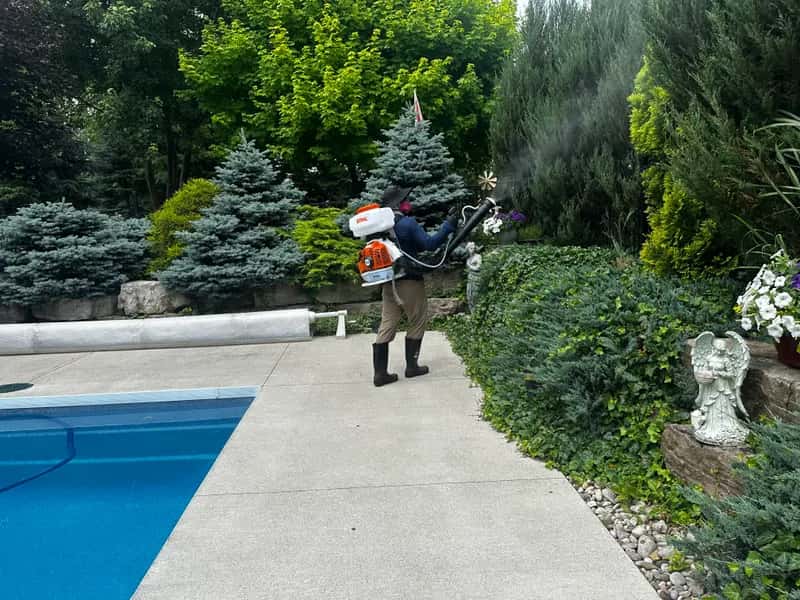
For most GTA homeowners, the highest tick and mosquito exposure happens in their own backyard — not in the woods. Ticks wait on grass blades and vegetation at the edges of your lawn. Mosquitoes rest in shrubs and hedges during the day. Professional barrier spray targets these exact micro-habitats.
BuzzSkito applies products with a Canadian PCP registration number, according to label directions, to the surfaces on your property where ticks and mosquitoes rest: lawn edges, under-leaf vegetation, garden beds, fence lines, and shrub borders. Treatments are renewed on a schedule, and the tick program targets the leaf litter and lawn edges where nymphs — the size of a poppy seed and responsible for most Lyme disease transmission — wait for a host.
If you would rather run that perimeter yourself, the limiting factor is delivery rather than product. Barrier work means wetting the underside of leaves and the full run of a fence line at a steady fine cone, and a one-litre trigger bottle loses pressure and runs dry before you finish one side of an average lot — which is why the do-it-yourself version of this job is done with a backpack sprayer.
The mosquito half of the problem can also be attacked from the opposite direction. Barrier spray treats the shrubs and hedges where mosquitoes rest during the day; a CO₂ trap instead puts out carbon dioxide and heat to intercept host-seeking females on their way to you, which is a genuinely different mechanism rather than a second version of the same one — our comparison of mosquito traps in Canada covers which designs actually reduce numbers in a suburban yard. Check outdoor mosquito traps on Amazon.ca →
On your own skin, a repellent with DEET, picaridin (icaridin), or oil of lemon eucalyptus deters both mosquitoes (Aedes and Culex) and ticks; factory permethrin-treated clothing adds another layer. Not sure which active to choose? See our comparison: picaridin vs DEET in Canada. Look for a Canadian PCP registration number on the label (see Health Canada's Pest Management Regulatory Agency).
That registration number is the thing to check before you buy, because online marketplaces carry plenty of imported repellents that were never registered here. Once you have it, the choice between the two actives is mostly about what you are wearing and who is wearing it — follow the label directions, which differ for young children. Check icaridin and DEET repellents on Amazon.ca →
Clothing is the separate layer, and it is worth treating as separate. Repellent on skin does nothing for the trouser cuffs and socks a tick actually climbs first, which is where factory permethrin-treated garments come in: the treatment is bonded into the fabric at manufacture rather than sprayed on at home, so it is a garment purchase, not a pesticide application. In Canada the factory-treated garment is the permitted format, for ages 16 and over — our guide to permethrin in Canada explains why the spray-on version is not, and bug-protective clothing in Canada covers the untreated alternatives for younger children. Check permethrin-treated clothing on Amazon.ca →
See our full guides for Ontario tick protection: