Published by BuzzSkito Mosquito & Tick Control
Published October 11, 2026 · Drafted with AI assistance and fact-checked against the sources listed below
What order should natural garden pest control follow?
Work from the least disruptive step to the most: identify, tolerate, prevent, remove by hand, protect natural enemies, and spray last. That order is integrated pest management (IPM). NC State Extension's gardener handbook states the goal as managing pests, not eradicating them, and holds chemical options back as a last resort. The University of California's IPM program gives a reason for patience: only about 1 percent of all insects and mites are harmful, and most pests are attacked by several species of natural enemies.
- Identify it. Name the insect and the plant before acting. Many insects on a plant are beneficial, and UC IPM notes that hoverfly larvae eating aphids are sometimes mistaken for caterpillars.
- Tolerate what the plant can take. NC State's handbook says plants can often withstand a great deal of leaf loss before serious problems occur, and it advises tolerating some pests as food for the beneficial insects.
- Prevent. Healthy soil, resistant varieties, clean transplants, planting dates and crop rotation come before any treatment. The seasonal calendar below gives the details.
- Remove by hand or with water. Pick off eggs, young and adults and drop them into a jar of water with a little dish detergent, or hit aphids and spider mites with a strong stream of water, which the handbook says dislodges and kills many of them.
- Exclude and trap. Floating row covers keep some adult insects from laying eggs on new plants but have to come off for pollination, and yellow sticky traps catch adult whiteflies, cucumber beetles and fungus gnats.
- Protect the insects that eat pests. UC IPM calls conserving the natural enemies already present the primary way to use biological control successfully.
- Spray last, and only where the pests are. UC IPM's advice is to use pesticides only when nonchemical controls have failed and pests are reaching intolerable levels, to choose the least toxic effective material (it names soaps, oils and microbials such as Bacillus thuringiensis, or Bt), and to treat heavily infested spots instead of whole plants.
Then check whether it worked, which is the fifth step in NC State's version. The same sequence applied to a whole house and yard is laid out in our guide to what the evidence supports in natural pest control, and the do-it-yourself pest control guide covers reading a pesticide label, storage and disposal.
How often should you check the garden?
At least twice a month, and as often as twice a week in warm weather, according to NC State's handbook. Many problems that seem to appear overnight took two to three weeks to develop, and the handbook warns that once damage is noticed it may be too late for hand-picking to work.
The garden walk: six things to check each time
- Leaf undersides. Aphids and other insects often feed there, out of sight.
- Eggs, young and adults. Look for all three stages, and identify what you find before you squash it.
- New transplants. Check the tops and bottoms of leaves, the stems and the soil before a plant goes in the ground.
- The kind of damage. Note what it looks like, and watch plants that had trouble in earlier years.
- Water, fertilizer and soil. If a plant looks off, review irrigation, fertility and soil pH before assuming a pest is the cause.
- Your notes. Record planting dates and the dates insect problems appear, so next year's timing is easier.
Companion planting chart: which plants have research behind them?
A handful of plant pairings have reduced pests in research trials; many of the repellent claims on popular charts are not backed by research. University of Minnesota Extension's review of companion planting lists the pairings that held up in studies, and NC State's handbook says most recommendations of marigolds and garlic as insect repellents are unproven, with evidence in some cases that they are not effective.
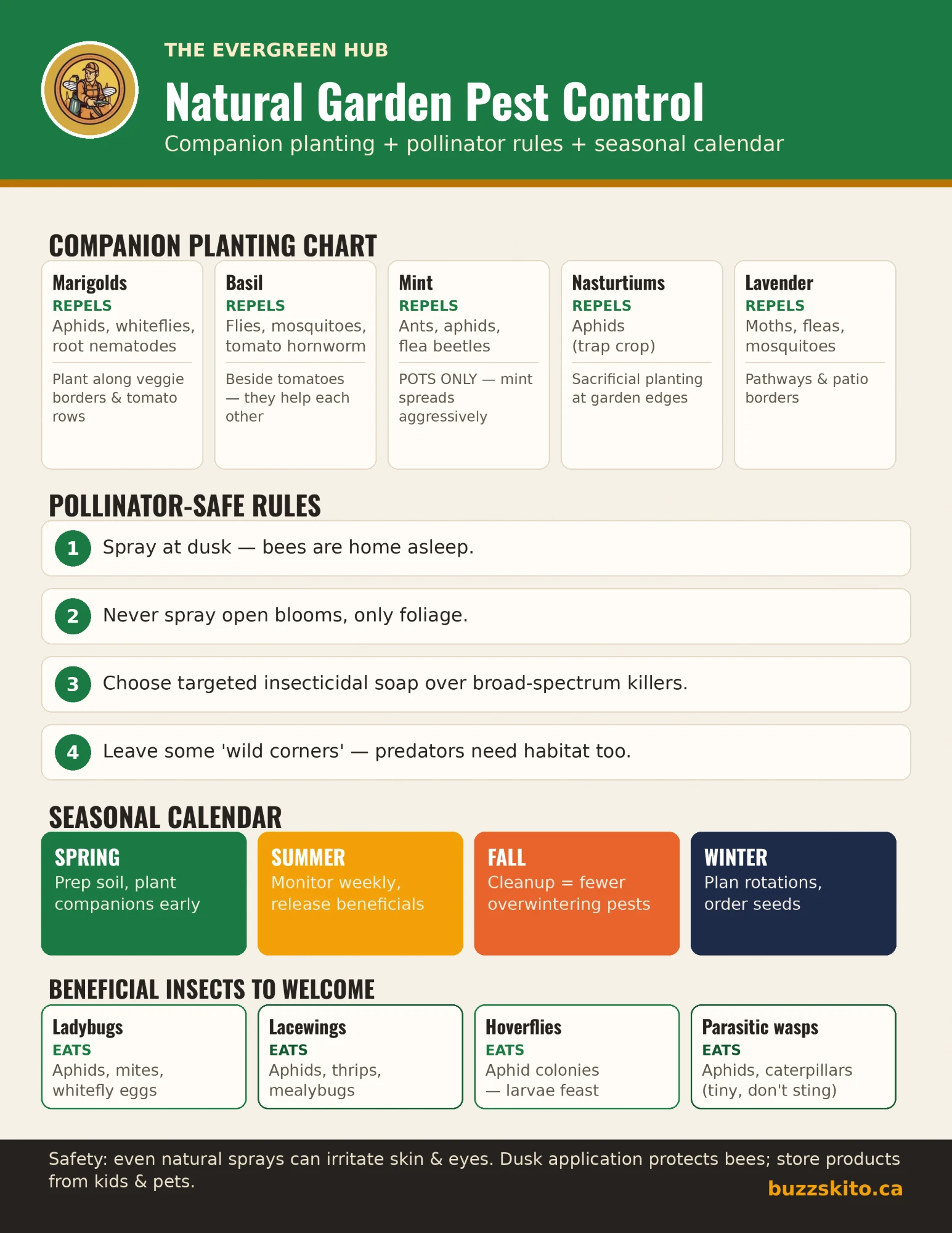
Minnesota describes three ways a companion plant can help: by smell (as a trap crop, a repellent or a mask for the crop), by feeding and sheltering predators and parasitoids, and by making the crop harder to find among mixed plants. The table lists the five plants on our one-page guide first, in the same order, then five more with research worth knowing.
| Plant | What charts claim | What university sources found | Best use |
|---|---|---|---|
| Marigolds | Repel aphids, whiteflies and root nematodes | Mixed. Marigolds helped reduce squash bug and cucumber beetle damage in an Iowa study, and a few studies found basil and marigolds reduced thrips on tomatoes, but multiple studies found marigolds do not deter Colorado potato beetles. Against nematodes they work only as a cover crop grown in the bed beforehand. | A solid cover crop before tomatoes, or mixed among tomatoes and squash |
| Basil | Repels flies, mosquitoes and tomato hornworms | Basil and marigolds reduced thrips on tomatoes in a few field and greenhouse studies, and basil may help tomato growth. Hornworms, flies and mosquitoes are not on Minnesota's list. | Between tomato plants |
| Mint | Repels ants, aphids and flea beetles | Not on Minnesota's list for any pest. For flea beetles, the review found little research behind repellent companions and some that contradicts them. | A kitchen herb, in a pot |
| Nasturtiums | Repel aphids (trap crop) | Reduced squash bug numbers, and in an Iowa study helped reduce cabbage looper and imported cabbageworm damage on broccoli and cabbage. No aphid trap-crop research is listed. | Beside squash and cabbage-family crops |
| Lavender | Repels moths, fleas and mosquitoes | Not on Minnesota's list. None of the sources read for this page reports a trial of lavender against garden pests. | One flowering plant among several in a border |
| Chives and onions | Repel flea beetles and other insects | Onion was among the plants that helped reduce cabbage worm damage in the Iowa study. Green onions as a flea beetle repellent have little research support. Chives themselves are not listed. | Among cabbage-family crops |
| Dill | Attracts lady beetles, hoverflies and parasitic wasps | No dill trial appears in the sources read. The principle is sound: UC IPM says adult hoverflies, green lacewings and many parasitic insects feed only on pollen and nectar. | Left to flower among vegetables |
| Sweet alyssum | Attracts hoverflies | In a Florida study, sweet alyssum and African marigolds planted with squash increased the natural enemies of aphids and slightly improved yield. | Edging for squash beds |
| Thyme and sage | Repel cabbage moths | Reduced diamondback moth numbers on Brussels sprouts in a greenhouse trial. Thyme also helped in the Iowa broccoli study. | Among cabbage-family crops |
| Arugula, mustard, napa cabbage | Trap crops for flea beetles | Well documented as flea beetle trap crops. Plantings of three or more species reduced damage more than a single trap crop. | A sacrificial strip beside cabbage-family crops |
Research findings as summarized by University of Minnesota Extension, except where another source is named.
Marigolds
Marigolds suppress root-knot nematodes only when they are grown as a dense cover crop in the bed before the vegetable, not as a border beside it. That is the finding of the University of Florida's guide to marigolds for nematode management, which gives the working method:
- Lead time. Plant marigolds at least two months before the vegetable crop, in the exact spot where that crop will grow.
- Density. Keep plants and rows 7 inches or less apart, about 289 plants per 100 square feet, so weeds cannot fill the gaps. Nematodes reproduce on weeds too.
- Type. French marigolds (Tagetes patula) appear to work against the widest range of nematodes. The signet varieties 'Golden Gem' and 'Tangerine Gem' are listed as susceptible to root-knot nematodes.
- Repeat. Marigolds cannot eradicate nematodes, so the cover crop has to be grown again every season before the main crop.
Planting marigolds between or beside vegetables is a different matter. Asked whether interplanting works, the Florida authors answer probably not: root-knot nematodes typically still find and reproduce on the roots of a susceptible crop or weed, and they call interplanting very risky. Marigolds also raise the numbers of some other nematodes, including sting, awl, stubby-root and spiral nematodes, so the university advises a soil nematode assay before relying on them. Above ground, Minnesota's verdict on marigolds as an insect deterrent is sometimes yes and sometimes no.
Basil
Basil's research-backed benefit is fewer thrips on tomatoes, not fewer mosquitoes or flies. Minnesota Extension adds that intercropping with basil may even help tomato growth, which is the kernel of truth in the chart's note that the two help each other. Its list says nothing about hornworms. On mosquitoes, our plant-by-plant review of mosquito-repelling plants concludes, citing US extension services, that a plant left growing in a bed or a pot does not repel them.
Mint
No source read for this page found that mint repels ants, aphids or flea beetles in a garden bed. The chart's pots-only note is growing advice about mint's spreading habit, and it changes nothing for pests either way. Grow mint because you cook with it. If a dog shares the yard, see the pet section below before choosing where the pot goes.
Nasturtiums
Nasturtiums have research support beside squash and cabbage-family crops, and none in these sources as an aphid trap. Minnesota Extension says the old practice of planting nasturtium with squash is supported by research showing fewer squash bugs, and the Iowa study it cites found nasturtium among the plants that helped reduce cabbage looper and imported cabbageworm damage.
A trap crop is the opposite of a repellent, since it pulls pests toward itself. If you grow nasturtiums as a sacrificial planting at the bed edge, finish the job. NC State's handbook describes trap cropping as planting something very attractive to the pest and then treating that crop with insecticide, the step most charts leave out. If you would rather not spray, the strong stream of water the same handbook describes for aphids is the way to deal with what the trap collects.
Lavender
Grow lavender because you like it, not as a repellent. None of the sources read for this page reports a trial of lavender against moths, fleas or mosquitoes in a yard. As one flowering plant among several, it adds to the season-long bloom UC IPM recommends for natural enemies. The ASPCA's plant list for dogs includes lavender among the toxic plants, which matters for the pathway and patio plantings the chart suggests.
Which companion plantings have the strongest evidence?
Trap crops and flower strips, not repellents. Minnesota calls it well documented that the spicier cabbage-family crops (arugula, mustard, rapeseed and napa cabbage) work as trap crops for flea beetles. It reports that Blue Hubbard squash attracts cucumber beetles, squash bugs and squash vine borers and can pull cucumber beetles away from other squash-family crops, and that buckwheat, cowpea and sunn hemp flowering alongside sweet corn raised the numbers of predators and parasitoids of corn earworm. Simply mixing crops helps as well. NC State advises spreading plants of one kind through the garden instead of planting them in a block, because unrelated plants in between can interrupt an attack by diluting the odor of the preferred plant.
Pollinator rules: how do you lower the risk to bees?
Spray less, spray in the evening, and keep spray off flowers. Three of the four rules in the pollinator panel of the one-page guide match what the National Pesticide Information Center's pollinator protection page advises; the third, on soap, rests on UC IPM and comes with a caveat. The rules lower the risk to bees; they do not remove it. NPIC's starting point is that most insecticides can hurt bees and butterflies, so the first protection is needing fewer sprays: tolerate harmless pests and try other methods first.
- Spray at dusk. NPIC advises against spraying while pollinators are active. An evening application, after bees have returned to their hives, lets the residue dry overnight.
- Never spray open blooms, only foliage. NPIC says not to spray flowers directly, and it warns that treating a tree that attracts bees while it is in bloom can be lethal to honey bees and other pollinators. UC IPM adds that systemic insecticides such as imidacloprid move into blossoms, where they can poison bees and natural enemies that feed on nectar and pollen.
- Choose insecticidal soap over broad-spectrum killers. Supported, with a limit. UC IPM rates soap and horticultural oil as toxic to predators and parasites on direct contact but not through residue, while carbamates, organophosphates and pyrethroids are toxic both ways and keep killing for days or weeks. NPIC's fact sheet on insecticidal soap calls it somewhat selective for soft-bodied insects such as aphids, whiteflies and mealybugs. It says flying adults with a stronger outer covering, such as lady beetles and bees, may be less affected, while immature, flightless insects are more vulnerable. Since the harm comes from direct contact, spray only the infested leaves.
- Leave some wild corners. NPIC recommends a complex landscape with a variety of plant types, ground cover and refuge areas. NC State notes that weeds can supply forage, nectar or pollen for beneficial organisms, and that the flowers of dandelion, plantain, knotweed and thistle are important to honey bees.
Two more points from the same NPIC page apply to any product, natural or not: read the Environmental Hazards section of the label, and apply as close as possible to the target pest to limit drift.
Seasonal calendar: what should you do in spring, summer, fall and winter?
Prevent in spring, watch and hand-remove in summer, clean up selectively in fall, and plan rotations in winter. The calendar on the one-page guide holds up in three seasons out of four; the exception is the summer advice to release beneficial insects. Each season below is headed with the guide's wording, changed only where the sources disagree.
Spring: prep soil, plant companions early
- Soil. A favorable soil environment grows healthy roots and plants that resist pests and diseases better than plants in poor soil. NC State advises a soil test and only the recommended amount of fertilizer and lime.
- Fertilizer restraint. UC IPM warns that excess fertilizer and irrigation let sap-feeding pests such as aphids reproduce faster than natural enemies can control them.
- Transplants. Inspect the tops and bottoms of leaves, the stems and the soil before planting. Whiteflies are easy to overlook on nursery stock.
- Timing. NC State plants squash as early as the season allows to get ahead of borers, which lay eggs there in July, and holds warm-weather crops until the soil has warmed. Your state or provincial extension service can give the dates for your area.
- Companions. Early means different things. Basil, lettuce or spinach can go in first, with tomatoes or peppers transplanted into the same bed as the early crop matures (Minnesota Extension). A marigold cover crop for nematodes needs its two months in the bed before the vegetable (University of Florida).
- Mulch. Several inches of organic mulch reduce weed competition and water loss, though heavy mulch also gives slugs a place to hide.
Summer: monitor weekly, but skip releasing beneficials
Weekly checks are right; buying insects to release, which the one-page guide also lists for summer, mostly is not. A weekly walk sits inside NC State's range of twice a month to twice a week in warm weather. On releases, UC IPM says they are unlikely to provide satisfactory pest control in most situations and that lady beetles from retail outlets are unlikely to be sufficient in number and quality.
The exception UC IPM gives is convergent lady beetles bought in bulk by mail order, refrigerated and released in very large numbers at intervals, which can control aphids temporarily. NC State explains the usual result: lady beetles shipped in for release tend to fly far away before they begin to feed. Summer is better spent on hand removal, water sprays and, where those fall short, spot treatment.
Fall: cleanup means fewer overwintering pests
Cleanup is supported where the pests were, and it does not have to mean stripping the whole yard. NC State's handbook notes that some insects hibernate in the soil or in the litter around plants, or lay eggs in or on the host plant. It says fall tilling can destroy insects in crop residues, and that raking up the fallen twigs of pecans, oaks, elms and hickories in fall removes twig girdler larvae. It also cautions that tilling harms soil structure, so if you till at all, fall is when it does the most against pests. Keep the cleanup to vegetable beds and to plants that had pest trouble, and leave the refuge areas from the pollinator rules alone.
Winter: plan rotations, order seeds
Rotation is the winter job with the clearest rule. NC State says not to grow the same kind of vegetable in the same place each year and to use related crops in a site only once every three or four years; for some tomato diseases the rotation may need to be five to seven years. Where a small garden cannot rotate, the handbook suggests leaving the bed fallow for a year or more, moving to containers or raised beds with new soil where a disease is known, or at least skipping the crop families that had problems. Ordering early matters because pest-resistant varieties often have to be located and bought in advance.
Beneficial insects to welcome: what do they eat?
Aphids above all, along with spider mites, whiteflies, mealybugs, thrips and caterpillars, and in three of the four insects on the one-page guide it is the young, not the adult, that does most of the killing. The prey lists below come from UC IPM's table of pests and their common natural enemies.
| Insect | Pests it attacks | Stage that does the work | What the adults need |
|---|---|---|---|
| Ladybugs (lady beetles) | Aphids, spider mites, whiteflies, mealybugs, scales and psyllids | Adults and larvae | A steady supply of prey |
| Lacewings | Aphids, thrips, mealybugs, whiteflies, spider mites and caterpillars | Larvae | Pollen and nectar (green lacewings) |
| Hoverflies (syrphid flies) | Aphids | Larvae | Pollen and nectar from flowers |
| Parasitic wasps | Aphids, caterpillars, whiteflies, scales and mealybugs | Larvae developing inside the pest | Pollen and nectar |
Source: University of California Statewide IPM Program, Table 1 and Quick Tips.
Two details on the guide need adjusting. It credits ladybugs with eating whitefly eggs; UC IPM lists whiteflies as lady beetle prey without naming a stage. And it says parasitic wasps eat aphids and caterpillars. More exactly, the female lays her eggs in the pest and the hatching larvae consume and kill it. NC State's handbook describes the result in aphids: the wasp emerges from a brown, parasitized aphid called a mummy. UC IPM confirms the guide's other note, describing these wasps as tiny to medium-sized and incapable of stinging people.
How do you keep beneficial insects in the garden?
- Flowers through the season. UC IPM recommends a variety of species that flower at different times, because many beneficial insects do poorly without nectar and pollen even when pests are abundant.
- A little prey. To retain predators and parasites, UC IPM says to grow plants that tolerate low numbers of plant-feeding insects and mites, so that some food is always available.
- No ant bodyguards. Ants protect aphids, whiteflies, mealybugs and soft scales from predators in exchange for honeydew. Where ants are controlled, UC IPM says pest numbers fall gradually over several generations; sticky barriers on trunks and baits placed near plants are among the methods it lists, and our guide to homemade ant baits explains how a slow-acting bait works.
- Less dust. Dust interferes with natural enemies and can set off spider mite outbreaks. Hose off small plants that become coated.
What are the risks to pets and children?
None of these methods is free of risk, and the two risks most often missed are the companion plants themselves and the spray bottle. The safety line at the foot of the one-page guide is supported: NPIC reports that insecticidal soap can irritate skin and eyes, and its advice to spray in the evening is the dusk rule above. The table gives what each source says.
| Method or plant | What the source says about pets | What it says about people | Precaution |
|---|---|---|---|
| Insecticidal soap (potassium salts of fatty acids) | Very low in toxicity to animals when swallowed or on the skin; the fact sheet has no separate entry for cats or dogs (NPIC) | Can irritate skin and eyes; swallowing a large dose may cause stomach upset and vomiting (NPIC) | Use it as the label directs, keep pets and children away while you spray, and store the product out of reach |
| Bt (Bacillus thuringiensis) | NC State's handbook says Bt formulations work without harming domestic animals | The handbook says the same of people | It is still a pesticide: use it as the label directs and store it out of reach |
| Mint, lavender, chives, onions and garlic | On the ASPCA's list of plants toxic to dogs | Not assessed by this page's sources | Pot or fence them where a pet that chews plants cannot reach |
| Basil, dill, cilantro, sage, thyme and garden nasturtium | On the ASPCA's list of plants that are not toxic to dogs | Not assessed by this page's sources | Ordinary supervision |
| French and African marigolds (Tagetes) | Not named on the ASPCA dog list; its marigold entries are different plants, pot marigold (Calendula officinalis) and Cape marigold (Dimorphotheca pluvialis), both listed as not toxic to dogs | Not assessed by this page's sources | Ask your veterinarian if a pet eats them |
| Parasitic wasps | No risk reported in the sources read | Incapable of stinging people (UC IPM) | None listed in the sources read |
The plants are the part most charts skip. The ASPCA's list of plants toxic and not toxic to dogs puts mint (Mentha species), lavender (Lavandula angustifolia) and chives in its toxic section, along with onions and garlic. The ASPCA's individual entries for mint and lavender, reached from that list, mark both as toxic to cats and horses too. For mint the entry names the essential oils and lists vomiting and diarrhea after large ingestions. For lavender it names linalool and linalyl acetate and lists nausea, vomiting and loss of appetite.
One naming trap: the toxic nasturtium entry on that list is watercress (Nasturtium officinale). The garden nasturtium on the chart (Tropaeolum majus) is in the section of plants that are not toxic to dogs.
On soap, the same NPIC fact sheet reports a soil half-life of less than one day and high toxicity to aquatic invertebrates, which is why labels tell users not to apply it directly to water. Keep spray and rinse water away from ponds. The fact sheet also notes reproductive and developmental effects in laboratory animals given high doses, and reports the conclusion that soap used according to its label will not pose a significant hazard.
NPIC notes the fact sheet dates from 2001 and is not being updated, so treat the product label as the current word. UC IPM's list of contact insecticides with little or no persistence also names horticultural oil and neem oil. None of this page's sources assesses their risk to pets or children, so this page does not rate them; read the label before using one.
If a pet eats a quantity of any garden plant, or a pet or child swallows or is splashed with a pesticide, call your veterinarian, your doctor or a poison control center. Our pet-safe pest control guide lists the poison-control phone numbers and rates other remedies one by one.
How does this plan handle aphids, whiteflies, fungus gnats and weeds?
The same order applies to each of them; what changes is which step does the most. Each has its own guide with the full method.
Aphids
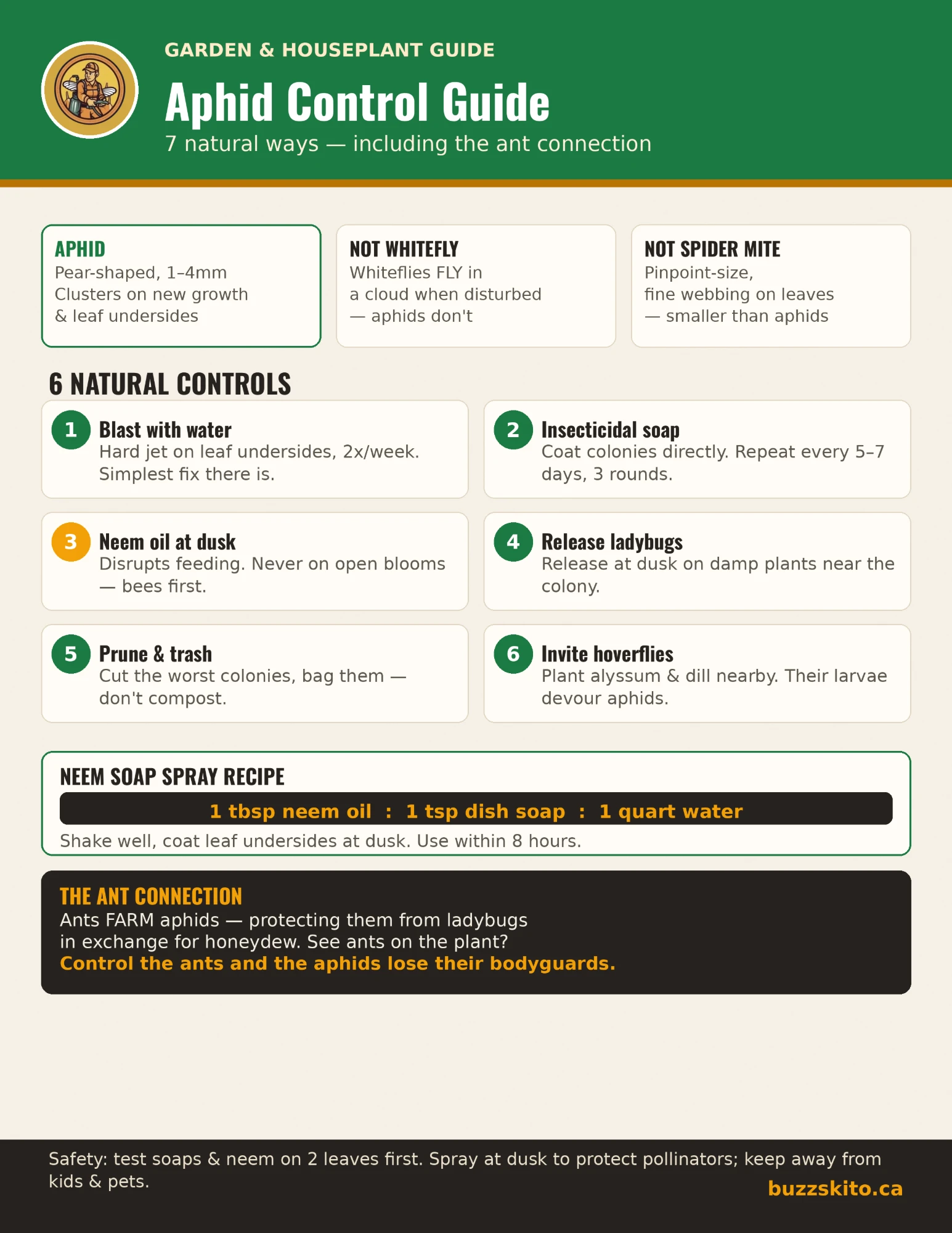
Start with water, then deal with the ants. NC State's handbook notes that aphids often feed on the undersides of leaves and that a strong stream of water dislodges and kills many of them; it adds that aluminum foil and other reflective mulches can repel aphids. UC IPM lists lacewings, lady beetles, parasitic wasps, soldier beetles and hoverfly larvae among their natural enemies, and explains that ants protect aphids from those enemies, sometimes moving them from plant to plant. The step-by-step guide to getting rid of aphids naturally covers identification, the ant connection and soap and oil sprays.
Whiteflies
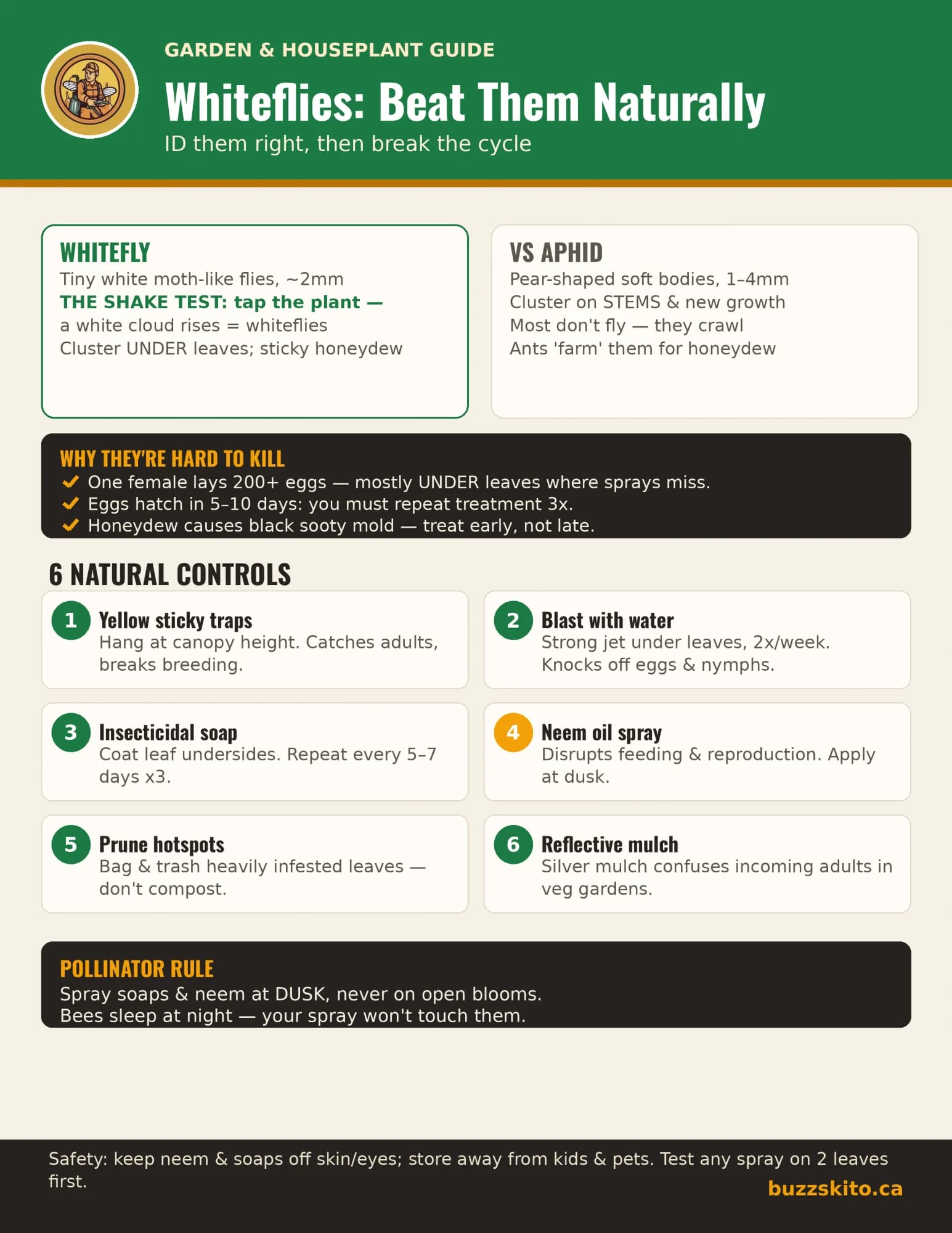
Trap the adults and protect their enemies. Yellow sticky traps catch adult whiteflies, and because whiteflies are easy to overlook on nursery plants, check leaf undersides before you buy. UC IPM lists lacewings, lady beetles, parasitic wasps, bigeyed bugs and minute pirate bugs as whitefly enemies, and warns that broad-spectrum insecticides that persist for days or weeks can cause pests to resurge by killing such predators. How to identify and get rid of whiteflies has the comparison chart and the full sequence.
Fungus gnats
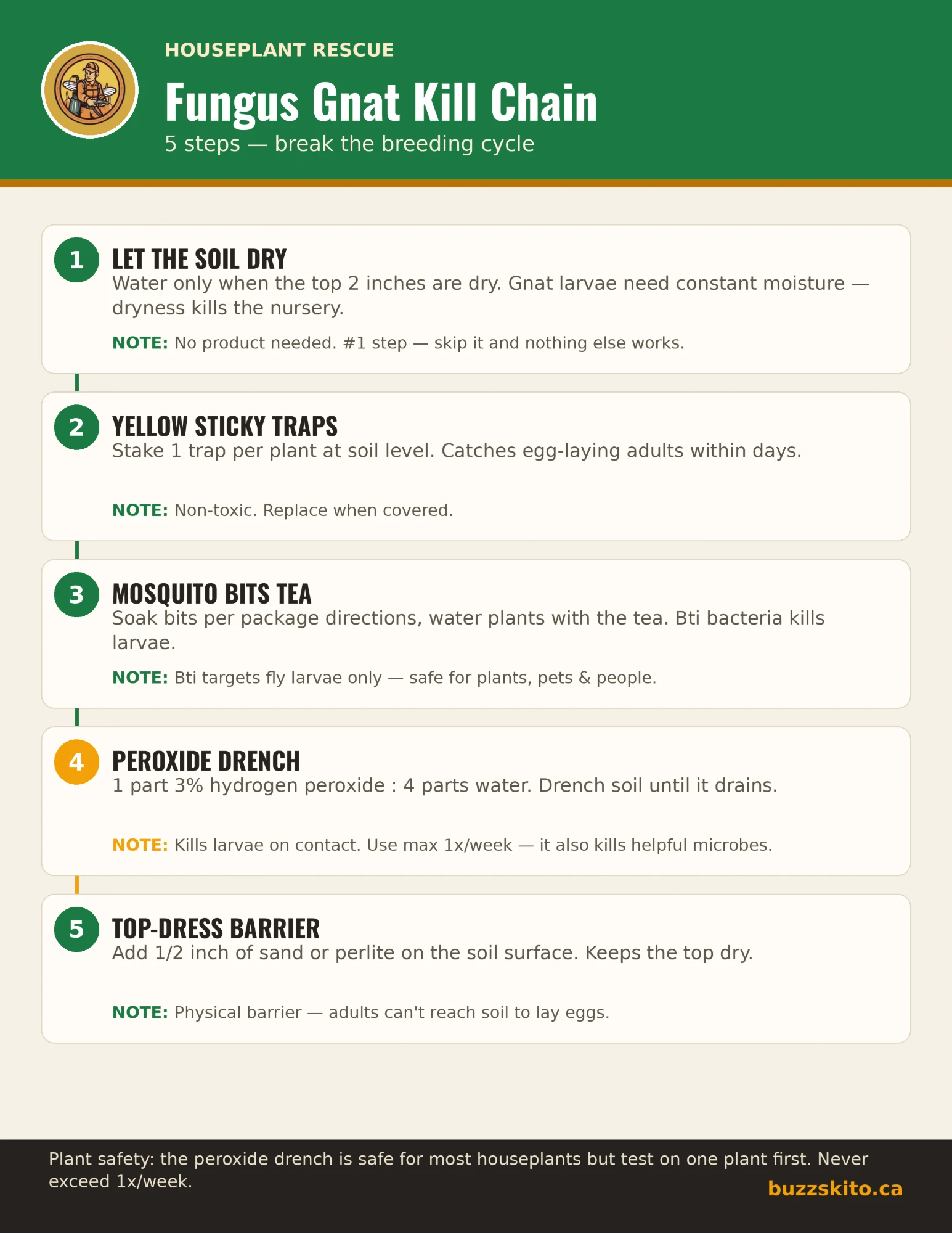
Fungus gnats get their own routine, built around houseplants. Among this page's sources, NC State's handbook notes that yellow sticky traps capture the winged adults and that beneficial nematodes feed on fungus gnats in the soil. The fungus gnat guide gives the rest: how dry to let the soil get, where to put the traps, and how a Bti drench fits in.
Weeds
Mulch first, then decide which weeds can stay. NC State's handbook says several inches of organic mulch reduce weed competition, and that some weed seeds need full sunlight to germinate, which mulch denies them. It also draws a line: weeds closely related to a crop can harbor that crop's pests and should go, while others supply nectar or pollen, and clover in a lawn makes nitrogen for the soil and feeds bees. The natural weed control guide covers vinegar, boiling water and mulch depth by material. Turf is its own system, and our lawn pest control guide explains how to confirm grubs, chinch bugs and armyworms and when treating them is justified.
When should you stop and try something else?
Stop repeating a step when the pest is still above the level of damage you decided to accept, and move to the next step in the order. The specific stopping points:
- Companion plants. If a pest is still doing unacceptable damage with the companion in place, more of the same plant will not fix it. Move to hand removal, water or row covers.
- Hand-picking and barriers. NC State says hand-picking may come too late once crop damage is noticed, and that mechanical barriers are not effective when the pest population is large.
- Insecticidal soap. UC IPM lists it among contact insecticides with little or no persistence, says to wet the infested plant parts thoroughly, and notes that repeated application may be needed for sustained control. NPIC warns that soap can be toxic to plants and can burn those with hairy leaves. If repeated sprays are not holding the pest, re-check the identification before reaching for something stronger.
- Bt. It is slow. NC State notes that caterpillars stop eating within two hours of consuming it but may keep moving for as long as 72 hours, so a caterpillar still alive on the second day does not mean the spray failed. Follow the label for any repeat application.
- Marigolds for nematodes. They cannot eradicate nematodes, and the University of Florida cautions that they may not reduce a severe infestation enough for the next crop to succeed.
- An insect you cannot name. Take a sample or a clear photo to your state or provincial extension office or Master Gardener help desk before treating anything.
The printable season-by-season card
Print or save
Natural garden pest control: the season-by-season card
Print this and keep it with your seed packets. Every line stands on its own.
- Every visit: identify before you act. Only about 1 percent of insects and mites are harmful.
- Walk the garden at least twice a month, twice a week in hot weather, and turn leaves over.
- Spring: test the soil, go easy on fertilizer, inspect transplants top and bottom, and mulch several inches deep.
- Spring, for root-knot nematodes: grow French marigolds solid, no more than 7 inches apart, for at least 2 months in the bed before the crop. A border does not do it.
- Summer: hand-pick into soapy water, and knock aphids and mites off with a strong stream of water.
- Summer: skip store-bought ladybugs. Plant flowers and tolerate a few pests to keep the wild ones.
- If you spray: insecticidal soap on infested leaves only, in the evening, never on open flowers.
- Fall: clear vegetable beds and plants that had pest trouble, and leave a refuge corner for beneficial insects.
- Winter: plan so related crops return to a bed only once every 3 to 4 years, and order resistant varieties early.
- Pets: mint, lavender, chives, onions and garlic are on the ASPCA's list of plants toxic to dogs.
Follow every product label, and store sprays where children and pets cannot reach them.
buzzskito.ca
This guide is general educational information, not medical advice. If you have symptoms or concerns after a bite or exposure, contact a healthcare provider.
Use any pesticide exactly as its label directs. The label is the law, and what is registered and sold varies by state.
Frequently Asked Questions
Does companion planting really keep pests away?+
Sometimes, and for fewer plant pairs than charts suggest. University of Minnesota Extension lists pairings that reduced pests in research, such as basil and marigolds for thrips on tomatoes, nasturtium for squash bugs, and arugula or mustard as a trap crop for flea beetles. It also warns that online lists of insect-repelling plants are not always backed by research, and it reports that multiple studies found marigolds do not deter Colorado potato beetles. Treat companion planting as one preventive layer alongside rotation, hand removal and protecting natural enemies, not as a replacement for them.
Should I buy ladybugs to release in my garden?+
Probably not. The University of California's IPM program says releases of natural enemies are unlikely to provide satisfactory pest control in most situations, and that lady beetles bought through retail outlets are unlikely to be sufficient in number and quality. Its one exception is convergent lady beetles bought in bulk by mail order and released in very large numbers at intervals, which can control aphids temporarily. NC State Extension adds that lady beetles shipped in for release tend to fly far away before they begin to feed. The alternative both describe is to keep flowers blooming through the season and tolerate a few pests as food for the wild ones.
What time of day should I spray plants for insects?+
In the evening. The National Pesticide Information Center advises against spraying while pollinators are active and says an evening application, after bees have returned to their hives, lets the residue dry overnight. It also says not to spray flowers directly and to read the Environmental Hazards section of the product label. This applies to natural products as well, since the University of California rates insecticidal soap as toxic to beneficial insects it contacts directly.
Do marigolds keep bugs away from tomatoes?+
Partly. University of Minnesota Extension reports that a few studies found basil and marigolds effective at reducing thrips on tomatoes, and its overall verdict on marigolds as an insect deterrent is sometimes yes and sometimes no. For root-knot nematodes, the University of Florida found that marigolds planted beside a susceptible crop probably do not protect it. What works is a dense stand of marigolds grown in the same bed for at least two months before the tomatoes go in, repeated every season.
Are mint and lavender toxic to dogs and cats?+
The ASPCA lists both as toxic to dogs, cats and horses. Its entry for mint names the plant's essential oils and gives vomiting and diarrhea after large ingestions as the signs. Its entry for lavender names linalool and linalyl acetate and gives nausea, vomiting and loss of appetite. Chives, onions and garlic are also on its list of plants toxic to dogs, while basil, dill, sage, thyme and garden nasturtium are listed as not toxic to dogs. Call your veterinarian if a pet eats a quantity of any garden plant.
Is dish soap the same as insecticidal soap?+
The sources read for this page describe only registered insecticidal soap. The National Pesticide Information Center defines its active ingredient as potassium salts of fatty acids, made by adding potassium hydroxide to fatty acids from animal fats and plant oils, and sold as products with label directions. None of the seven sources publishes a dish soap recipe or ratio for spraying plants, so this page does not give one. Even registered soap can burn leaves, particularly hairy ones, so follow the label on the product you use.
Sources
- Companion planting in home gardens — University of Minnesota Extension
- Marigolds (Tagetes spp.) for Nematode Management — University of Florida IFAS Extension
- Biological Control and Natural Enemies of Invertebrates — University of California Statewide IPM Program
- 8. Integrated Pest Management (IPM) — NC State Extension (North Carolina Extension Gardener Handbook, 2nd ed.)
- Pollinator Protection — National Pesticide Information Center
- Potassium Salts of Fatty Acids (General Fact Sheet) — National Pesticide Information Center
- Toxic and Non-Toxic Plant List — Dogs — ASPCA Animal Poison Control
How this guide was made: it was researched and drafted with AI assistance from the sources listed above. A second, independent AI pass then checked each factual claim against those sources. Found an error? Email support@buzzskito.ca.