Reviewed by Alex Francisco
Published November 23, 2026 · Fact-checked against the sources listed below
What do ant eggs look like?
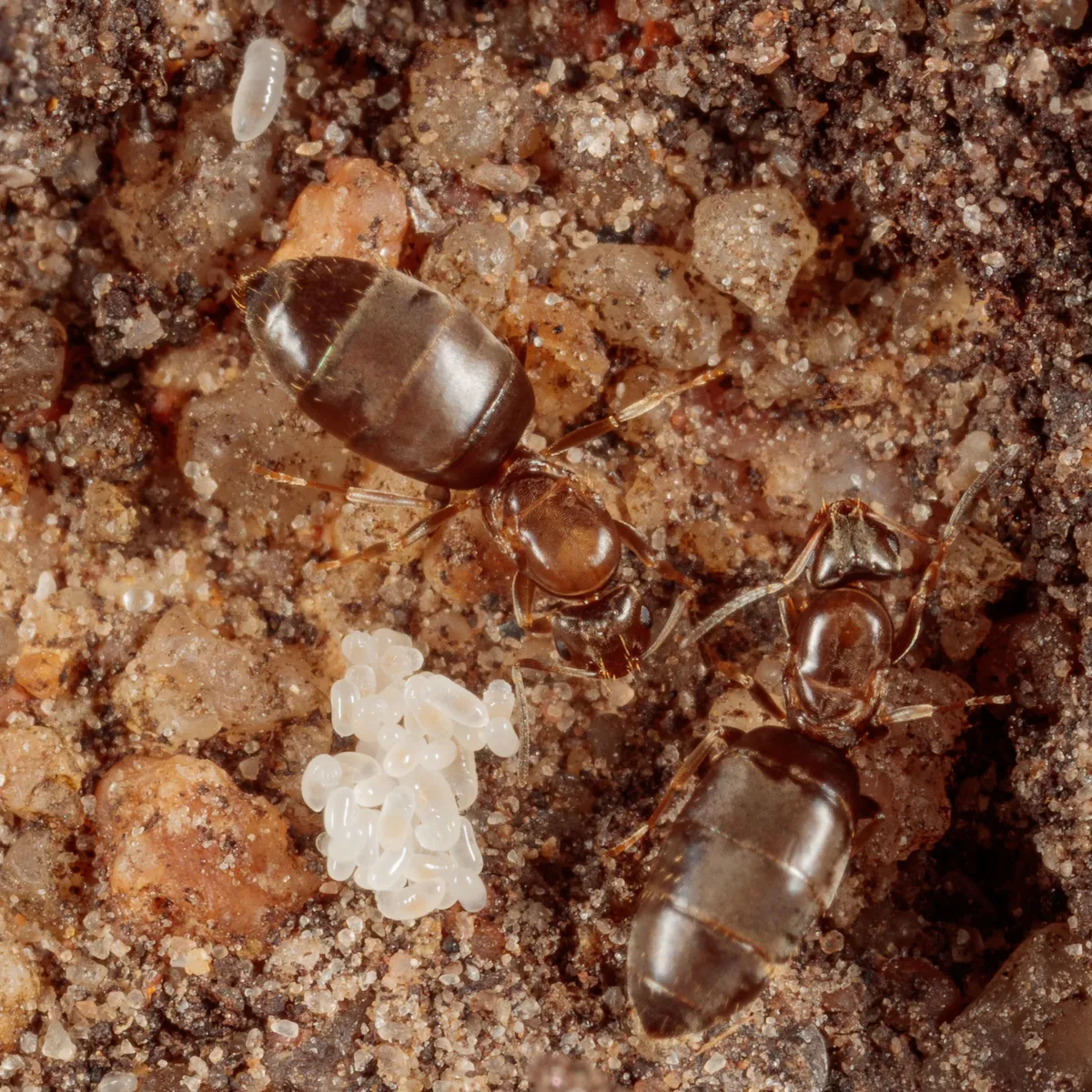
Real ant eggs look like tiny white or pale yellow specks that are hard to see without a magnifier. Texas A&M AgriLife's fire ant identification guide says ant eggs are white to pale yellow and vary in shape with the species, and gives harvester ant eggs as less than 0.5 mm long, about 1/50 inch. The University of Florida's guide to household ants calls ant eggs almost microscopic.
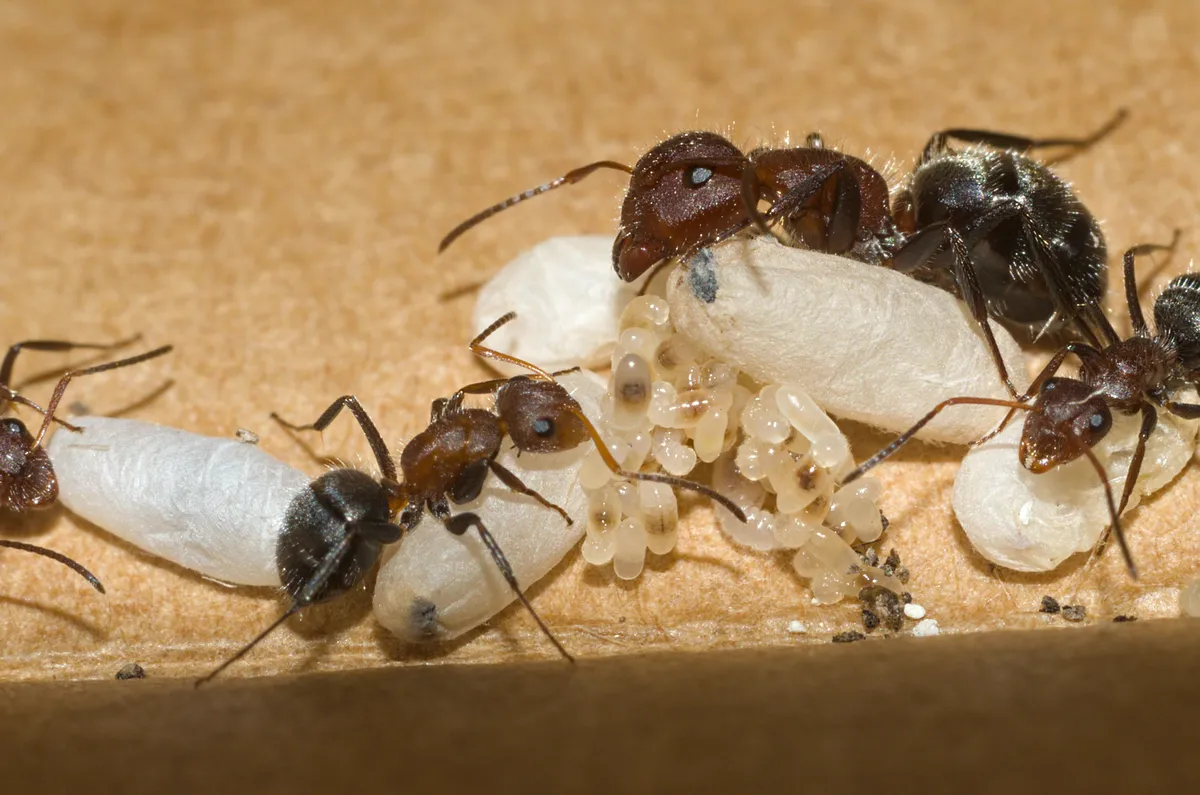
Many of the white grains people call ant eggs are not eggs. UC IPM's red imported fire ant guide says fire ant eggs are almost too small to be seen with the unaided eye, and its description of a brood photo calls them tiny, oblong and white, so anything you can count easily is more likely a larva or a pupa. Rutgers Cooperative Extension's carpenter ant fact sheet says carpenter ant pupae are enclosed in cocoons that are often misnamed ant eggs.
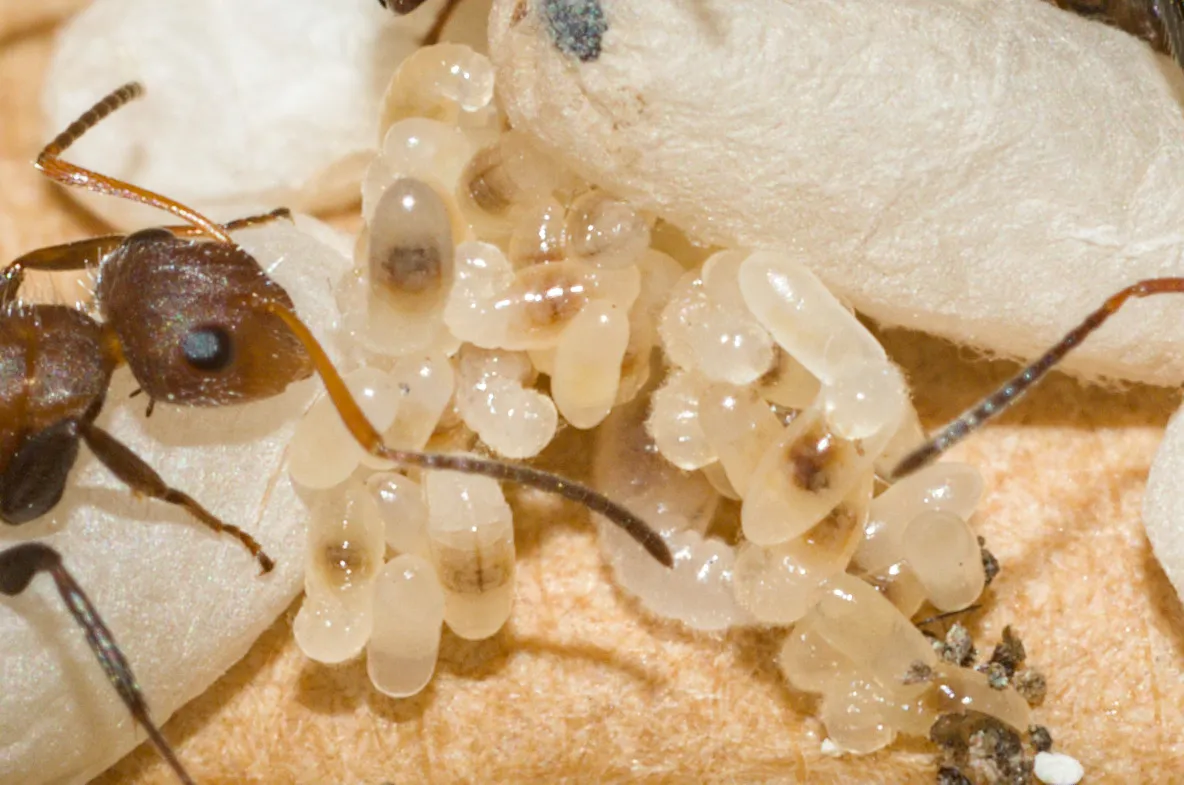
All ants go through the same four stages: egg, larva, pupa and adult. The University of Florida describes the larvae that hatch from the eggs as soft and legless, and the pupa as resembling the adult except that it is soft, uncolored and immobile. This page covers what each stage looks like; the general guide to insect eggs sorts the eggs of other household insects by where you found them.
What are the white things ants carry?
The white things ants carry are their young, mostly larvae and pupae. UC IPM says the egg, larval and pupal stages of fire ants are only seen when a nest is disturbed or when workers are carrying them to a new location. The University of Tennessee's fire ant biology page says the whitish objects often found at the tops of fire ant mounds are the ants' immature stages.
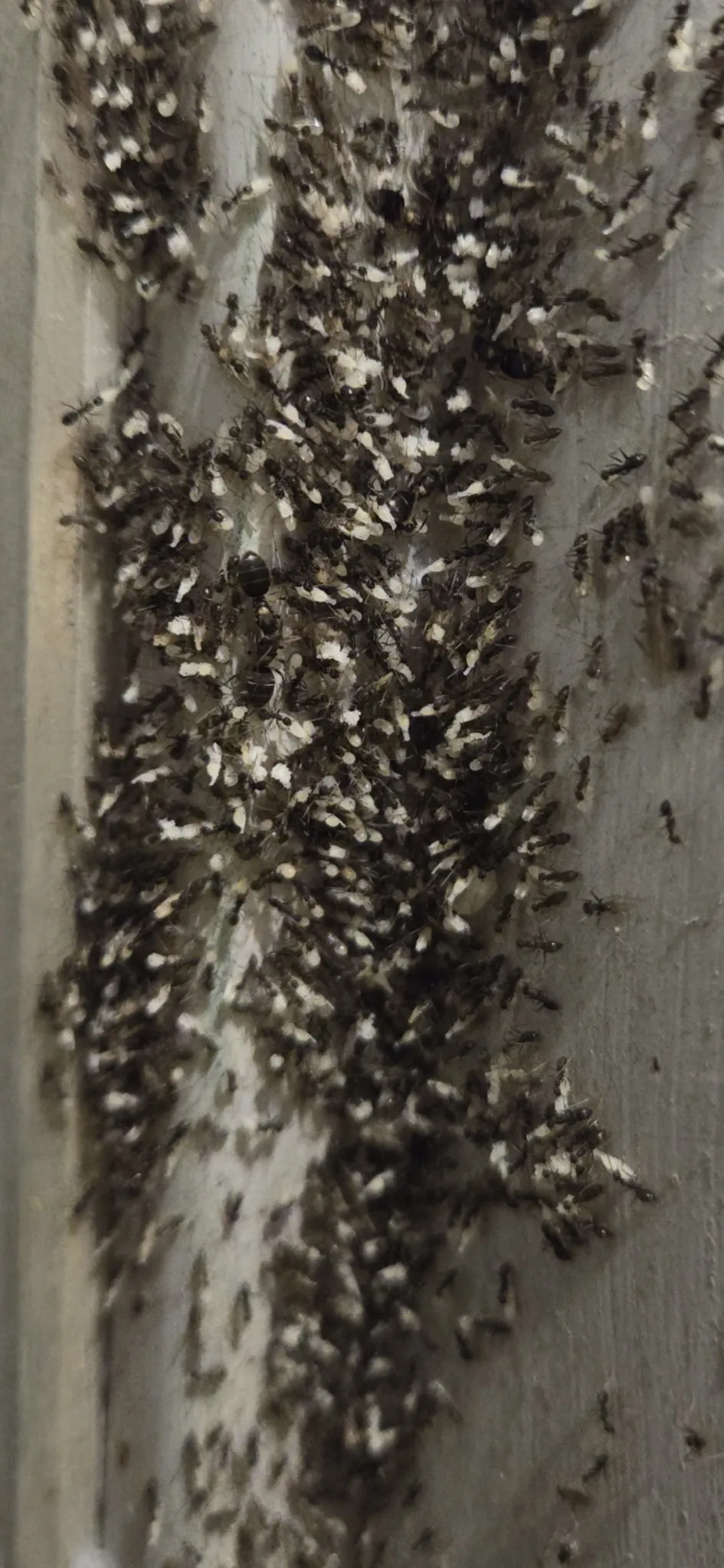
Workers move brood as the nest warms and cools and when the nest is disturbed. The University of Tennessee says the queen and brood of fire ants are moved through the mound in response to temperature: deep into it on cold days, closer to the surface as the mound warms. The University of Wisconsin-Madison's odorous house ant article says that when a nest is disturbed, odorous house ants quickly relocate to another sheltered spot. A line of ants carrying white grains along a wall or floor fits either case UC IPM gives for fire ants: a disturbed nest, or a move to a new location.
Not every pale thing in an ant line is brood. Ants also carry food: the University of Florida says a scout that finds promising food carries it, or a piece of it, back to the nest. Compare the load with the larvae and pupae described below.
What do ant larvae look like?
Ant larvae look like small, white, legless grubs with a small head. Texas A&M AgriLife describes ant larvae as creamy white, legless and grub-like, with small, distinct heads that bear chewing mouthparts. The same UC IPM photo description calls fire ant larvae small, white, comma-shaped and variable in size, and NC State Extension's carpenter ant guide calls carpenter ant larvae white, legless and maggot-like.
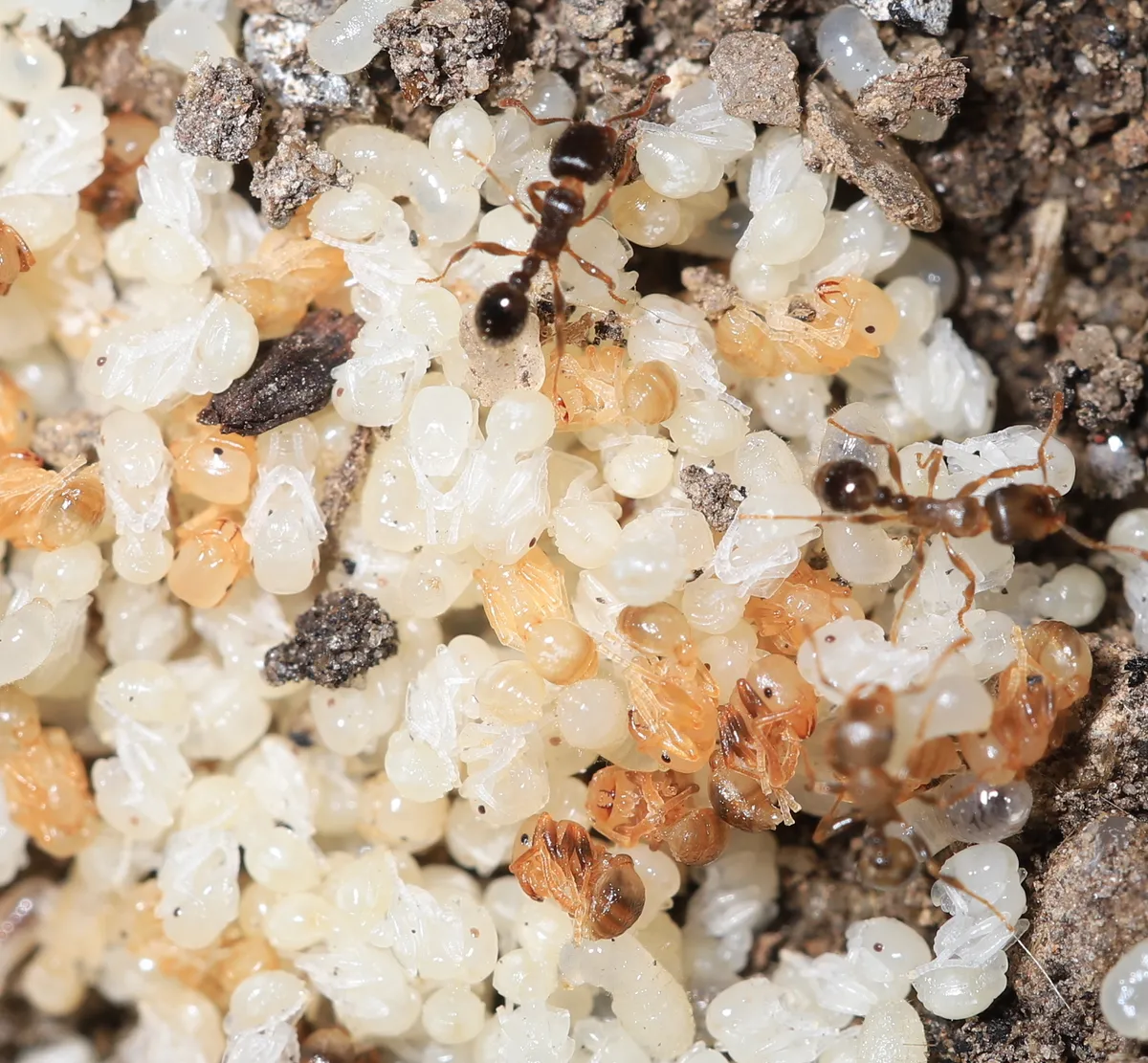
Larvae cannot move around on their own. UC IPM's ant guide calls them immobile and wormlike, and says they do not resemble adults. Workers feed them: the University of Florida explains that most adult ants cannot swallow solid food, so solid particles go to the larvae, which can digest them, and NC State adds that carpenter ant larvae liquefy solid food that the adults then consume.
What do ant pupae look like, and do all ants make cocoons?
Ant pupae look like pale, motionless adult ants, either bare or wrapped in a silk cocoon, depending on the species. Texas A&M AgriLife says ant pupae resemble adults in size and shape, with the legs and other appendages showing as ridges on the body, and that they start creamy white and darken as the adult develops. UC IPM says fire ant pupae look like adults except that their legs and antennae are held tightly against the body.
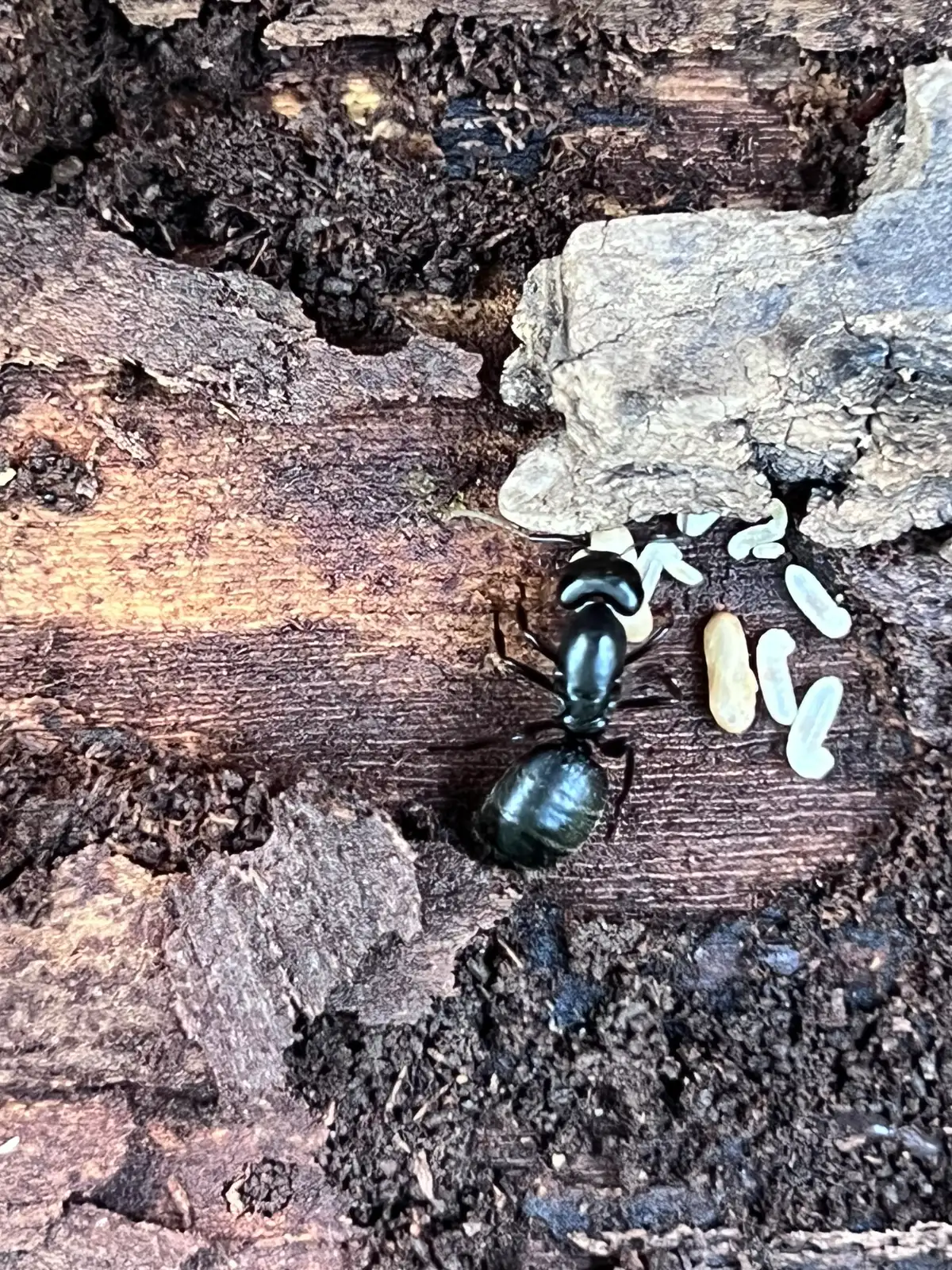
Some ants spin cocoons and many do not. Texas A&M AgriLife says the pupae of fire ants are naked, while harvester ant pupae occur in capsule-like cocoons, and the University of Florida says that in many ant species the pupa is in a cocoon spun by the larva.
A 2013 study of five ant species in BMC Evolutionary Biology by Tragust and colleagues notes, citing earlier work, that most ant brood is uncovered, that in some species the pupae are enclosed in a silk cocoon, and that the trait differs mostly among subfamilies but can also vary within them. The Argentine ant, a common house invader, was one of its species with naked pupae, and Formica selysi, collected in Switzerland, has naked and cocooned pupae in the same nest. Larvae are always uncovered, the study adds.
Carpenter ants are house ants that do spin cocoons. NC State says carpenter ant pupae are tan and capsule-shaped and are enclosed in cocoons that are often mistaken for eggs, and Penn State Extension's carpenter ant fact sheet also calls the cocoons tan. LSU AgCenter's profile of the small carpenter ant, Camponotus nearcticus, says its pale yellow cocoons are about the size of a typical worker and much larger than the eggs.
| Stage | Size | Color and shape | Moves? |
|---|---|---|---|
| Egg | Under 1/50 inch in harvester ants | White to pale yellow; elliptical to oblong | No |
| Larva | Varies in size, even within one nest | Creamy white, legless grub with a small head | No; workers carry it |
| Bare pupa | About adult size | Pale ant shape with legs held tight; darkens with age | No |
| Cocooned pupa | About worker size in the small carpenter ant | Tan or pale yellow silk capsule | No |
Compiled from Texas A&M AgriLife, UC IPM, NC State, Penn State, LSU AgCenter and the University of Florida, linked in the text. Sizes vary by species.
How long do ant eggs take to hatch?
Fire ant eggs hatch in about 7 to 10 days, but the time varies with the species and temperature, and the sources give figures for only a few ants. The University of Florida's red imported fire ant profile says a newly mated queen's first eggs hatch in 8 to 10 days, the larval stage typically lasts 6 to 12 days and the pupal stage 9 to 16 days. The University of Tennessee gives 7 to 10 days to hatch, 6 to 10 days as larvae and 9 to 15 days as pupae.
| Ant | Egg to adult | Source |
|---|---|---|
| Red imported fire ant | 22 to 38 days | University of Florida |
| Pharaoh ant, workers | About 38 days | University of Florida |
| Pharaoh ant, queens and males | About 42 days | University of Florida |
| Carpenter ants | About two months | Rutgers Cooperative Extension |
| Black carpenter ant, egg to worker | At least about 60 days | Penn State Extension |
| Small carpenter ant | About three months, depending on temperature | LSU AgCenter |
Times are as each source gives them. The sources consulted give no stage lengths for pavement, odorous house or Argentine ants.
The University of Florida's pharaoh ant profile gives about 38 days from egg to adult for workers and 42 days for queens and males. For carpenter ants, Rutgers says about two months, Penn State a minimum of about sixty days from egg to worker for the black carpenter ant, and LSU AgCenter about three months, depending on temperature, for the small carpenter ant. NC State says a black carpenter ant queen lays eggs twice a year, in early spring and late summer, and that the eggs take months to become adults. How long the adults then live is covered in how long ants live.
How does a queen ant start a colony with her first eggs?
A new queen typically seals herself into a small chamber, lays a first batch of eggs and raises them alone. The University of Florida says a newly mated fire ant queen lays 10 to 15 eggs within 24 hours of mating and 75 to 125 more before the first ones hatch, and feeds the first larvae while her unneeded wing muscles break down to supply nutrients. Rutgers says a carpenter ant queen lays a first clutch of 15 to 20 eggs and feeds the first larvae from her stored nutrients.
The first workers are small. The University of Florida calls the first fire ant workers minims, and NC State calls a carpenter ant queen's first workers nanitics, smaller than ordinary minor workers; they take over foraging and brood care while the queen keeps laying. The winged queens and males that start this cycle are the swarmers covered in flying ants and why they swarm.
Where do ants keep their eggs?
Ants keep their eggs, larvae and pupae inside the nest, where workers tend them, and where that nest is depends on the species. Look in these places first:
- Under stones, pavers and slabs. Virginia Tech's pavement ant fact sheet says pavement ants are commonly found under stones, concrete slabs and sidewalks, and that their eggs, larvae and pupae need a lot of care from the workers.
- In fire ant mounds. The University of Tennessee says the whitish immature stages are often found at the tops of mounds, and that the colony moves closer to the surface as the mound warms.
- In potted plants, under boards and in mulch. UC IPM lists potted plants among indoor nest sites and says ants build nests under boards, stones, tree stumps and plants; the University of Wisconsin-Madison says odorous house ants nest in mulch beds and beneath stones or pieces of wood.
- In wall voids. The University of Florida says pharaoh ants nest in hard-to-reach, warm (80°F to 86°F) and humid places near food or water, such as wall voids, and Wisconsin says odorous house ants can nest in wall voids and attics.
- In damp or rotting wood. Rutgers says a new carpenter ant queen prefers wood that is moist or partly decayed, and Penn State says carpenter ants usually avoid sound wood with a moisture content below 15 percent.
What does finding ant eggs in the house mean?
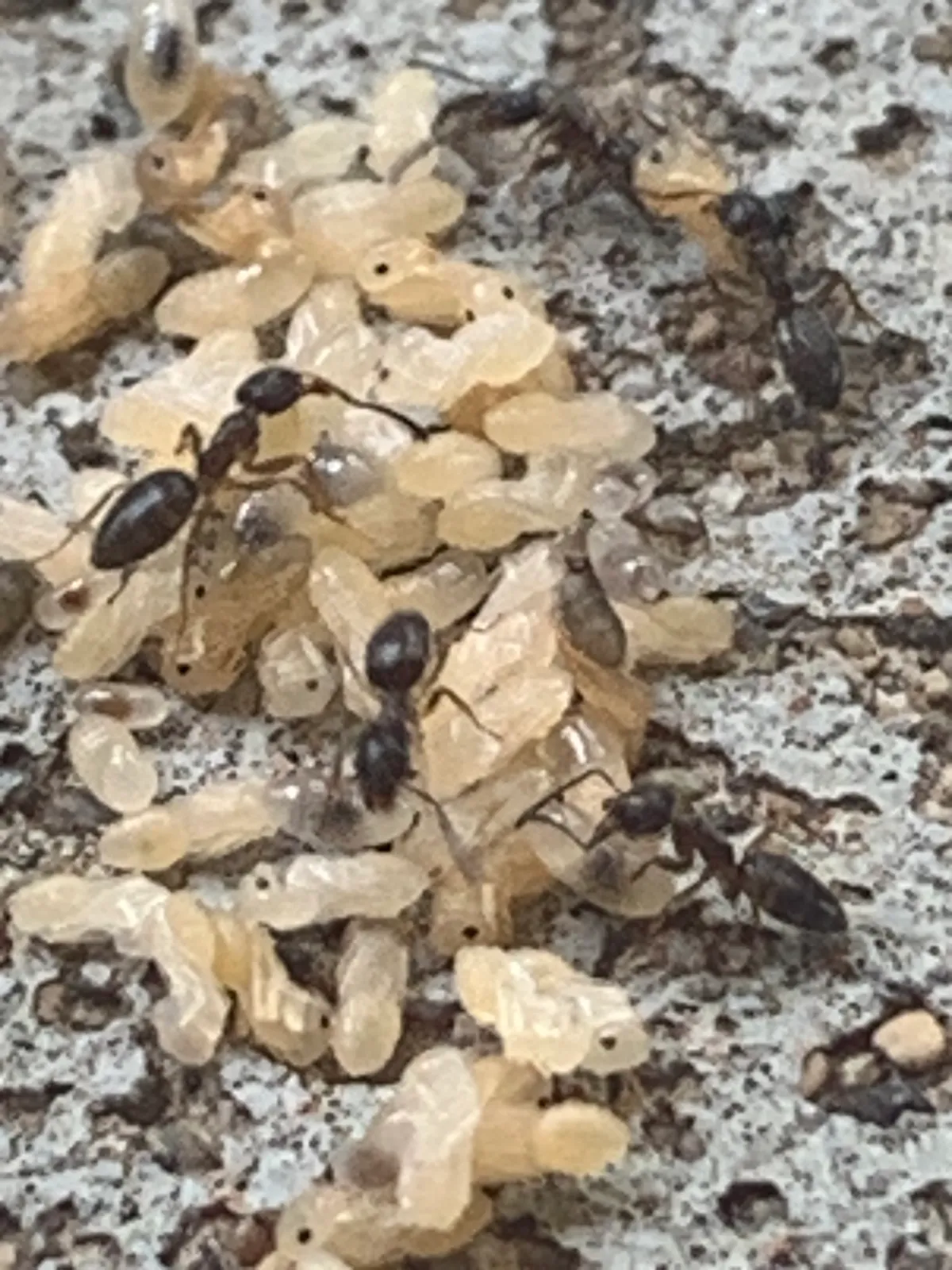
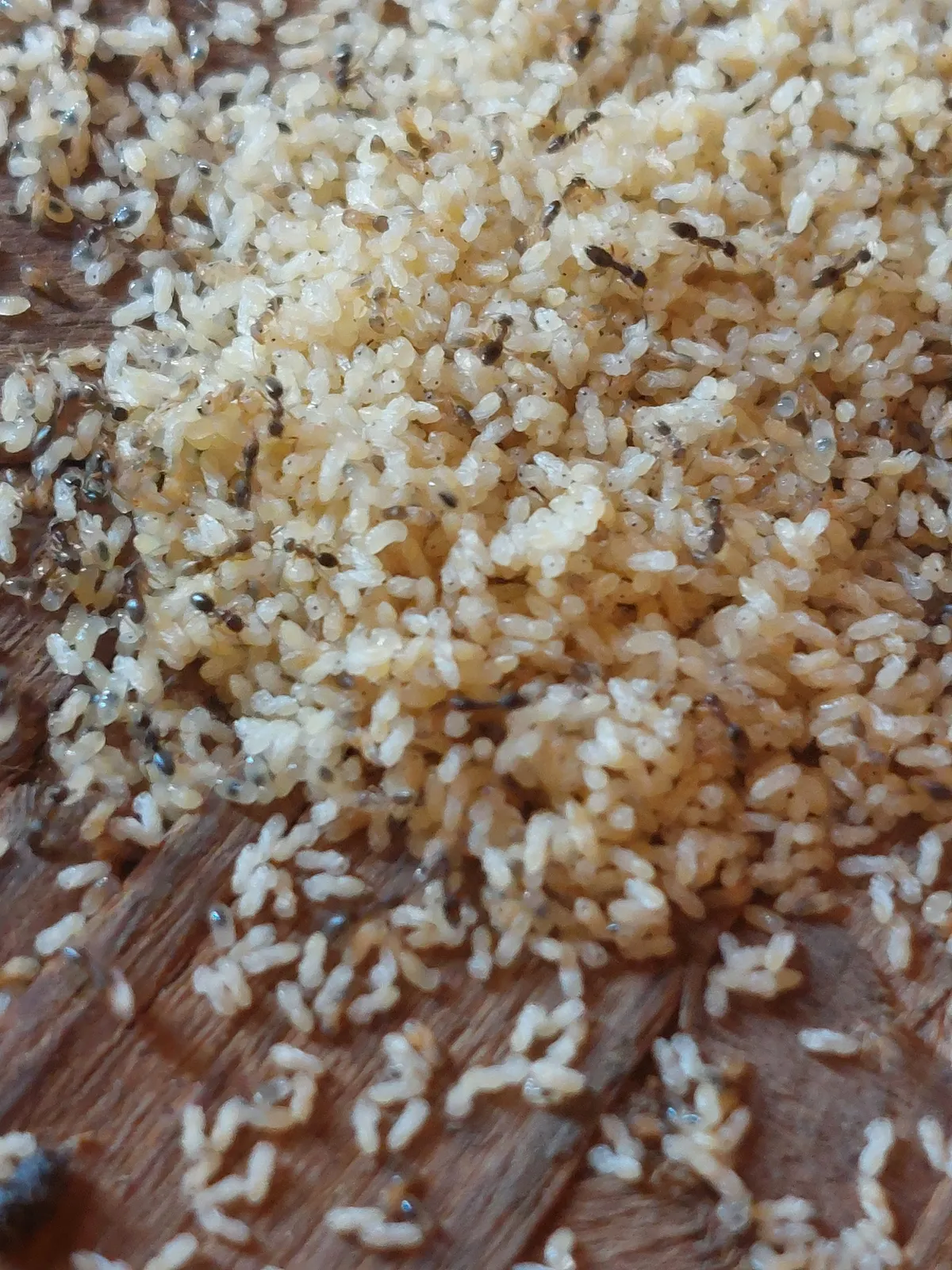
Ant brood indoors means ants are nesting there or moving a nest, not just passing through to find food. Brood stays in the nest unless workers are carrying it somewhere new, so a pile of larvae and pupae under a sink, behind a baseboard or in a houseplant pot marks where the colony, or part of it, is living. UC IPM says ants often enter buildings seeking food and water, warmth and shelter, or refuge from dry, hot weather or flooded conditions.
Which ant it is matters, because several house ants split into many nests:
- Carpenter ants. NC State says satellite nests form when workers move out of the main nest carrying some larvae and pupae, while the queen stays in the main nest, and that infestations are often linked to moisture problems. Penn State says an indoor nest may have come from a parent colony outdoors, often in a tree, log or waste wood within 100 yards of the house, so brood in a wall or window frame can belong to a satellite nest. More on how to find a carpenter ant nest.
- Pharaoh ants. The University of Florida says new colonies bud off when a queen and a few workers leave the mother colony, and that workers can even raise a new queen from brood carried away from it.
- Odorous house ants. The University of Wisconsin-Madison says their colonies can hold thousands of workers and many queens and can divide by budding.
To find out which ant you have, compare a worker with the photos in the ant identification hub; very small ants near brood are sorted in the guide to tiny ants in the house.
How do you tell ant eggs from termite eggs, maggots and other look-alikes?
Check whether the white things move on their own and where you found them. Ant eggs, larvae and pupae cannot move on their own; termite young and maggots can, and the perlite and fertilizer beads in potting soil are not alive at all.
Ant eggs vs termite eggs
Termite eggs are laid in the nest; the termites found in damaged wood are workers, and those walk. Texas A&M AgriLife's subterranean termite guide says a new queen lays her first eggs in a chamber dug in moist soil near wood, where the king keeps them clean and moist; that it is the worker caste that damages wood; and that the immature termites (larvae, workers and nymphs) of native subterranean termites range from 1/16 to 1/4 inch long.
Mississippi State Extension's termite biology page says termites develop gradually, from egg to nymph to adult, with no inactive pupal stage, and that worker termites are sightless and completely white. So a white capsule or a still, ant-shaped pupa is not a termite, while pale, wingless insects walking in damp wood or mud tubes point to termites, described in what termites look like.
Fly eggs and maggots
Fly eggs and maggots turn up on garbage, spoiled food and other decaying matter, not in a nest guarded by ants. Virginia Tech's house fly fact sheet describes house fly eggs as elongated, yellowish-white ovals about 1 mm (0.04 inch) long, laid in clusters of up to 100 on a food source, and the maggots as yellowish-white with a tapered head and no head capsule, reaching about 0.4 inch. Maggots move on their own; ant larvae do not. House fly pupae are oval capsules with a tough brown skin. See maggots and where they come from.
Spider egg sacs
A spider egg sac is a single case with the eggs inside, not a loose pile of grains. Penn State Extension's common house spider fact sheet says that spider's egg sacs are brown and oval, with tough, papery covers, 6 to 9 mm (about 1/4 to 3/8 inch) across, each holding 140 to 380 eggs. The guide to spider egg sacs shows the sacs of other common spiders.
Perlite, fertilizer beads and grains of rice
White or yellowish balls in potting soil with no ants around them are often part of the mix. Purdue's Plant and Pest Diagnostic Lab says slow-release fertilizer pellets are often somewhat transparent and pale yellow, about 1/8 inch across, and are blended into potting mix or applied to the soil surface. UGA Extension describes perlite as the crumbly, foam-like material in bagged potting mix, volcanic glass heated until it puffs up like popcorn. Rice-like grains that turn out to be insect eggs or cocoons are sorted in the guide to bug eggs that look like rice.
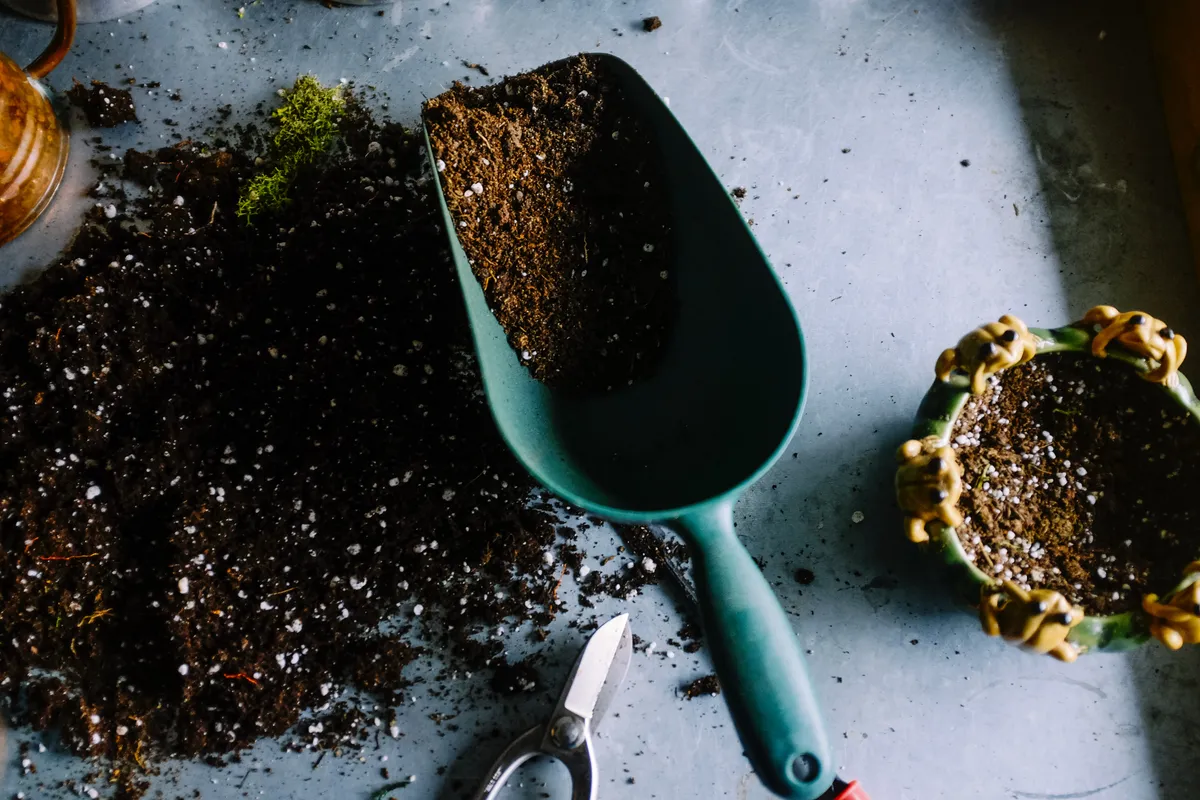
Is it ant brood? Five checks
- Are ants with it? Worker ants tend their brood, so workers standing over the grains or carrying them point to ants; perlite and fertilizer beads lie in the potting mix with nothing tending them.
- Does anything walk? White insects with legs that crawl away are termites or other insects; ant larvae and pupae cannot move on their own.
- What shape? Among the brood, specks almost too small to see are eggs; legless grubs are larvae; pale, ant-shaped bodies with the legs held tight are bare pupae; tan or pale yellow capsules are cocooned pupae.
- How big, beside a ruler? Harvester ant eggs are under 1/50 inch; a small carpenter ant cocoon is about the size of one of its workers; a slow-release fertilizer bead is about 1/8 inch.
- Where was it? Under a stone, paver or pot, in a mound, a wall void or damp wood fits ants; garbage fits flies; one brown, papery sac in a web fits a spider.
Commonly confused with
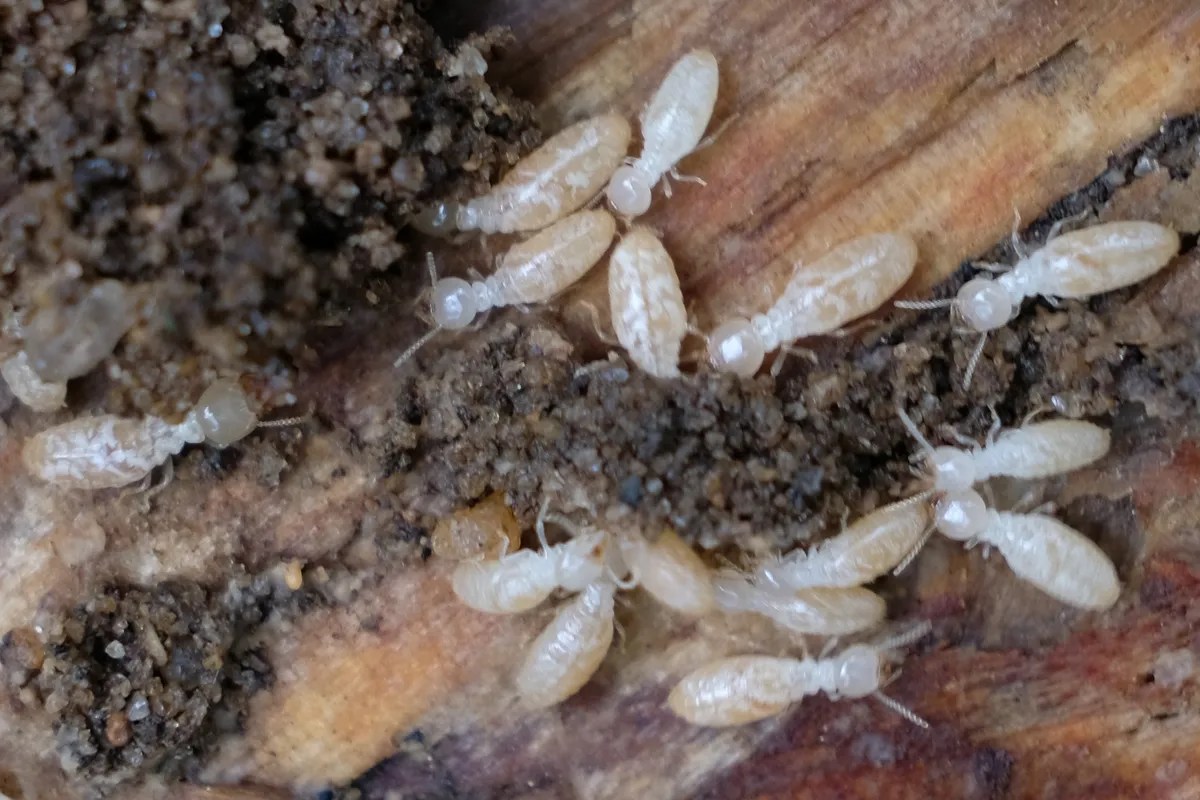 TermitesWhite to creamy white and they walk; termites have no pupal stage
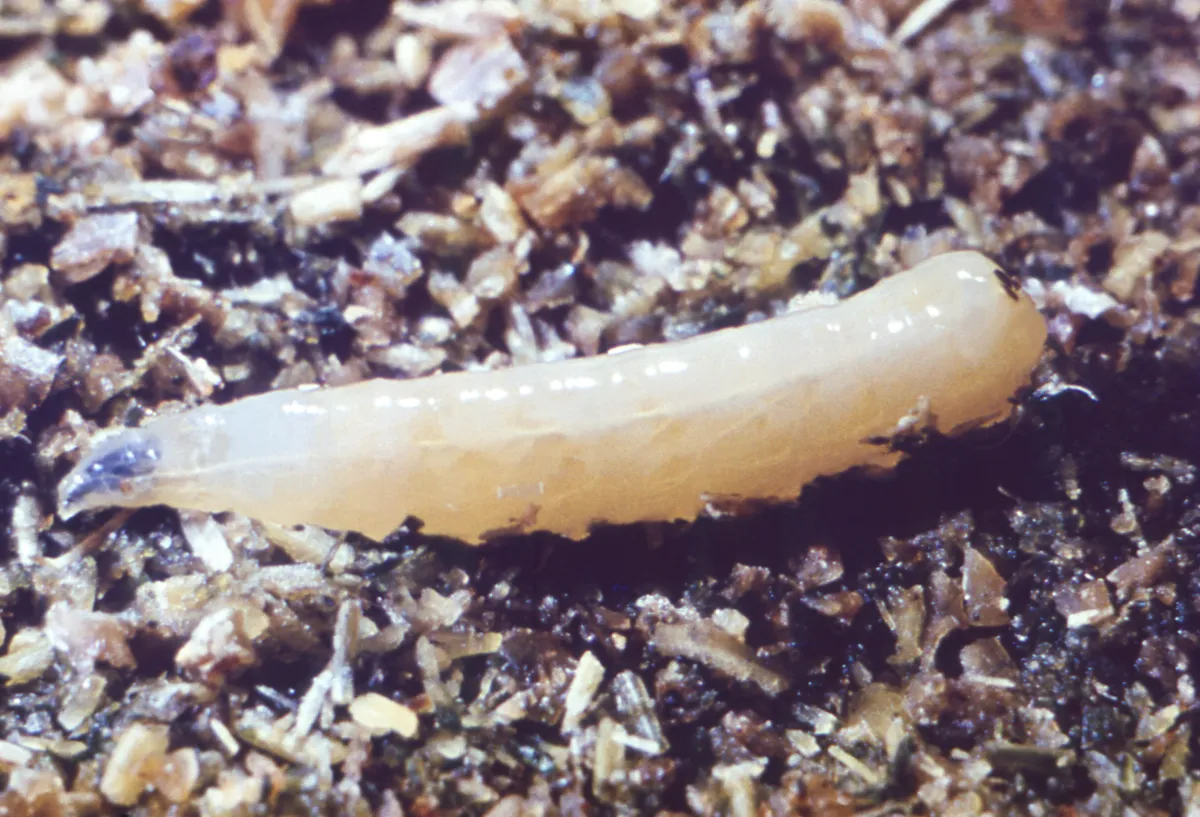 Fly maggotYellowish-white and tapered with no head capsule; found in garbage and spoiled food
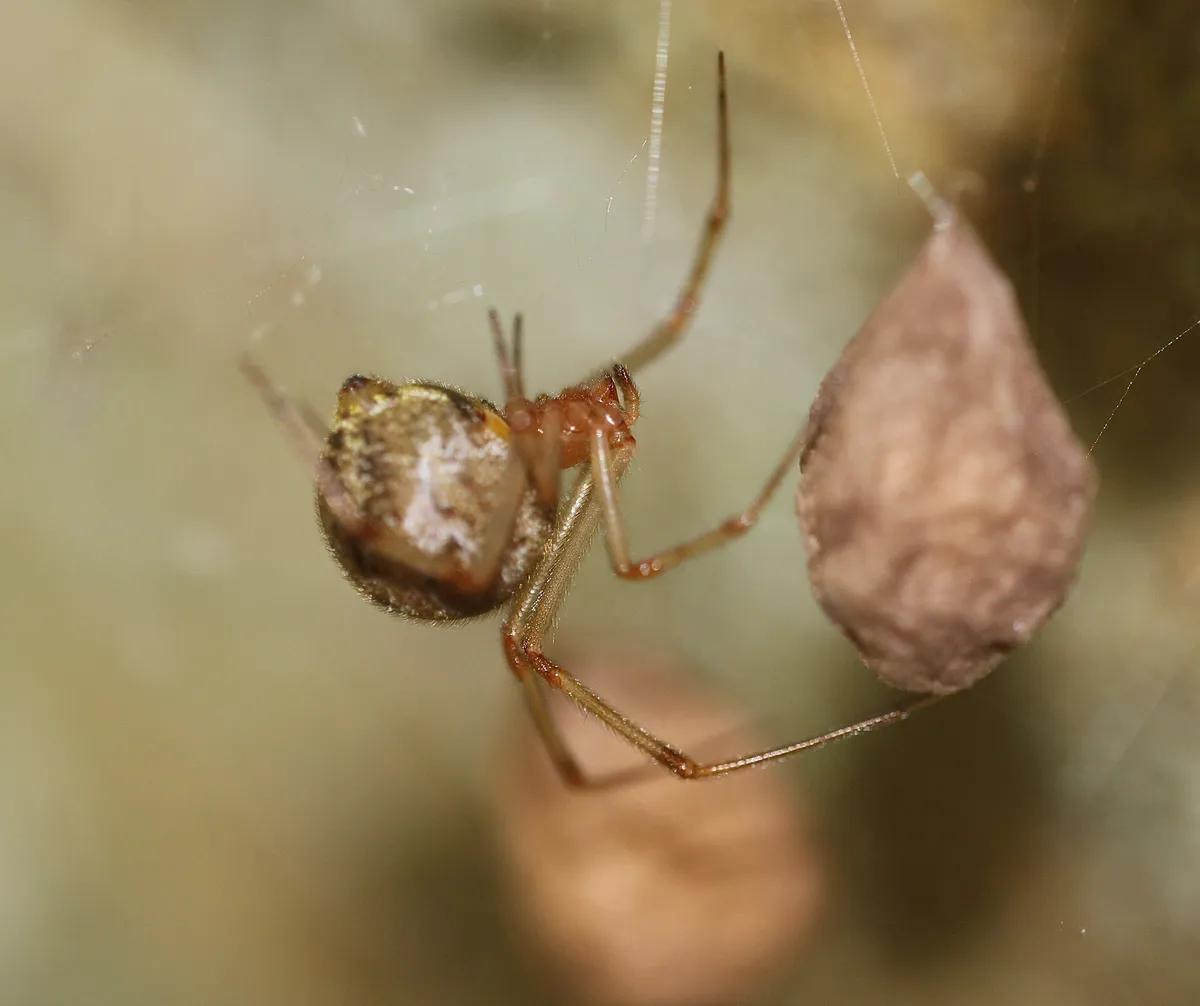 Spider egg sacOne brown, papery sac, about 1/4 to 3/8 inch across, not a pile of grains
 Insect eggsNot sure the eggs belong to ants? Sort them by where you found them
Photos: Termites: no rights reserved, via iNaturalist, CC0 1.0. Fly maggot: CDC (CDC Public Health Image Library, phil.cdc.gov), public domain. Spider egg sac: (c) Joey M, some rights reserved (CC BY), via iNaturalist, CC BY 4.0. Insect eggs: (c) Victor Engel, some rights reserved (CC BY), via iNaturalist, CC BY 4.0.
What should you do once you know they are ant eggs?
Use the brood to find the nest, then deal with the colony rather than the grains you can see. Scooping up a pile of larvae and pupae can leave the queen, who lays the eggs, and the rest of the colony behind; NC State notes that the carpenter ant queen stays in the main nest even when workers carry brood to satellite nests.
- Note exactly where the brood was and which way any ant trails run from it.
- Collect a few workers and identify the ant with the ant identification hub, since the right approach differs by species.
- Fix what drew them: leaks and damp wood for carpenter ants, food and water sources for pharaoh and odorous house ants.
- Choose a method from the ant guides. UC IPM calls baits a key tool and the only type of insecticide it recommends in most situations, and explains that workers carry bait back to the nest, where it is passed to other workers, larvae and queens; the University of Florida says a bait can reach the queen and brood. Use any product only as its label directs.
- For step-by-step control indoors, follow how to get rid of ants in the house or the guide to choosing and placing ant bait. If the brood is in a fire ant mound, keep clear of it: UC IPM says red imported fire ants quickly climb onto and sting anything touching their mound. See what fire ant stings do.
Use any pesticide exactly as its label directs. The label is the law, and what is registered and sold varies by state.
Frequently Asked Questions
Can you see ant eggs with the naked eye?+
Barely. UC IPM says fire ant eggs are almost too small to be seen with the unaided eye, the University of Florida calls ant eggs almost microscopic, and Texas A&M gives harvester ant eggs as under 0.5 mm, about 1/50 inch. Ant eggs are white to pale yellow specks, tended in the nest by workers or, in a new colony, by the queen. The bigger white grains people notice are larvae, pupae or carpenter ant cocoons, not eggs.
Why do ants carry their eggs?+
The white things ants carry are the colony's young, and most of what you can see is larvae and pupae rather than eggs. Workers move this brood when a nest is disturbed, as the nest warms and cools, or when part of a colony moves to a new nest. UC IPM says fire ant eggs, larvae and pupae are seen only when a nest is disturbed or when workers are carrying them to a new place.
How long does it take for an ant egg to become an ant?+
It depends on the species and the temperature. From egg to adult, red imported fire ants take 22 to 38 days and pharaoh ant workers about 38 days, the University of Florida says, and Rutgers gives about two months for carpenter ants. The eggs themselves hatch sooner: a new fire ant queen's first eggs hatch in 8 to 10 days, according to the University of Florida, and the University of Tennessee gives 7 to 10 days.
Are ant eggs a sign of an infestation?+
Ant eggs, larvae or pupae indoors are a sign that ants are nesting in or beside that spot, or moving a nest, because brood stays in the nest unless workers are carrying it to a new place. A pile of larvae and pupae in a wall, under a sink or in a plant pot marks a nest or a satellite nest. Identify the ant first: carpenter ants point to damp wood, while pharaoh and odorous house ants can split into many small nests.
What is the difference between ant eggs and termite eggs?+
Termite eggs are laid inside the nest, where Texas A&M says the king keeps them clean and moist. Termites also have no pupal stage, so a termite colony holds no cocoons and no still, ant-shaped pupae. Pale, wingless insects that walk around in damp wood or mud tubes point to termites, while ant larvae and pupae cannot move on their own.
Do all ants make cocoons?+
No. Texas A&M says fire ant pupae are naked, while harvester ant pupae sit in capsule-like cocoons, and carpenter ants also spin cocoons. A 2013 study in the journal BMC Evolutionary Biology says most ant brood is uncovered and that whether a species spins a cocoon differs mostly by subfamily, though one ant it studied has both kinds in the same nest. Larvae are always uncovered.
Are ant eggs the same as ant larvae?+
No. The egg is the first stage, a tiny white oval. The larva hatches from it and is a soft, legless, creamy white grub with a small head that workers must feed and carry. The larva later becomes a pupa, which looks like a pale adult ant and, in some species such as carpenter ants, is wrapped in a tan silk cocoon.
Where do ants lay their eggs?+
The queen lays her eggs inside the nest, where workers tend them. Depending on the species, that can be soil under stones, pavers or sidewalks, a fire ant mound, potted plants, mulch, boards on the ground, warm and humid wall voids, or moist, decaying wood for carpenter ants. Fire ant workers move the brood up and down in the mound as the temperature changes.
How many eggs does a queen ant lay?+
It varies widely by species. The University of Florida says a new fire ant queen lays 10 to 15 eggs within a day of mating, and that a mature fire ant queen can produce as many as 1,500 eggs a day. A pharaoh ant queen can lay 400 or more eggs in batches of 10 to 12, and a carpenter ant queen's first clutch is 15 to 20 eggs, according to Rutgers.
Are the white balls in my potting soil ant eggs?+
Often not, if no ants are with them. Purdue's diagnostic lab says slow-release fertilizer pellets are often pale yellow, somewhat transparent and about 1/8 inch across, and UGA Extension describes perlite as the crumbly, foam-like material in bagged potting mix. Ants do nest in potted plants, but workers tend their brood and carry it off when the nest is disturbed.
Sources
- Fire Ant Identification — Texas A&M AgriLife, Texas Imported Fire Ant Research and Management Project
- Pest Notes: Red Imported Fire Ant (Publication 7487) — University of California Statewide IPM Program
- Pest Notes: Ants (Publication 7411) — University of California Statewide IPM Program
- Ants (ENY203) — University of Florida, UF/IFAS Extension
- Red Imported Fire Ant, Solenopsis invicta Buren (EENY-195) — University of Florida, UF/IFAS Extension
- Pharaoh Ant, Monomorium pharaonis (EENY290) — University of Florida, UF/IFAS Extension
- Biology (Fire Ants in Tennessee) — University of Tennessee Institute of Agriculture
- Biology and Control of Carpenter Ants — NC State Extension
- Carpenter Ants and Their Control (FS1101) — Rutgers Cooperative Extension
- Carpenter Ants — Penn State Extension
- Camponotus nearcticus, Small Carpenter Ant (Hymenoptera: Formicidae), by Paula Castillo Bravo and Christopher E. Carlton (publication 3844) — LSU AgCenter (Louisiana State University Agricultural Center)
- Pavement Ant (ENTO-467NP) — Virginia Cooperative Extension, Virginia Tech
- Odorous House Ants — University of Wisconsin-Madison Division of Extension
- Pupal cocoons affect sanitary brood care and limit fungal infections in ant colonies (Tragust et al., 2013) — BMC Evolutionary Biology 13:225 (peer-reviewed journal, Springer Nature)
- Subterranean Termites (E-368) — Texas A&M AgriLife Extension
- Termite Biology (eastern subterranean termites and Formosan termites) — Mississippi State University Extension
- House Fly (ENTO-137NP) — Virginia Cooperative Extension, Virginia Tech
- Common House Spider — Penn State Extension
- Fertilizer Eggs?! (Picture of the Week, December 12, 2022) — Purdue University Plant and Pest Diagnostic Laboratory
- Cut Veggie Garden Costs by Making Your Own Seed Starting Mix — UGA Cooperative Extension, Fulton County
Read and approved by Alex Francisco. Found an error? Email support@buzzskito.ca.