BuzzSkito Mosquito & Tick Control Specialists · Published July 27, 2026 · Updated October 8, 2026
How Do You Actually Get Rid of Ants?
By feeding them. That is the whole counterintuitive core of ant control, and a common failure mode is a homeowner doing the opposite.
An ant colony is not the line of insects on your counter. It is a queen (sometimes several), a mass of brood, and a labour force sitting somewhere you cannot see — under the patio slab, in the void behind the dishwasher, beneath the front step, inside a wall cavity. The workers you see are foragers, and foragers are a small minority of the colony at any given moment. Kill every ant on your counter tonight and the queen replaces them within days. This is why spraying feels productive and accomplishes nothing: it operates entirely on the visible minority while the reproductive engine is untouched.
Bait inverts that. Ants feed each other by trophallaxis — they carry food in a social stomach and regurgitate it to nestmates, larvae, and the queen. A forager that drinks slow-acting bait does not die on your counter; it walks home, gets tapped for food by a dozen nestmates, and the active ingredient distributes itself through the colony over days. That is the only mechanism available to a Canadian consumer that reaches the individuals who matter, and it is the reason professionals bait rather than spray for nuisance ants too.
The plan in one paragraph: identify your species (thirty seconds, and it changes what you do), find and follow the trail to the entry point, place slow-acting bait on the trail, remove competing food but leave the trail itself alone, tolerate a recruitment surge for the first few days, wait several weeks without touching anything, and only then clean up and seal the entry. The rest of this guide is that plan in detail — plus the two situations where it changes: carpenter ants, and apartments.
Check current Canadian availability of the core kit:
First, Which Ant Are You Fighting?
Four species are the ones most often reported inside Ontario homes, and they demand different responses.
Pavement ant — the one most often reported indoors. Small (2.5–3 mm), dark brown to black, with fine parallel grooves on the head and thorax you can see with a phone macro shot. Its Canadian signature is the little volcano of excavated sand at the edge of a driveway crack or between patio slabs. It nests under hardscape — walkways, front steps, garage aprons, the concrete apron around a pool — and forages inside through the sill-plate gap or the slab edge. Pavement ants are pure nuisance: no bite worth mentioning, no structural damage, no health risk. They are also the easiest species to eliminate, because they take liquid sugar bait enthusiastically and colonies are usually single-nest.
Odorous house ant — the one that punishes spraying. Same size and colour as a pavement ant, so people mix them up constantly. Two tells: the back of the thorax is uneven rather than smoothly stepped, and a crushed worker smells distinctly of rotten coconut or blue cheese. It nests opportunistically — under stones, in mulch, behind siding, inside wall insulation — and colonies commonly have multiple queens and multiple nest sites. That biology is why it is on this list: hit a multi-queen, multi-nest colony with a repellent spray and it responds by budding, splitting into satellite nests in new locations. Spray one and the result can look like the ants simply “moved to a different room” — which is close to what actually happened.
Pharaoh ant — the apartment problem. Tiny, roughly 2 mm, pale yellow to amber, almost see-through. A tropical species that survives in Canada only inside heated buildings, which makes it a condo, apartment, hospital and long-term-care pest rather than a suburban-house one. Pharaoh ants are the textbook budding species — the pest-control literature has warned for decades against spraying them, because a treated colony fragments and colonizes new voids throughout the building. If you have tiny pale ants in a multi-unit building, do not buy a spray; bait, and report it to the building.
Carpenter ant — not a kitchen problem at all. Big (6–13 mm), usually black, with an evenly rounded upper back and a single waist node. The diagnostic is not the ant, it is the debris: coarse, pencil-shaving-like frass containing insect body parts, usually beneath a window sill, door frame, deck ledger, or anywhere a leak has been quietly wetting wood. Carpenter ants do not eat wood — they excavate it to nest — but the galleries follow the moisture damage, which means an active carpenter ant nest is a water-intrusion diagnosis with an insect attached. Bait can be part of that job, but finding and fixing the moisture source is the job. That is a different playbook, and it gets its own page: how to get rid of carpenter ants in Canada.
One more worth knowing if you garden in the GTA: European fire ants are established in pockets of the Toronto area. Reddish, about 4–5 mm, and they sting — repeatedly and painfully — when a nest in damp soil or mulch is disturbed. They are a yard problem, not a countertop problem, they are genuinely difficult to eliminate, and they are one of the few ant situations where hiring a professional up front is the right call.
Why Spraying Makes Ants Worse
The ant aisle is dominated by aerosols and perimeter sprays because they sell a feeling. Here is what they actually do, in the order the damage happens.
They kill the couriers. Bait only works if foragers survive long enough to walk home and share. A contact spray kills them where they stand. If you spray and then bait, you have removed the delivery fleet you are about to depend on.
They cause budding. Repellent residues are a stress signal. In single-queen species the colony shifts its trail. In multi-queen species — odorous house ants, pharaoh ants — the response is to fragment: queens and brood relocate to new sites, and one nest becomes three or four scattered through the structure. You have not reduced the population; you have distributed it and made it harder to find.
They poison the ground your bait needs. This is the expensive part and it is invisible. Ants avoid surfaces with pyrethroid residue, so a bait station placed on or near a previously sprayed counter, baseboard, or door frame gets ignored. If you spray for a couple of weeks, switch to bait, and then conclude that bait does not work, residue refusal is the likely explanation — the bait never got a fair test. If you have already sprayed, wash the area with soap and water, let it dry a day, and then bait.
There is a legitimate role for non-repellent professional products applied to a structure’s exterior, and licensed operators use them precisely because ants cannot detect them and carry the active back to the nest. That is a different class of product from the consumer can, applied under a licence, with a Canadian label behind it. It is not what is on the shelf next to the barbecue supplies.
The Counterintuitive Rule: Do Not Clean the Trail
Every instinct says wipe it. Do not — not until the treatment is finished. This single rule is the difference between a quick fix and a months-long fight, and it is the step the urge to tidy up will talk you out of.
That neat line of ants is following a chemical trail pheromone laid by a scout who found food. It is a navigation system, and while it exists, every forager in the colony knows exactly how to reach the spot you put your bait. Wipe it with vinegar, bleach, or a spray cleaner and you erase the map. The foragers scatter, re-scout randomly, and there is a good chance they establish a completely new route into your house that bypasses your bait entirely — and that you cannot see, because it now runs behind the toe-kick instead of across the counter.
So the sequence is: find the trail, follow it to where it enters (a gap at the counter backsplash, a pipe collar under the sink, the door threshold), place bait on the trail a few centimetres to the side of the line so ants meet it without you disturbing them, and then walk away. Clean the rest of the kitchen aggressively — crumbs, grease film, pet bowl, sticky recycling — because you want your bait to be the most attractive thing in the room. Just do not touch the line itself.
Then expect this: within a few hours, more ants. Often dramatically more, swarming the bait like a tiny black stain. That is recruitment, it usually peaks in the first few days, and it is the strongest confirmation you can get that the bait is palatable and moving. The temptation to reach for a spray at exactly this moment is enormous, and giving in is a common way these treatments fail.
Once activity has fully stopped — nothing on the bait for several consecutive days — then do the cleanup: hot soapy water along the whole trail route, so no residual pheromone map is left for the next colony to inherit. Clean at the end, not the beginning.
Gel vs Liquid vs Granular — Choosing the Right Bait
Liquid bait is the right default for Canadian house ants. Pavement ants and odorous house ants are strong carbohydrate feeders, liquid is easy to carry in a social stomach and easy to pass around, and enclosed liquid stations keep the bait from drying out and keep it away from kids and pets. The borax-family actives used in domestic Canadian liquid baits are deliberately slow — the whole design goal is that the forager gets home first. These products are commonly stocked by Canadian hardware and big-box retailers, and the Canadian pack should carry a PCP registration number — check for it on the pack, because that is the compliance box you want ticked.
Solid and protein baits cover the other half of the menu. Colonies shift their nutritional demand through the season — heavy on carbohydrate when workers are fuelling themselves, heavier on protein and fat when there is brood to raise. A colony in a protein phase will march straight past a sugar bait, and homeowners read that as “the bait doesn’t work.” The professional habit is to offer both and let the ants choose: put a liquid station and a solid/greasy station a hand’s width apart on the trail and watch which one gets traffic within a day. That single trick resolves many “they ignored the bait” complaints.
Gel is the precision tool. A syringe puts a pinhead dab exactly where ants travel and where a plastic station cannot go: the seam behind a cabinet hinge, the gap where the water line enters the wall, the crack at the base of a door frame. It is what a technician reaches for. The Canadian caveat is the same one that dogs the whole imported-pesticide category — a great many gels sold to Canadian buyers through online marketplaces are US-market product, formulated and labelled under US EPA registration. Under the Pest Control Products Act, a pesticide sold or used in Canada generally must carry a Canadian PCP registration number on its label. Zoom the listing photos, look for that number, and treat its absence as your answer. We walk through this exact situation in detail for the roach equivalent in our Advion gel Canada guide; the logic transfers directly to ant gels.
Granular bait is an outdoor format with a provincial complication. Broadcast granules are designed to be carried back to outdoor nests, which makes them a legitimate tool against colonies nesting in a lawn or bed rather than under a slab. But in Ontario, cosmetic-pesticide rules restrict which products may be used on lawns and gardens, and that is exactly the use case a granular ant bait describes. The practical rule that keeps you safe: buy outdoor pesticide products off a physical store shelf in your own province rather than from an online marketplace, because retailers stock to provincial rules. Then read the label, which is the legal instruction set. Indoor baiting is not affected by the cosmetic ban — that is about lawns and gardens — so nothing above changes for a kitchen trail.
The Bait Placement Plan, Step by Step
- Follow the trail before you buy anything. Get down at counter level and track the line back to where it disappears. That entry point is your primary placement, and later it is your primary caulking target.
- Place on the trail, not near it. A station two feet away is furniture. Put it directly alongside the line so foragers encounter it without you having to disturb them.
- Use more stations than feels necessary. A typical kitchen ant problem wants several placements, not one: at the entry point, along the trail, under the sink, behind the stove, in the cupboard corner nearest the activity.
- Offer both menus. Liquid sugar bait and a grease/protein station side by side on the first night. Whichever gets traffic in 24 hours tells you what this colony is feeding on right now.
- Do the perimeter too, if the nest is outside. Pavement ants nesting under a slab can be baited at the outdoor entry crack as well as indoors — but use a product whose label covers outdoor use in your province.
- Refresh the bait. Dried-out liquid bait is invisible to ants. Check every few days and replace stations that are drained or crusted — during a heavy recruitment surge that can happen fast.
- Do not spray, dust, or clean anywhere near the placements. That includes essential-oil sprays, which are also repellent, and diatomaceous earth, which ants will detour around. Dusts belong in wall voids and dry hidden gaps, not on the bait route.
- Give it several weeks before you judge it. Pharaoh ants and large multi-nest colonies can need considerably longer.
Why Your Ant Bait Stopped Working
When a bait job stalls, the cause is usually one of these eight, and they are all fixable:
- Wrong menu. Sugar bait offered to a protein-feeding colony. Add a grease/protein station.
- Bait dried out. The easiest failure to miss. Liquid bait crusts over and stops being food.
- You sprayed. Residue near the placement causes refusal. Wash with soap and water, wait a day, re-bait.
- You cleaned the trail. The delivery route is gone; the ants have re-routed somewhere you cannot see.
- Competing food. An unwashed pet bowl, a sticky recycling bin, or grease on the stove hood is out-competing your bait. Your bait must be the best offer in the room.
- Too few placements, too far from the action. Ants forage in narrow corridors; a station a metre off the route is not on the map.
- You gave up too early. Several weeks is normal. Judge by whether the trail is thinning, not by whether an ant exists.
- It is not the species you think. Big black ants with sawdust are carpenter ants and need a moisture diagnosis; tiny pale ants in an apartment are pharaoh ants and need the building treated, not your kitchen.
If you have worked that list and still want a second opinion on the product itself, we ranked the shelf head-to-head — enclosed liquid stations, solid protein stations, gels and perimeter granules — in what actually kills an ant colony in Canada. And if the question is narrower than that, the station formats alone (bait stations versus glue boards, indoor versus outdoor, and what each label says about placement where pets can reach) are compared in our guide to choosing ant traps for a Canadian home.
Moisture and Exclusion: Stopping the Next Colony
Bait ends this colony. Moisture and gaps decide whether you do this again next June.
Water first. Ants come indoors for moisture at least as often as for food, and two weather patterns push them in for opposite reasons: a hot dry stretch (foragers hunting water) and a heavy rain event that floods shallow nests under slabs and mulch. Fix the dripping trap under the vanity, the sweating cold-water line, the toilet that weeps at the base, the sink cabinet with a slow leak that nobody has looked in for two years. Then look outside: downspouts discharging at the foundation, a hose bib that drips onto the slab, an air-conditioner condensate line puddling beside the wall, a window well that holds water. Every one of those is a reason for a colony to set up within a metre of your foundation.
Then the highways. Trim shrubs and tree limbs so nothing touches siding or roof — branches are bridges that skip your ground-level defences entirely. Pull mulch back from the foundation and keep the first few inches bare; deep damp mulch against the wall is prime odorous-house-ant and fire-ant habitat. Move the firewood pile away from the house and off the ground, which matters most for carpenter ants. Store recycling with the lids on and rinse the sticky containers.
Then the gaps. Once activity is over, silicone caulk on the foundation cracks and the utility penetrations (water line, gas line, cable, dryer vent, hose bib collar), a door sweep on any exterior or garage-entry door with daylight under it, and weatherstripping where a frame has gone loose. In a Canadian house, every one of those seals also cuts a draught, so the work does something for you regardless of insects. The same exclusion pass does double duty against the autumn invaders — it is exactly what we recommend for keeping spiders out and cluster flies, which exploit the identical gaps every October.
For the dry hidden spaces — a wall void behind a plate, the gap under a bath, the cavity above a soffit — a barely visible film of insecticidal diatomaceous earth is a durable, resistance-proof supplement that works indefinitely while dry. It is not a substitute for bait (ants detect and detour around visible dust, and DE goes inert the moment it gets damp), and it must be kept well away from your bait placements. Application technique, the food-grade versus pool-grade distinction, and the Canadian registration detail are all in our diatomaceous earth buyer’s guide for Canada.
What the Canadian Rules Actually Mean for Your Ant Shopping
Two layers of regulation apply, and knowing them makes you a much harder person to sell junk to.
Federal: PMRA registration. Health Canada’s Pest Management Regulatory Agency registers the pesticides that may legally be sold or used in Canada — with narrow exemptions for a listed set of minimum-risk products — and a registered product carries a PCP registration number on its label. That number is your one-glance test. It is the reason American forum advice fails Canadians so often: a great many of the products named in a US ant thread simply are not registered here, and the cross-border marketplace listings that appear to solve that are usually US-labelled stock with no Canadian directions behind them. This applies to gels, concentrates, dusts sold as insecticides, and anything else making a pest-kill claim.
Provincial: cosmetic-use rules. Ontario restricts the use and sale of pesticides for cosmetic purposes on lawns, gardens, parks and school grounds, with a lower-risk class exempted and specific carve-outs for things like public-health and structural situations. Practically, this means the outdoor product selection on an Ontario shelf is narrower than what you will see advertised from a US retailer, and it is one more reason to buy outdoor products in person in your own province. It also means the indoor half of this guide is unaffected — the cosmetic rules are about lawns and gardens, not your kitchen cupboard. Other provinces have their own versions of these rules, so if you are outside Ontario, check yours.
One product to refuse outright. If you are ever offered insecticide “ant chalk” — a stick of chalk you draw lines with, usually imported, sometimes sold under names implying miraculous results — do not buy it. It is not PMRA-registered, it has no legal Canadian label, and it is designed to look exactly like the chalk a child would put in their mouth. Regulators on both sides of the border have warned about it for years. There is no situation in which it is a better answer than an ordinary enclosed bait station.
Carpenter Ants Are a Different Problem
It is worth repeating in its own section, because the cost of confusing the two is measured in lumber. If your ants are large (6–13 mm), mostly black, have a smoothly rounded upper back, and you are finding coarse sawdust-like frass with insect fragments in it — on a windowsill, under a deck ledger, at the base of a door frame, in the basement below a bathroom — you are not looking at a picnic pest. You are looking at an insect that nests in wood softened by water, which means somewhere in that assembly there is or was a leak.
Baiting can be part of a carpenter ant program, but on its own it treats the symptom. The controlling questions are where the moisture is coming from, how much wood is affected, and whether the nest you found is the parent colony or a satellite of one living in a tree stump twenty metres away. That is a genuinely different investigation, and it is the one job in this article where calling a professional early is usually cheaper than the DIY path. Full playbook: how to get rid of carpenter ants in Canada.
What Not to Buy
Being straight about this is more useful than another product recommendation.
Ultrasonic repellers. No credible evidence against ants, and the premise does not match the animal — ants navigate by chemical trail and touch, not sound. The US Federal Trade Commission has taken action against unsupported claims in this category before. Our broader verdict is in do ultrasonic pest repellers work?
Total-release foggers. A fogger coats open surfaces — precisely where the colony is not — while leaving a repellent film across every place you might otherwise have baited. Add the fire and inhalation hazards of propellant cans in a closed kitchen and there is no version of the ant problem a fogger improves.
Sticky traps for ants. They earn their keep for cockroaches, where they are diagnostic instrumentation. For ants they are neither control (the colony out-produces the board effortlessly) nor useful information (you already know where the trail is — you can see it).
Scent-based home remedies as a control method. Vinegar, cinnamon, coffee grounds, chalk lines, citrus oil, peppermint. They disrupt trails temporarily; they do not kill colonies, and mid-treatment they are actively harmful because they destroy the delivery route your bait depends on.
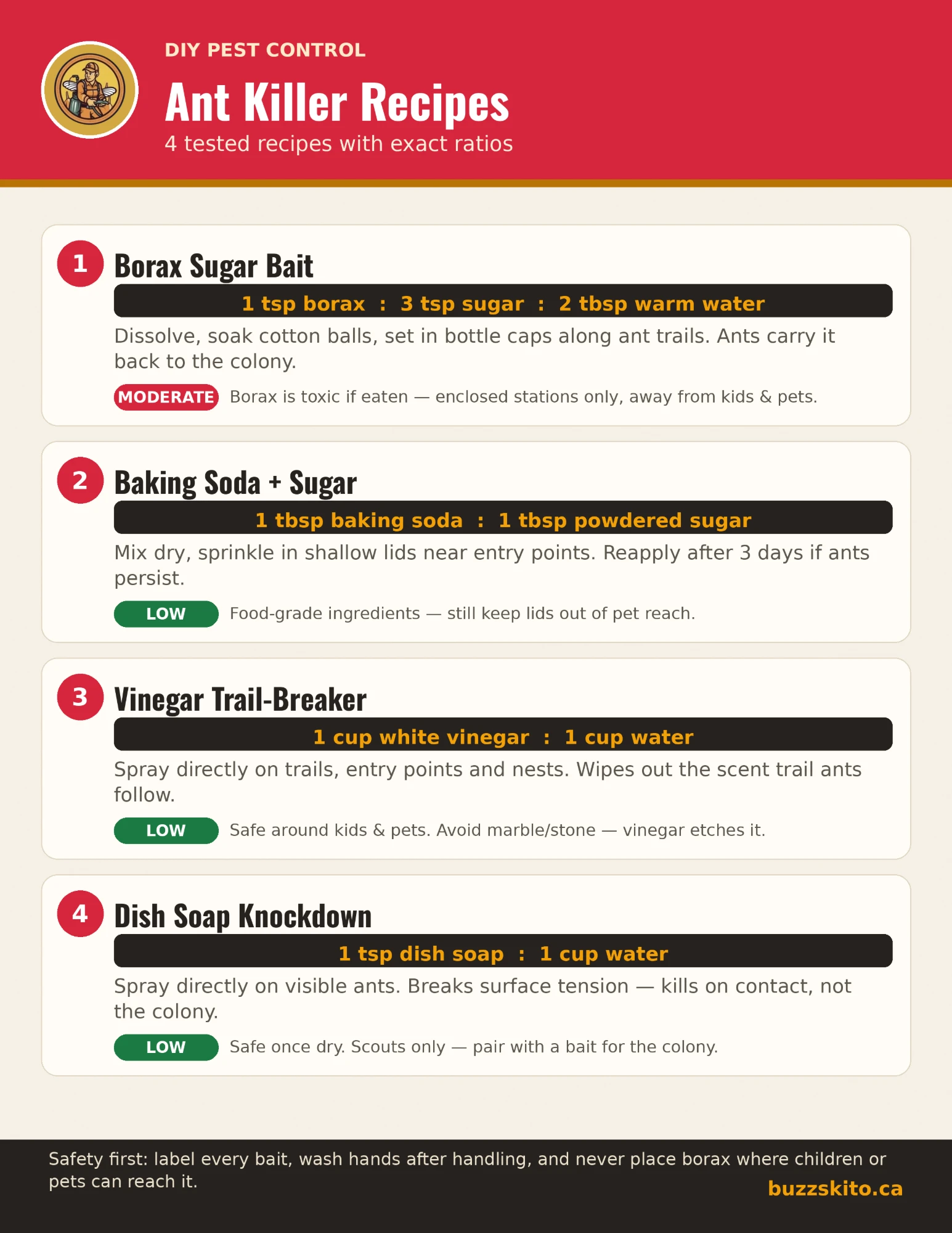
Homemade borax-and-sugar recipes, mostly. The chemistry is real — this is what commercial liquid baits are — but the concentration is the whole trick. Mix it too strong and foragers die before they get home, which turns a colony-killing bait into an expensive contact spray. Commercial baits have already solved that problem, are child-resistant, and are inexpensive. If you do go homemade, err far weaker than the internet recipes suggest.
When It Is a Professional Job (and When It Is Not)
We will start with the honest half: a nuisance-ant problem in a Canadian kitchen is genuinely DIY. A pavement-ant trail across a Mississauga kitchen counter in July is solved by a pack of liquid bait stations and the patience not to spray. Paying for a service call so someone can place the same bait is a poor trade, and any operator who will not tell you that is not one to hire.
Escalate to a licensed professional when the situation is one of these:
- Carpenter ants with structural signs. Frass, hollow-sounding wood, or ants coming from a wall where you know there has been a leak. You need the moisture source found and the extent of damage assessed — often a contractor as well as an exterminator.
- Pharaoh ants in a multi-unit building. They bud through walls and wiring chases; treating one unit relocates the problem. This needs coordinated building-wide baiting. In most provinces, including Ontario, pest control in rental housing is the landlord’s legal responsibility — report it in writing, with photos and a date, because a verbal mention to the superintendent starts no clock.
- European fire ants in the yard. Stinging ants in the lawn and beds are a quality-of-life problem, difficult to eradicate, and usually a multi-season commitment.
- You cannot find the nest. Weeks of baiting with activity continuing, or ants appearing on an upper floor with no trail you can trace, means the nest is somewhere a homeowner inspection will not reach.
- Ants indoors in deep winter. Active foragers in a heated Canadian house in January usually mean the nest is inside the building envelope. That is a structural finding, not a housekeeping one.
- You are not sure whether they are ants or termites. Get the identification made properly. The cost of guessing wrong on a termite is not comparable to anything in this article.
For what that work typically costs in Canada and how to sanity-check a quote, see our Canadian pest control cost guide. And be appropriately suspicious of anyone who proposes to solve a nuisance-ant problem by spraying your baseboards and leaving.
The Ant Year — Timing in a Canadian Climate
Ants do not run on a calendar; they run on soil temperature and moisture. But in a climate with a real winter, those two variables move through the year in a fairly predictable order, and knowing that order tells you when a single bait station does the work of a whole midsummer campaign. The month ranges below are a rough southern-Ontario guide — shift them earlier or later to match your own spring.
As the soil warms — roughly late March into April. Colonies come out of dormancy and the first foragers start probing indoors. Early-season sightings are usually scouts, and a scouting trail is the cheapest possible thing to bait — one station now does what a midsummer campaign has to do later.
Spring warm-up — roughly May into June. Colony expansion and swarming. Pavement-ant nuptial flights and the sidewalk “ant wars” between neighbouring colonies belong to this stretch, and carpenter-ant swarmers fly in spring too — winged black ants indoors in May deserve a proper look, not a vacuum.
High summer — the water push. A hot dry fortnight drives foragers indoors hunting moisture, and the next heavy thunderstorm floods shallow nests under slabs and mulch and pushes them in for the opposite reason. Both ends of that swing point the same direction: inside. If ants are going to turn up on a kitchen counter, this is the weather that sends them.
Cooling off — roughly September into October. Activity tapers as the colony provisions for winter. This is the ideal window for the exclusion pass — caulk, sweeps, mulch pulled back — because you are sealing an empty house rather than trapping an active trail inside.
Below freezing — roughly November into March. Outdoor colonies are dormant below the frost line. Ants seen indoors now are a signal, not a nuisance: the nest is very likely inside the heated envelope.
Getting Rid of Ants in the United States: What Is Different
In the United States the method is the same as in Canada, but the ants, the regulator and the bait shelf are not. Slow-acting bait on the live trail, no repellent spray, then sealing and moisture repair still does the work. The pavement, odorous house, pharaoh and carpenter ants described above are household pests south of the border too, and UC IPM’s Pest Notes on ants lists all four in its table of common household ants. What the southern states, the Gulf Coast, Florida, Hawaii and California add is four invasive species a Canadian guide has no reason to cover, and one of them breaks the bait-first rule.
Red imported fire ants: a yard ant with a medical side
Red imported fire ants (Solenopsis invicta) are a mound-building outdoor ant of the southern states, and they are managed with a yard-wide bait program, not a kitchen bait station. USDA APHIS reports that imported fire ants infest more than 367 million acres in Alabama, Arkansas, California, Florida, Georgia, Louisiana, Mississippi, North Carolina, Oklahoma, South Carolina, Tennessee, Texas, Virginia and Puerto Rico, and it regulates the movement of nursery stock, hay and soil-moving equipment out of quarantine areas. Workers in a single colony range from 1/8 to 1/4 inch, and the soil mounds are seldom wider than 18 inches, according to the University of Florida’s red imported fire ant profile.
Fire ants both bite and sting. The CDC’s guidance for outdoor workers says the venom can cause a burning sensation, and that red bumps at the sting site may develop into white, fluid-filled pustules within a day or two. Its first aid advice is to rub the ants off briskly, because they hold on with their jaws, and to get the person to an emergency medical facility immediately for severe chest pain, nausea, severe sweating, loss of breath, serious swelling or slurred speech.
For control, Texas A&M’s fire ant project calls the Two-Step Method the best proven approach: broadcast a fire ant bait over the entire yard, then treat only the problem mounds with a product labeled for individual mounds. It works best where there are five or more mounds per quarter-acre, the baits need weeks to months to reach 80 to 90 percent control, and they are reapplied once or twice a year. Timing matters. University of Georgia Extension notes that foraging slows when soil temperature is below 65 to 70°F or above 90°F, and that bait should go down when the ground and grass are dry and no rain is expected. The same bulletin says sprinkling grits on a mound is ineffective. If you are not sure the red ant in your lawn is a fire ant at all, the guide to telling fire ants from other red ants sorts that out first.
Argentine ants: the supercolony of California and the Southeast
Argentine ants (Linepithema humile) are baited much like odorous house ants, but at a larger scale and mostly outdoors. They are dull brown and about 1/8 inch long, and UC IPM calls them the most common ant in and around the house and garden in California, with colonies that link into one large supercolony with multiple queens. The University of Florida’s Argentine ant profile documents them throughout the southeastern and southern states and up the western coastline, notes that they do not sting or bite people, and says they infest buildings especially during rainy, cold weather.
Bait strength matters with this ant. UC IPM says prepackaged stations, which usually contain 5.4 percent borate, can kill foragers in the home but are less effective against a major Argentine ant infestation, because the foragers die before they can carry the bait back. For a severe infestation it points to liquid borate products with a lower concentration, 0.5 to 1.0 percent in a sugar-water solution, used in larger refillable stations, and says results may take several days to a week to show. Argentine ants are also one of several species Americans call sugar ants, and the guide to what sugar ants really are helps you work out which one is on your counter.
Ghost ants: Florida, Hawaii and heated buildings
Ghost ants (Tapinoma melanocephalum) are a tropical, multi-queen house ant whose indoor colonies are controlled with bait. Workers are 1.3 to 1.5 mm long, which is roughly 1/16 inch, and the University of Florida’s ghost ant profile describes the species as well established in Florida and Hawaii, present in Texas since the mid-1990s, and able to survive in northern states only in greenhouses and other heated environments. Colonies contain numerous reproducing females and probably spread by budding, and crushed workers smell like rotten coconuts, the same tell as the odorous house ant, which belongs to the same genus. The profile says indoor colonies nesting in voids can be controlled with baits, and it reserves barrier sprays for the cracks and crevices where outdoor foragers get in. Identification, range and control are covered in depth in the ghost ant guide.
Tawny crazy ants: the exception to bait-first
Tawny crazy ants (Nylanderia fulva) are an ant where a consumer bait station is not the answer. Texas A&M’s urban entomology program reports that the species was found around Houston in 2002, that it builds no central nest or mound and lives under rocks, timbers and debris, that workers are not attracted to most bait products, and that effective treatment products are not readily available to consumers. Its advice is to call a professional pest control provider if you suspect them.
University of Georgia Extension’s tawny crazy ant circular describes the workers as orange to reddish-brown, 1/12 to 1/10 inch long, with foraging columns that move erratically, and records the ant in Alabama, Louisiana, Mississippi and Georgia as well as Texas and Florida. Workers have no sting but can bite. The University of Florida’s tawny crazy ant fact sheet adds that the ants infest electrical switch boxes, and that they are an areawide problem controlled better when a whole community acts at the same time.
Baiting versus spraying: what US university extension says
US extension services reach the same verdict as the Canadian sections above for ants trailing indoors: bait them, and do not spray the ants you see. UC IPM states that baits are the only type of insecticide recommended in most situations, that spraying around a foundation kills only foraging ants without killing the colony and the queens, and that no insecticide spray should be used while baits are out. The University of Kentucky’s ant control guide for householders calls spraying only the ants you see the mistake most people make, tells readers to expect more ants around the bait at first and not to spray them, and suggests trying another product if one bait is ignored. On timing, UC IPM says it can take 5 to 10 days to see fewer ants and several weeks or more for control to be complete.
The two differ on placement, and the difference is useful. Kentucky places bait beside indoor trails and warns against using cleaning agents around it, which matches the leave-the-trail rule above. UC IPM, writing largely about Argentine ants that nest outdoors, prefers bait stations outside, spaced every 10 to 20 feet around the foundation, with invading ants sponged up indoors with soapy water. It reserves indoor baiting for a serious infestation where the entry point cannot be found. Kentucky does describe one job for a liquid insecticide: drenching a below-ground outdoor nest once it has been located, following the label directions for treating ant mounds. Both agree on the core point: do not spray insecticide around a bait that is working.
Bait ingredients on US shelves, and what EPA registration means
US consumers can choose among several bait active ingredients, not only the borax-type stations this guide leans on for Canada. UC IPM lists boric acid or borate, fipronil, hydramethylnon and avermectin B (abamectin) as examples to look for on a bait label. The University of Kentucky adds imidacloprid, indoxacarb, thiamethoxam and dinotefuran, and names Combat, Raid, Ortho and Terro as popular consumer brands and Maxforce, Advion, Optigard and Alpine as professional baits sold online. The two sources do not fully agree on indoxacarb: UC IPM, in a publication last updated in 2012, rates bait stations with indoxacarb or propoxur as not very effective because the ingredient acts too fast, while Kentucky’s 2026 revision lists indoxacarb among the active ingredients of the baits it describes, a group that includes professional baits it calls highly effective. UC IPM also warns that granules containing cyfluthrin or permethrin can be mistaken for baits but are contact insecticides that kill foragers without controlling the colony.
The number to look for on a US product is the EPA registration number, the counterpart of the Canadian PCP number discussed above. The EPA’s overview of pesticide registration explains that federal law requires pesticides sold or distributed in the United States, including imported ones, to be registered by the agency, that it must approve all label language first, and that using a pesticide in a manner inconsistent with its labeling is a violation of federal law. In general, states have primary authority for enforcing against illegal pesticide use. The EPA’s guide to reading a pesticide label shows where that number sits. The exception is the group of minimum risk pesticides that EPA has exempted from registration. For a US buyer the label check in this guide simply flips: look for an EPA registration number where a Canadian would look for a PCP number.
Borate baits are low in toxicity, not free of risk. The National Pesticide Information Center’s boric acid fact sheet says boric acid is low in toxicity if eaten or if it contacts skin, that in the form of borax it can be corrosive to the eye, and that boric acid products have been registered in the United States since 1948, with more than five hundred sold. Because young children put their hands and other items in their mouths, it notes that many of these products must be applied out of children’s reach. For an exposure it directs people to the first aid instructions on the product label and to Poison Control at 800-222-1222. The chemistry, and the question of homemade recipes, are covered in the guide to borax and boric acid as ant bait.
Metric sizes in this guide, in US units
The Canadian sections above give ant sizes in millimeters and distances in meters, and the table below converts each one. The conversions are arithmetic; US extension publications round them, and UC IPM lists odorous house ants at 1/8 inch, pharaoh ants at 1/16 inch and carpenter ant workers at 1/4 to 1/2 inch.
| Where it appears above | Metric | US equivalent |
|---|---|---|
| Pavement ant and odorous house ant workers | 2.5 to 3 mm | About 1/10 to 1/8 inch |
| Pharaoh ant workers | About 2 mm | About 5/64 inch, a little over 1/16 inch |
| Carpenter ant workers | 6 to 13 mm | About 1/4 to 1/2 inch |
| European fire ant workers | 4 to 5 mm | About 5/32 to 3/16 inch |
| Bait set to the side of the trail | A few centimeters | An inch or two |
| A station too far off the route, or a nest close to the foundation | 1 meter | About 3.3 feet (39 inches) |
| A parent carpenter ant colony in a tree stump | 20 meters | About 66 feet |
More Ant Guides: Match the Species, the Room and the Remedy
The fastest route to a fix is to identify the ant first, then deal with the room, then pick the remedy. The complete ant reference for US homes explains how colonies work and how to tell the common household species apart. If the ants are very small, the identification key for tiny ants works from size, color and smell, and the guide to black ants in and around the house separates little black ants from the carpenter ants that matter for the structure.
Winged ants raise a different question. What a swarm of flying ants means, indoors or out, has its own page, and the side-by-side look at flying ants versus termites shows the antennae, waist and wing differences summarized in the callout near the top of this guide. If stings or bites are the worry, start with which US ants bite and which sting, then read whether carpenter ants bite if the ants are large and black.
For the plan itself, getting rid of ants in the house follows the trail from the entry point to the nest across the whole building, and the companion page on ants in the kitchen deals with keeping bait away from food-prep surfaces. Home remedies are examined separately: what vinegar does and does not do to ants explains why it clears a trail without reaching the colony. Bait choice follows diet, so what ants eat explains the swing between sugar and protein, and how long workers and queens live shows why a colony outlasts anything that only kills workers.
Frequently Asked Questions
How do I get rid of ants in my house permanently?+
Kill the queen, not the trail. The workers marching across your counter are foragers — only a small fraction of a colony — and squashing or spraying them changes nothing underground. Bait works because ants share food by mouth-to-mouth transfer (trophallaxis): a forager fills up on slow-acting bait, walks home, and feeds the brood and the queen over the following days. Place liquid or gel bait directly on the active trail, leave it alone for several weeks, resist the urge to spray or wipe, and fix the moisture and entry points afterward so the next colony has no reason to come in. That sequence — bait, wait, exclude — is the whole plan.
Why are there suddenly MORE ants after I put down bait?+
Because it is working. A forager that finds a good food source lays a recruitment pheromone on the way home, and within hours the colony sends dozens more workers down that chemical highway. A bait station swarmed with ants on day two is the single best sign you have — it means the bait is palatable, the trail is intact, and the active ingredient is being carried into the nest. The surge typically peaks in the first few days and then falls away as the colony declines. A common mistake is panicking at the surge and spraying it, which kills the delivery drivers and ends the treatment.
What kind of ants get into houses in Ontario?+
Four matter. Pavement ants (2.5–3 mm, dark brown-black, fine parallel grooves on the head) nest under driveways, walkways, patio slabs and foundation edges, and are one of the ants most often reported in Ontario kitchens. Odorous house ants are the same size but smell like rotten coconut or blue cheese when crushed, and they split colonies when disturbed. Pharaoh ants are tiny (about 2 mm) and pale amber, live only inside heated buildings, and are notorious for budding into new colonies when sprayed — they are an apartment and institutional problem. Carpenter ants are the big ones (6–13 mm, black, evenly rounded back) and are a structural issue, not a picnic issue, because they excavate galleries in moisture-damaged wood.
Does spraying ants make the problem worse?+
Frequently, yes — and with two species it is close to guaranteed. Most consumer ant sprays are repellent pyrethroids: the survivors detect the residue and move away from it. In single-queen species that mostly means relocating a trail. In multi-queen species such as odorous house ants and pharaoh ants, the stress response is budding — the colony splits, queens and brood scatter to new nest sites, and you convert one problem into three or four in different walls. Spray residues also make ants refuse bait placed nearby, so if you spray for a week and then switch to bait, it is easy to conclude that bait does not work when the bait never had clean ground to stand on.
Should I clean up the ant trail?+
Not until the baiting is finished — this is the most counterintuitive rule in ant control. The trail is a pheromone highway, and it is the delivery route your bait depends on. Wiping it with vinegar, bleach, or an all-purpose cleaner erases the route, scatters the foragers, and forces them to re-scout, which often means they find a different way in and never return to your bait. Leave the trail alone, put the bait on it, and tolerate a week or two of visible ants. Once activity stops completely — no ants on the bait for several days — then wash the trail down with soapy water so a future colony cannot pick up the old chemical map.
Gel, liquid, or granular ant bait — which one should I use?+
Liquid sugar-based bait is the best default for indoor Canadian house ants: pavement ants and odorous house ants are strong carbohydrate feeders, liquid moves through a colony efficiently by trophallaxis, and enclosed liquid bait stations are widely available in Canada — check the pack for a Canadian PCP registration number. Gel bait is the precision format for cracks, hinge voids, and the seam a station cannot sit in, but many gels sold to Canadian buyers through online marketplaces are US-market product — check the label for a Canadian PCP registration number before buying. Granular bait is an outdoor broadcast format, and in Ontario it runs straight into provincial cosmetic-pesticide rules on lawns and gardens, so read the label and the provincial rules before you scatter anything.
Is Advion ant gel legal in Canada?+
Treat it the same way you should treat any imported pesticide: check the label, not the listing. Advion (indoxacarb) is the reflexive answer on American ant forums, and the versions that reach Canadian buyers through cross-border marketplace listings are typically US-market product formulated and labelled under US EPA registration. Under the Pest Control Products Act, a pesticide sold or used in Canada generally must carry a Canadian PCP registration number on its label, and no PCP number means no Canadian label directions stand behind how you use it. The practical point is that you do not need the import: enclosed liquid borax bait stations sold by Canadian hardware and big-box retailers run on the same carry-it-home mechanism.
Do ultrasonic ant repellers work?+
No. Ultrasonic plug-in devices have been marketed against ants for decades and there is no credible evidence they repel, kill, or deter them — ants navigate by chemical trails and physical contact, not by hearing, so the premise does not map onto the animal. The US Federal Trade Commission has taken action against unsupported claims in this category. Put that money toward a multi-pack of liquid bait stations instead; it will actually reach the queen. We cover the wider category, including the versions marketed for rodents and mosquitoes, in our ultrasonic pest repeller guide.
Do vinegar, cinnamon, coffee grounds, or essential oils get rid of ants?+
They interfere with trails; they do not kill colonies. Vinegar and strong scents can temporarily disrupt the pheromone path, and ants will detour around cinnamon or a citrus-oil line for a while. None of it reaches the queen, so the colony keeps producing workers and simply finds a new route — usually one you cannot see. Worse, the vinegar wipe-down is actively counterproductive mid-treatment, because it destroys the trail your bait needs. Use these as nothing more than a short-term barrier on a countertop while the bait does the real work, and do not use them anywhere near a bait placement.
How long does ant bait take to work?+
Expect visible trail activity to drop off within days to a couple of weeks for a typical pavement-ant or odorous-house-ant kitchen trail, with full colony collapse taking several weeks. The delay is deliberate: a bait that killed foragers on contact would never get carried home, so the active ingredient is chosen to be slow. Larger, multi-queen, or multi-nest infestations (pharaoh ants especially) can need months of continuous baiting, because you have to reach several queens through several nests. Keep bait fresh — dried-out liquid bait is invisible to ants — and judge progress by whether the trail is thinning, not by whether you still see an ant.
Do ants in the house mean my home is dirty?+
No. Ants come inside for three reasons — food, water, and shelter — and weather does far more to drive them in than housekeeping does. A hot dry stretch in July sends foragers indoors looking for moisture, and heavy rain floods shallow nests under a patio slab and pushes them into the wall cavity. Spotless kitchens get ants. What cleanliness genuinely changes is competition: crumbs, a sticky recycling bin, an unwashed pet bowl, and grease film on the stove give ants alternatives to your bait, which slows the whole treatment down. So clean the kitchen because it makes the bait the most attractive thing in the room, not because ants are a hygiene verdict.
Do ants go away on their own in the winter?+
Outdoor colonies do not die — they go dormant deep below the frost line and return in spring, which is why the same patio-slab colony reappears every May. What matters is the diagnosis you make if you see ants indoors in January or February. Foragers active in a heated house in the dead of a Canadian winter usually mean the nest itself is inside the building envelope: a wall void, under a bathtub, behind a warm chimney chase, or in moisture-damaged wood. That is a more serious finding than a summer trail, and if the ants are large and black, treat it as a possible carpenter-ant structural problem and get the wood inspected.
When should I call an exterminator for ants?+
A kitchen ant trail in Canada is genuinely a DIY job — a pack of liquid bait stations costs a fraction of a service call and works. Call a licensed professional when: you have large black ants plus coarse sawdust-like frass or hollow-sounding wood (carpenter ants damaging structure); you have tiny pale ants in an apartment or condo (pharaoh ants bud through buildings and need coordinated multi-unit treatment, which in most provinces including Ontario is the landlord’s responsibility); you have stinging red ants in the yard (European fire ants are established in parts of the GTA and are miserable to remove); you cannot find the nest after weeks of baiting; or you are not sure whether the winged insects you found are ants or termites. Our Canadian pest control cost guide covers what that work typically runs.
How do I get rid of fire ants in my yard in the United States?+
University extension services in the southern states teach the Two-Step Method for red imported fire ants. Step one is broadcasting a fire ant bait over the whole yard while the ants are foraging. Step two is treating only the problem mounds with a product labeled for individual mounds. Texas A&M reports that baits are slow, taking weeks to months to reach 80 to 90 percent control, and are reapplied once or twice a year. Follow the label on every product.
Which ant bait ingredients are sold in the US, and what does the EPA registration number mean?+
University extension publications list borates (borax or boric acid), fipronil, hydramethylnon, abamectin, imidacloprid, indoxacarb, thiamethoxam and dinotefuran among the active ingredients in US ant baits. Federal law requires pesticides sold or distributed in the United States, including imported ones, to be registered by the EPA, apart from minimum risk products the agency has exempted. The EPA registration number on the label shows a product went through that process, and using it in a way that conflicts with its labeling is a violation of federal law.
Do Argentine ants, ghost ants and crazy ants need a different treatment from other house ants?+
Two of the three do not. Argentine ants and ghost ants live in colonies with many queens, and university extension sources describe controlling them with baits, with sweet liquid baits favored for Argentine ants, because spraying kills only the foragers. Tawny crazy ants are the exception. Texas A&M reports that their workers are not attracted to most bait products and that effective treatment products are not readily available to consumers, so it advises calling a professional pest control provider if you suspect them.
Related Pest Guides
- How to Get Rid of Carpenter Ants in Canada — The Structural Guide
- How to Get Rid of Cockroaches in Canada — The Bait-First Plan
- How to Get Rid of Silverfish in Canada
- Diatomaceous Earth in Canada — Buyer’s Guide and Application Technique
- Do Ultrasonic Pest Repellers Work? The Honest Verdict
- How to Keep Spiders Out of Your House
- Pest Control Cost Canada — What Professionals Charge