BuzzSkito Mosquito & Tick Control Specialists · Published July 27, 2026 · Updated October 8, 2026
How Do You Actually Get Rid of Carpenter Ants?
By finding the nest. That is not a throat-clearing preamble to the real advice — it is the advice, and it is what separates a problem solved in one season from a problem still being sprayed at three summers on. Every other pest on this site can be beaten by changing a condition: dry the basement and silverfish leave, bait the kitchen and roaches collapse. Carpenter ants do not work that way, because the thing you need to kill is a queen sitting inside a piece of wood you cannot see, protected by a few thousand workers whose job is to bring her food from anywhere within a radius that can easily exceed the width of your lot.
Kill the ants on the counter and you have removed a tiny fraction of a colony, in the worst possible way: the survivors reroute, the satellite nest relocates a stud bay deeper into the wall, and the trail you could have followed disappears. Find the nest and the treatment part is almost anticlimactic — a dust into that void, or a bait line on that trail, and it is done.
So the plan for this page runs in that order. Confirm what you actually have. Read the frass. Work out whether the nest is inside the building or outside it — the season and the calendar will tell you more than the ants will. Understand the parent-and-satellite structure, because that is why this problem keeps coming back. Find the water, because the ants went where the wood was wet. Then, and only then, treat — and know the line where DIY stops being the cheaper option, because with carpenter ants that line arrives earlier than people expect.
Check current Canadian availability of the diagnostic kit:
Confirm It Is a Carpenter Ant — and Not a Termite
Carpenter ants (Camponotus species) are among the largest ants found in Ontario, and the two usually identified here are an all-black species and one with a rusty red-brown midsection. Get one under decent light and check three things. The waist is sharply pinched, wasp-like, with a single node. The antennae are elbowed — a short first segment, then a distinct bend. And viewed from the side, the back is a single smooth arch, not a bumpy or notched profile like most other ants.
One more tell that surprises people: size varies within a single colony. Carpenter ant workers are polymorphic, so a trail can contain small ants around 6 mm walking beside majors well over a centimetre. If you have ants of noticeably different sizes on one trail, that is a carpenter ant signature, not two species meeting.
The comparison that actually matters is with termites, because the response is different and the cost of getting it wrong runs one direction. A termite has no waist — it is straight-sided from head to abdomen. Its antennae are straight and beaded, not elbowed. Termite workers are soft and creamy-white, which is why the old name was “white ants.” And in swarming season, the wings settle it instantly: a carpenter ant’s front pair of wings is clearly longer than the back pair, while all four termite wings are the same length and shed off in tidy piles on a windowsill.
The damage signatures diverge just as cleanly. Carpenter ants keep their galleries immaculate — smooth, sanded-looking chambers with all the debris pushed outside. Subterranean termites do the opposite: they pack galleries with soil, and they build mud shelter tubes up foundation walls and joists because they must stay in contact with moist ground. And no, termites are not somebody else’s problem in Canada: the eastern subterranean termite is established in documented pockets of southern Ontario, including parts of Toronto and several southwestern Ontario municipalities, some of which run their own termite programs and maintain rules about moving untreated wood or soil out of designated areas. Mud tubes, soil-packed grain, or piles of equal-length wings mean you stop, put the bait away, and get a licensed structural inspection.
Frass: The Sign Worth Learning to Read
If you find frass, you are ahead of most people fighting this. Frass is the excavated material carpenter ants push out of their galleries through small slit-like openings, and it looks like coarse sawdust or fine pencil shavings — dry, fluffy, pale, and, critically, mixed with insect body parts. Legs, wing fragments, dead ant sections, and whatever else was in the void: shreds of fibreglass insulation, crumbs of rigid foam, bits of old newspaper from a 1960s wall. That inclusion is what distinguishes it from renovation dust or wood-boring beetle powder, which is fine and flour-like.
Common places it turns up: under a basement window frame, along the top of a foundation wall where the sill plate sits, at the base of a door casing, on the treads below an attic hatch, on top of attic insulation near the soffits, on a deck board directly below the ledger where the deck meets the house, and inside a garage against the wall shared with the living space. Occasionally it drifts down from a ceiling light fixture, which is a fast escalation — that means a nest in the joist bay above.
Two things to do with it. First, sweep it up and mark the date. If a fresh pile appears within a few days, the nest above it is active right now, which is the green light for treatment and the evidence a professional will want. Second, do not seal the opening. The instinct is to caulk the slit shut. Resist it: that opening is your monitor, your access point for dust, and the thing that tells you whether treatment worked. Seal it after the colony is dead, not before.
The Winter Rule: Ants Indoors in February Means a Nest Indoors
Overwintering biology makes an indoor February sighting genuinely diagnostic, and the check costs nothing. Carpenter ants that live outdoors in Ontario go into overwintering dormancy once the cold sets in. They cluster in the nest, they do not forage, and they do not send workers across a snow-covered yard to your kitchen. So a live carpenter ant walking your countertop in January or February did not come in from outside. It is already inside — in a wall void, a subfloor, an attic soffit, the framing behind a shower, or the boxed-in space around a chimney — kept active all winter by the warmth of the house it is living inside.
The same logic applies to winged ants. Swarmers are produced by mature colonies and released to found new ones, and outdoor colonies swarm outdoors in spring. Winged carpenter ants emerging inside your house — typically accumulating at windows, because they fly to light — means a nest inside the structure that has been there long enough to reach reproductive maturity. In Ontario that usually shows up in late winter or spring, when the interior warmth runs ahead of the season outside.
Contrast that with the ordinary summer picture: a handful of workers appearing in the kitchen in July, mostly at night, often near a sink or a pet bowl. That could be a foraging trail from a stump at the back of the yard, and the investigation runs outward rather than inward. Same insect, entirely different job.
Parent Colonies, Satellite Colonies, and Why It Keeps Coming Back
Here is the structure behind a lot of failed carpenter ant campaigns. A carpenter ant colony is not one nest — it is a network.
The parent colony holds the queen, her eggs and the youngest larvae. Those eggs need consistent humidity to stay viable, so the parent colony has to be in genuinely damp wood: a stump, a dead limb, a fallen log, a rotting fence post, a buried offcut of lumber, a woodpile that has been sitting on soil for two seasons, or — when things have gone badly — a rotted sill plate or roof deck inside the house.
The satellite colonies hold older larvae, pupae, workers and the winged reproductives. None of those life stages need high humidity, which means satellites can live in perfectly dry wood: your wall studs, your subfloor, a hollow-core door, the void inside a boxed soffit, roof sheathing, even rigid foam insulation board, which carpenter ants tunnel through with enthusiasm despite it not being wood at all. Workers commute between parent and satellites along established trails, moving brood and food back and forth.
Now the failure mode is obvious. You find ants in the kitchen wall, you treat the kitchen wall, the ants stop for a while, and then they are back — because you killed a satellite while a queen in a stump forty metres away kept producing replacements. Or the reverse: you find and destroy a nest in the backyard log, and satellites already established inside the house carry on regardless, since one of them can raise a new queen’s worth of trouble on its own. The only durable outcome comes from a treatment the workers carry through the whole network — which is precisely why bait, and non-repellent professional products, succeed where contact killers do not.
The Root Cause Is Water, Not Ants
Carpenter ants are not randomly distributed. They excavate wood that is soft, and wood goes soft when it gets wet and stays wet. If you find a nest, there is a water story behind it, and if you fix the ants without fixing the water you have booked a rerun.
The Ontario list, and the water story sitting behind each one:
- Ice damming. The winter classic. Meltwater backs up under shingles, soaks the roof sheathing and the soffit framing, and by the following summer that wood is exactly what a satellite colony wants. Attic frass near the eaves usually traces back to this.
- Failed flashing. Chimneys, skylight curbs, the little roof over a bay window, and the junction where a second-storey wall meets a lower roof. Slow, invisible, and it wets structural framing directly.
- Deck ledger boards. Where the deck bolts to the house is a classic exterior nest site, because water tracks behind the ledger and sits there with nothing to dry it. Check the underside of the deck at the house wall.
- Downspouts dumping at the foundation. Saturated soil against a sill plate and wet rim joists behind the siding. Extensions are an inexpensive fix.
- Wood-to-soil contact. Fence posts, deck posts, landscape timbers, planter boxes against siding, and mulch piled up over the sill. Wood touching soil is wet wood.
- Interior plumbing. Behind a shower surround, under a dishwasher, at a fridge water line, around a bathtub drain. These produce nests in the middle of a house with no exterior clue at all.
- Firewood and yard debris. A woodpile stacked against the house on bare ground is a parent colony waiting to happen, and every log you carry inside is a delivery.
The corollary is a genuinely useful piece of triage: carpenter ants in a stump at the back of your lot, with no trail to the house and no indoor activity, are not a problem you need to solve. They are native insects doing the job of breaking down deadwood. Remove or grind the stump if you want to reduce pressure, but blanket-treating a yard because there are ants in it is money spent on nothing. The trigger for action is a trail heading toward the house, or evidence inside it.
Find the Nest: The Inspection That Decides Everything
Carpenter ants forage at night, which makes daytime inspection mostly unproductive and a headlamp the tool the whole inspection depends on. Pick a warm evening, start about an hour after sunset, and give it a proper hour.
Walk the trail, do not interrupt it. Ants move along edges: the top of the foundation, the underside of siding trim, deck rails and joists, fence tops, hydro and cable lines, and any tree branch or shrub touching the roof or wall — those are bridges, and carpenter ants use them constantly. Find a moving ant and follow it in both directions. Where is it coming from, and where is it going? Do not spray it, do not wipe the trail with vinegar, and try not to break the line: you are following a map, and every disruption redraws it.
Then bring the moisture meter. This is where the job usually breaks open. Run a pinless meter along the sill plate, the rim joist, window and door headers, the wall behind a shower, the deck ledger, and any framing you can reach in the basement or attic. Take a reading on wood you know is dry as your baseline, then hunt for the anomaly. Damp framing in a house with no obvious leak is telling you two things at once: where the ants are, and where the repair is.
Listen. A large, active colony inside a wall void can be audible — a faint dry rustling, most often described as crinkling cellophane, and usually heard at night when the house is quiet. Tap along a suspect wall and listen. It is not subtle once you have heard it, and it is strong enough evidence to justify a professional call on its own.
Watch for the frass to point down. Frass falls. A pile at floor level means the opening is somewhere above it, sometimes several feet up. Follow the vertical.
Why DIY Spraying Fails on Carpenter Ants
Walk into a Canadian Tire, a Home Depot Canada or a Rona and the ant section is mostly aerosols and ready-to-use trigger sprays — the Raid, Wilson, Doktor Doom and Ortho end of the shelf. The actives are typically repellent pyrethroids. On a carpenter ant problem, they fail in three specific ways, and it is worth understanding each because the same logic explains what does work.
They kill a rounding error. A mature colony numbers in the thousands across a parent nest and its satellites. The ants visible on your counter at any moment are a vanishingly small fraction of that, and the queen — the only individual whose death actually ends the colony — is never among them.
They are repellent, so the colony scatters. Pyrethroid residue is detectable to ants. Spray a trail and the survivors do not queue up to die on it; they reroute. Satellites relocate deeper into the structure, sometimes splitting into more nests than you started with, and the tidy trail that would have led you to the source is gone. In carpenter ant work, losing the trail is a real setback, because the trail was the diagnostic.
They sabotage bait. This is the expensive one. Bait only works if living foragers carry it home. Spraying kills exactly those foragers and leaves residue that makes ants refuse nearby bait placements. It is easy to spray for a fortnight, switch to bait, and conclude that bait does not work either — when the bait never had a functioning workforce to exploit.
Spray has one honest role: a direct treatment into a nest opening you have actually located, applied per the label. That is a completely different act from misting a baseboard because you saw an ant near it. And a note on Canadian rules while we are here — every pesticide legally sold in Canada carries a PCP registration number on the label from Health Canada’s Pest Management Regulatory Agency, and the non-repellent actives professionals rely on for ant work are commercial-class here, which is why a licensed operator has options you simply cannot buy. Ontario’s cosmetic pesticide restrictions, incidentally, do not block carpenter ant treatment: structural pest control is not cosmetic lawn-and-garden use.
Baiting: The Consumer Method That Reaches the Queen
Bait is the retail option that can reach a colony you cannot see, and it works because of how carpenter ants eat. They are liquid feeders — outdoors they live substantially on honeydew from aphids — and they share food by regurgitation, passing it worker to worker and ultimately to larvae and the queen. A slow-acting toxicant in a liquid sugar bait rides that distribution network straight to the target.
What to buy, honestly: sugar-based liquid borax or boric acid ant baits — the Terro-style liquid stations that Canadian Tire, Home Depot Canada and Rona all stock in ant season. Check the label for a PCP registration number and check that carpenter ants are named. Granular baits, the ones designed to be scattered on soil, are generally a poor match: carpenter ants are not big granule foragers, and most of it just sits there.
Now the rules that decide whether it works:
- Place on the trail, not where you saw one ant once. Bait works by interception. Put stations directly on the established travel line — along the foundation edge, on the deck rail they run, under the sink beside the pipe they follow.
- Never spray anything near the bait. Not aerosols, not vinegar, not essential-oil “natural” sprays. All of them are aversive and all of them break the chain.
- Do not make it stronger. A common DIY mistake with homemade borax mixes is over-dosing, which kills the forager on the spot. A dead ant on your counter is a failed delivery. Commercial liquid baits are formulated slow on purpose.
- Expect traffic to increase first. For the first few days, more ants show up, because workers recruit nestmates to a good food source. That surge is the mechanism working. Panicking and spraying it is a common way this goes wrong.
- If they ignore the sugar bait, try protein. Carpenter ant food preference shifts through the season — more protein demand when brood is being raised, more carbohydrate later. Setting out a small greasy or protein bait alongside the sugar one and seeing which gets worked is a legitimate field test.
- Give it weeks. Meaningful decline takes several weeks, not days. Keep bait fresh; dried-out bait is invisible bait.
Product selection matters less here than nest-finding does, but if you want the shelf sorted before you spend anything, we compared the Canadian options — liquid borax stations, protein baits, gels and perimeter products — in our guide to the ant killers that reach the queen in Canada. For the enclosed-station formats specifically, including which are safe to leave down around pets and kids, see bait stations versus glue traps for Canadian homes.
Dusting a Void — Once You Actually Know Where the Nest Is
Dust is the professional’s answer for a located nest, because a dust travels through a void, coats the surfaces ants walk on, and keeps killing indefinitely as long as it stays dry. For a homeowner in Canada, that means insecticidal diatomaceous earth applied with a bulb duster — and, as always, a label carrying a PCP registration number, because DE sold as a feed additive is a different product with no pest-use directions behind it.
Technique matters more than product. Puff a thin, barely visible film; ants detect and detour around a visible pile, so a heavy application actively performs worse. Good targets you can reach without opening a wall: the gap along a sill plate, the void behind a loose baseboard, the soffit or attic edge near where frass is falling, and the slit-like opening the ants are already using — which is the target worth prioritising, since it leads directly into the gallery. Do not puff dust into electrical boxes or around wiring; a wall void is a legitimate target, an outlet is not, and no gallery is worth that risk.
What not to do: do not drill exploratory holes into walls hoping to find a gallery. Blind drilling into a stud bay is how people hit wiring and plumbing, and it rarely finds the nest anyway; that work belongs to someone with a meter, a borescope and insurance. And remember DE’s hard limitation on this particular pest — carpenter ants nest in wood that is damp, and DE is inert the moment it gets wet. In a genuinely wet void it will do very little, which is one of the honest reasons carpenter ants often tip toward professional treatment. Our full application and product-selection guidance is in the diatomaceous earth buyer’s guide for Canada.
Exclusion and Yard Work: Stop Rebuilding the Highway
None of this kills an ant today, and all of it decides whether you are doing this again in two years.
Cut the bridges. Prune tree limbs and shrubs back so nothing touches the roof or the siding — a couple of metres of clearance. Overhanging branches are a common carpenter ant entry route into upper storeys, and they bypass every bit of ground-level sealing you did.
Break wood-to-soil contact. Firewood off the ground, off the wall, and ideally not against the house at all; bring in only what you burn that day. Pull mulch back from the siding so the sill plate is not buried. Replace or lift landscape timbers sitting directly in soil. Dig out buried construction offcuts if you find them — they are classic parent-colony real estate.
Deal with the deadwood. Stumps, dead limbs and hollowing trees anywhere in the yard — and on the lots next door — are the realistic parent-colony sites. You do not need a sterile lot, but the dead stump twenty feet off the deck is worth grinding.
Then seal. Caulk foundation cracks, gaps around utility penetrations, and the joints where trim meets siding. Fit door sweeps. Screen weep holes and vents. In a Canadian house every one of those seals also cuts a draft, and the identical exclusion pass is what we recommend against the autumn invasion crowd — the technique overlaps almost exactly with cluster flies and keeping spiders out, which exploit the same gaps every October.
Two more small things that pay: fix the downspout that dumps at the foundation, and clean the gutters, since the overflow is often the water story behind an attic nest. If you are also seeing large flying insects around outdoor lights in early summer and wondering what they are, our June bugs in Ontario guide covers the other big Ontario insect people mistake for something serious.
What Does Not Work — Said Plainly
Ultrasonic plug-in repellers. No. There is no credible evidence they control any structural pest, and a colony inside a wall void is acoustically insulated from the device anyway. We wrote up the whole category in do ultrasonic pest repellers work; the summary is that the money is better spent on a moisture meter.
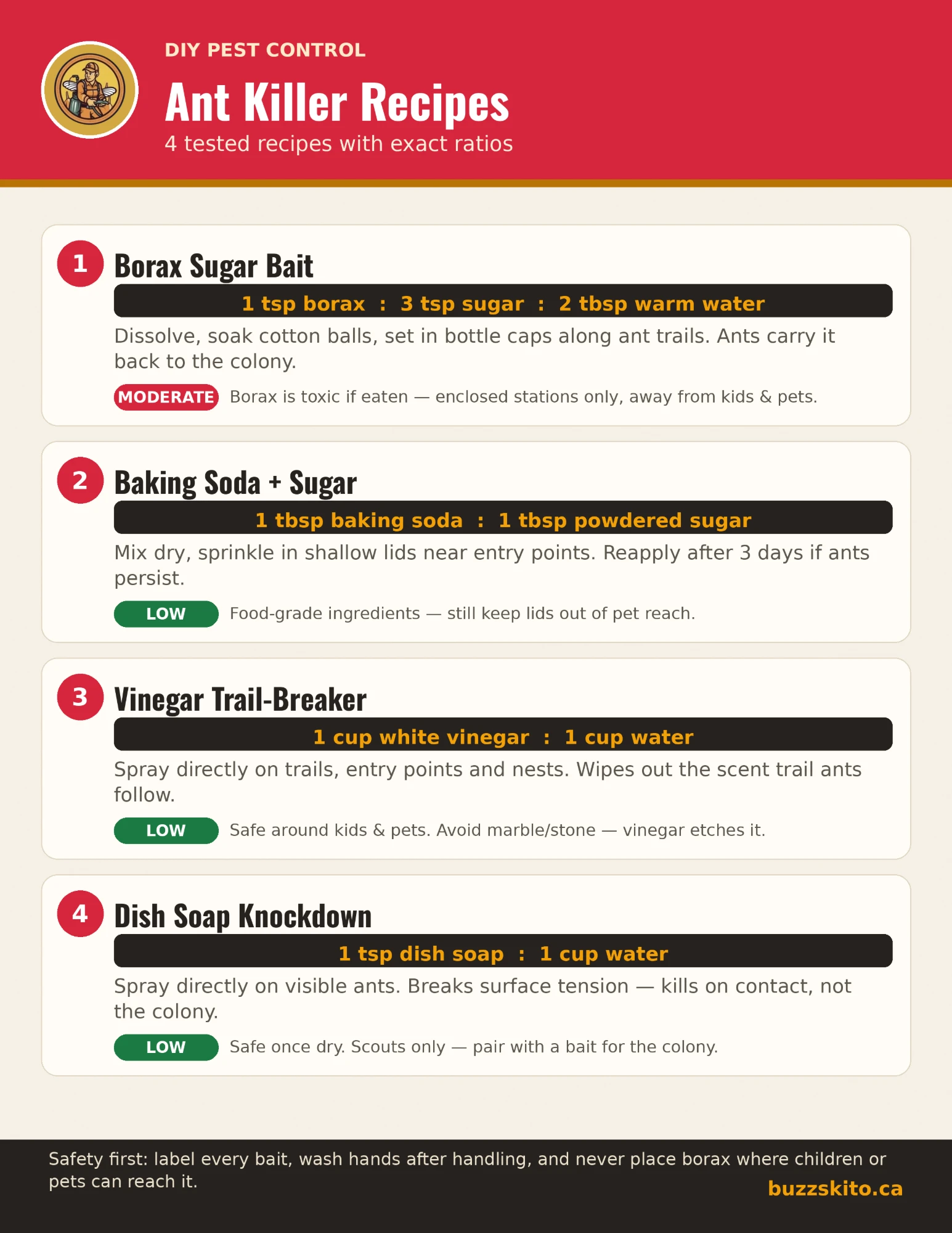
Cinnamon, vinegar, coffee grounds, chalk, peppermint oil. These disrupt a pheromone trail temporarily. The ants take a different route for a day or two. The queen notices nothing. If a “remedy” makes the ants disappear from your counter overnight, what it did was move the trail, and you have lost your best diagnostic.
Boiling water on a nest. Fine on an outdoor anthill in soil; irrelevant to a colony inside wood, and a bad idea anywhere near a structure.
Sticky traps. Useful as monitors for some pests, near-useless as control here. They will not out-catch a colony and they will not tell you where the nest is the way a trail and a moisture reading will.
Total-release foggers. Actively counterproductive here. A fogger coats open surfaces, which is where carpenter ants are not, scatters satellites deeper into the structure, contaminates every location where bait would have worked, and carries real fire and inhalation risks in an enclosed space. A fogger is not a recognised carpenter ant treatment.
The Honest Call-a-Pro Threshold
We publish product research, and on most pests we will tell you that the DIY route is genuinely good enough. Carpenter ants are the page where that changes, because the value is in diagnosis and access rather than in the product — and because the consequence of getting it wrong compounds inside a wall for years.
Call a licensed operator when any of these are true:
- Live ants indoors in winter, or winged swarmers emerging inside the house. Both mean a mature nest inside the structure.
- Frass in more than one location, or frass coming from a ceiling. Multiple satellites, or a nest in a joist bay above living space.
- Audible rustling in a wall, or wood that sounds hollow or feels spongy when probed.
- Several weeks of correct baiting with no decline. At that point you are missing the nest, not under-dosing.
- You cannot find the nest after two proper after-dark inspections with a light and a meter.
- Any suspicion of termites. Different insect, different regulations, different urgency — stop and get an inspection.
What a good operator brings that you cannot buy: non-repellent commercial-class actives that ants carry through the colony without detecting, commercial-class void treatments, injection equipment for wall cavities, moisture meters and borescopes, and the pattern recognition to read a trail back to a stump you would have walked past twenty times. On cost, our Canadian pest control cost guide puts carpenter ant work meaningfully above general ant work — roughly $300–$800 in Ontario versus $150–$400 — and that premium is buying inspection and nest treatment, not a bigger sprayer.
Two things to insist on when you hire. An inspection before a price. Anybody quoting a carpenter ant job over the phone is selling a perimeter spray, and a perimeter spray does not find nests. And a moisture conversation. If nobody asks about leaks, ice damming, the deck ledger or the shower wall, you are getting a treatment rather than a solution. Frequently the real repair belongs to a roofer or a carpenter, and the exterminator is the cheaper half of the job.
One last note on who is telling you this, because it should shape how you weigh it. BuzzSkito is a mosquito and tick control company — that is the work we are licensed and equipped for, and we do not treat ants. This guide is independent research rather than an account of our own service calls, which is exactly why it keeps pointing you toward a licensed structural operator instead of toward us. If you take one thing away from the page, make it the deck ledger: a trail running along the board where a deck meets the house is worth acting on, because somebody should be looking behind that board before the wood behind it goes any further.
Carpenter Ants in the United States: What Is Different
To get rid of carpenter ants in the United States, find the nest and treat it directly, or set a slow-acting bait labeled for carpenter ants along the trail, as its label directs, so the foragers carry it home, then repair the damp wood that drew them in. Killing the ants you can see will not do it, because the University of California’s carpenter ant Pest Notes put only about 10% of the ants out foraging at any one time. That method is the same on both sides of the border. What changes is the species on your wall, the month the swarmers fly, the number to look for on the label, and which products are reserved for licensed applicators.
Which Carpenter Ant Is It? Species by US Region
Extension services name a different carpenter ant for each part of the country: the black carpenter ant in the Northeast, the western black carpenter ant and a red-and-black relative in the West, and the Florida carpenter ant in Florida and some neighboring states.
| Region | Species | How extension sources describe it | Worker length |
|---|---|---|---|
| Northeast | Black carpenter ant Camponotus pennsylvanicus | Dark, shiny brown to black; a common invader of homes in the northeastern US, and also found in Florida’s panhandle | 1/4 to 1/2 inch |
| Western states | Western black carpenter ant Camponotus modoc | Uniformly black with dark red legs; with the usually red-and-black Camponotus vicinus, one of the two most destructive species in the Western US | 1/4 to 1/2 inch |
| Florida and some neighboring states | Florida carpenter ant Camponotus floridanus | Ash brown to rusty-orange head and thorax with a black rear section; nests in existing voids and soft material, not in sound wood | 0.2 to 0.4 inch |
The eastern row comes from Penn State Extension’s carpenter ant fact sheet, the western row from UC IPM, and the Florida row from the University of Florida’s Florida carpenter ant profile. Florida is where the stakes change. UF/IFAS reports that Florida carpenter ants will not excavate nesting galleries in sound wood: they move into existing voids, or dig only soft material such as rotten or pithy wood and Styrofoam. The same publication contrasts them with the wood-damaging black carpenter ant, which it places in Florida’s panhandle, so the species still matters there. A second Florida species, the Tortugas carpenter ant, is limited to the central and southern parts of the state.
When Do Carpenter Ants Swarm in the US?
Carpenter ant swarmers fly in spring to early summer in the East and the West alike, and across a much longer rainy season in Florida. The University of Kentucky’s carpenter ant fact sheet places mating in late May to early June. Washington State University’s carpenter ant fact sheet gives April to early June for mating swarms. UC IPM says only that the flights happen in spring and that the timing varies by species, adding that the western black carpenter ant swarms in the late afternoon, often after a heavy rain. In Florida, UF/IFAS describes winged ants flying in the evening or at night during the rainy season, May through November, with complaints numerous in the spring swarm season, usually between April and June, when winged ants are often found in homes.
The indoor rule on this page holds in the US too. Penn State says numerous winged ants at windows inside a house probably came from an indoor nest, and the Kentucky fact sheet calls large numbers of winged adults indoors a good indicator that the nest is inside the home. Penn State also supports the winter rule for cold-winter states: the ants are inactive in winter but stay active when a nest sits in a heated part of a building. A swarm is a sign of age as well. Penn State puts a colony at several years old, with about 2,000 to 3,000 workers, before it usually produces winged males and queens.
For the bigger picture, how many ants are alive on Earth explains how researchers estimated the global number at any one time and what that estimate leaves out.
What US Homeowners Can Buy, and What the Label Decides
US homeowners can buy slow-acting ant baits, borate and desiccant dusts, and pyrethroid sprays, and the number to look for on the label is an EPA registration number where a Canadian product carries a PCP number. The National Pesticide Information Center’s label guide describes that number as the unique product number and says using a pesticide in any manner not listed on its label is against the law. The EPA requires pesticides to be registered unless they meet its minimum-risk criteria. For carpenter ants the practical step is to confirm before buying that the label names carpenter ants and the place you plan to treat.
- Baits. The Kentucky and California sources both say a bait should be slow-acting, so the ants carry it back and share it with the colony. UC IPM calls carpenter ants finicky and suggests first offering a plain food such as sugar milk or diced crickets or mealworms, then swapping in several different baits labeled for ant control and letting the ants pick. Penn State is blunter: the ants frequently ignore baits. Boric acid is sold as bait among other forms. NPIC’s boric acid fact sheet counts over five hundred boric acid products sold in the United States, rates boric acid low in toxicity if eaten or on skin, and still reports nausea, vomiting, stomach aches and diarrhea in people who have eaten it. It says children may be especially sensitive to pesticides compared with adults, though it is not clear whether they are more sensitive to boric acid specifically, and it advises following the label and taking steps to minimize exposure.
- Dusts for a located nest. UC IPM lists dusts containing disodium octaborate tetrahydrate or desiccants, Kentucky lists borate and desiccant dusts, and Penn State lists diatomaceous earth, silica aerogel and boric acid dusts blown into nests and cavities. UC IPM, which is written for California, adds that diatomaceous earth is readily available in retail stores, that only a licensed applicator can apply silica gel, and that desiccant dusts are low in toxicity to people but can cause serious lung irritation if inhaled.
- Sprays applied into the nest. UC IPM names pyrethroid sprays such as permethrin or cyfluthrin for direct application into a colony once you have located it, and notes that reaching it may mean drilling holes for access, a step the Kentucky fact sheet suggests leaving to professionals.
Washington State University gives three examples of carpenter ant products that are legal in that state: Bonide Termite and Carpenter Ant Killer, Combat Source Kill Max and Ortho Bug B Gon Insect Killer, with permethrin, fipronil, and bifenthrin plus zeta-cypermethrin as their active ingredients. It tells readers to read and follow all label directions. Fipronil perimeter sprays are a different matter. UC IPM calls them very effective against carpenter ants and says only a licensed applicator can apply them, and the Kentucky fact sheet says the same of fipronil sprays.
When US Extension Services Say to Call a Professional
US extension services point homeowners to a professional when the nest is hard to identify, when reaching it means drilling into wood, when control is needed outdoors, and when a satellite colony is inside the structure. Kentucky’s fact sheet recommends professional help because the interior of a carpenter ant nest is hard to identify, suggests leaving any drilling to professionals, and says pest management professionals should be contacted if outdoor control is necessary. Penn State considers it unlikely that a satellite colony can be eliminated without materials applied by professional pest management companies. Washington State puts it in one line: carpenter ants are a structural pest, so you may need to contact a pest management professional.
UF/IFAS lays out the sequence for Florida. Find the nest by watching where foragers enter a void, then treat it directly, since a small amount of insecticidal dust or spray applied to the nest area is usually successful. Where that is not possible, it points to one of the baits made for carpenter ants, used as the label directs. The indoor nest sites it lists include wall voids, under attic insulation, under bathtubs, and under window and door frames with moisture intrusion.
US Measurements for the Numbers on This Page
The metric figures used earlier on this page convert to US units as follows, with the matching US extension figure where one exists.
| Figure | Metric, as written above | US units |
|---|---|---|
| Carpenter ant workers in one colony | About 6 mm to over 1 cm | About 1/4 inch to over 3/8 inch (Penn State and UC IPM give 1/4 to 1/2 inch) |
| Pavement ant worker | About 3 mm | About 1/8 inch |
| Example distance from a wall nest to a parent colony in a stump | 40 meters | About 130 feet |
| Clearance between branches and the roof or siding | A couple of meters | About 6 to 7 feet |
Penn State adds four US benchmarks worth keeping beside those. Carpenter ants usually will not infest wood that is sound and has a moisture content below 15 percent, which gives a moisture reading something to be judged against. Stumps, logs and waste wood should be removed within 100 yards of the building, or 300 feet. It times the flashlight inspection of the basement, attic, garage and exterior for May through July, between 10:00 p.m. and 2:00 a.m. And it puts winged ants at up to 3/4 inch long. In Florida, UF/IFAS puts peak foraging from just before sunset until two hours after sunset, and again around dawn.
Where to Go Next: Look-Alikes, Swarmers, Baits and Bites
Start with identification if any doubt remains, because the right next page depends on which ant you have. Our complete ant reference for North American homes explains how colonies work and how the common household species differ. A big dark ant is not automatically a carpenter ant, and the guide to black ants in and around the house separates the large ones that matter for the structure from little black ants, pavement ants and odorous house ants. If yours are very small, work through the identification key for tiny ants, and if the trail runs to something sweet on the counter, what Americans mean by sugar ants is the likelier match. A reddish ant that stings is not the Florida carpenter ant, which UF/IFAS says has no sting, and the red ants guide sorts fire ants from their look-alikes.
Winged ants on a windowsill raise two questions: why now, and are they termites? Our flying ants guide covers mating flights and has a section on what a swarm inside the house means, and flying ants versus termites, side by side lays out the antennae, waist and wing differences in one table.
For treatment beyond the nest hunt described here, how to get rid of ants in the house walks through following a trail to its entry point and matching the bait to the ant, and the kitchen ant guide covers bait placement that keeps products away from food-prep surfaces. Borate baits get a page of their own: borax and boric acid for ants explains why a low concentration matters and what NPIC says about children and pets. When a bait sits untouched, what ants eat and how a colony’s needs shift through the season explains the likely reason. And before reaching for a pantry remedy, read whether vinegar kills ants, which covers what it does to a trail and why it does not reach the colony.
Two smaller questions tend to follow. Whether carpenter ants bite has its own page, including what the formic acid feels like, and which US ants bite, which sting and which do both covers the species that deserve more caution. For the biology behind a colony that keeps coming back, see how long workers, queens and colonies live. And for the strangest thing that happens to carpenter ants, the zombie ant fungus guide explains how a fungus takes over their behavior and why it cannot infect people.
Frequently Asked Questions
How do I tell carpenter ants from termites?+
Three checks settle it. Waist: carpenter ants have a sharply pinched, wasp-like waist; termites are straight-sided from head to tail. Antennae: carpenter ants have elbowed antennae with a distinct bend; termites have straight, beaded antennae. Wings (on the swarmers you find on a windowsill in spring): a carpenter ant’s front wings are noticeably longer than the back pair, while all four termite wings are the same length and shed off in neat piles. The debris tells you too — carpenter ants push clean, coarse sawdust-like frass out of the wood, while subterranean termites pack their galleries with soil and build mud tubes up the foundation. If you find soft, creamy-white insects in damp wood rather than dark ants, stop DIY work and get a licensed inspection.
Do carpenter ants actually damage a house?+
Yes, but slowly, and never in the way termites do. Carpenter ants do not eat wood — they excavate it to make nesting galleries, chewing out smooth, sanded-looking chambers and pushing the shavings outside as frass. A mature colony working in a rim joist or a wet sill plate for several years can genuinely weaken a structural member, and satellite nests in studs, subfloor and roof sheathing add up. The honest framing for most Ontario homeowners: the ants are usually less expensive than the reason they are there. They target wood that is already wet or rotting, so the roof leak, the failed flashing or the ice-dammed soffit that softened the wood is normally the bigger repair bill.
What does carpenter ant frass look like?+
Like coarse sawdust or pencil shavings, usually with recognisable insect body parts mixed in — legs, wings, and bits of dead ant — plus fragments of whatever else was in the void, such as fibreglass insulation or rigid foam. It is dry, fluffy and clean-looking, because it is excavated material rather than digested wood. You find it in small cone-shaped piles under window and door frames, at the base of a wall, along a basement sill plate, on top of attic insulation, or on a deck below the ledger board. Two things people mistake for it: fine sand piles between patio stones (that is pavement ants, a nuisance not a structural problem) and drywall dust from renovation. If the pile reappears within a few days after you sweep it up, you have an active nest above it.
Why am I seeing carpenter ants in my house in winter?+
Because the colony is inside the building envelope. In Ontario, outdoor carpenter ant colonies go into overwintering dormancy once temperatures drop and they do not forage — so live workers wandering your kitchen in January or February are not coming in from the yard. They are inside a heated wall void, an attic soffit, a subfloor, or the framing around a chimney or bathroom, and the warmth has kept them active. That overwintering biology is what makes a February indoor sighting diagnostic, and it is the point at which the job stops being about ants and starts being about locating a nest inside your home. Winged swarmers appearing indoors in late winter or early spring point the same way — those emerge from a mature nest inside the structure.
What is the difference between a parent colony and a satellite colony?+
The parent colony holds the queen, the eggs and the youngest larvae, and it needs consistently damp wood to keep those eggs viable — typically a stump, a dead tree limb, a buried scrap of lumber, a rotting fence post or a woodpile, usually outdoors and often surprisingly far from the house. Satellite colonies hold older larvae, pupae, workers and winged reproductives, none of which require that humidity, so they can occupy dry framing: wall voids, hollow doors, subfloor, attic sheathing, foam insulation. Workers commute between them along established trails. That structure is exactly why people fight carpenter ants for years — killing the satellite in your wall removes the visible problem while the parent colony outside keeps rebuilding it.
Does spraying carpenter ants work?+
Not on its own, and it often makes the job harder. The ready-to-use ant aerosols on Canadian shelves are typically repellent pyrethroids — deltamethrin, cypermethrin, permethrin and relatives. They kill the ants you hit, which is a tiny slice of a colony numbering in the thousands, and the residue is detectable to the survivors, so trails reroute, satellite nests relocate deeper into the structure, and you lose the trail you needed in order to find the nest. Worse, spraying kills the foraging workers who would otherwise have carried bait home to the queen, so a week of spraying can sabotage the one method that reaches the colony. Spray has one legitimate role for a homeowner: a direct treatment into a nest opening you have actually located, following the label.
What bait actually works on carpenter ants in Canada?+
Sugar-based liquid baits are the right format, because carpenter ants are liquid feeders that live on aphid honeydew outdoors and share food mouth-to-mouth throughout the colony. Borax and boric acid liquid ant baits — the Terro-style liquid stations stocked at Canadian Tire, Home Depot Canada and Rona — are the widely available domestic-class option; check that the label carries a PCP registration number and lists carpenter ants. Two rules decide whether it works. Do not spray anywhere near the bait, because you need those foragers alive and walking home. And do not concentrate the mixture to make it stronger — a fast kill leaves a dead ant on the counter instead of a poisoned queen. Expect ant traffic to increase for the first few days as workers recruit to the bait; that is the mechanism working, not failing.
Where do carpenter ants nest inside a house?+
Follow the water. The usual list in Ontario homes: the rim joist and sill plate above the foundation, the framing under a leaking window or door, the header over a bay window, the wall behind a shower or tub, the subfloor under a dishwasher or fridge line, the roof sheathing and soffit where ice damming has soaked the deck, the framing around a chimney with failed flashing, the deck ledger board where it meets the siding, and — a genuinely Canadian one — rigid foam insulation board, which they tunnel through readily even though it is not wood. Hollow-core doors, curtain rods and boxed-in soffits are common satellite sites. What they have in common is a void adjacent to wood that has been wet at some point.
Do carpenter ants bite?+
They can, and a large worker can deliver a pinch you will feel, sometimes followed by a brief sting because carpenter ants can spray formic acid into the wound. They have no stinger and no venom in the medical sense, they are not aggressive unless you handle them or disturb a nest, and the bite has no lasting consequence beyond a few minutes of irritation. Wash it and move on. The reason to take carpenter ants seriously is structural, not medical — which is the opposite of how people usually rank pests.
Are there termites in Ontario?+
Yes — the eastern subterranean termite is established in documented pockets of southern Ontario, including parts of Toronto and several southwestern Ontario municipalities. "We don’t have termites in Canada" is one of the more expensive myths going around. Some municipalities operate termite programs and maintain designated infested areas, and there can be rules about moving untreated wood and soil out of them, so if you find mud tubes running up a foundation wall, hollow-sounding wood with soil packed into the grain, or piles of equal-length shed wings, call your municipality and a licensed structural inspector rather than opening a bag of ant bait.
How much does carpenter ant treatment cost in Ontario?+
Carpenter ants sit at the higher end of ant work in Ontario because the job includes inspection, nest location and void treatment rather than a perimeter spray — our Canadian pest control cost guide puts general ant work in the $150–$400 range and carpenter ants closer to $300–$800, with severity, property size and access moving every number. Two honest caveats. First, a quote given over the phone without an inspection is a red flag; nobody can price a carpenter ant job without finding out where the nest is. Second, the pest cheque is often the smaller one — if the ants are in a rotted sill plate or an ice-dammed soffit, a carpenter or roofer is the actual fix, and treating without repairing the moisture just buys you a rerun next spring.
When should I stop DIYing and call a professional?+
Call a licensed operator when any of these are true: you see live workers indoors in winter, winged swarmers emerge inside the house, frass appears in more than one location or comes from a ceiling, you hear a faint rustling like crinkling cellophane inside a wall when you tap it, the wood sounds hollow or feels spongy, you have baited properly for several weeks with no decline, or you suspect termites rather than ants. Professionals bring what consumers cannot buy in Canada — non-repellent commercial-class actives and void treatments — plus moisture meters, drilling and injection, and the experience to read a trail back to a nest. In carpenter ant work specifically, a professional is often cheaper than the third round of products plus another year of rot.
Do ultrasonic repellers or home remedies get rid of carpenter ants?+
No. Ultrasonic plug-ins have no credible evidence behind them for any structural pest, and carpenter ants nesting inside a wall void are physically insulated from whatever the device emits. Cinnamon, vinegar, coffee grounds, chalk lines, essential oils and dish soap sprays all do the same thing: they temporarily disrupt a pheromone trail, so ants take a different route through your wall for a day or two while the queen keeps laying. Diatomaceous earth is the exception among the "natural" options — it genuinely kills ants that walk through it, provided it stays dry and is applied as a thin, barely visible film in a void rather than a visible pile they will simply walk around.
When do carpenter ants swarm in the United States?+
Mostly in spring and early summer, with the date shifting by region. University of Kentucky entomologists put mating in late May to early June, Washington State University gives April to early June, and the University of Florida describes evening and night flights through the rainy season, May through November, with complaints numerous in the spring swarm season, usually between April and June. Penn State Extension adds the detail that matters indoors: numerous winged ants at windows inside a house probably came from a nest inside it.
Do Florida carpenter ants damage houses the way northern carpenter ants do?+
Not in the same way, according to the University of Florida. Its entomologists report that Florida carpenter ants will not excavate nesting galleries in sound wood; they move into existing voids or dig only soft material such as rotten or pithy wood and Styrofoam. They have no sting, though workers can bite and spray formic acid. Nests are very common under window and door frames with moisture intrusion, so the leak still needs fixing. The wood-damaging black carpenter ant is found in Florida’s panhandle.
What can US homeowners buy to kill carpenter ants?+
Extension services name three kinds of product: slow-acting baits labeled for carpenter ants, dusts containing borates or desiccants such as diatomaceous earth, and pyrethroid sprays such as permethrin or cyfluthrin applied directly into a nest you have located. Check for an EPA registration number, and remember that the label decides where and how a product may be used. University of California and University of Kentucky sources describe fipronil sprays as very effective, but say only licensed applicators can apply them.
Related Household Pest Guides
- Diatomaceous Earth in Canada — Buyer’s Guide and Application Technique
- How to Get Rid of Silverfish in Canada
- How to Get Rid of Cockroaches in Canada
- How to Get Rid of Cluster Flies in Canada
- How to Get Rid of Wasps in Canada
- Do Ultrasonic Pest Repellers Actually Work?
- Pest Control Cost Canada — What Professionals Charge