
Published by BuzzSkito Mosquito & Tick Control
Published October 11, 2026 · Drafted with AI assistance and fact-checked against the sources listed below
Which homemade ant killer recipes are worth making?
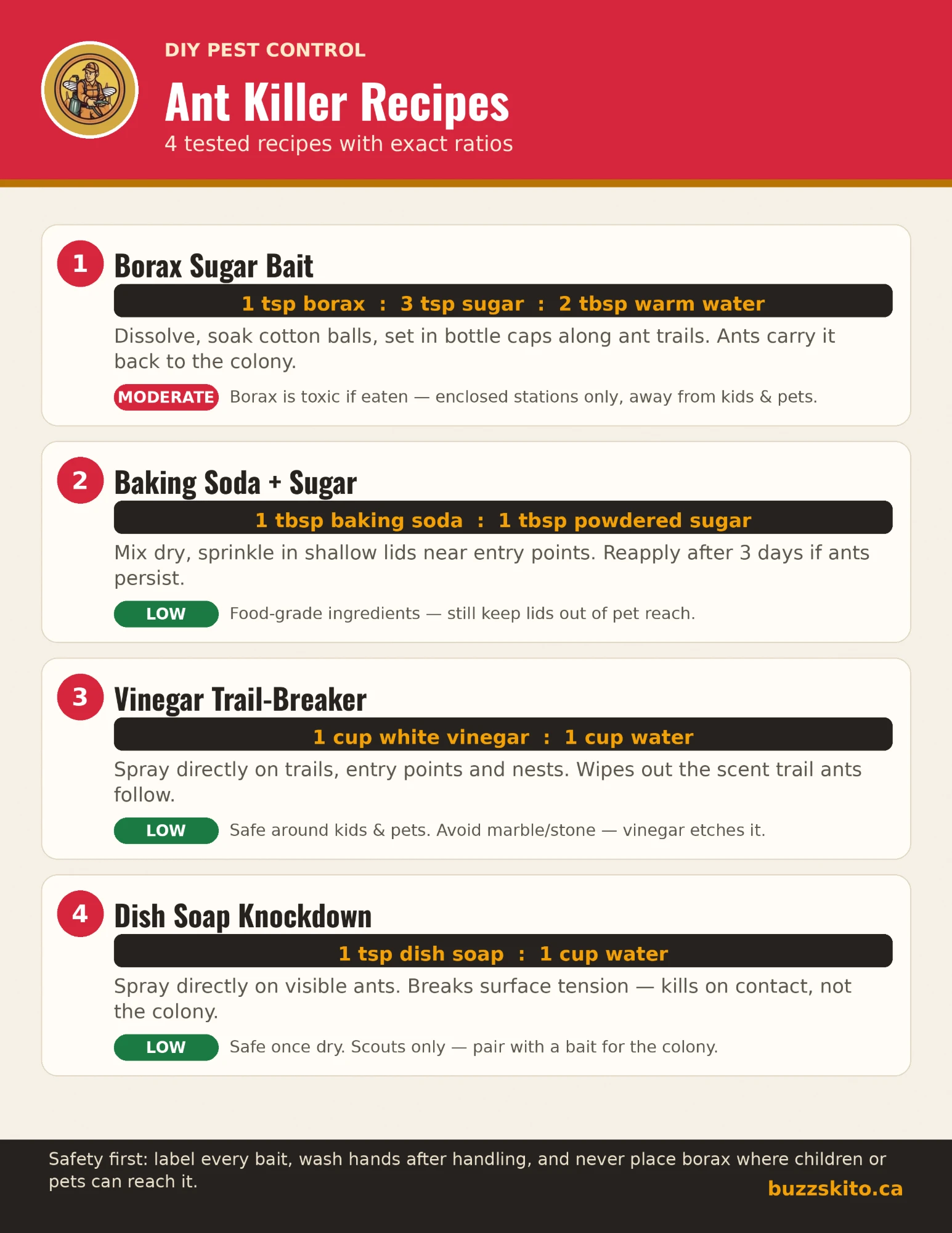
Only one of the four recipes on the one-page guide can reach a colony, and only when it is mixed far weaker than the guide shows. A weak borax or boric acid bait works because workers drink it and carry it home. The vinegar mix and the soap spray deal with the trail and the ants in front of you, and the baking soda mix has no extension or government recipe behind it.
| Recipe | Published ratio | Published by | Reaches the colony? |
|---|---|---|---|
| 1. Borax Sugar Bait | 1/2 tsp boric acid powder, 9 tsp sugar, 1 cup hot water | University of California | Yes, over weeks |
| Peanut butter bait (not on the guide) | 1 tsp boric acid powder in 2 cups peanut butter; same ratio for mint apple jelly or corn syrup | Texas A&M AgriLife Extension | Yes, over weeks, if the food is one the ants take |
| 2. Baking Soda + Sugar | None found | No extension or government source reviewed | Not shown; one laboratory study on confined ants |
| 3. Vinegar Trail-Breaker | 1 part vinegar to 1 part water | University of Nebraska-Lincoln | No |
| 4. Dish Soap Knockdown | 1 tsp liquid dish soap per cup of water | Nebraska Extension | No |
Each ratio is reproduced from the source linked in its section.
Bait matters because of where the ants are. The University of California's Pest Notes on ants say foragers are typically a small proportion of the colony, and that workers carry bait back to the nest, where it is passed mouth to mouth to other workers, larvae and queens. A spray stops at the ants it touches. The complete guide to ants in the home covers how colonies work.
All of these are home remedies, and the National Pesticide Information Center's page on pesticide home remedies spells out what that means: often no label saying how much to use, where and how often, possibly no first aid directions, and often no testing to show that the mix kills or repels the pest. Health Canada's page on the risks of homemade pesticides makes similar points and adds that some uses of boron or boric acid may cause overexposure, which it says can be harmful to health, especially for children. Labeled, ready-made stations are compared in the ant control product guides.
1. Borax Sugar Bait: what ratio do university sources publish?
A far weaker one than the guide shows: 1/2 teaspoon of boric acid powder and 9 teaspoons of sugar dissolved in 1 cup of hot water. The University of California's guide to ants in gardens and landscapes says this makes a solution of approximately 1 percent boric acid and 19 percent sugar, and that a properly mixed bait is effective against Argentine ants and other sugar-feeding ants.
Borax Sugar Bait (the weak liquid version)
About 1 cup
You need
- 1/2 teaspoon boric acid powder
- 9 teaspoons (3 tablespoons) granulated sugar
- 1 cup hot water
Steps
- Use a jar and a spoon that will not go back into the kitchen.
- Stir the sugar and boric acid powder into the hot water until both dissolve, then let it cool.
- Label the jar with its contents and the date.
- Soak a cotton ball and put it in an enclosed station (see below) beside the ant trail.
- Add fresh liquid before the cotton dries, and leave the feeding ants alone.
What it does: Workers carry it to the nest and share it with other workers, larvae and queens. The University of California's Pest Notes say it can take 5 to 10 days to see fewer ants and several weeks or more for complete control.
Where it stops working: Ants that want grease or protein may ignore it, and it stops attracting ants once it dries. The guide's version (1 teaspoon borax, 3 teaspoons sugar, 2 tablespoons water) carries about 16 times as much powder per cup of water.
Pets and children: keep well away
Pets. The National Pesticide Information Center says boric acid affects animals in a similar way to people and that signs of poisoning can start within 2 hours of eating it. Put the station where a dog or cat cannot reach or chew it.
Children. The center rates boric acid as low in toxicity if eaten, but people who swallowed it have had nausea, vomiting, stomach aches and diarrhea. Keep the bait, the jar and the powder up high and labeled.
Recipe as published by University of California Statewide IPM Program, Ant Management in Gardens and Landscapes
The spoon measure is for boric acid powder. The University of California says the bait can be made with boric acid or borax (sodium tetraborate decahydrate), but its worked example uses boric acid, as does the Texas A&M recipe below, and neither converts one powder to the other. If laundry borax is what you have, do not add extra to compensate. A separate guide explains how the two differ and the research behind low-dose baits.
Why does a weak borax bait beat a strong one?
Because a strong mix either drives ants away or kills the forager before she has shared it. The University of California's garden guide puts effective baits at 1/2 to 1 percent boric acid and says stronger ones are less effective because they repel ants. Its Pest Notes add that prepackaged stations, usually 5.4 percent borate, do less against major infestations because foragers die before they can bring the bait back. Texas A&M AgriLife Extension's bulletin on household ants draws the line more loosely, saying concentrations of 0.5 to 3.7 percent are the most attractive to Argentine ants, but it calls its own 1 percent bait better than higher concentrations because it is less repellent and kills as efficiently.
What if the ants walk past the sugar? The peanut butter bait
Change the food, not the dose. The University of California says thief ants and pharaoh ants prefer protein or greasy baits year-round and fire ants prefer baits containing oils. Texas A&M publishes a bait for that case, written for pharaoh ants whose nest cannot be found: 1 part boric acid powder to 100 parts of the food the ants like most. Peanut butter is its greasy option; mint apple jelly and corn syrup are its sweet ones. Not sure what you have? Start with which species people mean by sugar ants.
Boric acid peanut butter bait
About 2 cups; a quarter batch is 1/4 teaspoon of powder in 1/2 cup of food
You need
- 2 cups peanut butter, or 2 cups of mint apple jelly or corn syrup if that is what your ants take
- 1 teaspoon boric acid powder
Steps
- Put dabs of peanut butter, jelly and sugar water on squares of foil and watch which one draws a line of ants.
- Mix 1 teaspoon of boric acid powder thoroughly into 2 cups of that food (1 part in 100).
- Push small amounts into 2-inch pieces of drinking straw, or put a dab inside an enclosed station.
- Set out 20 to 30 small placements where ants have been seen.
- Replace placements as they dry out.
What it does: Workers take the food back and feed it to the colony. Texas A&M says that with the right food, kept fresh and moist, ants should be controlled after 3 to 4 weeks of careful, thorough baiting.
Where it stops working: Texas A&M says baits usually kill many, but not all, of the ants in a colony, and that a bait succeeds only if it contains a food the target ants find attractive. Do the food check in step 1 before mixing a batch.
Pets and children: keep well away
Pets. Texas A&M's instruction is never to place any bait in areas accessible to pets. This bait is made of food, so an open cap on the floor is the wrong place for it.
Children. The same rule covers small children. Use straw pieces or a taped, labeled container, and store the batch away from food.
Recipe as published by Texas A&M AgriLife Extension, Managing Household Ant Pests (B-6183)
How do you make a simple bait station?
Put the bait inside something closed that only an ant can enter. The guide pictures cotton balls in open bottle caps while its own safety tag asks for enclosed stations, and the sources side with the tag. The University of California says stations protect bait from sunlight and from disturbance by children, and that they should stay out of areas pets and small children can get to. Texas A&M allows bottle caps, foil and straw pieces for its paste, but never where small children or pets can reach. One simple way to do that:
- Choose a small, rigid container with a tight lid that will never hold food again.
- Punch three or four ant-sized holes in the side, a little above the bottom so liquid cannot run out.
- Put in a cotton ball soaked in the sugar bait, or a small dab of the peanut butter bait.
- Press the lid on, tape it shut, and write the contents and the date on it.
- Set it beside the ant trail, off food-preparation surfaces and out of reach of children and pets.
- Check it regularly and add fresh bait before it dries out or turns rancid.
- When the ants are gone, throw the container away and wash your hands.
A lid slows a child or a pet down; it does not make the bait harmless, so placement is the real safeguard. See where to put ant bait in a kitchen.
2. Baking Soda + Sugar: does it kill ants?
It killed confined ants in one laboratory study, but no extension or government source reviewed for this page publishes it as a recipe. None of them lists baking soda for ants or gives a ratio, so the guide's mix (1 tablespoon baking soda to 1 tablespoon powdered sugar, reapplied after 3 days) appears here without a recipe card.
The laboratory work is a 2004 study by University of Georgia entomologists Brinkman and Gardner in the journal Florida Entomologist. Argentine ant and red imported fire ant workers, in groups of ten, were confined in small containers on surfaces dusted with baking soda, and at the heaviest doses most were dead after six days. When Argentine ants were given baking soda in sugar water, the best result was about half dead after six days, at a 5 percent mix, and stronger mixes did no better.
Neither setup is the guide's dry mix, and the authors wrote that the best way to use baking soda in a home had yet to be worked out. Those were confined workers, not colonies in a kitchen. If a week of baking soda has not changed the trail, make the weak sugar bait instead.
3. Vinegar Trail-Breaker: what does a 1:1 mix do?
It cleans away the scent trail and deters ants, and that is all it is published to do. The University of Nebraska-Lincoln's Backyard Farmer page on ants gives the guide's ratio: wipe down surfaces with a 1:1 mixture of vinegar and water to remove pheromone trails and deter ants. No other source opened for this page gives vinegar a ratio.
Vinegar Trail-Breaker
2 cups
You need
- 1 cup vinegar (the university names no type; the one-page guide uses white vinegar)
- 1 cup water
Steps
- Pour both into a spray bottle and label it.
- Remove the food the ants were after, then vacuum or wipe up the ants.
- Spray the mix on the hard surfaces along their path and wipe them down, most thoroughly at the spot where they come in.
- Keep it away from bait stations and the ants feeding at them.
What it does: Removes the pheromone trail that leads other workers to the food and, the university says, deters ants.
Where it stops working: It does not reach the nest or the queen, and no source reviewed says how many ants it kills on contact. Ants lay a new trail if the food and the entry point are still there.
Pets and children: lower risk
Pets. Lower risk here means nothing is left out for a pet to eat. No source cited on this page rates vinegar itself, and the National Pesticide Information Center notes that home remedies may come without warnings about harm to pets. Wipe the surface dry before pets walk on it.
Children. The center also notes that a home remedy often has no label and may have no first aid directions. Mark the bottle, store it out of reach, and keep the spray out of eyes.
Recipe as published by University of Nebraska-Lincoln, Backyard Farmer
The guide's caution about marble and stone is worth keeping. Vinegar is acidic, and Iowa State University Extension's advice on stone countertops is to clean marble with only mild dish soap and warm water and to avoid acidic cleaners on granite, quartz and soapstone. A separate guide covers what vinegar does and does not do to ants.
4. Dish Soap Knockdown: does soapy water kill ants?
Yes, the ants it wets, and nothing after it dries. The University of California's Pest Notes say some soap products, such as window cleaners, can kill ants on contact but leave no residual toxicity, and that soapy water removes the scent trail. They give no ratio. The guide's 1 teaspoon per cup matches a standard strength: Nebraska Extension's article on soap sprays lists a 2 percent soap solution as 2 teaspoons per pint. That table was written for houseplant pests such as aphids, so it confirms the strength is a normal one; it is not an ant trial.
Dish Soap Knockdown
1 cup; a pint bottle takes 2 teaspoons of soap
You need
- 1 cup water
- 1 teaspoon liquid dishwashing soap
Steps
- Mix gently in a spray bottle and label it.
- Spray until the ants are wet.
- Wipe up the ants and the trail, then rinse the surface.
- Do not spray the ants feeding at a bait station.
What it does: Kills the ants it wets and washes away the scent trail. The University of California says sponging or mopping a trail with soapy water may be as effective as an insecticide spray at temporarily removing foraging ants indoors.
Where it stops working: Nebraska Extension says a soap spray must wet the insect and has no residual activity, so it does nothing once dry and nothing to the colony. Homemade soap sprays can also damage plant leaves.
Pets and children: lower risk
Pets. Lower risk here means the spray is wiped up and rinsed off, not left out. The National Pesticide Information Center points out that familiar items such as dish soap can contain additives that could cause harm, so rinse sprayed floors and counters before pets have access.
Children. Treat the bottle as a cleaner, not as water: mark it and store it out of reach.
Recipe as published by Nebraska Extension in Lancaster County (2 percent soap solution)
The guide says the soap breaks surface tension, which is one explanation extension services give. Nebraska Extension adds that insecticidal soaps may disrupt cell membranes or remove the insect's protective wax, so that it dies of water loss. Either way, the colony still needs a bait.
Are these recipes safe around pets and children?
None of them is free of risk, and the two boric acid baits need the most care. The guide's tags run from moderate for borax down to low and safe for the rest; the sources are consistent with that order but do not support the word safe.
| Remedy | Risk tier | What the source says |
|---|---|---|
| Borax or boric acid sugar bait | Keep away | NPIC: low in toxicity if eaten, but it has caused nausea, vomiting, stomach aches and diarrhea; signs in animals can start within 2 hours |
| Peanut butter bait | Keep away | Texas A&M: never place baits where small children or pets can reach |
| Baking soda and sugar | No recipe to rate | NPIC: even too much of a low toxicity ingredient can be harmful |
| Vinegar and water | Lower risk | NPIC: home remedies often have no label and may lack first aid directions |
| Dish soap and water | Lower risk | NPIC: familiar items such as dish soap can contain additives that could cause harm |
NPIC is the National Pesticide Information Center. Tiers are this page's summary, not a regulatory rating; the cited sources do not rate vinegar or dish soap individually.
The center's boric acid fact sheet rates boric acid as low in toxicity if eaten or if it touches skin, which is not the same as harmless. As borax it can be corrosive to the eye and irritating to the skin. The center says children may be especially sensitive to pesticides, that seizures and death have been reported more often in infants exposed long-term to boric acid than in adults, and that many boric acid products must be applied out of children's reach. It adds that, without data comparing children and adults directly, it is not clear whether children are more sensitive to boric acid itself.
The guide's footer covers the practical side: label every bait, wash your hands after handling it, and never put borax where children or pets can get to it. That includes the box of powder and the jar of leftover bait. The cited sources describe no comparable poisoning from vinegar, dish soap or baking soda, which is not the same as no risk. A separate page looks at pest control methods and what they mean for dogs and cats.
When does homemade ant bait fail?
It fails when the ants will not eat it, when it is too strong, when it goes stale, or when the colony is more than a bait can handle.
- They walk past it. Offer a little of something sweet and something greasy and use whichever they take; the University of California and Texas A&M both describe checking this way. See also how to tell very small household ants apart.
- It is too strong. Above 1 percent boric acid, the University of California says, bait becomes repellent. Remake it to the published measure.
- It dried out. Baits can dry up or become rancid, the University of California warns.
- There is easier food nearby. Both sources say to clean up spilled food and grease.
- Something is keeping them off it. The University of California says not to use insecticide sprays while baiting. Keep wiping trails, but away from the station.
- The colony is the wrong kind. Texas A&M says baits usually kill many, but not all, of the ants in a colony, and that crazy ants are difficult to attract to baits.
Give a bait the weeks the sources say it needs. If ants never feed, or nothing has changed after about a month, stop. The next step is a registered bait with a label, or a professional, which is the University of California's advice for a problem that persists. See the room-by-room plan for ants in the house.
The printable recipe card
Print or save
Homemade ant killer recipe card
Bait is for the colony. Vinegar and soap are for the trail and the ants you can see.
- Weak sugar bait (University of California): 1/2 teaspoon boric acid powder + 9 teaspoons sugar + 1 cup hot water. Do not make it stronger.
- Peanut butter bait for ants that ignore sugar water (Texas A&M): 1 teaspoon boric acid powder in 2 cups peanut butter. Same ratio in mint apple jelly or corn syrup if they prefer those.
- Station: small lidded container with ant-sized holes, soaked cotton inside, taped, labeled, out of reach of children and pets.
- Vinegar trail wipe (University of Nebraska-Lincoln): 1 cup vinegar + 1 cup water, wiped over hard surfaces. Keep it off marble and other stone.
- Soap contact spray (Nebraska Extension's 2 percent strength): 1 teaspoon liquid dish soap + 1 cup water. Wipe up and rinse.
- Baking soda and sugar: no extension or government recipe. Skip it.
- While baiting: no insecticide spray, and no vinegar or soap on the station or the ants feeding at it.
- Timeline: fewer ants in 5 to 10 days; several weeks or more for the colony. No change after a month? Use a labeled bait or call a professional.
- Label every mix and wash your hands. If bait or powder is swallowed: Poison Control 800-222-1222 (US); for a pet, call a veterinarian.
Ratios are reproduced from the university sources named; BuzzSkito has not run trials on them.
buzzskito.ca
This guide is general educational information, not medical advice. If you have symptoms or concerns after a bite or exposure, contact a healthcare provider.
Use any pesticide exactly as its label directs. The label is the law, and what is registered and sold varies by state.
Frequently Asked Questions
How long does homemade ant killer take to work?+
A soap spray works at once on the ants it wets, a vinegar wipe clears the trail, and neither does anything to the nest. A weak boric acid bait is slower by design. The University of California says it can take 5 to 10 days to see fewer ants and several weeks or more for control to be complete, and Texas A&M AgriLife Extension allows 3 to 4 weeks or more of careful baiting. Keep the bait fresh and moist for that whole period. If ants never feed on it, or nothing has changed after about a month, switch to a labeled bait or call a professional.
Can I use laundry borax instead of boric acid powder?+
The University of California says a liquid ant bait can be made with either boric acid or borax, but the measured recipes it and Texas A&M publish both use boric acid powder, and neither gives a separate amount for borax. The two are different compounds, so the published half teaspoon per cup is not a borax measurement. What the sources agree on is the direction: a weak bait of about 1 percent works better than a strong one, which the University of California says repels ants. If borax is what you have, do not add extra to make up for the difference.
Does baking soda and powdered sugar kill ants?+
No extension or government source reviewed for this page recommends it or publishes a ratio. In a 2004 University of Georgia laboratory study in the journal Florida Entomologist, most worker ants confined on surfaces heavily dusted with baking soda died within six days, but when Argentine ants were given baking soda in sugar water, about half were dead after six days at best. The authors wrote that the best way to use it in a home had yet to be worked out. Nothing found for this page shows a lid of dry powder working in a kitchen. A weak boric acid and sugar bait has university recipes behind it.
Can I use vinegar or soap spray and ant bait at the same time?+
Yes, in different places. The University of California says baits take time to work and to keep cleaning up trails in the meantime, and it says not to use insecticide sprays while baiting. A bait only works if foragers keep reaching it and walking home, so do the wiping on stray trails elsewhere in the room and leave the station, and the line of ants leading to it, alone. Once the ants are gone, clean the whole route with soapy water or the vinegar mix and caulk the entry point.
Will borax ant bait harm plants if I use it outside?+
It can. Texas A&M AgriLife Extension advises care with boric acid outdoors because it is toxic to plants, and the National Pesticide Information Center says boric acid and borax can kill plants by causing them to dry out. The University of California does describe liquid borate bait used outdoors, near nests and trails and along foundations, but in refillable bait stations. Keep homemade bait in a closed container, wipe up spills, and do not pour leftover bait onto a lawn or garden bed.
Is homemade borax ant bait dangerous for dogs and cats?+
It has to be kept away from them. The National Pesticide Information Center rates boric acid as low in toxicity if eaten, but says it affects animals in a similar way to people, who have had nausea, vomiting, stomach aches and diarrhea after eating it, and that signs of poisoning in animals can start within 2 hours. Texas A&M's rule is never to place bait where small children or pets can reach it. Use an enclosed, labeled station, store the powder and any leftover bait out of reach, and call your veterinarian if a pet eats bait or powder.
Sources
- Ant Management in Gardens and Landscapes — University of California Statewide Integrated Pest Management Program
- Ants (Pest Notes, UC ANR Publication 7411) — University of California Statewide Integrated Pest Management Program
- Managing Household Ant Pests (B-6183) — Texas A&M AgriLife Extension Service
- Boric Acid Fact Sheet — National Pesticide Information Center
- Pesticide Home Remedies — National Pesticide Information Center
- Ants — University of Nebraska-Lincoln, Backyard Farmer
- Washing Pests Away — Nebraska Extension in Lancaster County
How this guide was made: it was researched and drafted with AI assistance from the sources listed above. A second, independent AI pass then checked each factual claim against those sources. Found an error? Email support@buzzskito.ca.