BuzzSkito Mosquito & Tick Control Specialists · Published July 12, 2026
As an Amazon Associate I earn from qualifying purchases. BuzzSkito only points to products we would genuinely use or recommend, at no extra cost to you.
The One Way Ticks Actually Reach You: Questing
Ticks have exactly one way of getting onto you, and it is not dramatic. A tick climbs to the top of a grass blade, a weed, or a low shrub, anchors itself with its back legs, and stretches its front legs out into the air. This posture is called questing. The tick’s front legs carry sensors that detect body heat, the carbon dioxide in your breath, vibration, and shadow. When a warm body brushes the plant, the tick grabs onto fur or clothing and climbs aboard. That is the entire mechanism — no flight, no leap, no swim, no ambush from above.
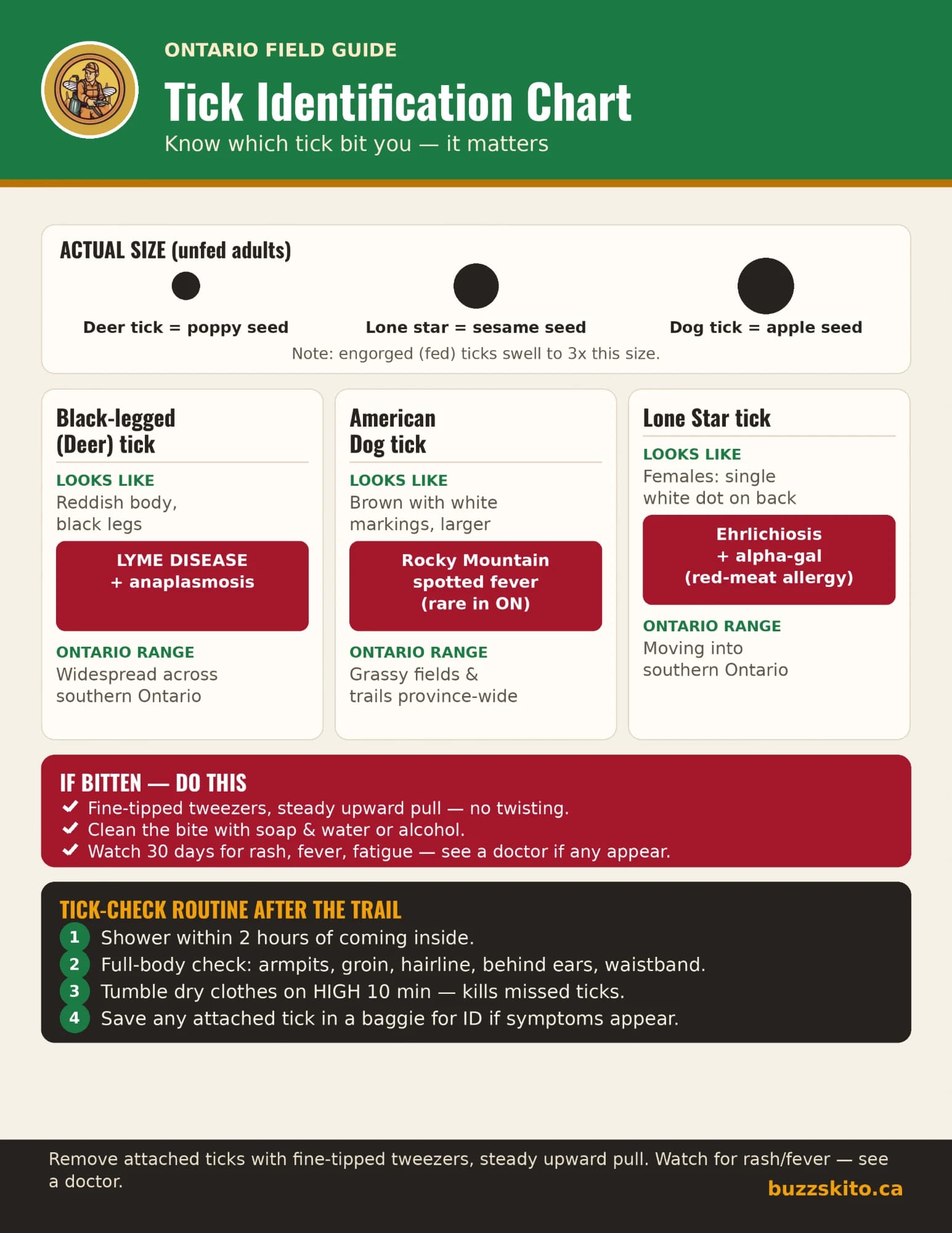
Because questing depends on something touching the plant, ticks concentrate exactly where people and pets walk: the edge of the lawn, the margins of trails, unmowed grass, and the leaf-littered transition zone where a yard meets woods or a ravine. In Ontario, the tick that matters most is the blacklegged (deer) tick, which can carry Lyme disease; the American dog tick is also common in grassy areas.
Can Ticks Fly? No — They Have No Wings
No tick, at any life stage, has wings. Larvae hatch with six legs, and nymphs and adults have eight — but never wings. If a biting insect flew at you near dusk, it was a mosquito, a black fly, or a biting midge. Ticks travel only by hitching a ride, which is genuinely good news: it means keeping your grass short and clearing brush along the edges dramatically reduces your contact with them.
Can Ticks Jump? No — That’s Fleas
This is the most common tick myth, and it comes from confusing ticks with fleas. Fleas have powerful, spring-loaded back legs and can leap roughly 30 cm — well over 100 times their body length. Ticks have nothing of the kind. A tick cannot launch itself even a millimetre; it can only crawl and cling. So the quickest field test in your yard: if the tiny biting bug jumped away, it was a flea; if you found it crawling slowly or already attached, it was a tick.
Can Ticks Swim? No — But They Survive Water Longer Than You’d Think
Ticks have no swimming appendages and cannot propel themselves through water, so a tick never swims toward a host. You pick ticks up on land, from vegetation — not from a lake, pool, or puddle. But here is the part that surprises people: a tick is remarkably hard to drown. Ticks breathe extremely slowly through tiny openings on their bodies called spiracles, and they can seal them and go dormant. A blacklegged tick can survive full submersion for two to three days, and some have been kept alive underwater even longer in the lab.
That has a practical consequence: a quick rinse, a swim, or a cold wash cycle will not reliably kill a tick. If you find a tick after being at the lake or in the pool, do not assume the water killed it — a survivor can still bite and transmit disease. Remove any attached tick promptly and treat it as fully live.
Can Ticks Drown in the Wash? Dry Heat Is What Kills Them
Because ticks resist water so well, washing clothes is not a dependable way to kill them. The reliable step is heat and dryness. Public-health guidance is consistent on this: tumble-dry clothing on high heat for at least 10 minutes to kill ticks that may be hiding in the fabric. If clothes are damp or dirty and you want to wash first, use hot water (over 54°C / 130°F) — but the dryer on high is the step you can count on. Ticks die from desiccation far faster than from a soak.
Do Ticks Fall From Trees? Almost Never
Ticks do not climb trees to drop on hosts. They quest low, because that is where hosts pass. The myth persists because ticks are often found on the upper body — the scalp, neck, or behind the ears — which makes it feel like they fell from above. In reality the tick almost always latched onto a lower leg during questing and then crawled upward over several minutes, looking for a sheltered place to feed. That is why your yard defence belongs at ground level: grass, leaf litter, and shaded edges, not overhead branches.
How High Do Ticks Climb, and How Do You Stop Them?
In Ontario, ticks quest low. Nymphs usually wait within a few centimetres of the ground to about ankle height; adult blacklegged ticks climb a bit higher, to roughly knee height, on taller grass and brush. None climb to head height to attack. Because ticks board at the lower legs, the classic personal defence works extremely well: tuck your pants into your socks, wear light colours so ticks are easy to spot, and treat footwear and pant legs with permethrin. Check insect shield permethrin treated clothing on Amazon.ca →
Gaiters close the gap the tuck leaves open. Since a tick boards at the ankle and climbs, the weak point is the few centimetres where a trouser hem meets a boot — exactly the seam that works loose twenty minutes into a walk. A pair of over-the-boot gaiters covers it outright, and a light-coloured pair gives you a smooth surface where a crawling tick shows up against the fabric and can be flicked off long before it finds skin. Check hiking gaiters on Amazon.ca →
For the yard itself, because ticks can only reach you from vegetation they have climbed, control is genuinely effective:
- Mow to 3–4 inches. Short grass gives ticks nowhere to quest and dries out the ground-level humidity they need.
- Clear leaf litter at yard edges every spring and fall — it is where blacklegged ticks overwinter and stay damp.
- Create a 3-foot wood-chip or gravel barrier between lawn and any woods, ravine, or tall grass. Ticks avoid crossing the dry, sunny strip.
- Discourage mice and deer — mice are the main host for immature ticks. Store firewood off the ground and don’t feed wildlife.
- Professional barrier spray. BuzzSkito’s tick barrier treatment targets the lawn edges, leaf litter, and shaded borders where ticks quest, re-applied through the season as the residual wears off.
Steps one and three are where most yards quietly fail, and it is a reach problem rather than a willingness problem. A mower cannot get at the strip that actually matters: the last half-metre against the fence, the skirt of the shed, the base of a retaining wall, and the ragged margin where lawn gives out into brush. That is precisely the band ticks quest from, and left alone it stays tall and humid all season while the open lawn looks immaculate. A string trimmer is the tool that shortens it, and walking the boundary with one every couple of weeks does more for tick pressure than cutting the middle of the yard ever will. Check string trimmers on Amazon.ca →
Because a questing tick crawls slowly for minutes to hours before it bites, a tick check after time outdoors usually catches it in time. Keep a fine-tipped removal tool handy so you can grip a tick close to the skin and pull straight out. Check tick-removal tools on Amazon.ca →
As an Amazon Associate I earn from qualifying purchases. Price shown on Amazon.ca, at no extra cost to you.
🏆 Our Top Pick — Tick Removal
8.5/10· BuzzSkito ratingBecause a questing tick crawls for minutes before biting, a prompt, clean removal is your best defence. A dedicated fine-tipped remover grips the tick close to the skin and pulls it straight out in one piece — far more reliable than fingernails, and worth keeping in the car, the trail bag, and by the door.
Pros
- Grips close to the skin to lift the whole tick
- Reduces the risk of leaving mouthparts behind
- Compact and cheap enough to keep several
Cons
- Needs a steady hand on tiny nymphs
- Not a substitute for a full tick check
Related Reading
- Do Ticks Fly or Jump? How They Actually Get on You
- How to Keep Ticks Out of Your Yard (Ontario)
- BuzzSkito Tick Control Service
Frequently Asked Questions
Can ticks fly?+
No. Ticks cannot fly — they are wingless at every life stage, from larva to nymph to adult. No tick species in Ontario or anywhere else has wings. A tick reaches a host by "questing": it climbs to the tip of a grass blade or low plant, holds its front legs out, and grabs on when a person or animal brushes past. If a biting bug flew at you, it was a mosquito, black fly, or biting midge — not a tick.
Can ticks jump?+
No. Ticks cannot jump. They have no jumping legs and no mechanism to launch themselves, unlike fleas, which can leap roughly 30 cm. This is the single most common tick myth. A tick simply waits on vegetation with its front legs extended and latches on when a host touches the plant. If something bit you and hopped away, it was almost certainly a flea.
Can ticks swim?+
No — ticks do not swim to reach you. They have no swimming appendages and cannot propel themselves through water. Ticks are picked up on land, from grass and leaf litter, not from a lake or pool. What surprises people is that a tick can survive being submerged: because it breathes extremely slowly through tiny openings called spiracles, it can stay underwater for days without dying. So a tick may float or cling if it lands in water, but it never swims toward a host.
Can ticks drown, and will washing kill them?+
Ticks are very hard to drown. A blacklegged (deer) tick can survive full submersion for two to three days, and some studies have kept ticks alive underwater even longer. A quick rinse, a swim, or a normal cold wash cycle will not reliably kill an attached or crawling tick. To kill ticks on clothing, tumble-dry on HIGH heat for at least 10 minutes — dryness and heat kill ticks far faster than water. Hot water alone (over 54°C / 130°F) helps, but the dryer is the reliable step.
Do ticks fall or drop from trees onto your head?+
Very rarely. Ticks do not climb trees to drop on hosts — they quest low to the ground, usually below knee height, because that is where hosts pass. The myth that ticks "rain down from trees" persists because people find ticks on the scalp, neck, or behind the ears. Those ticks almost always boarded at the lower legs during questing and then crawled upward over several minutes looking for a place to bite. Focus yard defence on grass and leaf litter, not overhead branches.
If ticks cannot fly, jump, or swim, how do they get on you?+
By questing. A tick climbs onto the tip of tall grass, a weed, or a low shrub, anchors with its back legs, and stretches its front legs out — sensing your body heat, the carbon dioxide you exhale, vibration, and shadow. When you, a pet, or wildlife brushes the plant, the tick grabs on and crawls upward. This is why ticks are picked up at the lawn-to-woods edge, on trail margins, and in unmowed grass — and why a barrier spray on those exact zones is so effective.
How high can ticks climb?+
Ticks in Ontario typically quest between ground level and about knee height (30–50 cm) on grass, weeds, and low brush. Nymphs — the poppy-seed-sized stage responsible for most Lyme transmission — wait lowest, often near ankle height. Adult blacklegged ticks climb a little higher. None climb to head height to attack; any tick on your upper body crawled there after latching onto your lower legs. Tucking pants into socks and treating footwear and pant legs with permethrin stops most bites before they start.
Are ticks that survive water still dangerous?+
Yes. A tick that survived a swim, a rinse, or a soak is fully capable of biting and transmitting disease afterward. In Ontario the main concern is the blacklegged (deer) tick, which can transmit Lyme disease when attached for roughly 24 hours or more. Never assume water killed a tick you found on skin, a pet, or clothing. Remove any attached tick promptly with fine-tipped tweezers, gripping close to the skin and pulling straight out, and dry-heat clothing to kill hidden ticks.