Published by BuzzSkito Mosquito & Tick Control
Published October 21, 2026 · Drafted with AI assistance and fact-checked against the sources listed below
What does mouse urine look like?
Mouse urine looks like tiny drops, streaks and trails. The National Park Service's rodent damage guide says rodents urinate while walking or perched on an edge, so trails can build up across a room, and CDC's manual for urban rodent surveys describes rodent urine as wet, glossy or sticky, or as a dried stain.
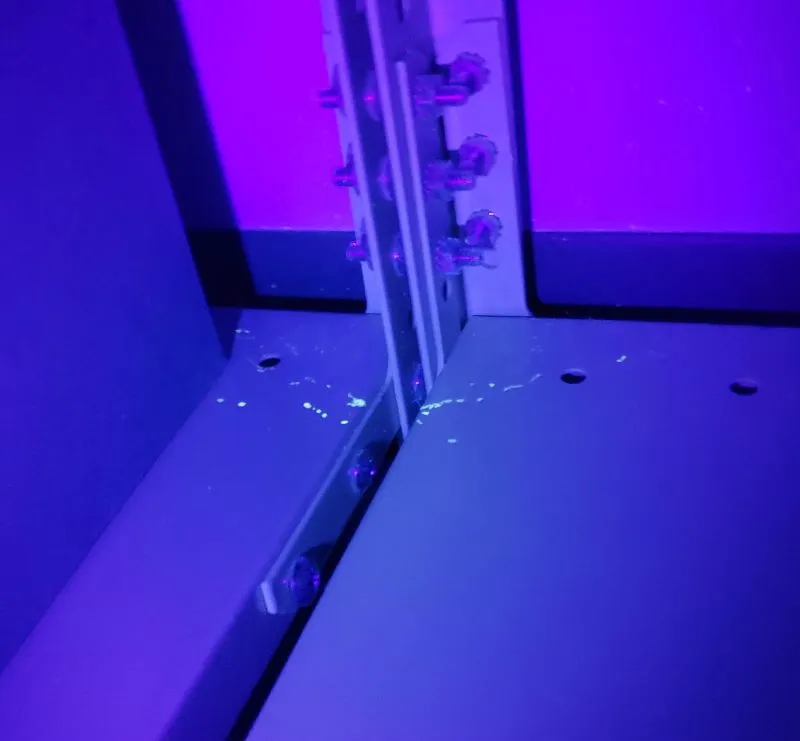
The drops are easy to miss: Illinois's public health department says in its sample pest management procedures that mouse urine spots are harder to detect than a rat's, and suggests a black light for finding many small drops. Where urine builds up, NPS says, it can stain fabric and ceiling tiles and darken surfaces; stained tiles away from any water source likely mean mice or rats, not a leak.
What does mouse pee smell like?
Mouse pee smells musky and ammonia-like. A University of Arizona newsletter on house mice describes a musky ammonia smell, often more noticeable in pantries, cabinets and drawers and stronger along baseboards and walls, where mice leave microdroplets of urine as they travel.
A smell you notice points to mice that have been around a while or in numbers. UC IPM's Pest Notes on the house mouse say the musky odor is common in large or long-term infestations, and an allergy practice parameter on rodents says that because rodents urinate constantly as they travel, infestations often come with a strong urine odor.
The house mouse chapter of Prevention and Control of Wildlife Damage calls a characteristic musky odor a positive indication of house mice, one that can tell them apart from rats. A smell of rot is different: the Arizona newsletter says dead mice give off extremely pungent odors of decay.
Does mouse urine glow under a black light?
Yes, wet or dry, but a glow is a clue, not proof. The house mouse chapter says urine fluoresces under ultraviolet light, although so do some other materials, and the Arizona newsletter counts some cleaning solutions among them. NPS's advice is to use a UV flashlight to help confirm mice where other signs of mouse activity are present.
Checking a stain with a UV light
- Darken the room: the Arizona newsletter says urine can be seen under a black light in an otherwise dark room.
- Sweep the light along baseboards and walls and into pantries, cabinets and drawers.
- Look for many small drops, as Illinois's procedures advise, not just one spot.
- Check each glowing spot in daylight for droppings 1/8 to 1/4 inch long, rub marks or gnawing nearby.
- Touch nothing and never sweep or vacuum: photograph it, then follow CDC's cleanup below.
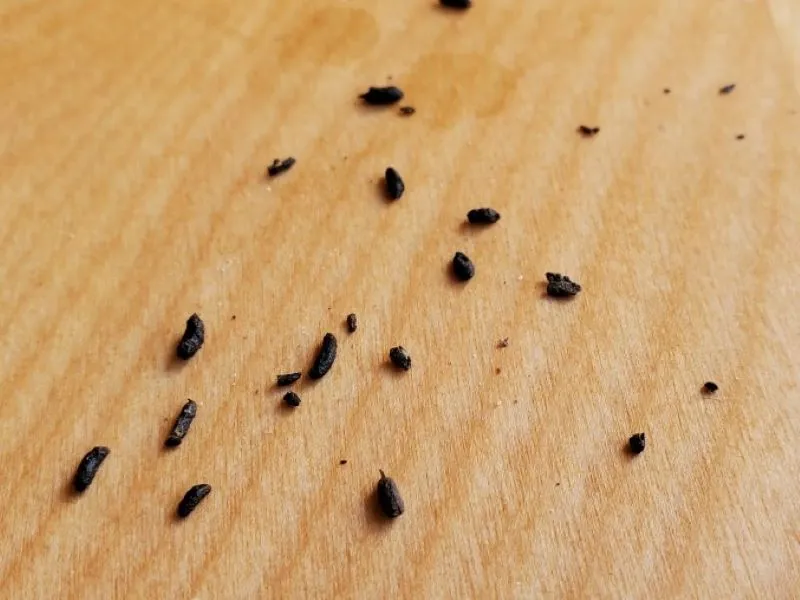
Droppings are the sign to look for first; what mouse poop looks like shows them beside their look-alikes, from rat droppings to cockroach specks.
Where do you find mouse urine in a house?
Along the routes mice travel and where they feed or nest. The house mouse chapter says urine stains may occur along travelways or in feeding areas; NPS says mice mark their routes with urine and that nests may smell of urine and droppings; and the practice parameter lists urine staining of floors, carpets and ceilings among the signs of rodents.
- Kitchens and pantries. Nebraska Extension's guide to controlling house mice says house mice nest near heat sources such as water heaters, ovens and refrigerators.
- Along walls. Nebraska says mice keep contact with walls as they travel at night, and the Arizona newsletter says the urine smell is often stronger along baseboards.
- Ceilings and attics. NPS points to stained ceiling tiles away from any leak; in an attic, consider bats too (below).
- Cars. CDC says rodents may nest in cars, trucks and campers, especially ones used infrequently.
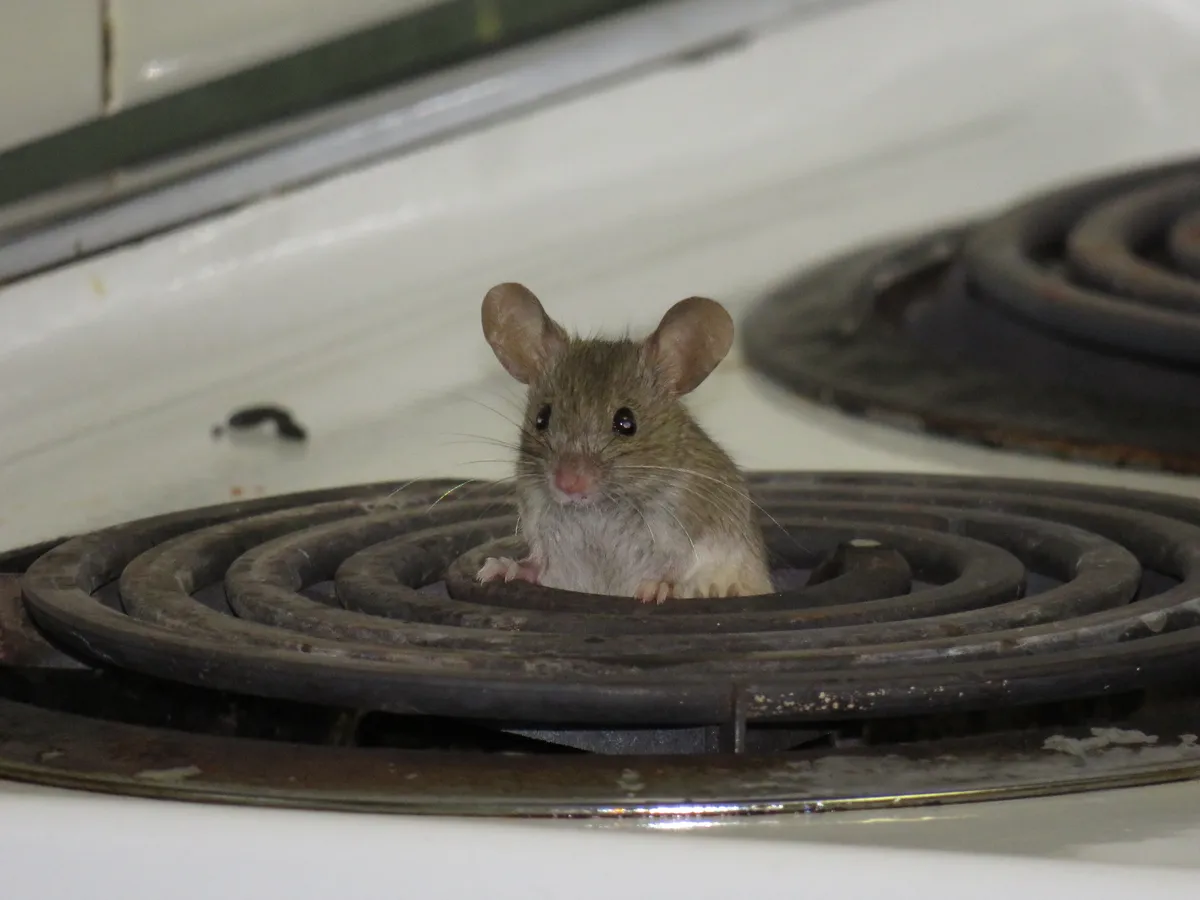
Why so many spots? The Arizona newsletter says house mice urinate continuously, producing thousands of microdroplets a day, and that their signs are often found before the mice, which UC IPM says are active mostly at night. When mice are most active has its own guide, and the complete guide to house mice covers how they live.
What are urine pillars and rub marks?
Urine pillars are small mounds of grease, urine and dirt; rub marks are dark, greasy smears along mouse routes. Illinois's procedures say house mice occasionally build the mounds, which they call urinating pillars, and that they can become quite conspicuous; none of the other sources on this page mentions them.
The house mouse chapter says rub marks form on beams, rafters, pipes and walls as oil and dirt rub off the fur along frequently traveled routes, and that a mouse's are smaller than a rat's. CDC's survey manual says fresh ones are black, soft and greasy, and NPS says the smears show on walls, around holes and pipes and on electrical wiring.
The Arizona newsletter says rub marks hold chemicals mice use to communicate and should be washed off with soap and water; since NPS says mice mark these routes with urine too, disinfect them first, as below.
What else leaves stains and smells like mouse urine?
Rats, deer mice and bats leave the closest matches. For specks or pellets rather than drops, see cockroach droppings, bed bug stains and the animal poop identification chart.
Rats
Rat signs run bigger: NPS gives rat droppings as 1/2 to 3/4 inch long, wider and blunt at the ends, and Illinois says rat urine spots are easier to detect than a mouse's. The guide to rat droppings compares the two, and how to tell a rat from a mouse compares the animals.
Deer mice
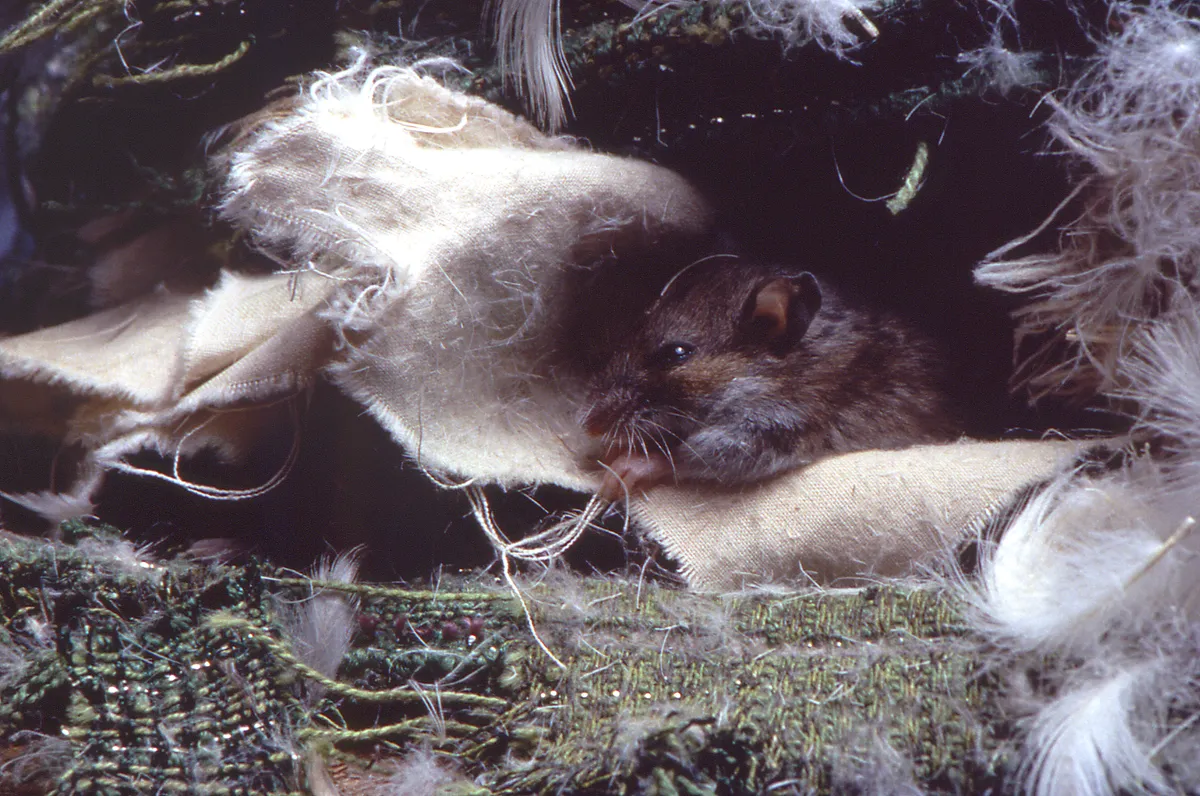
A deer mouse's signs look like a house mouse's. UC IPM's Pest Notes on the deer mouse say its nests, droppings and other signs are similar, though deer mice are far more likely to cache acorns, seeds or nuts and often move into vacated homes and cabins. CDC links the deer mouse to the most common US hantavirus behind hantavirus pulmonary syndrome; the deer mouse guide shows how to recognize one.
Bats
In an attic or high on a wall, consider bats. The US Fish and Wildlife Service's House Bat Management says brown stains and odors from urine, droppings and body secretions near the eaves of wooden buildings may often point to bats inside, that in old, loosely built houses their waste can seep through and stain ceilings and walls, and that bat droppings crush easily into shiny bits of insect. The guide to bat poop covers them.
Other signs to compare
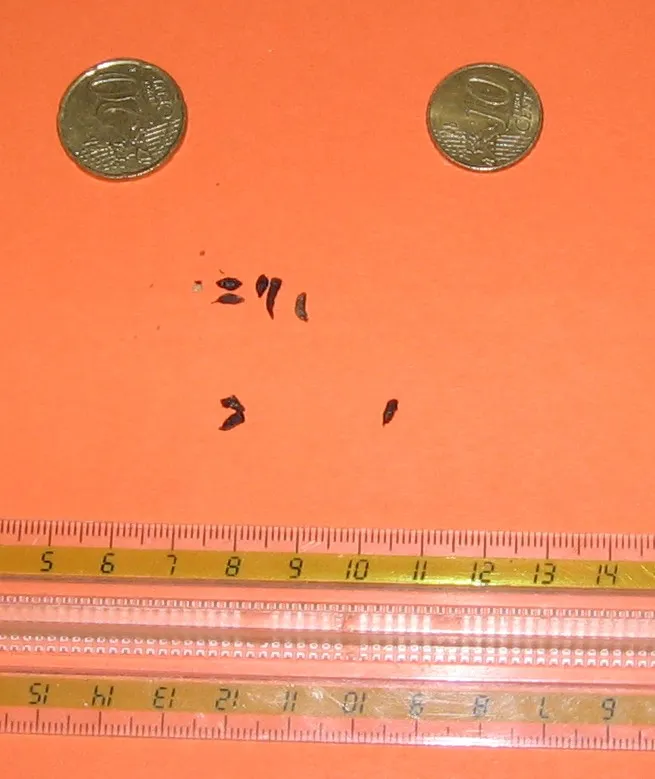 Mouse droppingsDark pellets 1/8 to 1/4 inch long; found beside a stain, they point to mice
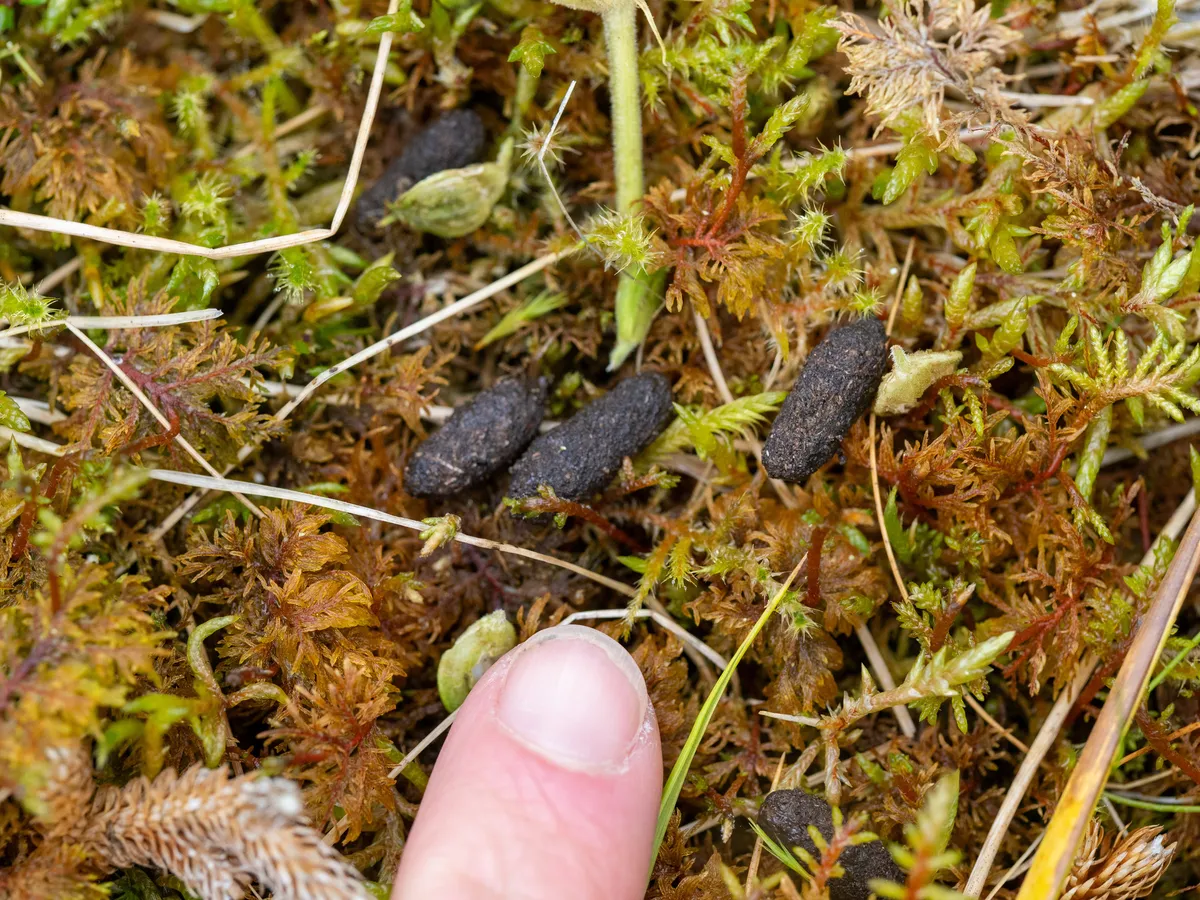 Rat droppings1/2 to 3/4 inch, wider and blunt-ended; rat urine spots are easier to see
 Deer mouseLeaves signs like a house mouse's; spreads the most common US hantavirus
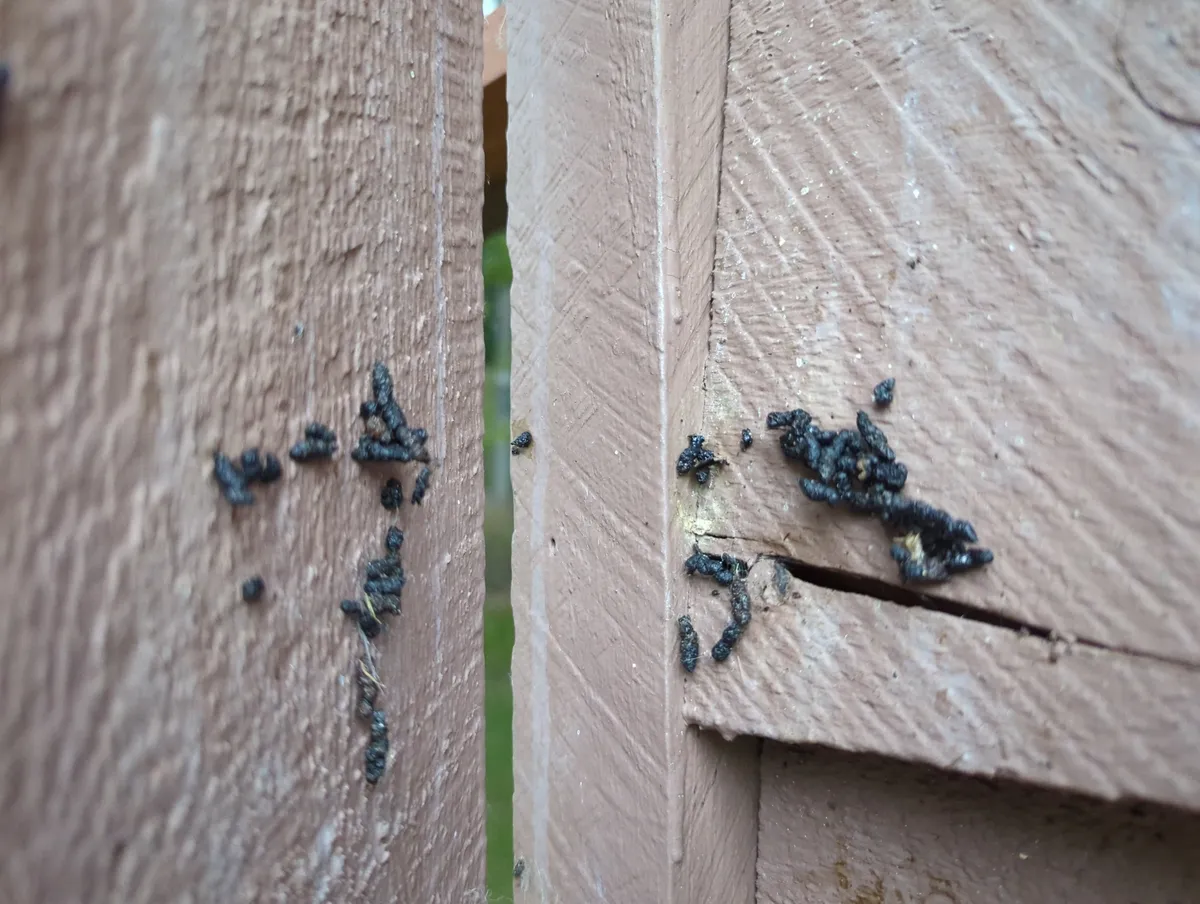 Bat droppingsBrown stains and odor near the eaves; droppings crush into shiny insect bits
Photos: Mouse droppings: Hansmuller, CC BY-SA 4.0, via Wikimedia Commons, CC BY-SA 4.0. Rat droppings: no rights reserved, via iNaturalist, CC0 1.0. Deer mouse: U.S. Fish and Wildlife Service - Midwest Region, Public domain, via Wikimedia Commons, public domain. Bat droppings: (c) Matt Muir, some rights reserved (CC BY), via iNaturalist, CC BY 4.0.
Is mouse urine harmful?
It can be. Rodent urine can carry viruses and bacteria, and mouse urine is a major source of allergens. CDC's hantavirus prevention page says that when fresh urine, droppings or nesting materials of an infected rodent are stirred up, the virus can get into the air and be breathed in, and that it can also spread through cuts or the eyes, nose or mouth.
- Hantavirus, mainly from deer mice. CDC's hantavirus overview says people get hantavirus from contact with rodents, especially their urine, droppings and saliva, and that the deer mouse spreads the most common US hantavirus behind hantavirus pulmonary syndrome. Nebraska says house mice are not known to carry hantavirus, but advises caution with every cleanup, since few people can tell which rodents they have.
- LCM, from house mice. CDC's page on lymphocytic choriomeningitis says the house mouse spreads it through fresh urine, droppings, saliva or nesting materials. Most healthy people have no or only mild symptoms, but infection in pregnancy can cause miscarriage or serious birth defects.
- Leptospirosis. CDC's leptospirosis page says the bacteria behind it spread through the urine of infected animals, rodents among them, including through food or water contaminated by that urine.
- Allergies and asthma. UC IPM calls house mouse urine a major source of allergens and links its proteins to early-onset asthma in sensitive children; Nebraska says mouse urine has been implicated as an asthma trigger in some people. The practice parameter says the main mouse allergen, first identified in mouse urine, was detectable in 82% of homes in a nationally representative US housing survey.
How do you clean up mouse urine safely?
Wet it, then wipe it; never sweep or vacuum it, which CDC's steps for cleaning up after rodents say can put tiny droplets containing viruses into the air. CDC's steps for a house, shed or cabin:
- Open all doors and windows for 30 minutes and stay out while the space airs.
- Put on rubber or plastic gloves.
- Spray the urine and any droppings until very wet with an EPA-registered disinfectant, or a fresh mix of 1.5 cups of household bleach per gallon of water, and let it soak for 5 minutes or as the label directs.
- Wipe it all up with paper towels and put them in a covered garbage can that is emptied regularly.
- Mop or sponge floors, countertops, cabinets and drawers with disinfectant.
- Wash your gloved hands, take the gloves off, then wash your hands with soap and warm water.
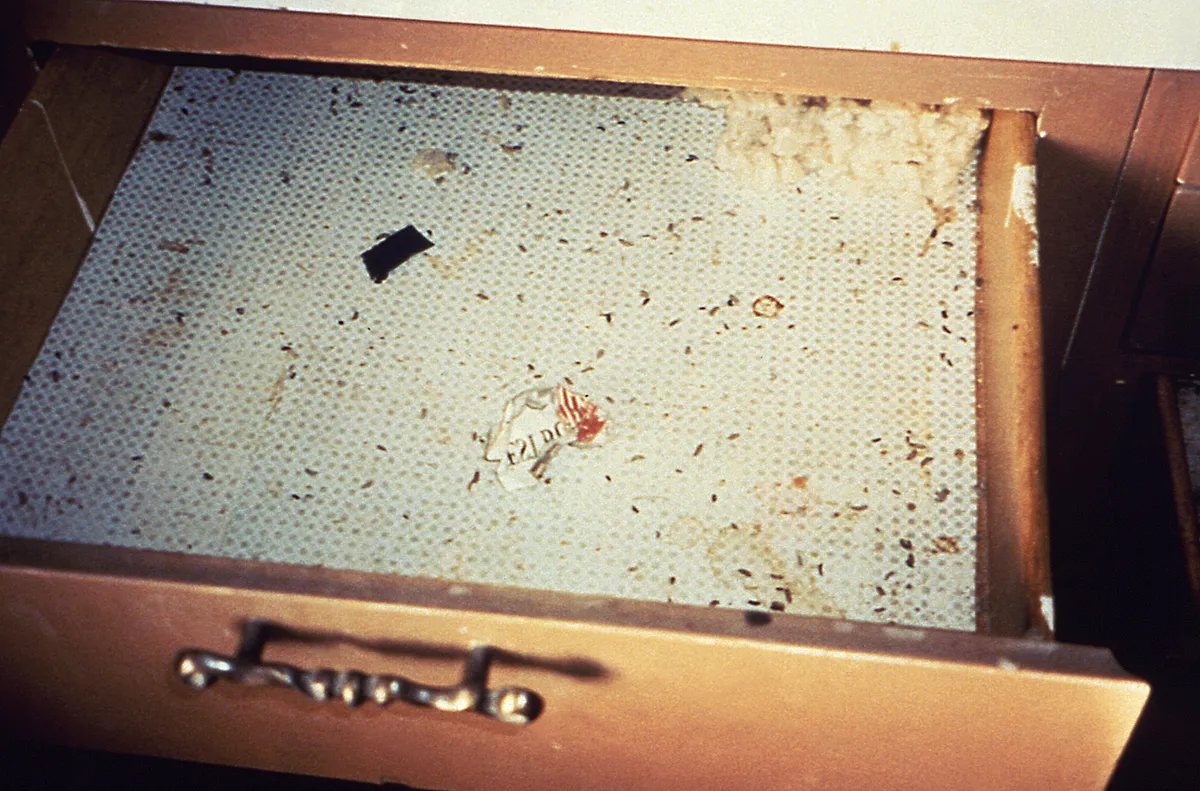
For heavy infestations, vacant homes with many rodents or buildings where disease has been confirmed in the rodents, CDC lists coveralls, rubber boots or shoe covers, gloves, goggles and a respirator with a HEPA filter. What a professional mouse cleanup involves is covered separately.
How do you get mouse urine out of clothes, carpets and car vents?
Disinfect and remove the urine first; CDC's steps for soft and porous things come after that.
- Clothes and bedding. Wash in hot water with detergent, then machine-dry on high or dry in the sun, CDC says; its 2002 hantavirus recommendations add rubber, latex, vinyl or nitrile gloves for handling contaminated laundry.
- Carpets and upholstery. Shampoo with a commercial disinfectant, or use a commercial-grade steam cleaner or shampoo. UC IPM's deer mouse notes warn that bleach solution may damage rugs and fabrics.
- Books and papers. Leave them in sunlight for several hours, or in a rodent-free room for at least three weeks; CDC strongly suggests six.
- Insulation, boxes and ducts. Bag soiled insulation and throw out soiled cardboard, CDC says, and call a professional rodent exterminating service if rodents have gotten into heating and cooling ducts.
A mouse pee smell from the car vents
Rodents can reach a car's passenger compartment through ducting, rusted areas and cable conduit, CDC notes. Its steps: open the hood, doors and trunk for 20 minutes, inspect the air intakes and filters before starting the engine, and disconnect the battery before inspecting the engine compartment. Wearing plastic gloves and a long-sleeved shirt, soak any urine, droppings or nest with disinfectant before picking it up, with no vacuum or high-pressure sprayer until then, and replace the air filter if nesting material is in the intake. CDC suggests a qualified mechanic for help; keeping mice out of a parked car covers prevention.
Getting rid of the smell
None of the agency sources cited here offers a deodorizer or mentions enzyme cleaners: CDC's cleanup removes the source by disinfecting and wiping up urine, washing what can be washed and throwing out soaked insulation and cardboard. Whatever you use for odor afterward, disinfect first. A smell that returns after cleaning can mean mice are still active.
What should you do once you know it is mice?
Seal, trap and clean. CDC's hantavirus overview advises sealing holes and gaps, setting traps and clearing away easy-to-get food, and CDC's trapping guide recommends snap traps placed where you have seen urine and droppings, not glue or live traps, which can scare rodents into urinating and increase your chance of getting sick.
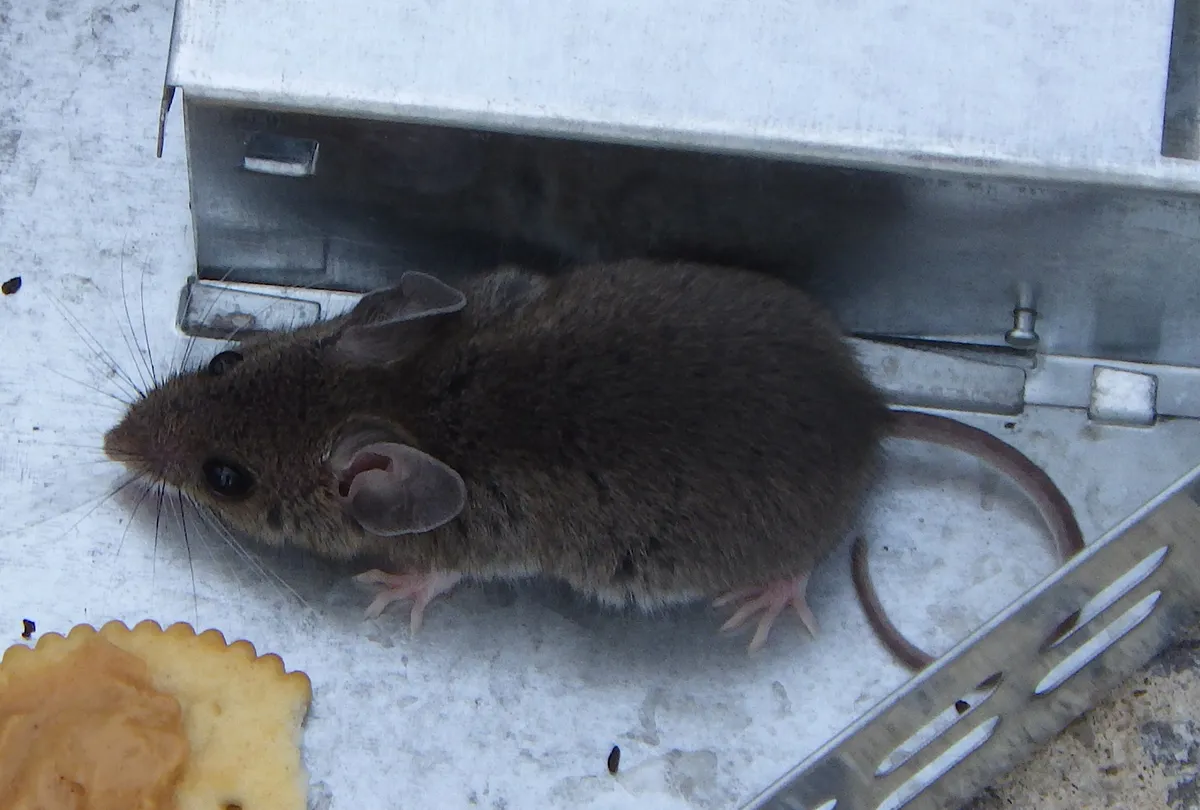
Then watch for new signs: CDC says a week with nothing caught and no new signs means the rodents are gone, while new droppings, urine spots or gnawing after a week may mean wary rats. The complete guide to mice covers sealing and trapping, which mouse traps to use compares them, and the four steps for clearing mice out of a house and sealing gaps before winter cover the whole job.
This guide is general educational information, not medical advice. If you have symptoms or concerns after a bite or exposure, contact a healthcare provider.
Frequently Asked Questions
How can you tell if urine is mouse urine?+
Look for other mouse signs in the same place. The National Park Service says that because many substances glow, a UV light helps confirm mice when other signs of activity are present as well. The companion sign to look for first is droppings: NPS gives mouse droppings as 1/8 to 1/4 inch long, like small dark grains of rice, against 1/2 to 3/4 inch for a rat's. A musky smell, small drops and streaks along walls, and greasy rub marks on baseboards or pipes point the same way.
Can you see mouse urine without a black light?+
Sometimes. CDC's manual for urban rodent surveys describes rodent urine as wet, glossy or sticky, or as a dried stain. The National Park Service says urine that builds up can stain fabric and ceiling tiles and that urine splatters darken surfaces. Single drops are easy to miss, though: Illinois's public health department notes that mouse urine spots are harder to detect than a rat's and suggests a black light for finding many small drops.
Does mouse pee smell ever go away?+
Not while urine-soaked material and active mice remain. None of the agency sources cited here offers a deodorizer; CDC's approach is to disinfect and wipe up urine, wash or steam-clean soft items, and bag or throw out soaked insulation and cardboard. UC IPM links the musky odor to large or long-term infestations, and a smell that returns after cleaning can mean mice are still active. A smell of rot is different: a University of Arizona newsletter says dead mice give off strong odors of decay.
Can you get sick from smelling mouse urine?+
CDC does not discuss the smell itself. What it warns about is breathing in air after fresh urine, droppings or nesting materials of an infected rodent are stirred up, which can spread hantavirus, and that is why it says never to sweep or vacuum them. Mouse urine is also a major source of allergens, UC IPM says, and Nebraska Extension says it has been implicated as an asthma trigger in some people. If you suspect hantavirus disease, CDC says to see a physician immediately.
Is dried mouse urine still dangerous?+
Treat it with the same care as fresh. CDC's 2002 hantavirus recommendations estimate that hantaviruses probably survive less than a week indoors and much less in sunlight outdoors, but you usually cannot tell how old a dried stain is or whether mice are still adding fresh urine nearby. The allergen in mouse urine lasts longer: an allergy practice parameter says rodent allergens become part of household dust, which can stay allergenic for long periods. CDC's soak-then-wipe method covers old and new stains alike.
Can mouse urine cause allergies or asthma?+
It can in sensitive people. UC IPM says house mouse urine is a major source of allergens and that exposure to its proteins has been linked to early-onset asthma in sensitive children and to other allergic reactions later in life. An allergy practice parameter says the main mouse allergen was first identified in mouse urine and was detectable in 82% of homes in a nationally representative US housing survey. The same parameter recommends skin prick or blood tests for patients with suspected rodent exposure, so an allergist can check.
How do you get mouse urine out of clothes?+
Disinfect the urine first, then wash them. CDC says its steps for soft items follow after rodent urine has been sanitized, and to launder clothing, bedding and stuffed animals that may be contaminated in hot water with detergent, then machine-dry them on a high setting or hang them to dry in the sun. CDC's 2002 recommendations add rubber, latex, vinyl or nitrile gloves for handling contaminated laundry, and say cleanup should limit dust from contaminated surfaces getting into the air, so carry soiled items to the washer gently rather than shaking them out.
Can you use bleach on mouse urine in carpet?+
Bleach may damage it. CDC's soaking step allows a bleach solution or an EPA-registered disinfectant on the urine itself, but for carpets, rugs and upholstered furniture it recommends shampooing with a commercial disinfectant or using a commercial-grade steam cleaner or shampoo. UC IPM cautions that a bleach solution may damage rugs and fabrics and irritate skin, so on carpet, choose a disinfectant whose label allows carpet use. On hard floors and countertops, CDC's mix of 1.5 cups of bleach per gallon of water is an option.
Why does my car smell like mouse pee?+
Rodents may nest in cars, especially ones used infrequently, CDC says, and they can reach the passenger compartment through ducting, rusted areas and cable conduit. CDC's steps: air the car out with the hood, doors and trunk open for 20 minutes, check the air intakes and filters before starting the engine, soak any urine, droppings or nest with disinfectant before picking it up, and replace the air filter if nesting material is in the intake. CDC suggests a qualified mechanic for help.
Why do mice pee everywhere?+
Because they urinate as they move. A University of Arizona newsletter says house mice urinate continuously, producing thousands of microdroplets a day, and an allergy practice parameter says rodents constantly urinate as they travel. The National Park Service adds that mice mark their territory and travel routes with secreted oils and urine, and that they urinate while walking or perched on an edge, so urine trails can build up across a room. That is why the stains follow walls, runways and feeding spots.
Sources
- Conserve O Gram 3/12: Identifying Mouse and Rat Damage in Museum Collections (updated January 23, 2026) — National Park Service, U.S. Department of the Interior
- Integrated Pest Management: Conducting Urban Rodent Surveys (2006) — Centers for Disease Control and Prevention
- Sample Pest Management Procedures for Specific Pests (Appendix D of Developing and Implementing an Integrated Pest Management Program in Schools and Day Care Centers, 2009) — Illinois Department of Public Health, Division of Environmental Health
- Keep House Mice Away This Winter, by Shaku Nair and Shujuan Li (University of Arizona), in Pests and Pesticides in Child-serving Facilities: An IPM Newsletter (December 2023) — University of Tennessee Extension, Entomology and Plant Pathology
- Pest Notes: House Mouse (UC ANR Publication 7483) — University of California Statewide IPM Program
- Environmental Assessment and Exposure Reduction of Rodents: A Practice Parameter (Annals of Allergy, Asthma and Immunology, 2012) — Joint Task Force on Practice Parameters (AAAAI, ACAAI and JCAAI), via PubMed Central
- House Mice (Prevention and Control of Wildlife Damage, 1994), by Robert M. Timm — University of Nebraska-Lincoln, Digital Commons
- G1105: Controlling House Mice — Nebraska Extension, University of Nebraska-Lincoln
- Pest Notes: Deer Mouse (UC ANR Publication 74161) — University of California Statewide IPM Program
- House Bat Management (Resource Publication 143, 1982), by Arthur M. Greenhall — U.S. Fish and Wildlife Service, via the USGS Publications Warehouse
- Hantavirus Prevention — Centers for Disease Control and Prevention
- About Hantavirus — Centers for Disease Control and Prevention
- About Lymphocytic Choriomeningitis — Centers for Disease Control and Prevention
- About Leptospirosis — Centers for Disease Control and Prevention
- How to Clean Up After Rodents — Centers for Disease Control and Prevention
- Hantavirus Pulmonary Syndrome — United States: Updated Recommendations for Risk Reduction (MMWR, 2002) — Centers for Disease Control and Prevention
- How to Trap Up to Remove Rodents — Centers for Disease Control and Prevention
How this guide was made: it was researched and drafted with AI assistance from the sources listed above. A second, independent AI pass then checked each factual claim against those sources. Found an error? Email support@buzzskito.ca.