
Published by BuzzSkito Mosquito & Tick Control
Published October 11, 2026 · Drafted with AI assistance and fact-checked against the sources listed below
What does pet-safe pest control actually mean?
It means choosing the method a cat or dog is least able to eat, breathe in or carry on its coat, because no pest remedy is free of risk. None of the veterinary, poison-control and government sources used for this page certifies a remedy as safe for pets; the furthest any of them goes is to call a substance low in toxicity, or not generally an issue when it is used in a stated way. Read that way, the options run from least exposure to most: sealing and cleanup, traps a pet cannot reach, enclosed baits, then dusts, sprays and scented oils, and last, loose poison baits and products made for another species.
A product with a pesticide label may be used only where, how and on the species the label says. And natural is not a risk rating: peppermint oil, borax and diatomaceous earth all carry warnings here, and how well each one works is covered in which natural pest control methods the evidence supports.
How risky is each remedy around pets and children?
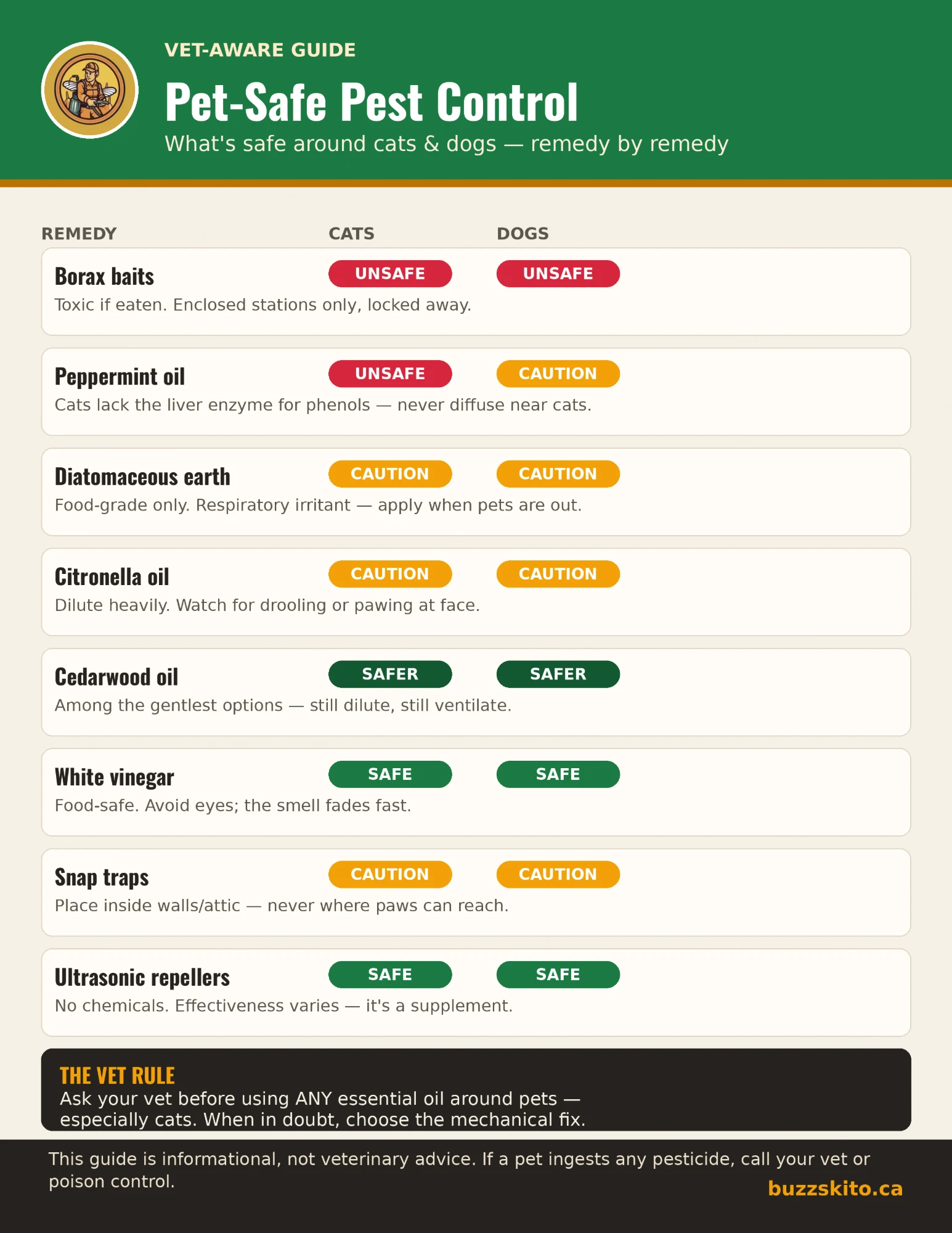
The range runs from minor (rinsed, diluted vinegar, or a trap a pet cannot reach) to life-threatening (a dog flea product on a cat, rat poison, metaldehyde slug bait). The first eight rows follow the one-page guide in its own order; the rest are common products it leaves out.
| Remedy | Risk to dogs | Risk to cats | Lower-risk swap or rule |
|---|---|---|---|
| Borax baits | Low toxicity in bait amounts; mild stomach upset; a chewed station can block the gut | Same as dogs | Enclosed station out of reach; never an open dish or loose powder |
| Peppermint oil | Still at risk, though without the cat's enzyme deficiency | High: on a poison-control list of oils known to poison cats | Seal entry holes instead; no oil on fur, no diffuser in a shared room |
| Diatomaceous earth | Dust irritates the nose, eyes and skin | Same as dogs | Pets out of the room; apply only where the label directs |
| Citronella oil | Stomach irritation if swallowed; skin and eye irritant | Same, plus cats' sensitivity to essential oils | Candles, coils and torch oil out of reach; nothing concentrated on the animal |
| Cedarwood oil | Cedar is on a veterinary list of oils that can cause seizures | Same list; cats are at particular risk from essential oils | Treat it like any essential oil; ask a veterinarian first |
| White vinegar | Acidic: can upset the stomach and irritate | Same as dogs | Dilute, rinse and let dry |
| Snap traps | No poison; injury if the pet springs one | Same as dogs | Behind objects, in closed cabinets or in rooms the pet does not enter |
| Ultrasonic repellers | No chemical; not assessed by the veterinary sources used here | Same as dogs | Do not rely on one; seal and trap |
| Tea tree oil | Potentially toxic to the liver | On the list of oils known to poison cats | No concentrated oil on any pet |
| Dog-only flea and tick spot-ons such as permethrin | For dogs, and only as the label directs | Dangerous, possibly life-threatening | A cat-labeled product chosen with a veterinarian; keep a treated dog apart until dry |
| Rat and mouse poison | Poisoning from bait or from a poisoned rodent | Same as dogs | Snap traps; any bait in a tamper-proof station |
| Metaldehyde slug and snail bait | Very toxic; a small amount can poison | Significantly toxic to household pets, a poison-control source says | Iron phosphate bait is much less toxic to dogs but can still be toxic; no piles |
| Mothballs | More likely than cats to eat them | More sensitive to them | Airtight containers only; never loose |
| DEET and other human repellents | Misuse can lead to neurological problems | Same warning | Only repellents labeled for animals |
| Glue traps | Stick to fur and skin | Same as dogs | Not where pets can touch them; vegetable oil loosens the glue |
Summarized from the sources named below; ask your veterinarian about your own animal.
What changes when children live in the home too?
- Borax and boric acid. NPIC says seizures and deaths have been reported more often in infants exposed to boric acid over a long period than in adults, and that many products must be applied out of children's reach. Get down to a child's level and check after you apply.
- Diatomaceous earth and essential oils. NPIC's irritation warnings for the dust were written about people, and it says some citronella products should not be used on children younger than six months unless a doctor directs it.
- Traps, glue boards and rodent bait. The University of California says to set traps where children are unlikely to encounter them, to keep glue boards away from children, and to put bait in tamper-proof stations out of their reach.
- Flea and tick products. FDA says to wash your hands with soap and water after applying one, or wear gloves, and to store products away from food and from things that go in a mouth, such as baby pacifiers.
- If a child swallows any pest product, call Poison Control at 800-222-1222, the number printed on NPIC's fact sheets.
What do the eight remedies on the one-page guide do to a cat or dog?
None of the eight is free of risk. Three are essential oils, two are powders, one is a mild acid and two involve no chemical at all.
Borax baits
Borax bait is a low-toxicity poison in a small dose, and the usual result when a pet gets into a bait station is mild stomach upset. NPIC's boric acid fact sheet rates boric acid as low in toxicity if eaten or if it contacts skin, and adds that borax can be corrosive to the eye. People who have eaten it have had nausea, vomiting, stomach aches and diarrhea. NPIC says animals are affected in a similar way and that their signs can start within 2 hours.
Poison-control veterinarians say much the same about ready-made baits. In a peer-reviewed review of the ten most common dog poisonings (Veterinary Medicine, March 2006), two ASPCA Animal Poison Control Center veterinarians wrote that serious poisoning is not expected when a pet eats an ant or roach bait, because the concentration of insecticide is low and the bait is small. The plastic or metal housing is often the greater concern, they add, since a swallowed piece can block the gut.
That is no reason to leave borax in the open. The amount is what separates a bait station from a spilled box of powder or a saucer of homemade syrup. Keep all of it behind appliances, inside closed cabinets or inside a station, and call your veterinarian if a pet eats loose powder, homemade bait or a whole station. Borax does not kill an insect that will not eat it; mixing strengths and the reasons a bait fails are in the guide to borax for ants.
Peppermint oil
Peppermint oil is on a poison-control list for cats, and the chart's warning holds up. Pet Poison Helpline names peppermint among the oils known to cause poisoning in cats, along with wintergreen, sweet birch, citrus, pine, ylang ylang, cinnamon, pennyroyal, clove, eucalyptus and tea tree. The Merck Veterinary Manual's chapter on essential oil poisoning gives the reason. Cats are deficient in a liver enzyme, glucuronyl transferase, which leaves them very sensitive to phenols and the phenolic compounds some oils contain, and they swallow what lands on their coat when they groom.
Dogs are not in the clear. Merck says dogs do not have the same enzyme deficiency but are still at risk, and that birds are at high risk. The most common signs it lists are vomiting, lethargy, drooling, wobbliness and loss of appetite, developing within minutes to hours.
Diffusers are the part owners miss. Both sources separate passive diffusers such as reeds, whose main hazard is irritation of the airways, from nebulizing and ultrasonic models that put microdroplets of oil into the air to settle on fur and be licked off. Merck's precautions are to never apply concentrated oil to a pet, keep pets out of the room while a diffuser runs, ventilate afterward, run it for less than 30 minutes and use diluted oil. Cats with asthma or other breathing problems are at greater risk, Pet Poison Helpline adds.
Peppermint oil does not close the gap a mouse came through, and whether the scent repels mice at all is examined in the guide to peppermint oil for mice.
Diatomaceous earth
Diatomaceous earth is a dust hazard more than a poison: the risk is a pet breathing it in or getting it in the eyes, not swallowing it. NPIC's diatomaceous earth fact sheet says very little is absorbed when it is eaten. Breathed in, it can irritate the nose and nasal passages, and an extremely large amount can cause coughing and shortness of breath. It can also irritate the eyes and dry the skin.
It kills insects by absorbing oils and fats from their outer layer so they dry out, and NPIC says it works only as long as it stays dry and undisturbed. A layer on an open floor gets walked through, sniffed and swept up, which is bad for the pet and for the pest control. Apply it only where the label directs, with pets out of the room.
On grade, NPIC counts more than 150 registered diatomaceous earth pesticide products, says some can be used directly on dogs and cats, and describes food-grade products as purified ones used in feed and in clarifying wine and beer. The crystalline form of silica, which it links to silicosis after long-term inhalation, may be present at very low levels in pesticide products. Look for a label that names your pest, and ask a veterinarian before dusting anything onto an animal.
Citronella oil
Citronella is a mild irritant on skin and a stomach irritant when swallowed, and no source used for this page publishes a dilution that makes it suitable to put on a pet. NPIC's citronella fact sheet calls oil of citronella mildly irritating to skin and eyes and has nothing specific on dogs or cats. It repels insects; it does not kill them.
The pet-specific warning comes from the ASPCA, whose Fourth of July safety tips say to keep citronella candles, insect coils and tiki torch oil out of reach: swallowing them can irritate the stomach and possibly depress the central nervous system, and inhaled oil could cause aspiration pneumonia. As an essential oil, citronella also falls under Merck's precautions, and the signs to watch for start with drooling, vomiting, lethargy and wobbliness. A candle does nothing for the pet itself, which matters because mosquitoes bite dogs too.
Cedarwood oil
None of the veterinary sources used for this page rates cedarwood oil as a gentler essential oil, and cedar appears on two of their lists of oils to worry about. The Merck Veterinary Manual names cedar, with birch, eucalyptus, hyssop, pennyroyal, sage, wintergreen and wormwood, among the essential oils that can cause seizures. Pet Poison Helpline's general article on essential oils includes cedar in its list of common oils that can cause poisoning. Neither list says whether it means cedarwood oil, cedar leaf oil or both, and neither ranks any cedar oil as milder than the rest.
Until a veterinary source draws that line, treat cedarwood oil like any other essential oil: not on the animal, not in a diffuser in a shared room, and not where a cat can lick it up. None of these sources says how well it works against any pest, and whether a cedar-based flea or tick spray suits your animal is a question for a veterinarian.
White vinegar
Vinegar draws the mildest warning of any liquid on the chart, with one caveat from poison control: it is an acid. The ASPCA's page on household products says vinegar is acidic and can cause stomach upset and irritation, and that it is not generally an issue when the solution is diluted, rinsed and allowed to dry. Keep the bottle and any spray away from a pet's eyes.
The ASPCA is describing a cleaning solution, and cleaning is vinegar's part in pest control. What it can and cannot do to an ant trail is covered in the guide to whether vinegar kills ants.
Snap traps
A snap trap contains no poison, so the whole risk is a pet reaching it. The University of California's house mouse guide says to set traps close to walls, behind objects and in dark corners, no more than about 10 feet apart where mice are active, and in locations where the risk of children, pets or other animals encountering them is low.
With pets, that means behind the stove and refrigerator, inside a closed cabinet or pantry, or in an attic, crawl space or garage the pet does not enter. A trap cannot be set or checked inside a finished wall, and it removes only the mice already indoors without closing the gap they used. Types, numbers and placement are in the guide to mouse traps.
Ultrasonic repellers
An ultrasonic repeller exposes a pet to no chemical, and the evidence says it does very little to pests either. The University of California guide explains that ultrasonic sound is directional, does not penetrate behind objects and fades quickly with distance. It concludes that there is little evidence that sound, magnetic or vibrational devices of any kind will drive established mice or rats from a building or provide any prevention or control.
None of the veterinary or poison-control sources used here assesses these devices for cats, dogs or pet rodents, so this page cannot rate them either way. If you keep a hamster, gerbil or guinea pig, ask your veterinarian before plugging one in, since the devices are aimed at rodents. The practical risk is a false sense of security that delays sealing and trapping; see what the research says about ultrasonic pest repellers.
What is the vet rule for essential oils around pets?
Ask your veterinarian before using any essential oil on or around a pet, and assume a cat is at more risk than a dog. That is the rule at the bottom of the one-page guide, and the sources support it: Merck's key points are that essential oils can be toxic to animals when inhaled or applied to the skin, and that cats and birds are at particular risk.
The reason to ask, and not to look up a recipe, is that no source used for this page publishes a dilution, a drop count or a list of oils that is acceptable for every animal. Tea tree oil shows what is at stake: Merck lists it among the essential oils that are potentially toxic to the liver, Pet Poison Helpline includes it among the oils known to poison cats, and the poison-control case record for the concentrated oil is summarized in the guide to what kills ticks on dogs instantly.
The second half of the rule, choosing the mechanical fix when in doubt, means reaching first for methods that have no dose at all: sealing, screening, trapping, vacuuming and removing food and water.
Which pest products are most dangerous to cats and dogs?
The products with the most serious outcomes in the veterinary sources are not on the one-page guide: dog flea and tick products used on cats, rat and mouse poison, metaldehyde slug bait and mothballs.
Dog-only flea and tick spot-ons, including permethrin
A flea and tick product made for dogs can be dangerous, and possibly life-threatening, on a cat. That warning is on FDA's list of items dangerous to pets, and permethrin is the best-documented example. A report from the ASPCA Animal Poison Control Center (Journal of Veterinary Emergency and Critical Care, 2000) describes dog-only spot-ons that contain 45 to 65 percent permethrin, says even small amounts can cause severe signs in cats, and notes that some cats appear to have been exposed by playing with a treated dog.
The most common signs in that report are tremors, muscle twitching, extreme sensitivity to touch, high body temperature and seizures, starting within hours or as late as 72 hours afterward. Most cats recover when they are treated early and aggressively, it says. Merck adds that among pets, cats appear to be more sensitive to the whole pyrethroid family, which includes permethrin.
FDA's guidance on flea and tick products reduces this to one line: if the product is for use on dogs, do not use it on cats. The rest of its advice starts with choosing the product with your veterinarian.
FDA's checklist for flea and tick products
- Ask first. Talk to your veterinarian before treating a pet that is weak, old, medicated, sick, pregnant or nursing, or one that has reacted to a product before.
- Read the label every time. The directions or warnings may have changed since you last used it.
- Match the species, life stage and weight. A product for dogs does not go on a cat. For a puppy or kitten, check that the product is labeled for that life stage and that the animal meets the minimum weight.
- Separate pets until it dries. This matters most with a dog-only product in a home that has a cat.
- Watch the pet afterward. FDA lists dizziness, wobbliness, poor appetite, depression, vomiting, diarrhea and excessive drooling, and says some animals have had seizures or died.
If a pet reacts badly to a flea or tick product, FDA says to call your veterinarian right away; the veterinarian may tell you to bathe the pet immediately with mild dish soap and rinse with large amounts of water. The guide to finding and removing ticks on dogs explains how the main types of tick preventive work.
Rat and mouse poison
Rodent poison can reach a pet by two routes. The Merck Veterinary Manual's rodenticide chapter says pets may be poisoned directly from baits or indirectly by eating poisoned rodents, and it calls anticoagulant baits the most frequent cause of poisoning in pets. The ASPCA poison-control review describes three main types. Anticoagulants cause a bleeding disorder three to five days after the bait is eaten and are treated with vitamin K1 for 14 to 30 days. Bromethalin attacks the nervous system and has no specific treatment. Cholecalciferol raises blood calcium and can lead to kidney failure.
A pet can therefore look normal for days after eating an anticoagulant bait. The University of California guide says all rodenticides are toxic to people, pets and wildlife, that bait belongs in tamper-proof stations out of their reach, and that there is evidence bromethalin can pass to predators that eat poisoned mice. A snap trap leaves no bait and no poisoned carcass. The rules for consumer baits are in the guide to mouse poison.
Slug and snail bait
Metaldehyde slug bait is very toxic to dogs, and a small amount can be enough. NPIC's question-and-answer page on snail bait says the baits contain ingredients dogs like and that poisonings can happen even after a dog eats a small amount. Pet Poison Helpline describes metaldehyde baits as significantly toxic to household pets, lists drooling, vomiting, agitation, tremors and seizures as signs in animals that eat them, and says untreated neurological signs result in severe fever and death.
Iron phosphate bait is the lower-risk swap, with a limit: NPIC says it is much less toxic to dogs but notes that such products are sometimes called pet safe even though they can be toxic. For either kind, store it where pets cannot get to it, clean up spills, spread it thinly instead of leaving piles, and follow the label on keeping pets off treated areas.
Mothballs
Mothballs are a pesticide that works by releasing a gas, and they poison pets that eat them or breathe the vapor. Pet Poison Helpline says cats are more sensitive to them while dogs are more likely to eat them, and that the old-fashioned naphthalene kind is the most toxic, though paradichlorobenzene mothballs can still cause illness. Signs include vomiting, mothball-scented breath, pale or brown gums, weakness, difficulty breathing, tremors and seizures. NPIC says mothballs are meant for closed, airtight containers, are not wildlife repellents, and can harm people, pets and wildlife when used in the open.
DEET and other human insect repellents
Do not put an insect repellent made for people on a pet. The ASPCA's safety tips say not to apply any repellent that is not labeled specifically for use on animals, and that misuse of repellent containing DEET can lead to neurological problems. Ask your veterinarian which product fits the pet.
Glue traps
Glue boards catch whatever steps on them, pets included. The University of California guide says not to use them where children, pets or desirable wildlife can contact them, and that a stuck animal can in most cases be freed with vegetable oil to loosen the glue. If the board is near the eyes or mouth, or the animal is panicking, let a veterinary clinic remove it.
How do you pet-proof a room before a pest treatment?
Take the pet, and everything it puts its mouth on, out of the area before any pesticide goes down, and keep it out until the product is dry and the room is aired. This run-through follows NPIC's guidance on pesticides and pets.
Before you spray, dust or bait: a pet-proofing run-through
- Read the label first. Follow its directions, including how long pets must stay away.
- Move the pets and their things out. Remove pets from the area before you begin, along with toys, chew bones, food bowls and bedding.
- Cover fish tanks. Liquid and vapors should not get into the water.
- Wait for dry and aired. Keep pets away until the pesticide is completely dry and the area has been well ventilated.
- Lawn granules. These may require keeping pets off the treated area for 24 hours or longer. The label gives the time.
- Hiring a company. Ask which products they will use and what the risk to your pets is before the work starts.
What should you do if a pet eats or touches a pesticide?
Call your veterinarian or an animal poison line right away, before any signs appear, with the product container in your hand. The numbers below are copied from each organization's own pages. This page is information, not veterinary advice.
- ASPCA Animal Poison Control Center: (888) 426-4435. Available 24 hours a day, 365 days a year. A consultation fee may apply.
- Pet Poison Helpline: (855) 764-7661. Available 24 hours a day, seven days a week. A fee applies for each incident.
- National Pesticide Information Center: 800-858-7378. Staffed Monday to Friday, so it is not the first call. NPIC says to contact a veterinarian or an animal poison line first, and to call NPIC to discuss the incident after the pet has had medical attention.
- For a person, including a child: Poison Control at 800-222-1222.
- Separate the pet and the product. Take the product away and move the pet out of the room. After a strong scent or a diffuser, Pet Poison Helpline says to move a cat into fresh air immediately and to get emergency veterinary treatment if the signs do not quickly resolve.
- Do not make the pet vomit unless a veterinarian or poison line tells you to. Merck says vomiting should not be induced after essential oil exposure, because the oil can be breathed into the lungs.
- Ask before you bathe. For an insecticide on the coat, Merck's guidance for the pyrethroid family is a bath with mild detergent and cool water. Keep the pet from licking itself in the meantime.
- Keep the evidence. Bring the container, the label or a sample of the bait to the clinic.
- Do not wait for signs. Signs can start within 2 hours after an animal eats boric acid and within minutes to hours after essential oil exposure, but permethrin signs in cats can be delayed for up to 72 hours, and bleeding from anticoagulant rat poison takes three to five days to appear.
Print or save
Pest control with pets in the house: 10 rules to print
Print this and keep it with your pest products. It does not replace a label or your veterinarian.
- Seal gaps, clean up and store food first. That leaves nothing for a pet to eat, breathe in or lick off.
- Read the whole label before every use, and use a product only where and on the species it names.
- Never put a dog flea or tick product on a cat. Keep a treated dog away from the cat until it is dry.
- No concentrated essential oil on any pet. Keep pets out of the room while a diffuser runs, and ask a veterinarian first if you have a cat or bird.
- Baits go in enclosed stations where no paw or tongue can reach. Never set out an open dish.
- Set snap traps behind appliances, in closed cabinets or in rooms pets do not enter. Never put a glue board where a pet can touch it.
- Before any spray or dust, move out pets, toys, chew bones, food bowls and bedding. Keep pets out until it is dry and the room is aired.
- Rat and mouse poison can reach a pet through the bait or a poisoned rodent. Trap first; any bait goes in a tamper-proof station.
- Keep human insect repellent, slug bait and mothballs where a pet cannot reach them.
- Suspected poisoning: call your veterinarian, ASPCA Poison Control at (888) 426-4435 or Pet Poison Helpline at (855) 764-7661 before signs appear. Bring the container.
Both animal poison lines may charge a fee. For a person, call Poison Control at 800-222-1222.
buzzskito.ca
This guide is general educational information, not medical advice. If you have symptoms or concerns after a bite or exposure, contact a healthcare provider.
Use any pesticide exactly as its label directs. The label is the law, and what is registered and sold varies by state.
Frequently Asked Questions
Is diatomaceous earth safe for dogs and cats to walk through?+
The main risk is the dust in the air, not the powder on their paws. The National Pesticide Information Center says diatomaceous earth can irritate the nose and nasal passages when it is breathed in, can irritate the eyes and dry the skin, and that very little is absorbed when it is eaten. It also says the powder only works while it stays dry and undisturbed, so a layer on an open floor that pets walk through is poor pest control as well as an irritant. Apply it only where the product label directs, with pets out of the room, and ask a veterinarian before putting any product on the animal itself.
Can I run a peppermint oil diffuser if I have a cat?+
Veterinary sources advise against running one in a room the cat is in. Pet Poison Helpline lists peppermint among the essential oils known to cause poisoning in cats and says owners should be cautious with diffusers. The Merck Veterinary Manual says to keep pets out of the room while a diffuser runs, to ventilate afterward and to limit sessions to less than 30 minutes. Nebulizing and ultrasonic diffusers put droplets of oil into the air that settle on fur and are swallowed during grooming. Cats with asthma or other breathing problems are at greater risk. Ask your veterinarian before using one at all.
My dog ate an ant trap. What should I do?+
Call your veterinarian or an animal poison line, and tell them the product name and how much of the station is missing. ASPCA Animal Poison Control Center veterinarians have written that serious poisoning is not expected from ant and roach baits, because the concentration of insecticide is low and the bait is small, and that signs are usually limited to mild stomach upset. They note that the plastic or metal housing is often the greater concern, because a swallowed piece can block the gut. The National Pesticide Information Center says signs in animals that eat boric acid can start within 2 hours.
How long should pets stay away after a pest control spray?+
As long as the product label says, and at least until the spray is completely dry and the room has been aired. That is the National Pesticide Information Center's general guidance, along with removing pets, toys, chew bones, food bowls and bedding before the application and covering fish tanks. Granular lawn products may call for keeping pets off the treated area for 24 hours or longer. If a company is doing the work, ask which products will be used and what the label requires for pets before the technician starts.
Are any essential oils safe for cats?+
None of the veterinary sources used for this page names an essential oil as safe for cats. The Merck Veterinary Manual says cats are at particular risk: they are deficient in a liver enzyme, glucuronyl transferase, which makes them very sensitive to the phenols some oils contain, and they swallow what is on their coat when they groom. Pet Poison Helpline lists eleven oils known to cause poisoning in cats, including peppermint, tea tree, citrus, pine, cinnamon, clove and eucalyptus, and says concentrated oils should never be applied directly to a cat. Ask a veterinarian before using any oil on or around a cat.
Can a cat or dog be poisoned by eating a poisoned mouse?+
Yes. The Merck Veterinary Manual says pets may be poisoned directly from rodent baits or indirectly by eating poisoned rodents, and it calls anticoagulant baits the most frequent cause of poisoning in pets. The University of California's house mouse guide reports evidence that bromethalin, a different type of rodent poison, can also pass to predators that eat poisoned mice. Because the bleeding caused by an anticoagulant takes three to five days to appear, a pet can seem normal at first. Call your veterinarian if you know or suspect that your pet ate bait or a poisoned rodent.
Sources
- Toxicoses From Essential Oils in Animals — Merck Veterinary Manual
- Essential Oils and Cats — Pet Poison Helpline
- Boric Acid General Fact Sheet — National Pesticide Information Center
- Diatomaceous Earth General Fact Sheet — National Pesticide Information Center
- Pest Notes: House Mouse (UC ANR Publication 7483) — University of California Statewide IPM Program
- Poisonous Household Products — ASPCA Animal Poison Control
- Safe Use of Flea and Tick Products in Pets — U.S. Food and Drug Administration
How this guide was made: it was researched and drafted with AI assistance from the sources listed above. A second, independent AI pass then checked each factual claim against those sources. Found an error? Email support@buzzskito.ca.