Published by BuzzSkito Mosquito & Tick Control
Published October 7, 2026 · Drafted with AI assistance and fact-checked against the sources listed below
What does natural pest control actually mean?
Natural pest control is best understood as integrated pest management that reaches for the less risky tools first, not as a list of plant-based sprays. EPA describes integrated pest management (IPM) as an environmentally sensitive approach built on common-sense practices, and says it applies to the home, garden and workplace as well as to farms. Its four steps are to set an action threshold, monitor and identify the pest, prevent problems, and then control them.
Within the control step, EPA says effective, less risky options are chosen first. It names highly targeted chemicals such as pheromones that disrupt mating, and mechanical controls such as trapping or weeding. If monitoring shows those are not working, targeted spraying of pesticides comes next, and it calls broadcast spraying of non-specific pesticides a last resort. Read that way, “natural” is a position on a ladder that runs from sealing and cleaning, through traps and biological controls, to low-risk materials, and only then to stronger products.
EPA also draws a line between IPM and organic growing: it says organic food production applies many of the same concepts as IPM but limits pesticides to those produced from natural sources, as opposed to synthetic chemicals. That is a rule about where a pesticide comes from, not about how toxic it is.
The University of Connecticut's Home Garden Education Office makes the toxicity point directly. It notes that some organic treatments may be less damaging to the environment than conventional insecticides but are still listed as pesticides, and that repeated applications of an organic product may end up costing more and affecting other populations more than a single dose of a conventional one, according to its guide to low-toxicity insecticides.
| Step on the ladder | Examples | Main limit |
|---|---|---|
| Exclusion and sanitation | Sealing gaps, sealed food containers, clearing brush | Takes a full inspection inside and out, and does not remove pests already present |
| Mechanical control | Trapping, weeding, physical barriers | Works pest by pest, so it needs the sealing step to stop new arrivals |
| Biological control | Bti for mosquito larvae, Bt for certain larval pests | Narrow targets and specific life stages only |
| Low-risk materials | Insecticidal soap, horticultural oil, neem, diatomaceous earth, boric acid | Pollinator, aquatic and child-safety cautions; the label sets the use |
| Minimum risk products | Plant oils such as cedarwood, peppermint and thyme | No efficacy requirement in the exemption |
A summary of the evidence cited in the sections below; each row is explained in its own section.
Where should natural pest control start?
It starts with the building and the yard: close the gaps pests use, then take away what they came for. The most specific guidance cited here is the CDC's, which is written about rodents; EPA's IPM framework makes the same prevention step the first line of pest control in general. For the order to work in when you do the job yourself, the do-it-yourself pest control guide walks through the steps.
How do you seal a home against pests?
Find the gaps first, then fill each one: steel wool and caulk for small holes, and metal, cement or hardware cloth for larger ones. The CDC's seal-up guidance says mice can fit through a hole the width of a pencil, 1/4 inch (6 mm) across, so a gap that looks too small to matter is not. For small holes it advises filling them with steel wool and putting caulk around the steel wool to hold it in place, or using spray foam. For larger openings it lists lath screen or metal, cement, hardware cloth and metal sheeting.
- Inside. The CDC lists the areas in, under and behind kitchen cabinets, closet corners, the fireplace, windows and doors, the space behind appliances, the pipes under sinks and washing machines and those leading to water heaters and furnaces, floor air and dryer vents, electrical, water, gas and sewer lines, the attic, basement or crawl space, floor drains, and the joint between floor and wall.
- Outside. It lists the roof among the rafters, gables, eaves and soffits, windows and doors (especially those without weather stripping), the gap between the foundation and the ground, attic and crawl space vents, and holes for electrical, plumbing, cable and gas lines.
How steel wool holds up as a barrier over time is covered in a closer look at steel wool for mice, and the guide to getting rid of mice humanely covers mice that are already inside.
How do you remove food, water and shelter?
Store, cover and move: keep food sealed, keep waste covered, and shift whatever shelters pests away from the house. The same CDC page gives these specifics.
- Food. Keep food sealed in thick plastic, metal or glass containers with tight lids.
- Pet food. Put pet food away after use, and do not leave food or water bowls out overnight.
- Trash. Keep indoor garbage in thick plastic or metal containers with tight lids.
- Compost and wood. Keep compost bins at least 100 feet from the house, and move woodpiles 100 feet or more away and raise the wood at least 1 foot off the ground.
- Yard. Clean up brush and weeds around the home, and keep grass and shrubbery within 100 feet of it well trimmed.
The CDC presents these as prevention. EPA's framework treats prevention as the first line of pest control and turns to control once monitoring shows it is required and preventive methods are no longer effective or available, which is why sealing and cleaning are the start of a natural program and not the whole of it.
Do biological controls work on household and yard pests?
Yes, when the organism fits the pest and its life stage, but they are narrow tools, not general sprays. Biological control here means a living organism, or a product made from one, used against a pest. The options that the sources for this guide document are Bti for mosquito larvae and Bt for certain larval garden pests.
What does Bti do, and what does it leave alone?
Bti kills mosquito larvae in standing water and does nothing about the adults already biting you. CDC's page on larvicides explains that larvicides kill mosquito larvae and pupae before they can grow into biting adults. It identifies Bacillus thuringiensis subspecies israelensis (Bti) as a bacterium found in soil that is toxic to mosquito larvae, blackflies and fungus gnats, says it has been used for mosquito control for more than 30 years, and states that it does not control biting female mosquitoes.
For yards, CDC says homeowners can use mosquito dunks or bits that contain larvicide, and that larvicides can be applied by hand to small bodies of water. It describes the water to treat as standing water that will not be used for drinking and cannot be covered, dumped or removed, and it warns against applying more than directed or reapplying more often than instructed. CDC adds that when larvicides are used according to the product label, they do not harm people, pets or the environment.
The practical reading is that dumping and covering water comes first, larvicide handles what is left, and the result is fewer new mosquitoes rather than relief from the ones already flying. A full yard plan is in the guide to getting rid of mosquitoes in a yard, and the backyard mosquito control guide puts the larvicide step in context with the rest.
What about Bt and spinosad on garden pests?
Bt mostly works on the feeding larvae of the insects its strain targets, and spinosad shows how a product of natural origin can still be hard on bees. The University of Connecticut explains that Bt spores and crystals must be eaten by the larval stage of an insect to work, that particular strains are host-specific, that most formulations do not work on mature insects, and that they are not harmful to animals, birds, humans or pollinators. Its table of strains pairs Bt kurstaki with caterpillars such as cabbage loopers, imported cabbageworm and tomato hornworms, and Bt israelensis with mosquito, fungus gnat and blackfly larvae.
Spinosad, by the same source, is based on compounds found in the bacterium Saccharopolyspora spinosa. It works by contact and by ingestion against pests that include ants, beetles, fruit flies, leafminers, mosquitoes and thrips. It is toxic to bees while wet, so the guide says not to apply it to plants in flower and to apply it in the evening, when it will have time to dry before pollinators visit.
Where do nematodes and released predators fit?
Mostly in lawn and garden care, and outside what the sources for this guide evaluate. Beneficial nematodes and predatory insects come up often as natural controls, but none of the government and university pages cited here rates how well either works, so this page takes no position on them. The University of Connecticut does make a related point about the helpful insects already in a yard: most microbial insecticides are very host-specific, which it calls important for protecting beneficial insects from unwanted consequences. How lawn grubs are confirmed, when treatment is worth it, and what extension research found for parasitic nematodes and other biological options is covered in the lawn pest control guide.
For plants, natural garden pest control applies the same order of steps to beds, borders and houseplants, and three common pests have pages of their own: fungus gnats, whiteflies and aphids.
What counts as a mechanical control?
Mechanical controls are physical: they trap, block, remove or exclude a pest without a pesticide. EPA names trapping and weeding as examples of less risky controls to choose first, and sealing gaps, covered above, applies the same idea to a building. Which type of mouse trap to use, how many to set and where to put them is covered in the guide to mouse traps.
Devices and scents sold as alternatives to traps and sprays raise a different question, which is whether they work at all. Electronic repellers that claim to drive pests away with sound are reviewed in what the evidence says about ultrasonic pest repellers. Scent repellents such as peppermint oil are weighed for mice in the page on peppermint oil for mice and in the wider guide to mice repellent. Neither is a mechanical control, and neither is covered by the CDC or EPA guidance cited here.
Which low-risk materials are worth considering, and what are their limits?
Soap, oil, neem, pyrethrin, diatomaceous earth and boric acid can each help against specific pests, and each has a documented limit. The table below summarizes what the University of Connecticut and the National Pesticide Information Center (NPIC) say about them. Rates, mixing and reapplication intervals belong to the product label, and this guide gives none.
| Material | How it acts | Main cautions in the sources |
|---|---|---|
| Insecticidal soap | On contact; may disrupt cell membranes and cause dehydration | Not above 90°F, in full sun, on drought-stressed plants or when leaves cannot dry; very toxic to pollinators until dry |
| Horticultural oil | On contact; coats the insect and blocks its breathing openings | Same cautions as soap; very toxic to pollinators until dry |
| Neem oil (azadirachtin) | Extract of the neem tree seed; stops immature insects feeding and disrupts molting | Slightly toxic to fish and aquatic animals; low toxicity to pollinators |
| Pyrethrin | Contact insecticide from a chrysanthemum flower; paralyzes the nervous system of target and nontarget insects | Bees are extremely sensitive; fish and lower aquatic invertebrates cannot break it down; leftovers do not go down drains |
| Diatomaceous earth | A dust that works as a desiccant, drying insects out | Prolonged exposure may irritate lungs and other tissues; highly toxic to bees |
| Boric acid | Kills insects that eat it by disrupting the stomach; can affect the nervous system | Low toxicity if eaten or on skin, but borax can be corrosive to the eye; many products must be applied out of children's reach |
Sources: University of Connecticut Home Garden Education Office; National Pesticide Information Center (boric acid).
Insecticidal soap and horticultural oil
Both work on contact, so they only affect what they reach while wet. The University of Connecticut says the oil forms a coating that blocks an insect's breathing openings, that soaps and oils may also disrupt cell membranes and metabolism, and that together they can manage aphids, mealybugs, thrips, whiteflies and scale. Its cautions are not to apply either when temperatures are above 90°F, in full sun, on drought-stressed plants, or when high humidity keeps leaf surfaces from drying.
Because both are very toxic to pollinators, the guide says not to use them on plants in bloom unless the spray goes on in early morning or late evening, or the plant is dormant. Pollinators are not affected once the product has dried.
This page gives no homemade recipes. The University of Connecticut says only commercially prepared insecticidal soaps should be used, because household soaps contain chemicals likely to burn foliage, and a homemade mix has no label, so it has no labeled rate or directions for any pest. The guide's advice is to read the pesticide label and follow its directions exactly.
Neem oil and pyrethrin
Neem is the gentler of the two on pollinators and pyrethrin the harsher, even though the University of Connecticut lists both among its low-toxicity options. Neem oil, whose active ingredient is azadirachtin, can control aphids, beetles, caterpillars, leafminers, mealybugs, sawfly larvae, scale, spider mites, thrips and whiteflies. The guide says it is effective against actively growing immature insects, stopping their feeding and disrupting their molting. It gives azadirachtin very low toxicity to humans and animals, slight toxicity to fish and aquatic animals, and low toxicity to pollinators.
For pyrethrin the warnings are stronger. The guide describes it as a contact insecticide that rapidly paralyzes the nervous system of nontarget insects as well as target ones. It says bees are extremely sensitive to it, so pyrethrins should be applied at night, when pollinators are not visiting plants. It also says fish, mayflies and other lower-level aquatic invertebrates lack the enzymes to break down pyrethrins, leading to a toxic buildup, and that leftover solutions should not be poured down drains because pyrethrin can pass unaffected through secondary treatment at municipal wastewater plants.
Diatomaceous earth
Diatomaceous earth is a dust that works as a desiccant, drying insects out. The University of Connecticut lists ants, aphids, bed bugs, cockroaches, crickets, fleas, millipedes, spiders, sow bugs and slugs among the pests it is used against. It describes the material as not toxic to humans, animals, fish or birds, and adds that prolonged exposure may irritate lungs and other tissues. It also calls it highly toxic to bees, which argues against using it on plants that bees visit. Whether it is worth using on bed bugs specifically is weighed in the guide to diatomaceous earth for bed bugs.
Boric acid
Boric acid is a naturally occurring compound and a pesticide at the same time. NPIC's boric acid fact sheet says it is found in soil, water and plants, that products containing boric acid have been registered for use in the United States since 1948, and that boric acid and its sodium salts are used against insects, spiders, mites, algae, molds, fungi and weeds. It can kill insects that eat it: it disrupts the stomach and can affect the nervous system, and it can also scratch and damage the insect's exterior.
On risk, NPIC says boric acid is low in toxicity if eaten or if it contacts skin, but that in the form of borax it can be corrosive to the eye. People who have eaten it have had nausea, vomiting, stomach aches and diarrhea. NPIC says children may be especially sensitive to pesticides compared with adults, although it is not clear whether they are more sensitive to boric acid in particular. The reason it gives for the label rule is behavior: young children crawl and play on the floor and put their hands and other items in their mouths, so many boric acid products must be applied in places out of children's reach. In animals that eat it, signs of poisoning can start within 2 hours.
Kitchen-cabinet versions of the question have their own pages: whether vinegar kills ants and what borax does to ants.
What does “minimum risk” on a pest product label mean?
A minimum risk pesticide is one that is exempt from the requirements of the federal pesticide statute, FIFRA, because its ingredients come from set lists and its label follows set rules; the exemption is about ingredients and labeling, not performance. The text is in 40 CFR 152.25(f), the federal regulation on minimum risk pesticides, which exempts products containing the listed active ingredients, alone or combined, provided every criterion in the section is met. The criteria cover four things.
- Active ingredients. Only substances on the regulation's first table are allowed. That table includes cedarwood oil, citronella oil, clove oil, garlic oil, peppermint oil, rosemary oil and thyme oil, along with less obvious entries such as citric acid, corn gluten meal and sodium chloride.
- Inert ingredients. Only commonly consumed food commodities, animal feed items, edible fats and oils, or specific substances on a second table.
- Label contents. Each active ingredient by name and percentage by weight, every inert ingredient, and the company's name and contact information, with no false or misleading statements.
- Claims. The product must not claim to control or mitigate microorganisms that pose a threat to human health, or to control insects or rodents that carry specific diseases, with ticks that carry Lyme disease as the regulation's example.
| Question | What the regulation says |
|---|---|
| Which ingredients may the product contain? | Only those on the regulation's active and inert ingredient tables |
| Does the label have to list what is in it? | Yes, actives by name and percentage by weight, and every inert ingredient |
| Can it claim to control disease-carrying ticks or rodents? | No; such claims are barred for products using this exemption |
| Must the maker show it works? | The regulation contains no efficacy requirement |
| Does the rule test how a given product performs or how safe it is in use? | No such test appears among its conditions, which cover ingredients, label contents and claims |
Source: 40 CFR 152.25(f), as published in the Electronic Code of Federal Regulations.
Two practical points follow from the text. First, a minimum risk label tells you what is in the bottle, and it does not tell you the product kills the pest on the front of the label. Peppermint oil and cedarwood oil are on the active ingredient table, which is why products built on them can be sold under the exemption, but the exemption does not settle whether they repel mice or insects; that question is taken up in what the research on peppermint oil and mice shows. Second, a plant-oil product that does claim to control disease-carrying ticks falls outside this exemption, so the exemption cannot be what stands behind that claim.
The University of Connecticut's guide adds a practical limit on essential oils in general. It describes them as used as nerve disrupters and repellents, names oils of cedar, cinnamon, citronella, clove, garlic, mint, rosemary and thyme among them, and says they volatilize quickly, so repeated applications may be necessary.
Is natural pest control safe for children, pets and pollinators?
Not automatically: some natural materials may be less damaging to the environment than conventional insecticides, but each one has its own hazards, and the sources say so plainly. Match the material to who and what is exposed.
- Pollinators. The University of Connecticut calls soap and oil very toxic to pollinators until dry, spinosad toxic to bees while wet and diatomaceous earth highly toxic to bees, and says bees are extremely sensitive to pyrethrin. It describes neem as low in toxicity to pollinators and most Bt formulations as not harmful to them. NPIC reports an EPA conclusion that boric acid is of relatively low toxicity to bees.
- Fish and drains. The same guide says leftover pyrethrin solutions should not go down drains, because fish and lower aquatic invertebrates cannot break pyrethrins down, and that neem is slightly toxic to fish and aquatic animals.
- Children. NPIC says children may be especially sensitive to pesticides in general, and that because young children crawl on floors and put hands and objects in their mouths, many boric acid products must be applied in places out of their reach.
- Pets. Signs of poisoning in animals that eat boric acid can start within 2 hours, according to NPIC.
- Lungs. The University of Connecticut says prolonged exposure to diatomaceous earth may irritate lungs and other tissues.
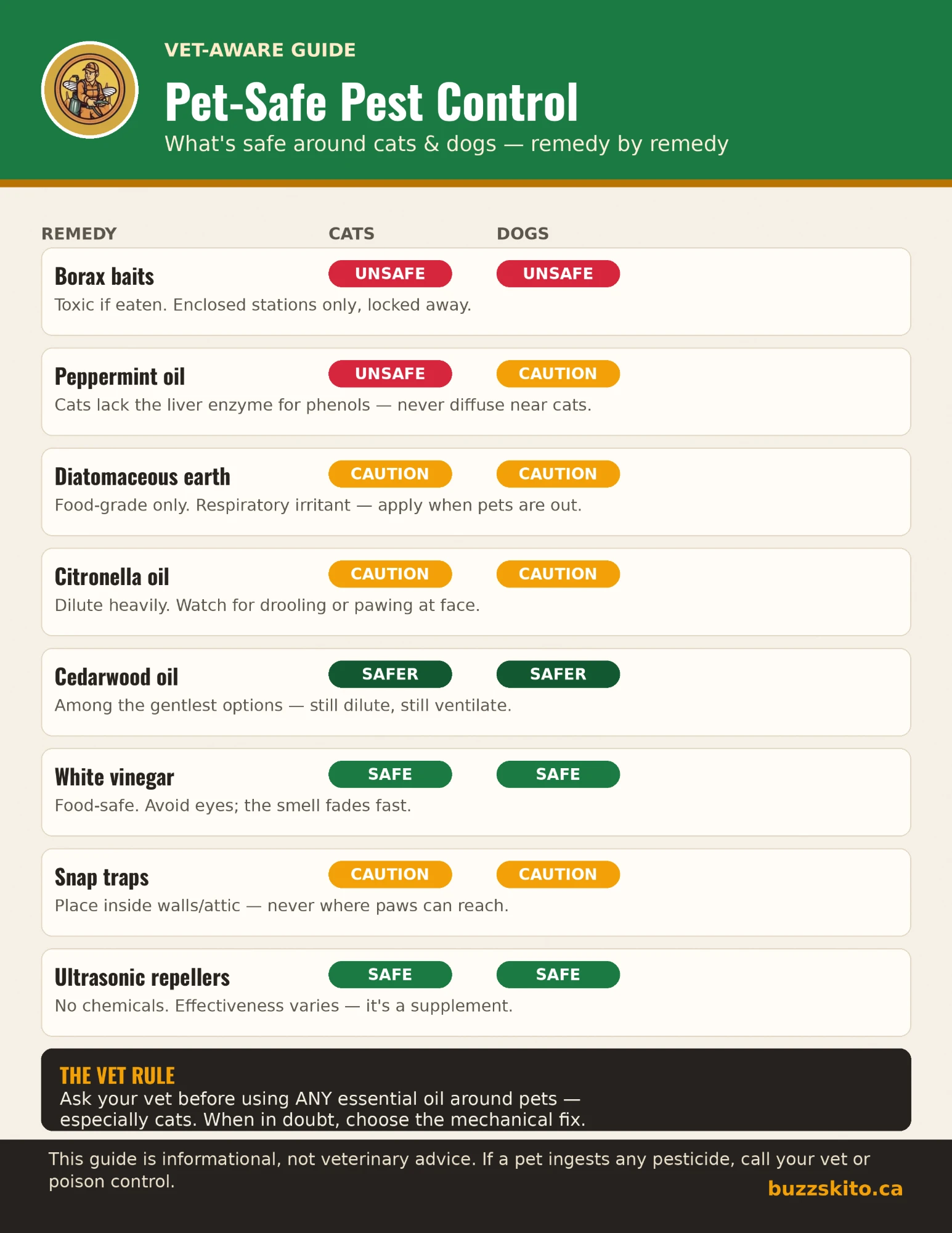
For households with cats or dogs, pest control around cats and dogs goes through common home remedies one at a time and gives the risk each carries, with veterinary sources.
When is natural pest control not enough?
When the pest is established, the damage or health risk is rising, or the pest lives where you cannot reach it. EPA's first IPM step is to decide the point at which pest populations or environmental conditions indicate that action must be taken, and it notes that sighting a single pest does not always mean control is needed, so the real question is whether you have reached that point. Once control is required and prevention is no longer enough, the agency says to weigh control methods for both effectiveness and risk: less risky controls first, targeted spraying if monitoring shows they are not working, and broadcast spraying of non-specific pesticides only as a last resort.
A pest control company that works under IPM should follow the same ladder, so ask what it plans to inspect, seal and monitor before it plans to spray. What that service typically costs, and how to compare quotes, is covered in the guide to professional pest control costs. Businesses run the same sequence as a documented program, which the commercial pest control guide explains for restaurants, health care and other settings. For ticks, what kills ticks separates the products and methods that have evidence from the ones that do not.
If you decide to buy traps, baits or other equipment, the pest product guides group the guides by pest.
Use any pesticide exactly as its label directs. The label is the law, and what is registered and sold varies by state.
Frequently Asked Questions
Does natural pest control actually work?+
It can, if you treat it as a sequence instead of a single product. EPA's integrated pest management approach puts prevention, monitoring and less risky controls first and leaves broadcast spraying for last. Sealing gaps and removing food and shelter cut what attracts pests, Bti is toxic to mosquito larvae, and soap, oil and boric acid have defined uses. The sources used here do not show that any one natural product clears every established infestation, and the federal minimum risk exemption sets no requirement to prove that a product works.
Is organic pest control safe for pets and children?+
Not automatically. The University of Connecticut notes that organic treatments are still listed as pesticides. The National Pesticide Information Center says boric acid is low in toxicity if eaten or touched, but that many boric acid products must be applied out of children's reach because young children crawl on floors and put their hands in their mouths, and that signs of poisoning in animals that eat it can start within 2 hours. Diatomaceous earth dust may irritate the lungs with prolonged exposure. If a child or pet swallows a pest product, contact Poison Control or a veterinarian right away.
Can natural methods get rid of mosquitoes?+
Only partly. CDC says Bti is toxic to mosquito larvae, blackflies and fungus gnats but does not control biting female mosquitoes, so it lowers the next generation and not the adults already flying. CDC describes larvicide dunks or bits as a way to treat standing water that cannot be covered, dumped or removed and that will not be used for drinking. That wording implies dumping or covering water is the first move, and the label sets how much to use and how often to reapply.
Do minimum risk pesticides have to be proven effective?+
The federal regulation that creates the exemption, 40 CFR 152.25(f), contains no requirement for a maker to demonstrate that a product works. It controls which active and inert ingredients may be used, what the label must list, and which claims are barred, including claims to control insects or rodents that carry specific diseases, with ticks that carry Lyme disease as its example. A minimum risk label therefore tells you about ingredients and rules, not about performance.
Is diatomaceous earth safe to use around the house?+
The University of Connecticut describes diatomaceous earth as not toxic to humans, animals, fish or birds, but says prolonged exposure may irritate lungs and other tissues, and that it is highly toxic to bees. That combination argues for following the label on where to apply it, avoiding breathing the dust, and keeping it off plants that bees visit. It works as a desiccant that dries insects out, so it has to reach the pest to do anything.
What should I do first when I see a pest?+
Identify it and judge how serious the problem is. EPA says sighting a single pest does not always mean control is needed. Its integrated pest management steps begin with deciding the point at which control is needed, then monitoring and identifying the pest accurately, then prevention, then control. In practice that means confirming the species, looking for gaps and for food and water sources, and choosing a less risky control that fits. Sealing, cleaning and trapping come before spraying.
Sources
- Integrated Pest Management (IPM) Principles — US Environmental Protection Agency
- How to Seal Up to Prevent Rodents — Centers for Disease Control and Prevention
- Larvicides — Centers for Disease Control and Prevention
- Insecticides: Low Toxicity Options — University of Connecticut Home Garden Education Office
- Boric Acid Fact Sheet — National Pesticide Information Center, Oregon State University
- 40 CFR 152.25 - Exemptions for pesticides of a character not requiring FIFRA regulation — Legal Information Institute, Cornell Law School (Electronic Code of Federal Regulations)
How this guide was made: it was researched and drafted with AI assistance from the sources listed above. A second, independent AI pass then checked each factual claim against those sources. Found an error? Email support@buzzskito.ca.