
Published by BuzzSkito Mosquito & Tick Control
Published October 20, 2026 · Drafted with AI assistance and fact-checked against the sources listed below
What is the black spider with white spots?
A fuzzy black spider with white spots that moves in jerks and jumps is probably a bold jumping spider (Phidippus audax). The Missouri Department of Conservation's (MDC) bold jumper page describes it as fuzzy and usually black, with spots on the abdomen that are typically white, orange or red, the largest in the middle, and the upper parts of the jaws iridescent green or blue. Females are 1/4 to 3/4 inch long, not counting the legs, and males usually under 1/2 inch.
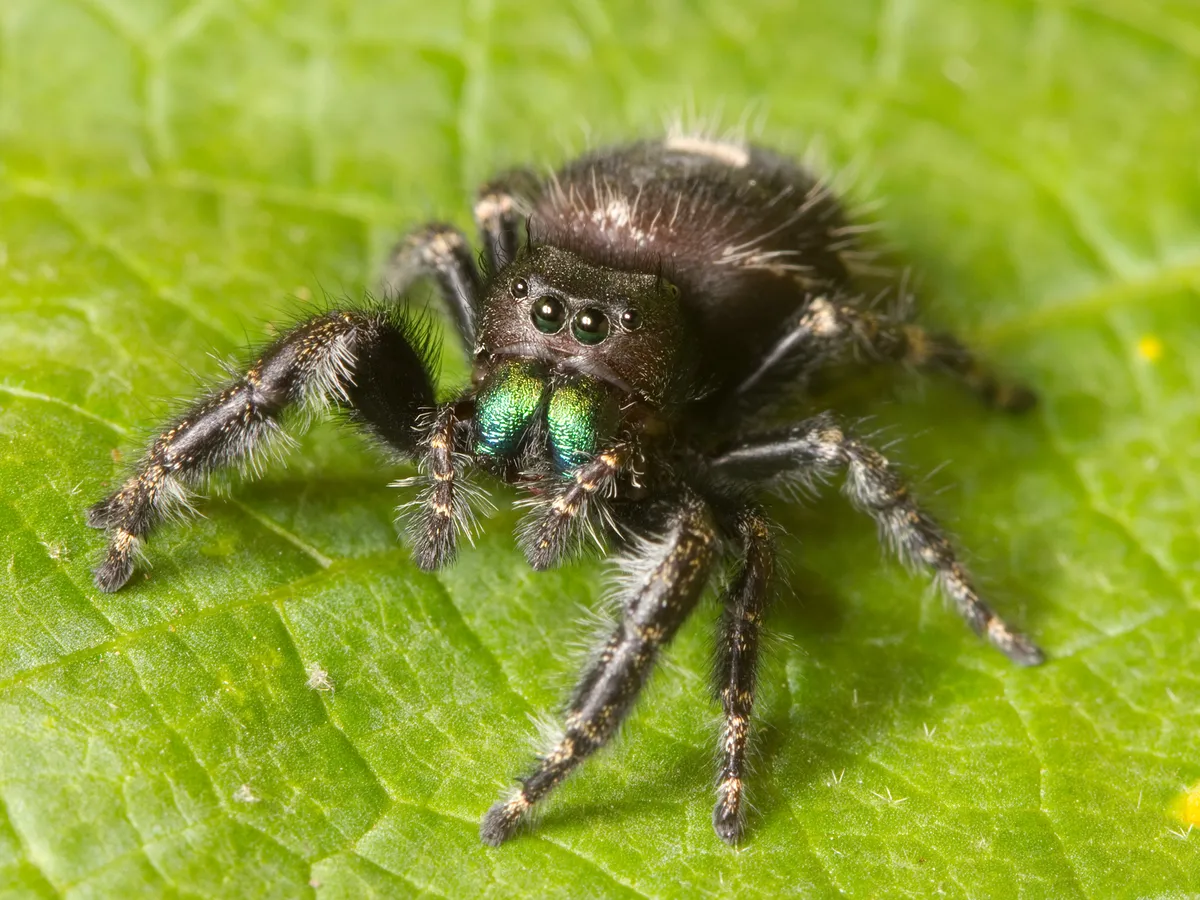
It builds no web, using silk only for a safety line and a retreat, MDC says, and it turns up on plants, tree trunks, fence posts and house or barn siding across much of the United States. Colorado State University's (CSU) fact sheet on jumping spiders calls it ubiquitous, lists it among the jumping spiders that often enter homes and describes the enormous, forward-facing front eyes that mark jumping spiders. CSU also warns that patterns vary within a species, so check the shape and the jumping as well as the spots.
MDC says the bite is harmless, though a bold jumper can bite if squeezed or handled, and CSU says most jumping spiders' jaws are too small to pierce skin; a bite that does causes only mild, temporary pain. The jumping spider guide covers the other species, and the guide to common house spiders covers the small black jumpers found indoors.
What if the white mark is a band, not spots?
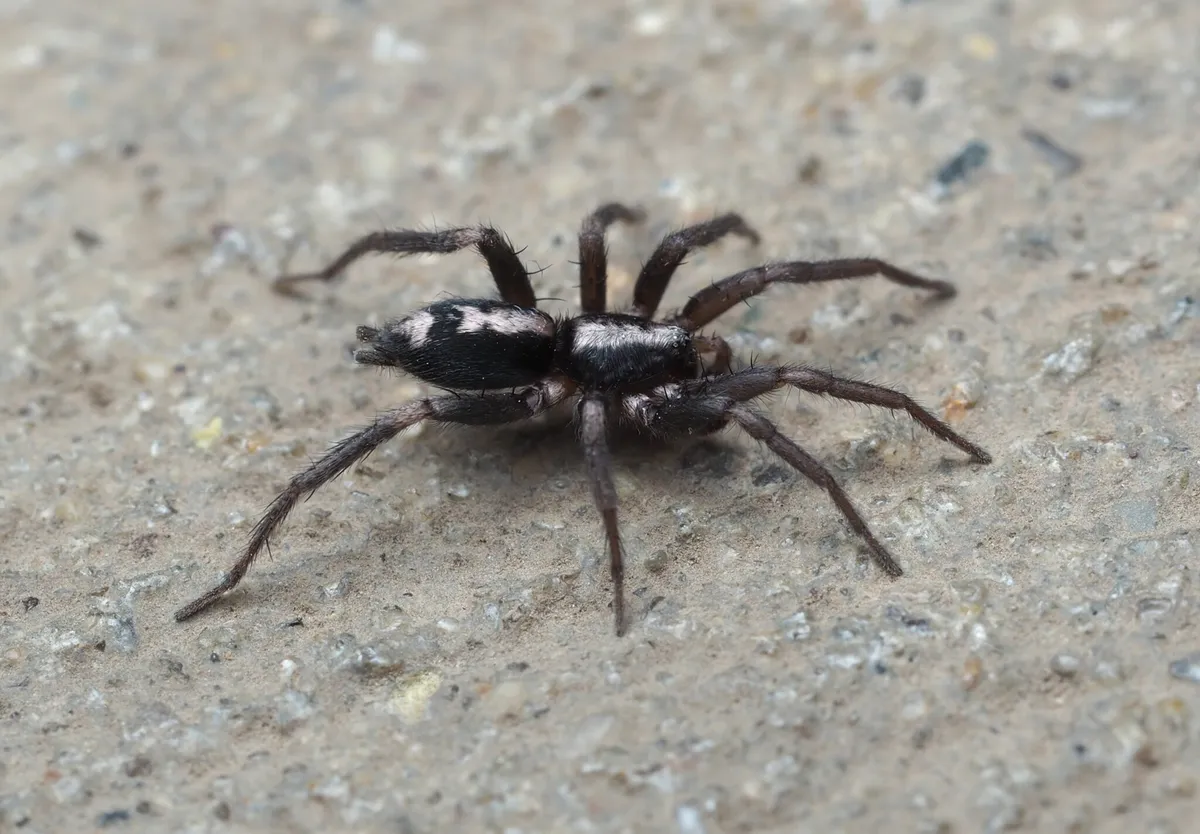
A dark spider with a white band across the abdomen, running fast across a floor at night, is probably an eastern parson spider (Herpyllus ecclesiasticus). Penn State Extension's parson spider page says the name comes from a white pattern on the abdomen that somewhat resembles a clerical collar, and that a small white spot sits just above the spinnerets at the rear. Females are 8 to 13 mm (about 5/16 to 1/2 inch) long and males about 6 mm (1/4 inch).
It is a ground spider: Penn State says ground spiders hunt at night without a web and hide by day in silken retreats in leaves and under boards and stones, and that the parson spider enters buildings in fall to spend the winter. Its bite is painful and may cause an allergic reaction in some people, but Penn State says parson spiders are generally not considered medically important; most bites happen when one is trapped against the skin in clothing or bedding.
What if it is shiny and smooth, not fuzzy?
Then check it for widow markings without touching it: a smooth, shiny black spider with a round abdomen and white marks may be a young or male black widow. UC IPM's guide to widow spiders says a young black widow's abdomen starts mostly white with black spots, then turns olive-gray or tan with white stripes and black dots, and darkens as the spider grows; adult males keep the juvenile colors. MDC says male black widows usually have faint red or white spots on top of the abdomen.
The Army Public Health Center's widow spider fact sheet says males are about half the size of females and that only adult females are a significant threat to people, because young widows and males do not have fangs large enough to penetrate human skin. It also notes that widows may bite if they or their webs are disturbed, so look without touching.
How do you tell which black spider you have?
Watch how it moves, then look at its body and web from a safe distance. UC IPM's Pest Note on spiders describes catching a spider by setting a jar over it and sliding paper underneath; use that only on a spider that is clearly not a widow.
Checks to run from a safe distance
- Does it jump or move in jerky hops, with two huge front eyes? It is a jumping spider, such as the bold jumper or Johnson's jumping spider.
- Is it shiny, with a big round abdomen, in a tangled web? It is a widow or a false widow. Look for red underneath without touching it.
- Does it run fast across the floor at night, with a white band on its back? It is probably a parson spider.
- Is it large and hairy, running on the ground with no web, maybe carrying babies? It is probably a wolf spider.
- Is it black and yellow, in a big round web with a zigzag band? It is a black-and-yellow garden spider.
- Is it glossy black and wandering on the ground in early summer? It may be a male purseweb spider.
- How big is it? Compare the body, without the legs, with a ruler marked in inches and with the sizes in the quick-ID table.
Is it a black widow?
Look underneath: an adult female black widow is shiny black with a red hourglass on the underside of a big, round abdomen. UC IPM describes her as shiny jet black on the body and legs and says the hourglass varies in appearance and on rare occasions is missing. The Army fact sheet puts mature females at about 1/2 inch long and lists five widows in North America: the southern, northern and western black widows, the brown widow and the red widow.
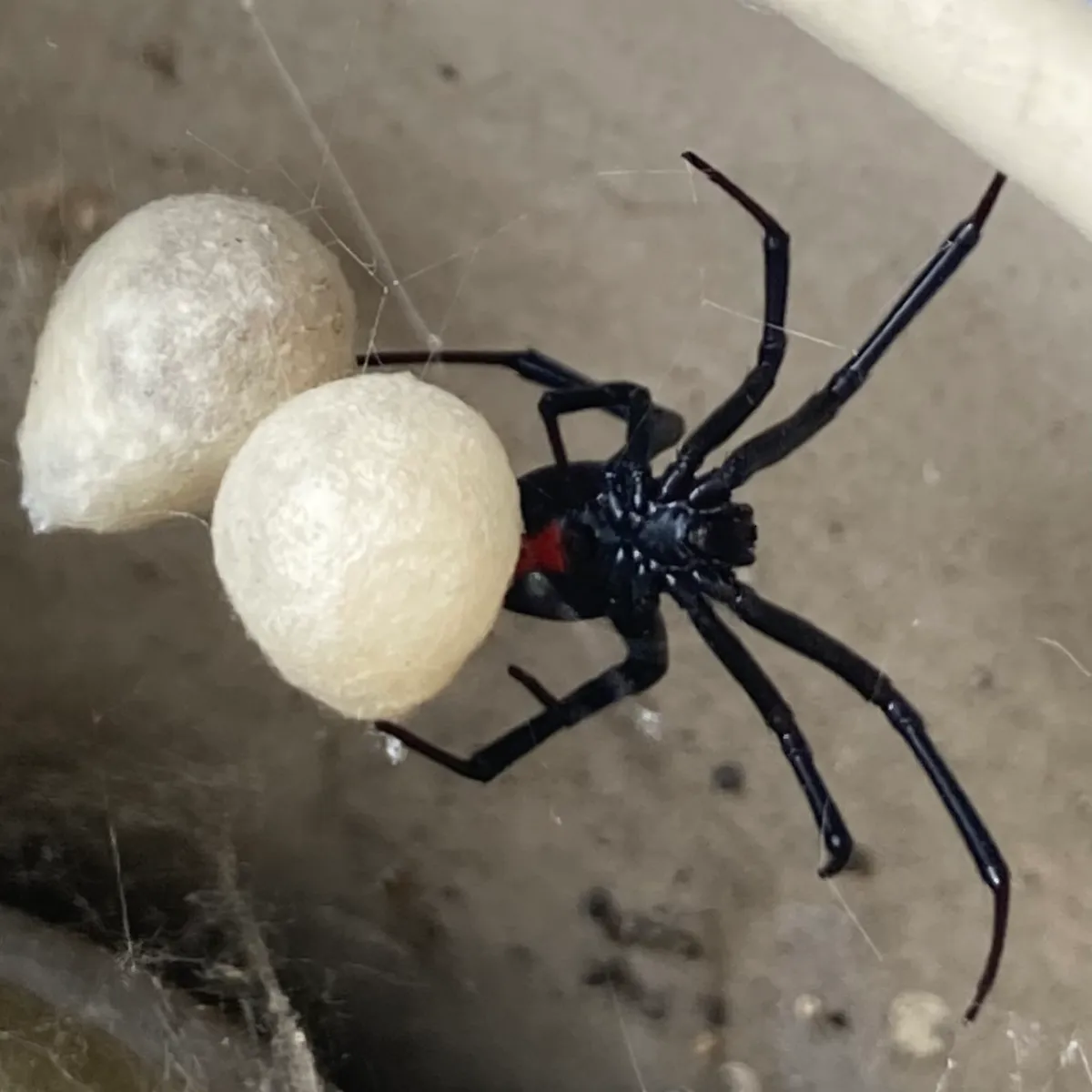
The northern black widow breaks the pattern. MDC's black widow page says its hourglass is broken in two and that it usually has a row of red spots down the back, faint or bold, sometimes with diagonal whitish marks on the sides. The Army calls it an East Coast spider, ranging from northern Florida to southeastern Canada and most common in the northern part of that range.
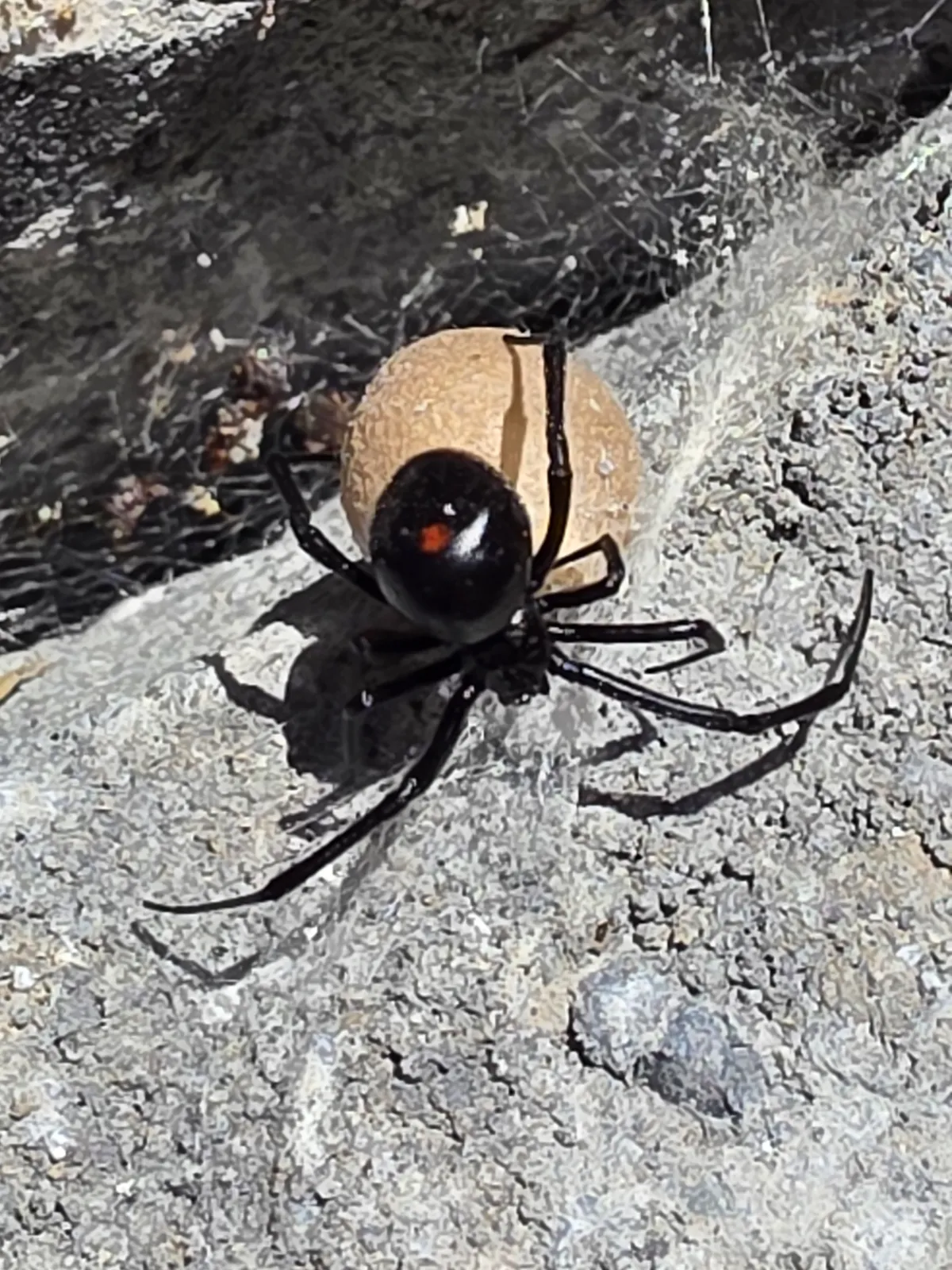
Widows keep to dark, undisturbed places. CDC's page on venomous spiders says black widows are most common in the southern and western United States and names woodpiles, eaves, fences and debris piles. UC IPM says that although they can be found in homes, they typically nest outside, in holes and crevices around the house, and that in garages they make webs by doors and near vents. Bites are quite rare even where widows are common, UC IPM says, but if one bites you, seek medical attention immediately.
The guide to venomous spiders in the US shows which widow lives in each state and what to do after a bite, and separate guides cover black widow spiders, the brown widow and the black widow bite. Egg sacs like the ones above are compared in the guide to spider egg sacs.
What black spider has red on its back?
Red on top of the abdomen points to a northern black widow, Johnson's jumping spider or a bold jumper with red spots, which MDC says can replace the white ones. Red legs on a black body point to a red widow or a male red-legged purseweb spider.
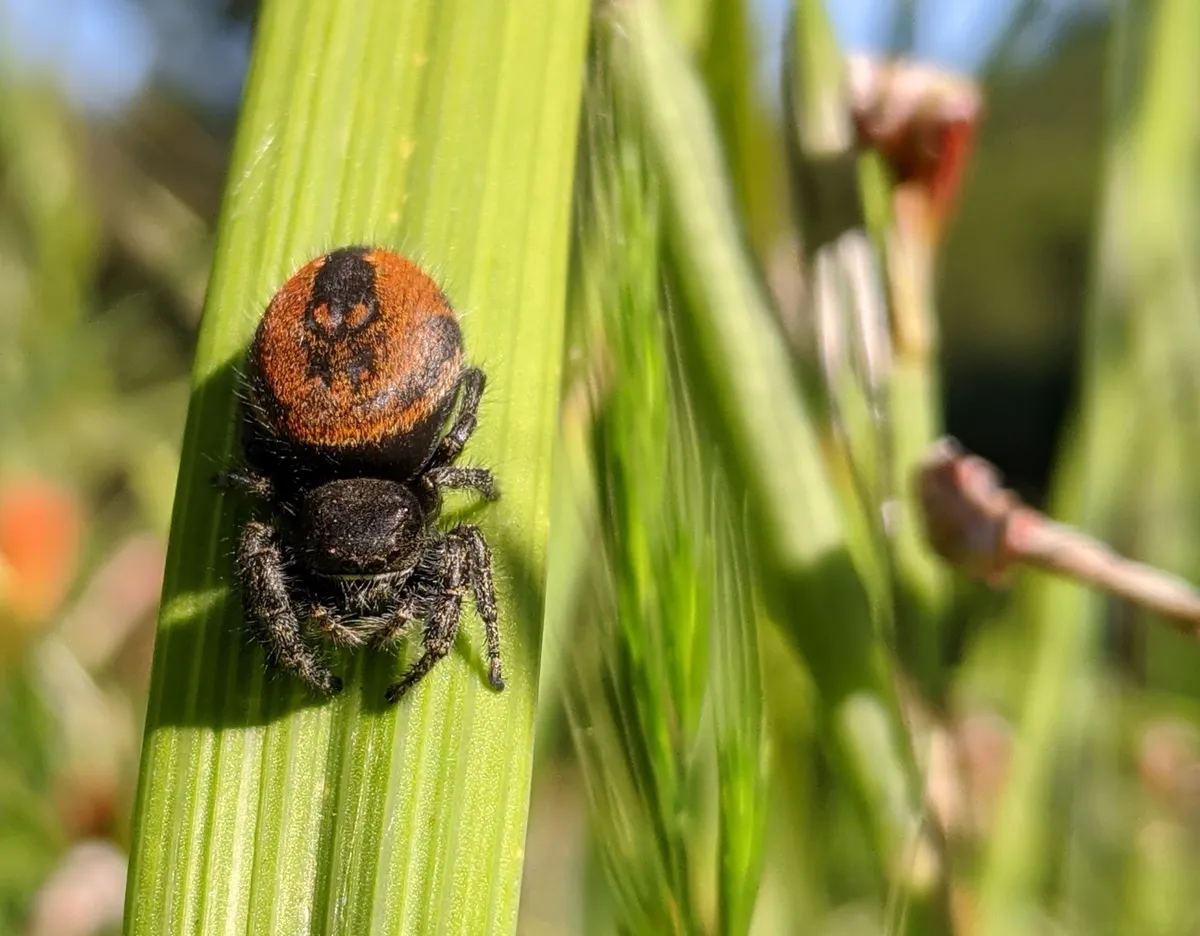
UC IPM describes Johnson's jumping spider (Phidippus johnsoni) as a red and black jumping spider 1/4 to 1/2 inch long: females are black with red on the top of the abdomen, and males have a black front half and an all-red abdomen. It may bite if disturbed, but UC IPM says the bites are usually not serious. CSU lists it among the jumping spiders found in Colorado.
On a shiny spider with a big, round abdomen, red spots down the back are the northern black widow's pattern described above. Red legs on a black body mark the red widow, which the Army says lives mainly in sand-pine scrub in central and southeast Florida, or a male red-legged purseweb spider: MDC's purseweb page says those males are shiny black with bright reddish-orange legs and wander across the ground by day in early summer, usually June, looking for females.
Is a shiny black spider in the house a false widow?
It may well be. UC IPM says black widows typically nest outside, though they can be found in homes, while the false black widow (Steatoda grossa) thrives indoors, especially in washrooms, inside cupboards and under appliances. It has the same round abdomen as a widow but is chocolate brown, about 3/8 inch (10 mm) long, and never red underneath.
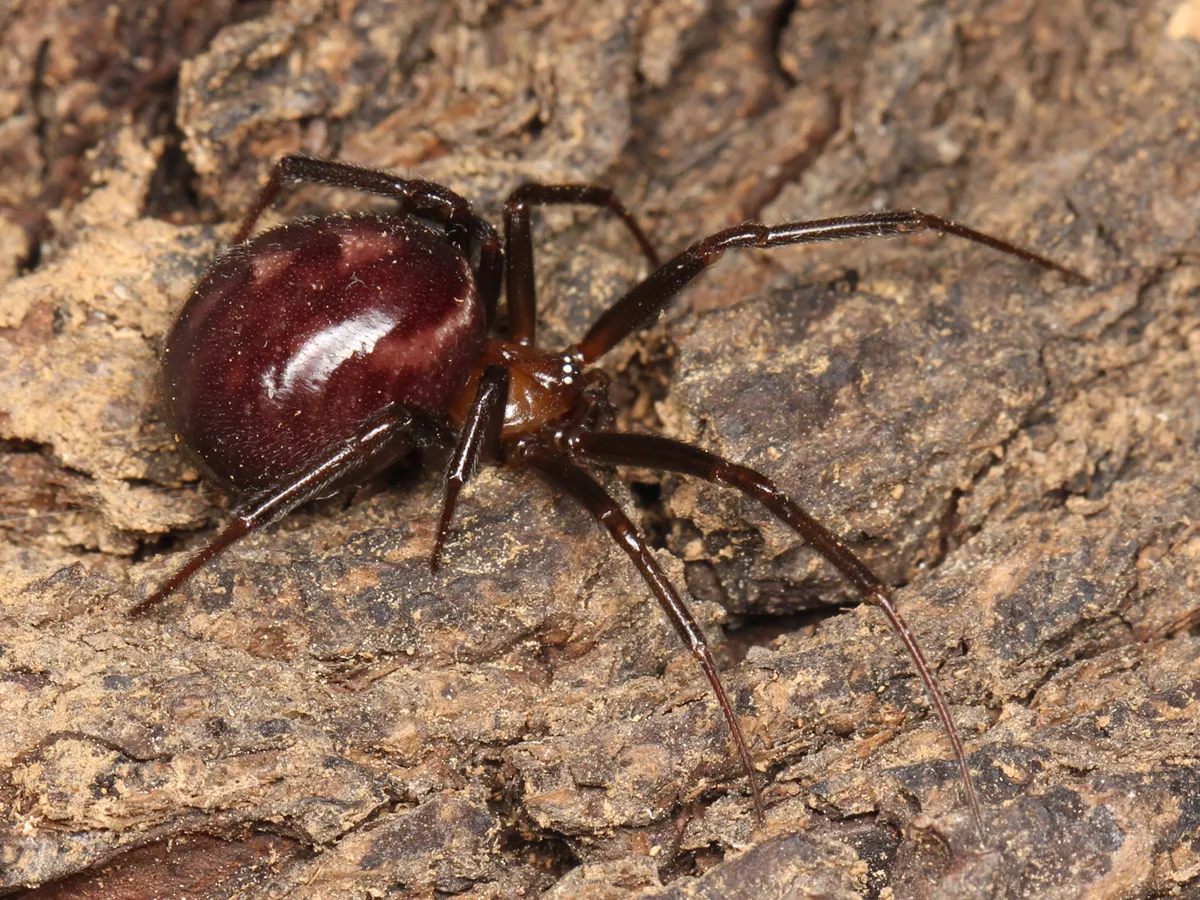
UC IPM says a false black widow bite may cause symptoms similar to a yellowjacket wasp sting. The false widow guide covers it in detail, and the house spider guide sorts it from the other spiders that live indoors. The name black house spider belongs to an Australian species, Badumna insignis, which the Australian Museum describes as common around window frames in southern and eastern Australia.
What is the big black spider on the floor or in the yard?
A large, hairy, dark spider running on the ground with no web is probably a wolf spider. MDC's wolf spider page gives wolf spiders as 1/4 inch to 1 inch long without the legs, usually gray, brown, black or tan with darker markings, especially stripes. They build no web and run their prey down, and a female carries her egg sac at the rear of her abdomen, then her young on her back.
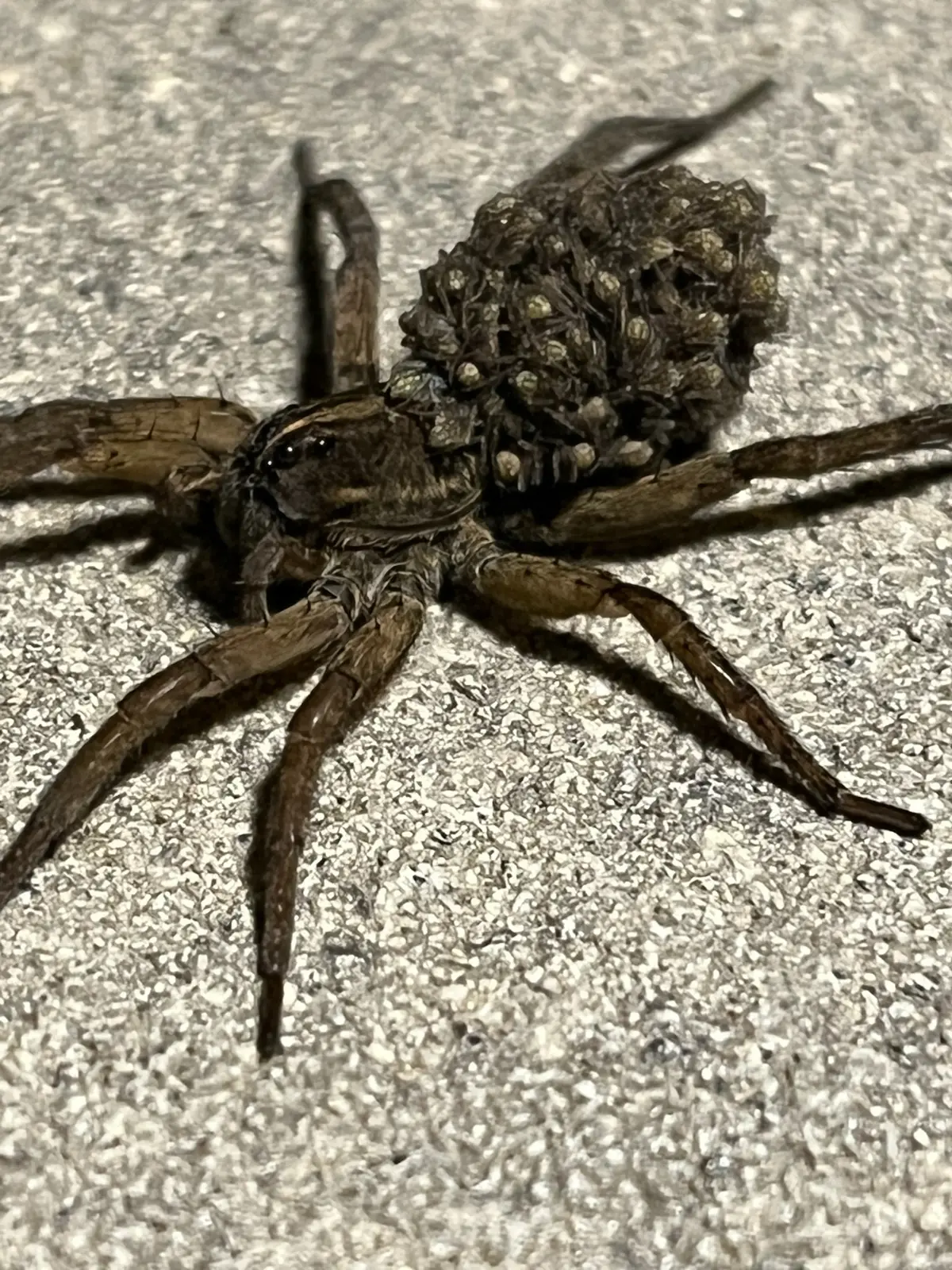
MDC says wolf spiders can bite if provoked, but the bites of North American wolf spiders are harmless. The wolf spider guide shows the common species and how to tell a small one from a brown recluse.
Two other big black spiders stay outdoors. Purseweb spiders are about 1/2 to 3/4 inch long, females up to 1 inch; MDC describes the black purseweb as glossy black, says purseweb spiders in Missouri usually live in a silk tube 6 to 10 inches long set against the base of a tree, and says purseweb bites do not pose a danger to people, except in rare cases of people highly sensitive to spider bites. The female black-and-yellow garden spider is 3/4 to 1 inch long, with a yellow and black abdomen and black legs striped yellow-orange, and spins an orb web about 2 feet across with a zigzag band through the middle; MDC calls it harmless.
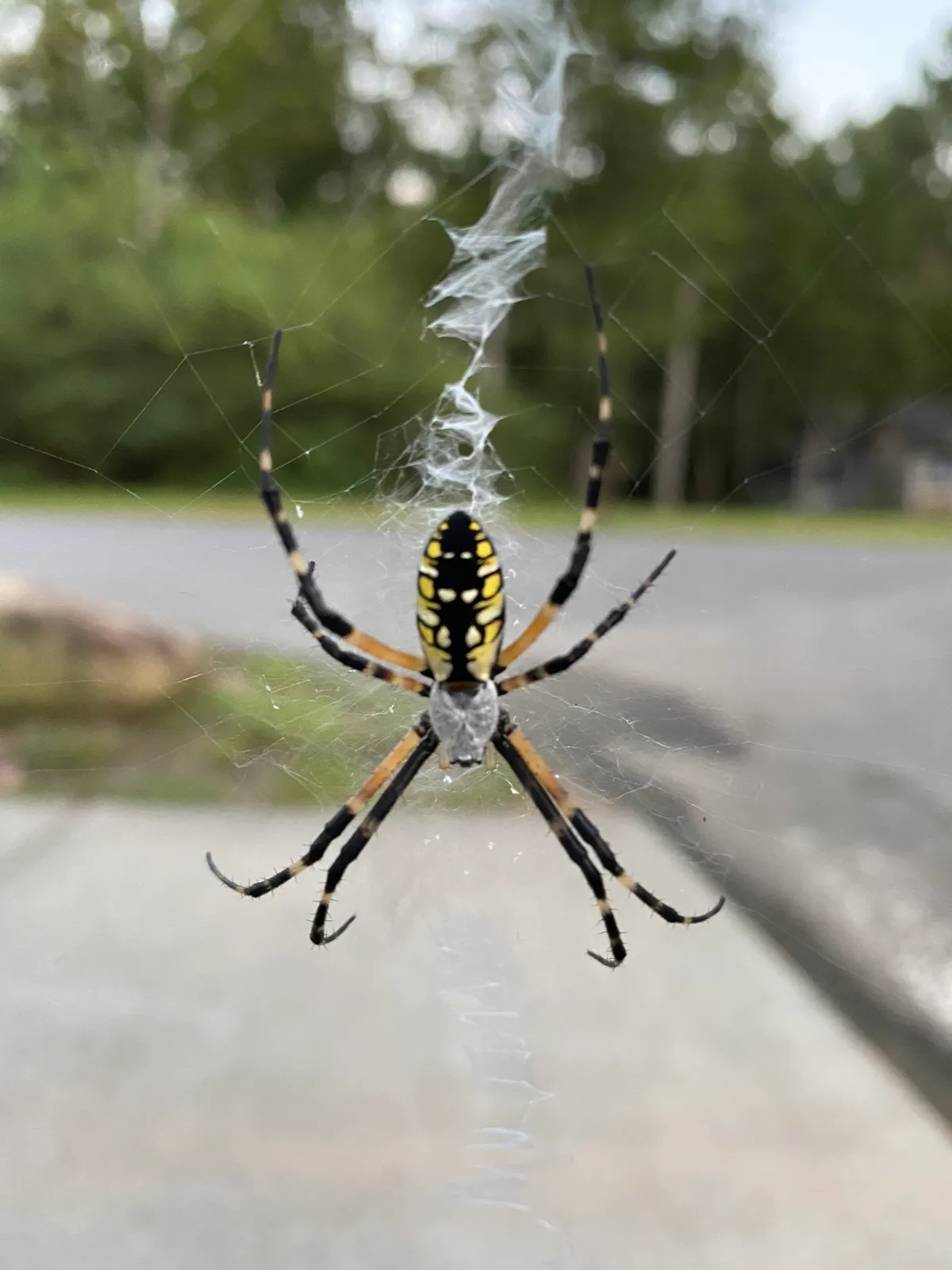
The orb weaver guide covers the garden spider's relatives. Two other large, dark spiders have guides of their own: fishing spiders and tarantulas.
Commonly confused with
- Jumping spidersFuzzy, with two huge front eyes; they jump and build no web
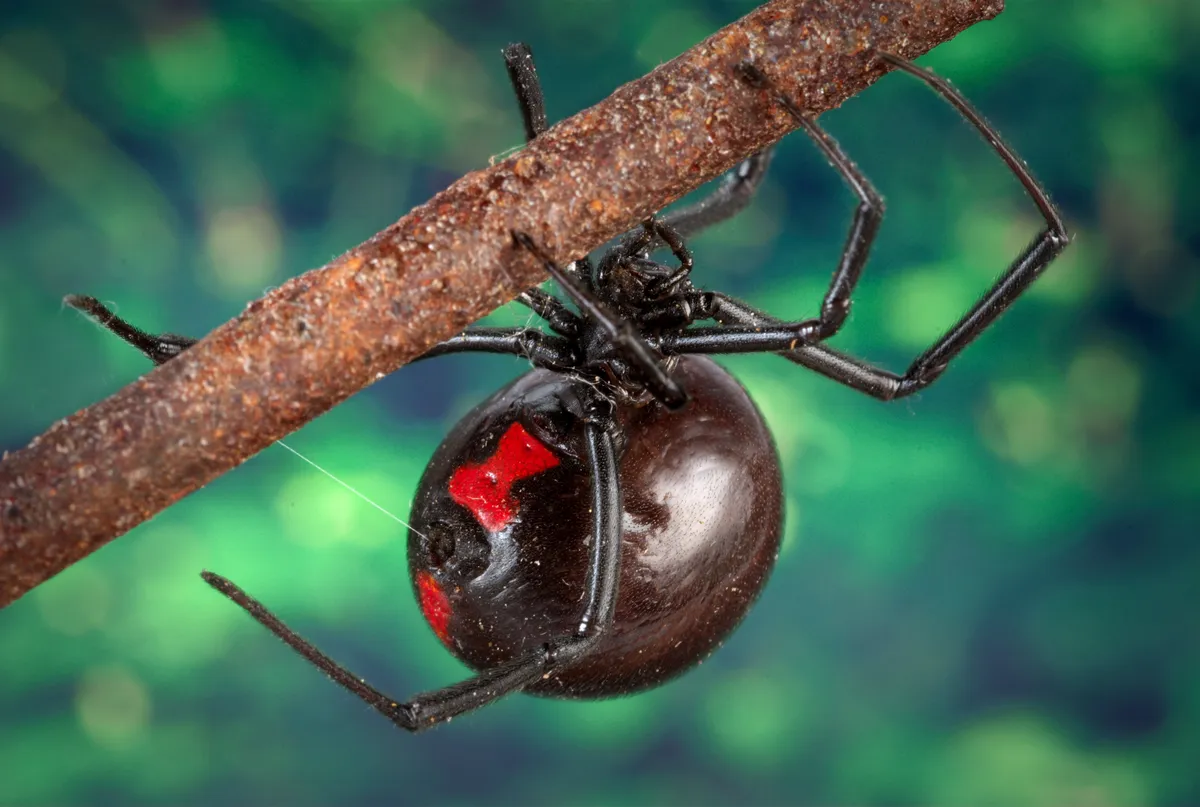 Black widowShiny black, with a red hourglass under a big, round abdomen
- False black widowThe same round shape, but chocolate brown and never red underneath
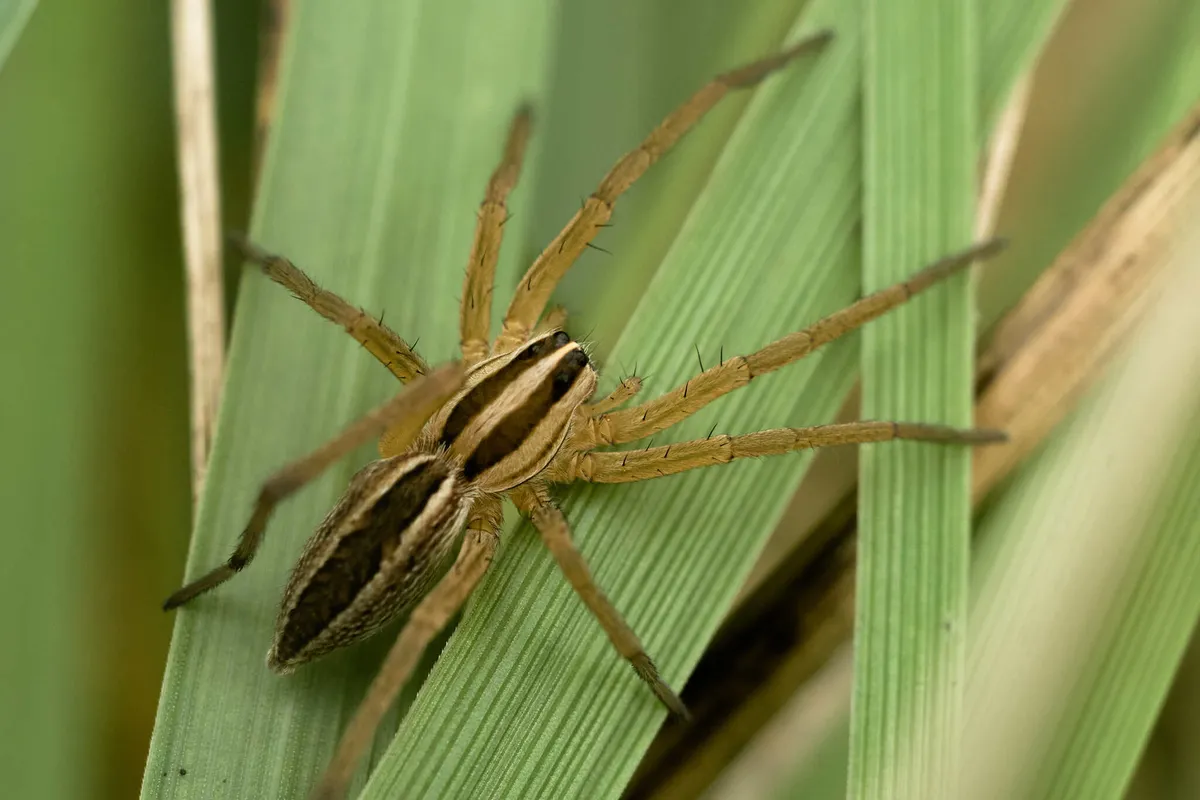 Wolf spiderRuns on the ground with no web; gray, brown, black or tan with stripes
Photos: Jumping spiders: Kaldari, CC0, via Wikimedia Commons, CC0 1.0. Black widow: CDC/ Paula Smith; photo: James Gathany (CDC Public Health Image Library, phil.cdc.gov), public domain. False black widow: Ryan Kaldari, CC0, via Wikimedia Commons, CC0 1.0. Wolf spider: no rights reserved, via iNaturalist, CC0 1.0.
Are black spiders dangerous?
Of the spiders on this page, only an adult female widow is a significant threat to people, according to the sources above. CDC's page on venomous spiders names the black widow and the brown recluse. UC IPM says most spider bites cause, at worst, a reaction no more severe than a bee sting, and that you should contact a physician, hospital or poison control center if any spider bite causes an unusual or severe reaction, such as increasing pain or extreme swelling.
After a black widow bite, seek medical attention immediately, as UC IPM and MDC advise. Poison Control says muscle cramps can begin within 15 to 60 minutes; it advises cleaning the bite with soap and water and calling a poison center at 1-800-222-1222, and says emergency department care is appropriate when pain is not controlled by oral pain medicine. The Army says widow bites are most dangerous to very small children, older adults and people with serious health problems, and CDC says to identify the spider only if you can do so safely.
What spider bites look like covers the marks that get mistaken for bites, and the venomous spiders guide covers first aid in full.
What should you do once you know what it is?
Leave harmless spiders alone or move them outside, and give widows fewer places to hide.
- Jumping, parson, wolf and garden spiders. None is medically important by the sources above. To move one out, set a jar over it and slide a sheet of paper underneath, as UC IPM describes.
- A widow. Do not handle it. Where widows are common, the Army fact sheet advises shaking out clothing and shoes, wearing gloves, long sleeves and boots when working where widows live, clearing debris, lumber, rock piles and dense ground cover from around the foundation, stacking firewood away from buildings and sealing cracks around windows, doors and pipes.
- Webs indoors. The Army advises vacuuming cobwebs and spiders, then sealing the vacuum bag in another plastic bag and putting it in an outdoor trash can. It calls pesticides a last resort and says the label is the law.
For a fuller plan, see how to keep spiders out of your house, a step-by-step plan for clearing spiders from a house and the guide to getting rid of spiders.
This guide is general educational information, not medical advice. If you have symptoms or concerns after a bite or exposure, contact a healthcare provider.
Frequently Asked Questions
Are black spiders with white spots poisonous?+
The usual one is not dangerous. A fuzzy black spider with white spots is probably a bold jumping spider, and the Missouri Department of Conservation calls its bite harmless; Colorado State University Extension says most jumping spiders cannot pierce skin and a successful bite causes only mild, temporary pain. A smooth, shiny black spider with white marks and a round abdomen may be a young or male black widow, which the Army says are not a significant threat, unlike an adult female widow.
What is the small black spider with white spots that jumps?+
It is a jumping spider, probably a bold jumper. The Missouri Department of Conservation describes the bold jumping spider as fuzzy and usually black, with white, orange or red spots, the middle one largest, and iridescent green or blue jaws. Females are 1/4 to 3/4 inch long and males usually under 1/2 inch. It hunts without a web on plants, fence posts and house siding, and Colorado State University lists it among the jumping spiders that often enter homes.
Is a black spider with white spots a black widow?+
Usually not, but check it without touching it. An adult female black widow is shiny black with a red hourglass underneath, according to UC IPM. Young black widows have white stripes and black dots on an olive-gray or tan abdomen, UC IPM says, and adult males keep those colors; the Missouri Department of Conservation adds that males often have faint red or white spots on top. The Army says young widows and males are not a significant threat.
What black spider has a red dot on its back?+
Several spiders can. The northern black widow usually has a row of red spots down the back and a broken hourglass underneath, according to the Missouri Department of Conservation. A bold jumping spider's spots can be red instead of white, MDC says, and male black widows usually have faint red or white spots on top. Johnson's jumping spider is black with red on top of the abdomen, and its males have an all-red abdomen, according to UC IPM. A shiny, round-bodied spider is the one to treat as a possible widow.
What is the black spider with red on its belly?+
Red under a shiny black, round abdomen marks a black widow. UC IPM describes the red hourglass of the adult female, which varies and is rarely missing, and the Missouri Department of Conservation says the northern black widow's hourglass is broken in two. The Army says the red widow of Florida has bright red legs and an orange-red half-moon underneath. The false black widow, by contrast, is chocolate brown and never red underneath, according to UC IPM.
What is the big black spider in my house?+
A big, hairy, dark spider running across the floor with no web is probably a wolf spider, which the Missouri Department of Conservation gives as 1/4 inch to 1 inch long, with a harmless bite. A shiny, round, dark brown spider in a cupboard or under an appliance may be a false black widow, which UC IPM says thrives indoors. A dark spider with a white band, fast at night, is probably a parson spider, which Penn State says comes indoors in fall.
Are black spiders in the house good or bad?+
Most are harmless hunters. The Missouri Department of Conservation says bold jumping spiders hunt insects such as true bugs and caterpillars, and that wolf spiders run their prey down; Penn State says parson spiders hunt at night. The one to keep away from is a black widow: UC IPM says bites are rare but advises seeking medical attention immediately after one, and the Army suggests clearing clutter and sealing cracks where widows are common.
What is a black house spider?+
Black house spider is the common name of an Australian species, Badumna insignis. The Australian Museum describes it as dark brown to black with a charcoal gray abdomen, often with white markings, building lacy webs with funnel-like entrances around window frames in southern and eastern Australia. In a US house, a shiny dark spider may be a false black widow, which UC IPM says thrives indoors, or a parson spider coming in for winter, as Penn State describes.
What should I do if a black widow bites me?+
UC IPM and the Missouri Department of Conservation advise seeking medical attention immediately. Poison Control says to clean the bite with soap and water and to call a poison center at 1-800-222-1222, and that emergency care is appropriate when pain is not controlled by oral pain medicine. It says cramps can begin within 15 to 60 minutes and recovery usually takes 24 to 48 hours. CDC says to identify the spider only if you can do so safely.
Do jumping spiders bite?+
Rarely, and not seriously. The Missouri Department of Conservation says a bold jumping spider can bite if squeezed or handled, but the bite is harmless. Colorado State University Extension says jumping spiders are not aggressive and try to bite only if confined, that most cannot pierce skin, and that a successful bite causes only mild, temporary pain. UC IPM says Johnson's jumping spider may bite if disturbed, but the bites are usually not serious.
Sources
- Bold Jumper — Missouri Department of Conservation
- Colorado Arachnids of Interest: Jumping Spiders — Colorado State University Extension
- Parson Spider — Penn State Extension
- Widow Spiders and Their Relatives (Pest Notes Publication 74149) — University of California Statewide IPM Program
- Black Widow Spiders — Missouri Department of Conservation
- Widow Spiders (Fact Sheet 18-030-0818) — U.S. Army Public Health Center
- Venomous Spiders at Work — CDC, National Institute for Occupational Safety and Health
- Spiders (Pest Notes Publication 7442) — University of California Statewide IPM Program
- Purseweb Spiders — Missouri Department of Conservation
- Wolf Spiders — Missouri Department of Conservation
- Black-and-Yellow Garden Spider — Missouri Department of Conservation
- How dangerous is a black widow spider bite? — Poison Control (National Capital Poison Center)
- Black House Spider — The Australian Museum
How this guide was made: it was researched and drafted with AI assistance from the sources listed above. A second, independent AI pass then checked each factual claim against those sources. Found an error? Email support@buzzskito.ca.