BuzzSkito Mosquito & Tick Control Specialists · Published July 12, 2026
As an Amazon Associate I earn from qualifying purchases. BuzzSkito only points to products we would genuinely use or recommend, at no extra cost to you.
The Deer Tick and the Blacklegged Tick Are the Same Species
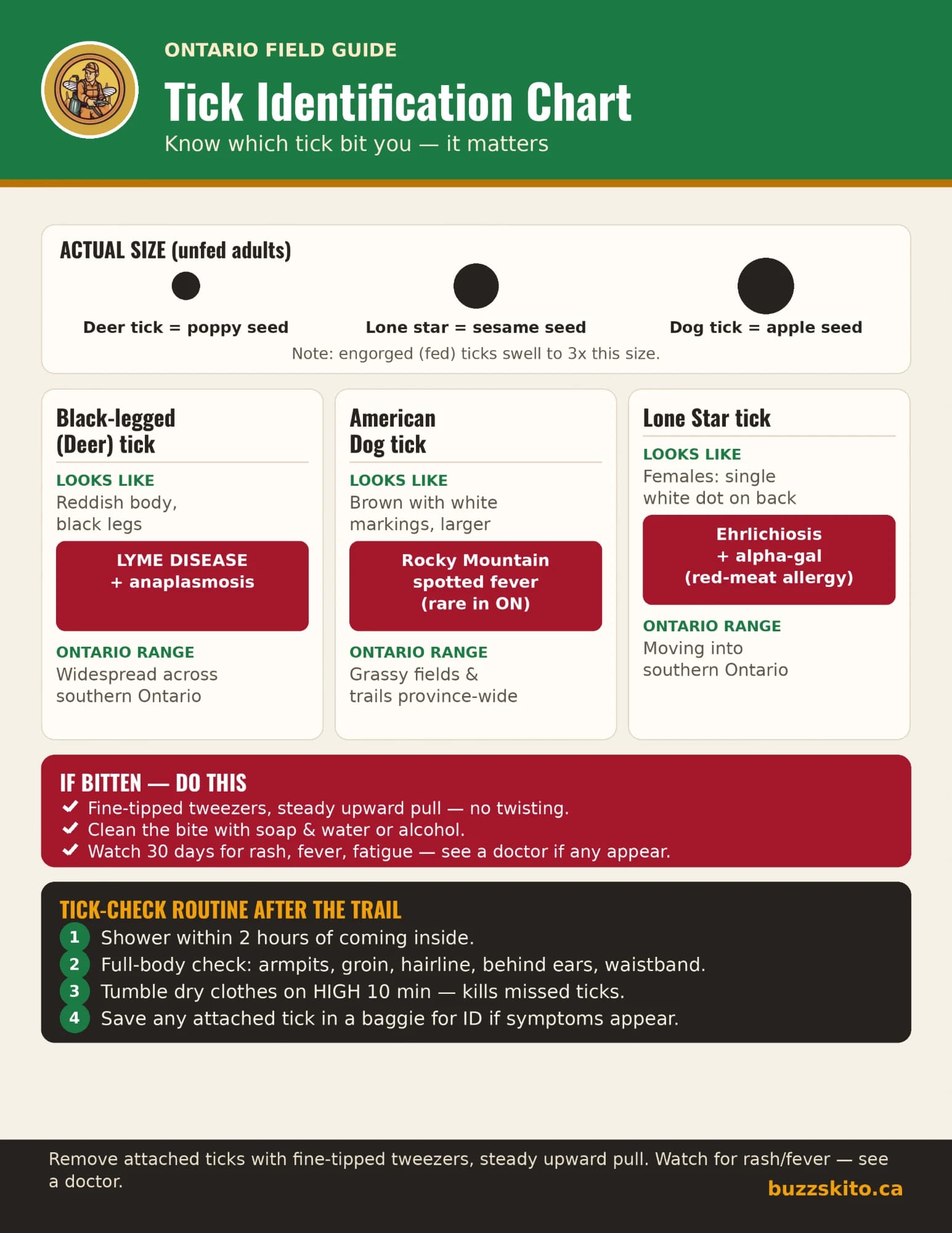
People searching “deer tick” and people searching “blacklegged tick” are looking at the same animal: Ixodes scapularis. “Deer tick” comes from the white-tailed deer that adult females feed on to complete their life cycle; “blacklegged tick” comes from its distinctive dark legs. Both names point to the single tick in Ontario capable of transmitting Lyme disease, so it is worth learning to recognize it. For a side-by-side breakdown of the two ticks GTA residents most often confuse, see our full deer tick vs dog tick comparison.
If you are reading this with a tick already attached, the one thing worth buying is a fine-tipped remover: it grips a poppy-seed-sized nymph right at the mouthparts and lifts it straight out, where household tweezers slip or squeeze the body. Check price on Amazon.ca →
How to Recognize an Adult Blacklegged Tick
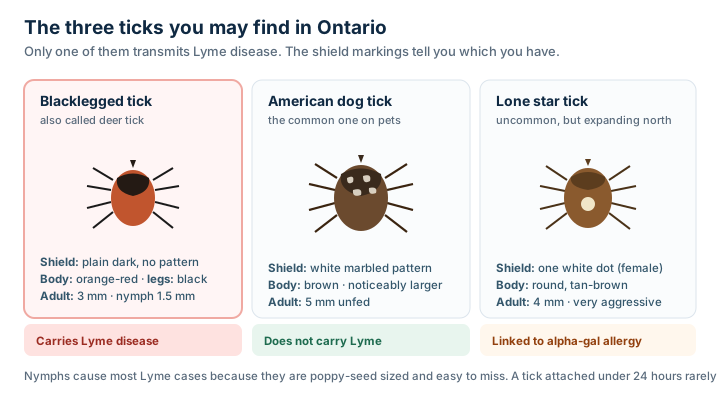
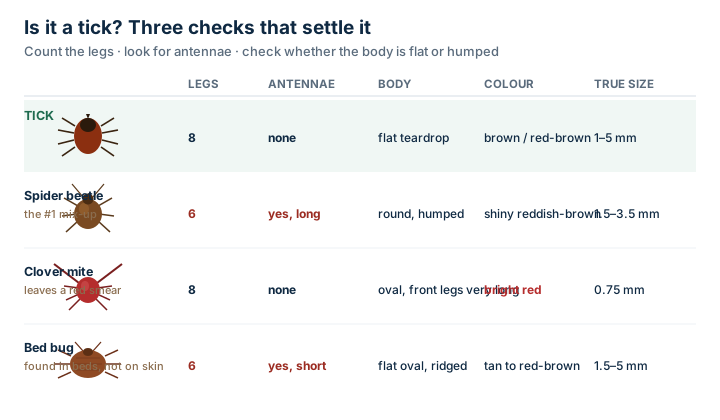
An unfed adult female is roughly the size and shape of a sesame seed. Look for a reddish-orange to brownish body behind a smaller, dark, glossy dorsal shield (the scutum) just behind the mouthparts. The eight legs are dark — nearly black — which is where the name comes from. There are no white or silver markings; that mottled marbling belongs to the American dog tick, a larger and harmless-for-Lyme species that is common right across the GTA. Males are a little smaller and uniformly dark, and they rarely bite. Once a female has fed for a day or two she swells to the size of a small grape and turns grey-olive, which can make her hard to identify by colour alone.
Where Blacklegged Ticks Live in Ontario
Blacklegged ticks are no longer a rarity confined to a few parks. Over the past two decades their range has expanded steadily across southern and eastern Ontario, driven by warming winters and by migrating birds that drop ticks far outside established zones. Well-known risk areas include:
- North shore of Lake Erie — Long Point, Turkey Point, Rondeau Provincial Park, and Point Pelee
- Eastern Ontario — the Thousand Islands, and the Kingston, Leeds–Grenville, and Ottawa areas
- Prince Edward County and the Bay of Quinte shoreline
- Niagara — including Wainfleet and surrounding wooded lands
- Pinery Provincial Park and the southern Lake Huron shore
Because their range is a moving target, do not treat “my area is not on the map” as safety. Ticks are increasingly reported across the wider GTA and Simcoe–Muskoka region. Check the current Ontario Lyme disease tracker for the latest risk picture, and remember that Public Health Ontario updates its estimated risk-area maps every year.
Toronto is the clearest case of a place that was once assumed to be off the map and is not. The ravine network carries wooded, leaf-littered habitat — and the deer and white-footed mice that go with it — straight through the middle of the city, which is why Toronto now reads as a tick hot spot rather than a safe urban exception.
When Are They Active?
Blacklegged ticks do not disappear in cold weather the way people assume. Adults become active whenever the air temperature climbs above roughly 4°C and the ground is clear of snow, so the two adult peaks are spring (April–May) and fall (October–November). The tiny nymphs — the stage responsible for most human Lyme cases because they are so easy to overlook — peak from late May through July, overlapping perfectly with the busiest months in Ontario backyards. In practice, that means tick checks are worth doing on any mild day after you have been in grass, brush, or the woods, not just in mid-summer.
Why This Tick Spreads Lyme and the Dog Tick Does Not
Lyme disease is caused by a corkscrew-shaped bacterium, Borrelia burgdorferi. Blacklegged ticks pick it up as larvae or nymphs when they feed on infected small mammals — white-footed mice are the main reservoir — and can then pass it to the next host they bite. The American dog tick (Dermacentor variabilis), despite being larger and more often noticed in the GTA, feeds on a different host cycle and does not transmit Lyme in Ontario. That is why species identification is the single most useful thing you can do after a bite: a dog tick bite carries essentially no Lyme risk, while a blacklegged tick attached for a day or more does. Health Canada’s pest-management guidance and Public Health Ontario both stress prevention and prompt removal over panic.
Species is only half the answer, though. Even among blacklegged ticks, only a fraction actually carry the bacterium, and the share differs by region and life stage — see what percentage of ticks carry Lyme disease in Ontario for the surveillance figures.
How to Remove a Blacklegged Tick
Fast, correct removal is your best defence, because the tick usually needs to feed for 24 to 36 hours before it can transmit the Lyme bacterium. Here is the method public-health agencies recommend:
- Use fine-tipped tweezers or a dedicated tick tool. Grasp the tick as close to the skin surface as you can, right at the mouthparts.
- Pull straight up with steady, even pressure. Do not twist or jerk — that can snap the mouthparts off and leave them in the skin.
- Do not crush the body while it is attached, and skip the folk remedies (petroleum jelly, nail polish, a lit match) — they can make the tick regurgitate infected fluid into the bite.
- Clean the bite with soap and water or rubbing alcohol afterward.
- Save the tick in a sealed bag or take a sharp, well-lit photo, and write down the date. That record matters if symptoms appear.
A dedicated fine-tipped tool grips a poppy-seed-sized nymph far more reliably than household tweezers. Check tick-removal tools on Amazon.ca →
As an Amazon Associate I earn from qualifying purchases. Price shown on Amazon.ca, at no extra cost to you.
🏆 Our Top Pick — Tick Removal
8.6/10· BuzzSkito ratingFine-Tipped Tick Removal Tool Set
A dedicated tick-removal tool grips right at the mouthparts and lifts a poppy-seed-sized nymph out cleanly — the safe, steady-pressure removal public-health agencies recommend, and far more reliable than fumbling with household tweezers when speed matters.
Pros
- Grips close to the skin at the mouthparts
- Handles even tiny nymphs
- Inexpensive to keep in a first-aid kit
Cons
- Still requires slow, steady technique
- Keep one per outdoor bag so it is on hand
When to Test and When to See a Doctor
Ontario guidance is built around your exposure and symptoms, not around lab-testing the tick itself — a negative tick test would not clear you, and a positive one would not confirm infection. What is genuinely useful is species identification: submit a clear photo to the free eTick.ca service to learn whether you were bitten by a blacklegged tick at all. If it was a blacklegged tick attached for more than about 24 hours in a known risk area, contact your health-care provider promptly, because a single preventive dose of doxycycline is sometimes offered within 72 hours of removal. Then watch the bite for 30 days and seek care if you develop an expanding rash (often, but not always, a bull’s-eye pattern), fever, fatigue, headache, or aching joints — early Lyme disease is very treatable with antibiotics.
Protecting Your Yard and Yourself
Because blacklegged ticks quest low on vegetation and cannot fly or jump, yard control genuinely works. Mow to 3–4 inches, clear leaf litter at the edges each spring and fall, keep a dry wood-chip or gravel strip between lawn and woods, and discourage mice and deer. On your body, tuck pant legs into socks, wear light colours to spot ticks, treat footwear and pant legs with permethrin, and use a DEET or icaridin (picaridin) repellent on skin. A licensed barrier spray applied to the shaded borders where deer ticks actually wait removes them at the source for the season.
For the clothing half of that list, the format sold to Canadian consumers is factory pre-treated permethrin clothing (intended for ages 16 and over), which covers the ankle-to-knee band where blacklegged ticks actually board. Check price on Amazon.ca → See tick repellents on Amazon.ca →
Related Reading
- Deer Tick vs Dog Tick in Canada — How to Tell Them Apart
- Ontario Lyme Disease Tracker 2026
- Lyme Disease Risk Areas in Ontario
- How to Keep Ticks Out of Your Yard
- BuzzSkito Tick Control Service
Frequently Asked Questions
What is a blacklegged tick?+
The blacklegged tick (Ixodes scapularis), also called the deer tick, is the only tick species that transmits Lyme disease in Ontario and eastern Canada. Adults are small — an unfed adult female is about the size of a sesame seed (3–5 mm) with a reddish-orange body and a dark black shield behind the head, along with the dark legs that give the species its name. Nymphs are far smaller, roughly the size of a poppy seed.
What is the difference between a deer tick and a blacklegged tick?+
There is no difference — "deer tick" and "blacklegged tick" are two common names for the exact same species, Ixodes scapularis. "Deer tick" refers to the white-tailed deer that adult females feed on; "blacklegged tick" refers to its dark legs. Both names describe the single Lyme-disease vector in Ontario. It should not be confused with the American dog tick, a larger species that does not spread Lyme.
Do blacklegged ticks carry Lyme disease in Ontario?+
Yes. The blacklegged tick is the only tick in Ontario known to transmit the bacterium that causes Lyme disease, Borrelia burgdorferi. Not every blacklegged tick is infected — infection rates vary by location and life stage — but in established risk areas a meaningful share of nymphs and adults carry the bacteria. The American dog tick, which is common across the GTA, does not transmit Lyme disease.
Where are blacklegged ticks found in Ontario?+
Blacklegged ticks are now established across much of southern and eastern Ontario, and their range keeps expanding. Long-recognized risk areas include the north shore of Lake Erie (Long Point, Turkey Point, Rondeau, Point Pelee), the Thousand Islands and eastern Ontario near Kingston and Ottawa, Prince Edward County, Wainfleet, and Pinery Provincial Park. Public Health Ontario publishes updated estimated risk-area maps each year, and ticks can turn up outside mapped zones because migrating birds spread them.
When are blacklegged ticks active in Ontario?+
Adult blacklegged ticks are active any time the temperature is above roughly 4°C and the ground is not snow-covered, which means spring (April–May) and fall (October–November) are peak adult months. Nymphs, which cause most human Lyme cases, peak from late May through July. Because of milder winters, ticks can be found on warm days nearly year-round in southern Ontario, so tick checks are worthwhile whenever you have been in grass or brush.
How do I remove a blacklegged tick?+
Use fine-tipped tweezers or a dedicated tick-removal tool. Grasp the tick as close to the skin as possible, then pull straight upward with steady, even pressure — do not twist, jerk, or crush it. Avoid folk methods like petroleum jelly, nail polish, or a hot match, which can make the tick release infected fluids. After removal, wash the bite with soap and water, note the date, and save the tick in a sealed bag or take a clear photo in case you need identification later.
How long does a tick need to be attached to transmit Lyme disease?+
A blacklegged tick generally needs to be attached and feeding for about 24 to 36 hours before it can transmit the Lyme bacterium. That delay is why prompt removal is so protective — finding and removing a tick within a day of attachment dramatically lowers infection risk. If you were bitten in a risk area and the tick was attached longer, contact your health-care provider, because a single preventive dose of antibiotics is sometimes offered within 72 hours.
Should I get a blacklegged tick tested?+
Ontario public-health guidance focuses on your symptoms and exposure, not on testing the tick itself, so a negative tick test does not rule out infection and a positive one does not confirm it. You can submit a photo to eTick.ca for free species identification, which tells you whether it was a blacklegged tick at all. Watch the bite for 30 days: see a doctor if you develop an expanding rash (often a bull's-eye), fever, fatigue, or joint aches.